Éléchoc Basic v1.0Done by: Wang Zhi 2P3(28)
SummaryIntroductionGame materialsGame playCalculation of scoresRules
AboutÉléchoc is a combined word of élément and choc in the French; choc means collision.This is a strategy card game targeted at secondary school pupils.It aims to enhance the pupils’ knowledge on basic chemistry elements.This strategy game is solely based on educational facts.
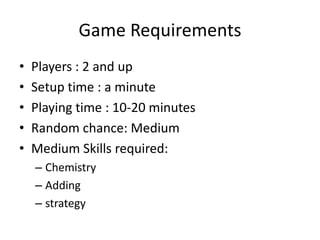
Game RequirementsPlayers : 2 and upSetup time : a minutePlaying time : 10-20 minutesRandom chance: MediumMedium Skills required:ChemistryAddingstrategy
Materials SetThe Deck2 dice
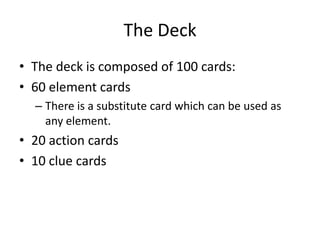
The DeckThe deck is composed of 100 cards:60 element cardsThere is a substitute card which can be used as any element.20 action cards10 clue cards
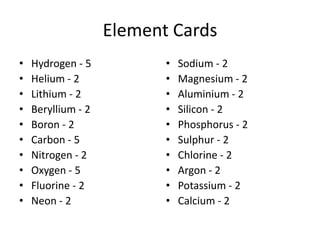
Element CardsHydrogen - 5Helium - 2Lithium - 2Beryllium - 2Boron - 2Carbon - 5Nitrogen - 2Oxygen - 5Fluorine - 2Neon - 2Sodium - 2Magnesium - 2Aluminium - 2Silicon - 2Phosphorus - 2Sulphur - 2Chlorine - 2Argon - 2Potassium - 2Calcium - 2
The Deck (Field Cards)There are 10 field cards.They compromises the conditions for chemical reactions:Temperature – 2Pressure – 2Catalysts & Solvent – 2Light – 2Electricity – 2
The Deck (Action Cards)There are 30 action cards.It includes:5 ‘sly steal’ card2 ‘compound gobbler’ card2 ‘pass go’ cards2 ‘recycle’ cards3 ‘just say no’ cards3 ‘breaking up’ cards3 ‘into the void’ cards
Usage of cardsSly Deal: You can steal an element card from one rival, but you can't steal an element in a compound.Breaking Up: You can disassemble a compound and return the elements to the field of the player who first played the card.Compound Gobbler: Let you steal a compound from one rival.Just Say No: Can be played at any time during the game to cancel the actions from your rival.Into The Void: You can choose to have all players discard a card or a rival to discard 2 cards. (Picked randomly)Recycle: You can use an action card from the used pile.Pass go: Draw 2 extra cards.
Clue CardsOxide clue cards – 5Dioxide clue cards – 5The cards have oxide or dioxide provided for the player.The player plays the other element(s) as instructed on the card to form a compound.
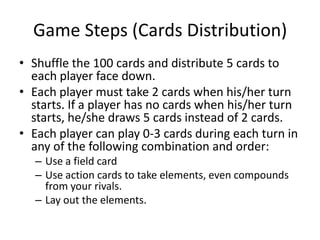
Game Steps (Cards Distribution)Shuffle the 100 cards and distribute 5 cards to each player face down.Each player must take 2 cards when his/her turn starts. If a player has no cards when his/her turn starts, he/she draws 5 cards instead of 2 cards.Each player can play 0-3 cards during each turn in any of the following combination and order:Use a field cardUse action cards to take elements, even compounds from your rivals.Lay out the elements.
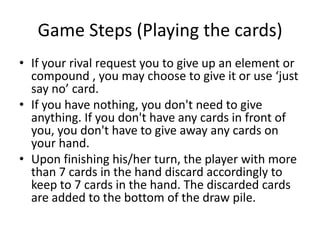
Game Steps (Playing the cards)If your rival request you to give up an element or compound , you may choose to give it or use ‘just say no’ card.If you have nothing, you don't need to give anything. If you don't have any cards in front of you, you don't have to give away any cards on your hand.Upon finishing his/her turn, the player with more than 7 cards in the hand discard accordingly to keep to 7 cards in the hand. The discarded cards are added to the bottom of the draw pile.
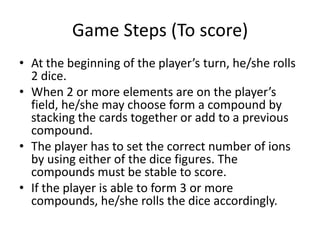
Game Steps (To score)At the beginning of the player’s turn, he/she rolls 2 dice.When 2 or more elements are on the player’s field, he/she may choose form a compound by stacking the cards together or add to a previous compound.The player has to set the correct number of ions by using either of the dice figures. The compounds must be stable to score.If the player is able to form 3 or more compounds, he/she rolls the dice accordingly.
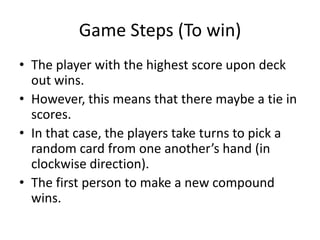
Game Steps (To win)The player with the highest score upon deck out wins.However, this means that there maybe a tie in scores.In that case, the players take turns to pick a random card from one another’s hand (in clockwise direction).The first person to make a new compound wins.
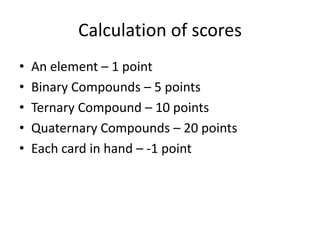
Calculation of scoresAn element – 1 pointBinary Compounds – 5 pointsTernary Compound – 10 pointsQuaternary Compounds – 20 pointsEach card in hand – -1 point
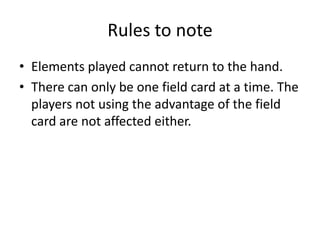
Rules to noteElements played cannot return to the hand.There can only be one field card at a time. The players not using the advantage of the field card are not affected either.
Referenceshttp://en.wikipedia.org/wiki/Monopoly_Dealhttp://www.tutorvista.com/content/science/science-ii/chemical-reactions-equations/chemical-change.phphttp://www.science.co.il/ptelements.asp

Elements

  • 1.
    Éléchoc Basic v1.0Doneby: Wang Zhi 2P3(28)
  • 2.
  • 3.
    AboutÉléchoc is acombined word of élément and choc in the French; choc means collision.This is a strategy card game targeted at secondary school pupils.It aims to enhance the pupils’ knowledge on basic chemistry elements.This strategy game is solely based on educational facts.
  • 4.
    Game RequirementsPlayers :2 and upSetup time : a minutePlaying time : 10-20 minutesRandom chance: MediumMedium Skills required:ChemistryAddingstrategy
  • 5.
  • 6.
    The DeckThe deckis composed of 100 cards:60 element cardsThere is a substitute card which can be used as any element.20 action cards10 clue cards
  • 7.
    Element CardsHydrogen -5Helium - 2Lithium - 2Beryllium - 2Boron - 2Carbon - 5Nitrogen - 2Oxygen - 5Fluorine - 2Neon - 2Sodium - 2Magnesium - 2Aluminium - 2Silicon - 2Phosphorus - 2Sulphur - 2Chlorine - 2Argon - 2Potassium - 2Calcium - 2
  • 8.
    The Deck (FieldCards)There are 10 field cards.They compromises the conditions for chemical reactions:Temperature – 2Pressure – 2Catalysts & Solvent – 2Light – 2Electricity – 2
  • 9.
    The Deck (ActionCards)There are 30 action cards.It includes:5 ‘sly steal’ card2 ‘compound gobbler’ card2 ‘pass go’ cards2 ‘recycle’ cards3 ‘just say no’ cards3 ‘breaking up’ cards3 ‘into the void’ cards
  • 10.
    Usage of cardsSlyDeal: You can steal an element card from one rival, but you can't steal an element in a compound.Breaking Up: You can disassemble a compound and return the elements to the field of the player who first played the card.Compound Gobbler: Let you steal a compound from one rival.Just Say No: Can be played at any time during the game to cancel the actions from your rival.Into The Void: You can choose to have all players discard a card or a rival to discard 2 cards. (Picked randomly)Recycle: You can use an action card from the used pile.Pass go: Draw 2 extra cards.
  • 11.
    Clue CardsOxide cluecards – 5Dioxide clue cards – 5The cards have oxide or dioxide provided for the player.The player plays the other element(s) as instructed on the card to form a compound.
  • 12.
    Game Steps (CardsDistribution)Shuffle the 100 cards and distribute 5 cards to each player face down.Each player must take 2 cards when his/her turn starts. If a player has no cards when his/her turn starts, he/she draws 5 cards instead of 2 cards.Each player can play 0-3 cards during each turn in any of the following combination and order:Use a field cardUse action cards to take elements, even compounds from your rivals.Lay out the elements.
  • 13.
    Game Steps (Playingthe cards)If your rival request you to give up an element or compound , you may choose to give it or use ‘just say no’ card.If you have nothing, you don't need to give anything. If you don't have any cards in front of you, you don't have to give away any cards on your hand.Upon finishing his/her turn, the player with more than 7 cards in the hand discard accordingly to keep to 7 cards in the hand. The discarded cards are added to the bottom of the draw pile.
  • 14.
    Game Steps (Toscore)At the beginning of the player’s turn, he/she rolls 2 dice.When 2 or more elements are on the player’s field, he/she may choose form a compound by stacking the cards together or add to a previous compound.The player has to set the correct number of ions by using either of the dice figures. The compounds must be stable to score.If the player is able to form 3 or more compounds, he/she rolls the dice accordingly.
  • 15.
    Game Steps (Towin)The player with the highest score upon deck out wins.However, this means that there maybe a tie in scores.In that case, the players take turns to pick a random card from one another’s hand (in clockwise direction).The first person to make a new compound wins.
  • 16.
    Calculation of scoresAnelement – 1 pointBinary Compounds – 5 pointsTernary Compound – 10 pointsQuaternary Compounds – 20 pointsEach card in hand – -1 point
  • 17.
    Rules to noteElementsplayed cannot return to the hand.There can only be one field card at a time. The players not using the advantage of the field card are not affected either.
  • 18.