Part 2: Gender Training Designs i
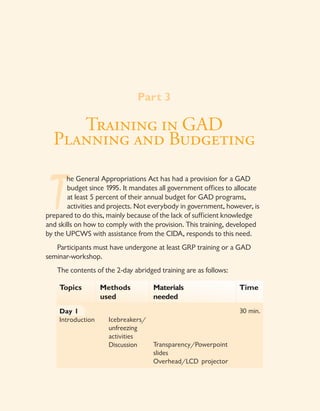
Transforming
Government to
Think and Act GAD
A Handbook on Gender
and Development Training
National Commission on the
Role of Filipino Women
Published by the
2003
Manila, Philippines
Canadian International
Development Agency
Published by the
National Commission on the Role of Filipino Women
Canadian International Development Agency
Copyright 2003
All rights reserved.
Any part of this book may be
used and reproduced provided
proper acknowledgement is made.
ISBN 971-8701-03-6
Writer
Elena O. Masilungan
Editor
Estrella Maniquis
Design and Layout
Rolando F. Santos
Message
M
aking the bureaucracy work for women’s empowerment and
gender equality is a continuing and challenging task that the
government is committed to pursue. Adopted in the early
1990s, the gender mainstreaming strategy was implemented
by the National Commission on the Role of Filipino Women in order to
sensitize governmental institutions and transform them into active and
proactive agents towards the goals of women’s empowerment and
gender equality. Towards this end, much effort had been devoted to
provide gender sensitivity sessions for government officials, agencies and
sectors as a first step in achieving these twin goals.
Over the years, GAD training tools on various aspects of planning,
budgeting and programming have been developed and utilized by
NCRFW and its partners. Many of these have been found to be useful
locally and even internationally by other national machineries on
women.
Given that various groups and government agencies now conduct
their own GAD training, it is necessary to standardize GAD core
messages which have been distilled and crystallized through many years
of GAD training by both trainers and participants. These core messages
will help further clarify key concepts and practical strategies on gender
mainstreaming.
Transforming Government to Think and Act GAD: A Handbook on Gender
and Development Training was developed in an effort to provide GAD
trainers with conceptual handles and innovative approaches to GAD
application.
We would like to express our appreciation to our colleagues from
the University of the Philippines Center for Women Studies who
conducted various GAD Training Sessions for the GAD Resource
Centers in the different regions of the country. We would like to thank
iii
as well those who validated and provided additional inputs and further
enhanced the initial draft of this book. Elena Masilungan spent long
hours writing and rewriting the manuscript while Estrella Maniquis spent
time in editing and improving the format and style of the handbook.
Finally, our thanks to the constant and strong support of the Canadian
International Development Agency without which this handbook would
not have been produced.
Aurora Javate-de Dios
Chairperson, NCRFW
iv Transforming Government to Think and Act GAD: A Handbook on Gender and Development Training
Message
T
he silver anniversary at the advent of the millennium has been
very symbolic for the National Commission on the Role of
Filipino Women. It has a grand tradition of leadership as the first
national machinery to be set up in Asia in 1975, continually
striving to achieve its mission of making government work for women’s
empowerment and gender equality. It envisions a Philippine society
where women and men equally contribute to and benefit from national
development.
In this spirited effort, the NCRFW conceptualized the Gender
Mainstreaming Resource Kit a year after its 25th
anniversary. In the
conception of the GMRK, the NCRFW brought together the most
respected minds in Gender and Development to draft the seven tools in
the kit.
Policies are not gender neutral. It affects men and women differently.
Thus, the GMRK presents aids and guides to facilitate gender
mainstreaming in agencies. With these tools, government agencies,
academic and training institutions and civil society will be better
equipped to build on their accomplishments. These can also address the
gaps and confront the challenges that have faced them in their gender
mainstreaming work.
I believe that the Commission is beaming with pride in this
contribution. This is a big milestone and I am proud to be part of the
experience in laying the foundation for women equality and
empowerment. As an active participant in the conceptualization process
of this Kit, I have continued to nurture its development. It is a great joy
to see how each guidebook, sourcebook and manual in this kit has
blossomed to formulate the women’s agenda and integrate the
Framework Plan for Women (FPW). It will be most rewarding to see how
each tool will bear fruits of gender-responsive policies and plans,
programs and budgets and good governance.
v
With this, we are optimistic that the government shall realize
empowerment and equality for Filipino women. Let us look forward to
ensuring that the Gender and Development experience endures for
equality and empowerment.
Amelou Benitez-Reyes, Ph.D
NCRFW Commissioner for Culture, 2002 to present
NCRFW Chairperson, 1998 to 2001
vi Transforming Government to Think and Act GAD: A Handbook on Gender and Development Training
Message
T
he Canadian International Development Agency (CIDA) is
honoured to have been a partner of the Government of the
Philippines for many years in promoting Gender Equality. One
decade-long of partnership with the National Commission on the
Role of Filipino Women (NCRFW) through the Institutional
Strengthening Project for Gender Mainstreaming has been highly
successful in terms of increasing the capacity of government to
implement laws and policies such as the Women in Development and
Nation-Building Act (RA 7192). This same partnership has resulted in
numerous innovative approaches to gender mainstreaming which have
been catalysts for similar efforts in the neighbouring countries of the
Asia-Pacific region.
It gives me great pleasure, on behalf of CIDA, to congratulate all
those who have contributed to the long and challenging process of
producing the “Gender Mainstreaming Resource Kit”, a compilation of
seven ‘tools’ in the form of source books, manuals, guides and training
modules. I am certain that these will be applied towards a better quality
of life for Filipino women through more effective governance that fosters
gender equality.
While much has been accomplished, much remains to be done and
the challenges are great. Amid these challenges, CIDA remains
committed to integrating gender equality in all of our development
efforts in the Philippines.
Gérard Bélanger
Counsellor (Development) and Head of Aid
CIDA, Philippines
vii
Acknowledgements
T
he production of this Handbook would not have been possible
without the guidance and support of people who believe in the
importance of this tool towards the achievement of women’s
empowerment and gender equality.
We express our gratitude to the supervision and direction rendered
by the GMRK advisors, Executive Director Emmeline Verzosa, Deputy
Executive Director Lorenza Umali and former NCRFW-CIDA Project
Manager and now CIDA Senior Program Officer Myrna Jarillas.
Very special thanks to Ermelita Valdeavilla, Sarah Umandal and
former Chairperson Amelou Benitez-Reyes who initiated the project and
provided guidance in the production of the Resource Kit. Ms. Umandal
was then Project Manager of the Institutional Strengthening Project
Phase II (ISP II) and it was during Executive Director Valdeavilla’s and
Chairperson Reyes’ term that the GMRK reached fruition.
We acknowledge the Institute of Philippine Culture and the
University of the Philippines Center for Women Studies from whom the
core messages used in this Handbook were derived.
Appreciation is also due to Commissioner Jurgette Honculada, Dr.
Carol Sobritchea, the NCRFW Management Committee and technical
staff and all those who were involved in the validation of the basic GAD
concepts contained in this tool.
Credit is also due to Elena Masilungan, who helped NCRFW in
drafting and finalizing this tool. We also wish to thank Estrella Maniquis
for her endearing commitment as Resource Kit editor. We thank
Rolando Santos, design and layout artist, for transforming the
manuscript into a handy and user-friendly tool. We would also like to
acknowledge Arnel Orea for the concept of the cover design. Gratitude is
also due to Ms. Prossy Dumlao and her daughter Aina who shared their
insights on how the design of this tool may be further enhanced.
ix
We are also grateful to the Resource Kit Management Team
composed of Veronica Villavicencio, Luz Lopez-Rodriguez and Rina
Jimenez-David. Their substantive inputs have been instrumental in the
review of the manuscript and further development of the tool.
Finally, we thank Chairperson Aurora Javate-de Dios who came at
midpoint but gave solely unrelenting support to the GMRK project.
Most of all, gratitude is due to the nameless women and men who
have given their time and energy to the realization of this project. This
has been a most rewarding experience.
x Transforming Government to Think and Act GAD: A Handbook on Gender and Development Training
Project Team
Resource Kit Management Team
Rina Jimenez-David
Luz Lopez-Rodriguez
Sarah Umandal
Veronica Villavicencio
Technical Review Team
Marichu Buergo
Eduardo Layag
Virginia Leander
Anna Liza Aquino
Jo-Al Mejia
Precy Platon-Tica
Lourdita Villavicencio
Support Staff
Leabel Jordan
Ronald Manaig
xi
Acronyms
CIDA Canadian International Development Agency
DBM Department of Budget and Management
DILG Department of the Interior and Local Government
FY Fiscal Year
GAD Gender and Development
GEWEF Gender Equality and Women’s Empowerment Framework
GREAT Gender-Responsive, Equality-oriented and Aware of social and
economic differences of its Target beneficiaries
GRP Gender-Responsive Planning
GST Gender Sensitivity Training
HRD Human Resource Development
LGU Local Government Unit
NCRFW National Commission on the Role of Filipino Women
NEDA National Economic and Development Authority
PAPs Programs, Activities and Projects
PGNs Practical Gender Needs
RA Republic Act
RKMT Resource Kit Management Team
SGNs Strategic Gender Needs
SMART Specific, Measurable, Attainable, Realistic and Time-bound
TNA Training Needs Assessment
UCWS-UP University Center for Women Studies-University of the Philippines
VCR Video Cassette Recorder
VMG Vision, Mission, Goal
WAD Women and Development
WID Women in Development
xii Transforming Government to Think and Act GAD: A Handbook on Gender and Development Training
Table of Contents
Messages ............................................................................................. iii
Acknowledgements ......................................................................... ix
Acronyms ..........................................................................................xii
Rationale
Organization of the Handbook............................................................xvi
Users of the Handbook ...................................................................... xvii
How to Use the Handbook ................................................................ xvii
Limitation of the Handbook .............................................................. xviii
Part 1: Getting Started
The Training Team.................................................................................. 1
Developing a Training Module ................................................................ 2
Running the Training .............................................................................. 6
Evaluating the Training ........................................................................... 7
Part 2: Gender Training Designs
Gender Sensitivity Training (GST) .........................................................11
Training in Gender-Responsive Development Planning ......................... 27
GAD Training ....................................................................................... 51
Part 3: Training in GAD Planning and Budgeting
Day One .............................................................................................. 55
Day Two ............................................................................................... 62
Annexes
Annex A: Icebreakers/ Unfreezing Activities ....................................... 67
Annex B: Sample Diagnostic Questionnaire ......................................... 75
Annex C: Sample Evaluation Form .......................................................77
Annex D: Gender Analysis Tools ......................................................... 81
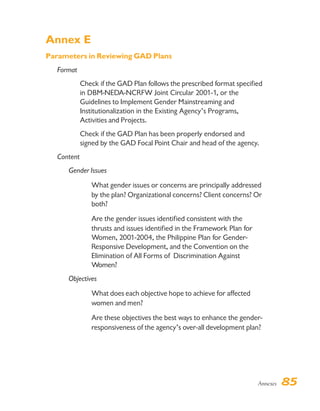
Annex E: Parameters in Reviewing GAD Plans..................................... 85
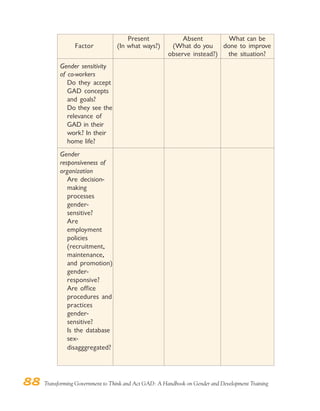
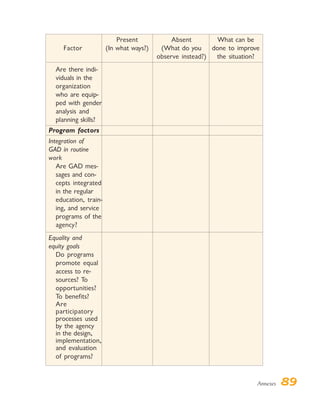
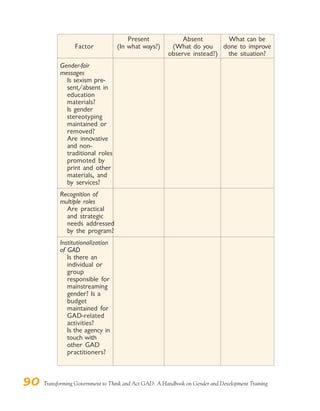
Annex F: Home Situation Assessment Kit ............................................ 87
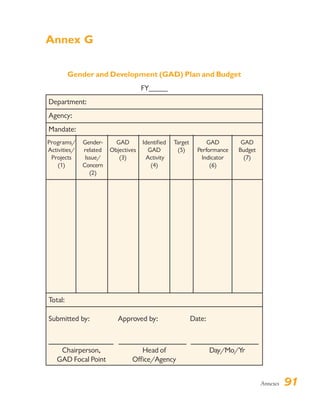
Annex G: GAD Plan and Budget Form ................................................ 91
Annex H: Suggested Readings for GAD Training.................................. 93
Index.................................................................................................... 95
Rationale
T
he gender approach to development, also known by its acronym
GAD (gender and development), was introduced in government
in the early 1990s as an alternative development strategy. GAD
seeks to transform the way government pursues development so
that it can respond effectively and with sensitivity to issues confronting
women. The GAD perspective recognizes that gender concerns cut
across all areas of development and therefore should not be overlooked
in the development planning process. Indeed, gender must influence
government when it plans, budgets for, implements, monitors and
evaluates policies, programs and projects for development.
By the start of the1990s many countries had already adopted GAD
as a mainstream development approach. The Philippine government,
however, was not ready for GAD at the time. People in government still
commonly assumed that development efforts must be “gender-neutral,”
intended to benefit both women and men. They had yet to recognize
that because of the cultural conditioning of gender relations, women and
men have different roles in society and consequently have different
needs as well. By ignoring these differences, the gender-neutral
approach to development was not improving women’s lives but was
contributing to their disadvantaged status in society. Such an approach
effectively relegated women to the margins of the development process,
where there was very little opportunity for them to influence
development agenda and directions.
The challenge of making government “think and act” GAD and of
bringing the GAD perspective from the margins to the mainstream
became the mandate of the National Commission on the Role of Filipino
xv
Women (NCRFW). Its first order of business was to hold orientation
briefings, workshops, seminars and training on GAD for government
officials and technical personnel of national offices and agencies.
NCRFW, together with some GAD experts and advocates in as well as
outside government, developed various modules for these sessions. The
modules, together with a training guide and a glossary of commonly
used GAD concepts and terms are presented in this Handbook on
Gender and Development Training. It is hoped that the Handbook
will be a great help in continuing and sustaining the effort to transform
government into a gender-responsive institution.
Organization of the Handbook
The Handbook is a tool to help agencies design their GAD training
program and conduct training sessions. It has four parts. Parts 1-3 are
included in Book 1 while Part 4 or Gender 101 comprises Book 2 of the
Handbook.
Part 1: Getting Started presents general pointers on how to
develop, run, and evaluate a GAD training program.
Part 2: Gender Training Designs gives a synopses of modules
commonly used for gender sensitivity training (GST), training
in gender-responsive planning (GRP), and combined GST
and GRP training.
Part 3: Training in GAD Planning and Budgeting is a module
developed by the University of the Philippines Center for
Women Studies (UPCWS) and the NCRFW to equip
planners, budget officers and other officials and technical
personnel with the knowledge and skills needed in preparing
the GAD plans and budget of government agencies and local
government units (LGUs).
Part 4: Gender 101 presents a glossary of commonly used terms
and concepts associated with GAD.
xvi Transforming Government to Think and Act GAD: A Handbook on Gender and Development Training
Users of the Handbook
The Handbook is intended primarily for government agencies and
LGUs, particularly their human resource development (HRD) managers,
trainers, and GAD Focal Points. It can also be used by trainers and
members of the GAD Resource Centers set up in some regions. It is
highly recommended that users of this manual be trainers who have
gone through GST and GRP training themselves.
The Handbook is especially useful to trainers who are already into
GAD training, those who have substantial knowledge on GAD, or those
who have extensive experience in conducting HRD training. GAD
training is different from other training programs because it involves not
just a transfer or enhancement of skills and knowledge — it seeks to
transform attitudes and behaviors as well. GAD trainers, therefore, must
be advocates who have a deep personal commitment to change the way
government perceives and responds to gender issues and concerns.
They must be true GAD believers.
How to Use the Handbook
The Handbook is primarily a trainers’ guide. It contains three types
of modules — GST, GRP training, and training in GAD planning and
budgeting. GST introduces the concept of gender and how it affects the
decisions and actions of individuals and institutions. It also establishes the
relationship between gender and development. The next phase, GRP
training, focuses on the significance of gender in government planning
and how gender concerns may be integrated into development policies,
plans, programs and projects. The training in GAD planning and
budgeting shows the application of GAD as being an integral part of the
development planning process of government.
The training modules are addressed to the trainer in particular and
can be used in two ways — as they are, or modified to suit the specific
needs of the participants by using only those segments that are
applicable. An occasional “Note to Trainer” (boxed) gives reminders or
tips that trainers will find particularly useful to the smooth conduct of
Rationale xvii
the session or course. In the glossary, the words listed are defined only
within the context of GAD.
Limitation of the Handbook
The Handbook reflects 10 years of gender mainstreaming activities
and strategies undertaken by the NCRFW and its partners, particularly
the Canadian International Development Agency (CIDA). It does not
aim to be the definitive source book on GAD training in government. It
does not provide step-by step, detailed instructions on how to do the
training. Rather, it presents a general guide that trainers can refer to as
they design and conduct gender training for their agencies. This allows
trainers the flexibility to modify and adapt the training methods and
processes so as to better respond to the needs and objectives of their
respective organizations. While the Handbook is intended to be
comprehensive enough, the development of its modules is limited to the
experience of the NCRFW and training partners. Its validation was a
joint effort of the NCRFW, the Resource Kit Management Team
(RKMT) and the UCWS-UP.
Also, the focus of the Handbook is on the contents of the training
course, especially on GAD’s core messages, rather than on training
methods and resources. The focus on content, reinforced in the chapter
on the definition of GAD terms and concepts, is deliberate. The aim is
to afford participants a clearer grasp of the basic concepts underpinning
this relatively new thinking, and to address the confusion resulting from
the various interpretations of GAD definitions. Since the primary users
of the Handbook are government trainers including GAD trainers, it is
expected that it is within their experience and expertise to decide and
innovate on the appropriate and effective methods to use for each
session.
xviii Transforming Government to Think and Act GAD: A Handbook on Gender and Development Training
Transforming Government
to Think and Act GAD
A Handbook on Gender
and Development Training
Part 1: Getting Started 1
Part 1
Getting Started
G
ender training aims to develop awareness, knowledge and
skills and to change perceptions, attitudes and behaviors in
relation to gender. It is different from other forms of training
because it touches on personal and political issues and engages
both the minds and hearts of participants. It works best if it addresses
awareness-raising as well as skills-building. The challenge is to maintain a
balance between these two objectives.
The Training Team
The team should have at least two members, whether they are facilitators
or trainers. The unit of the agency coordinating or organizing the training
must also be part of the training team; so
should the resource persons
who would be tapped to
handle the sessions. It is
also good to include a
male trainer to help in the
group dynamics especially
with mixed groups, and
to impress on the
participants that gender is
a concern not just of women.
1
2 Transforming Government to Think and Act GAD: A Handbook on Gender and Development Training
Any disharmony among the team members will be sensed by the
participants and detract from the team’s effectiveness. To ensure a
smooth working relationship, the members of the team should
discuss their respective training styles and methods and other
issues that may arise during the course of the training.
make sure that all agree on the basics about gender.
have a common understanding of the participants’ needs and
dynamics.
agree on fees, responsibilities, and the time required for planning
and training.
walk through the training program as a team to establish its
logical flow as well as to correct some gaps that may have been
overlooked.
Developing a Training Module
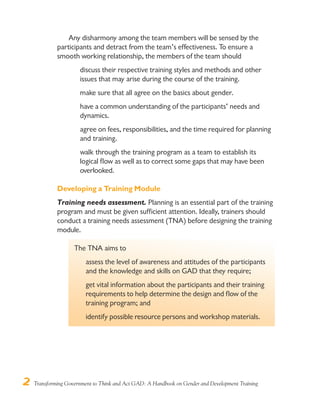
Training needs assessment. Planning is an essential part of the training
program and must be given sufficient attention. Ideally, trainers should
conduct a training needs assessment (TNA) before designing the training
module.
The TNA aims to
assess the level of awareness and attitudes of the participants
and the knowledge and skills on GAD that they require;
get vital information about the participants and their training
requirements to help determine the design and flow of the
training program; and
identify possible resource persons and workshop materials.
Part 1: Getting Started 3
Factors
The articulated training
needs of participants
The gender issues that have
to be addressed in their
respective lines of work
The number of participants
and their characteristics
such as sex, age, religion,
ethnicity, educational
background, occupation,
office responsibilities and
duties
Participants’ attitudes and
perceptions of gender issues
and concerns and their
willingness to participate in
the training
Availability of participants
for training vis-à-vis the
length and frequency of
training
Participants’ resources that
can be used for the training
Relevance
These help determine the
content and flow of the
training.
These guide the partici-
pants in formulating their
inputs to the action planning
that will be done toward
the end of the training.
The structure, duration and
style of training can be
adapted to fit the partici-
pants’ characteristics.
These help surface any
resistance to the training
and the reasons for this, so
that the training can be
restructured to address the
problems.
Training duration must not
be too long as to disrupt
the participants’ schedule
nor too short that the
quality of training suffers.
Workshops can use case
studies coming from the
participants themselves,
greatly facilitating the
learning process
Source: Oxfam, 1994
Six factors have to be considered in the TNA.
4 Transforming Government to Think and Act GAD: A Handbook on Gender and Development Training
The TNA allows the training team to adapt the training materials and
structures to the needs and objectives of the participants. The methods
and contents, usually the first to be considered, should be chosen only
after the aims and objectives of the training and the TNA have been
taken into account.
Contents. The contents are the topics and core messages of the
training program. Gender training must include gender awareness both at
the personal and at the theoretical level to provide a firm basis for the
new skills that will be acquired and the expected change in behavior. This
will enable participants to realize that gender is not a development issue
only but a personal one as well.
The topics must be taken up in a logical order, starting with the
Introduction which should include at least the following:
Introduction of the participants, the training team and the
support staff
Expectation check of all groups
Norms setting, such as the formation of responsible teams to
help out in the daily needs of the training and agreeing on general
rules that will govern the conduct of the training
Overview of the training course
Articulation of the four assumptions or premises (David, 1995) of
gender training, namely that
- GAD is not a war of the sexes;
- GAD is not anti-male;
- both women and men are victims of gender inequality, although
the victims are more often women than men; and
- both women and men have a stake in the struggle for gender
equality.
In Conclusion, participants are asked to come up with their respective
Action Plans detailing how they intend to apply what was learned. They
Part 1: Getting Started 5
then evaluate the training course and its contents and methods, the
training materials, styles of the training team, even logistical
considerations such as venues and schedules.
Methods. Various methods of presenting the different sessions are
available to the trainer. Participatory methods are the most effective for
adult learning, including gender training. They should be chosen not at
random but purposefully. They should be learner-centered by meeting
the specific needs and objectives of the participants. They must also
address the relevant issues that confront participants using the problem-
posing approach.
The methods and techniques chosen must create an environment
that facilitates learning and fosters openness and trust, especially in
sessions where there is sharing of personal experiences and dialogue.
They must lead participants to reflect on how each session has affected
them. At best, they can be tools for empowering the participants to
develop gender responsiveness in their thinking, behavior and action.
Training techniques can be of two types: open or closed. The open
techniques stimulate creativity, raise awareness, and do not have a
present outcome. Examples of these are brainstorming, storytelling,
games, and role playing. The closed techniques can be used to update
knowledge and transfer new skills, and consist mainly of lecture inputs,
summary and synthesis, and demonstration.
Training objectives
To acquire knowledge and
new information
To improve skills
To influence participants to
change their attitudes and
values
To allow participants to
develop creativity
Methods/techniques
Lecture discussion, seminar
workshop, team teaching
Case studies, role playing,
demonstrations, video
showing, worksheets
Role playing, demonstra-
tions, structured games
Brainstorming
Source: UCWS, 2001
6 Transforming Government to Think and Act GAD: A Handbook on Gender and Development Training
Trainers may also conduct icebreakers and unfreezing exercises,
especially in situations where participants appear bored or sleepy, low on
energy or interest, or anxious and uptight as they go through some of
the training activities. It is best to start a session with these exercises,
usually in the form of a short game or action song that is relevant to the
session’s topics. Everyone must take part in the icebreakers and the
unfreezers since these encourage trust and openness, and make the
training fun as well.
Running the Training
Once the training starts, the facilitator becomes the person most
depended on to ensure that it runs smoothly. Following are points for the
facilitator to keep in mind:
Set clear training objectives for each session. Provide
introductions and instructions to participants, provide training
materials, keep the time schedule, and do the summing up and
the concluding.
Be sensitive to group dynamics and the way individuals relate to
you and to the whole group.
Encourage balanced participation so that no one individual or
group dominates discussions and sharing sessions.
Always relate the concepts to everyday situations and
experiences. Encourage the participants to translate the concepts
into real terms by sharing their experiences or views that reflect
or support the concepts.
Deal constructively with resistance and hostility. Gender issues can
be controversial and can make participants feel uncomfortable,
defensive or threatened. Your aim is to keep this tension at a level
where it promotes the motivation for change. Maintain an accepting
and open climate for discussion but do not let remarks that express
prejudice to go unchallenged. If something does need to be
challenged, do so in a way that the speaker will not feel he or she is
being censured or attacked for airing such a view.
Part 1: Getting Started 7
Evaluating the Training
Monitoring and evaluation are important and have to be planned from
the start like the other training components. They should be done
throughout the training course, in four phases.
Preprogramming critiquing or “cliniquing”
* The training team meets as often as necessary to assess a just-
concluded session.
* At the end of the day, assessment is done on the participants’
learning progress and the effectiveness of the modules and their
implementation. Plans are made for the next day.
* Participants are periodically given a “temperature check” in
which their reactions, general attitudes and feedback are
actively sought and acted upon, when necessary.
Mid-program evaluation
* Participants are encouraged to express their reactions to the
contents of the training program and the training methods and
styles of the trainers and facilitators, and to assess the
attainment of their learning expectations and objectives.
End-of-program assessment
* Participants make a list of all they have learned and how these
may be applied to daily life or work situations. The individual or
group action plans drawn up by the participants to address
gender issues in their respective agencies become the basis for
the assessment.
* Participants assess the training program’s effectiveness by
accomplishing feedback or evaluation forms. The following are
evaluated in particular:
> participants’ performance vis-a-vis expressed gains;
> training design, content and methods;
8 Transforming Government to Think and Act GAD: A Handbook on Gender and Development Training
> trainers, facilitators and resource persons;
> training materials, visual aids and adequacy of supplies;
> scheduling, especially duration and pacing;
> training facilities, board and lodging;
> administrative and logistical support;
> team work of training team and staff; and
> costs.
Postprogram Evaluation
* Information gathered from the evaluation instruments is
analyzed.
* Plans incorporating improvements for the next training
program and follow-up mechanisms for the participants are
formulated.
Evaluation instruments may include:
Temperature checks. Examples of these are the mood meter,
where participants indicate their reaction to the day’s sessions
through icons such as ☺ and , and the democracy wall, where
they write down positive or negative reactions about the day’s
events on a paper or board attached to the wall.
Reflection logs. These contain participants’ insights and reactions
to the day’s events.
Learning diaries. New knowledge and skills acquired are recorded
here by the participants.
Work reports. Participants assess the group work they did earlier,
including the processes involved in completing the work and how
effective these are in reinforcing the new knowledge and skills
learned from the sessions.
Part 1: Getting Started 9
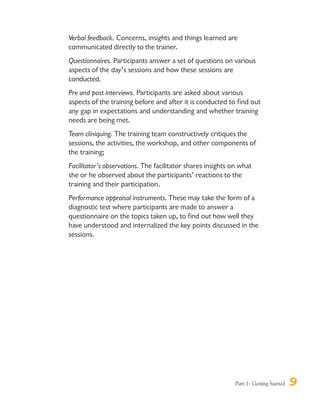
Verbal feedback. Concerns, insights and things learned are
communicated directly to the trainer.
Questionnaires. Participants answer a set of questions on various
aspects of the day’s sessions and how these sessions are
conducted.
Pre and post interviews. Participants are asked about various
aspects of the training before and after it is conducted to find out
any gap in expectations and understanding and whether training
needs are being met.
Team cliniquing. The training team constructively critiques the
sessions, the activities, the workshop, and other components of
the training;
Facilitator’s observations. The facilitator shares insights on what
she or he observed about the participants’ reactions to the
training and their participation.
Performance appraisal instruments. These may take the form of a
diagnostic test where participants are made to answer a
questionnaire on the topics taken up, to find out how well they
have understood and internalized the key points discussed in the
sessions.
Part 2
Gender
Training Designs
Gender Sensitivity Training (GST)
G
ender sensitivity training is an initial effort to show how
gender shapes the roles of women and men in society,
including their role in development, and how it affects
relations between them. It is given to those who have very
little gender awareness or none at all. For people in government to
appreciate GAD and eventually become its advocate, they first have to
heighten their awareness of gender concerns and be willing to respond to
gender issues. GST makes this possible.
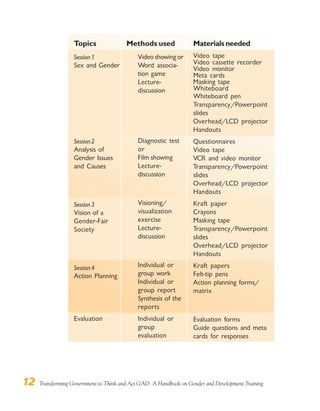
Below is a sample GST module consisting of four sessions that can be
conducted from one day and a half to two days:
Topics
Introduction
Methods used
Icebreakers/
unfreezing
activities
Discussion
Materialsneeded
Transparency/Powerpoint
slides
Overhead/LCD projector
11
12 Transforming Government to Think and Act GAD: A Handbook on Gender and Development Training
Topics
Session 1
Sex and Gender
Session 2
Analysis of
Gender Issues
and Causes
Session 3
Vision of a
Gender-Fair
Society
Session 4
Action Planning
Evaluation
Methods used
Video showing or
Word associa-
tion game
Lecture-
discussion
Diagnostic test
or
Film showing
Lecture-
discussion
Visioning/
visualization
exercise
Lecture-
discussion
Individual or
group work
Individual or
group report
Synthesis of the
reports
Individual or
group
evaluation
Materialsneeded
Video tape
Video cassette recorder
Video monitor
Meta cards
Masking tape
Whiteboard
Whiteboard pen
Transparency/Powerpoint
slides
Overhead/LCD projector
Handouts
Questionnaires
Video tape
VCR and video monitor
Transparency/Powerpoint
slides
Overhead/LCD projector
Handouts
Kraft paper
Crayons
Masking tape
Transparency/Powerpoint
slides
Overhead/LCD projector
Handouts
Kraft papers
Felt-tip pens
Action planning forms/
matrix
Evaluation forms
Guide questions and meta
cards for responses
Part 2: Gender Training Designs 13
Introduction
Note to Trainer:
At this stage, not everybody would have
acquired and internalized gender sensitivity.
Participants in this situation are likely,
therefore, to show resistance or even
hostility during training. Refer to the section
on Running the Training (p. 6) for tips on how
to deal with this.
1. The GST may start with icebreakers and unfreezing activities to
set a relaxing mood so participants can get to know each other
and gain the confidence to speak in front of the group. Such
activities also stimulate interest in the training.
2. The Introduction follows, consisting of these activities:
Introduction of the participants, the training team and the
support staff
Expectation check of all groups as to the content, processes
and methods of training; the training team’s conduct of the
sessions relative to the participants’ expectations and needs,
and the hopes and fears for the training
Norms setting to define the behaviors and attitudes that must
prevail during the training; formation of responsible teams
where participants are grouped to help out with the daily
needs of the training, such as seeing to the cleanliness and
orderliness of the training room, assembling the participants
so sessions can start on time, taking care of the icebreakers
or unfreezing games, recapping the past day’s activities and
sessions, and surfacing evaluation and feedback on various
aspects of the training
14 Transforming Government to Think and Act GAD: A Handbook on Gender and Development Training
Overview of the training course, including its objectives, the
sessions, and time frame
Articulation of the four premises of GAD training, namely
that
- GAD is not a war of the sexes
- GAD is not anti-male;
- both women and men are victims of gender inequality,
although the victims are more often women than men; and
- both women and men have a stake in the struggle for
gender equality.
Note to Trainer:
The portions in the Introduction may be
conducted through games, sharing sessions
and other creative activities to establish a
non-threatening and fun way of starting the
GST. Samples of icebreakers and unfreezing
activities are found in Annex A.
Keep in mind also that this training
design focuses more on the core messages
and not so much on the methods. This gives
trainers the leeway to choose the methods
or techniques they think would be effective
for each session.
Session 1 Sex and Gender
1. Introduce the session through any of the following activities:
a video showing on the situation of women;
a word association game to distinguish the concepts of sex and
gender; or
other priming activities to prepare the participants’ mind to
“think gender”.
Part 2: Gender Training Designs 15
Note to Trainer:
See Annex A for a sample of these priming
activities.
Also, in between sessions, especially
during the early afternoon hours, you may
notice that attention or interest among the
participants may have flagged or declined.
This can be countered by leading the group
in doing some energizers, samples of which
are also found in Annex A.
2. Hold a lecture-discussion, surfacing the following core messages:
Sex is a natural distinguishing variable based on biological
characteristics of being a man or a woman. It refers to
physical attributes pertaining to a person’s body contour,
features, genitals, hormones, genes, chromosomes and
reproductive organs. Sex differences between women and
men are biological.
Gender refers to the socially differentiated roles,
characteristics and expectations attributed by culture to
women and men. It identifies the social behavior of women
and men and the relationship between them. Gender roles
and attributes are not natural or biologically given.
Sex is a biological fact, while gender is a social construct. Sex
is a natural attribute that a person is born with. Gender, on
the other hand, is created, produced, reproduced, and
maintained by social institutions, a process otherwise referred
to as the social construction of gender. Because gender roles,
attitudes, behaviors, characteristics and expectations are
learned, they can also be unlearned.
16 Transforming Government to Think and Act GAD: A Handbook on Gender and Development Training
Note to Trainer:
Allow enough time for participants to share
their thoughts and feedback on the topics
being discussed. Since the discussion is
mostly on gender concepts, relate the
concepts to actual situations, possibly those
closest to the participants’ experience. Or
cite data to make the concepts less technical
or abstract.
Also, the participants would be greatly
helped in grasping the core messages if
these are outlined on transparency slides
and shown onscreen during the lecture-
discussion. Printed copies can also be
distributed.
Session 2 Analysis of Gender Issues and Causes
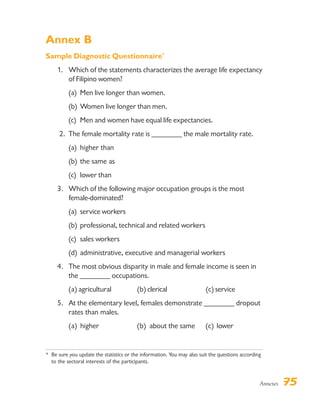
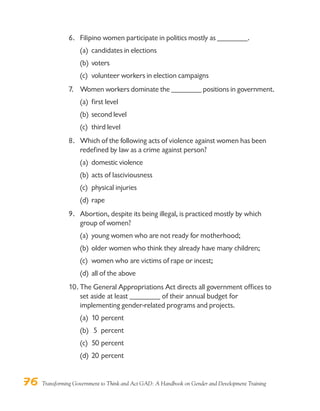
1. Conduct a diagnostic test on gender issues in the Philippines. The
test can be in the form of a questionnaire that participants answer
individually within 10 minutes or less . You then provide the
answers, elaborating on each issue and the analysis of the statistics
cited.
Note to Trainer:
The data in the diagnostic test questionnaire must
be recent. Sources are the National Statistics
Office, the labor force survey of the Department
of Labor and Employment, the National Economic
and Development Authority, the Facts and Figures
publication produced by the NCFRW, and other
government offices that generate statistics (refer
to www.ncrfw.gov.ph and www.nscb.gov.ph). A
sample questionnaire is shown in Annex B.
Part 2: Gender Training Designs 17
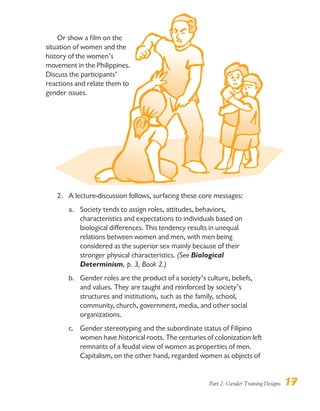
Or show a film on the
situation of women and the
history of the women’s
movement in the Philippines.
Discuss the participants’
reactions and relate them to
gender issues.
2. A lecture-discussion follows, surfacing these core messages:
a. Society tends to assign roles, attitudes, behaviors,
characteristics and expectations to individuals based on
biological differences. This tendency results in unequal
relations between women and men, with men being
considered as the superior sex mainly because of their
stronger physical characteristics. (See Biological
Determinism, p. 3, Book 2.)
b. Gender roles are the product of a society’s culture, beliefs,
and values. They are taught and reinforced by society’s
structures and institutions, such as the family, school,
community, church, government, media, and other social
organizations.
c. Gender stereotyping and the subordinate status of Filipino
women have historical roots. The centuries of colonization left
remnants of a feudal view of women as properties of men.
Capitalism, on the other hand, regarded women as objects of
18 Transforming Government to Think and Act GAD: A Handbook on Gender and Development Training
pleasure and commodities for exchange. These beliefs are still
mirrored in state policies and institutional practices that affect
women’s rights, especially their reproductive health rights,
and in women’s limited access to and benefit from political
and economic processes.
d. Patriarchy is also a legacy of colonization. The colonial thinking
was that men are superior to women. Therefore, men should
dominate the exercise of political and economic power in
society’s institutions, including the family.
e. The learning of gender roles begins in early childhood. Girls
are taught to be feminine, while boys are taught to be
masculine. Feminine traits include being modest, submissive
and nurturing. Masculine traits include being domineering and
aggressive. Women, because of the feminine traits attributed
to them, are expected to be good homemakers and nurturers
of family members. Men, as masculine beings, are expected to
be the family provider and to be responsible for its survival.
f. There is great danger if a family blindly subscribes to
traditional gender roles. At its worst, this can perpetuate
inequality, particularly if the father considers the women in
the family as subordinates who are subject to his will. This
thinking also puts the wife and children at risk of being
subjected to violence and abuse.
Part 2: Gender Training Designs 19
g. Gender roles have resulted in gender bias, manifested in the
following:
i.
Marginalization,
where women’s
participation in
development is
limited to
t r a d i t i o n a l
programs and
p r o j e c t s ,
especially those
related to
maternal and
child care, day
care centers
and nutrition. It
results in failure
to recognize
women’s concerns in other areas, particularly within the
economic sectors. Hence, women are unable to develop their
potential to the full.
ii. Subordination, or the secondary status of women in
society. Because of this, women have less access to and
control over development resources and benefits.
iii. Multiple burden, or the condition in which women
perform several tasks and responsibilities despite their
limited time and energy. This multiple burden refers to
doing unpaid work in the home, paid work as a member
of the workforce, and volunteer work in the community.
iv. Gender stereotyping, or the tendency to assign fixed,
unquestioned and unexamined beliefs and perceptions
about women and men.
MANIFESTATIONS
OF GENDER BIAS
20 Transforming Government to Think and Act GAD: A Handbook on Gender and Development Training
v. Violence against women whether threatened or actual,
perpetrated on women simply because they are women.
It includes sexual harassment, sexual assault, rape, incest,
pornography, battering, trafficking, and abuse whether
psychological, verbal or economic. These acts of violence
reinforce male dominance over women.
vi. Obstacles to personal development that arise from
gender bias and have a direct negative impact on women’s
sense of self-worth and personhood.
h. The gender division of labor is another reason for women’s
subordinate status. Reproduction has been assigned to
women because of their ability to conceive and give birth.
Reproductive functions, however, are not limited to
childbearing and nurturing, but include other tasks such as
caring for family members and managing the home.
Reproductive work is mostly unpaid work done in the home.
Production, or paid work done outside the home, is the
domain of men. This production-reproduction divide is what
is known as the gender division of labor, with production
considered as the more important because of the economic
benefits and advantages it gives to those who are engaged in
it and to society.
i. Aside from reproductive and productive roles, the two other
gender roles are
- community management, involving voluntary work for the
community; and
- constituency-based politics, involving participation in
decision making and organizations at all political levels of
government and civil society. (Levy 1996)
Women tend to assume the reproductive and community
management roles, while men dominate the productive and
constituency-based politics roles. In this gender division of
Part 2: Gender Training Designs 21
labor, men are the decision makers and leaders. Women’s
roles are secondary to men’s roles even if these tend to be
multiple roles performed simultaneously. Housework, which is
done mainly by women, is not even considered work and is
not included in the computation of the Gross National
Product.
j. While childbearing will always be done by women, child
rearing and housekeeping need not. The equitable
arrangement is for parenting and housework to be shared by
the sexes. This arrangement also gives reproductive work the
recognition it deserves.
k. The family is in a strategic position to transform gender roles
because of its nurturing influence on members. It must
promote relationships guided by respect for the fundamental
and equal rights of all members. A family that is less than
gender-fair handicaps its members from realizing their
potentials and aspirations.
l. Gender roles determine not only women’s cultural and social
status but their economic and political status as well. In all
these spheres, women’s status has been secondary to men’s.
m. The manifestations of gender bias show that the power
relations between men and women are far from equal or
balanced but grossly skewed in favor of men. To put it
another way, gender relations are not level but stratified, and
women are found at the lower rungs. In examining gender
relations, women’s secondary status must be recognized and
transformed so that their human right to equality can be
realized.
n. It is not enough to integrate gender considerations when
addressing women’s issues. The interplay between gender
and other factors such as class, race, ethnicity, religion,
education, even location (whether they live in urban or rural
areas), must also be taken into account. This way, gender
22 Transforming Government to Think and Act GAD: A Handbook on Gender and Development Training
issues become social issues that must be addressed by public
action, with government as a leading actor in the effort.
o. Women’s rights are human rights. This has to be emphasized
because there are specific rights that women are entitled to
but do not fully enjoy. For example, in spite of the long years
of struggle to show how domestic violence violates the basic
right of women to life and dignity, government has not yet
enacted a law that penalizes such a crime.
Session 3 Vision of a Gender-Fair Society
1. Open the session with a Visioning exercise, where participants
describe or draw a picture of what they think a gender-fair society
should be. After some minutes, ask the participants to present
their drawings to the group and to explain what they mean.
2. Write down the ideas of the participants on the board. These will
serve later on as inputs for the lecture-discussion.
3. Conduct a lecture-discussion surfacing the following core messages
and relating them with the participants’ inputs when possible.
A society is gender-fair when it manifests the following:
Among women:
a. appreciation of
one’s self-worth,
dignity and capacity
to improve oneself
and one’s situation;
b. active participation
in collective action
to help other
women and their
families and
communities;
Part 2: Gender Training Designs 23
c. sufficient support mechanisms, such as gender-
sensitive child care support systems, to free women
for personal pursuits and enable men to share in
parenting duties;
d. programs to enhance women’s capacity to develop
their potentials to the full;
e. role models or women and men whose lives and
achievements mirror gender equality; and
f. other concrete manifestations that gender equality
goals are being achieved.
Among families:
a. sharing of responsibilities in the home, from
parenting to being breadwinners to domestic work;
b. nonsexist child rearing, in which daughters and sons
are treated the same way and are trained for the
same tasks;
c. institutional support and facilities, such as
counseling, to strengthen the family or see it
through a crisis and resolve problems;
d. measures and programs to address violence against
women and children in the family; and
e. a culture that empowers women, in particular the
recognition of and a supportive attitude toward
women’s quest for full development.
In the sociocultural sphere:
a. nonsexist education and training;
b. health programs for women that address all stages
of their life cycle, including services on nutrition,
reproductive health and family planning;
c. more positive and realistic portrayal of women and
men in media and advertising;
24 Transforming Government to Think and Act GAD: A Handbook on Gender and Development Training
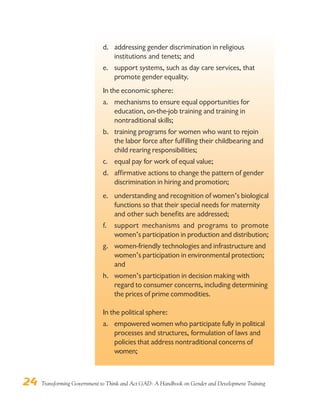
d. addressing gender discrimination in religious
institutions and tenets; and
e. support systems, such as day care services, that
promote gender equality.
In the economic sphere:
a. mechanisms to ensure equal opportunities for
education, on-the-job training and training in
nontraditional skills;
b. training programs for women who want to rejoin
the labor force after fulfilling their childbearing and
child rearing responsibilities;
c. equal pay for work of equal value;
d. affirmative actions to change the pattern of gender
discrimination in hiring and promotion;
e. understanding and recognition of women’s biological
functions so that their special needs for maternity
and other such benefits are addressed;
f. support mechanisms and programs to promote
women’s participation in production and distribution;
g. women-friendly technologies and infrastructure and
women’s participation in environmental protection;
and
h. women’s participation in decision making with
regard to consumer concerns, including determining
the prices of prime commodities.
In the political sphere:
a. empowered women who participate fully in political
processes and structures, formulation of laws and
policies that address nontraditional concerns of
women;
Part 2: Gender Training Designs 25
b. critical mass of gender-sensitive women and men in
decision making positions;
c. affirmative action programs to increase the number
of women representatives in the three branches of
government, particularly in decision making
positions;
d. strong women’s groups and organizations; and
e. a women’s vote that can influence policy making and
legislation toward gender equality.
In the legal sphere:
a. concrete legal basis for standards that would ensure
equal rights for women and men, particularly in the
areas of property rights, citizenship rights, safety
standards, and equal opportunities;
b. sanctions to promote and protect equal
employment opportunities for women;
c. protective legislation addressing women’s
childbearing functions, such as those concerning
maternity benefits and non-exposure to toxic
chemicals;
d. legal literacy for both women and men;
e. a gender-sensitive judicial system, including gender-
sensitive lawyers, police officers and other
professionals in the judiciary; and
f. protective legislation for a gender-sensitive court
proceeding and hearing of cases related to violence
against women, including shifting the burden of
proof from the women victims and survivors of
violence to the alleged perpetrators.
26 Transforming Government to Think and Act GAD: A Handbook on Gender and Development Training
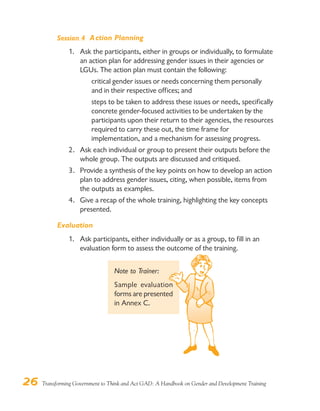
Session 4 Action Planning
1. Ask the participants, either in groups or individually, to formulate
an action plan for addressing gender issues in their agencies or
LGUs. The action plan must contain the following:
critical gender issues or needs concerning them personally
and in their respective offices; and
steps to be taken to address these issues or needs, specifically
concrete gender-focused activities to be undertaken by the
participants upon their return to their agencies, the resources
required to carry these out, the time frame for
implementation, and a mechanism for assessing progress.
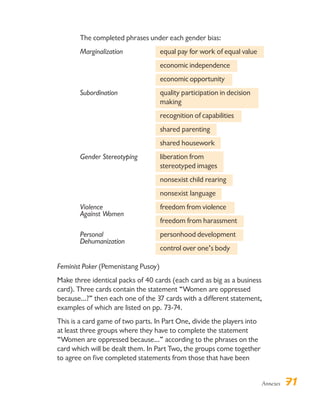
2. Ask each individual or group to present their outputs before the
whole group. The outputs are discussed and critiqued.
3. Provide a synthesis of the key points on how to develop an action
plan to address gender issues, citing, when possible, items from
the outputs as examples.
4. Give a recap of the whole training, highlighting the key concepts
presented.
Evaluation
1. Ask participants, either individually or as a group, to fill in an
evaluation form to assess the outcome of the training.
Note to Trainer:
Sample evaluation
forms are presented
in Annex C.
Part 2: Gender Training Designs 27
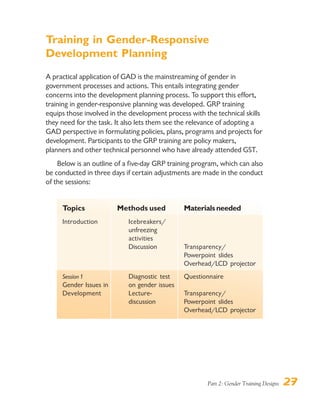
Training in Gender-Responsive
Development Planning
A practical application of GAD is the mainstreaming of gender in
government processes and actions. This entails integrating gender
concerns into the development planning process. To support this effort,
training in gender-responsive planning was developed. GRP training
equips those involved in the development process with the technical skills
they need for the task. It also lets them see the relevance of adopting a
GAD perspective in formulating policies, plans, programs and projects for
development. Participants to the GRP training are policy makers,
planners and other technical personnel who have already attended GST.
Below is an outline of a five-day GRP training program, which can also
be conducted in three days if certain adjustments are made in the conduct
of the sessions:
Topics
Introduction
Session 1
Gender Issues in
Development
Materialsneeded
Transparency/
Powerpoint slides
Overhead/LCD projector
Questionnaire
Transparency/
Powerpoint slides
Overhead/LCD projector
Methods used
Icebreakers/
unfreezing
activities
Discussion
Diagnostic test
on gender issues
Lecture-
discussion
28 Transforming Government to Think and Act GAD: A Handbook on Gender and Development Training
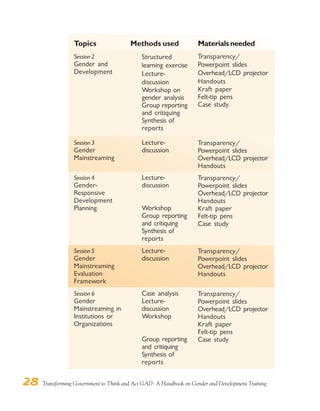
Topics
Session 2
Gender and
Development
Session 3
Gender
Mainstreaming
Session 4
Gender-
Responsive
Development
Planning
Session 5
Gender
Mainstreaming
Evaluation
Framework
Session 6
Gender
Mainstreaming in
Institutions or
Organizations
Methods used
Structured
learning exercise
Lecture-
discussion
Workshop on
gender analysis
Group reporting
and critiquing
Synthesis of
reports
Lecture-
discussion
Lecture-
discussion
Workshop
Group reporting
and critiquing
Synthesis of
reports
Lecture-
discussion
Case analysis
Lecture-
discussion
Workshop
Group reporting
and critiquing
Synthesis of
reports
Materialsneeded
Transparency/
Powerpoint slides
Overhead/LCD projector
Handouts
Kraft paper
Felt-tip pens
Case study
Transparency/
Powerpoint slides
Overhead/LCD projector
Handouts
Transparency/
Powerpoint slides
Overhead/LCD projector
Handouts
Kraft paper
Felt-tip pens
Case study
Transparency/
Powerpoint slides
Overhead/LCD projector
Handouts
Transparency/
Powerpoint slides
Overhead/LCD projector
Handouts
Kraft paper
Felt-tip pens
Case study
Part 2: Gender Training Designs 29
Topics
Session 7
Gender
Mainstreaming in
Programs, Projects
and Activities
Session 8 Action
Planning
Evaluation
Methods used
Case analysis
Lecture-
discussion
Workshop
Group reporting
and critiquing
Synthesis of
reports
Workshop
Group reporting
and critiquing
Synthesis of
reports
Individual or
group evaluation
Materialsneeded
Transparency/
Powerpoint slides
O v e r h e a d / LC D
projector
Handouts
Kraft paper
Felt-tip pens
Case study
Kraft paper
Felt-tip pens
Case study
Evaluation form
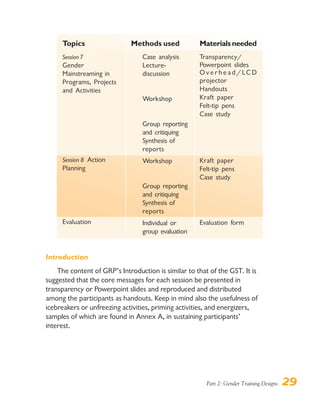
Introduction
The content of GRP’s Introduction is similar to that of the GST. It is
suggested that the core messages for each session be presented in
transparency or Powerpoint slides and reproduced and distributed
among the participants as handouts. Keep in mind also the usefulness of
icebreakers or unfreezing activities, priming activities, and energizers,
samples of which are found in Annex A, in sustaining participants’
interest.
30 Transforming Government to Think and Act GAD: A Handbook on Gender and Development Training
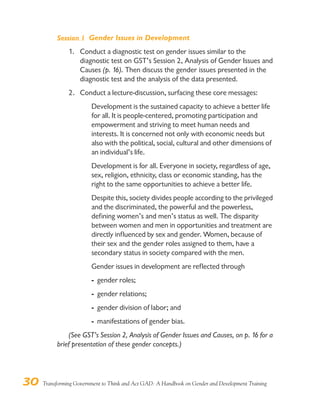
Session 1 Gender Issues in Development
1. Conduct a diagnostic test on gender issues similar to the
diagnostic test on GST’s Session 2, Analysis of Gender Issues and
Causes (p. 16). Then discuss the gender issues presented in the
diagnostic test and the analysis of the data presented.
2. Conduct a lecture-discussion, surfacing these core messages:
Development is the sustained capacity to achieve a better life
for all. It is people-centered, promoting participation and
empowerment and striving to meet human needs and
interests. It is concerned not only with economic needs but
also with the political, social, cultural and other dimensions of
an individual’s life.
Development is for all. Everyone in society, regardless of age,
sex, religion, ethnicity, class or economic standing, has the
right to the same opportunities to achieve a better life.
Despite this, society divides people according to the privileged
and the discriminated, the powerful and the powerless,
defining women’s and men’s status as well. The disparity
between women and men in opportunities and treatment are
directly influenced by sex and gender. Women, because of
their sex and the gender roles assigned to them, have a
secondary status in society compared with the men.
Gender issues in development are reflected through
- gender roles;
- gender relations;
- gender division of labor; and
- manifestations of gender bias.
(See GST’s Session 2, Analysis of Gender Issues and Causes, on p. 16 for a
brief presentation of these gender concepts.)
Part 2: Gender Training Designs 31
Session 2 Gender and Development
1. Conduct a lecture-discussion, surfacing the following core
messages:
G A D i s a
development
paradigm or
approach that
recognizesgender
inequality and the
disadvantaged
s t a t u s o f
women as
shown by
m a l e
dominance
oversocialand
e c o n o m i c
resources. It is
concerned with the social construction of gender and its impact on
thelivesofwomenandmen,althoughitfocusesmoreonwomen’s
role in development and how their lives are affected by it.
Gender issues in development result in gender needs, of
which there are two kinds: practical and strategic.
Practical gender needs are characterized by the following:
- They are based on women’s socially accepted roles in
society.
- They do not challenge the gender division of labor nor do
they question women’s subordination, even if it is these
conditions that have given rise to such gender needs.
- They are addressed through policies, programs and projects
that lessen the impact of discrimination and marginalization
on women.
32 Transforming Government to Think and Act GAD: A Handbook on Gender and Development Training
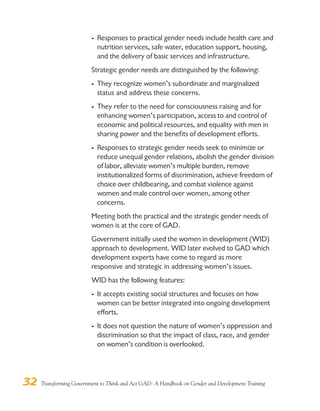
- Responses to practical gender needs include health care and
nutrition services, safe water, education support, housing,
and the delivery of basic services and infrastructure.
Strategic gender needs are distinguished by the following:
- They recognize women’s subordinate and marginalized
status and address these concerns.
- They refer to the need for consciousness raising and for
enhancing women’s participation, access to and control of
economic and political resources, and equality with men in
sharing power and the benefits of development efforts.
- Responses to strategic gender needs seek to minimize or
reduce unequal gender relations, abolish the gender division
of labor, alleviate women’s multiple burden, remove
institutionalized forms of discrimination, achieve freedom of
choice over childbearing, and combat violence against
women and male control over women, among other
concerns.
Meeting both the practical and the strategic gender needs of
women is at the core of GAD.
Government initially used the women in development (WID)
approach to development. WID later evolved to GAD which
development experts have come to regard as more
responsive and strategic in addressing women’s issues.
WID has the following features:
- It accepts existing social structures and focuses on how
women can be better integrated into ongoing development
efforts.
- It does not question the nature of women’s oppression and
discrimination so that the impact of class, race, and gender
on women’s condition is overlooked.
Part 2: Gender Training Designs 33
- It advocates legal and administrative changes to promote
women’s integration into the economic sector.
- It promotes interventions that respond to practical gender
needs such as income-generating projects, health care and
nutrition projects, and child care services.
The women’s movement has been a catalyst in critiquing development
planning and advancing the GAD planning approach. Women’s groups
must be involved in development planning.
GAD is distinguished by the following:
- It questions social, economic and political structures and the
gender roles assigned to women and men.
- It examines gender relations and seeks to transform
unequal relations toward the kind of development that is
more equitable and sustainable.
- It considers women as agents of development and not just
passive recipients of development assistance.
- It promotes interventions and affirmative action programs
that integrate women into the development process.
- It stresses the need for women to organize themselves and
participate in political processes.
- It recognizes women’s role in both productive and
reproductive work, and promotes the equal participation of
women and men in these spheres.
The GAD framework gives agencies the gender-sensitive lens
with which to examine the differential situation of women and
men. Through gender analysis, gender-responsive programs
and projects are developed and implemented to transform
situations that have negative impacts on women.
34 Transforming Government to Think and Act GAD: A Handbook on Gender and Development Training
There are tools that facilitate gender analysis of programs,
projects and activities. In choosing what tools to use, there is
a need to
- define and address gender roles, the practical and strategic
gender needs of women, and the sexes’ differential access
to and control over resources and benefits;
- understand gender relations;
- identify and respond to constraints and opportunities; and
- understand the levels of women’s empowerment and
equality with men in terms of welfare, access,
conscientization, participation and control.
Part 2: Gender Training Designs 35
Gender analysis leads to
- the design of interventions and strategies that would
address gender issues and accomplish the objectives of
gender equality and equity;
- the implementation of the policies, programs or projects
and enhancement of the organization so that both women
and men can participate in project activities and share in
their benefits; and
- anticipation and monitoring of gender-related effects and
outcomes and redress of the inequitable consequences of
project activities.
Tools that can be used for gender analysis are
- activity profile of policies, programs, projects and
organizations;
- profile of the effects of gender roles;
- access and control profile to analyze gaps in access to and
control of resources and benefits; and
- profile of sources and nature of constraints and
opportunities and lessons learned from the interventions
and strategies that respond to the gender issues.
Gender analysis can be done at various points of the project
cycle.
2. Divide the participants into groups for a workshop to evaluate
sex-disaggregated data of a particular community, household or
project using gender as the variable for analysis. Some specific
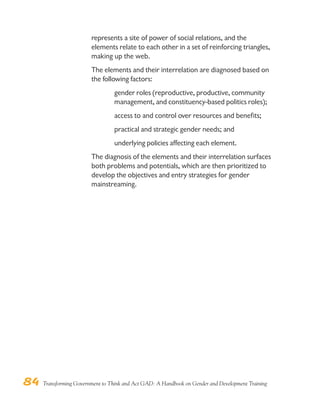
gender analysis tools that may be used are: an activity profile or
the typical day schedule using the Harvard analytical framework, a
project development cycle using Sara Longwe’s Women’s
Empowerment and Equality Framework(which we have adopted
to what we now use as Gender Equality and Women’s
Empowerment Framework [GEWEF]), or the Participatory Rural
Appraisal, Gender and Environmental Analysis.
36 Transforming Government to Think and Act GAD: A Handbook on Gender and Development Training
Note to Trainer:
Samples of these tools for gender analysis
are found in Annex D.
3. Ask the groups to present their outputs for discussion and
critiquing.
4. Provide a synthesis of how to do a gender analysis, citing, when
possible, items presented in the outputs as examples.
Session 3 Gender Mainstreaming
Conduct a lecture-discussion, surfacing the following core messages:
The GAD framework is translated from theory to practice
through the gender mainstreaming strategy.
The mainstream, in the development context, is an interrelated set
of dominant ideas and development directions and the
organizations that make decisions about resource allocation and
opportunities for development. It is in the mainstream that choices
are considered and decisions are made which affect the economic,
social and political options of a large number of people.
Mainstream development has been elitist, “male-streamed,”
exploitative and alienating. This has disadvantaged women,
especially poor women. There is a need for a vision of
development that is more human-centered, pro-poor and
participatory.
Gender mainstreaming is defined as
- a set of processes and strategies that calls for government to
recognize gender issues on a sustained basis.
Part 2: Gender Training Designs 37
- a strategy to integrate women’s and men’s concerns and
experiences into the design, implementation, monitoring and
evaluation of policies, programs and projects in all political,
economic and social agenda.
- an approach that situates gender equality issues at the center of
broad policy decisions, institutional structures and resource
allocation, and includes women’s views and priorities in making
decisions about development goals and processes.
- an assessment of the implications for women and men of such
planned government actions as policies, legislation, and
programs and projects.
Gender inequality is a development issue that is recognized both
nationally and globally. A number of legal bases at the
international and local levels mandate government to carry out
gender mainstreaming to address it.
Among the international mandates for gender mainstreaming are
a. the United Nations Convention on the Elimination of All
Forms of Discrimination Against Women (1979);
b. the Beijing Platform for Action adopted during the Fourth
World Conference on Women (1995); and
c. commitments made by the country in such global meetings as
the International Conference on Population and Development
(1994) and the World Summit for Social Development (1995).
The national mandates are
a. Article II, Section 14 of the 1987 Philippine Constitution which
provides for fundamental equality before the law of women
and men;
b. Republic Act 7192, or the Women in Development and Nation
Building Act of 1992;
c. The GAD budget policy (Section 27) of the Annual G.A.A.
mandating all government agencies to allocate at least 5% of
their total budget for gender concerns;
38 Transforming Government to Think and Act GAD: A Handbook on Gender and Development Training
d. Executive Order 273
institutionalizing GAD
concerns in the
development planning
process; and
e. The Annual National
Budget Call and the
guidelines on GAD
planning and budgeting
and corresponding
Joint Circulars issued by
DBM, NCRFW, NEDA
or DILG.
Session 4 Gender-Responsive Development Planning
1. Conduct a lecture-discussion, surfacing these core messages:
Gender-responsive development planning means
mainstreaming gender considerations in the planning,
budgeting, implementation, monitoring and evaluation of
policies and actions for development.
There is a need for gender-responsive planning because
- women and men have different gender roles, needs and
interests;
- women and men have unequal status and access to decision
making;
- resources are limited and allowing market forces to dictate
priorities can increase inequalities;
- women-specific issues, which are often overlooked, have to
be addressed; and
- affirmative action programs have to be developed and
implemented to address gender inequalities and allow
women to advance.
Part 2: Gender Training Designs 39
An agency GAD Plan may be defined as
- a systematically designed set of programs, activities and
projects (PAPs) with clear objectives that addresses gender
issues and concerns of agencies and their constituents, and
with appropriate strategies, activities and monitoring and
evaluation indicators.
- a blueprint of how agencies could make themselves gender-
responsive;
- a set of interventions designed to transform gender-blind
agencies into organizations with a gender perspective; or
- an instrument to make all aspects of an agency and its work
gender-responsive, and on which the GAD Budget is based.
The GAD plan and budget of an agency must contain the
following: a) the existing agency PAPs that will be enhanced to
respond to identified gender issues; b) the gender issues that
were identified during the conduct of a gender analysis and
that the agency commits to address; c) the GAD objectives
which spell out what the agency intends to accomplish in
relation to the identified gender issues; d) the specific
activities that the agency shall undertake to make the agency
and its regular PAPs address the identified gender issues; e)
the targets to be achieved over a period of time; f) the
indicators that will measure the accomplishment of set
targets; g) the cost of implementing the GAD activities.
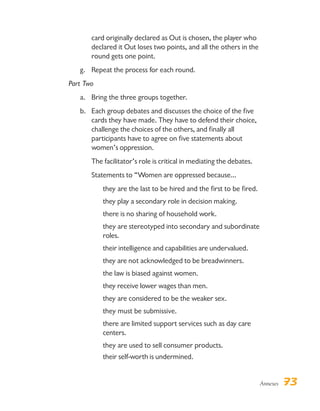
The GAD Plan identifies PAPs that systematically integrate or
address gender concerns of an agency.
The activities that will make the agency or the existing PAPs of
the agency address the gender issues of its clients or
organization are called GAD activities. The GAD activities
can either be client-focused or organization-focused.
40 Transforming Government to Think and Act GAD: A Handbook on Gender and Development Training
Client-focused GAD activities are activities that seek to
address the gender issues of the agency’s clients. Among
others, it could be the inclusion of GAD in the modules used
by agencies when training their women and men beneficiaries;
the revision of program policies or procedures that hinder
women’s full access to program resources and services; and
the inclusion and implementation of components or activities
that will ensure the delivery of goods and services to women.
For oversight agencies whose clients are government
organizations, client-focused GAD activities may include the
review and integration of GAD in policies, database systems,
monitoring and evaluation, or integration of GAD in the
training modules for government employees.
Organization-focused activities are activities that seek to
a) create the organizational environment for implementing
gender-responsive policies, programs and projects; and b)
address the gender issues of employees particularly those that
affect women’s performance as government workers like
sexual harassment and women’s full participation in human
resource development undertakings and decision making
structures and processes.
Agencies shall give premium to client-focused GAD activities
than the organization-focused GAD activities.
The GAD plan serves as a framework for the agencies’ and
LGUs’ gender mainstreaming efforts.
2. Participants are divided into groups for a workshop to review an
agency GAD Plan. The following guide questions, developed by
the NCRFW, may be used as basis in analyzing the GAD Plan.
Note to Trainer:
It is suggested that participants be given a copy of
the agency’s VMG to serve as reference in reviewing
the agency GAD plan.
Part 2: Gender Training Designs 41
In the agency’s Vision, Mission and Goal:
- Are women acknowledged as part of society?
- Are women identified as partners in development?
- Are women identified as beneficiaries of development?
- Does the GAD Plan contain an expression of desirable
gender-related changes and improvement in the social,
economic, political and cultural life?
- Are gender goals integrated with the social, economic,
political and cultural goals?
In conducting a Situational Analysis of the agency:
- Are data sex-disaggregated?
- Is the gender dimension of mainstream sectoral issues
identified?
- Are gender issues identified?
- Does the GAD Plan capture the differential situation of
women and men?
With regard to the agency’s Objectives:
- Are these responsive to the situation presented or with the
problems identified?
- Do they include addressing the situation of women or
responding to the gender issues identified?
- Would the objectives lead to an improvement in the
situation of women?
With regard to the agency’s Programs and Interventions:
- Are the PAPs identified consistent with the objectives?
- Do they respond to the identified needs of women and men?
42 Transforming Government to Think and Act GAD: A Handbook on Gender and Development Training
- Would they lead to the improvement of women’s situation?
- Do the PAPs address strategic gender needs? Would they lead
to the recognition of women as equal partners of men?
- Do they have built-in strategies to involve women in the
development, implementation and monitoring of specific
PAPs?
- Are there accompanying indicators and monitoring and
evaluation mechanisms to measure the gender
responsiveness of the program? To ensure the
implementation of the PAPs?
With regard to Performance Indicators:
- Do the identified performance indicators adequately reflect
desired changes in the lives of women and men?
- Do the indicators reveal progress towards the achievement
of the objectives?
(See Annex E for related parameters in reviewing a GAD plan.)
3. Ask the groups to present their outputs for discussion and
critiquing.
4. Provide a synthesis of the key points on how to develop a GAD
Plan, citing, when possible, items from the outputs as examples.
Session 5 Gender Mainstreaming Evaluation Framework
1. Conduct a lecture-discussion, surfacing the following core
messages:
The Gender Mainstreaming Evaluation Framework, developed
by the NCRFW, is a tool that tracks and assesses the
progress and status of gender mainstreaming in agencies and
LGUs.
There are four stages in gender mainstreaming.
Part 2: Gender Training Designs 43
- Stage 1 is Foundation Formation where an agency or LGU
first incorporates GAD, using RA 7192 as a guide. During
this stage, the agency or LGU carries out the following:
a. issuance of broad statements expressing support for
GAD by top management;
b. review of existing policies, addressing both the
agency’s personnel and its clients, to determine their
gender responsiveness;
c. allocation of a budget to fund GAD PAPs; and
d. evaluation and analysis of the agency’s or LGU’s
potentials for incorporating GAD in its programs and
projects.
- Stage 2 is Installation of Strategic Mechanisms which marks
the organizational transition of the agency toward gender
mainstreaming. Some of these strategic mechanisms are:
a. establishment of GAD Focal Points and technical
working groups that serve as the planners and
implementors of gender mainstreaming; development
of GAD Plans that spell out the agency’s or LGU’s
vision and goals with regard to gender mainstreaming,
translate and incorporate GAD into actual PAPs, and
set the direction of the mainstreaming efforts;
b. identification of necessary logistics, such as funding
and staff, to be tapped for implementing GAD PAPs;
and
c. issuance of policies and guidelines to hasten gender
mainstreaming.
- Stage 3 is GAD Application where GAD PAPs are
consolidated for more impact. It usually happens after a
GAD Plan has been drawn up and the institutional
mechanisms have been installed. The status of the agency or
44 Transforming Government to Think and Act GAD: A Handbook on Gender and Development Training
LGU before and after the implementation of gender
mainstreaming may be reviewed and compared during this
stage. It is also at this point that GAD interventions start to
have an impact and interventions to achieve gender
mainstreaming become more strategic in terms of number
and quality. Following are some of the things that take place
in Stage 3:
a. GAD interventions are reflected in the Key Result
Areas of the agency or LGU and in the performance
contract of its officials.
b. Steps are taken to ensure that the agency’s flagship
programs address gender issues.
c. GAD training programs become more focused and
particular to the needs of the sponsors, advocates and
targets of change.
d. GAD interventions are undertaken not only by the
central office but by regional offices and attached
agencies.
e. Field workers begin using the gender lens to develop,
analyze, monitor and evaluate PAPs.
- Stage 4, or the Enhancement of Commitment and
Institutionalization, is the full realization and implementation
of gender mainstreaming and its continuous evaluation. At
this stage,
a. policies and procedures are constantly modified and
improved to make them gender-sensitive.
b. GAD PAPs are constantly introduced, evaluated and
enhanced to sustain mainstreaming efforts; and
Part 2: Gender Training Designs 45
Enhancement of Commitment
and Institutionalization
GAD Application
Installation of Strategic
Mechanisms
Foundation Formation
FOUR STAGES IN GENDER MAINSTREAMING
c. the accountability of sustaining the
gains of mainstreaming is claimed
and accepted as a commitment of
everyone in the agency or LGU.
There are four possible entry points in gender mainstreaming.
- People or the stakeholders, whose participation and
support for gender mainstreaming are critical to its success.
They may be the
a. sponsors, who have the power to sanction or
legitimize the change brought about by
mainstreaming. They are the heads of agencies or
LGUs who express support for gender mainstreaming
by issuing policies or installing enabling mechanisms.
b. change agents, who are responsible for actually
making the change. They are the GAD Focal Points
and the members of the technical working group who
plan, implement, and monitor and evaluate
mainstreaming efforts.
c. targets, or those who are the focus of gender
mainstreaming. They are every person who makes up
the agency or LGU and its clients and constituents.
46 Transforming Government to Think and Act GAD: A Handbook on Gender and Development Training
d. advocates, or those who seek the change but lack the
power to sanction it. Oversight agencies, such as the
National Economic and Development Authority and
the NCRFW, may be considered as advocates who
monitor the progress of gender mainstreaming in
agencies or LGUs but cannot oblige them to carry it
out or prescribe its manner of implementation.
- Policies or the official statements of support for gender
mainstreaming issued by the agency or LGU
- Enabling mechanisms or the systems and measures set up in
the agency or LGU and the funds allocated for GAD PAPs
- Programs and projects currently being carried out by the
agency or LGU
Session 6 Gender Mainstreaming in Institutions or Organizations*
1. Start the session with a lecture-discussion, surfacing these core
messages:
Gender mainstreaming is incorporated into institutional
processes along two tracks: a) through gender-responsive
development planning, especially mainstreaming gender
concerns in programs, activities and projects; and b) through
mainstreaming gender concerns in the organizations
themselves, including their policies and work environment.
FOURENTRYPOINTSINGENDERMAINSTREAMING
People Policy
Enabling
mechanisms
Programs and
projects
Part 2: Gender Training Designs 47
Note to Trainer:
A Home Situation Assessment Kit was
developed by Amar Torres to assist
development planners and workers in
assessing their organization’s peculiar
situation. See Annex F. Another GMRK
tool, Ways to Gender-Responsive
Organizations: Tools and Guides for Sowing
Gender Responsiveness in Government
Organizations, may also be used as reference.
There are no gender-neutral organizations. Varying degrees
of discrimination against women exist in organizations. This
can be seen in
- the inequitable situation of women and men in terms of
access to work and employment, wages, conditions of work,
and benefits like training and promotion;
- women not being equitably represented in decision making;
and
- the incidence or threat of sexual harassment, abuse and
other hazards in the workplace of which women are the
primary victims.
As such, there is a need for affirmative action programs to
address these areas of disparity.
In integrating gender concerns in government organizations,
the following factors must be analyzed:
- adequacy of organizational mandate on GAD;
- presence of gender equality targets and indicators;
- gender-responsiveness of structures and systems, including
employees’ union, and roles and relationships within the
organization; and
- differential impact of policies and plans.
48 Transforming Government to Think and Act GAD: A Handbook on Gender and Development Training
Organizational analysis must take into account
- access to and control of resources, opportunities, services
and benefits;
- gender relations;
- gender stereotyping; and
- gender needs and interests.
2. Divide the participants into groups for a workshop to determine
the gender responsiveness of a government office.
The following guide questions may be considered to determine
the extent of gender mainstreaming in a government office.
Has an adequate organizational mandate been issued to
support gender mainstreaming within the organization?
Does the office conduct strategic planning on how to
mainstream GAD in its work?
Does it have a gender sensitivity program for officials and
staff?
Has it identified, developed or adopted gender equality
targets and indicators?
Are the structures, systems, roles and relationships prevailing
in it gender-responsive?
Have tools and materials been developed to facilitate gender
mainstreaming in its policies, programs and projects?
Are the gender impacts on clients and target beneficiaries
considered when policies, programs and projects are
developed, implemented, monitored and evaluated?
Has a specific budget been allocated for GAD PAPs?
3. Ask each group to report its output for discussion and critiquing.
4. Provide a synthesis of the important points on how to assess the
gender responsiveness of a government office, citing, when
possible, items from the outputs as examples.
Part 2: Gender Training Designs 49
Session 7 Gender Mainstreaming
in Programs, Activities and Projects
1. Start with a lecture-discussion, surfacing these
core messages:
G e n d e r - r e s p o n s i v e
development planning
must be consultative,
participatory and
intersectoral when
a p p l i e d t o
programs, activities
and projects.
T h e g e n d e r
perspective can be
integrated at each
step of the project
c y c l e , f r o m t h e
situational analysis of the program,
activity or project, to planning and
budgeting, implementation, and monitoring and evaluation.
In mainstreaming the gender perspective in existing PAPs,
there is a need to
- identify the gender issues and analyze their causes and
effects;
- reformulate goals and objectives to make them gender-
responsive;
- identify the entry points for mainstreaming, and the
constraints and opportunities that limit or promote it;
- identify indicators of success and sustainability and monitor
progress based on these indicators; and
- draw up strategies for sustainability, such as allocation of
resources, interventions and initiatives of policy makers,
50 Transforming Government to Think and Act GAD: A Handbook on Gender and Development Training
planners, implementors, GAD Focal Points, and advocates,
among others, and their continued commitment to GAD.
2. Divide participants into groups for a workshop to review the
gender responsiveness of an agency’s or LGU’s PAPs.
Note to Trainer:
The same guide questions used in analyzing
a GAD Plan, found in Session 4, Gender-
Responsive Development Planning (p. 38),
can be used for the above workshop.
3. Ask each group to present its output for discussion and critiquing.
4. Provide a synthesis of the important points on how to assess the
gender responsiveness of an agency’s PAPs, citing, when possible,
items in the outputs as examples.
Session 8 Action Planning
1. Ask the participants, either in groups or individually, to formulate
their action plans for gender mainstreaming in their agencies or
LGUs.
The action plans must identify
the entry points for gender mainstreaming; and
concrete gender-focused activities to be undertaken upon the
participants’ return to their agencies or LGUs, the time frame
for implementation, and assessment of their progress.
2. Ask the participants, either individually or as a group, to present
their outputs for discussion and critiquing.
3. Provide a synthesis of the key points on how to mainstream gender
in agencies, citing, when possible, items in the outputs as examples.
4. Give a recap of the whole training, highlighting the syntheses of
the various workshops.
Part 2: Gender Training Designs 51
Evaluation
Ask the participants, either individually or in groups, to answer an
evaluation form, samples of which are found in Annex C.
GAD Training
GAD training is a combination of GST and GRP training. This may range
from a one-hour GAD orientation seminar to a five-day seminar-
workshop. Agencies and LGUs can choose from the different sessions
presented in the GST and GRP training the mix of topics that best meets
their training needs and objectives.
Participants to the GAD training usually have varying levels of
awareness of gender issues in development. While it is ideal that they go
through a GST first, an alternative is for them to start the GAD training
with a leveling-off session to review basic gender concepts and issues. It is
also critical to tie this up with a session on the need for and relevance of
GAD. From these two basic sessions, agencies and LGUs, together with
the training team, can now design the appropriate GAD training for their
staff.
Part 3
Training in GAD
Planning and Budgeting
T
he General Appropriations Act has had a provision for a GAD
budget since 1995. It mandates all government offices to allocate
at least 5 percent of their annual budget for GAD programs,
activities and projects. Not everybody in government, however, is
prepared to do this, mainly because of the lack of sufficient knowledge
and skills on how to comply with the provision. This training, developed
by the UPCWS with assistance from the CIDA, responds to this need.
Participants must have undergone at least GRP training or a GAD
seminar-workshop.
The contents of the 2-day abridged training are as follows:
Topics Methods
used
Materials
needed
Time
Icebreakers/
unfreezing
activities
Discussion Transparency/Powerpoint
slides
Overhead/LCD projector
30 min.Day 1
Introduction
54 Transforming Government to Think and Act GAD: A Handbook on Gender and Development Training
Topics Methodsused Materialsneeded Time
Lecture-
discussion
Group
exercise in
gender
diagnosis/
Film Showing
(Impossible
Dream)
Processing of
outputs
Lecture-
discussion
Lecture-
discussion
Lecture-
discussion
Workshop
Presentation
of outputs
Reporting &
critiquing
Synthesis
Workshop
Presentation
of outputs
Reporting &
critiquing
Synthesis
Individual or
group evaluation
Transparency/
Powerpoint slides
Overhead/LCD
projector
Handouts
Kraft paper
Felt-tip pens
Whiteboard
Whiteboard marker
Transparency/
Powerpoint slides
Overhead/LCD
projector
Handouts
Transparency/
Powerpoint slides
Overhead/LCD
projector
Handouts
Transparency/
Powerpoint slides
Overhead/LCD
projector
Handouts
Case study w/ analysis
Kraft paper
Felt-tip pen
Masking tape
Sample agency GAD
plans
Kraft paper
Felt-tip pen
Masking tape
Evaluation form
1 hr.
45 min.
30 mins.
30 mins.
1 hr.
2 hrs.
3 hrs.
30 min.
Session 1
Review of GAD
Concepts
Session 2
Gender Equality
and Women’s
Empowerment
Framework
Session 3
Gender
Mainstreaming
Session 4
GAD Planning
and Budgeting
Day 2
Session 5
Application of
GAD Planning
and Budgeting
Session 6
Designing a
GAD Plan and
Budget
Evaluation
Part 3: Training in GAD Planning and Budgeting 55
Day One
Introduction
Start with an Introduction, highlighting the following activities:
introduction of the participants, the training team and the
support staff;
expectation check;
norms setting and formation of responsible teams;
overview of the training course; and
articulation of the four assumptions or premises of GAD training.
Note to Trainer:
See Introduction on Gender Sensitivity Training
(p.13). Icebreakers and unfreezing activities,
samples of which are found in Annex A, can
also be used to start the session.
Session 1 Review of GAD Concepts
Note to Trainer:
Write down the core messages on transparency
slides or prepare a Powerpoint presentation and
show them onscreen while the lecture-
discussion is going on. The slides can also
be reproduced as handouts.
1. Review GAD concepts through a lecture-discussion, surfacing
these core messages:
Development issues are addressed by policies, laws, programs
and projects. They should be formulated through the use of
the gender lens and its relation to the class, age, religion,
ethnicity, race, sexual orientation, and education of those
affected by the issues.
56 Transforming Government to Think and Act GAD: A Handbook on Gender and Development Training
Tools for gender analysis include the following:
- Gender role analysis where roles of women and men are
classified into reproductive, productive, community
management, and constituency-based politics determining
who has access to and control of resources, which are in
the form of
- productive resources such as land, equipment, tools,
labor, cash and credit, employable earning skills, and
opportunities;
- political resources referring to representative
organizations, leadership, education and information; and
- time resources, including leisure and relaxation.
Just like the gender division of labor, there is inequality between
women and men in terms of access to and control of resources.
Men have greater access to and control of resources.
The needs of women and men are the product of existing gender
roles. Gender needs may be characterized as practical and
strategic (see Book 2, p. 36). Practical gender needs are met
through actions which assist women and men to perform existing
gender roles more easily. Strategic gender needs are addressed
through actions which challenge or change existing gender roles.
Addressing the needs of women and men may transform
existing gender roles.
Practical gender needs
tend to involve women
as beneficiaries, and
perhaps, participants.
can improve conditions
of women’s lives.
generally, do not alter
traditional roles and
relations.
Strategic gender
needs
involve women as
agents and enable
women to become
agents of change.
can improve women’s
position in society.
can empower women
and transform relations.
Part 3: Training in GAD Planning and Budgeting 57
Women and men have different gender needs, manifested by
- the disaggregation of categories such as household,
community, target groups or people-centered development;
- the gender division of labor;
- household structures;
- the different gender roles of women and men; and
- women and men’s differential access to and control over
resources.
All these considerations have implication on development policies,
laws, programs and projects.
2. Divide the participants into groups and ask them to identify the
usual work and tasks of women and men in the household and in
the community within a 24-hour day schedule. Then ask them to
classify the tasks according to the four gender roles, namely
reproductive, productive, community management, and
constituency-based politics. Alternatively, show the film
“Impossible Dream” and elicit feedback.
3. Ask the groups to present their outputs for discussion and
critiquing.
4. Process and synthesize the discussion on the unequal gender
division of labor, citing items from the outputs as examples.
Note to Trainer:
Another possible exercise for gender
diagnosis is to determine if it is women or
men who have access to and control of the
following resources: land, cash, equipment,
tools, formal credit, training, job
opportunity and promotion, and the GAD
budget.
58 Transforming Government to Think and Act GAD: A Handbook on Gender and Development Training
Levels of
empowerment Description
Action for
empowerment
Empowerment
issues
Welfare
Access
Conscientization
Participation
Control
Addresses only
basic needs
without attempting
to solve underlying
structural causes
Involves equality
in access to
resources
Recognition that
problem stems
from structural
institutional
discrimination
Women have moved
to a level where they
take decisions along-
side men
Ultimate level of
equality and
empowerment
Empowerment
involves the desire to
understand own
problems and needs
Recognition that
lack of access is a
barrier to growth
and well-being
Recognitionof
women’srolein
reinforcingor
changingtheir
disadvantagedsituation
Organizing them-
selves,workingcollec-
tively, they gain in-
creased recognition
Equal representation,
active roles in
development, recog-
ition of contributions;
maintaining and
seeking higher goals
What are our
problems?
Why do we have
problems?
What can we do
about these
problems?
With what
means?
How can we
sustain our
actions and aim
high?
GEWEF
Session 2 Gender Equality and
Women’s Empowerment
Framework
Conduct a lecture-discussion, surfacing
these core messages:
Gender equality is attained through
an interconnected cycle of strategies
and interventions progressing along
five levels of empowerment:
- welfare;
- access;
- conscientization;
- participation; and
- control.
Part 3: Training in GAD Planning and Budgeting 59
The framework, developed by Sara Longwe, shows how
development programs and projects are designed and ensures
that all interventions and strategies eventually overcome gender
and class discrimination.
Session 3 Gender Mainstreaming
Conduct a lecture-discussion, surfacing the core messages presented
in GRP training’s Session 3, Gender Mainstreaming (p. 36) and Session 5,
Gender Mainstreaming Evaluation Framework (p. 42).
Session 4 GAD Planning and Budgeting
Conduct a lecture-discussion, surfacing the following core messages.
GAD planning pertains to the operational aspect of gender
planning. A GAD plan which contains PAPs that address gender
concerns is the concrete result of GAD planning.
Agencies and LGUs are directed to carry out GAD planning and
budgeting because of the following mandates:
International
- Beijing Platform for Action
National
- RA 7192, the Women in Development and Nation Building Act
- Executive Order 273, Approving and Adopting the Philippine
Plan for Gender and Development, 1995-2025
- The Annual General Appropriations Act allocating a GAD
Budget for Government Agencies
- DBM-NEDA-NCRFW Joint Circular on GAD Budget
Utilization
- Annual Fiscal Year Budget Call, Policy Guidelines and Procedures
in the Preparation of National Agency Budget Proposals
60 Transforming Government to Think and Act GAD: A Handbook on Gender and Development Training
Local
- Annual Local Budget Memorandum, Internal Revenue
Allotment and other related Budget Preparation Matters
- DILG-DBM-NCRFW Joint Memorandum Circular, Guidelines
for Integrating GAD in the Local Planning and Budgeting System
through the Formulation of GAD Plans
- DILG’s Memorandum Circular 98-148, Mobilization of Local
Government Resources to Mainstream and Mobilize GAD in their
Local Development Plans
A GAD Plan is a systematically designed set of PAPs carried out
by agencies or LGUs over a given period of time to address the
gender issues and concerns of their constituents and personnel.
A tool for gender mainstreaming, the GAD Plan is anchored on
the following:
- mandates of agencies or executive agenda of LGUs;
- agency or LGU plan;
- Philippine Plan for Gender-Responsive Development, 1995-
2025 and the Framework Plan for Women, 2001-2004; and
- Local Government Code.
The stages in preparing the GAD Plan are as follows:
- Conduct a gender diagnosis and analysis by identifying and
examining the gender issues confronting the agency or LGU.
- Set priorities by determining which of the identified gender
issues can be responded to within a given period.
- Revisit existing programs, whether contained in the
Comprehensive or Medium-Term Development Plan or the
Annual Investment Plan, and redesign them to better address
gender issues and concerns. Or develop new programs to
address the issues/concerns.
- Consolidate into a GAD plan, specifying a) PAPs; b) gender
issues to be addressed; c) objectives; d) identified GAD
activity; e) target; f) GAD indicators; and g) GAD budget (see
Annex G for sample GAD Plan and Budget form)
Part 3: Training in GAD Planning and Budgeting 61
GAD indicators must consist of the following:
- expected outputs and targeted beneficiaries;
- measurable, desirable outcomes of gender mainstreaming and
institutionalization within the organization; and
- impact on the constituency.
The GAD Budget is the cost of implementing the GAD Plan. It is
a portion of an agency’s or LGU’s yearly appropriation,
corresponding to at least 5 percent of the total budget.
The GAD Budget is not an additional amount over and above an
agency’s or LGU’s regular budget. Nor is it a lump amount that is
taken out of the total budget to be used solely for women-specific
PAPs.
The GAD Budget also covers budget for proposed or existing
activities/interventions under existing PAPs provided they
substantially address gender issues or enhance existing PAPs
towards gender responsiveness.
GAD planning and budgeting is not just a technical process. It is a
political tool as well for women — who traditionally have less
political influence on who gets what and how much of
government’s limited resources — to push government to have a
women’s agenda and allocate resources for it.
The GAD plan and budget also represent a claim. Through these
institutional mechanisms, women are able to get government to
pay attention to gender issues and concerns that would otherwise
be overlooked. GAD planning and budgeting are not separate
processes but are integral to the overall development planning
and budgeting of government.
Generally, PAPs acceptable under the GAD Budget are those that
address gender issues identified by the agency. For the period
2001-2004, GAD interventions are specified in the Framework
Plan for Women. GAD PAPs must address at least one of the
Plan’s areas of concern, which are: a) women’s economic
empowerment; b) protection and fulfillment of women’s human
rights; and c) gender-responsive governance.
62 Transforming Government to Think and Act GAD: A Handbook on Gender and Development Training
Note to Trainer:
See GRP’s Session 4, Gender-Responsive
Development Planning (p. 38), for a detailed
discussion on PAPs.
Day Two
Session 5 Application of GAD Planning and Budgeting
1. Group participants according to agency, LGU or sector for the
workshop. Ask them to analyze a sample GAD Plan and Budget
by identifying
the gender-related issues and concerns;
the GAD objectives and targets referring to these issues and
concerns;
existing PAPs to address them; and
performance indicators on these PAPs.
Note to Trainer:
See GRP’s Session 4, Gender-Responsive
Development Planning (p. 38) for guide
questions in analyzing a GAD plan. See also
Annex E, Parameters in Reviewing a GAD
Plan, for the guide questions.
Part 3: Training in GAD Planning and Budgeting 63
2. Ask the groups to present their outputs for discussion and
critiquing.
3. Provide a synthesis of the key points to keep in mind in analyzing
an agency’s or LGU’s GAD Plan and Budget, citing, when
possible, items from the outputs as examples.
Session 6 Designing a GAD Plan and Budget
1. Ask the groups to design a GAD Plan and GAD Budget for their
respective agencies or LGUs. Use the same criteria above for the
workshop. Participants may also refer to the guide questions on
GRP’s Session 6, Gender Mainstreaming in Institutions and
Organizations (p. 46).
2. Ask the groups to present their outputs for discussion and
critiquing.
3. Provide a synthesis of the key points in designing a GAD Plan and
Budget, citing, when possible, items from the outputs as
examples.
4. Give a recap of the whole training, highlighting the key points in
designing a GAD Plan and a GAD Budget.
Evaluation
Ask participants, either individually or in groups, to answer an
evaluation form. Sample forms are found in Annex C.
Annexes
Annex A
1. Icebreakers/ Unfreezing Activities
(Source: Oxfam, 1994)
Greeting
Show how people from different countries greet each other. Then
ask each participant to pick a slip from a basket. On each slip is
written one of the following:
Place hands together and bow (India)
Kiss on both cheeks (France)
Rub noses (Iceland)
Hug warmly (Russia)
Bow (Japan)
Slap each hand and bump each hip (some parts of southern
Africa)
Ask the participants to go around the room and greet each
other based on the greeting written on their slips.
“I am…”
A participant says her/his name and a characteristic to describe
her/him. The person next to her/him does the same and
introduces the other participants before her/him as well. For
example, “I am Susan and I’m a nature lover…. This is Jay and he
likes sports…. Cathy and she has three sons,” and so on.
2. Energizers
All Change
Arrange chairs in a circle. Each participant sits on a chair, except
for one. She/he stands in the middle and calls out a certain
characteristic, for example, “All people who are wearing
something blue.” These people then stand up and rush to find
another chair, including the caller. The participant who is not able
Annexes 67
68 Transforming Government to Think and Act GAD: A Handbook on Gender and Development Training
to get a chair becomes the caller. If the caller calls “All change,”
everybody stands up and rush to get their chairs.
Word and Deed
Ask participants to form a circle. The first person in the circle
does an action, while describing another. For example, she/he
says, “I am sweeping the floor” while dancing. The next
participant then acts out what the first participant says she/he
was doing, while saying something else: “I am jumping,” while
pretending to sweep the floor. This continues round the circle.
Tropical Rainforest
Everybody sits in a circle. Person A acts out something, and the
person next to her/him copies it, and so on round the circle.
Then Person A changes to another action, and everyone gradually
follows suit. It is important that each person copies the action of
the person to her/his right, and not Person A. Person A also
waits until everyone has done the action before changing to a new
one. The actions are as follows:
- snap the fingers;
- slap the hands on her/his thigh;
- stamp the feet.
Then repeat the sounds in reverse, ending with everyone
being silent again.
3. Priming Activities
(Source: Karina Constantino-David, Gender Seminar for Men, Hasik,1995)
Slap-Clap-Snap (Pitik-Palak)
Instructions:
a. This involves a series of movements: slap in the lap, one
clap, one snap of the fingers, and one clap. Have the
participants repeat the actions until they can do these in
unison.
Annexes 69
b. As they are doing the motions, the trainer or facilitator
asks them one by one to shout out, as they snap, the first
word that comes to mind when she/he mentions women.
Another member of the training team writes down the
responses on the whiteboard or flip chart.
c. After a while, the trainer or facilitator mentions men. Each
participant then shouts out what comes to mind as they
snap their fingers. The responses are again written down.
This activity can serve as an introduction to the topic of Sex
and Gender. The slap-clap-snap-clap motion ensures that
participants are not given enough time to think of “appropriate”
answers. Predictably, the answers they give are usually
stereotyped images of women and men.
Feminist Puzzle: Building a Vision of a Gender-Fair Society
Instructions:
a. Divide the participants into five groups.
b. Give each group one puzzle set consisting of:
- a work board, like kraft paper on which the following
strips are posted:
PRODUCTIVE-REPRODUCTIVE DIVIDE
MARGINALIZATION
SUBORDINATION
MULTIPLE BURDEN
GENDER STEREOTYPING
VIOLENCE AGAINST WOMEN
PERSONAL DEHUMANIZATION
THE PERSONAL IS POLITICAL
70 Transforming Government to Think and Act GAD: A Handbook on Gender and Development Training
- puzzle pieces which are simply individual words cut up
into separate pieces (see page 71)
- masking tape to attach the puzzle pieces
c. Give a brief recap of the productive-reproductive divide,
the manifestations of gender bias, and why the personal is
political.
d. After the recap, ask the group to complete phrases
describing the vision of a gender-fair society that respond
to each of the manifestations of gender bias. Tell the
participants there are at least two phrases per
manifestation and that they have 30 minutes to complete
the puzzle.
Remind the groups that
- a phrase means two words;
- all puzzle pieces must be used; and
- a phrase must make sense even without use of
commas, colons and diacritical marks.
e. At the end of 30 minutes, ask the group to pin their work
boards on the wall. The facilitator then begins to score the
completed puzzle according to the following criteria:
- a correct phrase gets one point; and
- a correct phrase that is placed under the wrong
category or a partially correct phrase under the right
category gets ½ point.
The facilitator has her/his own work board pinned on the wall.
f. Deal with each manifestation of gender bias, check the
answers of the groups, pin up the facilitator’s phrase, and
put down the groups’ score. Aside from scoring the
completed puzzles, this is also an opportunity to clarify
and deepen points and concepts.
Annexes 71
The completed phrases under each gender bias:
Marginalization equal pay for work of equal value
economic independence
economic opportunity
Subordination quality participation in decision
making
recognition of capabilities
shared parenting
shared housework
Gender Stereotyping liberation from
stereotyped images
nonsexist child rearing
nonsexist language
Violence freedom from violence
Against Women
freedom from harassment
Personal personhood development
Dehumanization
control over one’s body
Feminist Poker (Pemenistang Pusoy)
Make three identical packs of 40 cards (each card as big as a business
card). Three cards contain the statement “Women are oppressed
because...?” then each one of the 37 cards with a different statement,
examples of which are listed on pp. 73-74.
This is a card game of two parts. In Part One, divide the players into
at least three groups where they have to complete the statement
“Women are oppressed because…” according to the phrases on the
card which will be dealt them. In Part Two, the groups come together
to agree on five completed statements from those that have been
72 Transforming Government to Think and Act GAD: A Handbook on Gender and Development Training
selected in Part One. Players are scored based on whether their
judgments of the cards are accepted by the group or not.
Part One
a. Divide the participants into three groups of eight players
each, although this may vary according to the number of
participants.
b. The facilitator deals out the five cards to each player.
There will be five rounds where each player will choose
one card from their hand and decide whether it is a
strong or weak phrase to finish the statement about
women’s oppression. Each round is started by a different
person.
c. Once the players have chosen their respective cards, they
place the cards face down in front of them, declaring
whether their cards are In or Out based on whether they
are strong or weak to finish the statement “Women are
oppressed because….”
In the same sequence all the players who declared Out
turn up their card and explain and justify their decision.
d. The group debates each decision. If it accepts the player’s
decision, she/he gains one point. If the decision is
rejected, she/he loses one point and the card is placed in
the center of the table.
e. After all the Out cards have been discussed and decisions
taken, the process is repeated with the In cards declared
by the players. If the group agrees with the player, the
card is placed in the center. If the group disagrees, the
player loses one point.
f. At the end of the round, one card is chosen from all those
placed in the center. This card is the group’s view of the
most accurate reason for women’s oppression for that
round. The player who selected it gets two points. If a
Annexes 73
card originally declared as Out is chosen, the player who
declared it Out loses two points, and all the others in the
round gets one point.
g. Repeat the process for each round.
Part Two
a. Bring the three groups together.
b. Each group debates and discusses the choice of the five
cards they have made. They have to defend their choice,
challenge the choices of the others, and finally all
participants have to agree on five statements about
women’s oppression.
The facilitator’s role is critical in mediating the debates.
Statements to “Women are oppressed because…
they are the last to be hired and the first to be fired.
they play a secondary role in decision making.
there is no sharing of household work.
they are stereotyped into secondary and subordinate
roles.
their intelligence and capabilities are undervalued.
they are not acknowledged to be breadwinners.
the law is biased against women.
they receive lower wages than men.
they are considered to be the weaker sex.
they must be submissive.
there are limited support services such as day care
centers.
they are used to sell consumer products.
their self-worth is undermined.
74 Transforming Government to Think and Act GAD: A Handbook on Gender and Development Training
their place is in the home.
men are the hunters and women are the hunted.
their self-concept is based on men’s perceptions.
their contributions to economic production are not
recognized.
parenting is primarily a woman’s concern.
they are treated as second-class citizens.
they are treated as sex objects.
they are victims of sexual harassment.
they are potential victims of rape and other forms of
violence.
they suffer from multiple burden.
of men.
there is a double standard in society.
they are economically marginalized.
men are considered more capable than women.
men have more privileges.
society socializes women into subordinate roles.
they have less access to opportunities and resources.
they have limited control over their own development.
they are brought up to serve men.
they have no control over their own bodies.
their work is not valued.
their primary role is reproduction.
they are forced to give sexual favors to their bosses.
they are discriminated against, especially in leadership
positions.
The training team may change any of the statements with
ones of their own.
Annexes 75
Annex B
Sample Diagnostic Questionnaire*
1. Which of the statements characterizes the average life expectancy
of Filipino women?
(a) Men live longer than women.
(b) Women live longer than men.
(c) Men and women have equal life expectancies.
2. The female mortality rate is ________ the male mortality rate.
(a) higher than
(b) the same as
(c) lower than
3. Which of the following major occupation groups is the most
female-dominated?
(a) service workers
(b) professional, technical and related workers
(c) sales workers
(d) administrative, executive and managerial workers
4. The most obvious disparity in male and female income is seen in
the ________ occupations.
(a) agricultural (b) clerical (c) service
5. At the elementary level, females demonstrate ________ dropout
rates than males.
(a) higher (b) about the same (c) lower
* Be sure you update the statistics or the information. You may also suit the questions according
to the sectoral interests of the participants.
76 Transforming Government to Think and Act GAD: A Handbook on Gender and Development Training
6. Filipino women participate in politics mostly as ________.
(a) candidates in elections
(b) voters
(c) volunteer workers in election campaigns
7. Women workers dominate the ________ positions in government.
(a) first level
(b) second level
(c) third level
8. Which of the following acts of violence against women has been
redefined by law as a crime against person?
(a) domestic violence
(b) acts of lasciviousness
(c) physical injuries
(d) rape
9. Abortion, despite its being illegal, is practiced mostly by which
group of women?
(a) young women who are not ready for motherhood;
(b) older women who think they already have many children;
(c) women who are victims of rape or incest;
(d) all of the above
10. The General Appropriations Act directs all government offices to
set aside at least ________ of their annual budget for
implementing gender-related programs and projects.
(a) 10 percent
(b) 5 percent
(c) 50 percent
(d) 20 percent
Annexes 77
Annex C
Sample Evaluation Form
Daily Evaluation Form/Learning Diary
Date:
Session:
Resource Speaker:
Please answer briefly the following questions:
A. What are your insights from the session?
B. What activity/ies or subjects did you like best or interest
you the most? Why?
C. What activity/ies or subjects did you like the least? Why?
D. If you were the one who conducted the session/s, how
would you have done it?
Participant’s Name (Optional):
78 Transforming Government to Think and Act GAD: A Handbook on Gender and Development Training
Final Evaluation Form
Participant’s Name (Optional):
A. General Program Comments
1. The course objectives were:
_______________________________
1 2 3 4 5
vague clearly defined
2. Were the defined objectives achieved?
_______________________________
1 2 3 4 5
not at all partially totally
3. To what extent did the course meet your expectations?
_______________________________
1 2 3 4 5
not at all sufficiently exceedingly
4. To what extent did you find the course useful to you and your
organization?
_______________________________
1 2 3 4 5
not at all somewhat useful very useful
5. Overall, how would you rate this training?
_______________________________
1 2 3 4 5
poor average excellent
6. Which of the course topics did you find most
relevant? irrelevant?
___________________ ___________________
___________________ ___________________
Annexes 79
7. Do you think the course has adequate coverage? If not, what
other topics would you have wanted discussed but were not
included in this training?
8. How helpful are the handouts and other reference materials
in the knowledge making process?
9. How useful are the other training and other information
materials, i.e. videotapes, slides, etc., in making the seminar
more interesting?
10. What other improvements can you suggest in terms of
program content and methodology?
11. What knowledge/insight did you gain from the training which
you consider most significant?
B. Facilities/Administrative Staff Services
Please rate the following:
1. Facilities used for the program
_______________________________
1 2 3 4 5
inadequate very good
2. Administrative staff
_______________________________
1 2 3 4 5
inefficient very efficient
3. Food, accommodation, venue
_______________________________
1 2 3 4 5
inadequate very good
4. Other comments?
80 Transforming Government to Think and Act GAD: A Handbook on Gender and Development Training
C. Participation
1. Personal participation in the training’s activities, e.g.
icebreakers, unfreezers, group sharing, workshop, discussion
_______________________________
1 2 3 4 5
inadequate very active
2. What factors hindered your participation in the training’s
activities?
3. What factors motivated your participation the training’s
activities?
Would you recommend the training to a friend/colleague?
( ) Yes ( ) No
Annexes 81
Annex D
Gender Analysis Tools
Some tools for gender analysis:
1. Typical Day Schedule
(Source: Serrano, Rosanita and Pennie Azarcon-dela Cruz [eds.], Women in
Project Management: A Course Manual, 1996)
The information identifies the specific roles and
responsibilities of women and men as indicated in a typical
activity schedule.
It indicates the unbalanced work of women and men.
It reflects the gender issues of a woman’s multiple burden.
2. Harvard Analytical Framework
(Source: Overholt, Catherine, et al., Gender Roles in Development Projects: A
Casebook, 1985)
Developed by C. Overholt, it identifies activities women and
men carry out, the resources that each use, and who has
access to and control over them and their use, and the
benefits that women and men derive from these activities.
Activity Profile
Identify all relevant productive, reproductive and
community tasks. Who does what, when and where?
Access and Control Profile
Identify and list the resources used to carry out the tasks
in the activity profile. Identify who has access to resources
and control over their use and who benefits.
Influencing factors
Identify the influencing factors that determine the gender
differentiation enumerated in both the activity and the
access and control profiles and how they may influence
the outcome of the project.
82 Transforming Government to Think and Act GAD: A Handbook on Gender and Development Training
3. Ecogen: Ecology, Organization and Gender
(Source: Serrano, Rosanita and Pennie Azarcon-dela Cruz [eds.], Women in
Project Management: A Course Manual, 1996)
Since there are indicators which show that the burden of
destruction of natural resources fall on women, it is important
to determine the role of gender in terms of access to and
control over these resources. Data in this gender analysis are
gathered and processed in the following ways:
Wealth ranking. Perception of the level of well-being of
certain people or households in the community by key
informants using the following indicators: perceived
sources of income, land size, land and household assets,
agricultural yield, among others. The residents themselves
identify those to be included in the ranking.
In-depth household interviews. Interviews using an open-
ended questionnaire on a variety of topics, depending on
the project site: household composition; socioeconomic
status; gender division of labor; decision making in the
household, among others. The result of the wealth
ranking activity may be used in selecting the households
to be interviewed.
Focused group discussion. Small group meetings to discuss a
specific topic in an informal setting in which all are
encouraged to offer ideas and opinions.
Participant observation. Involves “tagging” the female and
male heads of selected households and unobtrusively
recording their single and multiple activities over a 24-
hour period to understand and verify their time use and
allocation.
Gender resource mapping. Examines how women, men and
children use and manage resources in the community.
Gender-disaggregated seasonal activities calendar. A
calendar that identifies livelihood tasks and categorizes
Annexes 83
responsibilities by season, gender, age, and intensity of
activity. It also highlights community and ecological
constraints such as floods, drought, and local fiestas.
4. Women Empowerment and Equality Framework (Sara
Langwe)
(Source: UNICEF Training Manual, 1996)
The gender dimensions of a program or project are analyzed
using the framework’s five levels of empowerment: welfare,
access, conscientization, participation and control. These five
levels represent different dimensions of the development
process that must be present in a program or project so it
can overcome gender inequality.
Gender issues in all aspects of a program or project — from
the situation analysis to the identification of the problem, the
program or project objectives, the implementation strategy to
its management system — must be addressed along these five
levels. This means, for example, that program or project
objectives must not be confined at the welfare level.
Otherwise, a number of gender issues may be overlooked,
resulting in their not being addressed at all.
In the Philippines, this framework is referred to as “Gender
Equality and Women’s Empowerment Framework.”
5. Web of Institutionalization
(Source: Levy, Caren, DPU Working Paper No. 74, 1996)
This tool, developed by Caren Levy, uses a “web” to assess
how GAD is being institutionalized. It identifies at least 13
elements (political commitment, policy/planning, procedures,
pressure of political constituencies, representative political
structures, staff development, resources, mainstream location
of responsibility, women’s and men’s experience and
interpretation of their reality, delivery of programmes and
projects, methodology, research, theory building) which are
crucial to the process of institutionalization. Each element
84 Transforming Government to Think and Act GAD: A Handbook on Gender and Development Training
represents a site of power of social relations, and the
elements relate to each other in a set of reinforcing triangles,
making up the web.
The elements and their interrelation are diagnosed based on
the following factors:
gender roles (reproductive, productive, community
management, and constituency-based politics roles);
access to and control over resources and benefits;
practical and strategic gender needs; and
underlying policies affecting each element.
The diagnosis of the elements and their interrelation surfaces
both problems and potentials, which are then prioritized to
develop the objectives and entry strategies for gender
mainstreaming.
Annexes 85
Annex E
Parameters in Reviewing GAD Plans
Format
Check if the GAD Plan follows the prescribed format specified
in DBM-NEDA-NCRFW Joint Circular 2001-1, or the
Guidelines to Implement Gender Mainstreaming and
Institutionalization in the Existing Agency’s Programs,
Activities and Projects.
Check if the GAD Plan has been properly endorsed and
signed by the GAD Focal Point Chair and head of the agency.
Content
Gender Issues
What gender issues or concerns are principally addressed
by the plan? Organizational concerns? Client concerns? Or
both?
Are the gender issues identified consistent with the
thrusts and issues identified in the Framework Plan for
Women, 2001-2004, the Philippine Plan for Gender-
Responsive Development, and the Convention on the
Elimination of All Forms of Discrimination Against
Women?
Objectives
What does each objective hope to achieve for affected
women and men?
Are these objectives the best ways to enhance the gender-
responsiveness of the agency’s over-all development plan?
86 Transforming Government to Think and Act GAD: A Handbook on Gender and Development Training
GAD PAPs
Will the GAD PAPs achieve the stated objectives within the
framework of the agency’s mandate and functions? Or are
the GAD activities unrelated to the thrusts of the over-all
development plan?
Which aspects of the mainstreaming process are addressed
by the planned activities?
What outcomes are expected from the GAD PAPs?
How do the GAD activities compare with former plans?
Performance Indicators
Which level of performance or outcomes do the
indicators describe?
Are the performance indicators specific, measurable,
attainable, realistic and time-bound (SMART) and gender-
responsive, equality-oriented and aware of social and
economic differences of its target beneficiaries (GREAT)?
In what ways can the indicator system be improved?
Proposed Budget
Is the budget realistic in relation to planned activities?
Are the budget items proportionately allocated across
objectives?
Annexes 87
Annex F
Home Situation Assessment Kit
Source: Torres, Amaryllis T., “A Framework for Analyzing Organizations and Programs”
in Jeanne Illo’s Gender in Projects and Organizations: A Casebook, 1996.
Present Absent What can be
Factor (In what ways?) (What do you done to improve
observe instead?) the situation?
Organizational
factors
Mandate and
objectives
Are these
gender-
sensitive?
Do these
express
commitment to
improving
human
condition?
Are these
committed to
gender goals?
Sponsorship
for GAD
Do key decision
makers
understand and
support GAD
goals?
Are there
primemovers
for GAD in the
agency?
Gender sensitivity
of co-workers
Are co-workers
gender-
sensitive?
88 Transforming Government to Think and Act GAD: A Handbook on Gender and Development Training
Present Absent What can be
Factor (In what ways?) (What do you done to improve
observe instead?) the situation?
Gender sensitivity
of co-workers
Do they accept
GAD concepts
and goals?
Do they see the
relevance of
GAD in their
work? In their
home life?
Gender
responsiveness of
organization
Are decision-
making
processes
gender-
sensitive?
Are
employment
policies
(recruitment,
maintenance,
and promotion)
gender-
responsive?
Are office
procedures and
practices
gender-
sensitive?
Is the database
sex-
disagggregated?
Annexes 89
Present Absent What can be
Factor (In what ways?) (What do you done to improve
observe instead?) the situation?
Are there indi-
viduals in the
organization
who are equip-
ped with gender
analysis and
planning skills?
Program factors
Integration of
GAD in routine
work
Are GAD mes-
sages and con-
cepts integrated
in the regular
education, train-
ing, and service
programs of the
agency?
Equality and
equity goals
Do programs
promote equal
access to re-
sources? To
opportunities?
To benefits?
Are
participatory
processes used
by the agency
in the design,
implementation,
and evaluation
of programs?
90 Transforming Government to Think and Act GAD: A Handbook on Gender and Development Training
Present Absent What can be
Factor (In what ways?) (What do you done to improve
observe instead?) the situation?
Gender-fair
messages
Is sexism pre-
sent/absent in
education
materials?
Is gender
stereotyping
maintained or
removed?
Are innovative
and non-
traditional roles
promoted by
print and other
materials, and
by services?
Recognition of
multiple roles
Are practical
and strategic
needs addressed
by the program?
Institutionalization
of GAD
Is there an
individual or
group
responsible for
mainstreaming
gender? Is a
budget
maintained for
GAD-related
activities?
Is the agency in
touch with
other GAD
practitioners?
Annexes 91
Annex G
Gender and Development (GAD) Plan and Budget
FY_____
Department:
Agency:
Mandate:
Programs/ Gender- GAD Identified Target GAD GAD
Activities/ related Objectives GAD (5) Performance Budget
Projects Issue/ (3) Activity Indicator (7)
(1) Concern (4) (6)
(2)
Total:
Submitted by: Approved by: Date:
Chairperson, Head of Day/Mo/Yr
GAD Focal Point Office/Agency
92 Transforming Government to Think and Act GAD: A Handbook on Gender and Development Training
Annexes 93
Annex H
Suggested Readings for GAD Training
David, Karina C.
1995 Gender Seminar for Men: The HASIK Experience. Quezon City:
HASIK (Harnessing Self-Reliant Initiatives and Knowledge),
Inc.
Eviota, Elizabeth (ed.)
1994 Sex and Gender in Philippine Society: A Discussion of Issues and
Relations between Women and Men. Manila: National
Commission on the Role of Filipino Women
Illo, Jeanne Frances I.
1991 Gender Analysis and Planning: The 1990 IPC-CIDA Workshops.
Jeanne Frances I Illo, ed. Quezon City: Institute of Philippine
Culture, Ateneo de Manila University.
Levy, Caren
1996 “The Process of Institutionalising Gender in Policy and
Planning: The ‘Web’ of Institutionalisation.” DPU Working Paper
No. 74, Development Planning Unit, University College,
London.
Longwe, Sara Hlukepile
1991 “Gender Awareness: The Missing Element in the Third World
Development Project” in Changing Perceptions: Writings on
Gender and Development. Oxfam, Oxford.
MATCH International
1991 Two Halves Make a Whole: Balancing Gender Relations in
Development. Ottawa: Canadian Council for International
Cooperation, Match International, and Association quebecoise
des organisms de cooperation internationale.
Moser, Caroline O. N. and Caren Levy
1986 “A Theory and Methodology of Gender Planning: Meeting
Women’s Practical and Strategic Gender Needs.” DPU Planning
and Working Paper No 11, Development Planning Unit,
University College, London.
94 Transforming Government to Think and Act GAD: A Handbook on Gender and Development Training
Moser, Caroline O. N.
1993 “Gender Planning and Development: Theory, Practice and
Training.” Routledge, London.
NCRFW and the Canadian International Development Agency ASEAN
Regional Programme
1996 Resource Package in Gender Mainstreaming. Manila.
Overholt, Catherine, Mary B. Anderson, Kathleen Cloud, and James E.
Austin (eds.)
1985 “Women in Development: A Framework for Project Analysis.” In
Gender Roles in Development Projects. West Hartford: Kumarian
Press.
Philippines (Republic)
2000 A Guidebook on Gender Mainstreaming: How Far Have We Gone?
Manila: NCRFW.
Philippines (Republic)
1993 Guidelines for Developing and Implementing Gender-Responsive
Programs and Projects. Manila: NCRFW and the National
Economic and Development Authority.
Rathgeber, Eva M.
1990 “WID, WAD, GAD: Trends in Research and Practice.” Journal of
Developing Areas 24 July 1990.
Santos, Aida F., Eleanor C. Conda and Ma. Dulce F. Natividad
1999 Toward a Gender-Responsive Legislation. Manila: NCRFW.
Schalkwyk, Johanna, Helen Thomas and Beth Woroniuk
1996 Mainstreaming: A Strategy for Achieving Equality between Women
and Men. Swedish International Development Agency.
Serrano, Rosanita and Pennie Azarcon-dela Cruz (eds.)
1996 Women in Project Management: A Course Manual. Manila:
NCRFW and AusAid.
Thomas-Slater, Barbara, Andrea Lee Esser, and M. Dale Shields
1993 Tools of Gender Analysis: A Guide to Field Methods for Bridging
Gender into Sustainable Resource Management. For the ECOGEN
Research Project. Worcester, Massachusetts: Clark University.
Annexes 95
Index
A
Access 18, 19, 32, 34, 35, 38, 40, 47, 56, 57, 58, 59, 74, 85, 89, 90, 91, 92 (Book 1); 4, 21, 27, 28,
30, 34, 36 (Book 2)
Advocacy 3, 40 (Book 2)
Affirmative action 24, 25, 33, 38, 47 (Book 1); 3, 13, 40 (Book 2)
B
Biological determinism 17 (Book 1); 3, 14 (Book 2)
C
Class 21, 30, 32, 55, 59, 74 (Book 1); 4, 6, 7, 8, 27, 39, 40 (Book 2)
Condition xv, 19, 31, 32, 47, 56, 87 (Book 1); 3, 4, 10, 12, 13, 34, 37, 38 (Book 2)
Conscientization 34, 58, 83 (Book 1); 3, 5, 12, 22, 28 (Book 2)
Consciousness raising 32 (Book 1); 5, 22 (Book 2)
Control 19, 32, 34, 35, 47, 56, 57, 58, 71, 74, 81, 82, 83, 84 (Book 1); 16, 18, 21, 23, 27, 28, 35, 36,
37 (Book 2)
D
Development i, ii, iii, iv, v, vi, vii, ix, x, xii, xiii, xv, xvi, xvii, xviii, xix, 11, 16, 19, 20, 23, 27, 28, 30, 31,
59, 91, 93 (Book 1); 8, 11, 13, 16, 17, 21, 22, 23, 24, 25, 26, 27, 28, 29, 30, 31, 33, 34, 35, 36,
39, 40, 41 (Book 2)
Development planning cycle 23, 24, 33 (Book 2)
Development planning process xv, xvii, 27, 38 (Book 1); 24 (Book 2)
Disadvantaged position of women 6 (Book 2)
Discrimination 24, 31, 32, 37, 47, 58, 59, 85 (Book 1); 3, 6, 8, 9, 10, 12, 13, 22, 26, 39, 41 (Book 2)
Double/Multiple Burden 6 (Book 2)
E
Empowerment iii, v, vi, ix, xii, 30, 34, 35, 54, 58, 61, 83 (Book 1);
21, 22, 23, 25, 28, 29, 36, 39, 41, (Book 2)
Engender 25 (Book 2)
F
Feminism,
Cultural feminism 9 (Book 2)
Ecofeminism 9 (Book 2)
Liberal 7 (Book 2)
Marxist 7 (Book 2)
96 Transforming Government to Think and Act GAD: A Handbook on Gender and Development Training
Moderate 9 (Book 2)
Postfeminism 10 (Book 2)
Prolife 10 (Book 2)
Radical 8 (Book 2)
Socialist 8 (Book 2)
Feminist 69, 71 (Book 1); 9, 10, (Book 2)
G
GAD advocate 11 (Book 2)
GAD budget 37, 39, 57, 59, 60, 61, 63 (Book 1); 25, 26 (Book 2)
GAD budget policy 37 (Book 1); 25 (Book 2)
GAD focal point xvii, 43, 45, 50, 85, 91 (Book 1); 26 (Book 2)
GAD mainstreaming 30 (Book 2)
GAD perspective xv, 27 (Book 1); 26 (Book 2)
GAD plan xiv, xvi, 39, 40, 41, 42, 43, 50, 59, 60, 61 (Book 1); 25, 26, 32 (Book 2)
Gender i, iii, v, vi, vii, ix, xii, xiii, xiv, xv, xvi, xvii, xviii, xix, 1, 2, 3, 4, 5, 6, 7, 11, 12, 13, 14, 15, 16, 17,
18, 19, 20, 21, 22, 23, 24, 25, 26, 27, 28, 29, 30, 31, 32, 33, 34, 35, 36, 37, 38, 39, 40, 41, 42,
43, 44, 45, 46, 47, 48, 49, 50, 51, 54, 55, 56, 57, 58, 59, 60, 61, 62, 63, 68, 69, 70, 71, 76, 81,
82, 83, 84, 85, 86, 87, 88, 89, 91, 93, 94 (Book 1); 1, 3, 5, 7, 8, 11, 12, 13, 14, 15, 16, 19, 20,
21, 22, 23, 24, 25, 26, 27, 28, 29, 30, 31, 32, 33, 34, 35, 36, 37, 39, 40, 41, (Book 2)
Gender analysis xiv, 28, 33, 34, 35, 36, 39, 56, 81, 82, 93, 94 (Book 1); 27 (Book 2)
Gender and development iii, v, vi, xii, xv, xvii, 27, 28, 31, 59, 91, 93 (Book 1); 10, 11, 27, (Book 2)
Gender awareness 4, 11, 93 (Book 1); 3, 5, 12, 15, 22 (Book 2)
Gender-based analysis in project development 28 (Book 2)
Gender division of labor 20, 30, 31, 32, 56, 57, 82 (Book 1); 12, 27, 37, 40 (Book 2)
Gender equality iii, v, vii, ix, xii, 4, 14, 23, 24, 25, 35, 37, 47, 48, 54, 58, 83 (Book 1); 7, 12, 13, 21,
22, 23, 28, 29, 31, 34, 36, 39, 41 (Book 2)
Gender equality and women’s empowerment framework 35, 54, 58 (Book 1); 28 (Book 2)
Gender equity 35 (Book 1); 12, 13 (Book 2)
Gender gap 14, 39 (Book 2)
Gender goals 41, 87 (Book 1); 29, 30 (Book 2)
Gender ideology 14 (Book 2)
Gender impact analysis 29 (Book 2)
Gender impacts 48 (Book 1); 29 (Book 2)
Gender indicators 30 (Book 2)
Gender interests 47 (Book 1); 30 (Book 2)
Gender issues and concerns xvii, 3, 39, 60, 61 (Book 1); 30 (Book 2)
Gender mainstreaming iii, v, vii, xviii, 28, 29, 36, 37, 40, 42, 43, 44, 45, 46, 47, 48, 49, 50, 54, 59,
60, 61, 63, 84, 85, 94 (Book 1); 1, 21, 26, 30, 31 (Book 2)
Gender mainstreaming evaluation framework 28, 42, 59 (Book 1); 31 (Book 2)
Gender needs 31, 32, 33, 34, 42, 47, 56, 57, 84, 93 (Book 1); 23, 30, 36 (Book 2)
Gender-neutral policy, program or project 32 (Book 2)
Gender planning 59, 93, 94 (Book 1); 32 (Book 2)
Index 97
Gender relations xv, 21, 30, 32, 33, 34, 47, 93 (Book 1); 5, 7, 33, 40 (Book 2)
Gender relations analysis 33 (Book 2)
Gender responsiveness 5, 42, 43, 48, 50, 61 (Book 1); 34 (Book 2)
Gender roles 15, 17, 18, 19, 20, 21, 30, 33, 34, 35, 38, 56, 57, 84, 94 (Book 1); 15, 30, 33, 35, 36,
40 (Book 2)
Gender sensitivity iii, xii, xiii, xvi, 11, 13, 48, 55, 87, 88 (Book 1); 1, 3, 5, 15, 22 (Book 2)
Gender statistics 35 (Book 2)
Gender stereotyping 17, 19, 47, 69, 71 (Book 1); 16 (Book 2)
Gender subordination 16 (Book 2)
Gender-fair society 12, 22, 69, 70 (Book 1); 14 (Book 2)
Gender-responsive development planning xii, xiii, xvi, 38, 47, 49, 50, 62 (Book 1); 33 (Book 2)
Gender-responsive indicator system 34 (Book 2)
M
Mainstream xv, 36, 41, 48, 50, 60, 83, 84, 85, 86, 91, 94 (Book 1); 25, 35 (Book 2)
Marginalization 19, 31, 69, 71 (Book 1); 16 (Book 2)
Multiple burden 19, 32, 69, 74, 81 (Book 1); 6, 7 (Book 2)
Multiple roles 21, 91 (Book 1)
Multiple roles of women 17 (Book 2)
P
Participation 6, 9, 19, 20, 22, 24, 30, 32, 33, 34, 40, 45, 58, 71, 80, 83 (Book 1); 4, 14, 16, 17, 28,
29, 34, 35, 36, 40, 41 (Book 2)
Patriarchy 18 (Book 1); 8, 9, 14, 18 (Book 2)
Position 21, 25, 56, 74, 76, 82 (Book 1); 3, 4, 6, 13, 15, 18, 33, 37, 38, 40 (Book 2)
Practical gender needs xii, 31, 32, 33, 56, 84, 93 (Book 1); 36 (Book 2)
Public/private dichotomy 12, 19, 28 (Book 2)
R
Resources and benefits 19, 34, 35, 84 (Book 1); 23, 38 (Book 2)
S
Sex 3, 4, 12, 14, 15, 17, 21, 30, 34, 35, 69, 73, 74, 88, 91, 93 (Book 1); 6, 8, 11, 15, 16, 19, 20, 26,
35 (Book 2)
Sex-disaggregated data 35, 41 (Book 1); 38 (Book 2)
Sexism 91 (Book 1); 9, 19 (Book 2)
Sex roles 11, 15 (Book 2)
Status xv, 17, 19, 20, 21, 30, 31, 32, 38, 42, 43, 82 (Book 1); 4, 5, 6, 7, 8, 12, 19, 27, 29, 31, 38,
39, 40 (Book 2)
Strategic gender needs xii, 32, 34, 42, 56, 84, 93 (Book 1); 36 (Book 2)
Structural gender inequality 39 (Book 2)
Subordination 19, 69, 71 (Book 1); 16 (Book 2)
98 Transforming Government to Think and Act GAD: A Handbook on Gender and Development Training
T
“The Personal is Political” 69, 70 (Book 1); 18 (Book 2)
V
Violence against women 20, 23, 25, 32, 69, 76 (Book 1); 20 (Book 2)
W
Welfare 34, 58, 83 (Book 1); 10, 23, 28, 39, 40 (Book 2)
Women and development 39, 40 (Book 2)
Women in development vii, xii, 32, 37, 59, 94 (Book 1); 27, 39 (Book 2)
NCRFW
BOARD OF COMMISSIONERS
Aurora Javate-de Dios
Chairperson
GOVERNMENT COMMISSIONERS ALTERNATE REPRESENTATIVE
Sec. Luis P. Lorenzo, Jr., DA Ms. Jindra Linda L. Demeterio
Sec. Emilia T. Boncodin, DBM Usec. Mario L. Relampagos
Sec. Edilberto C. de Jesus, DepEd Dir. Alice A. Pañares
Sec. Blas F. Ople, DFA Usec. Delia Domingo-Albert
Sec. Jose D. Lina, Jr., DILG Assec. Austere A. Panadero
Sec. Manuel M. Dayrit, DOH Assec. Zenaida O. Ludovice
Sec. Patricia A. Sto. Tomas, DOLE Usec. Danilo P. Cruz
Sec. Corazon Juliano-Soliman, DSWD Usec. Lourdes G. Balanon
Assec. Roda F. Yap
Sec. Manuel A. Roxas II, DTI Assec. Armin B. Raquel Santos
DG Romulo L. Neri, NEDA ADG Margarita R. Songco
NON GOVERNMENT COMMISSIONERS
Myrna S. Feliciano, Academe/Education Sector
Isabelita Sy-Palanca, Business and Industry
Dr. Amelou Benitez-Reyes, Culture
Eulalia H. Lim, Elderly and Disabled Sector
Victoria Tauli-Corpuz, Indigenous Peoples
Jurgette A. Honculada, Labor Sector
Alexandra Prieto-Romualdez, Media and Arts
Germelyn G. Esparrago, Urban Poor Sector
Myrna T. Yao, National Council of Women in the Philippines
Juanita V. Gomez, Peasants and Fisherfolks
Encarnacion N. Raralio, Science and Health
Damcelle S. Torres, Youth Sector
Emmeline L. Verzosa
Executive Director
Executive Director’s Office
Information Resource Division
National Commission on the Role of Filipino Women
1145 J.P. Laurel St., San Miguel, Manila, Philippines
Tel. No. (632) 735 4955; 735 4767
Fax: (632) 736 4449
E-mail: edo@ncrfw.gov.ph; ird@ncrfw.gov.ph
www.ncrfw.gov.ph
with support from the
Canadian International
Development Agency

Gad handbook

  • 2.
    Part 2: GenderTraining Designs i Transforming Government to Think and Act GAD A Handbook on Gender and Development Training National Commission on the Role of Filipino Women Published by the 2003 Manila, Philippines Canadian International Development Agency
  • 3.
    Published by the NationalCommission on the Role of Filipino Women Canadian International Development Agency Copyright 2003 All rights reserved. Any part of this book may be used and reproduced provided proper acknowledgement is made. ISBN 971-8701-03-6 Writer Elena O. Masilungan Editor Estrella Maniquis Design and Layout Rolando F. Santos
  • 4.
    Message M aking the bureaucracywork for women’s empowerment and gender equality is a continuing and challenging task that the government is committed to pursue. Adopted in the early 1990s, the gender mainstreaming strategy was implemented by the National Commission on the Role of Filipino Women in order to sensitize governmental institutions and transform them into active and proactive agents towards the goals of women’s empowerment and gender equality. Towards this end, much effort had been devoted to provide gender sensitivity sessions for government officials, agencies and sectors as a first step in achieving these twin goals. Over the years, GAD training tools on various aspects of planning, budgeting and programming have been developed and utilized by NCRFW and its partners. Many of these have been found to be useful locally and even internationally by other national machineries on women. Given that various groups and government agencies now conduct their own GAD training, it is necessary to standardize GAD core messages which have been distilled and crystallized through many years of GAD training by both trainers and participants. These core messages will help further clarify key concepts and practical strategies on gender mainstreaming. Transforming Government to Think and Act GAD: A Handbook on Gender and Development Training was developed in an effort to provide GAD trainers with conceptual handles and innovative approaches to GAD application. We would like to express our appreciation to our colleagues from the University of the Philippines Center for Women Studies who conducted various GAD Training Sessions for the GAD Resource Centers in the different regions of the country. We would like to thank iii
  • 5.
    as well thosewho validated and provided additional inputs and further enhanced the initial draft of this book. Elena Masilungan spent long hours writing and rewriting the manuscript while Estrella Maniquis spent time in editing and improving the format and style of the handbook. Finally, our thanks to the constant and strong support of the Canadian International Development Agency without which this handbook would not have been produced. Aurora Javate-de Dios Chairperson, NCRFW iv Transforming Government to Think and Act GAD: A Handbook on Gender and Development Training
  • 6.
    Message T he silver anniversaryat the advent of the millennium has been very symbolic for the National Commission on the Role of Filipino Women. It has a grand tradition of leadership as the first national machinery to be set up in Asia in 1975, continually striving to achieve its mission of making government work for women’s empowerment and gender equality. It envisions a Philippine society where women and men equally contribute to and benefit from national development. In this spirited effort, the NCRFW conceptualized the Gender Mainstreaming Resource Kit a year after its 25th anniversary. In the conception of the GMRK, the NCRFW brought together the most respected minds in Gender and Development to draft the seven tools in the kit. Policies are not gender neutral. It affects men and women differently. Thus, the GMRK presents aids and guides to facilitate gender mainstreaming in agencies. With these tools, government agencies, academic and training institutions and civil society will be better equipped to build on their accomplishments. These can also address the gaps and confront the challenges that have faced them in their gender mainstreaming work. I believe that the Commission is beaming with pride in this contribution. This is a big milestone and I am proud to be part of the experience in laying the foundation for women equality and empowerment. As an active participant in the conceptualization process of this Kit, I have continued to nurture its development. It is a great joy to see how each guidebook, sourcebook and manual in this kit has blossomed to formulate the women’s agenda and integrate the Framework Plan for Women (FPW). It will be most rewarding to see how each tool will bear fruits of gender-responsive policies and plans, programs and budgets and good governance. v
  • 7.
    With this, weare optimistic that the government shall realize empowerment and equality for Filipino women. Let us look forward to ensuring that the Gender and Development experience endures for equality and empowerment. Amelou Benitez-Reyes, Ph.D NCRFW Commissioner for Culture, 2002 to present NCRFW Chairperson, 1998 to 2001 vi Transforming Government to Think and Act GAD: A Handbook on Gender and Development Training
  • 8.
    Message T he Canadian InternationalDevelopment Agency (CIDA) is honoured to have been a partner of the Government of the Philippines for many years in promoting Gender Equality. One decade-long of partnership with the National Commission on the Role of Filipino Women (NCRFW) through the Institutional Strengthening Project for Gender Mainstreaming has been highly successful in terms of increasing the capacity of government to implement laws and policies such as the Women in Development and Nation-Building Act (RA 7192). This same partnership has resulted in numerous innovative approaches to gender mainstreaming which have been catalysts for similar efforts in the neighbouring countries of the Asia-Pacific region. It gives me great pleasure, on behalf of CIDA, to congratulate all those who have contributed to the long and challenging process of producing the “Gender Mainstreaming Resource Kit”, a compilation of seven ‘tools’ in the form of source books, manuals, guides and training modules. I am certain that these will be applied towards a better quality of life for Filipino women through more effective governance that fosters gender equality. While much has been accomplished, much remains to be done and the challenges are great. Amid these challenges, CIDA remains committed to integrating gender equality in all of our development efforts in the Philippines. Gérard Bélanger Counsellor (Development) and Head of Aid CIDA, Philippines vii
  • 9.
    Acknowledgements T he production ofthis Handbook would not have been possible without the guidance and support of people who believe in the importance of this tool towards the achievement of women’s empowerment and gender equality. We express our gratitude to the supervision and direction rendered by the GMRK advisors, Executive Director Emmeline Verzosa, Deputy Executive Director Lorenza Umali and former NCRFW-CIDA Project Manager and now CIDA Senior Program Officer Myrna Jarillas. Very special thanks to Ermelita Valdeavilla, Sarah Umandal and former Chairperson Amelou Benitez-Reyes who initiated the project and provided guidance in the production of the Resource Kit. Ms. Umandal was then Project Manager of the Institutional Strengthening Project Phase II (ISP II) and it was during Executive Director Valdeavilla’s and Chairperson Reyes’ term that the GMRK reached fruition. We acknowledge the Institute of Philippine Culture and the University of the Philippines Center for Women Studies from whom the core messages used in this Handbook were derived. Appreciation is also due to Commissioner Jurgette Honculada, Dr. Carol Sobritchea, the NCRFW Management Committee and technical staff and all those who were involved in the validation of the basic GAD concepts contained in this tool. Credit is also due to Elena Masilungan, who helped NCRFW in drafting and finalizing this tool. We also wish to thank Estrella Maniquis for her endearing commitment as Resource Kit editor. We thank Rolando Santos, design and layout artist, for transforming the manuscript into a handy and user-friendly tool. We would also like to acknowledge Arnel Orea for the concept of the cover design. Gratitude is also due to Ms. Prossy Dumlao and her daughter Aina who shared their insights on how the design of this tool may be further enhanced. ix
  • 10.
    We are alsograteful to the Resource Kit Management Team composed of Veronica Villavicencio, Luz Lopez-Rodriguez and Rina Jimenez-David. Their substantive inputs have been instrumental in the review of the manuscript and further development of the tool. Finally, we thank Chairperson Aurora Javate-de Dios who came at midpoint but gave solely unrelenting support to the GMRK project. Most of all, gratitude is due to the nameless women and men who have given their time and energy to the realization of this project. This has been a most rewarding experience. x Transforming Government to Think and Act GAD: A Handbook on Gender and Development Training
  • 11.
    Project Team Resource KitManagement Team Rina Jimenez-David Luz Lopez-Rodriguez Sarah Umandal Veronica Villavicencio Technical Review Team Marichu Buergo Eduardo Layag Virginia Leander Anna Liza Aquino Jo-Al Mejia Precy Platon-Tica Lourdita Villavicencio Support Staff Leabel Jordan Ronald Manaig xi
  • 12.
    Acronyms CIDA Canadian InternationalDevelopment Agency DBM Department of Budget and Management DILG Department of the Interior and Local Government FY Fiscal Year GAD Gender and Development GEWEF Gender Equality and Women’s Empowerment Framework GREAT Gender-Responsive, Equality-oriented and Aware of social and economic differences of its Target beneficiaries GRP Gender-Responsive Planning GST Gender Sensitivity Training HRD Human Resource Development LGU Local Government Unit NCRFW National Commission on the Role of Filipino Women NEDA National Economic and Development Authority PAPs Programs, Activities and Projects PGNs Practical Gender Needs RA Republic Act RKMT Resource Kit Management Team SGNs Strategic Gender Needs SMART Specific, Measurable, Attainable, Realistic and Time-bound TNA Training Needs Assessment UCWS-UP University Center for Women Studies-University of the Philippines VCR Video Cassette Recorder VMG Vision, Mission, Goal WAD Women and Development WID Women in Development xii Transforming Government to Think and Act GAD: A Handbook on Gender and Development Training
  • 13.
    Table of Contents Messages............................................................................................. iii Acknowledgements ......................................................................... ix Acronyms ..........................................................................................xii Rationale Organization of the Handbook............................................................xvi Users of the Handbook ...................................................................... xvii How to Use the Handbook ................................................................ xvii Limitation of the Handbook .............................................................. xviii Part 1: Getting Started The Training Team.................................................................................. 1 Developing a Training Module ................................................................ 2 Running the Training .............................................................................. 6 Evaluating the Training ........................................................................... 7 Part 2: Gender Training Designs Gender Sensitivity Training (GST) .........................................................11 Training in Gender-Responsive Development Planning ......................... 27 GAD Training ....................................................................................... 51 Part 3: Training in GAD Planning and Budgeting Day One .............................................................................................. 55 Day Two ............................................................................................... 62
  • 14.
    Annexes Annex A: Icebreakers/Unfreezing Activities ....................................... 67 Annex B: Sample Diagnostic Questionnaire ......................................... 75 Annex C: Sample Evaluation Form .......................................................77 Annex D: Gender Analysis Tools ......................................................... 81 Annex E: Parameters in Reviewing GAD Plans..................................... 85 Annex F: Home Situation Assessment Kit ............................................ 87 Annex G: GAD Plan and Budget Form ................................................ 91 Annex H: Suggested Readings for GAD Training.................................. 93 Index.................................................................................................... 95
  • 15.
    Rationale T he gender approachto development, also known by its acronym GAD (gender and development), was introduced in government in the early 1990s as an alternative development strategy. GAD seeks to transform the way government pursues development so that it can respond effectively and with sensitivity to issues confronting women. The GAD perspective recognizes that gender concerns cut across all areas of development and therefore should not be overlooked in the development planning process. Indeed, gender must influence government when it plans, budgets for, implements, monitors and evaluates policies, programs and projects for development. By the start of the1990s many countries had already adopted GAD as a mainstream development approach. The Philippine government, however, was not ready for GAD at the time. People in government still commonly assumed that development efforts must be “gender-neutral,” intended to benefit both women and men. They had yet to recognize that because of the cultural conditioning of gender relations, women and men have different roles in society and consequently have different needs as well. By ignoring these differences, the gender-neutral approach to development was not improving women’s lives but was contributing to their disadvantaged status in society. Such an approach effectively relegated women to the margins of the development process, where there was very little opportunity for them to influence development agenda and directions. The challenge of making government “think and act” GAD and of bringing the GAD perspective from the margins to the mainstream became the mandate of the National Commission on the Role of Filipino xv
  • 16.
    Women (NCRFW). Itsfirst order of business was to hold orientation briefings, workshops, seminars and training on GAD for government officials and technical personnel of national offices and agencies. NCRFW, together with some GAD experts and advocates in as well as outside government, developed various modules for these sessions. The modules, together with a training guide and a glossary of commonly used GAD concepts and terms are presented in this Handbook on Gender and Development Training. It is hoped that the Handbook will be a great help in continuing and sustaining the effort to transform government into a gender-responsive institution. Organization of the Handbook The Handbook is a tool to help agencies design their GAD training program and conduct training sessions. It has four parts. Parts 1-3 are included in Book 1 while Part 4 or Gender 101 comprises Book 2 of the Handbook. Part 1: Getting Started presents general pointers on how to develop, run, and evaluate a GAD training program. Part 2: Gender Training Designs gives a synopses of modules commonly used for gender sensitivity training (GST), training in gender-responsive planning (GRP), and combined GST and GRP training. Part 3: Training in GAD Planning and Budgeting is a module developed by the University of the Philippines Center for Women Studies (UPCWS) and the NCRFW to equip planners, budget officers and other officials and technical personnel with the knowledge and skills needed in preparing the GAD plans and budget of government agencies and local government units (LGUs). Part 4: Gender 101 presents a glossary of commonly used terms and concepts associated with GAD. xvi Transforming Government to Think and Act GAD: A Handbook on Gender and Development Training
  • 17.
    Users of theHandbook The Handbook is intended primarily for government agencies and LGUs, particularly their human resource development (HRD) managers, trainers, and GAD Focal Points. It can also be used by trainers and members of the GAD Resource Centers set up in some regions. It is highly recommended that users of this manual be trainers who have gone through GST and GRP training themselves. The Handbook is especially useful to trainers who are already into GAD training, those who have substantial knowledge on GAD, or those who have extensive experience in conducting HRD training. GAD training is different from other training programs because it involves not just a transfer or enhancement of skills and knowledge — it seeks to transform attitudes and behaviors as well. GAD trainers, therefore, must be advocates who have a deep personal commitment to change the way government perceives and responds to gender issues and concerns. They must be true GAD believers. How to Use the Handbook The Handbook is primarily a trainers’ guide. It contains three types of modules — GST, GRP training, and training in GAD planning and budgeting. GST introduces the concept of gender and how it affects the decisions and actions of individuals and institutions. It also establishes the relationship between gender and development. The next phase, GRP training, focuses on the significance of gender in government planning and how gender concerns may be integrated into development policies, plans, programs and projects. The training in GAD planning and budgeting shows the application of GAD as being an integral part of the development planning process of government. The training modules are addressed to the trainer in particular and can be used in two ways — as they are, or modified to suit the specific needs of the participants by using only those segments that are applicable. An occasional “Note to Trainer” (boxed) gives reminders or tips that trainers will find particularly useful to the smooth conduct of Rationale xvii
  • 18.
    the session orcourse. In the glossary, the words listed are defined only within the context of GAD. Limitation of the Handbook The Handbook reflects 10 years of gender mainstreaming activities and strategies undertaken by the NCRFW and its partners, particularly the Canadian International Development Agency (CIDA). It does not aim to be the definitive source book on GAD training in government. It does not provide step-by step, detailed instructions on how to do the training. Rather, it presents a general guide that trainers can refer to as they design and conduct gender training for their agencies. This allows trainers the flexibility to modify and adapt the training methods and processes so as to better respond to the needs and objectives of their respective organizations. While the Handbook is intended to be comprehensive enough, the development of its modules is limited to the experience of the NCRFW and training partners. Its validation was a joint effort of the NCRFW, the Resource Kit Management Team (RKMT) and the UCWS-UP. Also, the focus of the Handbook is on the contents of the training course, especially on GAD’s core messages, rather than on training methods and resources. The focus on content, reinforced in the chapter on the definition of GAD terms and concepts, is deliberate. The aim is to afford participants a clearer grasp of the basic concepts underpinning this relatively new thinking, and to address the confusion resulting from the various interpretations of GAD definitions. Since the primary users of the Handbook are government trainers including GAD trainers, it is expected that it is within their experience and expertise to decide and innovate on the appropriate and effective methods to use for each session. xviii Transforming Government to Think and Act GAD: A Handbook on Gender and Development Training
  • 19.
    Transforming Government to Thinkand Act GAD A Handbook on Gender and Development Training
  • 20.
    Part 1: GettingStarted 1 Part 1 Getting Started G ender training aims to develop awareness, knowledge and skills and to change perceptions, attitudes and behaviors in relation to gender. It is different from other forms of training because it touches on personal and political issues and engages both the minds and hearts of participants. It works best if it addresses awareness-raising as well as skills-building. The challenge is to maintain a balance between these two objectives. The Training Team The team should have at least two members, whether they are facilitators or trainers. The unit of the agency coordinating or organizing the training must also be part of the training team; so should the resource persons who would be tapped to handle the sessions. It is also good to include a male trainer to help in the group dynamics especially with mixed groups, and to impress on the participants that gender is a concern not just of women. 1
  • 21.
    2 Transforming Governmentto Think and Act GAD: A Handbook on Gender and Development Training Any disharmony among the team members will be sensed by the participants and detract from the team’s effectiveness. To ensure a smooth working relationship, the members of the team should discuss their respective training styles and methods and other issues that may arise during the course of the training. make sure that all agree on the basics about gender. have a common understanding of the participants’ needs and dynamics. agree on fees, responsibilities, and the time required for planning and training. walk through the training program as a team to establish its logical flow as well as to correct some gaps that may have been overlooked. Developing a Training Module Training needs assessment. Planning is an essential part of the training program and must be given sufficient attention. Ideally, trainers should conduct a training needs assessment (TNA) before designing the training module. The TNA aims to assess the level of awareness and attitudes of the participants and the knowledge and skills on GAD that they require; get vital information about the participants and their training requirements to help determine the design and flow of the training program; and identify possible resource persons and workshop materials.
  • 22.
    Part 1: GettingStarted 3 Factors The articulated training needs of participants The gender issues that have to be addressed in their respective lines of work The number of participants and their characteristics such as sex, age, religion, ethnicity, educational background, occupation, office responsibilities and duties Participants’ attitudes and perceptions of gender issues and concerns and their willingness to participate in the training Availability of participants for training vis-à-vis the length and frequency of training Participants’ resources that can be used for the training Relevance These help determine the content and flow of the training. These guide the partici- pants in formulating their inputs to the action planning that will be done toward the end of the training. The structure, duration and style of training can be adapted to fit the partici- pants’ characteristics. These help surface any resistance to the training and the reasons for this, so that the training can be restructured to address the problems. Training duration must not be too long as to disrupt the participants’ schedule nor too short that the quality of training suffers. Workshops can use case studies coming from the participants themselves, greatly facilitating the learning process Source: Oxfam, 1994 Six factors have to be considered in the TNA.
  • 23.
    4 Transforming Governmentto Think and Act GAD: A Handbook on Gender and Development Training The TNA allows the training team to adapt the training materials and structures to the needs and objectives of the participants. The methods and contents, usually the first to be considered, should be chosen only after the aims and objectives of the training and the TNA have been taken into account. Contents. The contents are the topics and core messages of the training program. Gender training must include gender awareness both at the personal and at the theoretical level to provide a firm basis for the new skills that will be acquired and the expected change in behavior. This will enable participants to realize that gender is not a development issue only but a personal one as well. The topics must be taken up in a logical order, starting with the Introduction which should include at least the following: Introduction of the participants, the training team and the support staff Expectation check of all groups Norms setting, such as the formation of responsible teams to help out in the daily needs of the training and agreeing on general rules that will govern the conduct of the training Overview of the training course Articulation of the four assumptions or premises (David, 1995) of gender training, namely that - GAD is not a war of the sexes; - GAD is not anti-male; - both women and men are victims of gender inequality, although the victims are more often women than men; and - both women and men have a stake in the struggle for gender equality. In Conclusion, participants are asked to come up with their respective Action Plans detailing how they intend to apply what was learned. They
  • 24.
    Part 1: GettingStarted 5 then evaluate the training course and its contents and methods, the training materials, styles of the training team, even logistical considerations such as venues and schedules. Methods. Various methods of presenting the different sessions are available to the trainer. Participatory methods are the most effective for adult learning, including gender training. They should be chosen not at random but purposefully. They should be learner-centered by meeting the specific needs and objectives of the participants. They must also address the relevant issues that confront participants using the problem- posing approach. The methods and techniques chosen must create an environment that facilitates learning and fosters openness and trust, especially in sessions where there is sharing of personal experiences and dialogue. They must lead participants to reflect on how each session has affected them. At best, they can be tools for empowering the participants to develop gender responsiveness in their thinking, behavior and action. Training techniques can be of two types: open or closed. The open techniques stimulate creativity, raise awareness, and do not have a present outcome. Examples of these are brainstorming, storytelling, games, and role playing. The closed techniques can be used to update knowledge and transfer new skills, and consist mainly of lecture inputs, summary and synthesis, and demonstration. Training objectives To acquire knowledge and new information To improve skills To influence participants to change their attitudes and values To allow participants to develop creativity Methods/techniques Lecture discussion, seminar workshop, team teaching Case studies, role playing, demonstrations, video showing, worksheets Role playing, demonstra- tions, structured games Brainstorming Source: UCWS, 2001
  • 25.
    6 Transforming Governmentto Think and Act GAD: A Handbook on Gender and Development Training Trainers may also conduct icebreakers and unfreezing exercises, especially in situations where participants appear bored or sleepy, low on energy or interest, or anxious and uptight as they go through some of the training activities. It is best to start a session with these exercises, usually in the form of a short game or action song that is relevant to the session’s topics. Everyone must take part in the icebreakers and the unfreezers since these encourage trust and openness, and make the training fun as well. Running the Training Once the training starts, the facilitator becomes the person most depended on to ensure that it runs smoothly. Following are points for the facilitator to keep in mind: Set clear training objectives for each session. Provide introductions and instructions to participants, provide training materials, keep the time schedule, and do the summing up and the concluding. Be sensitive to group dynamics and the way individuals relate to you and to the whole group. Encourage balanced participation so that no one individual or group dominates discussions and sharing sessions. Always relate the concepts to everyday situations and experiences. Encourage the participants to translate the concepts into real terms by sharing their experiences or views that reflect or support the concepts. Deal constructively with resistance and hostility. Gender issues can be controversial and can make participants feel uncomfortable, defensive or threatened. Your aim is to keep this tension at a level where it promotes the motivation for change. Maintain an accepting and open climate for discussion but do not let remarks that express prejudice to go unchallenged. If something does need to be challenged, do so in a way that the speaker will not feel he or she is being censured or attacked for airing such a view.
  • 26.
    Part 1: GettingStarted 7 Evaluating the Training Monitoring and evaluation are important and have to be planned from the start like the other training components. They should be done throughout the training course, in four phases. Preprogramming critiquing or “cliniquing” * The training team meets as often as necessary to assess a just- concluded session. * At the end of the day, assessment is done on the participants’ learning progress and the effectiveness of the modules and their implementation. Plans are made for the next day. * Participants are periodically given a “temperature check” in which their reactions, general attitudes and feedback are actively sought and acted upon, when necessary. Mid-program evaluation * Participants are encouraged to express their reactions to the contents of the training program and the training methods and styles of the trainers and facilitators, and to assess the attainment of their learning expectations and objectives. End-of-program assessment * Participants make a list of all they have learned and how these may be applied to daily life or work situations. The individual or group action plans drawn up by the participants to address gender issues in their respective agencies become the basis for the assessment. * Participants assess the training program’s effectiveness by accomplishing feedback or evaluation forms. The following are evaluated in particular: > participants’ performance vis-a-vis expressed gains; > training design, content and methods;
  • 27.
    8 Transforming Governmentto Think and Act GAD: A Handbook on Gender and Development Training > trainers, facilitators and resource persons; > training materials, visual aids and adequacy of supplies; > scheduling, especially duration and pacing; > training facilities, board and lodging; > administrative and logistical support; > team work of training team and staff; and > costs. Postprogram Evaluation * Information gathered from the evaluation instruments is analyzed. * Plans incorporating improvements for the next training program and follow-up mechanisms for the participants are formulated. Evaluation instruments may include: Temperature checks. Examples of these are the mood meter, where participants indicate their reaction to the day’s sessions through icons such as ☺ and , and the democracy wall, where they write down positive or negative reactions about the day’s events on a paper or board attached to the wall. Reflection logs. These contain participants’ insights and reactions to the day’s events. Learning diaries. New knowledge and skills acquired are recorded here by the participants. Work reports. Participants assess the group work they did earlier, including the processes involved in completing the work and how effective these are in reinforcing the new knowledge and skills learned from the sessions.
  • 28.
    Part 1: GettingStarted 9 Verbal feedback. Concerns, insights and things learned are communicated directly to the trainer. Questionnaires. Participants answer a set of questions on various aspects of the day’s sessions and how these sessions are conducted. Pre and post interviews. Participants are asked about various aspects of the training before and after it is conducted to find out any gap in expectations and understanding and whether training needs are being met. Team cliniquing. The training team constructively critiques the sessions, the activities, the workshop, and other components of the training; Facilitator’s observations. The facilitator shares insights on what she or he observed about the participants’ reactions to the training and their participation. Performance appraisal instruments. These may take the form of a diagnostic test where participants are made to answer a questionnaire on the topics taken up, to find out how well they have understood and internalized the key points discussed in the sessions.
  • 30.
    Part 2 Gender Training Designs GenderSensitivity Training (GST) G ender sensitivity training is an initial effort to show how gender shapes the roles of women and men in society, including their role in development, and how it affects relations between them. It is given to those who have very little gender awareness or none at all. For people in government to appreciate GAD and eventually become its advocate, they first have to heighten their awareness of gender concerns and be willing to respond to gender issues. GST makes this possible. Below is a sample GST module consisting of four sessions that can be conducted from one day and a half to two days: Topics Introduction Methods used Icebreakers/ unfreezing activities Discussion Materialsneeded Transparency/Powerpoint slides Overhead/LCD projector 11
  • 31.
    12 Transforming Governmentto Think and Act GAD: A Handbook on Gender and Development Training Topics Session 1 Sex and Gender Session 2 Analysis of Gender Issues and Causes Session 3 Vision of a Gender-Fair Society Session 4 Action Planning Evaluation Methods used Video showing or Word associa- tion game Lecture- discussion Diagnostic test or Film showing Lecture- discussion Visioning/ visualization exercise Lecture- discussion Individual or group work Individual or group report Synthesis of the reports Individual or group evaluation Materialsneeded Video tape Video cassette recorder Video monitor Meta cards Masking tape Whiteboard Whiteboard pen Transparency/Powerpoint slides Overhead/LCD projector Handouts Questionnaires Video tape VCR and video monitor Transparency/Powerpoint slides Overhead/LCD projector Handouts Kraft paper Crayons Masking tape Transparency/Powerpoint slides Overhead/LCD projector Handouts Kraft papers Felt-tip pens Action planning forms/ matrix Evaluation forms Guide questions and meta cards for responses
  • 32.
    Part 2: GenderTraining Designs 13 Introduction Note to Trainer: At this stage, not everybody would have acquired and internalized gender sensitivity. Participants in this situation are likely, therefore, to show resistance or even hostility during training. Refer to the section on Running the Training (p. 6) for tips on how to deal with this. 1. The GST may start with icebreakers and unfreezing activities to set a relaxing mood so participants can get to know each other and gain the confidence to speak in front of the group. Such activities also stimulate interest in the training. 2. The Introduction follows, consisting of these activities: Introduction of the participants, the training team and the support staff Expectation check of all groups as to the content, processes and methods of training; the training team’s conduct of the sessions relative to the participants’ expectations and needs, and the hopes and fears for the training Norms setting to define the behaviors and attitudes that must prevail during the training; formation of responsible teams where participants are grouped to help out with the daily needs of the training, such as seeing to the cleanliness and orderliness of the training room, assembling the participants so sessions can start on time, taking care of the icebreakers or unfreezing games, recapping the past day’s activities and sessions, and surfacing evaluation and feedback on various aspects of the training
  • 33.
    14 Transforming Governmentto Think and Act GAD: A Handbook on Gender and Development Training Overview of the training course, including its objectives, the sessions, and time frame Articulation of the four premises of GAD training, namely that - GAD is not a war of the sexes - GAD is not anti-male; - both women and men are victims of gender inequality, although the victims are more often women than men; and - both women and men have a stake in the struggle for gender equality. Note to Trainer: The portions in the Introduction may be conducted through games, sharing sessions and other creative activities to establish a non-threatening and fun way of starting the GST. Samples of icebreakers and unfreezing activities are found in Annex A. Keep in mind also that this training design focuses more on the core messages and not so much on the methods. This gives trainers the leeway to choose the methods or techniques they think would be effective for each session. Session 1 Sex and Gender 1. Introduce the session through any of the following activities: a video showing on the situation of women; a word association game to distinguish the concepts of sex and gender; or other priming activities to prepare the participants’ mind to “think gender”.
  • 34.
    Part 2: GenderTraining Designs 15 Note to Trainer: See Annex A for a sample of these priming activities. Also, in between sessions, especially during the early afternoon hours, you may notice that attention or interest among the participants may have flagged or declined. This can be countered by leading the group in doing some energizers, samples of which are also found in Annex A. 2. Hold a lecture-discussion, surfacing the following core messages: Sex is a natural distinguishing variable based on biological characteristics of being a man or a woman. It refers to physical attributes pertaining to a person’s body contour, features, genitals, hormones, genes, chromosomes and reproductive organs. Sex differences between women and men are biological. Gender refers to the socially differentiated roles, characteristics and expectations attributed by culture to women and men. It identifies the social behavior of women and men and the relationship between them. Gender roles and attributes are not natural or biologically given. Sex is a biological fact, while gender is a social construct. Sex is a natural attribute that a person is born with. Gender, on the other hand, is created, produced, reproduced, and maintained by social institutions, a process otherwise referred to as the social construction of gender. Because gender roles, attitudes, behaviors, characteristics and expectations are learned, they can also be unlearned.
  • 35.
    16 Transforming Governmentto Think and Act GAD: A Handbook on Gender and Development Training Note to Trainer: Allow enough time for participants to share their thoughts and feedback on the topics being discussed. Since the discussion is mostly on gender concepts, relate the concepts to actual situations, possibly those closest to the participants’ experience. Or cite data to make the concepts less technical or abstract. Also, the participants would be greatly helped in grasping the core messages if these are outlined on transparency slides and shown onscreen during the lecture- discussion. Printed copies can also be distributed. Session 2 Analysis of Gender Issues and Causes 1. Conduct a diagnostic test on gender issues in the Philippines. The test can be in the form of a questionnaire that participants answer individually within 10 minutes or less . You then provide the answers, elaborating on each issue and the analysis of the statistics cited. Note to Trainer: The data in the diagnostic test questionnaire must be recent. Sources are the National Statistics Office, the labor force survey of the Department of Labor and Employment, the National Economic and Development Authority, the Facts and Figures publication produced by the NCFRW, and other government offices that generate statistics (refer to www.ncrfw.gov.ph and www.nscb.gov.ph). A sample questionnaire is shown in Annex B.
  • 36.
    Part 2: GenderTraining Designs 17 Or show a film on the situation of women and the history of the women’s movement in the Philippines. Discuss the participants’ reactions and relate them to gender issues. 2. A lecture-discussion follows, surfacing these core messages: a. Society tends to assign roles, attitudes, behaviors, characteristics and expectations to individuals based on biological differences. This tendency results in unequal relations between women and men, with men being considered as the superior sex mainly because of their stronger physical characteristics. (See Biological Determinism, p. 3, Book 2.) b. Gender roles are the product of a society’s culture, beliefs, and values. They are taught and reinforced by society’s structures and institutions, such as the family, school, community, church, government, media, and other social organizations. c. Gender stereotyping and the subordinate status of Filipino women have historical roots. The centuries of colonization left remnants of a feudal view of women as properties of men. Capitalism, on the other hand, regarded women as objects of
  • 37.
    18 Transforming Governmentto Think and Act GAD: A Handbook on Gender and Development Training pleasure and commodities for exchange. These beliefs are still mirrored in state policies and institutional practices that affect women’s rights, especially their reproductive health rights, and in women’s limited access to and benefit from political and economic processes. d. Patriarchy is also a legacy of colonization. The colonial thinking was that men are superior to women. Therefore, men should dominate the exercise of political and economic power in society’s institutions, including the family. e. The learning of gender roles begins in early childhood. Girls are taught to be feminine, while boys are taught to be masculine. Feminine traits include being modest, submissive and nurturing. Masculine traits include being domineering and aggressive. Women, because of the feminine traits attributed to them, are expected to be good homemakers and nurturers of family members. Men, as masculine beings, are expected to be the family provider and to be responsible for its survival. f. There is great danger if a family blindly subscribes to traditional gender roles. At its worst, this can perpetuate inequality, particularly if the father considers the women in the family as subordinates who are subject to his will. This thinking also puts the wife and children at risk of being subjected to violence and abuse.
  • 38.
    Part 2: GenderTraining Designs 19 g. Gender roles have resulted in gender bias, manifested in the following: i. Marginalization, where women’s participation in development is limited to t r a d i t i o n a l programs and p r o j e c t s , especially those related to maternal and child care, day care centers and nutrition. It results in failure to recognize women’s concerns in other areas, particularly within the economic sectors. Hence, women are unable to develop their potential to the full. ii. Subordination, or the secondary status of women in society. Because of this, women have less access to and control over development resources and benefits. iii. Multiple burden, or the condition in which women perform several tasks and responsibilities despite their limited time and energy. This multiple burden refers to doing unpaid work in the home, paid work as a member of the workforce, and volunteer work in the community. iv. Gender stereotyping, or the tendency to assign fixed, unquestioned and unexamined beliefs and perceptions about women and men. MANIFESTATIONS OF GENDER BIAS
  • 39.
    20 Transforming Governmentto Think and Act GAD: A Handbook on Gender and Development Training v. Violence against women whether threatened or actual, perpetrated on women simply because they are women. It includes sexual harassment, sexual assault, rape, incest, pornography, battering, trafficking, and abuse whether psychological, verbal or economic. These acts of violence reinforce male dominance over women. vi. Obstacles to personal development that arise from gender bias and have a direct negative impact on women’s sense of self-worth and personhood. h. The gender division of labor is another reason for women’s subordinate status. Reproduction has been assigned to women because of their ability to conceive and give birth. Reproductive functions, however, are not limited to childbearing and nurturing, but include other tasks such as caring for family members and managing the home. Reproductive work is mostly unpaid work done in the home. Production, or paid work done outside the home, is the domain of men. This production-reproduction divide is what is known as the gender division of labor, with production considered as the more important because of the economic benefits and advantages it gives to those who are engaged in it and to society. i. Aside from reproductive and productive roles, the two other gender roles are - community management, involving voluntary work for the community; and - constituency-based politics, involving participation in decision making and organizations at all political levels of government and civil society. (Levy 1996) Women tend to assume the reproductive and community management roles, while men dominate the productive and constituency-based politics roles. In this gender division of
  • 40.
    Part 2: GenderTraining Designs 21 labor, men are the decision makers and leaders. Women’s roles are secondary to men’s roles even if these tend to be multiple roles performed simultaneously. Housework, which is done mainly by women, is not even considered work and is not included in the computation of the Gross National Product. j. While childbearing will always be done by women, child rearing and housekeeping need not. The equitable arrangement is for parenting and housework to be shared by the sexes. This arrangement also gives reproductive work the recognition it deserves. k. The family is in a strategic position to transform gender roles because of its nurturing influence on members. It must promote relationships guided by respect for the fundamental and equal rights of all members. A family that is less than gender-fair handicaps its members from realizing their potentials and aspirations. l. Gender roles determine not only women’s cultural and social status but their economic and political status as well. In all these spheres, women’s status has been secondary to men’s. m. The manifestations of gender bias show that the power relations between men and women are far from equal or balanced but grossly skewed in favor of men. To put it another way, gender relations are not level but stratified, and women are found at the lower rungs. In examining gender relations, women’s secondary status must be recognized and transformed so that their human right to equality can be realized. n. It is not enough to integrate gender considerations when addressing women’s issues. The interplay between gender and other factors such as class, race, ethnicity, religion, education, even location (whether they live in urban or rural areas), must also be taken into account. This way, gender
  • 41.
    22 Transforming Governmentto Think and Act GAD: A Handbook on Gender and Development Training issues become social issues that must be addressed by public action, with government as a leading actor in the effort. o. Women’s rights are human rights. This has to be emphasized because there are specific rights that women are entitled to but do not fully enjoy. For example, in spite of the long years of struggle to show how domestic violence violates the basic right of women to life and dignity, government has not yet enacted a law that penalizes such a crime. Session 3 Vision of a Gender-Fair Society 1. Open the session with a Visioning exercise, where participants describe or draw a picture of what they think a gender-fair society should be. After some minutes, ask the participants to present their drawings to the group and to explain what they mean. 2. Write down the ideas of the participants on the board. These will serve later on as inputs for the lecture-discussion. 3. Conduct a lecture-discussion surfacing the following core messages and relating them with the participants’ inputs when possible. A society is gender-fair when it manifests the following: Among women: a. appreciation of one’s self-worth, dignity and capacity to improve oneself and one’s situation; b. active participation in collective action to help other women and their families and communities;
  • 42.
    Part 2: GenderTraining Designs 23 c. sufficient support mechanisms, such as gender- sensitive child care support systems, to free women for personal pursuits and enable men to share in parenting duties; d. programs to enhance women’s capacity to develop their potentials to the full; e. role models or women and men whose lives and achievements mirror gender equality; and f. other concrete manifestations that gender equality goals are being achieved. Among families: a. sharing of responsibilities in the home, from parenting to being breadwinners to domestic work; b. nonsexist child rearing, in which daughters and sons are treated the same way and are trained for the same tasks; c. institutional support and facilities, such as counseling, to strengthen the family or see it through a crisis and resolve problems; d. measures and programs to address violence against women and children in the family; and e. a culture that empowers women, in particular the recognition of and a supportive attitude toward women’s quest for full development. In the sociocultural sphere: a. nonsexist education and training; b. health programs for women that address all stages of their life cycle, including services on nutrition, reproductive health and family planning; c. more positive and realistic portrayal of women and men in media and advertising;
  • 43.
    24 Transforming Governmentto Think and Act GAD: A Handbook on Gender and Development Training d. addressing gender discrimination in religious institutions and tenets; and e. support systems, such as day care services, that promote gender equality. In the economic sphere: a. mechanisms to ensure equal opportunities for education, on-the-job training and training in nontraditional skills; b. training programs for women who want to rejoin the labor force after fulfilling their childbearing and child rearing responsibilities; c. equal pay for work of equal value; d. affirmative actions to change the pattern of gender discrimination in hiring and promotion; e. understanding and recognition of women’s biological functions so that their special needs for maternity and other such benefits are addressed; f. support mechanisms and programs to promote women’s participation in production and distribution; g. women-friendly technologies and infrastructure and women’s participation in environmental protection; and h. women’s participation in decision making with regard to consumer concerns, including determining the prices of prime commodities. In the political sphere: a. empowered women who participate fully in political processes and structures, formulation of laws and policies that address nontraditional concerns of women;
  • 44.
    Part 2: GenderTraining Designs 25 b. critical mass of gender-sensitive women and men in decision making positions; c. affirmative action programs to increase the number of women representatives in the three branches of government, particularly in decision making positions; d. strong women’s groups and organizations; and e. a women’s vote that can influence policy making and legislation toward gender equality. In the legal sphere: a. concrete legal basis for standards that would ensure equal rights for women and men, particularly in the areas of property rights, citizenship rights, safety standards, and equal opportunities; b. sanctions to promote and protect equal employment opportunities for women; c. protective legislation addressing women’s childbearing functions, such as those concerning maternity benefits and non-exposure to toxic chemicals; d. legal literacy for both women and men; e. a gender-sensitive judicial system, including gender- sensitive lawyers, police officers and other professionals in the judiciary; and f. protective legislation for a gender-sensitive court proceeding and hearing of cases related to violence against women, including shifting the burden of proof from the women victims and survivors of violence to the alleged perpetrators.
  • 45.
    26 Transforming Governmentto Think and Act GAD: A Handbook on Gender and Development Training Session 4 Action Planning 1. Ask the participants, either in groups or individually, to formulate an action plan for addressing gender issues in their agencies or LGUs. The action plan must contain the following: critical gender issues or needs concerning them personally and in their respective offices; and steps to be taken to address these issues or needs, specifically concrete gender-focused activities to be undertaken by the participants upon their return to their agencies, the resources required to carry these out, the time frame for implementation, and a mechanism for assessing progress. 2. Ask each individual or group to present their outputs before the whole group. The outputs are discussed and critiqued. 3. Provide a synthesis of the key points on how to develop an action plan to address gender issues, citing, when possible, items from the outputs as examples. 4. Give a recap of the whole training, highlighting the key concepts presented. Evaluation 1. Ask participants, either individually or as a group, to fill in an evaluation form to assess the outcome of the training. Note to Trainer: Sample evaluation forms are presented in Annex C.
  • 46.
    Part 2: GenderTraining Designs 27 Training in Gender-Responsive Development Planning A practical application of GAD is the mainstreaming of gender in government processes and actions. This entails integrating gender concerns into the development planning process. To support this effort, training in gender-responsive planning was developed. GRP training equips those involved in the development process with the technical skills they need for the task. It also lets them see the relevance of adopting a GAD perspective in formulating policies, plans, programs and projects for development. Participants to the GRP training are policy makers, planners and other technical personnel who have already attended GST. Below is an outline of a five-day GRP training program, which can also be conducted in three days if certain adjustments are made in the conduct of the sessions: Topics Introduction Session 1 Gender Issues in Development Materialsneeded Transparency/ Powerpoint slides Overhead/LCD projector Questionnaire Transparency/ Powerpoint slides Overhead/LCD projector Methods used Icebreakers/ unfreezing activities Discussion Diagnostic test on gender issues Lecture- discussion
  • 47.
    28 Transforming Governmentto Think and Act GAD: A Handbook on Gender and Development Training Topics Session 2 Gender and Development Session 3 Gender Mainstreaming Session 4 Gender- Responsive Development Planning Session 5 Gender Mainstreaming Evaluation Framework Session 6 Gender Mainstreaming in Institutions or Organizations Methods used Structured learning exercise Lecture- discussion Workshop on gender analysis Group reporting and critiquing Synthesis of reports Lecture- discussion Lecture- discussion Workshop Group reporting and critiquing Synthesis of reports Lecture- discussion Case analysis Lecture- discussion Workshop Group reporting and critiquing Synthesis of reports Materialsneeded Transparency/ Powerpoint slides Overhead/LCD projector Handouts Kraft paper Felt-tip pens Case study Transparency/ Powerpoint slides Overhead/LCD projector Handouts Transparency/ Powerpoint slides Overhead/LCD projector Handouts Kraft paper Felt-tip pens Case study Transparency/ Powerpoint slides Overhead/LCD projector Handouts Transparency/ Powerpoint slides Overhead/LCD projector Handouts Kraft paper Felt-tip pens Case study
  • 48.
    Part 2: GenderTraining Designs 29 Topics Session 7 Gender Mainstreaming in Programs, Projects and Activities Session 8 Action Planning Evaluation Methods used Case analysis Lecture- discussion Workshop Group reporting and critiquing Synthesis of reports Workshop Group reporting and critiquing Synthesis of reports Individual or group evaluation Materialsneeded Transparency/ Powerpoint slides O v e r h e a d / LC D projector Handouts Kraft paper Felt-tip pens Case study Kraft paper Felt-tip pens Case study Evaluation form Introduction The content of GRP’s Introduction is similar to that of the GST. It is suggested that the core messages for each session be presented in transparency or Powerpoint slides and reproduced and distributed among the participants as handouts. Keep in mind also the usefulness of icebreakers or unfreezing activities, priming activities, and energizers, samples of which are found in Annex A, in sustaining participants’ interest.
  • 49.
    30 Transforming Governmentto Think and Act GAD: A Handbook on Gender and Development Training Session 1 Gender Issues in Development 1. Conduct a diagnostic test on gender issues similar to the diagnostic test on GST’s Session 2, Analysis of Gender Issues and Causes (p. 16). Then discuss the gender issues presented in the diagnostic test and the analysis of the data presented. 2. Conduct a lecture-discussion, surfacing these core messages: Development is the sustained capacity to achieve a better life for all. It is people-centered, promoting participation and empowerment and striving to meet human needs and interests. It is concerned not only with economic needs but also with the political, social, cultural and other dimensions of an individual’s life. Development is for all. Everyone in society, regardless of age, sex, religion, ethnicity, class or economic standing, has the right to the same opportunities to achieve a better life. Despite this, society divides people according to the privileged and the discriminated, the powerful and the powerless, defining women’s and men’s status as well. The disparity between women and men in opportunities and treatment are directly influenced by sex and gender. Women, because of their sex and the gender roles assigned to them, have a secondary status in society compared with the men. Gender issues in development are reflected through - gender roles; - gender relations; - gender division of labor; and - manifestations of gender bias. (See GST’s Session 2, Analysis of Gender Issues and Causes, on p. 16 for a brief presentation of these gender concepts.)
  • 50.
    Part 2: GenderTraining Designs 31 Session 2 Gender and Development 1. Conduct a lecture-discussion, surfacing the following core messages: G A D i s a development paradigm or approach that recognizesgender inequality and the disadvantaged s t a t u s o f women as shown by m a l e dominance oversocialand e c o n o m i c resources. It is concerned with the social construction of gender and its impact on thelivesofwomenandmen,althoughitfocusesmoreonwomen’s role in development and how their lives are affected by it. Gender issues in development result in gender needs, of which there are two kinds: practical and strategic. Practical gender needs are characterized by the following: - They are based on women’s socially accepted roles in society. - They do not challenge the gender division of labor nor do they question women’s subordination, even if it is these conditions that have given rise to such gender needs. - They are addressed through policies, programs and projects that lessen the impact of discrimination and marginalization on women.
  • 51.
    32 Transforming Governmentto Think and Act GAD: A Handbook on Gender and Development Training - Responses to practical gender needs include health care and nutrition services, safe water, education support, housing, and the delivery of basic services and infrastructure. Strategic gender needs are distinguished by the following: - They recognize women’s subordinate and marginalized status and address these concerns. - They refer to the need for consciousness raising and for enhancing women’s participation, access to and control of economic and political resources, and equality with men in sharing power and the benefits of development efforts. - Responses to strategic gender needs seek to minimize or reduce unequal gender relations, abolish the gender division of labor, alleviate women’s multiple burden, remove institutionalized forms of discrimination, achieve freedom of choice over childbearing, and combat violence against women and male control over women, among other concerns. Meeting both the practical and the strategic gender needs of women is at the core of GAD. Government initially used the women in development (WID) approach to development. WID later evolved to GAD which development experts have come to regard as more responsive and strategic in addressing women’s issues. WID has the following features: - It accepts existing social structures and focuses on how women can be better integrated into ongoing development efforts. - It does not question the nature of women’s oppression and discrimination so that the impact of class, race, and gender on women’s condition is overlooked.
  • 52.
    Part 2: GenderTraining Designs 33 - It advocates legal and administrative changes to promote women’s integration into the economic sector. - It promotes interventions that respond to practical gender needs such as income-generating projects, health care and nutrition projects, and child care services. The women’s movement has been a catalyst in critiquing development planning and advancing the GAD planning approach. Women’s groups must be involved in development planning. GAD is distinguished by the following: - It questions social, economic and political structures and the gender roles assigned to women and men. - It examines gender relations and seeks to transform unequal relations toward the kind of development that is more equitable and sustainable. - It considers women as agents of development and not just passive recipients of development assistance. - It promotes interventions and affirmative action programs that integrate women into the development process. - It stresses the need for women to organize themselves and participate in political processes. - It recognizes women’s role in both productive and reproductive work, and promotes the equal participation of women and men in these spheres. The GAD framework gives agencies the gender-sensitive lens with which to examine the differential situation of women and men. Through gender analysis, gender-responsive programs and projects are developed and implemented to transform situations that have negative impacts on women.
  • 53.
    34 Transforming Governmentto Think and Act GAD: A Handbook on Gender and Development Training There are tools that facilitate gender analysis of programs, projects and activities. In choosing what tools to use, there is a need to - define and address gender roles, the practical and strategic gender needs of women, and the sexes’ differential access to and control over resources and benefits; - understand gender relations; - identify and respond to constraints and opportunities; and - understand the levels of women’s empowerment and equality with men in terms of welfare, access, conscientization, participation and control.
  • 54.
    Part 2: GenderTraining Designs 35 Gender analysis leads to - the design of interventions and strategies that would address gender issues and accomplish the objectives of gender equality and equity; - the implementation of the policies, programs or projects and enhancement of the organization so that both women and men can participate in project activities and share in their benefits; and - anticipation and monitoring of gender-related effects and outcomes and redress of the inequitable consequences of project activities. Tools that can be used for gender analysis are - activity profile of policies, programs, projects and organizations; - profile of the effects of gender roles; - access and control profile to analyze gaps in access to and control of resources and benefits; and - profile of sources and nature of constraints and opportunities and lessons learned from the interventions and strategies that respond to the gender issues. Gender analysis can be done at various points of the project cycle. 2. Divide the participants into groups for a workshop to evaluate sex-disaggregated data of a particular community, household or project using gender as the variable for analysis. Some specific gender analysis tools that may be used are: an activity profile or the typical day schedule using the Harvard analytical framework, a project development cycle using Sara Longwe’s Women’s Empowerment and Equality Framework(which we have adopted to what we now use as Gender Equality and Women’s Empowerment Framework [GEWEF]), or the Participatory Rural Appraisal, Gender and Environmental Analysis.
  • 55.
    36 Transforming Governmentto Think and Act GAD: A Handbook on Gender and Development Training Note to Trainer: Samples of these tools for gender analysis are found in Annex D. 3. Ask the groups to present their outputs for discussion and critiquing. 4. Provide a synthesis of how to do a gender analysis, citing, when possible, items presented in the outputs as examples. Session 3 Gender Mainstreaming Conduct a lecture-discussion, surfacing the following core messages: The GAD framework is translated from theory to practice through the gender mainstreaming strategy. The mainstream, in the development context, is an interrelated set of dominant ideas and development directions and the organizations that make decisions about resource allocation and opportunities for development. It is in the mainstream that choices are considered and decisions are made which affect the economic, social and political options of a large number of people. Mainstream development has been elitist, “male-streamed,” exploitative and alienating. This has disadvantaged women, especially poor women. There is a need for a vision of development that is more human-centered, pro-poor and participatory. Gender mainstreaming is defined as - a set of processes and strategies that calls for government to recognize gender issues on a sustained basis.
  • 56.
    Part 2: GenderTraining Designs 37 - a strategy to integrate women’s and men’s concerns and experiences into the design, implementation, monitoring and evaluation of policies, programs and projects in all political, economic and social agenda. - an approach that situates gender equality issues at the center of broad policy decisions, institutional structures and resource allocation, and includes women’s views and priorities in making decisions about development goals and processes. - an assessment of the implications for women and men of such planned government actions as policies, legislation, and programs and projects. Gender inequality is a development issue that is recognized both nationally and globally. A number of legal bases at the international and local levels mandate government to carry out gender mainstreaming to address it. Among the international mandates for gender mainstreaming are a. the United Nations Convention on the Elimination of All Forms of Discrimination Against Women (1979); b. the Beijing Platform for Action adopted during the Fourth World Conference on Women (1995); and c. commitments made by the country in such global meetings as the International Conference on Population and Development (1994) and the World Summit for Social Development (1995). The national mandates are a. Article II, Section 14 of the 1987 Philippine Constitution which provides for fundamental equality before the law of women and men; b. Republic Act 7192, or the Women in Development and Nation Building Act of 1992; c. The GAD budget policy (Section 27) of the Annual G.A.A. mandating all government agencies to allocate at least 5% of their total budget for gender concerns;
  • 57.
    38 Transforming Governmentto Think and Act GAD: A Handbook on Gender and Development Training d. Executive Order 273 institutionalizing GAD concerns in the development planning process; and e. The Annual National Budget Call and the guidelines on GAD planning and budgeting and corresponding Joint Circulars issued by DBM, NCRFW, NEDA or DILG. Session 4 Gender-Responsive Development Planning 1. Conduct a lecture-discussion, surfacing these core messages: Gender-responsive development planning means mainstreaming gender considerations in the planning, budgeting, implementation, monitoring and evaluation of policies and actions for development. There is a need for gender-responsive planning because - women and men have different gender roles, needs and interests; - women and men have unequal status and access to decision making; - resources are limited and allowing market forces to dictate priorities can increase inequalities; - women-specific issues, which are often overlooked, have to be addressed; and - affirmative action programs have to be developed and implemented to address gender inequalities and allow women to advance.
  • 58.
    Part 2: GenderTraining Designs 39 An agency GAD Plan may be defined as - a systematically designed set of programs, activities and projects (PAPs) with clear objectives that addresses gender issues and concerns of agencies and their constituents, and with appropriate strategies, activities and monitoring and evaluation indicators. - a blueprint of how agencies could make themselves gender- responsive; - a set of interventions designed to transform gender-blind agencies into organizations with a gender perspective; or - an instrument to make all aspects of an agency and its work gender-responsive, and on which the GAD Budget is based. The GAD plan and budget of an agency must contain the following: a) the existing agency PAPs that will be enhanced to respond to identified gender issues; b) the gender issues that were identified during the conduct of a gender analysis and that the agency commits to address; c) the GAD objectives which spell out what the agency intends to accomplish in relation to the identified gender issues; d) the specific activities that the agency shall undertake to make the agency and its regular PAPs address the identified gender issues; e) the targets to be achieved over a period of time; f) the indicators that will measure the accomplishment of set targets; g) the cost of implementing the GAD activities. The GAD Plan identifies PAPs that systematically integrate or address gender concerns of an agency. The activities that will make the agency or the existing PAPs of the agency address the gender issues of its clients or organization are called GAD activities. The GAD activities can either be client-focused or organization-focused.
  • 59.
    40 Transforming Governmentto Think and Act GAD: A Handbook on Gender and Development Training Client-focused GAD activities are activities that seek to address the gender issues of the agency’s clients. Among others, it could be the inclusion of GAD in the modules used by agencies when training their women and men beneficiaries; the revision of program policies or procedures that hinder women’s full access to program resources and services; and the inclusion and implementation of components or activities that will ensure the delivery of goods and services to women. For oversight agencies whose clients are government organizations, client-focused GAD activities may include the review and integration of GAD in policies, database systems, monitoring and evaluation, or integration of GAD in the training modules for government employees. Organization-focused activities are activities that seek to a) create the organizational environment for implementing gender-responsive policies, programs and projects; and b) address the gender issues of employees particularly those that affect women’s performance as government workers like sexual harassment and women’s full participation in human resource development undertakings and decision making structures and processes. Agencies shall give premium to client-focused GAD activities than the organization-focused GAD activities. The GAD plan serves as a framework for the agencies’ and LGUs’ gender mainstreaming efforts. 2. Participants are divided into groups for a workshop to review an agency GAD Plan. The following guide questions, developed by the NCRFW, may be used as basis in analyzing the GAD Plan. Note to Trainer: It is suggested that participants be given a copy of the agency’s VMG to serve as reference in reviewing the agency GAD plan.
  • 60.
    Part 2: GenderTraining Designs 41 In the agency’s Vision, Mission and Goal: - Are women acknowledged as part of society? - Are women identified as partners in development? - Are women identified as beneficiaries of development? - Does the GAD Plan contain an expression of desirable gender-related changes and improvement in the social, economic, political and cultural life? - Are gender goals integrated with the social, economic, political and cultural goals? In conducting a Situational Analysis of the agency: - Are data sex-disaggregated? - Is the gender dimension of mainstream sectoral issues identified? - Are gender issues identified? - Does the GAD Plan capture the differential situation of women and men? With regard to the agency’s Objectives: - Are these responsive to the situation presented or with the problems identified? - Do they include addressing the situation of women or responding to the gender issues identified? - Would the objectives lead to an improvement in the situation of women? With regard to the agency’s Programs and Interventions: - Are the PAPs identified consistent with the objectives? - Do they respond to the identified needs of women and men?
  • 61.
    42 Transforming Governmentto Think and Act GAD: A Handbook on Gender and Development Training - Would they lead to the improvement of women’s situation? - Do the PAPs address strategic gender needs? Would they lead to the recognition of women as equal partners of men? - Do they have built-in strategies to involve women in the development, implementation and monitoring of specific PAPs? - Are there accompanying indicators and monitoring and evaluation mechanisms to measure the gender responsiveness of the program? To ensure the implementation of the PAPs? With regard to Performance Indicators: - Do the identified performance indicators adequately reflect desired changes in the lives of women and men? - Do the indicators reveal progress towards the achievement of the objectives? (See Annex E for related parameters in reviewing a GAD plan.) 3. Ask the groups to present their outputs for discussion and critiquing. 4. Provide a synthesis of the key points on how to develop a GAD Plan, citing, when possible, items from the outputs as examples. Session 5 Gender Mainstreaming Evaluation Framework 1. Conduct a lecture-discussion, surfacing the following core messages: The Gender Mainstreaming Evaluation Framework, developed by the NCRFW, is a tool that tracks and assesses the progress and status of gender mainstreaming in agencies and LGUs. There are four stages in gender mainstreaming.
  • 62.
    Part 2: GenderTraining Designs 43 - Stage 1 is Foundation Formation where an agency or LGU first incorporates GAD, using RA 7192 as a guide. During this stage, the agency or LGU carries out the following: a. issuance of broad statements expressing support for GAD by top management; b. review of existing policies, addressing both the agency’s personnel and its clients, to determine their gender responsiveness; c. allocation of a budget to fund GAD PAPs; and d. evaluation and analysis of the agency’s or LGU’s potentials for incorporating GAD in its programs and projects. - Stage 2 is Installation of Strategic Mechanisms which marks the organizational transition of the agency toward gender mainstreaming. Some of these strategic mechanisms are: a. establishment of GAD Focal Points and technical working groups that serve as the planners and implementors of gender mainstreaming; development of GAD Plans that spell out the agency’s or LGU’s vision and goals with regard to gender mainstreaming, translate and incorporate GAD into actual PAPs, and set the direction of the mainstreaming efforts; b. identification of necessary logistics, such as funding and staff, to be tapped for implementing GAD PAPs; and c. issuance of policies and guidelines to hasten gender mainstreaming. - Stage 3 is GAD Application where GAD PAPs are consolidated for more impact. It usually happens after a GAD Plan has been drawn up and the institutional mechanisms have been installed. The status of the agency or
  • 63.
    44 Transforming Governmentto Think and Act GAD: A Handbook on Gender and Development Training LGU before and after the implementation of gender mainstreaming may be reviewed and compared during this stage. It is also at this point that GAD interventions start to have an impact and interventions to achieve gender mainstreaming become more strategic in terms of number and quality. Following are some of the things that take place in Stage 3: a. GAD interventions are reflected in the Key Result Areas of the agency or LGU and in the performance contract of its officials. b. Steps are taken to ensure that the agency’s flagship programs address gender issues. c. GAD training programs become more focused and particular to the needs of the sponsors, advocates and targets of change. d. GAD interventions are undertaken not only by the central office but by regional offices and attached agencies. e. Field workers begin using the gender lens to develop, analyze, monitor and evaluate PAPs. - Stage 4, or the Enhancement of Commitment and Institutionalization, is the full realization and implementation of gender mainstreaming and its continuous evaluation. At this stage, a. policies and procedures are constantly modified and improved to make them gender-sensitive. b. GAD PAPs are constantly introduced, evaluated and enhanced to sustain mainstreaming efforts; and
  • 64.
    Part 2: GenderTraining Designs 45 Enhancement of Commitment and Institutionalization GAD Application Installation of Strategic Mechanisms Foundation Formation FOUR STAGES IN GENDER MAINSTREAMING c. the accountability of sustaining the gains of mainstreaming is claimed and accepted as a commitment of everyone in the agency or LGU. There are four possible entry points in gender mainstreaming. - People or the stakeholders, whose participation and support for gender mainstreaming are critical to its success. They may be the a. sponsors, who have the power to sanction or legitimize the change brought about by mainstreaming. They are the heads of agencies or LGUs who express support for gender mainstreaming by issuing policies or installing enabling mechanisms. b. change agents, who are responsible for actually making the change. They are the GAD Focal Points and the members of the technical working group who plan, implement, and monitor and evaluate mainstreaming efforts. c. targets, or those who are the focus of gender mainstreaming. They are every person who makes up the agency or LGU and its clients and constituents.
  • 65.
    46 Transforming Governmentto Think and Act GAD: A Handbook on Gender and Development Training d. advocates, or those who seek the change but lack the power to sanction it. Oversight agencies, such as the National Economic and Development Authority and the NCRFW, may be considered as advocates who monitor the progress of gender mainstreaming in agencies or LGUs but cannot oblige them to carry it out or prescribe its manner of implementation. - Policies or the official statements of support for gender mainstreaming issued by the agency or LGU - Enabling mechanisms or the systems and measures set up in the agency or LGU and the funds allocated for GAD PAPs - Programs and projects currently being carried out by the agency or LGU Session 6 Gender Mainstreaming in Institutions or Organizations* 1. Start the session with a lecture-discussion, surfacing these core messages: Gender mainstreaming is incorporated into institutional processes along two tracks: a) through gender-responsive development planning, especially mainstreaming gender concerns in programs, activities and projects; and b) through mainstreaming gender concerns in the organizations themselves, including their policies and work environment. FOURENTRYPOINTSINGENDERMAINSTREAMING People Policy Enabling mechanisms Programs and projects
  • 66.
    Part 2: GenderTraining Designs 47 Note to Trainer: A Home Situation Assessment Kit was developed by Amar Torres to assist development planners and workers in assessing their organization’s peculiar situation. See Annex F. Another GMRK tool, Ways to Gender-Responsive Organizations: Tools and Guides for Sowing Gender Responsiveness in Government Organizations, may also be used as reference. There are no gender-neutral organizations. Varying degrees of discrimination against women exist in organizations. This can be seen in - the inequitable situation of women and men in terms of access to work and employment, wages, conditions of work, and benefits like training and promotion; - women not being equitably represented in decision making; and - the incidence or threat of sexual harassment, abuse and other hazards in the workplace of which women are the primary victims. As such, there is a need for affirmative action programs to address these areas of disparity. In integrating gender concerns in government organizations, the following factors must be analyzed: - adequacy of organizational mandate on GAD; - presence of gender equality targets and indicators; - gender-responsiveness of structures and systems, including employees’ union, and roles and relationships within the organization; and - differential impact of policies and plans.
  • 67.
    48 Transforming Governmentto Think and Act GAD: A Handbook on Gender and Development Training Organizational analysis must take into account - access to and control of resources, opportunities, services and benefits; - gender relations; - gender stereotyping; and - gender needs and interests. 2. Divide the participants into groups for a workshop to determine the gender responsiveness of a government office. The following guide questions may be considered to determine the extent of gender mainstreaming in a government office. Has an adequate organizational mandate been issued to support gender mainstreaming within the organization? Does the office conduct strategic planning on how to mainstream GAD in its work? Does it have a gender sensitivity program for officials and staff? Has it identified, developed or adopted gender equality targets and indicators? Are the structures, systems, roles and relationships prevailing in it gender-responsive? Have tools and materials been developed to facilitate gender mainstreaming in its policies, programs and projects? Are the gender impacts on clients and target beneficiaries considered when policies, programs and projects are developed, implemented, monitored and evaluated? Has a specific budget been allocated for GAD PAPs? 3. Ask each group to report its output for discussion and critiquing. 4. Provide a synthesis of the important points on how to assess the gender responsiveness of a government office, citing, when possible, items from the outputs as examples.
  • 68.
    Part 2: GenderTraining Designs 49 Session 7 Gender Mainstreaming in Programs, Activities and Projects 1. Start with a lecture-discussion, surfacing these core messages: G e n d e r - r e s p o n s i v e development planning must be consultative, participatory and intersectoral when a p p l i e d t o programs, activities and projects. T h e g e n d e r perspective can be integrated at each step of the project c y c l e , f r o m t h e situational analysis of the program, activity or project, to planning and budgeting, implementation, and monitoring and evaluation. In mainstreaming the gender perspective in existing PAPs, there is a need to - identify the gender issues and analyze their causes and effects; - reformulate goals and objectives to make them gender- responsive; - identify the entry points for mainstreaming, and the constraints and opportunities that limit or promote it; - identify indicators of success and sustainability and monitor progress based on these indicators; and - draw up strategies for sustainability, such as allocation of resources, interventions and initiatives of policy makers,
  • 69.
    50 Transforming Governmentto Think and Act GAD: A Handbook on Gender and Development Training planners, implementors, GAD Focal Points, and advocates, among others, and their continued commitment to GAD. 2. Divide participants into groups for a workshop to review the gender responsiveness of an agency’s or LGU’s PAPs. Note to Trainer: The same guide questions used in analyzing a GAD Plan, found in Session 4, Gender- Responsive Development Planning (p. 38), can be used for the above workshop. 3. Ask each group to present its output for discussion and critiquing. 4. Provide a synthesis of the important points on how to assess the gender responsiveness of an agency’s PAPs, citing, when possible, items in the outputs as examples. Session 8 Action Planning 1. Ask the participants, either in groups or individually, to formulate their action plans for gender mainstreaming in their agencies or LGUs. The action plans must identify the entry points for gender mainstreaming; and concrete gender-focused activities to be undertaken upon the participants’ return to their agencies or LGUs, the time frame for implementation, and assessment of their progress. 2. Ask the participants, either individually or as a group, to present their outputs for discussion and critiquing. 3. Provide a synthesis of the key points on how to mainstream gender in agencies, citing, when possible, items in the outputs as examples. 4. Give a recap of the whole training, highlighting the syntheses of the various workshops.
  • 70.
    Part 2: GenderTraining Designs 51 Evaluation Ask the participants, either individually or in groups, to answer an evaluation form, samples of which are found in Annex C. GAD Training GAD training is a combination of GST and GRP training. This may range from a one-hour GAD orientation seminar to a five-day seminar- workshop. Agencies and LGUs can choose from the different sessions presented in the GST and GRP training the mix of topics that best meets their training needs and objectives. Participants to the GAD training usually have varying levels of awareness of gender issues in development. While it is ideal that they go through a GST first, an alternative is for them to start the GAD training with a leveling-off session to review basic gender concepts and issues. It is also critical to tie this up with a session on the need for and relevance of GAD. From these two basic sessions, agencies and LGUs, together with the training team, can now design the appropriate GAD training for their staff.
  • 72.
    Part 3 Training inGAD Planning and Budgeting T he General Appropriations Act has had a provision for a GAD budget since 1995. It mandates all government offices to allocate at least 5 percent of their annual budget for GAD programs, activities and projects. Not everybody in government, however, is prepared to do this, mainly because of the lack of sufficient knowledge and skills on how to comply with the provision. This training, developed by the UPCWS with assistance from the CIDA, responds to this need. Participants must have undergone at least GRP training or a GAD seminar-workshop. The contents of the 2-day abridged training are as follows: Topics Methods used Materials needed Time Icebreakers/ unfreezing activities Discussion Transparency/Powerpoint slides Overhead/LCD projector 30 min.Day 1 Introduction
  • 73.
    54 Transforming Governmentto Think and Act GAD: A Handbook on Gender and Development Training Topics Methodsused Materialsneeded Time Lecture- discussion Group exercise in gender diagnosis/ Film Showing (Impossible Dream) Processing of outputs Lecture- discussion Lecture- discussion Lecture- discussion Workshop Presentation of outputs Reporting & critiquing Synthesis Workshop Presentation of outputs Reporting & critiquing Synthesis Individual or group evaluation Transparency/ Powerpoint slides Overhead/LCD projector Handouts Kraft paper Felt-tip pens Whiteboard Whiteboard marker Transparency/ Powerpoint slides Overhead/LCD projector Handouts Transparency/ Powerpoint slides Overhead/LCD projector Handouts Transparency/ Powerpoint slides Overhead/LCD projector Handouts Case study w/ analysis Kraft paper Felt-tip pen Masking tape Sample agency GAD plans Kraft paper Felt-tip pen Masking tape Evaluation form 1 hr. 45 min. 30 mins. 30 mins. 1 hr. 2 hrs. 3 hrs. 30 min. Session 1 Review of GAD Concepts Session 2 Gender Equality and Women’s Empowerment Framework Session 3 Gender Mainstreaming Session 4 GAD Planning and Budgeting Day 2 Session 5 Application of GAD Planning and Budgeting Session 6 Designing a GAD Plan and Budget Evaluation
  • 74.
    Part 3: Trainingin GAD Planning and Budgeting 55 Day One Introduction Start with an Introduction, highlighting the following activities: introduction of the participants, the training team and the support staff; expectation check; norms setting and formation of responsible teams; overview of the training course; and articulation of the four assumptions or premises of GAD training. Note to Trainer: See Introduction on Gender Sensitivity Training (p.13). Icebreakers and unfreezing activities, samples of which are found in Annex A, can also be used to start the session. Session 1 Review of GAD Concepts Note to Trainer: Write down the core messages on transparency slides or prepare a Powerpoint presentation and show them onscreen while the lecture- discussion is going on. The slides can also be reproduced as handouts. 1. Review GAD concepts through a lecture-discussion, surfacing these core messages: Development issues are addressed by policies, laws, programs and projects. They should be formulated through the use of the gender lens and its relation to the class, age, religion, ethnicity, race, sexual orientation, and education of those affected by the issues.
  • 75.
    56 Transforming Governmentto Think and Act GAD: A Handbook on Gender and Development Training Tools for gender analysis include the following: - Gender role analysis where roles of women and men are classified into reproductive, productive, community management, and constituency-based politics determining who has access to and control of resources, which are in the form of - productive resources such as land, equipment, tools, labor, cash and credit, employable earning skills, and opportunities; - political resources referring to representative organizations, leadership, education and information; and - time resources, including leisure and relaxation. Just like the gender division of labor, there is inequality between women and men in terms of access to and control of resources. Men have greater access to and control of resources. The needs of women and men are the product of existing gender roles. Gender needs may be characterized as practical and strategic (see Book 2, p. 36). Practical gender needs are met through actions which assist women and men to perform existing gender roles more easily. Strategic gender needs are addressed through actions which challenge or change existing gender roles. Addressing the needs of women and men may transform existing gender roles. Practical gender needs tend to involve women as beneficiaries, and perhaps, participants. can improve conditions of women’s lives. generally, do not alter traditional roles and relations. Strategic gender needs involve women as agents and enable women to become agents of change. can improve women’s position in society. can empower women and transform relations.
  • 76.
    Part 3: Trainingin GAD Planning and Budgeting 57 Women and men have different gender needs, manifested by - the disaggregation of categories such as household, community, target groups or people-centered development; - the gender division of labor; - household structures; - the different gender roles of women and men; and - women and men’s differential access to and control over resources. All these considerations have implication on development policies, laws, programs and projects. 2. Divide the participants into groups and ask them to identify the usual work and tasks of women and men in the household and in the community within a 24-hour day schedule. Then ask them to classify the tasks according to the four gender roles, namely reproductive, productive, community management, and constituency-based politics. Alternatively, show the film “Impossible Dream” and elicit feedback. 3. Ask the groups to present their outputs for discussion and critiquing. 4. Process and synthesize the discussion on the unequal gender division of labor, citing items from the outputs as examples. Note to Trainer: Another possible exercise for gender diagnosis is to determine if it is women or men who have access to and control of the following resources: land, cash, equipment, tools, formal credit, training, job opportunity and promotion, and the GAD budget.
  • 77.
    58 Transforming Governmentto Think and Act GAD: A Handbook on Gender and Development Training Levels of empowerment Description Action for empowerment Empowerment issues Welfare Access Conscientization Participation Control Addresses only basic needs without attempting to solve underlying structural causes Involves equality in access to resources Recognition that problem stems from structural institutional discrimination Women have moved to a level where they take decisions along- side men Ultimate level of equality and empowerment Empowerment involves the desire to understand own problems and needs Recognition that lack of access is a barrier to growth and well-being Recognitionof women’srolein reinforcingor changingtheir disadvantagedsituation Organizing them- selves,workingcollec- tively, they gain in- creased recognition Equal representation, active roles in development, recog- ition of contributions; maintaining and seeking higher goals What are our problems? Why do we have problems? What can we do about these problems? With what means? How can we sustain our actions and aim high? GEWEF Session 2 Gender Equality and Women’s Empowerment Framework Conduct a lecture-discussion, surfacing these core messages: Gender equality is attained through an interconnected cycle of strategies and interventions progressing along five levels of empowerment: - welfare; - access; - conscientization; - participation; and - control.
  • 78.
    Part 3: Trainingin GAD Planning and Budgeting 59 The framework, developed by Sara Longwe, shows how development programs and projects are designed and ensures that all interventions and strategies eventually overcome gender and class discrimination. Session 3 Gender Mainstreaming Conduct a lecture-discussion, surfacing the core messages presented in GRP training’s Session 3, Gender Mainstreaming (p. 36) and Session 5, Gender Mainstreaming Evaluation Framework (p. 42). Session 4 GAD Planning and Budgeting Conduct a lecture-discussion, surfacing the following core messages. GAD planning pertains to the operational aspect of gender planning. A GAD plan which contains PAPs that address gender concerns is the concrete result of GAD planning. Agencies and LGUs are directed to carry out GAD planning and budgeting because of the following mandates: International - Beijing Platform for Action National - RA 7192, the Women in Development and Nation Building Act - Executive Order 273, Approving and Adopting the Philippine Plan for Gender and Development, 1995-2025 - The Annual General Appropriations Act allocating a GAD Budget for Government Agencies - DBM-NEDA-NCRFW Joint Circular on GAD Budget Utilization - Annual Fiscal Year Budget Call, Policy Guidelines and Procedures in the Preparation of National Agency Budget Proposals
  • 79.
    60 Transforming Governmentto Think and Act GAD: A Handbook on Gender and Development Training Local - Annual Local Budget Memorandum, Internal Revenue Allotment and other related Budget Preparation Matters - DILG-DBM-NCRFW Joint Memorandum Circular, Guidelines for Integrating GAD in the Local Planning and Budgeting System through the Formulation of GAD Plans - DILG’s Memorandum Circular 98-148, Mobilization of Local Government Resources to Mainstream and Mobilize GAD in their Local Development Plans A GAD Plan is a systematically designed set of PAPs carried out by agencies or LGUs over a given period of time to address the gender issues and concerns of their constituents and personnel. A tool for gender mainstreaming, the GAD Plan is anchored on the following: - mandates of agencies or executive agenda of LGUs; - agency or LGU plan; - Philippine Plan for Gender-Responsive Development, 1995- 2025 and the Framework Plan for Women, 2001-2004; and - Local Government Code. The stages in preparing the GAD Plan are as follows: - Conduct a gender diagnosis and analysis by identifying and examining the gender issues confronting the agency or LGU. - Set priorities by determining which of the identified gender issues can be responded to within a given period. - Revisit existing programs, whether contained in the Comprehensive or Medium-Term Development Plan or the Annual Investment Plan, and redesign them to better address gender issues and concerns. Or develop new programs to address the issues/concerns. - Consolidate into a GAD plan, specifying a) PAPs; b) gender issues to be addressed; c) objectives; d) identified GAD activity; e) target; f) GAD indicators; and g) GAD budget (see Annex G for sample GAD Plan and Budget form)
  • 80.
    Part 3: Trainingin GAD Planning and Budgeting 61 GAD indicators must consist of the following: - expected outputs and targeted beneficiaries; - measurable, desirable outcomes of gender mainstreaming and institutionalization within the organization; and - impact on the constituency. The GAD Budget is the cost of implementing the GAD Plan. It is a portion of an agency’s or LGU’s yearly appropriation, corresponding to at least 5 percent of the total budget. The GAD Budget is not an additional amount over and above an agency’s or LGU’s regular budget. Nor is it a lump amount that is taken out of the total budget to be used solely for women-specific PAPs. The GAD Budget also covers budget for proposed or existing activities/interventions under existing PAPs provided they substantially address gender issues or enhance existing PAPs towards gender responsiveness. GAD planning and budgeting is not just a technical process. It is a political tool as well for women — who traditionally have less political influence on who gets what and how much of government’s limited resources — to push government to have a women’s agenda and allocate resources for it. The GAD plan and budget also represent a claim. Through these institutional mechanisms, women are able to get government to pay attention to gender issues and concerns that would otherwise be overlooked. GAD planning and budgeting are not separate processes but are integral to the overall development planning and budgeting of government. Generally, PAPs acceptable under the GAD Budget are those that address gender issues identified by the agency. For the period 2001-2004, GAD interventions are specified in the Framework Plan for Women. GAD PAPs must address at least one of the Plan’s areas of concern, which are: a) women’s economic empowerment; b) protection and fulfillment of women’s human rights; and c) gender-responsive governance.
  • 81.
    62 Transforming Governmentto Think and Act GAD: A Handbook on Gender and Development Training Note to Trainer: See GRP’s Session 4, Gender-Responsive Development Planning (p. 38), for a detailed discussion on PAPs. Day Two Session 5 Application of GAD Planning and Budgeting 1. Group participants according to agency, LGU or sector for the workshop. Ask them to analyze a sample GAD Plan and Budget by identifying the gender-related issues and concerns; the GAD objectives and targets referring to these issues and concerns; existing PAPs to address them; and performance indicators on these PAPs. Note to Trainer: See GRP’s Session 4, Gender-Responsive Development Planning (p. 38) for guide questions in analyzing a GAD plan. See also Annex E, Parameters in Reviewing a GAD Plan, for the guide questions.
  • 82.
    Part 3: Trainingin GAD Planning and Budgeting 63 2. Ask the groups to present their outputs for discussion and critiquing. 3. Provide a synthesis of the key points to keep in mind in analyzing an agency’s or LGU’s GAD Plan and Budget, citing, when possible, items from the outputs as examples. Session 6 Designing a GAD Plan and Budget 1. Ask the groups to design a GAD Plan and GAD Budget for their respective agencies or LGUs. Use the same criteria above for the workshop. Participants may also refer to the guide questions on GRP’s Session 6, Gender Mainstreaming in Institutions and Organizations (p. 46). 2. Ask the groups to present their outputs for discussion and critiquing. 3. Provide a synthesis of the key points in designing a GAD Plan and Budget, citing, when possible, items from the outputs as examples. 4. Give a recap of the whole training, highlighting the key points in designing a GAD Plan and a GAD Budget. Evaluation Ask participants, either individually or in groups, to answer an evaluation form. Sample forms are found in Annex C.
  • 84.
  • 86.
    Annex A 1. Icebreakers/Unfreezing Activities (Source: Oxfam, 1994) Greeting Show how people from different countries greet each other. Then ask each participant to pick a slip from a basket. On each slip is written one of the following: Place hands together and bow (India) Kiss on both cheeks (France) Rub noses (Iceland) Hug warmly (Russia) Bow (Japan) Slap each hand and bump each hip (some parts of southern Africa) Ask the participants to go around the room and greet each other based on the greeting written on their slips. “I am…” A participant says her/his name and a characteristic to describe her/him. The person next to her/him does the same and introduces the other participants before her/him as well. For example, “I am Susan and I’m a nature lover…. This is Jay and he likes sports…. Cathy and she has three sons,” and so on. 2. Energizers All Change Arrange chairs in a circle. Each participant sits on a chair, except for one. She/he stands in the middle and calls out a certain characteristic, for example, “All people who are wearing something blue.” These people then stand up and rush to find another chair, including the caller. The participant who is not able Annexes 67
  • 87.
    68 Transforming Governmentto Think and Act GAD: A Handbook on Gender and Development Training to get a chair becomes the caller. If the caller calls “All change,” everybody stands up and rush to get their chairs. Word and Deed Ask participants to form a circle. The first person in the circle does an action, while describing another. For example, she/he says, “I am sweeping the floor” while dancing. The next participant then acts out what the first participant says she/he was doing, while saying something else: “I am jumping,” while pretending to sweep the floor. This continues round the circle. Tropical Rainforest Everybody sits in a circle. Person A acts out something, and the person next to her/him copies it, and so on round the circle. Then Person A changes to another action, and everyone gradually follows suit. It is important that each person copies the action of the person to her/his right, and not Person A. Person A also waits until everyone has done the action before changing to a new one. The actions are as follows: - snap the fingers; - slap the hands on her/his thigh; - stamp the feet. Then repeat the sounds in reverse, ending with everyone being silent again. 3. Priming Activities (Source: Karina Constantino-David, Gender Seminar for Men, Hasik,1995) Slap-Clap-Snap (Pitik-Palak) Instructions: a. This involves a series of movements: slap in the lap, one clap, one snap of the fingers, and one clap. Have the participants repeat the actions until they can do these in unison.
  • 88.
    Annexes 69 b. Asthey are doing the motions, the trainer or facilitator asks them one by one to shout out, as they snap, the first word that comes to mind when she/he mentions women. Another member of the training team writes down the responses on the whiteboard or flip chart. c. After a while, the trainer or facilitator mentions men. Each participant then shouts out what comes to mind as they snap their fingers. The responses are again written down. This activity can serve as an introduction to the topic of Sex and Gender. The slap-clap-snap-clap motion ensures that participants are not given enough time to think of “appropriate” answers. Predictably, the answers they give are usually stereotyped images of women and men. Feminist Puzzle: Building a Vision of a Gender-Fair Society Instructions: a. Divide the participants into five groups. b. Give each group one puzzle set consisting of: - a work board, like kraft paper on which the following strips are posted: PRODUCTIVE-REPRODUCTIVE DIVIDE MARGINALIZATION SUBORDINATION MULTIPLE BURDEN GENDER STEREOTYPING VIOLENCE AGAINST WOMEN PERSONAL DEHUMANIZATION THE PERSONAL IS POLITICAL
  • 89.
    70 Transforming Governmentto Think and Act GAD: A Handbook on Gender and Development Training - puzzle pieces which are simply individual words cut up into separate pieces (see page 71) - masking tape to attach the puzzle pieces c. Give a brief recap of the productive-reproductive divide, the manifestations of gender bias, and why the personal is political. d. After the recap, ask the group to complete phrases describing the vision of a gender-fair society that respond to each of the manifestations of gender bias. Tell the participants there are at least two phrases per manifestation and that they have 30 minutes to complete the puzzle. Remind the groups that - a phrase means two words; - all puzzle pieces must be used; and - a phrase must make sense even without use of commas, colons and diacritical marks. e. At the end of 30 minutes, ask the group to pin their work boards on the wall. The facilitator then begins to score the completed puzzle according to the following criteria: - a correct phrase gets one point; and - a correct phrase that is placed under the wrong category or a partially correct phrase under the right category gets ½ point. The facilitator has her/his own work board pinned on the wall. f. Deal with each manifestation of gender bias, check the answers of the groups, pin up the facilitator’s phrase, and put down the groups’ score. Aside from scoring the completed puzzles, this is also an opportunity to clarify and deepen points and concepts.
  • 90.
    Annexes 71 The completedphrases under each gender bias: Marginalization equal pay for work of equal value economic independence economic opportunity Subordination quality participation in decision making recognition of capabilities shared parenting shared housework Gender Stereotyping liberation from stereotyped images nonsexist child rearing nonsexist language Violence freedom from violence Against Women freedom from harassment Personal personhood development Dehumanization control over one’s body Feminist Poker (Pemenistang Pusoy) Make three identical packs of 40 cards (each card as big as a business card). Three cards contain the statement “Women are oppressed because...?” then each one of the 37 cards with a different statement, examples of which are listed on pp. 73-74. This is a card game of two parts. In Part One, divide the players into at least three groups where they have to complete the statement “Women are oppressed because…” according to the phrases on the card which will be dealt them. In Part Two, the groups come together to agree on five completed statements from those that have been
  • 91.
    72 Transforming Governmentto Think and Act GAD: A Handbook on Gender and Development Training selected in Part One. Players are scored based on whether their judgments of the cards are accepted by the group or not. Part One a. Divide the participants into three groups of eight players each, although this may vary according to the number of participants. b. The facilitator deals out the five cards to each player. There will be five rounds where each player will choose one card from their hand and decide whether it is a strong or weak phrase to finish the statement about women’s oppression. Each round is started by a different person. c. Once the players have chosen their respective cards, they place the cards face down in front of them, declaring whether their cards are In or Out based on whether they are strong or weak to finish the statement “Women are oppressed because….” In the same sequence all the players who declared Out turn up their card and explain and justify their decision. d. The group debates each decision. If it accepts the player’s decision, she/he gains one point. If the decision is rejected, she/he loses one point and the card is placed in the center of the table. e. After all the Out cards have been discussed and decisions taken, the process is repeated with the In cards declared by the players. If the group agrees with the player, the card is placed in the center. If the group disagrees, the player loses one point. f. At the end of the round, one card is chosen from all those placed in the center. This card is the group’s view of the most accurate reason for women’s oppression for that round. The player who selected it gets two points. If a
  • 92.
    Annexes 73 card originallydeclared as Out is chosen, the player who declared it Out loses two points, and all the others in the round gets one point. g. Repeat the process for each round. Part Two a. Bring the three groups together. b. Each group debates and discusses the choice of the five cards they have made. They have to defend their choice, challenge the choices of the others, and finally all participants have to agree on five statements about women’s oppression. The facilitator’s role is critical in mediating the debates. Statements to “Women are oppressed because… they are the last to be hired and the first to be fired. they play a secondary role in decision making. there is no sharing of household work. they are stereotyped into secondary and subordinate roles. their intelligence and capabilities are undervalued. they are not acknowledged to be breadwinners. the law is biased against women. they receive lower wages than men. they are considered to be the weaker sex. they must be submissive. there are limited support services such as day care centers. they are used to sell consumer products. their self-worth is undermined.
  • 93.
    74 Transforming Governmentto Think and Act GAD: A Handbook on Gender and Development Training their place is in the home. men are the hunters and women are the hunted. their self-concept is based on men’s perceptions. their contributions to economic production are not recognized. parenting is primarily a woman’s concern. they are treated as second-class citizens. they are treated as sex objects. they are victims of sexual harassment. they are potential victims of rape and other forms of violence. they suffer from multiple burden. of men. there is a double standard in society. they are economically marginalized. men are considered more capable than women. men have more privileges. society socializes women into subordinate roles. they have less access to opportunities and resources. they have limited control over their own development. they are brought up to serve men. they have no control over their own bodies. their work is not valued. their primary role is reproduction. they are forced to give sexual favors to their bosses. they are discriminated against, especially in leadership positions. The training team may change any of the statements with ones of their own.
  • 94.
    Annexes 75 Annex B SampleDiagnostic Questionnaire* 1. Which of the statements characterizes the average life expectancy of Filipino women? (a) Men live longer than women. (b) Women live longer than men. (c) Men and women have equal life expectancies. 2. The female mortality rate is ________ the male mortality rate. (a) higher than (b) the same as (c) lower than 3. Which of the following major occupation groups is the most female-dominated? (a) service workers (b) professional, technical and related workers (c) sales workers (d) administrative, executive and managerial workers 4. The most obvious disparity in male and female income is seen in the ________ occupations. (a) agricultural (b) clerical (c) service 5. At the elementary level, females demonstrate ________ dropout rates than males. (a) higher (b) about the same (c) lower * Be sure you update the statistics or the information. You may also suit the questions according to the sectoral interests of the participants.
  • 95.
    76 Transforming Governmentto Think and Act GAD: A Handbook on Gender and Development Training 6. Filipino women participate in politics mostly as ________. (a) candidates in elections (b) voters (c) volunteer workers in election campaigns 7. Women workers dominate the ________ positions in government. (a) first level (b) second level (c) third level 8. Which of the following acts of violence against women has been redefined by law as a crime against person? (a) domestic violence (b) acts of lasciviousness (c) physical injuries (d) rape 9. Abortion, despite its being illegal, is practiced mostly by which group of women? (a) young women who are not ready for motherhood; (b) older women who think they already have many children; (c) women who are victims of rape or incest; (d) all of the above 10. The General Appropriations Act directs all government offices to set aside at least ________ of their annual budget for implementing gender-related programs and projects. (a) 10 percent (b) 5 percent (c) 50 percent (d) 20 percent
  • 96.
    Annexes 77 Annex C SampleEvaluation Form Daily Evaluation Form/Learning Diary Date: Session: Resource Speaker: Please answer briefly the following questions: A. What are your insights from the session? B. What activity/ies or subjects did you like best or interest you the most? Why? C. What activity/ies or subjects did you like the least? Why? D. If you were the one who conducted the session/s, how would you have done it? Participant’s Name (Optional):
  • 97.
    78 Transforming Governmentto Think and Act GAD: A Handbook on Gender and Development Training Final Evaluation Form Participant’s Name (Optional): A. General Program Comments 1. The course objectives were: _______________________________ 1 2 3 4 5 vague clearly defined 2. Were the defined objectives achieved? _______________________________ 1 2 3 4 5 not at all partially totally 3. To what extent did the course meet your expectations? _______________________________ 1 2 3 4 5 not at all sufficiently exceedingly 4. To what extent did you find the course useful to you and your organization? _______________________________ 1 2 3 4 5 not at all somewhat useful very useful 5. Overall, how would you rate this training? _______________________________ 1 2 3 4 5 poor average excellent 6. Which of the course topics did you find most relevant? irrelevant? ___________________ ___________________ ___________________ ___________________
  • 98.
    Annexes 79 7. Doyou think the course has adequate coverage? If not, what other topics would you have wanted discussed but were not included in this training? 8. How helpful are the handouts and other reference materials in the knowledge making process? 9. How useful are the other training and other information materials, i.e. videotapes, slides, etc., in making the seminar more interesting? 10. What other improvements can you suggest in terms of program content and methodology? 11. What knowledge/insight did you gain from the training which you consider most significant? B. Facilities/Administrative Staff Services Please rate the following: 1. Facilities used for the program _______________________________ 1 2 3 4 5 inadequate very good 2. Administrative staff _______________________________ 1 2 3 4 5 inefficient very efficient 3. Food, accommodation, venue _______________________________ 1 2 3 4 5 inadequate very good 4. Other comments?
  • 99.
    80 Transforming Governmentto Think and Act GAD: A Handbook on Gender and Development Training C. Participation 1. Personal participation in the training’s activities, e.g. icebreakers, unfreezers, group sharing, workshop, discussion _______________________________ 1 2 3 4 5 inadequate very active 2. What factors hindered your participation in the training’s activities? 3. What factors motivated your participation the training’s activities? Would you recommend the training to a friend/colleague? ( ) Yes ( ) No
  • 100.
    Annexes 81 Annex D GenderAnalysis Tools Some tools for gender analysis: 1. Typical Day Schedule (Source: Serrano, Rosanita and Pennie Azarcon-dela Cruz [eds.], Women in Project Management: A Course Manual, 1996) The information identifies the specific roles and responsibilities of women and men as indicated in a typical activity schedule. It indicates the unbalanced work of women and men. It reflects the gender issues of a woman’s multiple burden. 2. Harvard Analytical Framework (Source: Overholt, Catherine, et al., Gender Roles in Development Projects: A Casebook, 1985) Developed by C. Overholt, it identifies activities women and men carry out, the resources that each use, and who has access to and control over them and their use, and the benefits that women and men derive from these activities. Activity Profile Identify all relevant productive, reproductive and community tasks. Who does what, when and where? Access and Control Profile Identify and list the resources used to carry out the tasks in the activity profile. Identify who has access to resources and control over their use and who benefits. Influencing factors Identify the influencing factors that determine the gender differentiation enumerated in both the activity and the access and control profiles and how they may influence the outcome of the project.
  • 101.
    82 Transforming Governmentto Think and Act GAD: A Handbook on Gender and Development Training 3. Ecogen: Ecology, Organization and Gender (Source: Serrano, Rosanita and Pennie Azarcon-dela Cruz [eds.], Women in Project Management: A Course Manual, 1996) Since there are indicators which show that the burden of destruction of natural resources fall on women, it is important to determine the role of gender in terms of access to and control over these resources. Data in this gender analysis are gathered and processed in the following ways: Wealth ranking. Perception of the level of well-being of certain people or households in the community by key informants using the following indicators: perceived sources of income, land size, land and household assets, agricultural yield, among others. The residents themselves identify those to be included in the ranking. In-depth household interviews. Interviews using an open- ended questionnaire on a variety of topics, depending on the project site: household composition; socioeconomic status; gender division of labor; decision making in the household, among others. The result of the wealth ranking activity may be used in selecting the households to be interviewed. Focused group discussion. Small group meetings to discuss a specific topic in an informal setting in which all are encouraged to offer ideas and opinions. Participant observation. Involves “tagging” the female and male heads of selected households and unobtrusively recording their single and multiple activities over a 24- hour period to understand and verify their time use and allocation. Gender resource mapping. Examines how women, men and children use and manage resources in the community. Gender-disaggregated seasonal activities calendar. A calendar that identifies livelihood tasks and categorizes
  • 102.
    Annexes 83 responsibilities byseason, gender, age, and intensity of activity. It also highlights community and ecological constraints such as floods, drought, and local fiestas. 4. Women Empowerment and Equality Framework (Sara Langwe) (Source: UNICEF Training Manual, 1996) The gender dimensions of a program or project are analyzed using the framework’s five levels of empowerment: welfare, access, conscientization, participation and control. These five levels represent different dimensions of the development process that must be present in a program or project so it can overcome gender inequality. Gender issues in all aspects of a program or project — from the situation analysis to the identification of the problem, the program or project objectives, the implementation strategy to its management system — must be addressed along these five levels. This means, for example, that program or project objectives must not be confined at the welfare level. Otherwise, a number of gender issues may be overlooked, resulting in their not being addressed at all. In the Philippines, this framework is referred to as “Gender Equality and Women’s Empowerment Framework.” 5. Web of Institutionalization (Source: Levy, Caren, DPU Working Paper No. 74, 1996) This tool, developed by Caren Levy, uses a “web” to assess how GAD is being institutionalized. It identifies at least 13 elements (political commitment, policy/planning, procedures, pressure of political constituencies, representative political structures, staff development, resources, mainstream location of responsibility, women’s and men’s experience and interpretation of their reality, delivery of programmes and projects, methodology, research, theory building) which are crucial to the process of institutionalization. Each element
  • 103.
    84 Transforming Governmentto Think and Act GAD: A Handbook on Gender and Development Training represents a site of power of social relations, and the elements relate to each other in a set of reinforcing triangles, making up the web. The elements and their interrelation are diagnosed based on the following factors: gender roles (reproductive, productive, community management, and constituency-based politics roles); access to and control over resources and benefits; practical and strategic gender needs; and underlying policies affecting each element. The diagnosis of the elements and their interrelation surfaces both problems and potentials, which are then prioritized to develop the objectives and entry strategies for gender mainstreaming.
  • 104.
    Annexes 85 Annex E Parametersin Reviewing GAD Plans Format Check if the GAD Plan follows the prescribed format specified in DBM-NEDA-NCRFW Joint Circular 2001-1, or the Guidelines to Implement Gender Mainstreaming and Institutionalization in the Existing Agency’s Programs, Activities and Projects. Check if the GAD Plan has been properly endorsed and signed by the GAD Focal Point Chair and head of the agency. Content Gender Issues What gender issues or concerns are principally addressed by the plan? Organizational concerns? Client concerns? Or both? Are the gender issues identified consistent with the thrusts and issues identified in the Framework Plan for Women, 2001-2004, the Philippine Plan for Gender- Responsive Development, and the Convention on the Elimination of All Forms of Discrimination Against Women? Objectives What does each objective hope to achieve for affected women and men? Are these objectives the best ways to enhance the gender- responsiveness of the agency’s over-all development plan?
  • 105.
    86 Transforming Governmentto Think and Act GAD: A Handbook on Gender and Development Training GAD PAPs Will the GAD PAPs achieve the stated objectives within the framework of the agency’s mandate and functions? Or are the GAD activities unrelated to the thrusts of the over-all development plan? Which aspects of the mainstreaming process are addressed by the planned activities? What outcomes are expected from the GAD PAPs? How do the GAD activities compare with former plans? Performance Indicators Which level of performance or outcomes do the indicators describe? Are the performance indicators specific, measurable, attainable, realistic and time-bound (SMART) and gender- responsive, equality-oriented and aware of social and economic differences of its target beneficiaries (GREAT)? In what ways can the indicator system be improved? Proposed Budget Is the budget realistic in relation to planned activities? Are the budget items proportionately allocated across objectives?
  • 106.
    Annexes 87 Annex F HomeSituation Assessment Kit Source: Torres, Amaryllis T., “A Framework for Analyzing Organizations and Programs” in Jeanne Illo’s Gender in Projects and Organizations: A Casebook, 1996. Present Absent What can be Factor (In what ways?) (What do you done to improve observe instead?) the situation? Organizational factors Mandate and objectives Are these gender- sensitive? Do these express commitment to improving human condition? Are these committed to gender goals? Sponsorship for GAD Do key decision makers understand and support GAD goals? Are there primemovers for GAD in the agency? Gender sensitivity of co-workers Are co-workers gender- sensitive?
  • 107.
    88 Transforming Governmentto Think and Act GAD: A Handbook on Gender and Development Training Present Absent What can be Factor (In what ways?) (What do you done to improve observe instead?) the situation? Gender sensitivity of co-workers Do they accept GAD concepts and goals? Do they see the relevance of GAD in their work? In their home life? Gender responsiveness of organization Are decision- making processes gender- sensitive? Are employment policies (recruitment, maintenance, and promotion) gender- responsive? Are office procedures and practices gender- sensitive? Is the database sex- disagggregated?
  • 108.
    Annexes 89 Present AbsentWhat can be Factor (In what ways?) (What do you done to improve observe instead?) the situation? Are there indi- viduals in the organization who are equip- ped with gender analysis and planning skills? Program factors Integration of GAD in routine work Are GAD mes- sages and con- cepts integrated in the regular education, train- ing, and service programs of the agency? Equality and equity goals Do programs promote equal access to re- sources? To opportunities? To benefits? Are participatory processes used by the agency in the design, implementation, and evaluation of programs?
  • 109.
    90 Transforming Governmentto Think and Act GAD: A Handbook on Gender and Development Training Present Absent What can be Factor (In what ways?) (What do you done to improve observe instead?) the situation? Gender-fair messages Is sexism pre- sent/absent in education materials? Is gender stereotyping maintained or removed? Are innovative and non- traditional roles promoted by print and other materials, and by services? Recognition of multiple roles Are practical and strategic needs addressed by the program? Institutionalization of GAD Is there an individual or group responsible for mainstreaming gender? Is a budget maintained for GAD-related activities? Is the agency in touch with other GAD practitioners?
  • 110.
    Annexes 91 Annex G Genderand Development (GAD) Plan and Budget FY_____ Department: Agency: Mandate: Programs/ Gender- GAD Identified Target GAD GAD Activities/ related Objectives GAD (5) Performance Budget Projects Issue/ (3) Activity Indicator (7) (1) Concern (4) (6) (2) Total: Submitted by: Approved by: Date: Chairperson, Head of Day/Mo/Yr GAD Focal Point Office/Agency
  • 111.
    92 Transforming Governmentto Think and Act GAD: A Handbook on Gender and Development Training
  • 112.
    Annexes 93 Annex H SuggestedReadings for GAD Training David, Karina C. 1995 Gender Seminar for Men: The HASIK Experience. Quezon City: HASIK (Harnessing Self-Reliant Initiatives and Knowledge), Inc. Eviota, Elizabeth (ed.) 1994 Sex and Gender in Philippine Society: A Discussion of Issues and Relations between Women and Men. Manila: National Commission on the Role of Filipino Women Illo, Jeanne Frances I. 1991 Gender Analysis and Planning: The 1990 IPC-CIDA Workshops. Jeanne Frances I Illo, ed. Quezon City: Institute of Philippine Culture, Ateneo de Manila University. Levy, Caren 1996 “The Process of Institutionalising Gender in Policy and Planning: The ‘Web’ of Institutionalisation.” DPU Working Paper No. 74, Development Planning Unit, University College, London. Longwe, Sara Hlukepile 1991 “Gender Awareness: The Missing Element in the Third World Development Project” in Changing Perceptions: Writings on Gender and Development. Oxfam, Oxford. MATCH International 1991 Two Halves Make a Whole: Balancing Gender Relations in Development. Ottawa: Canadian Council for International Cooperation, Match International, and Association quebecoise des organisms de cooperation internationale. Moser, Caroline O. N. and Caren Levy 1986 “A Theory and Methodology of Gender Planning: Meeting Women’s Practical and Strategic Gender Needs.” DPU Planning and Working Paper No 11, Development Planning Unit, University College, London.
  • 113.
    94 Transforming Governmentto Think and Act GAD: A Handbook on Gender and Development Training Moser, Caroline O. N. 1993 “Gender Planning and Development: Theory, Practice and Training.” Routledge, London. NCRFW and the Canadian International Development Agency ASEAN Regional Programme 1996 Resource Package in Gender Mainstreaming. Manila. Overholt, Catherine, Mary B. Anderson, Kathleen Cloud, and James E. Austin (eds.) 1985 “Women in Development: A Framework for Project Analysis.” In Gender Roles in Development Projects. West Hartford: Kumarian Press. Philippines (Republic) 2000 A Guidebook on Gender Mainstreaming: How Far Have We Gone? Manila: NCRFW. Philippines (Republic) 1993 Guidelines for Developing and Implementing Gender-Responsive Programs and Projects. Manila: NCRFW and the National Economic and Development Authority. Rathgeber, Eva M. 1990 “WID, WAD, GAD: Trends in Research and Practice.” Journal of Developing Areas 24 July 1990. Santos, Aida F., Eleanor C. Conda and Ma. Dulce F. Natividad 1999 Toward a Gender-Responsive Legislation. Manila: NCRFW. Schalkwyk, Johanna, Helen Thomas and Beth Woroniuk 1996 Mainstreaming: A Strategy for Achieving Equality between Women and Men. Swedish International Development Agency. Serrano, Rosanita and Pennie Azarcon-dela Cruz (eds.) 1996 Women in Project Management: A Course Manual. Manila: NCRFW and AusAid. Thomas-Slater, Barbara, Andrea Lee Esser, and M. Dale Shields 1993 Tools of Gender Analysis: A Guide to Field Methods for Bridging Gender into Sustainable Resource Management. For the ECOGEN Research Project. Worcester, Massachusetts: Clark University.
  • 114.
    Annexes 95 Index A Access 18,19, 32, 34, 35, 38, 40, 47, 56, 57, 58, 59, 74, 85, 89, 90, 91, 92 (Book 1); 4, 21, 27, 28, 30, 34, 36 (Book 2) Advocacy 3, 40 (Book 2) Affirmative action 24, 25, 33, 38, 47 (Book 1); 3, 13, 40 (Book 2) B Biological determinism 17 (Book 1); 3, 14 (Book 2) C Class 21, 30, 32, 55, 59, 74 (Book 1); 4, 6, 7, 8, 27, 39, 40 (Book 2) Condition xv, 19, 31, 32, 47, 56, 87 (Book 1); 3, 4, 10, 12, 13, 34, 37, 38 (Book 2) Conscientization 34, 58, 83 (Book 1); 3, 5, 12, 22, 28 (Book 2) Consciousness raising 32 (Book 1); 5, 22 (Book 2) Control 19, 32, 34, 35, 47, 56, 57, 58, 71, 74, 81, 82, 83, 84 (Book 1); 16, 18, 21, 23, 27, 28, 35, 36, 37 (Book 2) D Development i, ii, iii, iv, v, vi, vii, ix, x, xii, xiii, xv, xvi, xvii, xviii, xix, 11, 16, 19, 20, 23, 27, 28, 30, 31, 59, 91, 93 (Book 1); 8, 11, 13, 16, 17, 21, 22, 23, 24, 25, 26, 27, 28, 29, 30, 31, 33, 34, 35, 36, 39, 40, 41 (Book 2) Development planning cycle 23, 24, 33 (Book 2) Development planning process xv, xvii, 27, 38 (Book 1); 24 (Book 2) Disadvantaged position of women 6 (Book 2) Discrimination 24, 31, 32, 37, 47, 58, 59, 85 (Book 1); 3, 6, 8, 9, 10, 12, 13, 22, 26, 39, 41 (Book 2) Double/Multiple Burden 6 (Book 2) E Empowerment iii, v, vi, ix, xii, 30, 34, 35, 54, 58, 61, 83 (Book 1); 21, 22, 23, 25, 28, 29, 36, 39, 41, (Book 2) Engender 25 (Book 2) F Feminism, Cultural feminism 9 (Book 2) Ecofeminism 9 (Book 2) Liberal 7 (Book 2) Marxist 7 (Book 2)
  • 115.
    96 Transforming Governmentto Think and Act GAD: A Handbook on Gender and Development Training Moderate 9 (Book 2) Postfeminism 10 (Book 2) Prolife 10 (Book 2) Radical 8 (Book 2) Socialist 8 (Book 2) Feminist 69, 71 (Book 1); 9, 10, (Book 2) G GAD advocate 11 (Book 2) GAD budget 37, 39, 57, 59, 60, 61, 63 (Book 1); 25, 26 (Book 2) GAD budget policy 37 (Book 1); 25 (Book 2) GAD focal point xvii, 43, 45, 50, 85, 91 (Book 1); 26 (Book 2) GAD mainstreaming 30 (Book 2) GAD perspective xv, 27 (Book 1); 26 (Book 2) GAD plan xiv, xvi, 39, 40, 41, 42, 43, 50, 59, 60, 61 (Book 1); 25, 26, 32 (Book 2) Gender i, iii, v, vi, vii, ix, xii, xiii, xiv, xv, xvi, xvii, xviii, xix, 1, 2, 3, 4, 5, 6, 7, 11, 12, 13, 14, 15, 16, 17, 18, 19, 20, 21, 22, 23, 24, 25, 26, 27, 28, 29, 30, 31, 32, 33, 34, 35, 36, 37, 38, 39, 40, 41, 42, 43, 44, 45, 46, 47, 48, 49, 50, 51, 54, 55, 56, 57, 58, 59, 60, 61, 62, 63, 68, 69, 70, 71, 76, 81, 82, 83, 84, 85, 86, 87, 88, 89, 91, 93, 94 (Book 1); 1, 3, 5, 7, 8, 11, 12, 13, 14, 15, 16, 19, 20, 21, 22, 23, 24, 25, 26, 27, 28, 29, 30, 31, 32, 33, 34, 35, 36, 37, 39, 40, 41, (Book 2) Gender analysis xiv, 28, 33, 34, 35, 36, 39, 56, 81, 82, 93, 94 (Book 1); 27 (Book 2) Gender and development iii, v, vi, xii, xv, xvii, 27, 28, 31, 59, 91, 93 (Book 1); 10, 11, 27, (Book 2) Gender awareness 4, 11, 93 (Book 1); 3, 5, 12, 15, 22 (Book 2) Gender-based analysis in project development 28 (Book 2) Gender division of labor 20, 30, 31, 32, 56, 57, 82 (Book 1); 12, 27, 37, 40 (Book 2) Gender equality iii, v, vii, ix, xii, 4, 14, 23, 24, 25, 35, 37, 47, 48, 54, 58, 83 (Book 1); 7, 12, 13, 21, 22, 23, 28, 29, 31, 34, 36, 39, 41 (Book 2) Gender equality and women’s empowerment framework 35, 54, 58 (Book 1); 28 (Book 2) Gender equity 35 (Book 1); 12, 13 (Book 2) Gender gap 14, 39 (Book 2) Gender goals 41, 87 (Book 1); 29, 30 (Book 2) Gender ideology 14 (Book 2) Gender impact analysis 29 (Book 2) Gender impacts 48 (Book 1); 29 (Book 2) Gender indicators 30 (Book 2) Gender interests 47 (Book 1); 30 (Book 2) Gender issues and concerns xvii, 3, 39, 60, 61 (Book 1); 30 (Book 2) Gender mainstreaming iii, v, vii, xviii, 28, 29, 36, 37, 40, 42, 43, 44, 45, 46, 47, 48, 49, 50, 54, 59, 60, 61, 63, 84, 85, 94 (Book 1); 1, 21, 26, 30, 31 (Book 2) Gender mainstreaming evaluation framework 28, 42, 59 (Book 1); 31 (Book 2) Gender needs 31, 32, 33, 34, 42, 47, 56, 57, 84, 93 (Book 1); 23, 30, 36 (Book 2) Gender-neutral policy, program or project 32 (Book 2) Gender planning 59, 93, 94 (Book 1); 32 (Book 2)
  • 116.
    Index 97 Gender relationsxv, 21, 30, 32, 33, 34, 47, 93 (Book 1); 5, 7, 33, 40 (Book 2) Gender relations analysis 33 (Book 2) Gender responsiveness 5, 42, 43, 48, 50, 61 (Book 1); 34 (Book 2) Gender roles 15, 17, 18, 19, 20, 21, 30, 33, 34, 35, 38, 56, 57, 84, 94 (Book 1); 15, 30, 33, 35, 36, 40 (Book 2) Gender sensitivity iii, xii, xiii, xvi, 11, 13, 48, 55, 87, 88 (Book 1); 1, 3, 5, 15, 22 (Book 2) Gender statistics 35 (Book 2) Gender stereotyping 17, 19, 47, 69, 71 (Book 1); 16 (Book 2) Gender subordination 16 (Book 2) Gender-fair society 12, 22, 69, 70 (Book 1); 14 (Book 2) Gender-responsive development planning xii, xiii, xvi, 38, 47, 49, 50, 62 (Book 1); 33 (Book 2) Gender-responsive indicator system 34 (Book 2) M Mainstream xv, 36, 41, 48, 50, 60, 83, 84, 85, 86, 91, 94 (Book 1); 25, 35 (Book 2) Marginalization 19, 31, 69, 71 (Book 1); 16 (Book 2) Multiple burden 19, 32, 69, 74, 81 (Book 1); 6, 7 (Book 2) Multiple roles 21, 91 (Book 1) Multiple roles of women 17 (Book 2) P Participation 6, 9, 19, 20, 22, 24, 30, 32, 33, 34, 40, 45, 58, 71, 80, 83 (Book 1); 4, 14, 16, 17, 28, 29, 34, 35, 36, 40, 41 (Book 2) Patriarchy 18 (Book 1); 8, 9, 14, 18 (Book 2) Position 21, 25, 56, 74, 76, 82 (Book 1); 3, 4, 6, 13, 15, 18, 33, 37, 38, 40 (Book 2) Practical gender needs xii, 31, 32, 33, 56, 84, 93 (Book 1); 36 (Book 2) Public/private dichotomy 12, 19, 28 (Book 2) R Resources and benefits 19, 34, 35, 84 (Book 1); 23, 38 (Book 2) S Sex 3, 4, 12, 14, 15, 17, 21, 30, 34, 35, 69, 73, 74, 88, 91, 93 (Book 1); 6, 8, 11, 15, 16, 19, 20, 26, 35 (Book 2) Sex-disaggregated data 35, 41 (Book 1); 38 (Book 2) Sexism 91 (Book 1); 9, 19 (Book 2) Sex roles 11, 15 (Book 2) Status xv, 17, 19, 20, 21, 30, 31, 32, 38, 42, 43, 82 (Book 1); 4, 5, 6, 7, 8, 12, 19, 27, 29, 31, 38, 39, 40 (Book 2) Strategic gender needs xii, 32, 34, 42, 56, 84, 93 (Book 1); 36 (Book 2) Structural gender inequality 39 (Book 2) Subordination 19, 69, 71 (Book 1); 16 (Book 2)
  • 117.
    98 Transforming Governmentto Think and Act GAD: A Handbook on Gender and Development Training T “The Personal is Political” 69, 70 (Book 1); 18 (Book 2) V Violence against women 20, 23, 25, 32, 69, 76 (Book 1); 20 (Book 2) W Welfare 34, 58, 83 (Book 1); 10, 23, 28, 39, 40 (Book 2) Women and development 39, 40 (Book 2) Women in development vii, xii, 32, 37, 59, 94 (Book 1); 27, 39 (Book 2)
  • 118.
    NCRFW BOARD OF COMMISSIONERS AuroraJavate-de Dios Chairperson GOVERNMENT COMMISSIONERS ALTERNATE REPRESENTATIVE Sec. Luis P. Lorenzo, Jr., DA Ms. Jindra Linda L. Demeterio Sec. Emilia T. Boncodin, DBM Usec. Mario L. Relampagos Sec. Edilberto C. de Jesus, DepEd Dir. Alice A. Pañares Sec. Blas F. Ople, DFA Usec. Delia Domingo-Albert Sec. Jose D. Lina, Jr., DILG Assec. Austere A. Panadero Sec. Manuel M. Dayrit, DOH Assec. Zenaida O. Ludovice Sec. Patricia A. Sto. Tomas, DOLE Usec. Danilo P. Cruz Sec. Corazon Juliano-Soliman, DSWD Usec. Lourdes G. Balanon Assec. Roda F. Yap Sec. Manuel A. Roxas II, DTI Assec. Armin B. Raquel Santos DG Romulo L. Neri, NEDA ADG Margarita R. Songco NON GOVERNMENT COMMISSIONERS Myrna S. Feliciano, Academe/Education Sector Isabelita Sy-Palanca, Business and Industry Dr. Amelou Benitez-Reyes, Culture Eulalia H. Lim, Elderly and Disabled Sector Victoria Tauli-Corpuz, Indigenous Peoples Jurgette A. Honculada, Labor Sector Alexandra Prieto-Romualdez, Media and Arts Germelyn G. Esparrago, Urban Poor Sector Myrna T. Yao, National Council of Women in the Philippines Juanita V. Gomez, Peasants and Fisherfolks Encarnacion N. Raralio, Science and Health Damcelle S. Torres, Youth Sector Emmeline L. Verzosa Executive Director
  • 119.
    Executive Director’s Office InformationResource Division National Commission on the Role of Filipino Women 1145 J.P. Laurel St., San Miguel, Manila, Philippines Tel. No. (632) 735 4955; 735 4767 Fax: (632) 736 4449 E-mail: edo@ncrfw.gov.ph; ird@ncrfw.gov.ph www.ncrfw.gov.ph with support from the Canadian International Development Agency