







GAAP UPDATE
What Next? Where Do We Go From Here?


Jake Vossen
January 29, 2013
Agenda
• FASB Developments – Selected Projects and Initiatives
   –   Revenue Recognition
   –   Leases
   –   Impairment of Intangible Assets Other than Goodwill
   –   Other
• Proposed Financial Reporting Framework for Small and
  Medium-Sized Entities (FRF for SME’s)
• Common SEC Review Comments/ PCAOB tone at the
  Top
• AICPA Clarified and Converged Standards for Auditing
  and Quality Control


                                                   © 2013 Hein & Associates, LLP. All rights reserved.
Revenue Recognition
Revenue Recognition
• Joint project between FASB and IASB
• Objective: To develop a single, principle-based
  revenue standard for US GAAP & IFRSs
• Revenue standard aims to improve accounting for
  contracts with customers by:
   – Providing a more robust framework for addressing revenue
     issues as they arise
   – Increasing comparability across industries & capital
     markets
   – Requiring better disclosure


                                               © 2013 Hein & Associates LLP. All rights reserved.
Revenue Recognition cont’d

• US GAAP
  – Many standards (over 100)
  – Significant industry specific guidance
• IFRS
  – Two key standards: IAS 18, Revenue, and IAS 11,
    Construction Contracts
  – Little industry guidance


                                             © 2013 Hein & Associates, LLP. All rights reserved.
Revenue Recognition cont’d

• Applies to:
   – Contracts with customers
   – Gain/loss recognition on sale of some nonfinancial assets
     (intangibles and PP&E)
   – Certain nonmonetary exchanges
   – Many industry-specific transactions such as real estate
     sales


                                              © 2013 Hein & Associates, LLP. All rights reserved.
Revenue Recognition cont’d

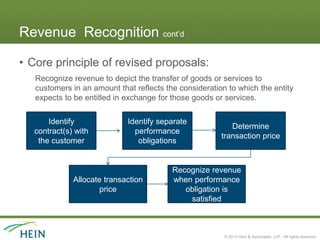
• Core principle of revised proposals:
   Recognize revenue to depict the transfer of goods or services to
   customers in an amount that reflects the consideration to which the entity
   expects to be entitled in exchange for those goods or services.

       Identify              Identify separate
                                                           Determine
   contract(s) with            performance
                                                        transaction price
    the customer                obligations


                                          Recognize revenue
              Allocate transaction        when performance
                      price                  obligation is
                                              satisfied


                                                         © 2013 Hein & Associates, LLP. All rights reserved.
Revenue Recognition – Differences from
Existing Standards

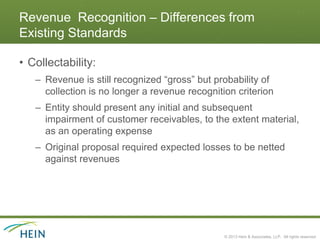
• Collectability:
   – Revenue is still recognized “gross” but probability of
     collection is no longer a revenue recognition criterion
   – Entity should present any initial and subsequent
     impairment of customer receivables, to the extent material,
     as an operating expense
   – Original proposal required expected losses to be netted
     against revenues


                                                © 2013 Hein & Associates, LLP. All rights reserved.
Revenue Recognition – Differences from
Existing Standards cont’d

• Allocation of transaction price:
   – If stand-alone selling price not available, an estimate may
     be made
   – New guidance is less restrictive than current guidance
     applicable to software revenue recognition (VSOE
     considerations), and may result in earlier recognition of
     revenue in some cases
   – Time value of money should be incorporated into amount
     of consideration, if it is significant and exceeds one year


                                                © 2013 Hein & Associates, LLP. All rights reserved.
Revenue Recognition – Differences from
Existing Standards cont’d

• “Constraint” on recognizing revenue on variable
  consideration (fixed and determinable – N/A):
   – An entity should recognize revenue as performance
     obligations are satisfied only up to the amount that the
     entity is confident will not be subject to significant reversal
     in the future
   – Adjusted in transaction price


                                                  © 2013 Hein & Associates, LLP. All rights reserved.
Revenue Recognition – Differences from
Existing Standards cont’d

• Bill and Hold Transactions:
   – Not previously discussed in GAAP, but part of SEC
     guidance
   – New guidance is very similar to SEC guidance
   – May impact private companies that were aggressive in
     recording certain bill and hold transactions as revenue


                                              © 2013 Hein & Associates, LLP. All rights reserved.
Implications of Revenue Changes

• Any contract tied to GAAP revenue will be impacted
   – Earn-outs on purchase agreements
   – Compensation agreements
   – Buy/sell arrangements, etc.
• Debt covenants may be impacted – Some debt
  agreements are being drafted currently to require
  “good faith” renegotiation of covenants based on any
  new accounting pronouncements


                                        © 2013 Hein & Associates, LLP. All rights reserved.
Revenue Recognition – Redeliberations &
Next Steps
Key Decisions
• Constraining the amount of revenue recognized
• Collectability of the sales price
• Accounting for licenses
• Onerous contracts
• Other matters
Still To Be Discussed
• Disclosures
• Transition and effective date


                                         © 2013 Hein & Associates, LLP. All rights reserved.
Leases
Lease Exposure Draft

Why a Leases Project?
• Existing lease accounting does not meet users’ needs
   – Accounting depends upon classification
   – Contractual rights and obligations (assets and liabilities) are off-
     balance sheet
   – Many users adjust financial statements
• Structuring opportunities
   – Current lease classification often based on bright lines
   – Significant difference in accounting on either side of
     operating/finance lease line


                                                     © 2013 Hein & Associates, LLP. All rights reserved.
Lease Exposure Draft cont’d

Who does this apply to?
• All leases (with limited exceptions of leases of intangibles)
• Includes capital and operating leases


                                             © 2013 Hein & Associates, LLP. All rights reserved.
Lease Exposure Draft cont’d

What are the major provisions?
• Proposed Right-of-Use Model: A lease contract is one in
  which the right to control the use of an asset (for a period
  of time) is transferred to the lessee
• All leases (except certain short-term leases) would be
  presented on the balance sheet
   Dr. Right of Use Asset
   Cr. Liability
• Short-term leases would be defined as a lease with a
  potential maximum period of 12 months or less


                                             © 2013 Hein & Associates, LLP. All rights reserved.
Lease Exposure Draft cont’d

Two Types of Leases:
• Accelerated Leases – Lessee consumes more than insignificant
  portion of leased asset
   –   Lease term is major part of economic life of asset
   –   PV of lease payments is substantially all of FV of asset

   –   Examples: Airplane with a 10-year lease; vehicle lease, equipment, etc.

• Straight-Line Leases – Lessee does not consume more than
  insignificant portion of leased asset
   –   Lease term is insignificant relative to economic life of asset
   –   PV of lease payments is insignificant relative to FV of asset
   –   Examples: Land or building


                                                                        © 2013 Hein & Associates, LLP. All rights reserved.
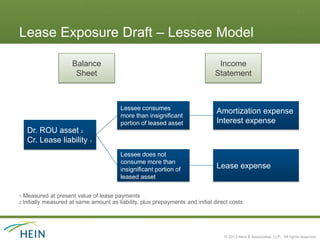
Lease Exposure Draft – Lessee Model

                       Balance                                                 Income
                        Sheet                                                 Statement


                                         Lessee consumes
                                                                              Amortization expense
                                         more than insignificant
                                         portion of leased asset              Interest expense
     Dr. ROU asset 2
     Cr. Lease liability 1
                                         Lessee does not
                                         consume more than
                                         insignificant portion of             Lease expense
                                         leased asset


1   Measured at present value of lease payments
2 Initially
          measured at same amount as liability, plus prepayments and initial direct costs


                                                                                 © 2013 Hein & Associates, LLP. All rights reserved.
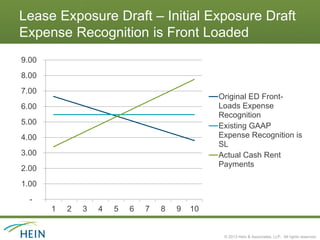
Lease Exposure Draft – Initial Exposure Draft
Expense Recognition is Front Loaded
9.00
8.00
7.00
                                                Original ED Front-
6.00                                            Loads Expense
                                                Recognition
5.00                                            Existing GAAP
4.00                                            Expense Recognition is
                                                SL
3.00                                            Actual Cash Rent
                                                Payments
2.00
1.00
  -
       1   2   3   4   5   6   7   8   9   10


                                                 © 2013 Hein & Associates, LLP. All rights reserved.
Lease Exposure Draft – Initial Exposure Draft
Expense Recognition is Front Loaded
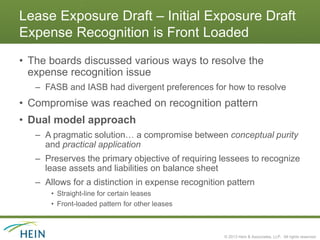
• The boards discussed various ways to resolve the
  expense recognition issue
   – FASB and IASB had divergent preferences for how to resolve
• Compromise was reached on recognition pattern
• Dual model approach
   – A pragmatic solution… a compromise between conceptual purity
     and practical application
   – Preserves the primary objective of requiring lessees to recognize
     lease assets and liabilities on balance sheet
   – Allows for a distinction in expense recognition pattern
       • Straight-line for certain leases
       • Front-loaded pattern for other leases


                                                    © 2013 Hein & Associates, LLP. All rights reserved.
Lease Exposure Draft – Disclosures

• Additional quantitative and qualitative disclosures will be
  required to understand the timing and amount of cash
  flows on leases
• Maturity schedule of all lease payments
• Disclose a maturity analysis of future contractual
  commitments associated with services and other non-
  lease components that are separated from a lease
  contract


                                             © 2013 Hein & Associates, LLP. All rights reserved.
Lease Exposure Draft – Potential Impacts

• Balance sheet will be grossed up with ROU assets and
  liabilities
• Operating leases will either be charged to amortization
  expense or lease expense
• EBITDA and other financial statement ratios could be
  impacted


                                           © 2013 Hein & Associates, LLP. All rights reserved.
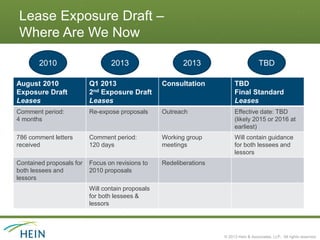
Lease Exposure Draft –
Where Are We Now

       2010                      2013                     2013                         TBD

August 2010               Q1 2013                  Consultation           TBD
Exposure Draft            2nd Exposure Draft                              Final Standard
Leases                    Leases                                          Leases
Comment period:           Re-expose proposals      Outreach               Effective date: TBD
4 months                                                                  (likely 2015 or 2016 at
                                                                          earliest)
786 comment letters       Comment period:          Working group          Will contain guidance
received                  120 days                 meetings               for both lessees and
                                                                          lessors
Contained proposals for   Focus on revisions to    Redeliberations
both lessees and          2010 proposals
lessors
                          Will contain proposals
                          for both lessees &
                          lessors


                                                                     © 2013 Hein & Associates, LLP. All rights reserved.
Impairment of Intangible Assets Other
Than Goodwill
Impairment of Intangible Assets Other Than
Goodwill

• Impairment of indefinite-lived assets other than
  goodwill
   – Simplifies the impairment testing for indefinite-lived
     intangible assets other than goodwill
   – Applies to indefinite-lived assets such as:
      • Customer lists, trademarks, licenses, distribution agreements, etc.


                                                       © 2013 Hein & Associates, LLP. All rights reserved.
Impairment of Intangible Assets Other Than
Goodwill cont’d

• Previous Guidance
   – Required intangible assets to be tested for impairment at
     least annually
   – Compare the book value or carrying value to the fair value
   – Impairment = loss in realizable value
• Preparer feedback was to allow for a qualitative
  approach for testing impairment
   – Reduce testing costs
• New Guidance – Allows for a qualitative evaluation of
  the likelihood of impairment


                                              © 2013 Hein & Associates, LLP. All rights reserved.
Impairment of Intangible Assets Other Than
Goodwill cont’d

• STEP 1 – Assess qualitative factors (e.g., industry
  trends, revenues, cash flows, etc.)
• STEP 2 –
   – Not more likely there is an impairment – STOP
   – Is more likely there is an impairment
      • Calculate the fair value of the asset and compare to book value

• New guidance does not change how an impairment
  loss is recognized


                                                       © 2013 Hein & Associates, LLP. All rights reserved.
Impairment of Intangible Assets Other Than
Goodwill cont’d

• When is this guidance effective?
   – Fiscal years beginning on or after September 15, 2012.
     Early adoption is permitted.


                                             © 2013 Hein & Associates, LLP. All rights reserved.
Other FASB Developments
Other Selected FASB Projects
• Financial Instruments: Classification and Measurement,
  Impairment, and Hedging
• Insurance Contracts
• Disclosure Framework
• Accounting for Repurchase Agreements
• Liquidity & Interest Rate Risk Disclosure
• Balance Sheet Offsetting
• Going Concern
• Comprehensive Income
• Investment Companies


                                          © 2013 Hein & Associates, LLP. All rights reserved.
Other FASB Initiatives

• Private Company Council
• Private Company Decision Making Framework
• Implementation Initiatives
• Pre-agenda Research
• Complexity Initiatives


                                   © 2013 Hein & Associates, LLP. All rights reserved.
Proposed Financial Reporting Framework
for Small and Medium-Sized Entities
(FRF for SME’s)
Proposed Financial Reporting Framework for
Small and Medium-Sized Entities (FRF for SME’s)

• Major Problems With Big GAAP:
  – Maintaining two sets of books – GAAP & Tax
  – Costly appraisals to mark assets to market
  – Self-reporting of tax uncertainties
  – Consolidations (VIE’s, etc.)


                                            © 2013 Hein & Associates, LLP. All rights reserved.
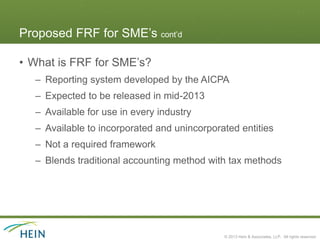
Proposed FRF for SME’s cont’d

• What is FRF for SME’s?
  – Reporting system developed by the AICPA
  – Expected to be released in mid-2013
  – Available for use in every industry
  – Available to incorporated and unincorporated entities
  – Not a required framework
  – Blends traditional accounting method with tax methods


                                             © 2013 Hein & Associates, LLP. All rights reserved.
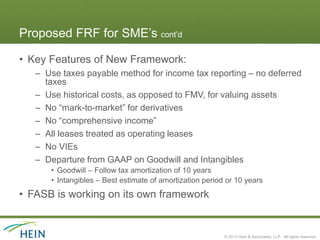
Proposed FRF for SME’s cont’d

• Key Features of New Framework:
   – Use taxes payable method for income tax reporting – no deferred
     taxes
   – Use historical costs, as opposed to FMV, for valuing assets
   – No “mark-to-market” for derivatives
   – No “comprehensive income”
   – All leases treated as operating leases
   – No VIEs
   – Departure from GAAP on Goodwill and Intangibles
      • Goodwill – Follow tax amortization of 10 years
      • Intangibles – Best estimate of amortization period or 10 years
• FASB is working on its own framework


                                                          © 2013 Hein & Associates, LLP. All rights reserved.
Common SEC Review Comments and
PCAOB Tone at the Top
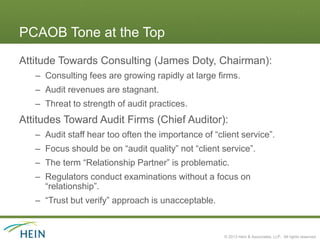
Attitude Towards Consulting (James Doty, Chairman):
   – Consulting fees are growing rapidly at large firms.
   – Audit revenues are stagnant.
   – Threat to strength of audit practices.
Attitudes Toward Audit Firms (Chief Auditor):
   – Audit staff hear too often the importance of “client service”.
   – Focus should be on “audit quality” not “client service”.
   – The term “Relationship Partner” is problematic.
   – Regulators conduct examinations without a focus on
     “relationship”.
   – “Trust but verify” approach is unacceptable.


                                                     © 2013 Hein & Associates, LLP. All rights reserved.
PCAOB Tone and the Top

Audit Quality (James Doty):
   – Consistent finding of auditing deficiencies
   – Explicit finding of audits priced below cost to establish long-term
     relationships.
   – Insufficient “professional skepticism” most common finding.
   – Audit firms should compete on quality not price.
   – Want firms to hire and retain top graduates committed to public
     service.


                                                    © 2013 Hein & Associates, LLP. All rights reserved.
Common SEC Review Comments

• Management’s Discussion and Analysis (MD&A)
  – Results of operations – Deficiencies:
     •   Boiler plate language
     •   Over simplifications
     •   Causes and effects omitted
     •   Performance metrics omitted (e.g., same store sales)
     •   Offsetting changes not disclosed
  – Liquidity – Deficiencies:
     • Inaccurate or incomplete descriptions
     • Contractual obligations table is incomplete
     • Obligations subject to uncertainty not included or disclosure is
       incomplete (e.g., uncertain tax positions, variable interest payments,
       OPEB plans)


                                                       © 2013 Hein & Associates, LLP. All rights reserved.
Common SEC Review Comments cont’d

• Segment Information – Deficiencies:
   – Segment information inappropriately aggregated
   – Lack of on-going analysis
   – Suggestions from staff:
      • Registrants should provide a comprehensive response to staff’s
        comments, including how CODM makes resource allocations and
        assesses performance, in aberrations
      • Continually monitor facts and circumstances


                                                      © 2013 Hein & Associates, LLP. All rights reserved.
Common SEC Review Comments cont’d
• Income Taxes – Deficiencies:
   – Reversals of valuation allowances:
       •   Consider all evidence, both positive and negative
       •   Degree to which positive evidence is verifiable
       •   Current state of economy
       •   Consistency of assumptions (e.g., DTA reversal with a goodwill
           impairment)
   – Deferred tax assets in loss years:
       •   Economic slowdown is not an aberration
       •   Magnitude and duration of losses
       •   Drivers of losses
       •   Registrant’s ability to make accurate forecasts
       •   Consistency of assumptions


                                                             © 2013 Hein & Associates, LLP. All rights reserved.
Common SEC Review Comments cont’d

• Goodwill Impairment – Deficiencies:
   – Reporting units at risk of failing Step 1:
      • Staff recommends disclosure
      • Disclosure should include changes in circumstances and
        assumptions that could affect potential impairment
      • Interim impairment tests should be disclosed
   – Goodwill Impairment Charges:
      • Disclose changes in circumstances that led to change
      • Why now?


                                                       © 2013 Hein & Associates, LLP. All rights reserved.
Common SEC Review Comments cont’d

• Revenue Recognition – Deficiencies:
  – Collectability reasonably assured
     • Customer’s credit worthiness
     • Payment terms
     • Collection practices, including history of modifying terms, or making
       other concessions
     • Write-off history

• Non-GAAP Disclosures:
  – Do not present a full non-GAAP income statement for
    purposes of reconciling non-GAAP financial measures to
    U.S. GAAP measures


                                                       © 2013 Hein & Associates, LLP. All rights reserved.
AICPA Clarified and Converged
Standards for Auditing and Quality
Control
Key Changes Impacting Audits

• Explicitly requires determination whether applicable
  reporting framework is acceptable
• Explicitly requires management acknowledgement of their
  responsibilities at onset of audit engagement
• Changes to wording of the auditor’s report, including the
  use of paragraph headings and expansion of the
  description of management’s responsibilities
• Requires more specific procedures to detect illegal acts
• Additional requirements related to opening balances in
  initial audits


                                            © 2013 Hein & Associates, LLP. All rights reserved.
Questions


            © 2013 Hein & Associates, LLP. All rights reserved.

GAAP UPDATE: What next? Where do we go from here?

  • 1.
    GAAP UPDATE What Next?Where Do We Go From Here? Jake Vossen January 29, 2013
  • 2.
    Agenda • FASB Developments– Selected Projects and Initiatives – Revenue Recognition – Leases – Impairment of Intangible Assets Other than Goodwill – Other • Proposed Financial Reporting Framework for Small and Medium-Sized Entities (FRF for SME’s) • Common SEC Review Comments/ PCAOB tone at the Top • AICPA Clarified and Converged Standards for Auditing and Quality Control © 2013 Hein & Associates, LLP. All rights reserved.
  • 3.
  • 4.
    Revenue Recognition • Jointproject between FASB and IASB • Objective: To develop a single, principle-based revenue standard for US GAAP & IFRSs • Revenue standard aims to improve accounting for contracts with customers by: – Providing a more robust framework for addressing revenue issues as they arise – Increasing comparability across industries & capital markets – Requiring better disclosure © 2013 Hein & Associates LLP. All rights reserved.
  • 5.
    Revenue Recognition cont’d •US GAAP – Many standards (over 100) – Significant industry specific guidance • IFRS – Two key standards: IAS 18, Revenue, and IAS 11, Construction Contracts – Little industry guidance © 2013 Hein & Associates, LLP. All rights reserved.
  • 6.
    Revenue Recognition cont’d •Applies to: – Contracts with customers – Gain/loss recognition on sale of some nonfinancial assets (intangibles and PP&E) – Certain nonmonetary exchanges – Many industry-specific transactions such as real estate sales © 2013 Hein & Associates, LLP. All rights reserved.
  • 7.
    Revenue Recognition cont’d •Core principle of revised proposals: Recognize revenue to depict the transfer of goods or services to customers in an amount that reflects the consideration to which the entity expects to be entitled in exchange for those goods or services. Identify Identify separate Determine contract(s) with performance transaction price the customer obligations Recognize revenue Allocate transaction when performance price obligation is satisfied © 2013 Hein & Associates, LLP. All rights reserved.
  • 8.
    Revenue Recognition –Differences from Existing Standards • Collectability: – Revenue is still recognized “gross” but probability of collection is no longer a revenue recognition criterion – Entity should present any initial and subsequent impairment of customer receivables, to the extent material, as an operating expense – Original proposal required expected losses to be netted against revenues © 2013 Hein & Associates, LLP. All rights reserved.
  • 9.
    Revenue Recognition –Differences from Existing Standards cont’d • Allocation of transaction price: – If stand-alone selling price not available, an estimate may be made – New guidance is less restrictive than current guidance applicable to software revenue recognition (VSOE considerations), and may result in earlier recognition of revenue in some cases – Time value of money should be incorporated into amount of consideration, if it is significant and exceeds one year © 2013 Hein & Associates, LLP. All rights reserved.
  • 10.
    Revenue Recognition –Differences from Existing Standards cont’d • “Constraint” on recognizing revenue on variable consideration (fixed and determinable – N/A): – An entity should recognize revenue as performance obligations are satisfied only up to the amount that the entity is confident will not be subject to significant reversal in the future – Adjusted in transaction price © 2013 Hein & Associates, LLP. All rights reserved.
  • 11.
    Revenue Recognition –Differences from Existing Standards cont’d • Bill and Hold Transactions: – Not previously discussed in GAAP, but part of SEC guidance – New guidance is very similar to SEC guidance – May impact private companies that were aggressive in recording certain bill and hold transactions as revenue © 2013 Hein & Associates, LLP. All rights reserved.
  • 12.
    Implications of RevenueChanges • Any contract tied to GAAP revenue will be impacted – Earn-outs on purchase agreements – Compensation agreements – Buy/sell arrangements, etc. • Debt covenants may be impacted – Some debt agreements are being drafted currently to require “good faith” renegotiation of covenants based on any new accounting pronouncements © 2013 Hein & Associates, LLP. All rights reserved.
  • 13.
    Revenue Recognition –Redeliberations & Next Steps Key Decisions • Constraining the amount of revenue recognized • Collectability of the sales price • Accounting for licenses • Onerous contracts • Other matters Still To Be Discussed • Disclosures • Transition and effective date © 2013 Hein & Associates, LLP. All rights reserved.
  • 14.
  • 15.
    Lease Exposure Draft Whya Leases Project? • Existing lease accounting does not meet users’ needs – Accounting depends upon classification – Contractual rights and obligations (assets and liabilities) are off- balance sheet – Many users adjust financial statements • Structuring opportunities – Current lease classification often based on bright lines – Significant difference in accounting on either side of operating/finance lease line © 2013 Hein & Associates, LLP. All rights reserved.
  • 16.
    Lease Exposure Draftcont’d Who does this apply to? • All leases (with limited exceptions of leases of intangibles) • Includes capital and operating leases © 2013 Hein & Associates, LLP. All rights reserved.
  • 17.
    Lease Exposure Draftcont’d What are the major provisions? • Proposed Right-of-Use Model: A lease contract is one in which the right to control the use of an asset (for a period of time) is transferred to the lessee • All leases (except certain short-term leases) would be presented on the balance sheet Dr. Right of Use Asset Cr. Liability • Short-term leases would be defined as a lease with a potential maximum period of 12 months or less © 2013 Hein & Associates, LLP. All rights reserved.
  • 18.
    Lease Exposure Draftcont’d Two Types of Leases: • Accelerated Leases – Lessee consumes more than insignificant portion of leased asset – Lease term is major part of economic life of asset – PV of lease payments is substantially all of FV of asset – Examples: Airplane with a 10-year lease; vehicle lease, equipment, etc. • Straight-Line Leases – Lessee does not consume more than insignificant portion of leased asset – Lease term is insignificant relative to economic life of asset – PV of lease payments is insignificant relative to FV of asset – Examples: Land or building © 2013 Hein & Associates, LLP. All rights reserved.
  • 19.
    Lease Exposure Draft– Lessee Model Balance Income Sheet Statement Lessee consumes Amortization expense more than insignificant portion of leased asset Interest expense Dr. ROU asset 2 Cr. Lease liability 1 Lessee does not consume more than insignificant portion of Lease expense leased asset 1 Measured at present value of lease payments 2 Initially measured at same amount as liability, plus prepayments and initial direct costs © 2013 Hein & Associates, LLP. All rights reserved.
  • 20.
    Lease Exposure Draft– Initial Exposure Draft Expense Recognition is Front Loaded 9.00 8.00 7.00 Original ED Front- 6.00 Loads Expense Recognition 5.00 Existing GAAP 4.00 Expense Recognition is SL 3.00 Actual Cash Rent Payments 2.00 1.00 - 1 2 3 4 5 6 7 8 9 10 © 2013 Hein & Associates, LLP. All rights reserved.
  • 21.
    Lease Exposure Draft– Initial Exposure Draft Expense Recognition is Front Loaded • The boards discussed various ways to resolve the expense recognition issue – FASB and IASB had divergent preferences for how to resolve • Compromise was reached on recognition pattern • Dual model approach – A pragmatic solution… a compromise between conceptual purity and practical application – Preserves the primary objective of requiring lessees to recognize lease assets and liabilities on balance sheet – Allows for a distinction in expense recognition pattern • Straight-line for certain leases • Front-loaded pattern for other leases © 2013 Hein & Associates, LLP. All rights reserved.
  • 22.
    Lease Exposure Draft– Disclosures • Additional quantitative and qualitative disclosures will be required to understand the timing and amount of cash flows on leases • Maturity schedule of all lease payments • Disclose a maturity analysis of future contractual commitments associated with services and other non- lease components that are separated from a lease contract © 2013 Hein & Associates, LLP. All rights reserved.
  • 23.
    Lease Exposure Draft– Potential Impacts • Balance sheet will be grossed up with ROU assets and liabilities • Operating leases will either be charged to amortization expense or lease expense • EBITDA and other financial statement ratios could be impacted © 2013 Hein & Associates, LLP. All rights reserved.
  • 24.
    Lease Exposure Draft– Where Are We Now 2010 2013 2013 TBD August 2010 Q1 2013 Consultation TBD Exposure Draft 2nd Exposure Draft Final Standard Leases Leases Leases Comment period: Re-expose proposals Outreach Effective date: TBD 4 months (likely 2015 or 2016 at earliest) 786 comment letters Comment period: Working group Will contain guidance received 120 days meetings for both lessees and lessors Contained proposals for Focus on revisions to Redeliberations both lessees and 2010 proposals lessors Will contain proposals for both lessees & lessors © 2013 Hein & Associates, LLP. All rights reserved.
  • 25.
    Impairment of IntangibleAssets Other Than Goodwill
  • 26.
    Impairment of IntangibleAssets Other Than Goodwill • Impairment of indefinite-lived assets other than goodwill – Simplifies the impairment testing for indefinite-lived intangible assets other than goodwill – Applies to indefinite-lived assets such as: • Customer lists, trademarks, licenses, distribution agreements, etc. © 2013 Hein & Associates, LLP. All rights reserved.
  • 27.
    Impairment of IntangibleAssets Other Than Goodwill cont’d • Previous Guidance – Required intangible assets to be tested for impairment at least annually – Compare the book value or carrying value to the fair value – Impairment = loss in realizable value • Preparer feedback was to allow for a qualitative approach for testing impairment – Reduce testing costs • New Guidance – Allows for a qualitative evaluation of the likelihood of impairment © 2013 Hein & Associates, LLP. All rights reserved.
  • 28.
    Impairment of IntangibleAssets Other Than Goodwill cont’d • STEP 1 – Assess qualitative factors (e.g., industry trends, revenues, cash flows, etc.) • STEP 2 – – Not more likely there is an impairment – STOP – Is more likely there is an impairment • Calculate the fair value of the asset and compare to book value • New guidance does not change how an impairment loss is recognized © 2013 Hein & Associates, LLP. All rights reserved.
  • 29.
    Impairment of IntangibleAssets Other Than Goodwill cont’d • When is this guidance effective? – Fiscal years beginning on or after September 15, 2012. Early adoption is permitted. © 2013 Hein & Associates, LLP. All rights reserved.
  • 30.
  • 31.
    Other Selected FASBProjects • Financial Instruments: Classification and Measurement, Impairment, and Hedging • Insurance Contracts • Disclosure Framework • Accounting for Repurchase Agreements • Liquidity & Interest Rate Risk Disclosure • Balance Sheet Offsetting • Going Concern • Comprehensive Income • Investment Companies © 2013 Hein & Associates, LLP. All rights reserved.
  • 32.
    Other FASB Initiatives •Private Company Council • Private Company Decision Making Framework • Implementation Initiatives • Pre-agenda Research • Complexity Initiatives © 2013 Hein & Associates, LLP. All rights reserved.
  • 33.
    Proposed Financial ReportingFramework for Small and Medium-Sized Entities (FRF for SME’s)
  • 34.
    Proposed Financial ReportingFramework for Small and Medium-Sized Entities (FRF for SME’s) • Major Problems With Big GAAP: – Maintaining two sets of books – GAAP & Tax – Costly appraisals to mark assets to market – Self-reporting of tax uncertainties – Consolidations (VIE’s, etc.) © 2013 Hein & Associates, LLP. All rights reserved.
  • 35.
    Proposed FRF forSME’s cont’d • What is FRF for SME’s? – Reporting system developed by the AICPA – Expected to be released in mid-2013 – Available for use in every industry – Available to incorporated and unincorporated entities – Not a required framework – Blends traditional accounting method with tax methods © 2013 Hein & Associates, LLP. All rights reserved.
  • 36.
    Proposed FRF forSME’s cont’d • Key Features of New Framework: – Use taxes payable method for income tax reporting – no deferred taxes – Use historical costs, as opposed to FMV, for valuing assets – No “mark-to-market” for derivatives – No “comprehensive income” – All leases treated as operating leases – No VIEs – Departure from GAAP on Goodwill and Intangibles • Goodwill – Follow tax amortization of 10 years • Intangibles – Best estimate of amortization period or 10 years • FASB is working on its own framework © 2013 Hein & Associates, LLP. All rights reserved.
  • 37.
    Common SEC ReviewComments and PCAOB Tone at the Top
  • 38.
    PCAOB Tone atthe Top Attitude Towards Consulting (James Doty, Chairman): – Consulting fees are growing rapidly at large firms. – Audit revenues are stagnant. – Threat to strength of audit practices. Attitudes Toward Audit Firms (Chief Auditor): – Audit staff hear too often the importance of “client service”. – Focus should be on “audit quality” not “client service”. – The term “Relationship Partner” is problematic. – Regulators conduct examinations without a focus on “relationship”. – “Trust but verify” approach is unacceptable. © 2013 Hein & Associates, LLP. All rights reserved.
  • 39.
    PCAOB Tone andthe Top Audit Quality (James Doty): – Consistent finding of auditing deficiencies – Explicit finding of audits priced below cost to establish long-term relationships. – Insufficient “professional skepticism” most common finding. – Audit firms should compete on quality not price. – Want firms to hire and retain top graduates committed to public service. © 2013 Hein & Associates, LLP. All rights reserved.
  • 40.
    Common SEC ReviewComments • Management’s Discussion and Analysis (MD&A) – Results of operations – Deficiencies: • Boiler plate language • Over simplifications • Causes and effects omitted • Performance metrics omitted (e.g., same store sales) • Offsetting changes not disclosed – Liquidity – Deficiencies: • Inaccurate or incomplete descriptions • Contractual obligations table is incomplete • Obligations subject to uncertainty not included or disclosure is incomplete (e.g., uncertain tax positions, variable interest payments, OPEB plans) © 2013 Hein & Associates, LLP. All rights reserved.
  • 41.
    Common SEC ReviewComments cont’d • Segment Information – Deficiencies: – Segment information inappropriately aggregated – Lack of on-going analysis – Suggestions from staff: • Registrants should provide a comprehensive response to staff’s comments, including how CODM makes resource allocations and assesses performance, in aberrations • Continually monitor facts and circumstances © 2013 Hein & Associates, LLP. All rights reserved.
  • 42.
    Common SEC ReviewComments cont’d • Income Taxes – Deficiencies: – Reversals of valuation allowances: • Consider all evidence, both positive and negative • Degree to which positive evidence is verifiable • Current state of economy • Consistency of assumptions (e.g., DTA reversal with a goodwill impairment) – Deferred tax assets in loss years: • Economic slowdown is not an aberration • Magnitude and duration of losses • Drivers of losses • Registrant’s ability to make accurate forecasts • Consistency of assumptions © 2013 Hein & Associates, LLP. All rights reserved.
  • 43.
    Common SEC ReviewComments cont’d • Goodwill Impairment – Deficiencies: – Reporting units at risk of failing Step 1: • Staff recommends disclosure • Disclosure should include changes in circumstances and assumptions that could affect potential impairment • Interim impairment tests should be disclosed – Goodwill Impairment Charges: • Disclose changes in circumstances that led to change • Why now? © 2013 Hein & Associates, LLP. All rights reserved.
  • 44.
    Common SEC ReviewComments cont’d • Revenue Recognition – Deficiencies: – Collectability reasonably assured • Customer’s credit worthiness • Payment terms • Collection practices, including history of modifying terms, or making other concessions • Write-off history • Non-GAAP Disclosures: – Do not present a full non-GAAP income statement for purposes of reconciling non-GAAP financial measures to U.S. GAAP measures © 2013 Hein & Associates, LLP. All rights reserved.
  • 45.
    AICPA Clarified andConverged Standards for Auditing and Quality Control
  • 46.
    Key Changes ImpactingAudits • Explicitly requires determination whether applicable reporting framework is acceptable • Explicitly requires management acknowledgement of their responsibilities at onset of audit engagement • Changes to wording of the auditor’s report, including the use of paragraph headings and expansion of the description of management’s responsibilities • Requires more specific procedures to detect illegal acts • Additional requirements related to opening balances in initial audits © 2013 Hein & Associates, LLP. All rights reserved.
  • 47.
    Questions © 2013 Hein & Associates, LLP. All rights reserved.