
Financial Reporting Framework for Small
and Medium Sized Enterprises
June 17, 2014
Agenda for Today
Today’s Agenda:
• Background
• FRF for SMEs- Who can use it
• Highlights of the Model
• Discussion of key differences between the Model
and GAAP
• Where to find more information
• Questions
Background
• Developed by an AICPA Task Force and the staff of the
AICPA.
• Not approved, disapproved or acted upon by any
technical committee of the AICPA or FASB, so it has no
authoritative status.
- Was exposed for public scrutiny however.
- No effective date.
Background
• It is a NON GAAP (OCBOA) Framework. Other OCBOA
frameworks include:
– Tax Basis
– Cash Basis
– Regulatory or Contractual Basis
• It has an advantage of other OCBOAs in its consistency.
• Can be compiled, reviewed or audited by external
accountants.
• FRF for SMEs is responsive to the issues and concerns
surrounding US GAAP among SME’s.
FRF for SME’s – Who can use it?
• Small and medium sized enterprises are not defined in
the framework. SMEs generally have:
– No GAAP regulatory reporting requirements
– No intention of going public
– For profit
– Generally owner managed
– Rely on financial statements to confirm assessments of
performance, cash flows, what they own, and what they owe.
FRF for SME’s – Who can use it?
• Small and medium sized enterprises are not defined in
the framework.
– Not in an industry with highly specialized accounting.
– Not engaged in overly complicated transactions.
– No significant foreign operations.
– Users have direct access to management.
– Users have greater interest in cash flows, liquidity, financial
position strength, and interest coverage.
– Banker does not base loan solely on financial statements, but
also on collateral and other mechanisms.
Background
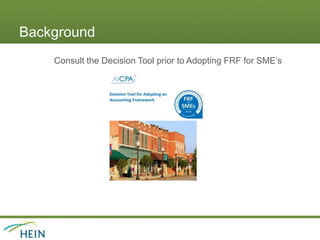
Consult the Decision Tool prior to Adopting FRF for SME’s
Highlights of the Framework
The framework is intended to deliver financial statements
that provide useful, relevant information in a simplified,
consistent, cost-effective way.
The framework is based on historical cost, and utilizes a
combination of accrual tax basis and traditional accounting
methods.
Highlights of the Framework
Organized into one book/online tool.
- Updates only expected every 3 or 4 years.
- Free on-line PDF download.
- 31 chapters.
- Rules can be cited.
- For example “FRF-SME 8.05” deals with
compensating cash balances.
Highlights of the Framework
In addition, the following resources are available
– Glossary
– Implementation guidance
– Summary of differences between tax basis, GAAP,
and IFRS are provided
– Disclosure checklist provided
– Example financial statements
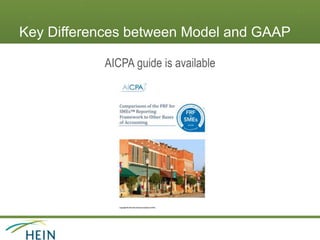
Key Differences between Model and GAAP
AICPA guide is available
Key Differences between the Model and GAAP
The Model uses “market value” not “fair value”.
“The amount of the consideration that would be agreed upon in an arm’s length
transaction between knowledgeable, willing parties who are under no compulsion to
act.”
• Market value measurement used only in very limited circumstances, such as
business combinations, certain nonmonetary transactions, and marketable equity
and debt securities that are held for sale.
Key Differences between the Model and GAAP
No impairment test under FRF for SME’s
- However, entities should write off assets no longer being used
No Comprehensive Income
No industry specific guidance
Key Differences between the Model and GAAP
Consolidation is flexible
• Policy Choice- Can report parent only statements with
equity investment presentation of subsidiaries.
• No Variable Interest Entities (VIEs).
Key Differences between the Model and GAAP
Income Taxes
• Policy Choice- Can use “Taxes Payable” or “Deferred
Income Tax” approach.
• No uncertain tax positions (i.e., no FIN 48.)
Key Differences between the Model and GAAP
Leases
• Traditional approaches and some tax methods allowed.
• Capital or Operating
– Not a big difference from GAAP now, but it will be once
new leasing rules are adopted by FASB.
Key Differences between the Model and GAAP
Push Down Accounting
Current GAAP rules reside primarily in SEC guidance.
FRF for SMEs is much more lenient in allowing push down
accounting.
- 50% change in ownership allows push down accounting.
- Whole chapter in the Model on push down accounting.
Key Differences between the Model and GAAP
Intangible Assets
- All have a finite life.
- Similar to IFRS, research costs are expensed, but a
policy choice to capitalize development costs.
Goodwill
- No impairment testing. Amortized using tax life or 15
years.
Key Differences between the Model and GAAP
Revenue
- Broad, principle based guidance.
- Recognize when performance is achieved and
collection is reasonably certain.
Key Differences between the Model and GAAP
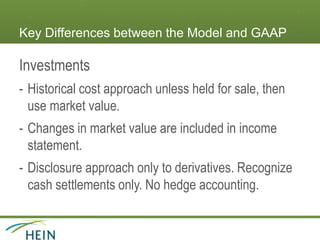
Investments
- Historical cost approach unless held for sale, then
use market value.
- Changes in market value are included in income
statement.
- Disclosure approach only to derivatives. Recognize
cash settlements only. No hedge accounting.
Key Differences between the Model and GAAP
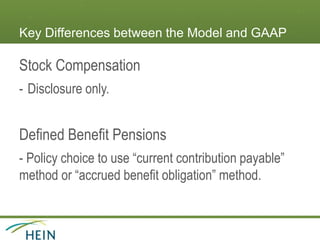
Stock Compensation
- Disclosure only.
Defined Benefit Pensions
- Policy choice to use “current contribution payable”
method or “accrued benefit obligation” method.
Key Differences between the Model and GAAP
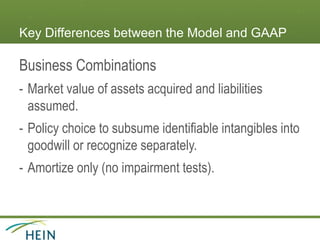
Business Combinations
- Market value of assets acquired and liabilities
assumed.
- Policy choice to subsume identifiable intangibles into
goodwill or recognize separately.
- Amortize only (no impairment tests).
Where to find more information
Resources at
www.aicpa.org/FRF-SMEs
Questions
THANK YOU
Please call with any questions for comments:
Jake Vossen (303) 298-9600
jvossen@heincpa.com
www.heincpa.com

Financial Reporting Framework for Small and Medium-Sized Entities

  • 1.
    Financial Reporting Frameworkfor Small and Medium Sized Enterprises June 17, 2014
  • 2.
    Agenda for Today Today’sAgenda: • Background • FRF for SMEs- Who can use it • Highlights of the Model • Discussion of key differences between the Model and GAAP • Where to find more information • Questions
  • 3.
    Background • Developed byan AICPA Task Force and the staff of the AICPA. • Not approved, disapproved or acted upon by any technical committee of the AICPA or FASB, so it has no authoritative status. - Was exposed for public scrutiny however. - No effective date.
  • 4.
    Background • It isa NON GAAP (OCBOA) Framework. Other OCBOA frameworks include: – Tax Basis – Cash Basis – Regulatory or Contractual Basis • It has an advantage of other OCBOAs in its consistency. • Can be compiled, reviewed or audited by external accountants. • FRF for SMEs is responsive to the issues and concerns surrounding US GAAP among SME’s.
  • 5.
    FRF for SME’s– Who can use it? • Small and medium sized enterprises are not defined in the framework. SMEs generally have: – No GAAP regulatory reporting requirements – No intention of going public – For profit – Generally owner managed – Rely on financial statements to confirm assessments of performance, cash flows, what they own, and what they owe.
  • 6.
    FRF for SME’s– Who can use it? • Small and medium sized enterprises are not defined in the framework. – Not in an industry with highly specialized accounting. – Not engaged in overly complicated transactions. – No significant foreign operations. – Users have direct access to management. – Users have greater interest in cash flows, liquidity, financial position strength, and interest coverage. – Banker does not base loan solely on financial statements, but also on collateral and other mechanisms.
  • 7.
    Background Consult the DecisionTool prior to Adopting FRF for SME’s
  • 8.
    Highlights of theFramework The framework is intended to deliver financial statements that provide useful, relevant information in a simplified, consistent, cost-effective way. The framework is based on historical cost, and utilizes a combination of accrual tax basis and traditional accounting methods.
  • 9.
    Highlights of theFramework Organized into one book/online tool. - Updates only expected every 3 or 4 years. - Free on-line PDF download. - 31 chapters. - Rules can be cited. - For example “FRF-SME 8.05” deals with compensating cash balances.
  • 10.
    Highlights of theFramework In addition, the following resources are available – Glossary – Implementation guidance – Summary of differences between tax basis, GAAP, and IFRS are provided – Disclosure checklist provided – Example financial statements
  • 11.
    Key Differences betweenModel and GAAP AICPA guide is available
  • 12.
    Key Differences betweenthe Model and GAAP The Model uses “market value” not “fair value”. “The amount of the consideration that would be agreed upon in an arm’s length transaction between knowledgeable, willing parties who are under no compulsion to act.” • Market value measurement used only in very limited circumstances, such as business combinations, certain nonmonetary transactions, and marketable equity and debt securities that are held for sale.
  • 13.
    Key Differences betweenthe Model and GAAP No impairment test under FRF for SME’s - However, entities should write off assets no longer being used No Comprehensive Income No industry specific guidance
  • 14.
    Key Differences betweenthe Model and GAAP Consolidation is flexible • Policy Choice- Can report parent only statements with equity investment presentation of subsidiaries. • No Variable Interest Entities (VIEs).
  • 15.
    Key Differences betweenthe Model and GAAP Income Taxes • Policy Choice- Can use “Taxes Payable” or “Deferred Income Tax” approach. • No uncertain tax positions (i.e., no FIN 48.)
  • 16.
    Key Differences betweenthe Model and GAAP Leases • Traditional approaches and some tax methods allowed. • Capital or Operating – Not a big difference from GAAP now, but it will be once new leasing rules are adopted by FASB.
  • 17.
    Key Differences betweenthe Model and GAAP Push Down Accounting Current GAAP rules reside primarily in SEC guidance. FRF for SMEs is much more lenient in allowing push down accounting. - 50% change in ownership allows push down accounting. - Whole chapter in the Model on push down accounting.
  • 18.
    Key Differences betweenthe Model and GAAP Intangible Assets - All have a finite life. - Similar to IFRS, research costs are expensed, but a policy choice to capitalize development costs. Goodwill - No impairment testing. Amortized using tax life or 15 years.
  • 19.
    Key Differences betweenthe Model and GAAP Revenue - Broad, principle based guidance. - Recognize when performance is achieved and collection is reasonably certain.
  • 20.
    Key Differences betweenthe Model and GAAP Investments - Historical cost approach unless held for sale, then use market value. - Changes in market value are included in income statement. - Disclosure approach only to derivatives. Recognize cash settlements only. No hedge accounting.
  • 21.
    Key Differences betweenthe Model and GAAP Stock Compensation - Disclosure only. Defined Benefit Pensions - Policy choice to use “current contribution payable” method or “accrued benefit obligation” method.
  • 22.
    Key Differences betweenthe Model and GAAP Business Combinations - Market value of assets acquired and liabilities assumed. - Policy choice to subsume identifiable intangibles into goodwill or recognize separately. - Amortize only (no impairment tests).
  • 23.
    Where to findmore information Resources at www.aicpa.org/FRF-SMEs
  • 24.
  • 25.
    THANK YOU Please callwith any questions for comments: Jake Vossen (303) 298-9600 jvossen@heincpa.com www.heincpa.com