CONDITIONAL
STATEMENTS
LEARNING OBJECTIVES
• - determines the relationship between the hypothesis and the conclusion of
an if-then statement
• - transforms a statement into an equivalent if-then statement
• - determines the inverse, converse, and contrapositive of an if-then
statement
• - illustrates the equivalences of the statement and its contrapositive, and the
converse and inverse of a statement
CONDITIONAL STATEMENTS
•Example #1:
•State the hypothesis and conclusion of this conditional.
•If it is sunny tomorrow, then we will go swimming.
•If you drink cold water, then you will be refreshed.
•If you think you are great, then you will be great.
CONDITIONAL STATEMENTS
•Example #2:
• Write a conditional statement from the given information.
•Hypothesis: You are kind, cheerful, and outgoing.
•Conclusion: You will have more friends.
•If you are kind, cheerful, and outgoing, then you will have more
friends.
CONDITIONAL STATEMENTS
•Example #2:
• Write a conditional statement from the given information.
• Hypothesis: You can admit your mistakes and ask for apology.
• Conclusion: You value relationship than pride.
•If you can admit your mistakes and ask for apology, then you
value relationship than pride.
CONDITIONAL STATEMENTS
•Example #3:
• Rewrite the conditional statement in the if-then form.
• Help save the environment by recycling bottles, cans, and papers.
• If you recycle bottles, cans, and papers, then you will help
save the environment.
CONDITIONAL STATEMENTS
•Example #4:
• Rewrite the conditional statement in the if-then form.
• You are enough if you think you are enough.
•If you think you are enough, then you are enough.
CONDITIONAL STATEMENTS
• Example #5:
• State in the if-then form. Show that the conditional is false.
• All isosceles triangles are right.
• Solution:
• If-then statement: If a triangle is an isosceles triangle, then it is right.
• Hypothesis: is an isosceles triangle.
• Conclusion: is a right triangle.
• The conditional is false. ----- counterexample
CONVERSE, INVERSE,AND
CONTRAPOSITIVE STATEMENTS
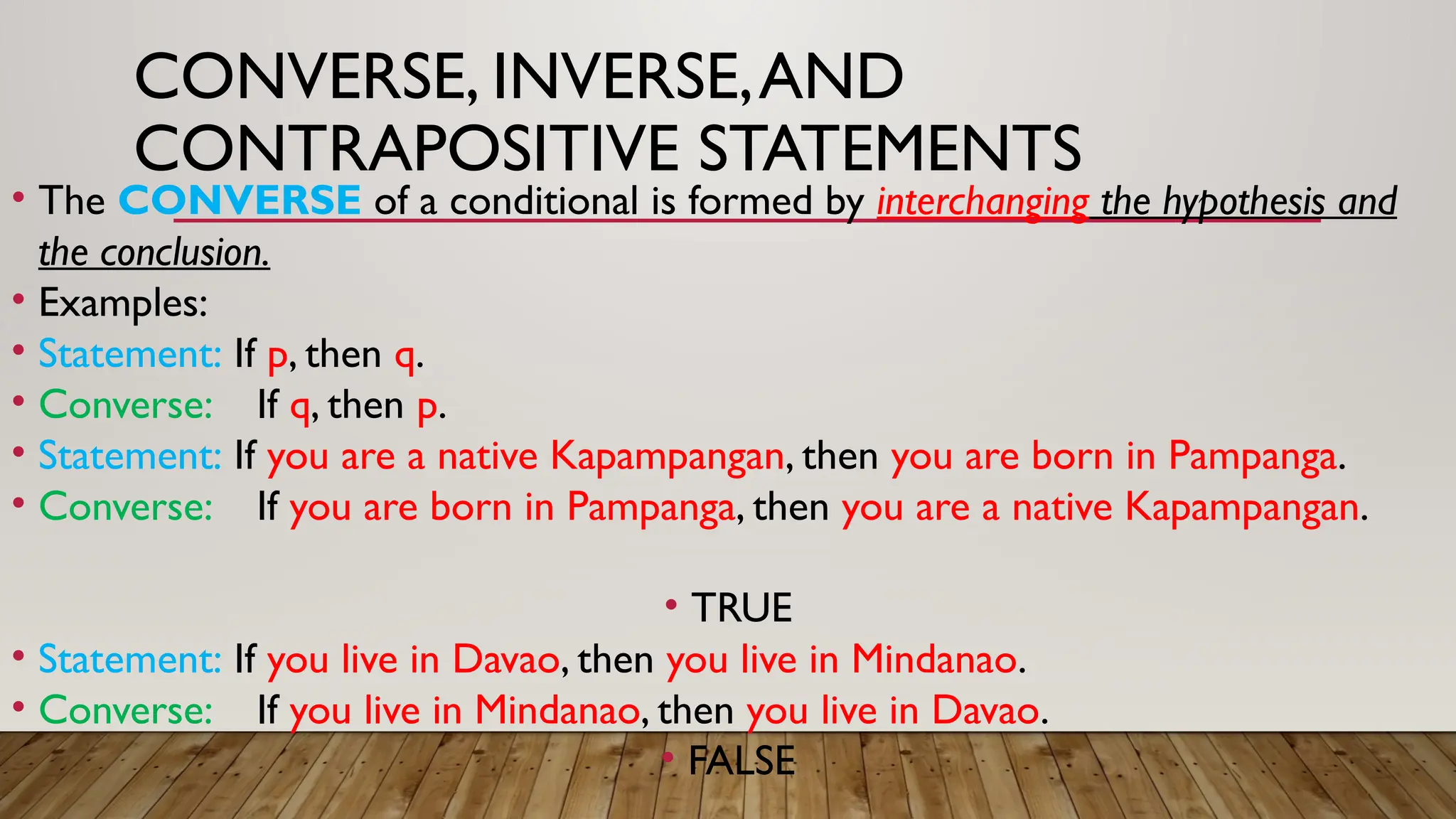
• The CONVERSE of a conditional is formed by interchanging the hypothesis and
the conclusion.
• Examples:
• Statement: If p, then q.
• Converse: If q, then p.
• Statement: If you are a native Kapampangan, then you are born in Pampanga.
• Converse: If you are born in Pampanga, then you are a native Kapampangan.
• TRUE
• Statement: If you live in Davao, then you live in Mindanao.
• Converse: If you live in Mindanao, then you live in Davao.
• FALSE
CONVERSE, INVERSE,AND
CONTRAPOSITIVE STATEMENTS
•When the conditional and its converse are both true, the
two statements can be combined to form a
biconditional statement by using the phrase if and only
if.
•You are a native Kapampangan if and only if you are born
in Pampanga.
CONVERSE, INVERSE,AND
CONTRAPOSITIVE STATEMENTS
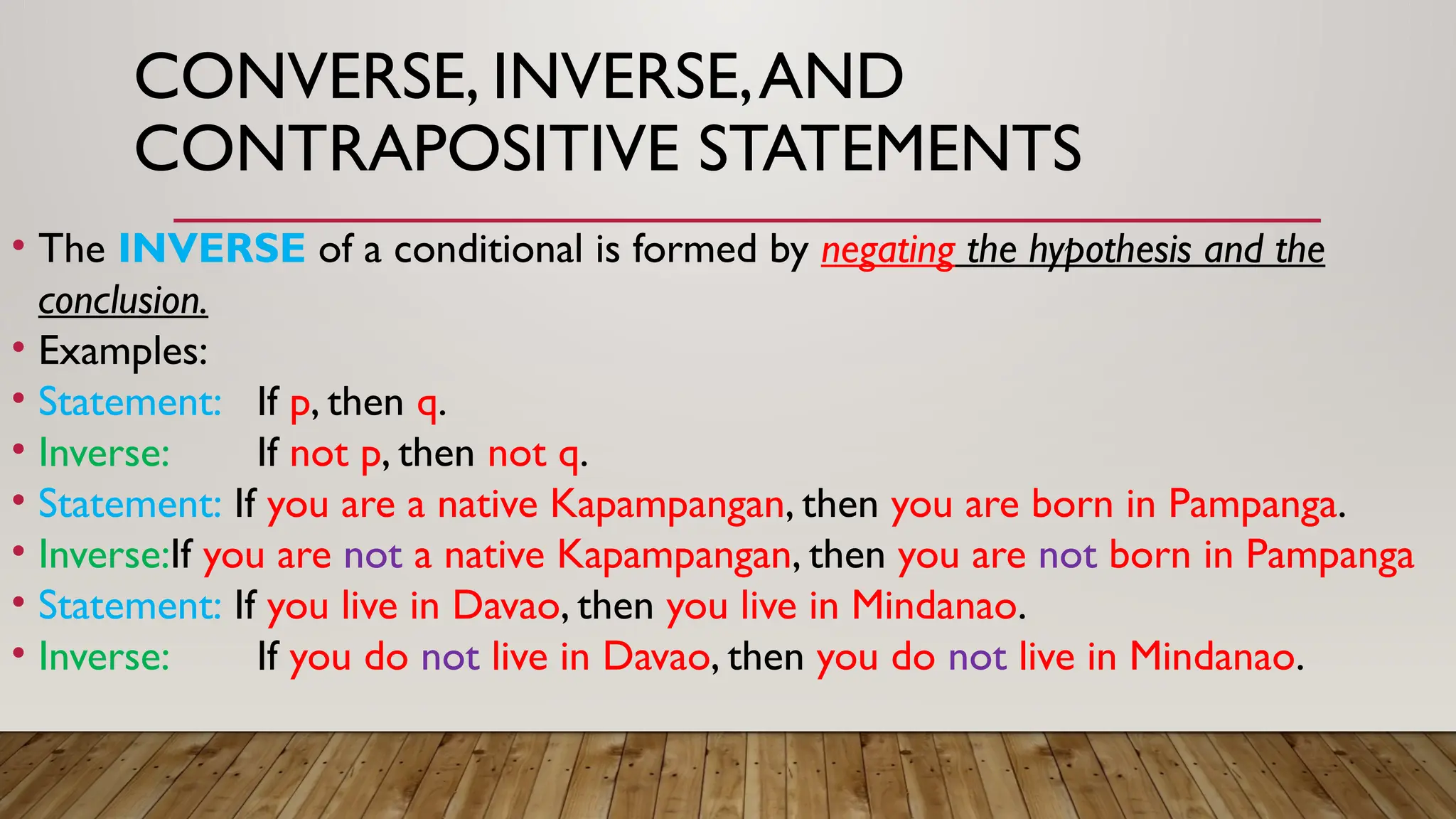
• The INVERSE of a conditional is formed by negating the hypothesis and the
conclusion.
• Examples:
• Statement: If p, then q.
• Inverse: If not p, then not q.
• Statement: If you are a native Kapampangan, then you are born in Pampanga.
• Inverse:If you are not a native Kapampangan, then you are not born in Pampanga
• Statement: If you live in Davao, then you live in Mindanao.
• Inverse: If you do not live in Davao, then you do not live in Mindanao.
CONVERSE, INVERSE,AND
CONTRAPOSITIVE STATEMENTS
• The CONTRAPOSITIVE of a conditional is formed by interchanging the
hypothesis and the conclusion AND negating both.
• Examples:
• Statement: If p, then q.
• Contrapositive: If not q, then not p.
• Statement: If you live in Cebu, then you live inVisayas.
• Contrapositive: If you do not live inVisayas, then you do not live in Cebu.
• Statement: If you have a good heart, then you are a good man.
• Contrapositive: If you are not a good man, then you do not have a good heart.
TRANSFORM THE FF. INTO CONVERSE, INVERSE,
AND CONTRAPOSITIVE STATEMENTS
• If today is Monday, then tomorrow is Tuesday
• If the weather is warm, then we should go swimming
• If an animal is a bird, then it has feathers.
• If you are in Houston, then you are in Texas.
• Differentiate Converse, inverse and contrapositive
statement.
• What is conclusion and statement.

G8 Math Q2- Week 6- Conditional Statement.pptx

  • 1.
  • 2.
    LEARNING OBJECTIVES • -determines the relationship between the hypothesis and the conclusion of an if-then statement • - transforms a statement into an equivalent if-then statement • - determines the inverse, converse, and contrapositive of an if-then statement • - illustrates the equivalences of the statement and its contrapositive, and the converse and inverse of a statement
  • 3.
    CONDITIONAL STATEMENTS •Example #1: •Statethe hypothesis and conclusion of this conditional. •If it is sunny tomorrow, then we will go swimming. •If you drink cold water, then you will be refreshed. •If you think you are great, then you will be great.
  • 4.
    CONDITIONAL STATEMENTS •Example #2: •Write a conditional statement from the given information. •Hypothesis: You are kind, cheerful, and outgoing. •Conclusion: You will have more friends. •If you are kind, cheerful, and outgoing, then you will have more friends.
  • 5.
    CONDITIONAL STATEMENTS •Example #2: •Write a conditional statement from the given information. • Hypothesis: You can admit your mistakes and ask for apology. • Conclusion: You value relationship than pride. •If you can admit your mistakes and ask for apology, then you value relationship than pride.
  • 6.
    CONDITIONAL STATEMENTS •Example #3: •Rewrite the conditional statement in the if-then form. • Help save the environment by recycling bottles, cans, and papers. • If you recycle bottles, cans, and papers, then you will help save the environment.
  • 7.
    CONDITIONAL STATEMENTS •Example #4: •Rewrite the conditional statement in the if-then form. • You are enough if you think you are enough. •If you think you are enough, then you are enough.
  • 8.
    CONDITIONAL STATEMENTS • Example#5: • State in the if-then form. Show that the conditional is false. • All isosceles triangles are right. • Solution: • If-then statement: If a triangle is an isosceles triangle, then it is right. • Hypothesis: is an isosceles triangle. • Conclusion: is a right triangle. • The conditional is false. ----- counterexample
  • 9.
    CONVERSE, INVERSE,AND CONTRAPOSITIVE STATEMENTS •The CONVERSE of a conditional is formed by interchanging the hypothesis and the conclusion. • Examples: • Statement: If p, then q. • Converse: If q, then p. • Statement: If you are a native Kapampangan, then you are born in Pampanga. • Converse: If you are born in Pampanga, then you are a native Kapampangan. • TRUE • Statement: If you live in Davao, then you live in Mindanao. • Converse: If you live in Mindanao, then you live in Davao. • FALSE
  • 10.
    CONVERSE, INVERSE,AND CONTRAPOSITIVE STATEMENTS •Whenthe conditional and its converse are both true, the two statements can be combined to form a biconditional statement by using the phrase if and only if. •You are a native Kapampangan if and only if you are born in Pampanga.
  • 11.
    CONVERSE, INVERSE,AND CONTRAPOSITIVE STATEMENTS •The INVERSE of a conditional is formed by negating the hypothesis and the conclusion. • Examples: • Statement: If p, then q. • Inverse: If not p, then not q. • Statement: If you are a native Kapampangan, then you are born in Pampanga. • Inverse:If you are not a native Kapampangan, then you are not born in Pampanga • Statement: If you live in Davao, then you live in Mindanao. • Inverse: If you do not live in Davao, then you do not live in Mindanao.
  • 12.
    CONVERSE, INVERSE,AND CONTRAPOSITIVE STATEMENTS •The CONTRAPOSITIVE of a conditional is formed by interchanging the hypothesis and the conclusion AND negating both. • Examples: • Statement: If p, then q. • Contrapositive: If not q, then not p. • Statement: If you live in Cebu, then you live inVisayas. • Contrapositive: If you do not live inVisayas, then you do not live in Cebu. • Statement: If you have a good heart, then you are a good man. • Contrapositive: If you are not a good man, then you do not have a good heart.
  • 13.
    TRANSFORM THE FF.INTO CONVERSE, INVERSE, AND CONTRAPOSITIVE STATEMENTS • If today is Monday, then tomorrow is Tuesday • If the weather is warm, then we should go swimming • If an animal is a bird, then it has feathers. • If you are in Houston, then you are in Texas.
  • 14.
    • Differentiate Converse,inverse and contrapositive statement. • What is conclusion and statement.