How did you use new media
technologies in the
construction and research
planning and evaluation
stages?
In what ways does your media
product use, develop or
challenge forms and
conventions of real media
products?
The product that my group chose to run with was a deodorant
called Emerge along with the slogan ‘from nothing to something’.
For starters, the message the slogan is giving is similar to the idea
and plot of most deodorant adverts nowadays, the idea that using
the product will benefit you and turn you into something that you
weren’t before. For example, the Lynx adverts all use the idea that
using their spray will get you the girls. One of their most stand-out adverts
shows a man on the beach spraying Lynx on followed by a large crowd of girls
running towards him. (http://www.youtube.com/watch?v=S-uVc13oDBI)
This is similar to the message from my product as it shows that he’s gone from
being nothing to something by simply using the product.
The way in which my product challenges typical conventions of a deodorant
advert is by addressing the audience in a serious manner. Popular deodorants
such a Lynx and even the new ‘Old Spice’ use comedy to try and sell their
product.
The ‘Old Spice’ advert shows a man speaking directly to the audience in a
comedic voice telling them all the nice things they could have if they used that
deodorant.
http://www.youtube.com/watch?v=owGykVbfgUE
However the message is still the same, the idea that using the product will
make you something that you weren’t before.
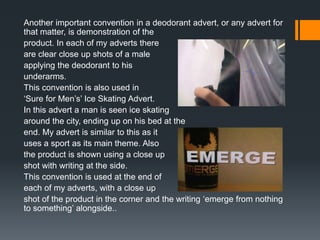
Another important convention in a deodorant advert, or any advert for
that matter, is demonstration of the
product. In each of my adverts there
are clear close up shots of a male
applying the deodorant to his
underarms.
This convention is also used in
‘Sure for Men’s’ Ice Skating Advert.
In this advert a man is seen ice skating
around the city, ending up on his bed at the
end. My advert is similar to this as it
uses a sport as its main theme. Also
the product is shown using a close up
shot with writing at the side.
This convention is used at the end of
each of my adverts, with a close up
shot of the product in the corner and the writing ‘emerge from nothing
to something’ alongside..
However, my advert is different in the style that it’s presented
in. The ‘Sure for Men advert’ uses a calmer more elegant style
in its filming and music choice. Whereas my adverts take a
straighter to the point approach, using livelier soundtracks and
a more action styled sequence. Through each of my 3 visual
adverts, I
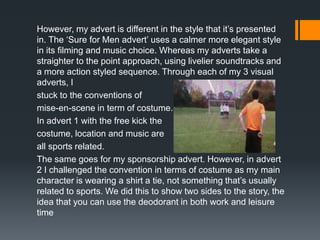
stuck to the conventions of
mise-en-scene in term of costume.
In advert 1 with the free kick the
costume, location and music are
all sports related.
The same goes for my sponsorship advert. However, in advert
2 I challenged the convention in terms of costume as my main
character is wearing a shirt a tie, not something that’s usually
related to sports. We did this to show two sides to the story, the
idea that you can use the deodorant in both work and leisure
time
In nearly all adverts today music is a key feature and selling point
as its attractive and adds vibrancy to them. Music is especially
important in deodorant adverts as it helps to create a fast paced
atmosphere, particularly in sport deodorant adverts such as mine.
For example, in the Lucozade adverts, although not the same
product as mine, Lucozade gives the same message of
performance enhancing. These adverts all use fast paced music
and sports themes to get their idea across and sell the product.
In their advert for their product ‘sport lite’ they use the song
‘Louder’ by DJ Fresh, this gives the advert a fast paced and
energetic feeling, helping to get the message across. In my
adverts, fast paced tracks are also used to give this same
atmosphere and message, however I developed it further in my
advert with the guy doing kick ups and used a track that could be
related to the sport used (football). The track is called ‘Return of
the Tres’ which I took from a short clip from Nikes ‘Joga Bonito’
football videos on YouTube, and created an energetic, sporty
feeling within the advert.
(http://www.youtube.com/watch?v=9T_LiUAVl4g)
How effective is the combination of
your main product and ancillary
texts?
What have you learned from
your audience feedback?
How did you use new media
technologies in the construction
and research, planning and
evaluation stages?
Technology is rapidly advancing and this means that there are
more media technologies now than there has ever been.
These opened loads of doors for me as it meant that I could
research, plan and evaluate my project all using technology.
The researching stage, I used a range of web pages both in
school and out, including YouTube and Survey Monkey. Once I
had concreted the idea I was going to use I started watching a
variety of adverts on YouTube related to that product and
evaluating them, including those of ‘Lynx’ and ‘Sure For Men’,
this helped me to gain an insight into the typical conventions
you would see in a deodorant advert. I also watched a number
of adverts that weren’t related to the product I was using and
evaluated them, including that of ‘Marks and Spencer’ and
‘Cadburys’, this was just to gain a broader knowledge of what
adverts in general included. YouTube also came in handy
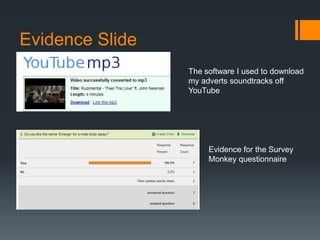
when it came to downloading sound effects such as the
referee’s whistle used in Advert 1: the football match. I found
the sound effect on YouTube, copied the URL and pasted it
into a YouTube to mp3 converter which downloaded the file for
me. (see evidence slide)
After researching the conventions I used Survey Monkey to
create a questionnaire asking what people liked and disliked
about deodorant adverts and whether they liked the name of
the product itself and its slogan (see evidence slide). The
questions included ‘do you exercise/play sports?’ and ‘do you
use deodorant’. The questionnaire was then sent using
Microsoft outlook to people from a local sixth form that
matched the target audience, and the results were sent back to
me. This was really useful in giving me an even bigger idea of
what to include in my adverts and how they should be
addressed. Outlook was easy and extremely practical to use
and allowed me to send a blanket email to a group of people,
saving me a lot of time.
The internet was also helpful in providing me with a guideline
of the do’s and don’ts when it comes to creating an advert.
Particularly a document on the ASA which gave me a list of
typical advert conventions and even a list of banned adverts
and reasons as to why they weren’t broadcasted.
Technology played its biggest role when it came to the
practical side of the project. The adverts were filmed using a
small, portable DV camera. The main advantage of these
cameras is their small size, they allowed me to get shots that I
maybe wouldn’t have been able to get with a larger camera
and also meant that track shots were much easier to film as
the camera was light and easy to run with. They were also
practical in moving from location to location, because they
were lightweight and portable and could easily be kept in a
bag, unlike the extremely large cameras used in the industry. A
good thing about the DV cameras was its rotatable screen
which allowed us to watch what we were filming as we did it;
this therefore meant I could make sure the shots I was filming
were effective and looked professional. A disadvantage of the
cameras however is their battery life, which is typically rather
short. This had to be taken into consideration when going out
to film as any time wasting could result in a dead camera
before the filming is complete. Another problem was the
lighting, the cameras were poor when it came to picking up
light so we weren’t able to film in darker conditions and
therefore had to film in the morning or early afternoon,
something which, again had to be taken into consideration
when planning the task.
The final part of the project also used technology significantly,
including the use of Apple Macs and particularly it’s built in
movie editing programme ‘iMovie’. The programme was
extremely helpful when it came to editing the film; it was user
friendly and easily imported my clips into it. Clips could be
cropped and moved around easily and this meant the film
could be put together with sounds and music smoothly. Using
iMovie allowed me to easily apply writing over my video clips
meaning I could add ‘EMERGE’ in writing at the end of each
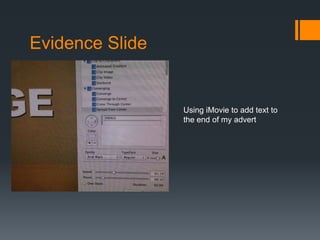
advert (see evidence slide) However, at times the software
crashed leaving us with unsaved work that had to be done;
luckily we weren’t that far into editing anyway. Also, when
applying effects such as slow motion I found that the clip would
just disappear altogether leaving a blank screen until I
reversed the effect back to normal.
Evidence Slide
The software I used to download
my adverts soundtracks off
YouTube
Evidence for the Survey
Monkey questionnaire
Evidence Slide
Using iMovie to add text to
the end of my advert

G324 Advanced Portfolio: Evaluation

  • 1.
    How did youuse new media technologies in the construction and research planning and evaluation stages?
  • 2.
    In what waysdoes your media product use, develop or challenge forms and conventions of real media products?
  • 3.
    The product thatmy group chose to run with was a deodorant called Emerge along with the slogan ‘from nothing to something’. For starters, the message the slogan is giving is similar to the idea and plot of most deodorant adverts nowadays, the idea that using the product will benefit you and turn you into something that you weren’t before. For example, the Lynx adverts all use the idea that using their spray will get you the girls. One of their most stand-out adverts shows a man on the beach spraying Lynx on followed by a large crowd of girls running towards him. (http://www.youtube.com/watch?v=S-uVc13oDBI) This is similar to the message from my product as it shows that he’s gone from being nothing to something by simply using the product. The way in which my product challenges typical conventions of a deodorant advert is by addressing the audience in a serious manner. Popular deodorants such a Lynx and even the new ‘Old Spice’ use comedy to try and sell their product. The ‘Old Spice’ advert shows a man speaking directly to the audience in a comedic voice telling them all the nice things they could have if they used that deodorant. http://www.youtube.com/watch?v=owGykVbfgUE However the message is still the same, the idea that using the product will make you something that you weren’t before.
  • 4.
    Another important conventionin a deodorant advert, or any advert for that matter, is demonstration of the product. In each of my adverts there are clear close up shots of a male applying the deodorant to his underarms. This convention is also used in ‘Sure for Men’s’ Ice Skating Advert. In this advert a man is seen ice skating around the city, ending up on his bed at the end. My advert is similar to this as it uses a sport as its main theme. Also the product is shown using a close up shot with writing at the side. This convention is used at the end of each of my adverts, with a close up shot of the product in the corner and the writing ‘emerge from nothing to something’ alongside..
  • 5.
    However, my advertis different in the style that it’s presented in. The ‘Sure for Men advert’ uses a calmer more elegant style in its filming and music choice. Whereas my adverts take a straighter to the point approach, using livelier soundtracks and a more action styled sequence. Through each of my 3 visual adverts, I stuck to the conventions of mise-en-scene in term of costume. In advert 1 with the free kick the costume, location and music are all sports related. The same goes for my sponsorship advert. However, in advert 2 I challenged the convention in terms of costume as my main character is wearing a shirt a tie, not something that’s usually related to sports. We did this to show two sides to the story, the idea that you can use the deodorant in both work and leisure time
  • 6.
    In nearly alladverts today music is a key feature and selling point as its attractive and adds vibrancy to them. Music is especially important in deodorant adverts as it helps to create a fast paced atmosphere, particularly in sport deodorant adverts such as mine. For example, in the Lucozade adverts, although not the same product as mine, Lucozade gives the same message of performance enhancing. These adverts all use fast paced music and sports themes to get their idea across and sell the product. In their advert for their product ‘sport lite’ they use the song ‘Louder’ by DJ Fresh, this gives the advert a fast paced and energetic feeling, helping to get the message across. In my adverts, fast paced tracks are also used to give this same atmosphere and message, however I developed it further in my advert with the guy doing kick ups and used a track that could be related to the sport used (football). The track is called ‘Return of the Tres’ which I took from a short clip from Nikes ‘Joga Bonito’ football videos on YouTube, and created an energetic, sporty feeling within the advert. (http://www.youtube.com/watch?v=9T_LiUAVl4g)
  • 7.
    How effective isthe combination of your main product and ancillary texts?
  • 9.
    What have youlearned from your audience feedback?
  • 11.
    How did youuse new media technologies in the construction and research, planning and evaluation stages?
  • 12.
    Technology is rapidlyadvancing and this means that there are more media technologies now than there has ever been. These opened loads of doors for me as it meant that I could research, plan and evaluate my project all using technology. The researching stage, I used a range of web pages both in school and out, including YouTube and Survey Monkey. Once I had concreted the idea I was going to use I started watching a variety of adverts on YouTube related to that product and evaluating them, including those of ‘Lynx’ and ‘Sure For Men’, this helped me to gain an insight into the typical conventions you would see in a deodorant advert. I also watched a number of adverts that weren’t related to the product I was using and evaluated them, including that of ‘Marks and Spencer’ and ‘Cadburys’, this was just to gain a broader knowledge of what adverts in general included. YouTube also came in handy when it came to downloading sound effects such as the referee’s whistle used in Advert 1: the football match. I found the sound effect on YouTube, copied the URL and pasted it into a YouTube to mp3 converter which downloaded the file for me. (see evidence slide)
  • 13.
    After researching theconventions I used Survey Monkey to create a questionnaire asking what people liked and disliked about deodorant adverts and whether they liked the name of the product itself and its slogan (see evidence slide). The questions included ‘do you exercise/play sports?’ and ‘do you use deodorant’. The questionnaire was then sent using Microsoft outlook to people from a local sixth form that matched the target audience, and the results were sent back to me. This was really useful in giving me an even bigger idea of what to include in my adverts and how they should be addressed. Outlook was easy and extremely practical to use and allowed me to send a blanket email to a group of people, saving me a lot of time. The internet was also helpful in providing me with a guideline of the do’s and don’ts when it comes to creating an advert. Particularly a document on the ASA which gave me a list of typical advert conventions and even a list of banned adverts and reasons as to why they weren’t broadcasted.
  • 14.
    Technology played itsbiggest role when it came to the practical side of the project. The adverts were filmed using a small, portable DV camera. The main advantage of these cameras is their small size, they allowed me to get shots that I maybe wouldn’t have been able to get with a larger camera and also meant that track shots were much easier to film as the camera was light and easy to run with. They were also practical in moving from location to location, because they were lightweight and portable and could easily be kept in a bag, unlike the extremely large cameras used in the industry. A good thing about the DV cameras was its rotatable screen which allowed us to watch what we were filming as we did it; this therefore meant I could make sure the shots I was filming were effective and looked professional. A disadvantage of the cameras however is their battery life, which is typically rather short. This had to be taken into consideration when going out to film as any time wasting could result in a dead camera before the filming is complete. Another problem was the lighting, the cameras were poor when it came to picking up light so we weren’t able to film in darker conditions and therefore had to film in the morning or early afternoon, something which, again had to be taken into consideration when planning the task.
  • 15.
    The final partof the project also used technology significantly, including the use of Apple Macs and particularly it’s built in movie editing programme ‘iMovie’. The programme was extremely helpful when it came to editing the film; it was user friendly and easily imported my clips into it. Clips could be cropped and moved around easily and this meant the film could be put together with sounds and music smoothly. Using iMovie allowed me to easily apply writing over my video clips meaning I could add ‘EMERGE’ in writing at the end of each advert (see evidence slide) However, at times the software crashed leaving us with unsaved work that had to be done; luckily we weren’t that far into editing anyway. Also, when applying effects such as slow motion I found that the clip would just disappear altogether leaving a blank screen until I reversed the effect back to normal.
  • 16.
    Evidence Slide The softwareI used to download my adverts soundtracks off YouTube Evidence for the Survey Monkey questionnaire
  • 17.
    Evidence Slide Using iMovieto add text to the end of my advert