Design and Construction of Hardware
Extensions (Add-Ons) for a Modular
Self-Reconfigurable Robot System
Mohamed Marei
ACS420
Presentation Outline
• Introduction (MSR)
• Hi-Gen Module
• Hardware Extensions (Add-Ons)
• Architecture
• Design
• Phase 1: Hardware (Electronics)
• Phase 2: Hardware (Chassis)
• Phase 3: Software Design
• Add-on Testing
• Conclusion and Further Work
• Questions
Aims and Objectives
Aims
• Study, design, and build a hardware add-on for a Modular Self-Reconfigurable
Robot (MSR) system under development (the HiGen Module)
Objectives
• Research MSR theory and implementations
• Research applications of MSR systems
• Design and build a hardware add-on (extension) for the HiGen module
• Program and test the hardware add-on
• Conduct experiments to assess the utility of the add-on
Introduction (MSR)
• Modular Self-Reconfigurable Robots (MSR)
• Concept credited to Fukuda (Dynamically Reconfigurable Robot) [1]
• Designed to fit any given task through reconfiguration
• Lattice, Chain, and Hybrid Architectures
• Homogeneous, Heterogeneous
ATRON: Snake and vehicle-like
[2]
Thor: Heterogeneous MSR
[3]
SuperBot: Bipedal Configuration
[4]
HiGen Module
• HiGen: High-speed Genderless Mechanical Connection Mechanism for Self-
Reconfigurable Modular Robots
• Genderless nature enables single-sided disconnect
• HiGen Module: Modular robot with four HiGen connectors
HiGen Module
[6]
Standalone HiGen Connector
[5]
Hardware Extensions (Add-Ons)
• Add functional “tools” to the robot
• Increase the utility of the robot
• Tool examples: sensors (camera modules); functional (grippers, wheels, etc.)
CKBot with camera module
[7]
Add-on Modules of Thor
[2]
Architecture
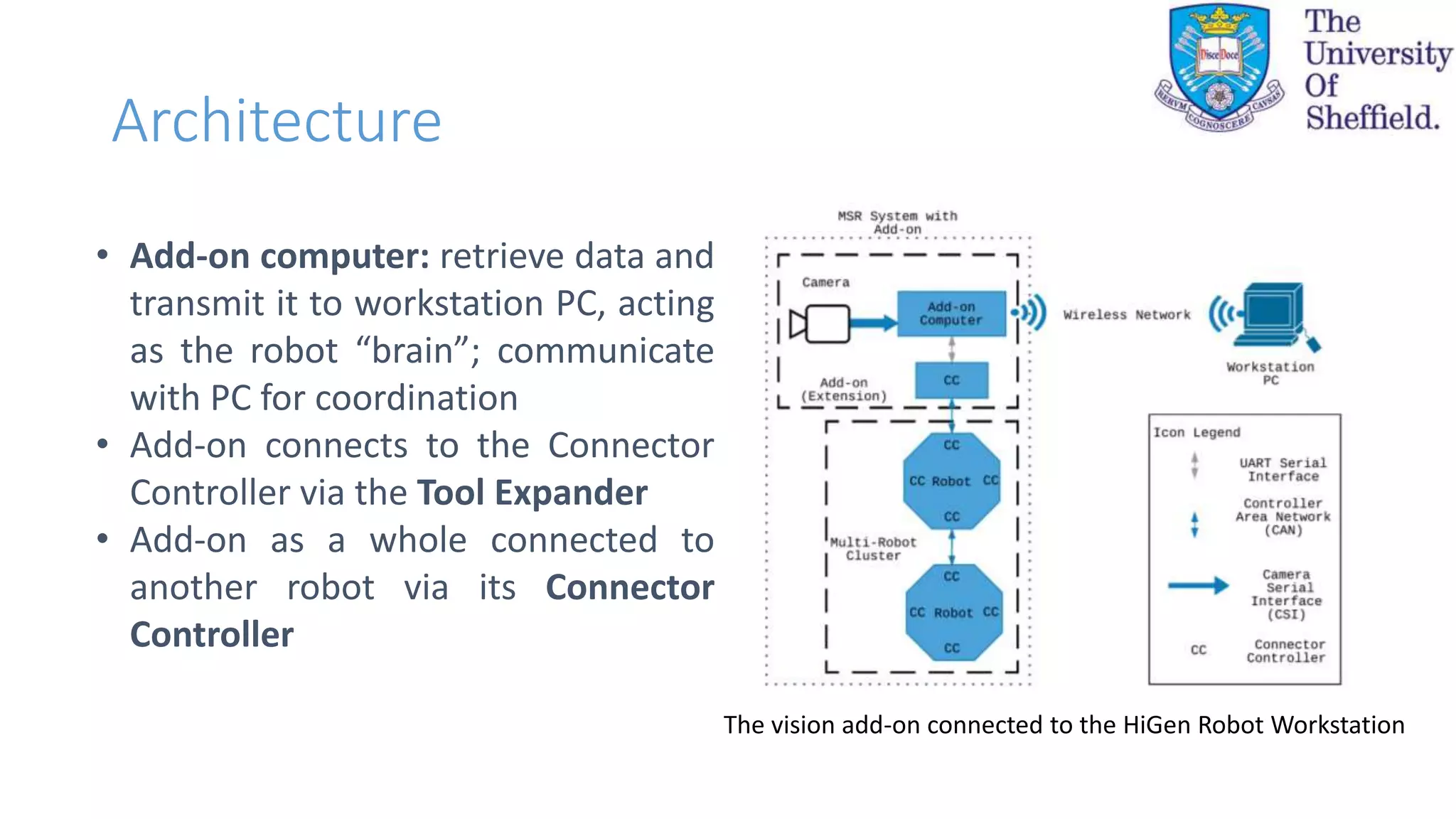
• Add-on computer: retrieve data and
transmit it to workstation PC, acting
as the robot “brain”; communicate
with PC for coordination
• Add-on connects to the Connector
Controller via the Tool Expander
• Add-on as a whole connected to
another robot via its Connector
Controller
The vision add-on connected to the HiGen Robot Workstation
Phase 1: Electronics Design
• Research into previous implementations of camera add-ons
• Based on Requirements decided with C. Parrott
• SBC (Single-board Computer) as the “brain” of the add-on
• Research into SBC’s  Raspberry Pi Model A+ and NoIR Camera
Raspberry Pi Model A+Raspberry Pi NoIR Camera Teensy 3.2 Board Connector Controller
[Parrott]
Phase 1 (Continued): Power Consumption
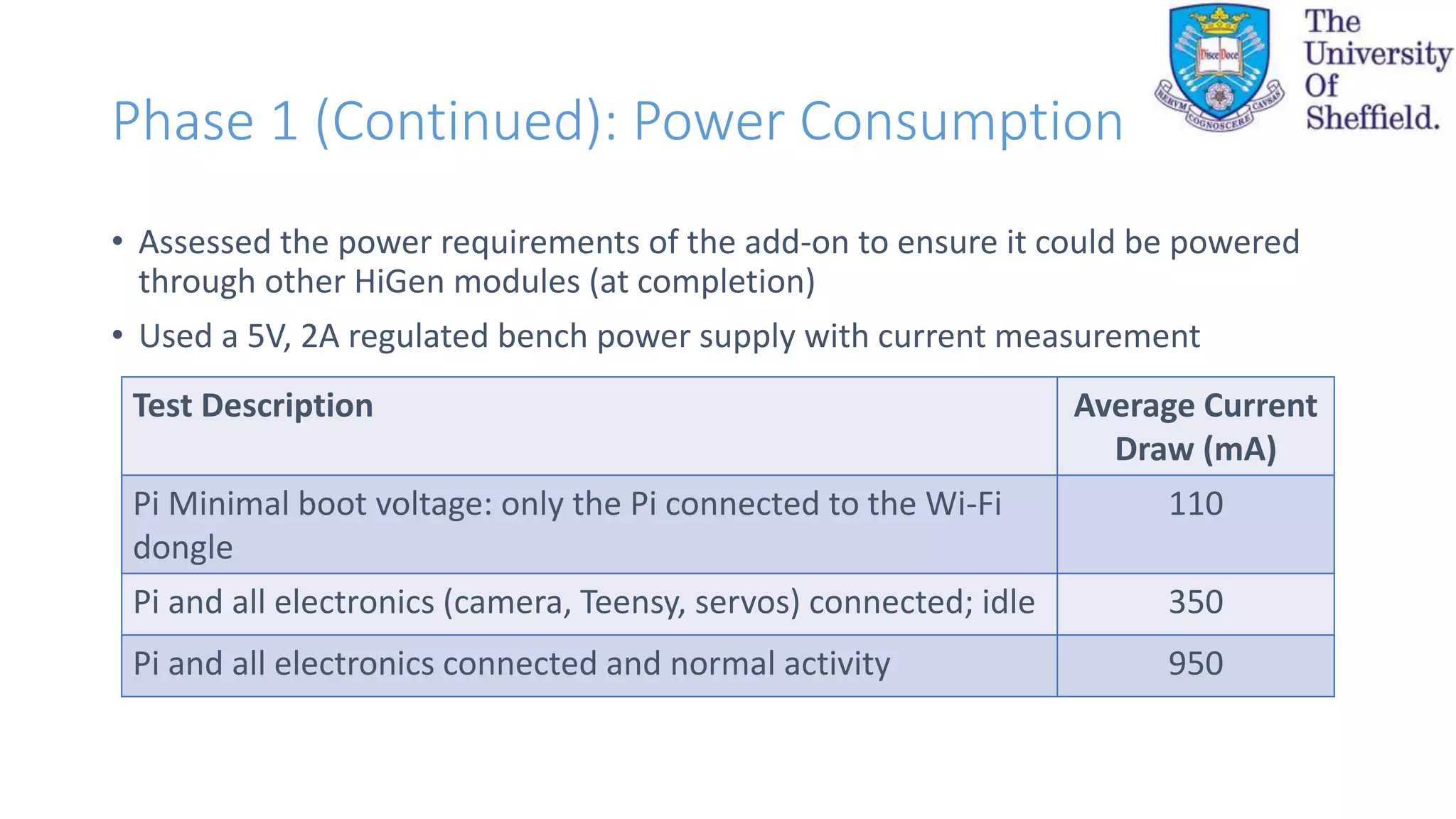
• Assessed the power requirements of the add-on to ensure it could be powered
through other HiGen modules (at completion)
• Used a 5V, 2A regulated bench power supply with current measurement
Test Description Average Current
Draw (mA)
Pi Minimal boot voltage: only the Pi connected to the Wi-Fi
dongle
110
Pi and all electronics (camera, Teensy, servos) connected; idle 350
Pi and all electronics connected and normal activity 950
Phase 1 (Continued): Electronics
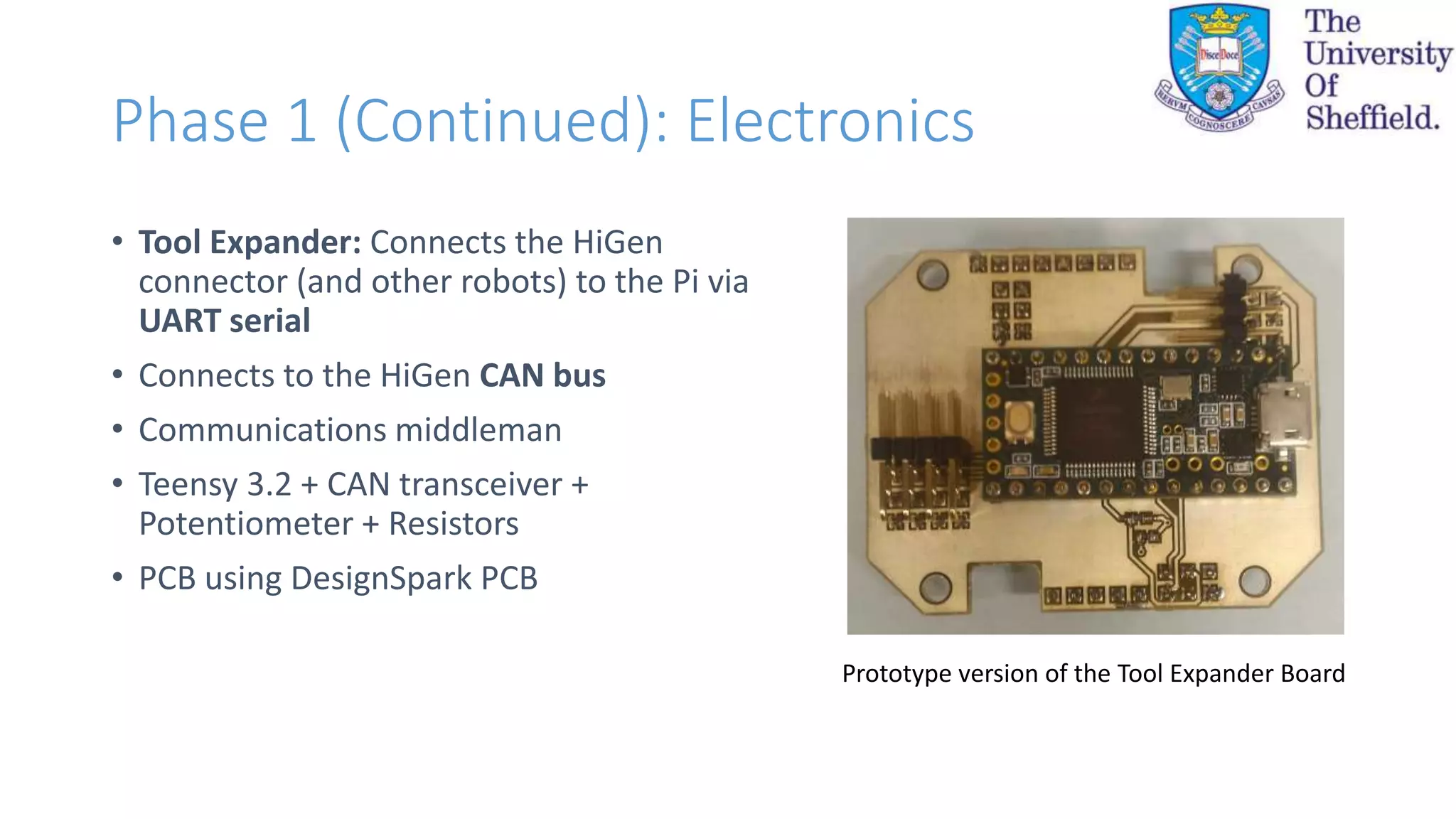
• Tool Expander: Connects the HiGen
connector (and other robots) to the Pi via
UART serial
• Connects to the HiGen CAN bus
• Communications middleman
• Teensy 3.2 + CAN transceiver +
Potentiometer + Resistors
• PCB using DesignSpark PCB
Prototype version of the Tool Expander Board
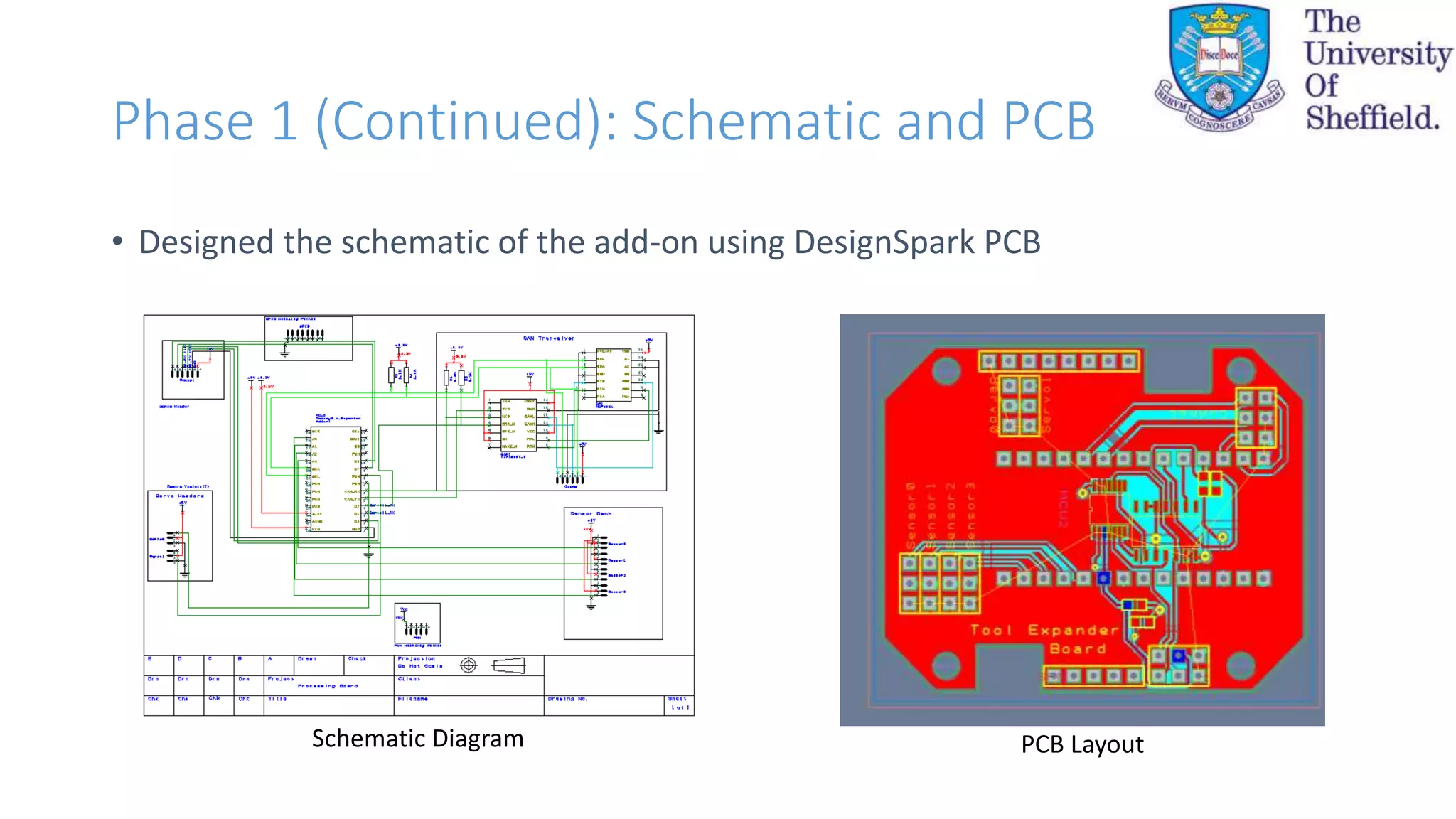
Phase 1 (Continued): Schematic and PCB
• Designed the schematic of the add-on using DesignSpark PCB
Schematic Diagram PCB Layout
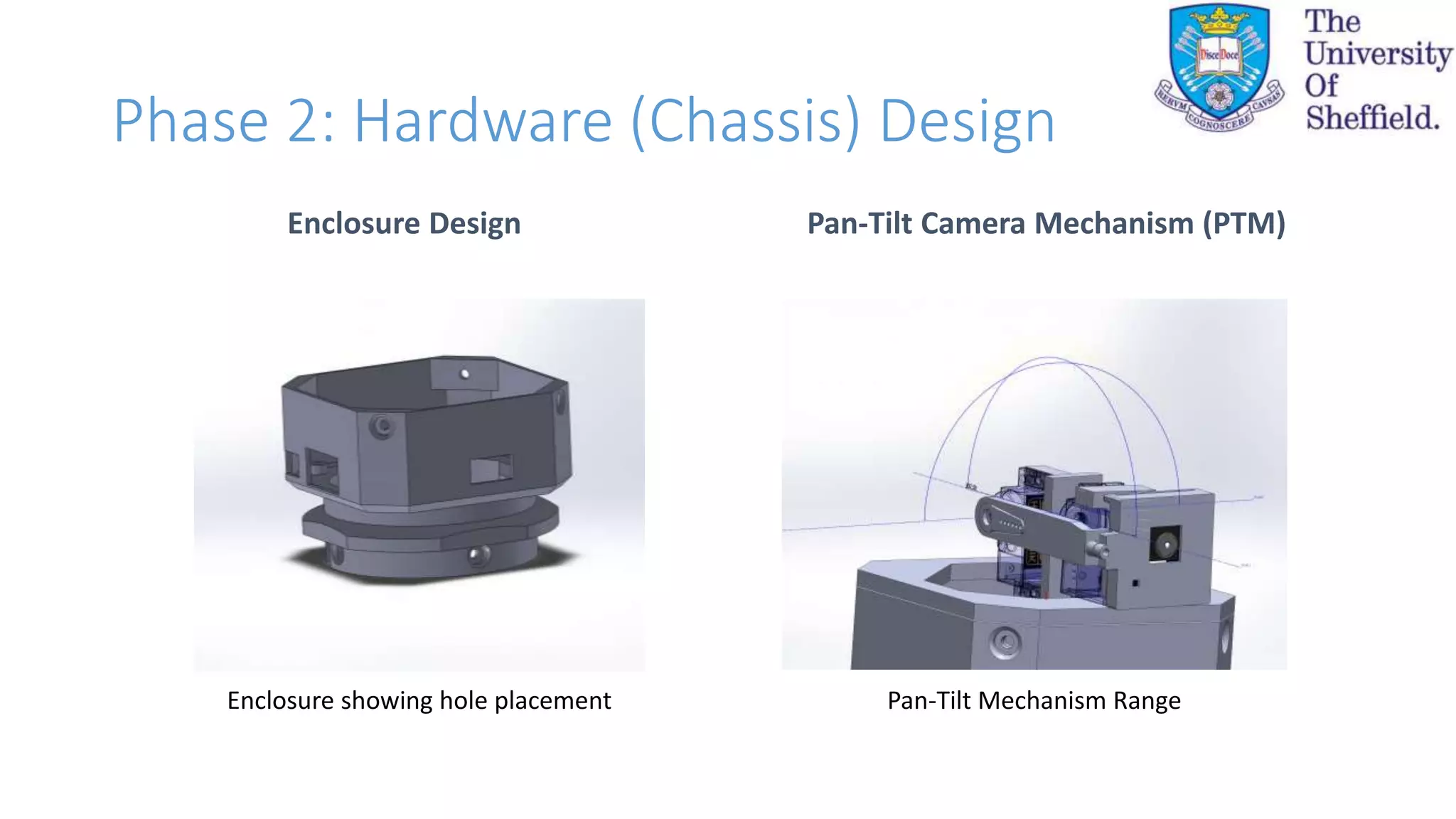
Phase 2: Hardware (Chassis) Design
Pan-Tilt Camera Mechanism (PTM)Enclosure Design
Pan-Tilt Mechanism RangeEnclosure showing hole placement
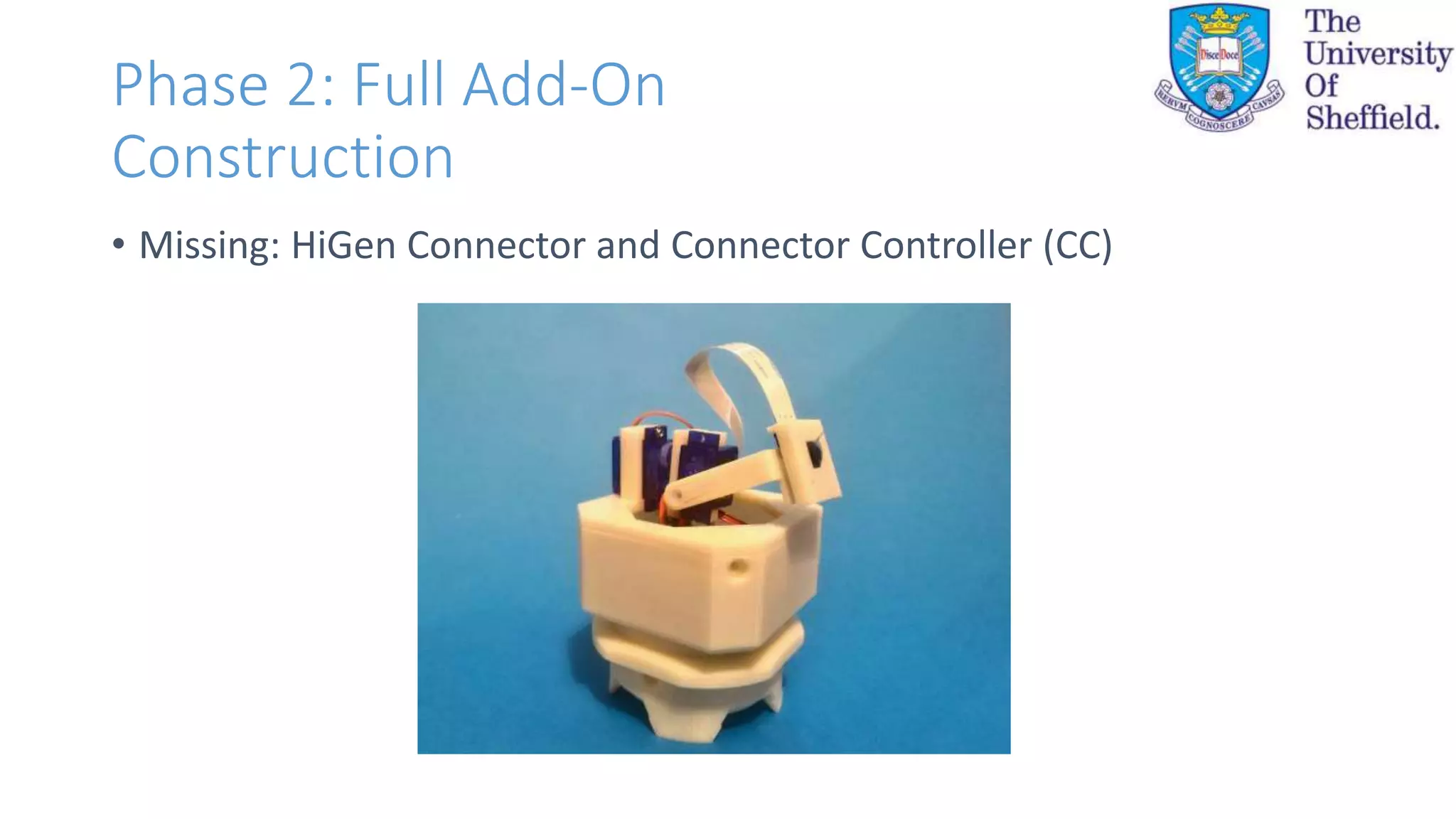
Phase 2: Full Add-On
Construction
• Missing: HiGen Connector and Connector Controller (CC)
Phase 3: Software Design
• Step 1: Operating System (OS) Selection
• Raspbian Wheezy (variant of Linux Debian)
• MATLAB and Simulink support package
• Step 2: Networking
• Wi-Fi Configuration
• Secure Shell (SSH)
• MATLAB command window
• Step 3: Motor Control
• Teensy 3.2 Microcontroller
• Microcontroller programming to control servos
Phase 3 (Continued): MATLAB
• Data acquisition
• Lightweight image processing (as opposed to using e.g. OpenCV [8])
• Simulink support package for hardware: Raspberry Pi and ARM
Microcontrollers
• Control design made easier through Simulink
• Integration of the steps in software design (Step 1, Step 2, and Step 3)
• Internet of Things support using ThingSpeak (later)
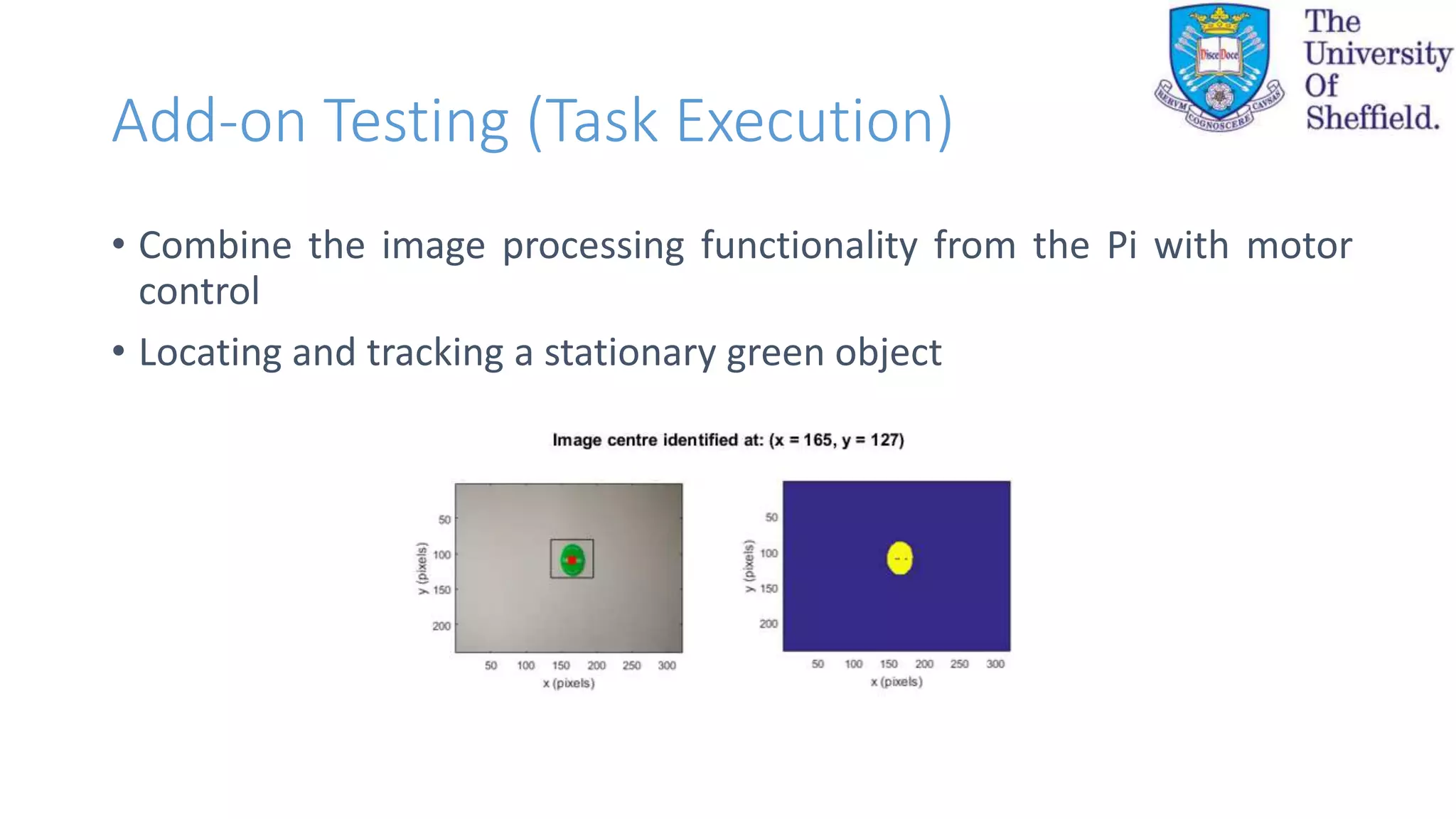
Add-on Testing (Task Execution)
• Combine the image processing functionality from the Pi with motor
control
• Locating and tracking a stationary green object
Add-On Testing (Task Execution)
• Attempted to integrate tracking functionality with servo control
to track a moving object
• Serial communication pathway from Pi Tool Expander: problem
• Instrument Control Toolbox: successful communication with Tool
Expander
• Explored alternative: design communication system in Simulink
• Integration still failed
• Third alternative: PC-in-the-loop
• Successful communication between Pi, Tool Expander and PC
Add-On Testing (Control and Data
Acquisition)
• Pan-tilt tracking: modelling using framework outlined by Chen et al. [9]
• Experiment: Object fixed distance and position away from add-on
• Constant position  constant tracking angles
• Not the case
Conclusion and Further Work
Achievements
• Hardware design of the add-on
• Successful programming and testing independent functions
• Attempted to combine functionality but faced problems
• Demonstrated the add-on’s ability to execute application-relevant tasks and acquire data
• Attempted to model and simulate the pan-tilt auto-tracking problem to develop a controller
Further Work
• Finalize integration and test with Connector Controller and HiGen connector
• Verify tracking model and implement on the Raspberry Pi
• Exploit the Raspberry Pi to enable Internet of Things (IoT) access through ThingSpeak [10]
Questions?
Thank You
References
• [1] Fukuda, T., & Nakagawa, S. (1987, October). A dynamically reconfigurable robotic system (concept of a system and optimal
configurations). In Robotics and IECON'87 Conferences (pp. 588-595). International Society for Optics and Photonics.
• [2] Østergaard, E. H., Kassow, K., Beck, R., & Lund, H. H. (2006). Design of the ATRON lattice-based self-reconfigurable robot.
Autonomous Robots, 21(2), 165-183.
• [3] Salemi, B., Moll, M., & Shen, W. M. (2006, October). SUPERBOT: A deployable, multi-functional, and modular self-
reconfigurable robotic system. In Intelligent Robots and Systems, 2006 IEEE/RSJ International Conference on (pp. 3636-3641). IEEE.
• [4] Lyder, A., Garcia, R. F. M., & Stoy, K. (2010). Genderless connection mechanism for modular robots introducing torque
transmission between modules. In Proceedings of the ICRA Workshop on Modular Robots, State of the Art (pp. 77-81).
• [5] Parrott, C., Dodd, T. J., & Gross, R. (2014, September). HiGen: A high-speed genderless mechanical connection mechanism with
single-sided disconnect for self-reconfigurable modular robots. In Intelligent Robots and Systems (IROS 2014), 2014 IEEE/RSJ
International Conference on (pp. 3926-3932). IEEE.
• [6] Parrott, C., Dodd, T. J., & Gross, R. (2014) Towards a 3-DOF mobile and self-reconfigurable modular robot.
• [7] Shirmohammadi, B., Taylor, C. J., Yim, M., Sastra, J., & Park, M. (2007, September). Using smart cameras to localize self-
assembling modular robots. In Distributed Smart Cameras, 2007. ICDSC'07. First ACM/IEEE International Conference on (pp. 76-
80). IEEE.
• [8] Open-Source Computer Vision Library (OpenCV). URL: http://opencv.org/
• [9] Chen, G., St-Charles, P. L., Bouachir, W., Bilodeau, G. A., & Bergevin, R. (2015, September). Reproducible Evaluation of
Pan-Tilt-Zoom Tracking. In Image Processing (ICIP), 2015 IEEE International Conference on (pp. 2055-2059). IEEE.
• [10] The Internet of Things: ThingSpeak. URL: https://thingspeak.com

FYP Presentation MAREI

  • 1.
    Design and Constructionof Hardware Extensions (Add-Ons) for a Modular Self-Reconfigurable Robot System Mohamed Marei ACS420
  • 2.
    Presentation Outline • Introduction(MSR) • Hi-Gen Module • Hardware Extensions (Add-Ons) • Architecture • Design • Phase 1: Hardware (Electronics) • Phase 2: Hardware (Chassis) • Phase 3: Software Design • Add-on Testing • Conclusion and Further Work • Questions
  • 3.
    Aims and Objectives Aims •Study, design, and build a hardware add-on for a Modular Self-Reconfigurable Robot (MSR) system under development (the HiGen Module) Objectives • Research MSR theory and implementations • Research applications of MSR systems • Design and build a hardware add-on (extension) for the HiGen module • Program and test the hardware add-on • Conduct experiments to assess the utility of the add-on
  • 4.
    Introduction (MSR) • ModularSelf-Reconfigurable Robots (MSR) • Concept credited to Fukuda (Dynamically Reconfigurable Robot) [1] • Designed to fit any given task through reconfiguration • Lattice, Chain, and Hybrid Architectures • Homogeneous, Heterogeneous ATRON: Snake and vehicle-like [2] Thor: Heterogeneous MSR [3] SuperBot: Bipedal Configuration [4]
  • 5.
    HiGen Module • HiGen:High-speed Genderless Mechanical Connection Mechanism for Self- Reconfigurable Modular Robots • Genderless nature enables single-sided disconnect • HiGen Module: Modular robot with four HiGen connectors HiGen Module [6] Standalone HiGen Connector [5]
  • 6.
    Hardware Extensions (Add-Ons) •Add functional “tools” to the robot • Increase the utility of the robot • Tool examples: sensors (camera modules); functional (grippers, wheels, etc.) CKBot with camera module [7] Add-on Modules of Thor [2]
  • 7.
    Architecture • Add-on computer:retrieve data and transmit it to workstation PC, acting as the robot “brain”; communicate with PC for coordination • Add-on connects to the Connector Controller via the Tool Expander • Add-on as a whole connected to another robot via its Connector Controller The vision add-on connected to the HiGen Robot Workstation
  • 8.
    Phase 1: ElectronicsDesign • Research into previous implementations of camera add-ons • Based on Requirements decided with C. Parrott • SBC (Single-board Computer) as the “brain” of the add-on • Research into SBC’s  Raspberry Pi Model A+ and NoIR Camera Raspberry Pi Model A+Raspberry Pi NoIR Camera Teensy 3.2 Board Connector Controller [Parrott]
  • 9.
    Phase 1 (Continued):Power Consumption • Assessed the power requirements of the add-on to ensure it could be powered through other HiGen modules (at completion) • Used a 5V, 2A regulated bench power supply with current measurement Test Description Average Current Draw (mA) Pi Minimal boot voltage: only the Pi connected to the Wi-Fi dongle 110 Pi and all electronics (camera, Teensy, servos) connected; idle 350 Pi and all electronics connected and normal activity 950
  • 10.
    Phase 1 (Continued):Electronics • Tool Expander: Connects the HiGen connector (and other robots) to the Pi via UART serial • Connects to the HiGen CAN bus • Communications middleman • Teensy 3.2 + CAN transceiver + Potentiometer + Resistors • PCB using DesignSpark PCB Prototype version of the Tool Expander Board
  • 11.
    Phase 1 (Continued):Schematic and PCB • Designed the schematic of the add-on using DesignSpark PCB Schematic Diagram PCB Layout
  • 12.
    Phase 2: Hardware(Chassis) Design Pan-Tilt Camera Mechanism (PTM)Enclosure Design Pan-Tilt Mechanism RangeEnclosure showing hole placement
  • 13.
    Phase 2: FullAdd-On Construction • Missing: HiGen Connector and Connector Controller (CC)
  • 14.
    Phase 3: SoftwareDesign • Step 1: Operating System (OS) Selection • Raspbian Wheezy (variant of Linux Debian) • MATLAB and Simulink support package • Step 2: Networking • Wi-Fi Configuration • Secure Shell (SSH) • MATLAB command window • Step 3: Motor Control • Teensy 3.2 Microcontroller • Microcontroller programming to control servos
  • 15.
    Phase 3 (Continued):MATLAB • Data acquisition • Lightweight image processing (as opposed to using e.g. OpenCV [8]) • Simulink support package for hardware: Raspberry Pi and ARM Microcontrollers • Control design made easier through Simulink • Integration of the steps in software design (Step 1, Step 2, and Step 3) • Internet of Things support using ThingSpeak (later)
  • 16.
    Add-on Testing (TaskExecution) • Combine the image processing functionality from the Pi with motor control • Locating and tracking a stationary green object
  • 17.
    Add-On Testing (TaskExecution) • Attempted to integrate tracking functionality with servo control to track a moving object • Serial communication pathway from Pi Tool Expander: problem • Instrument Control Toolbox: successful communication with Tool Expander • Explored alternative: design communication system in Simulink • Integration still failed • Third alternative: PC-in-the-loop • Successful communication between Pi, Tool Expander and PC
  • 18.
    Add-On Testing (Controland Data Acquisition) • Pan-tilt tracking: modelling using framework outlined by Chen et al. [9] • Experiment: Object fixed distance and position away from add-on • Constant position  constant tracking angles • Not the case
  • 19.
    Conclusion and FurtherWork Achievements • Hardware design of the add-on • Successful programming and testing independent functions • Attempted to combine functionality but faced problems • Demonstrated the add-on’s ability to execute application-relevant tasks and acquire data • Attempted to model and simulate the pan-tilt auto-tracking problem to develop a controller Further Work • Finalize integration and test with Connector Controller and HiGen connector • Verify tracking model and implement on the Raspberry Pi • Exploit the Raspberry Pi to enable Internet of Things (IoT) access through ThingSpeak [10]
  • 20.
  • 21.
    References • [1] Fukuda,T., & Nakagawa, S. (1987, October). A dynamically reconfigurable robotic system (concept of a system and optimal configurations). In Robotics and IECON'87 Conferences (pp. 588-595). International Society for Optics and Photonics. • [2] Østergaard, E. H., Kassow, K., Beck, R., & Lund, H. H. (2006). Design of the ATRON lattice-based self-reconfigurable robot. Autonomous Robots, 21(2), 165-183. • [3] Salemi, B., Moll, M., & Shen, W. M. (2006, October). SUPERBOT: A deployable, multi-functional, and modular self- reconfigurable robotic system. In Intelligent Robots and Systems, 2006 IEEE/RSJ International Conference on (pp. 3636-3641). IEEE. • [4] Lyder, A., Garcia, R. F. M., & Stoy, K. (2010). Genderless connection mechanism for modular robots introducing torque transmission between modules. In Proceedings of the ICRA Workshop on Modular Robots, State of the Art (pp. 77-81). • [5] Parrott, C., Dodd, T. J., & Gross, R. (2014, September). HiGen: A high-speed genderless mechanical connection mechanism with single-sided disconnect for self-reconfigurable modular robots. In Intelligent Robots and Systems (IROS 2014), 2014 IEEE/RSJ International Conference on (pp. 3926-3932). IEEE. • [6] Parrott, C., Dodd, T. J., & Gross, R. (2014) Towards a 3-DOF mobile and self-reconfigurable modular robot. • [7] Shirmohammadi, B., Taylor, C. J., Yim, M., Sastra, J., & Park, M. (2007, September). Using smart cameras to localize self- assembling modular robots. In Distributed Smart Cameras, 2007. ICDSC'07. First ACM/IEEE International Conference on (pp. 76- 80). IEEE. • [8] Open-Source Computer Vision Library (OpenCV). URL: http://opencv.org/ • [9] Chen, G., St-Charles, P. L., Bouachir, W., Bilodeau, G. A., & Bergevin, R. (2015, September). Reproducible Evaluation of Pan-Tilt-Zoom Tracking. In Image Processing (ICIP), 2015 IEEE International Conference on (pp. 2055-2059). IEEE. • [10] The Internet of Things: ThingSpeak. URL: https://thingspeak.com