FiberFit:
portable Python application
By Aza Tulepbergenov
Northwest Tissue Mechanics Laboratory
Boise State University,
Summer 2015 – Fall 2015
https://coen.boisestate.edu/ntm/fiberfit/
What it does?
• The mechanical properties of tissues in the body largely depend
on the underlying fibrillar network
• Fibrillar network can be described in terms of fiber orientation
distribution
• FiberFit quantifies fiber orientation distribution, thus allowing
researchers to gain deeper insights into tissue modeling and
injury repair
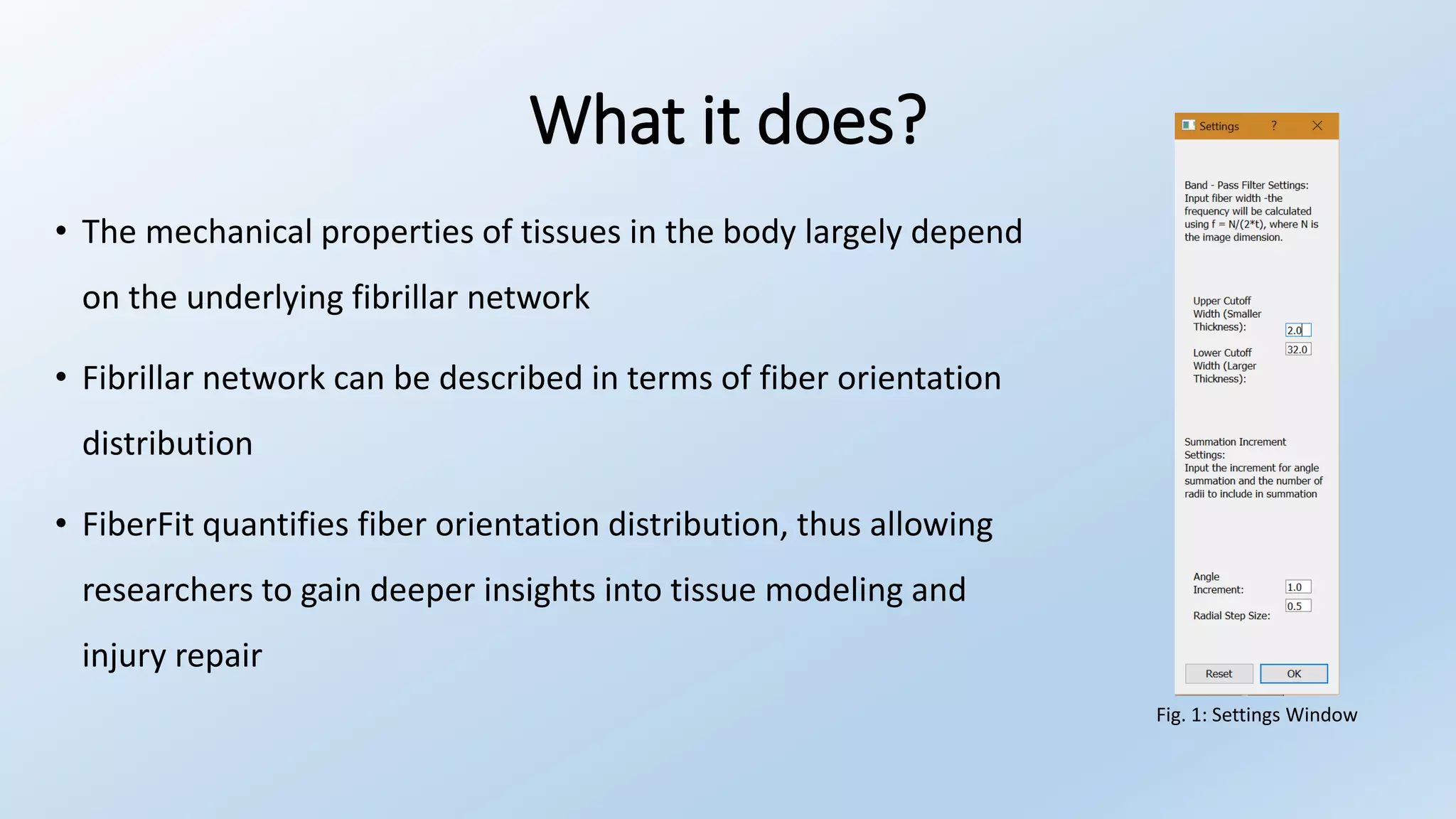
Fig. 1: Settings Window
Program Features (1)
• Python application that uses computer
vision to analyze fiber orientation in 2-D
grayscale images
• Utilizes NumPy and SciPy libraries* to
perform image analysis
• User Interface was built using Qt 5
bindings for Python
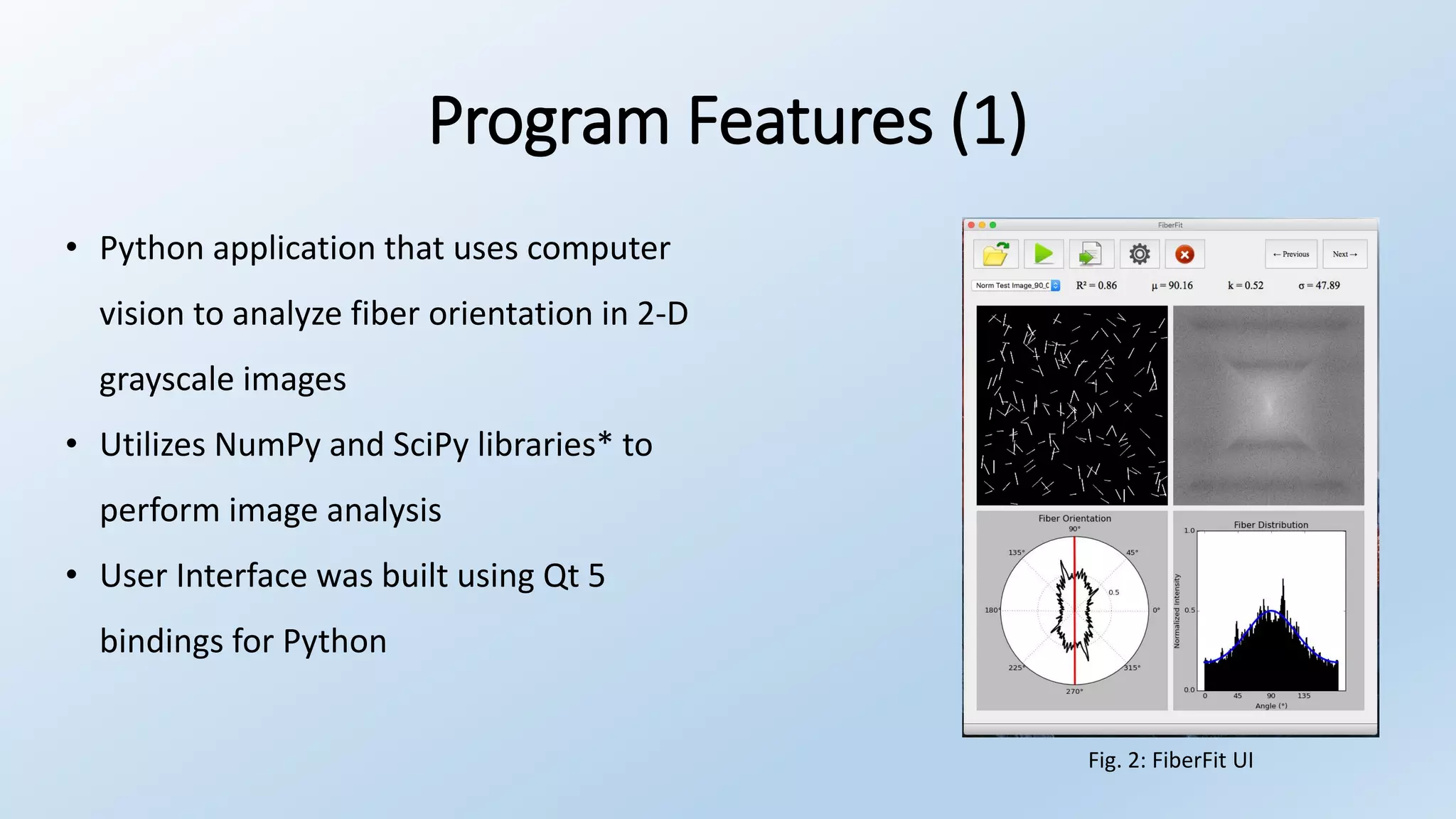
Fig. 2: FiberFit UI
Program Features (2)
• Processes multiple images
• Exports result of the analysis in PDF (utilizes open-source Python library) and csv
• Live progress bar, which updates user about status of the image analysis (utilizes
threading)
• Runs on Windows and Mac OS X without installing additional software
• Free to download at https://coen.boisestate.edu/ntm/fiberfit/
Used Technologies
• pyPDF2
• SciPy
• NumPy
• pandas
• Python standard libraries (os, time, sys)
• PyQt5
• cx_Freeze
• threading
• otool
• git
Reflection
• 2nd author of a research paper (currently under review)
• 1st author of a scientific manuscript for a research conference (currently under
review)
• Joined the project during summer of my freshman year
• Practiced agile development by constantly modifying the application based on
feedback from a graduate student and lab director
• Solved unfamiliar problems (i.e. relinking binaries in Mac OS X)

FiberFit-Demo

  • 1.
    FiberFit: portable Python application ByAza Tulepbergenov Northwest Tissue Mechanics Laboratory Boise State University, Summer 2015 – Fall 2015 https://coen.boisestate.edu/ntm/fiberfit/
  • 2.
    What it does? •The mechanical properties of tissues in the body largely depend on the underlying fibrillar network • Fibrillar network can be described in terms of fiber orientation distribution • FiberFit quantifies fiber orientation distribution, thus allowing researchers to gain deeper insights into tissue modeling and injury repair Fig. 1: Settings Window
  • 3.
    Program Features (1) •Python application that uses computer vision to analyze fiber orientation in 2-D grayscale images • Utilizes NumPy and SciPy libraries* to perform image analysis • User Interface was built using Qt 5 bindings for Python Fig. 2: FiberFit UI
  • 4.
    Program Features (2) •Processes multiple images • Exports result of the analysis in PDF (utilizes open-source Python library) and csv • Live progress bar, which updates user about status of the image analysis (utilizes threading) • Runs on Windows and Mac OS X without installing additional software • Free to download at https://coen.boisestate.edu/ntm/fiberfit/
  • 5.
    Used Technologies • pyPDF2 •SciPy • NumPy • pandas • Python standard libraries (os, time, sys) • PyQt5 • cx_Freeze • threading • otool • git
  • 6.
    Reflection • 2nd authorof a research paper (currently under review) • 1st author of a scientific manuscript for a research conference (currently under review) • Joined the project during summer of my freshman year • Practiced agile development by constantly modifying the application based on feedback from a graduate student and lab director • Solved unfamiliar problems (i.e. relinking binaries in Mac OS X)