SAFETY PRACTICES IN USING
FARM EQUIPMENT
THE COST OF ACCIDENTS
1. Physical costs – pain and suffering
2. Money – both for the injured person and the employer
3.Time off work because an accident may lead to loss of
earnings for the
individual.
For the self-employed, it could even end
their business. For the employer, there
may well be hidden costs. Many people
believe that minor injuries cost nothing
more than the price of a sticking plaster.
But people will have to spend time
dealing with the accident.They may have
to:
1. help the injured person and give first aid.
2. clean up.
3. reschedule the job.
4. repair or reset the equipment or check for faults.
5. investigate the accident and prepare reports.
6. deal with insurers or Health and Safety
Inspectors.
7. wait to have to get back to work.
8. accidents which cause damage to expensive plant
and equipment can cost even more.
TYPES OF
TRACTOR-
RELATED
ACCIDENTS
Rollovers or overturns are
generally due to driving
too fast ; striking surface
hazards such as rocks,
stumps and holes; running
into ditches; hitching high
for extra traction; driving
on steep slopes; and
operating front-end
loaders improperly.
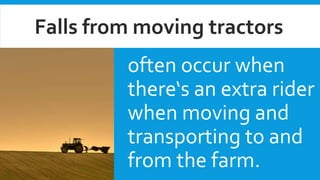
often occur when
there‘s an extra rider
when moving and
transporting to and
from the farm.
Falls from moving tractors
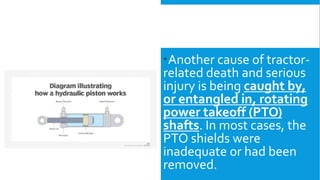
Another cause of tractor-
related death and serious
injury is being caught by,
or entangled in, rotating
power takeoff (PTO)
shafts. In most cases, the
PTO shields were
inadequate or had been
removed.
OTHER
TRACTOR-
CONNECTED
INJURIESAND
DAMAGE
INVOLVE:
1. colliding with motor
vehicles or roadside objects;
2. slipping and falling while
mounting and dismounting;
3. running over bystanders;
4. striking overhead hazards;
5. being struck by flying
objects, broken parts, or
hydraulic fluid;
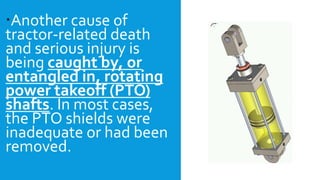
Another cause of
tractor-related death
and serious injury is
being caught by, or
entangled in, rotating
power takeoff (PTO)
shafts. In most cases,
the PTO shields were
inadequate or had been
removed.
6. being crushed by a poorly supported tractor
during repair work;
7. sustaining cuts, bruises, burns and other
nuisance, but painful injuries, connected with
maintenance and routine noperation;
8. being overcome by exhaust gases inside closed
buildings;
9. being burned by fires that erupt during refueling
or as a result of a collision or upset.
HOWTO REDUCE
THE RISK OF
TRACTOR
ACCIDENTS
Be ProperlyTrained
A person who does not know how to
operate a tractor safely in potentially
hazardous situations can be injured
or killed by exercising poor judgment.
Make sure all persons permitted to
operate tractors have been
thoroughly trained.A good place to
start training is with the Operator's
Manual. Review the Operator's
Manual, if possible with the tractor in
front of you.
Be Familiar with Operator's Manual
Read and follow procedures as outlined in the operator's manual.
By being familiar with the operating features of a tractor, the
operator will develop confidence when the tractor is driven under
adverse conditions. Learn the location and purpose of all of the
gauges and controls as well as other indicators. Knowing where the
controls are by memory can allow you to react more quickly in an
emergency situation.There have been accident situations where
individuals have become entangled in machinery or the power
takeoff shaft and rescuers or family did not know how to disengage
the equipment. Family members should know how to shut down
equipment or disengage the PTO in case of emergency.
Study the various decals on your equipment.
They may point out DANGER,WARNING
and CAUTION for various points on the
tractor. Have an experienced tractor
operator with you as you review the various
decals and ask questions! A copy of all
Operating Manuals and other relevant safety
materials should be kept on file for quick
reference.
SPECIAL DANGER
AREAS
An analysis of accidents investigated by
HSE indicates that there are certain
places and parts of machines which
present special danger.These are some
– but not all – of them. Remember that
any agricultural machine under power
like the one given below represents
potential anger.
1. Rice mill-rotating/moving
mechanisms
2.Thresher-all rotating mechanisms
3. Combine harvester – grain tank.
4.Tractor – hitch mechanism, PTO
shaft.
5. Mounted equipment – underneath.
6. HandTractor- rotating pulley
ALSO BEWARE OF:
1. in-house modifications to machines, and home-
made machines;
2. substandard parts (which may fail and throw off
flying particles);
3. any mechanism which can be turned manually but
which may gather
momentum;
4. any mechanism which has momentum and takes
time to stop; and
5. hydraulic fluid (where there is a danger of oil
injection).
HAZARDOUS ACTIVITIES
During the maintenance of agricultural machinery, there are many activities which are
potentially hazardous. Here are some of them:
LUBRICATING
If you need to remove the guard to lubricate the
machine, never lubricate while the machine is in motion.
CHECKING HYDRAULIC
SYSTEMS
Remember that hydraulic oil is under high
pressure.The external signs of oil injection may
be slight, but the internal damage is not and
may lead to surgery or amputation.
If checking for leaks, use something (eg. a
piece of card run along the hose) to show
where the leak is. Do not use your hands.
Release the pressure before working on the
system
SHARPENING
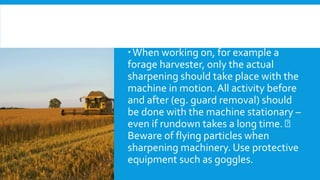
When working on, for example a
forage harvester, only the actual
sharpening should take place with the
machine in motion. All activity before
and after (eg. guard removal) should
be done with the machine stationary –
even if rundown takes a long time.
Beware of flying particles when
sharpening machinery. Use protective
equipment such as goggles.
WORKING UNDER MACHINES
When working under raised machines,
jacks should be used and correctly located,
and additional support (eg axle stands)
provided.
When working on hydraulically-raised
equipment (eg. trailers) use props. Never
rely just on the hydraulics.
HAMMERING
Beware of flying particles. Always
use the appropriate personal
protective equipment. It offers
protection not only against flying
particles, but also many other
risks
CLEANING
 Be aware of the danger of falling off or into
machinery, particularly in
wet or muddy conditions. Make sure you know
how to access machines
safely –especially large machines such as
combines.
 Don‘t clean with machines running and guards
removed
BLOCKAGES
Many accidents happen while cleaning
machine blockages – often because
operators attempt to clear a blockage
while the machine is still powered.
Again, the key question to ask is:
―Have I been trained to do this job
properly?‖ If the answer is ―no‖, do not
attempt it.
REMOVING BLOCKAGE
1. Use safe stop.
Safe Stop is probably the single most
important procedure for the
prevention of accidents. A blocked machine may
suddenly start operating again unless the engine
is stopped before the blockage is cleared.
The power must be locked off or the key
removed to stop other people restarting the
machine while you are working on it.
2. Check if the equipment has already
stopped.
Even if the power has been turned off,
machine parts may continue to rotate.
On some machines, run-down times of five
minutes are not unusual.
Many injuries are caused because work is
begun before the machine has
come to a complete stop.
3. Make the stop positive: chock
it.
Where possible, take additional
precautions to ensure that moving
parts remain stationary – eg
chocking the cutting cylinder of a
harvester to prevent movement.
4. Use a tool to clear the blockage.
Never use your bare hands to clear
a blockage or try to kick it free. Note
that, even in cases where operators
use a tool to clear a blockage, a
significant number are injured
because the machine is still running.
5. If it isn’t cleared, don’t
touch.
 Remember, machines can
suddenly move when a
blockage is cleared.
5. If it isn’t cleared,
don’t touch.
Remember,
machines can
suddenly move when
a blockage is cleared.
PERSONAL PROTECTIVE EQUIPMENT (PPE)
Personal protective equipment, or PPE, is designed to
protect workers from serious workplace injuries or
illnesses resulting from contact with chemical,
radiological, physical, electrical, mechanical, or other
workplace hazards. Besides face shields, safety glasses,

hard hats, and safety shoes, protective equipment
includes a variety of devices and garments such as
goggles, coveralls, gloves, vests, earplugs, and respirators
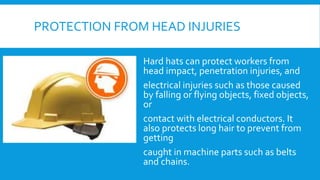
PROTECTION FROM HEAD INJURIES
Hard hats can protect workers from
head impact, penetration injuries, and
electrical injuries such as those caused
by falling or flying objects, fixed objects,
or
contact with electrical conductors. It
also protects long hair to prevent from
getting
caught in machine parts such as belts
and chains.
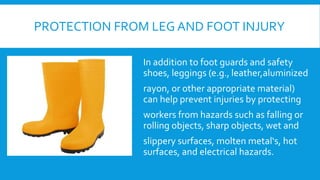
PROTECTION FROM LEG AND FOOT INJURY
In addition to foot guards and safety
shoes, leggings (e.g., leather,aluminized
rayon, or other appropriate material)
can help prevent injuries by protecting
workers from hazards such as falling or
rolling objects, sharp objects, wet and
slippery surfaces, molten metal‘s, hot
surfaces, and electrical hazards.
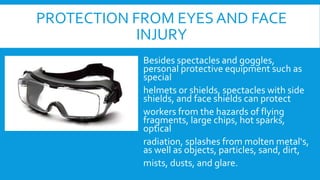
PROTECTION FROM EYES AND FACE
INJURY
Besides spectacles and goggles,
personal protective equipment such as
special
helmets or shields, spectacles with side
shields, and face shields can protect
workers from the hazards of flying
fragments, large chips, hot sparks,
optical
radiation, splashes from molten metal‘s,
as well as objects, particles, sand, dirt,
mists, dusts, and glare.
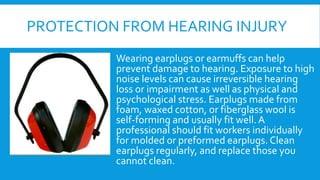
PROTECTION FROM HEARING INJURY
Wearing earplugs or earmuffs can help
prevent damage to hearing. Exposure to high
noise levels can cause irreversible hearing
loss or impairment as well as physical and
psychological stress. Earplugs made from
foam, waxed cotton, or fiberglass wool is
self-forming and usually fit well.A
professional should fit workers individually
for molded or preformed earplugs. Clean
earplugs regularly, and replace those you
cannot clean.
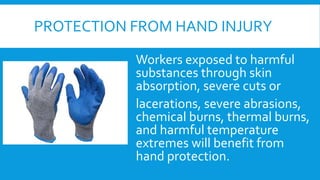
PROTECTION FROM HAND INJURY
Workers exposed to harmful
substances through skin
absorption, severe cuts or
lacerations, severe abrasions,
chemical burns, thermal burns,
and harmful temperature
extremes will benefit from
hand protection.
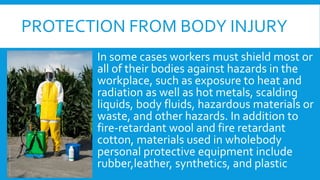
PROTECTION FROM BODY INJURY
In some cases workers must shield most or
all of their bodies against hazards in the
workplace, such as exposure to heat and
radiation as well as hot metals, scalding
liquids, body fluids, hazardous materials or
waste, and other hazards. In addition to
fire-retardant wool and fire retardant
cotton, materials used in wholebody
personal protective equipment include
rubber,leather, synthetics, and plastic
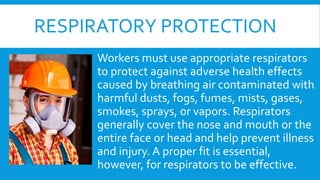
RESPIRATORY PROTECTION
Workers must use appropriate respirators
to protect against adverse health effects
caused by breathing air contaminated with
harmful dusts, fogs, fumes, mists, gases,
smokes, sprays, or vapors. Respirators
generally cover the nose and mouth or the
entire face or head and help prevent illness
and injury. A proper fit is essential,
however, for respirators to be effective.

4SAFETY-PRACTICES-IN-USING-FARM-EQUIPMENT.pptx

  • 1.
    SAFETY PRACTICES INUSING FARM EQUIPMENT
  • 2.
    THE COST OFACCIDENTS 1. Physical costs – pain and suffering 2. Money – both for the injured person and the employer 3.Time off work because an accident may lead to loss of earnings for the individual.
  • 3.
    For the self-employed,it could even end their business. For the employer, there may well be hidden costs. Many people believe that minor injuries cost nothing more than the price of a sticking plaster. But people will have to spend time dealing with the accident.They may have to:
  • 4.
    1. help theinjured person and give first aid. 2. clean up. 3. reschedule the job. 4. repair or reset the equipment or check for faults. 5. investigate the accident and prepare reports. 6. deal with insurers or Health and Safety Inspectors. 7. wait to have to get back to work. 8. accidents which cause damage to expensive plant and equipment can cost even more.
  • 5.
    TYPES OF TRACTOR- RELATED ACCIDENTS Rollovers oroverturns are generally due to driving too fast ; striking surface hazards such as rocks, stumps and holes; running into ditches; hitching high for extra traction; driving on steep slopes; and operating front-end loaders improperly.
  • 6.
    often occur when there‘san extra rider when moving and transporting to and from the farm. Falls from moving tractors
  • 7.
    Another cause oftractor- related death and serious injury is being caught by, or entangled in, rotating power takeoff (PTO) shafts. In most cases, the PTO shields were inadequate or had been removed.
  • 8.
    OTHER TRACTOR- CONNECTED INJURIESAND DAMAGE INVOLVE: 1. colliding withmotor vehicles or roadside objects; 2. slipping and falling while mounting and dismounting; 3. running over bystanders; 4. striking overhead hazards; 5. being struck by flying objects, broken parts, or hydraulic fluid;
  • 9.
    Another cause of tractor-relateddeath and serious injury is being caught by, or entangled in, rotating power takeoff (PTO) shafts. In most cases, the PTO shields were inadequate or had been removed.
  • 10.
    6. being crushedby a poorly supported tractor during repair work; 7. sustaining cuts, bruises, burns and other nuisance, but painful injuries, connected with maintenance and routine noperation; 8. being overcome by exhaust gases inside closed buildings; 9. being burned by fires that erupt during refueling or as a result of a collision or upset.
  • 11.
    HOWTO REDUCE THE RISKOF TRACTOR ACCIDENTS Be ProperlyTrained A person who does not know how to operate a tractor safely in potentially hazardous situations can be injured or killed by exercising poor judgment. Make sure all persons permitted to operate tractors have been thoroughly trained.A good place to start training is with the Operator's Manual. Review the Operator's Manual, if possible with the tractor in front of you.
  • 12.
    Be Familiar withOperator's Manual Read and follow procedures as outlined in the operator's manual. By being familiar with the operating features of a tractor, the operator will develop confidence when the tractor is driven under adverse conditions. Learn the location and purpose of all of the gauges and controls as well as other indicators. Knowing where the controls are by memory can allow you to react more quickly in an emergency situation.There have been accident situations where individuals have become entangled in machinery or the power takeoff shaft and rescuers or family did not know how to disengage the equipment. Family members should know how to shut down equipment or disengage the PTO in case of emergency.
  • 13.
    Study the variousdecals on your equipment. They may point out DANGER,WARNING and CAUTION for various points on the tractor. Have an experienced tractor operator with you as you review the various decals and ask questions! A copy of all Operating Manuals and other relevant safety materials should be kept on file for quick reference.
  • 14.
  • 15.
    An analysis ofaccidents investigated by HSE indicates that there are certain places and parts of machines which present special danger.These are some – but not all – of them. Remember that any agricultural machine under power like the one given below represents potential anger.
  • 16.
    1. Rice mill-rotating/moving mechanisms 2.Thresher-allrotating mechanisms 3. Combine harvester – grain tank. 4.Tractor – hitch mechanism, PTO shaft. 5. Mounted equipment – underneath. 6. HandTractor- rotating pulley
  • 17.
  • 18.
    1. in-house modificationsto machines, and home- made machines; 2. substandard parts (which may fail and throw off flying particles); 3. any mechanism which can be turned manually but which may gather momentum; 4. any mechanism which has momentum and takes time to stop; and 5. hydraulic fluid (where there is a danger of oil injection).
  • 19.
    HAZARDOUS ACTIVITIES During themaintenance of agricultural machinery, there are many activities which are potentially hazardous. Here are some of them:
  • 20.
    LUBRICATING If you needto remove the guard to lubricate the machine, never lubricate while the machine is in motion.
  • 21.
  • 22.
    Remember that hydraulicoil is under high pressure.The external signs of oil injection may be slight, but the internal damage is not and may lead to surgery or amputation. If checking for leaks, use something (eg. a piece of card run along the hose) to show where the leak is. Do not use your hands. Release the pressure before working on the system
  • 23.
  • 24.
    When working on,for example a forage harvester, only the actual sharpening should take place with the machine in motion. All activity before and after (eg. guard removal) should be done with the machine stationary – even if rundown takes a long time. Beware of flying particles when sharpening machinery. Use protective equipment such as goggles.
  • 25.
  • 26.
    When working underraised machines, jacks should be used and correctly located, and additional support (eg axle stands) provided. When working on hydraulically-raised equipment (eg. trailers) use props. Never rely just on the hydraulics.
  • 27.
  • 28.
    Beware of flyingparticles. Always use the appropriate personal protective equipment. It offers protection not only against flying particles, but also many other risks
  • 29.
  • 30.
     Be awareof the danger of falling off or into machinery, particularly in wet or muddy conditions. Make sure you know how to access machines safely –especially large machines such as combines.  Don‘t clean with machines running and guards removed
  • 31.
  • 32.
    Many accidents happenwhile cleaning machine blockages – often because operators attempt to clear a blockage while the machine is still powered. Again, the key question to ask is: ―Have I been trained to do this job properly?‖ If the answer is ―no‖, do not attempt it.
  • 33.
  • 34.
    1. Use safestop. Safe Stop is probably the single most important procedure for the prevention of accidents. A blocked machine may suddenly start operating again unless the engine is stopped before the blockage is cleared. The power must be locked off or the key removed to stop other people restarting the machine while you are working on it.
  • 35.
    2. Check ifthe equipment has already stopped. Even if the power has been turned off, machine parts may continue to rotate. On some machines, run-down times of five minutes are not unusual. Many injuries are caused because work is begun before the machine has come to a complete stop.
  • 36.
    3. Make thestop positive: chock it. Where possible, take additional precautions to ensure that moving parts remain stationary – eg chocking the cutting cylinder of a harvester to prevent movement.
  • 37.
    4. Use atool to clear the blockage. Never use your bare hands to clear a blockage or try to kick it free. Note that, even in cases where operators use a tool to clear a blockage, a significant number are injured because the machine is still running.
  • 38.
    5. If itisn’t cleared, don’t touch.  Remember, machines can suddenly move when a blockage is cleared.
  • 39.
    5. If itisn’t cleared, don’t touch. Remember, machines can suddenly move when a blockage is cleared.
  • 40.
    PERSONAL PROTECTIVE EQUIPMENT(PPE) Personal protective equipment, or PPE, is designed to protect workers from serious workplace injuries or illnesses resulting from contact with chemical, radiological, physical, electrical, mechanical, or other workplace hazards. Besides face shields, safety glasses, hard hats, and safety shoes, protective equipment includes a variety of devices and garments such as goggles, coveralls, gloves, vests, earplugs, and respirators
  • 41.
    PROTECTION FROM HEADINJURIES Hard hats can protect workers from head impact, penetration injuries, and electrical injuries such as those caused by falling or flying objects, fixed objects, or contact with electrical conductors. It also protects long hair to prevent from getting caught in machine parts such as belts and chains.
  • 42.
    PROTECTION FROM LEGAND FOOT INJURY In addition to foot guards and safety shoes, leggings (e.g., leather,aluminized rayon, or other appropriate material) can help prevent injuries by protecting workers from hazards such as falling or rolling objects, sharp objects, wet and slippery surfaces, molten metal‘s, hot surfaces, and electrical hazards.

  • 43.
    PROTECTION FROM EYESAND FACE INJURY Besides spectacles and goggles, personal protective equipment such as special helmets or shields, spectacles with side shields, and face shields can protect workers from the hazards of flying fragments, large chips, hot sparks, optical radiation, splashes from molten metal‘s, as well as objects, particles, sand, dirt, mists, dusts, and glare.
  • 44.
    PROTECTION FROM HEARINGINJURY Wearing earplugs or earmuffs can help prevent damage to hearing. Exposure to high noise levels can cause irreversible hearing loss or impairment as well as physical and psychological stress. Earplugs made from foam, waxed cotton, or fiberglass wool is self-forming and usually fit well.A professional should fit workers individually for molded or preformed earplugs. Clean earplugs regularly, and replace those you cannot clean.
  • 45.
    PROTECTION FROM HANDINJURY Workers exposed to harmful substances through skin absorption, severe cuts or lacerations, severe abrasions, chemical burns, thermal burns, and harmful temperature extremes will benefit from hand protection.
  • 46.
    PROTECTION FROM BODYINJURY In some cases workers must shield most or all of their bodies against hazards in the workplace, such as exposure to heat and radiation as well as hot metals, scalding liquids, body fluids, hazardous materials or waste, and other hazards. In addition to fire-retardant wool and fire retardant cotton, materials used in wholebody personal protective equipment include rubber,leather, synthetics, and plastic

  • 47.
    RESPIRATORY PROTECTION Workers mustuse appropriate respirators to protect against adverse health effects caused by breathing air contaminated with harmful dusts, fogs, fumes, mists, gases, smokes, sprays, or vapors. Respirators generally cover the nose and mouth or the entire face or head and help prevent illness and injury. A proper fit is essential, however, for respirators to be effective.


Editor's Notes

  • #8 Power take-off (PTO) is a device that transfers an engine's mechanical power to another piece of equipment. A PTO allows the hosting energy source to transmit power to additional equipment that does not have its own engine or motor. For example, a PTO can help run a jackhammer using a tractor's engine.
  • #12 There are numerous human factors involved in fatal tractor-related accidents. Certain factors like poor judgment, poor attitude, insufficient knowledge or training, fatigue, haste, stress, depression, intoxication , or showing off can cause a fatal tractor overturn accident. Each operator should be physically and mentally fit when operating a tractor. An operator who is sleepy, tired or not feeling well may not be able to react in time to avoid an accident.