Future Technology Trends
and possible impacts
Amol Vidwans
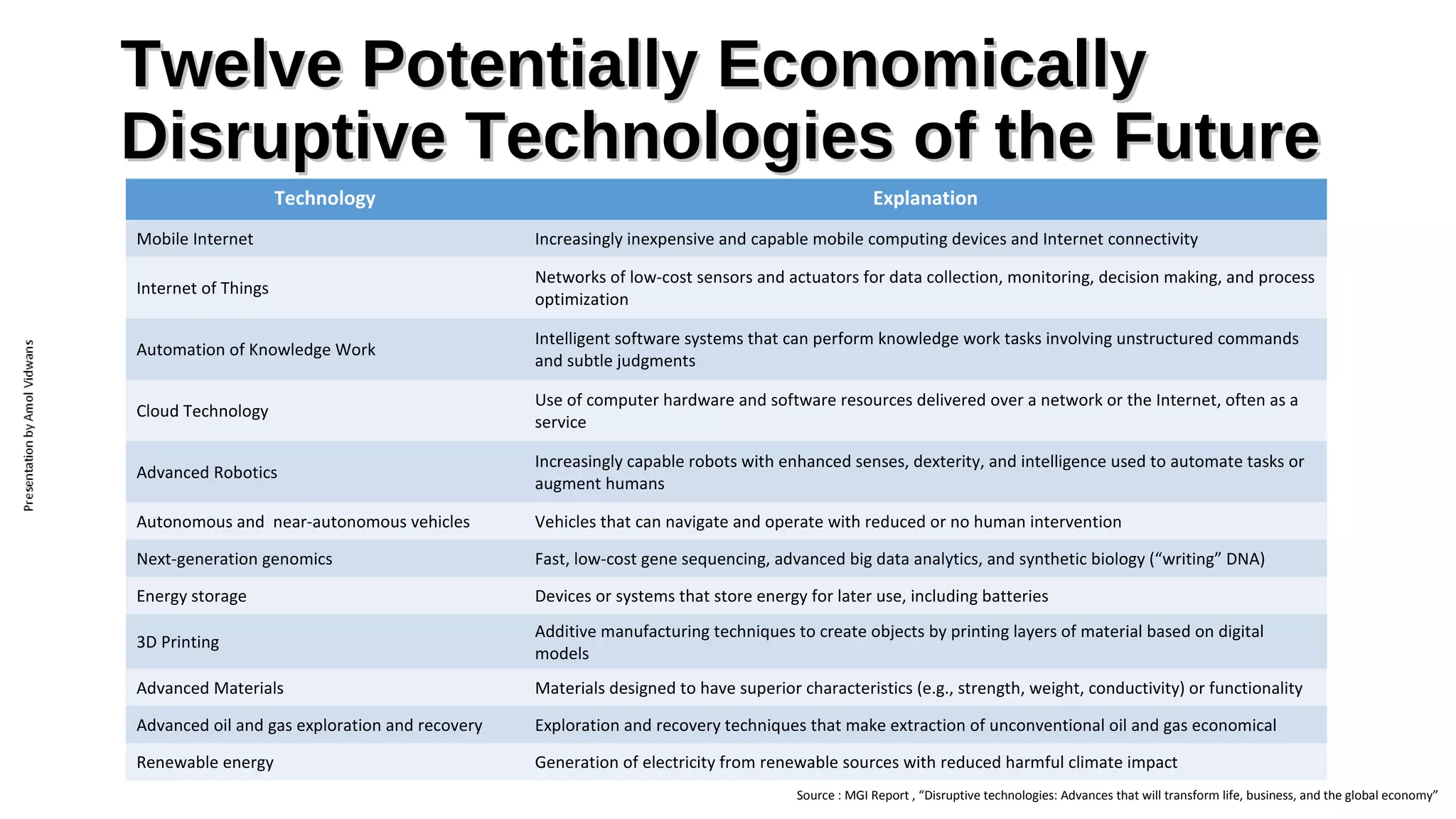
Twelve Potentially Economically
Disruptive Technologies of the Future
Technology

Explanation

Mobile Internet

Increasingly inexpensive and capable mobile computing devices and Internet connectivity

Internet of Things

Networks of low-cost sensors and actuators for data collection, monitoring, decision making, and process
optimization

Automation of Knowledge Work

Intelligent software systems that can perform knowledge work tasks involving unstructured commands
and subtle judgments

Cloud Technology

Use of computer hardware and software resources delivered over a network or the Internet, often as a
service

Advanced Robotics

Increasingly capable robots with enhanced senses, dexterity, and intelligence used to automate tasks or
augment humans

Autonomous and near-autonomous vehicles

Vehicles that can navigate and operate with reduced or no human intervention

Next-generation genomics

Fast, low-cost gene sequencing, advanced big data analytics, and synthetic biology (“writing” DNA)

Energy storage

Devices or systems that store energy for later use, including batteries

3D Printing

Additive manufacturing techniques to create objects by printing layers of material based on digital
models

Advanced Materials

Materials designed to have superior characteristics (e.g., strength, weight, conductivity) or functionality

Advanced oil and gas exploration and recovery

Exploration and recovery techniques that make extraction of unconventional oil and gas economical

Renewable energy

Generation of electricity from renewable sources with reduced harmful climate impact
Source : MGI Report , “Disruptive technologies: Advances that will transform life, business, and the global economy”
It is predicated that the connecting
rate of improvement and reach today,
will result in…
• 2 – 3 billion more people will have access to the Internet in 2025
• $5 – 7 trillion would be Potential economic impact by 2025 of automation
of knowledge work
• $100, 1 hour would be the Cost and time to sequence a human genome in
the next decade
• There will be 1.5 million Driver-caused deaths from car accidents in 2025,
potentially addressable by autonomous vehicles
• 100–200% Potential increase in North American oil production by 2025,
driven by hydraulic fracturing & horizontal drilling
• Potential share of solar and wind in global electricity generation will be
16% by 2025
Impact on Business…

These trends cannot be ignored and one will
have to make a beginning somewhere,
someplace, somehow…
So… why NOT start now?
Before we “start”, a few questions to
ponder on…
• How can we use the social matrix to improve collaboration and communication with customers, with
suppliers?
• How can we improve the product offerings based on by noting customer likes, wants and other behaviors
on the social matrix and drive value?
• Is there a possibility and opportunity for us to create value and improve business processes by collecting
and analyzing data through robotics / networked sensors connected to the machinery, workspaces and
customer touch-points?
• What are the Key Business Decisions that we can improve by bringing in big data analytics and
experimentation?
• Is there a possibility to monetize the data by creating a data-driven business model?
• Which products can be provided as a service, and how can IT help enable that?
• How can we use cloud to reach to new customers with existing products and services?
• Can we identify opportunities to make information gathering, communication and problem solving and the
work easier and more efficient by automating?
• How can we use IT to make the Customer experiences richer?
• How can we use data and infrastructure to create new products for existing and / or new customers?
Mobile-enabled solutions –
Opportunities in the Agro Industry
ATEE
RRAT
O
BBO
LLAA xteend
LL xt nd
Improving access to financial CCO e
O
)
too eASSE 2)
E2
t
services
A
(PPH
(H

Mobile Payment System
Micro-Insurance System
Micro-Lending System
Mobile Information Platform

act
Provision of agricultural information mppact
I m nee
CT I
EECT om-l-ilin
I I tt
DDRR oot tom11)
)
SE
nnbb HAASE
oo P H
( (P

Improving data visibility for supply chain
efficiency

Enhancing access to markets

Increasing access and affordability of financial
services tailored for agriculture

Farmer Helpline

Delivering information relevant to farmers,
such as agricultural techniques, use of
insecticides /pesticides, commodity prices
and weather forecasts

Smart Logistics
Traceability and Tracking System
Mobile Management of Supplier Networks

Optimizing supply chain management across
the sector, and delivering efficiency
improvements for transportation logistics

Mobile Management of Distribution
Networks

Agricultural trading platform
r
meer
toom ddd
us t - CCus eeAA d SSE
E
ll
HA
aauu (PPHA Agricultural tendering platform
VV s s (
ee
r r ic c )
eevvi 33)
SS
Agricultural bartering platform

Enhancing the link between commodity
exchanges, traders, buyers and seller of
agricultural produce
M2M Opportunities in the Agro
Industry
Other areas where IT can create
opportunities…

ERP / CRM /
Manufacturing
Systems &
Plant
Automation
How can it be done?
By doing things “differently”,
whilst Continuously Increasing Efficiency, Effectiveness, Agility of
existing Business Processes & Systems wherever possible…
Set the Enterprise IT Infrastructure
Agenda…
• To capture the next rounds of efficiencies
• To accelerate the transition to the next level infrastructure
• To reduce risks
• To improve organizational execution
Technology Shared Services & Centre
of Excellence (CoE) Model opportunity
• Consolidation of processes within the group in order to reduce
redundancies
• Delivers support processes as its core competency
• Could be a Separate organizational unit within the group
• Cost cutting is a major driver for im­plementation
• Clear focus on internal cus­tomers
• Operated like a business
The Big Picture…
A Representative Business Model for
Agro Industry
Conclusion
• There are business opportunities through effective use of IT

• to reach out more effective and efficiently to our existing customers
• to be able to explore, create, strength existing markets and grow into newer markets
• to perhaps take a relook at the business, business functions, business processes and
systems from an “integrated and inclusive customer experience perspective”

• Customer today has access to technology / information / data, knows how
to use it for voicing his/ her likes, wants and other behavior. It is all about
the “social matrix”
• On the loft side, this may result in stricter compliance and regulatory controls to be
adhered to by Governmental agencies and local bodies

• It is fact that there are multiple initiatives across the globe on “connected
agriculture” that are fast gaining acceptance amongst farmers particularly
in the “not so developed” and “developing” regions and nations
• Disruptive Technologies cannot be ignored

• Trends show us that the mobile, internet of things, cloud computing etc. are and will
continue to rapidly change the way business in conducted in the future

Future technology trends and possibilities for agro industry

  • 1.
    Future Technology Trends andpossible impacts Amol Vidwans
  • 2.
    Twelve Potentially Economically DisruptiveTechnologies of the Future Technology Explanation Mobile Internet Increasingly inexpensive and capable mobile computing devices and Internet connectivity Internet of Things Networks of low-cost sensors and actuators for data collection, monitoring, decision making, and process optimization Automation of Knowledge Work Intelligent software systems that can perform knowledge work tasks involving unstructured commands and subtle judgments Cloud Technology Use of computer hardware and software resources delivered over a network or the Internet, often as a service Advanced Robotics Increasingly capable robots with enhanced senses, dexterity, and intelligence used to automate tasks or augment humans Autonomous and near-autonomous vehicles Vehicles that can navigate and operate with reduced or no human intervention Next-generation genomics Fast, low-cost gene sequencing, advanced big data analytics, and synthetic biology (“writing” DNA) Energy storage Devices or systems that store energy for later use, including batteries 3D Printing Additive manufacturing techniques to create objects by printing layers of material based on digital models Advanced Materials Materials designed to have superior characteristics (e.g., strength, weight, conductivity) or functionality Advanced oil and gas exploration and recovery Exploration and recovery techniques that make extraction of unconventional oil and gas economical Renewable energy Generation of electricity from renewable sources with reduced harmful climate impact Source : MGI Report , “Disruptive technologies: Advances that will transform life, business, and the global economy”
  • 3.
    It is predicatedthat the connecting rate of improvement and reach today, will result in… • 2 – 3 billion more people will have access to the Internet in 2025 • $5 – 7 trillion would be Potential economic impact by 2025 of automation of knowledge work • $100, 1 hour would be the Cost and time to sequence a human genome in the next decade • There will be 1.5 million Driver-caused deaths from car accidents in 2025, potentially addressable by autonomous vehicles • 100–200% Potential increase in North American oil production by 2025, driven by hydraulic fracturing & horizontal drilling • Potential share of solar and wind in global electricity generation will be 16% by 2025
  • 4.
    Impact on Business… Thesetrends cannot be ignored and one will have to make a beginning somewhere, someplace, somehow… So… why NOT start now?
  • 5.
    Before we “start”,a few questions to ponder on… • How can we use the social matrix to improve collaboration and communication with customers, with suppliers? • How can we improve the product offerings based on by noting customer likes, wants and other behaviors on the social matrix and drive value? • Is there a possibility and opportunity for us to create value and improve business processes by collecting and analyzing data through robotics / networked sensors connected to the machinery, workspaces and customer touch-points? • What are the Key Business Decisions that we can improve by bringing in big data analytics and experimentation? • Is there a possibility to monetize the data by creating a data-driven business model? • Which products can be provided as a service, and how can IT help enable that? • How can we use cloud to reach to new customers with existing products and services? • Can we identify opportunities to make information gathering, communication and problem solving and the work easier and more efficient by automating? • How can we use IT to make the Customer experiences richer? • How can we use data and infrastructure to create new products for existing and / or new customers?
  • 6.
    Mobile-enabled solutions – Opportunitiesin the Agro Industry ATEE RRAT O BBO LLAA xteend LL xt nd Improving access to financial CCO e O ) too eASSE 2) E2 t services A (PPH (H Mobile Payment System Micro-Insurance System Micro-Lending System Mobile Information Platform act Provision of agricultural information mppact I m nee CT I EECT om-l-ilin I I tt DDRR oot tom11) ) SE nnbb HAASE oo P H ( (P Improving data visibility for supply chain efficiency Enhancing access to markets Increasing access and affordability of financial services tailored for agriculture Farmer Helpline Delivering information relevant to farmers, such as agricultural techniques, use of insecticides /pesticides, commodity prices and weather forecasts Smart Logistics Traceability and Tracking System Mobile Management of Supplier Networks Optimizing supply chain management across the sector, and delivering efficiency improvements for transportation logistics Mobile Management of Distribution Networks Agricultural trading platform r meer toom ddd us t - CCus eeAA d SSE E ll HA aauu (PPHA Agricultural tendering platform VV s s ( ee r r ic c ) eevvi 33) SS Agricultural bartering platform Enhancing the link between commodity exchanges, traders, buyers and seller of agricultural produce
  • 7.
    M2M Opportunities inthe Agro Industry
  • 8.
    Other areas whereIT can create opportunities… ERP / CRM / Manufacturing Systems & Plant Automation
  • 9.
    How can itbe done? By doing things “differently”, whilst Continuously Increasing Efficiency, Effectiveness, Agility of existing Business Processes & Systems wherever possible…
  • 10.
    Set the EnterpriseIT Infrastructure Agenda… • To capture the next rounds of efficiencies • To accelerate the transition to the next level infrastructure • To reduce risks • To improve organizational execution
  • 11.
    Technology Shared Services& Centre of Excellence (CoE) Model opportunity • Consolidation of processes within the group in order to reduce redundancies • Delivers support processes as its core competency • Could be a Separate organizational unit within the group • Cost cutting is a major driver for im­plementation • Clear focus on internal cus­tomers • Operated like a business
  • 12.
  • 13.
    A Representative BusinessModel for Agro Industry
  • 14.
    Conclusion • There arebusiness opportunities through effective use of IT • to reach out more effective and efficiently to our existing customers • to be able to explore, create, strength existing markets and grow into newer markets • to perhaps take a relook at the business, business functions, business processes and systems from an “integrated and inclusive customer experience perspective” • Customer today has access to technology / information / data, knows how to use it for voicing his/ her likes, wants and other behavior. It is all about the “social matrix” • On the loft side, this may result in stricter compliance and regulatory controls to be adhered to by Governmental agencies and local bodies • It is fact that there are multiple initiatives across the globe on “connected agriculture” that are fast gaining acceptance amongst farmers particularly in the “not so developed” and “developing” regions and nations • Disruptive Technologies cannot be ignored • Trends show us that the mobile, internet of things, cloud computing etc. are and will continue to rapidly change the way business in conducted in the future