FUTURE-PROOF YOUR NETWORK
TODAY TO SUPPORT IOT
TOMORROW
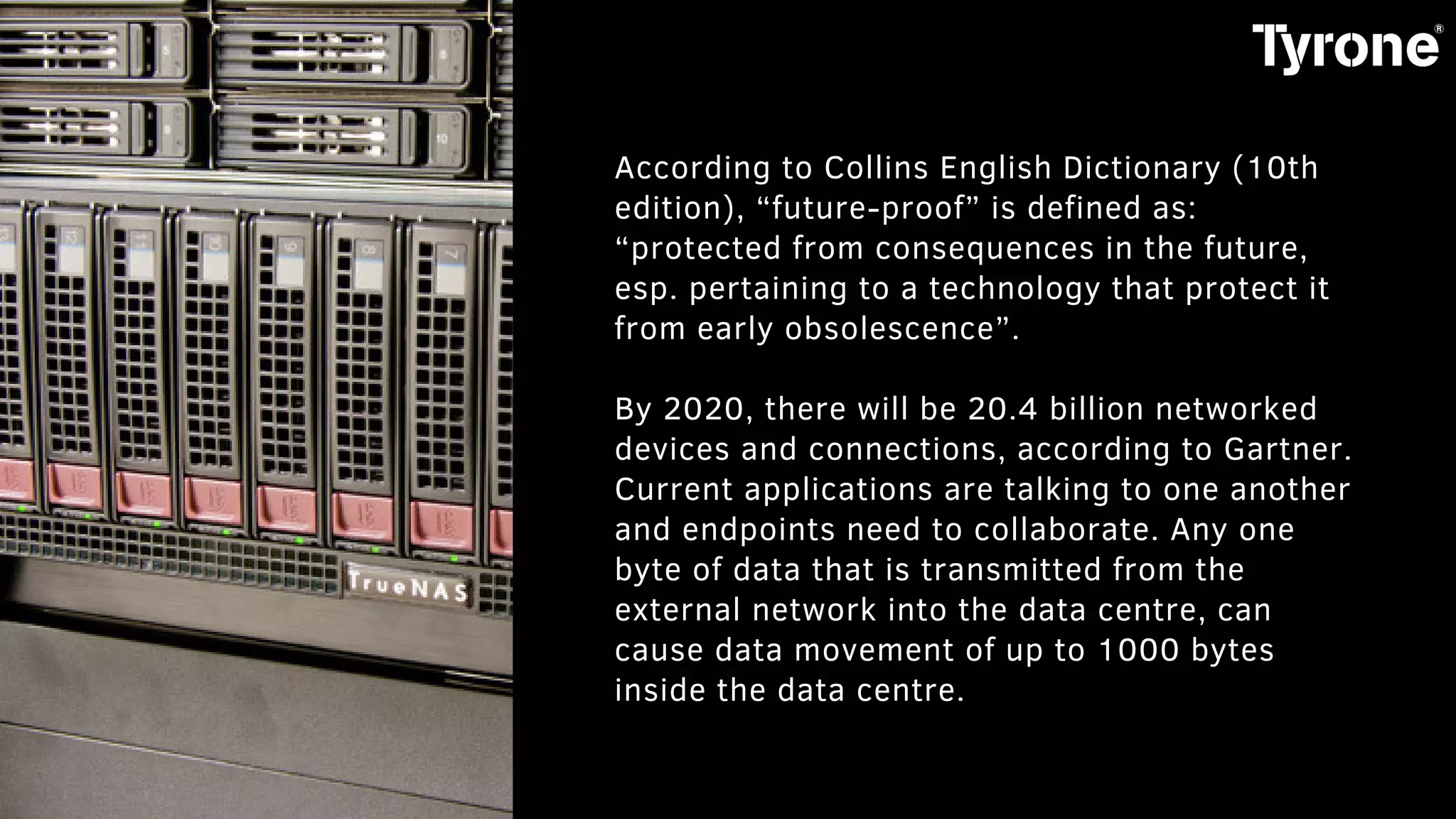
According to Collins English Dictionary (10th
edition), “future-proof” is defined as:
“protected from consequences in the future,
esp. pertaining to a technology that protect it
from early obsolescence”.
By 2020, there will be 20.4 billion networked
devices and connections, according to Gartner.
Current applications are talking to one another
and endpoints need to collaborate. Any one
byte of data that is transmitted from the
external network into the data centre, can
cause data movement of up to 1000 bytes
inside the data centre.
Key Considerations:
- Storage capabilities 
- Security
- Creating a future-proof ecosystem
- Network scale and capacity
- Computing power and placement
STORAGE
CAPABILITIES 
The untapped pool of data from IoT is
poised to provide organizations
visibility into parts of their operations
that impact business decisions. Given
how critical it is, it’s important to
devise a plan on how it will be stored,
which isn’t easy given IoT’s
unpredictable nature.
Using distributed cloud-based storage
is optimal as it provides flexibility,
scalability, compliance and a
sophisticated architecture to support
an essentially unlimited influx of data.
Many IoT devices have already been
compromised, from toys to corporate video
systems. While encryption and stringent rules for
access to stored data are widely employed to
protect against intrusions, network operators
need to consider advances in networking
equipment that can deliver low-latency, in-flight
data encryption.
This provides increased protection for data from
the moment it leaves one data center to the
moment it enters another.
S E C U R I T YS E C U R I T Y
To get the most out of IoT, it’s likely we’ll see
the rise of a vendor-neutral “IoT Command
Center” that is able to connect disparate
systems together. However, it will be some time
before this becomes a reality. In the meantime,
doing this internally or working with a company
that believes in open networking and open
source technology is critical in order to have
the flexibility needed to integrate with future
technologies. If one just goes with their favorite
IoT vendor of the moment, you could become
locked into them and their ecosystem or
compelled to build a completely different
infrastructure when other use cases come
along.
CREATING A
FUTURE-PROOF
ECOSYSTEM.
C R E A T I N G A
F U T U R E - P R O O F
E C O S Y S T E M  
It is projected that IoT devices will exceed cell
phones in use within two years. Further, this
traffic is unusual because it is more localized
and sourced from the devices to the cloud. For
example, smart city information will be created
in the city by devices for the benefit of that
location and its citizens. Network operators
must plan for this, as it is a significant change
from the internet today, in which content often
comes from a global provider to the user.
NETWORK
SCALE AND
CAPACITY.
N E T W O R K S C A L E
A N D C A P A C I T Y
IoT will accelerate the adoption of big
data analytics and distributed cloud
computing. An enormous amount of
structured and unstructured data will be
generated, and computational-intensive
analytics are required to gain meaningful
and actionable information.
This is where edge computing comes into
play. In fact, Business Insider estimates
that 5.6 billion IoT devices owned by
enterprises and governments will utilize
edge computing for data collection and
processing in 2020.
Computing power
and placement
Thank you!
Visit us on
www.tyronesystems.com

Future Proof Your Network Today To Support IOT Tomorrow

  • 1.
    FUTURE-PROOF YOUR NETWORK TODAYTO SUPPORT IOT TOMORROW
  • 2.
    According to CollinsEnglish Dictionary (10th edition), “future-proof” is defined as: “protected from consequences in the future, esp. pertaining to a technology that protect it from early obsolescence”. By 2020, there will be 20.4 billion networked devices and connections, according to Gartner. Current applications are talking to one another and endpoints need to collaborate. Any one byte of data that is transmitted from the external network into the data centre, can cause data movement of up to 1000 bytes inside the data centre.
  • 3.
    Key Considerations: - Storagecapabilities  - Security - Creating a future-proof ecosystem - Network scale and capacity - Computing power and placement
  • 4.
    STORAGE CAPABILITIES  The untapped poolof data from IoT is poised to provide organizations visibility into parts of their operations that impact business decisions. Given how critical it is, it’s important to devise a plan on how it will be stored, which isn’t easy given IoT’s unpredictable nature. Using distributed cloud-based storage is optimal as it provides flexibility, scalability, compliance and a sophisticated architecture to support an essentially unlimited influx of data.
  • 5.
    Many IoT deviceshave already been compromised, from toys to corporate video systems. While encryption and stringent rules for access to stored data are widely employed to protect against intrusions, network operators need to consider advances in networking equipment that can deliver low-latency, in-flight data encryption. This provides increased protection for data from the moment it leaves one data center to the moment it enters another. S E C U R I T YS E C U R I T Y
  • 6.
    To get themost out of IoT, it’s likely we’ll see the rise of a vendor-neutral “IoT Command Center” that is able to connect disparate systems together. However, it will be some time before this becomes a reality. In the meantime, doing this internally or working with a company that believes in open networking and open source technology is critical in order to have the flexibility needed to integrate with future technologies. If one just goes with their favorite IoT vendor of the moment, you could become locked into them and their ecosystem or compelled to build a completely different infrastructure when other use cases come along. CREATING A FUTURE-PROOF ECOSYSTEM. C R E A T I N G A F U T U R E - P R O O F E C O S Y S T E M  
  • 7.
    It is projectedthat IoT devices will exceed cell phones in use within two years. Further, this traffic is unusual because it is more localized and sourced from the devices to the cloud. For example, smart city information will be created in the city by devices for the benefit of that location and its citizens. Network operators must plan for this, as it is a significant change from the internet today, in which content often comes from a global provider to the user. NETWORK SCALE AND CAPACITY. N E T W O R K S C A L E A N D C A P A C I T Y
  • 8.
    IoT will acceleratethe adoption of big data analytics and distributed cloud computing. An enormous amount of structured and unstructured data will be generated, and computational-intensive analytics are required to gain meaningful and actionable information. This is where edge computing comes into play. In fact, Business Insider estimates that 5.6 billion IoT devices owned by enterprises and governments will utilize edge computing for data collection and processing in 2020. Computing power and placement
  • 9.
    Thank you! Visit uson www.tyronesystems.com