KEY WORDS
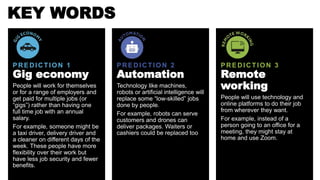
PR ED IC TION 1
Gig economy
People will work for themselves
or for a range of employers and
get paid for multiple jobs (or
“gigs”) rather than having one
full time job with an annual
salary.
For example, someone might be
a taxi driver, delivery driver and
a cleaner on different days of the
week. These people have more
flexibility over their work but
have less job security and fewer
benefits.
PR ED IC TION 2
Automation
Technology like machines,
robots or artificial intelligence will
replace some “low-skilled” jobs
done by people.
For example, robots can serve
customers and drones can
deliver packages. Waiters or
cashiers could be replaced too
PR ED IC TION 3
Remote
working
People will use technology and
online platforms to do their job
from wherever they want.
For example, instead of a
person going to an office for a
meeting, they might stay at
home and use Zoom.
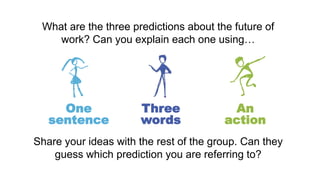
What are the three predictions about the future of
work? Can you explain each one using…
Share your ideas with the rest of the group. Can they
guess which prediction you are referring to?
One
sentence
Three
words
An
action
THE RISE OF THE GIG ECONOMY
BIG QUESTION
Will the rise of the gig economy create more opportunities or
problems? Try to think of as many reasons as possible to
support your side of the argument.
TEAM OPPORTUNITY
• Why might people want to work for
themselves?
• How might this help their work-life
balance?
• Who might benefit from this?
TEAM PROBLEM
• Is it harder or easier to find work on
your own?
• How might people feel about not
having a guaranteed source of
income?
• Who might miss out?
3 MINUTE
CHALLENGE
THE RISE OF AUTOMATION
BIG QUESTION
Will an increase in automation create more opportunities or
problems? Try to think of as many reasons as possible to
support your side of the argument.
TEAM OPPORTUNITY
• Why might machines do a job
better?
• How have machines already
improved the workplace?
• Who might benefit from this?
TEAM PROBLEM
• Should robots be allowed to take
people’s jobs?
• Which jobs might be more likely to
be replaced?
• Who might miss out?
3 MINUTE
CHALLENGE
THE RISE OF REMOTE WORKING
BIG QUESTION
Will the rise of remote working create more opportunities or
problems? Try to think of as many reasons as possible to
support your side of the argument.
TEAM OPPORTUNITY
• Why might people prefer to work
remotely?
• How could this help get the best
person for the job?
• Who might benefit from this?
TEAM PROBLEM
• What might be the downside of not
going into a workplace?
• Does everyone have what they
need to work remotely? Is this fair?
• Who might miss out?
3 MINUTE
CHALLENGE
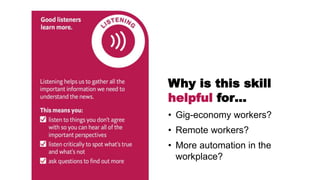
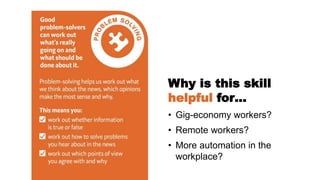
Why is this skill
helpful for…
• Gig-economy workers?
• Remote workers?
• More automation in the
workplace?
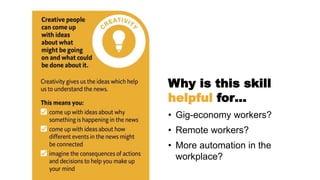
Why is this skill
helpful for…
• Gig-economy workers?
• Remote workers?
• More automation in the
workplace?
Why is this skill
helpful for…
• Gig-economy workers?
• Remote workers?
• More automation in the
workplace?
Why is this skill
helpful for…
• Gig-economy workers?
• Remote workers?
• More automation in the
workplace?

Future of work PowerPoint

  • 1.
    KEY WORDS PR EDIC TION 1 Gig economy People will work for themselves or for a range of employers and get paid for multiple jobs (or “gigs”) rather than having one full time job with an annual salary. For example, someone might be a taxi driver, delivery driver and a cleaner on different days of the week. These people have more flexibility over their work but have less job security and fewer benefits. PR ED IC TION 2 Automation Technology like machines, robots or artificial intelligence will replace some “low-skilled” jobs done by people. For example, robots can serve customers and drones can deliver packages. Waiters or cashiers could be replaced too PR ED IC TION 3 Remote working People will use technology and online platforms to do their job from wherever they want. For example, instead of a person going to an office for a meeting, they might stay at home and use Zoom.
  • 2.
    What are thethree predictions about the future of work? Can you explain each one using… Share your ideas with the rest of the group. Can they guess which prediction you are referring to? One sentence Three words An action
  • 3.
    THE RISE OFTHE GIG ECONOMY BIG QUESTION Will the rise of the gig economy create more opportunities or problems? Try to think of as many reasons as possible to support your side of the argument. TEAM OPPORTUNITY • Why might people want to work for themselves? • How might this help their work-life balance? • Who might benefit from this? TEAM PROBLEM • Is it harder or easier to find work on your own? • How might people feel about not having a guaranteed source of income? • Who might miss out? 3 MINUTE CHALLENGE
  • 4.
    THE RISE OFAUTOMATION BIG QUESTION Will an increase in automation create more opportunities or problems? Try to think of as many reasons as possible to support your side of the argument. TEAM OPPORTUNITY • Why might machines do a job better? • How have machines already improved the workplace? • Who might benefit from this? TEAM PROBLEM • Should robots be allowed to take people’s jobs? • Which jobs might be more likely to be replaced? • Who might miss out? 3 MINUTE CHALLENGE
  • 5.
    THE RISE OFREMOTE WORKING BIG QUESTION Will the rise of remote working create more opportunities or problems? Try to think of as many reasons as possible to support your side of the argument. TEAM OPPORTUNITY • Why might people prefer to work remotely? • How could this help get the best person for the job? • Who might benefit from this? TEAM PROBLEM • What might be the downside of not going into a workplace? • Does everyone have what they need to work remotely? Is this fair? • Who might miss out? 3 MINUTE CHALLENGE
  • 6.
    Why is thisskill helpful for… • Gig-economy workers? • Remote workers? • More automation in the workplace?
  • 7.
    Why is thisskill helpful for… • Gig-economy workers? • Remote workers? • More automation in the workplace?
  • 8.
    Why is thisskill helpful for… • Gig-economy workers? • Remote workers? • More automation in the workplace?
  • 9.
    Why is thisskill helpful for… • Gig-economy workers? • Remote workers? • More automation in the workplace?