WEBINAR
Future of Data Strategy
Speaker
Paul Moxon
SVP Data Architecture & Chief Evangelist
Denodo
3
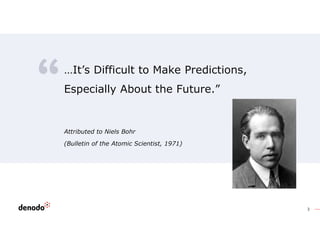
Attributed to Niels Bohr
(Bulletin of the Atomic Scientist, 1971)
…It’s Difficult to Make Predictions,
Especially About the Future.”
4
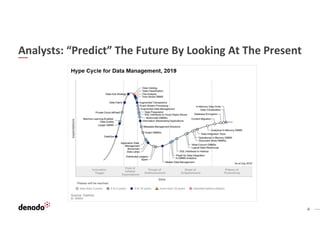
Analysts: “Predict” The Future By Looking At The Present
5
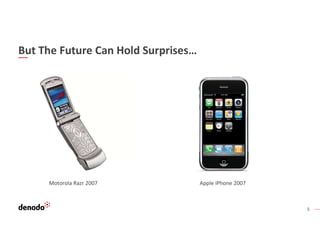
But The Future Can Hold Surprises…
Motorola Razr 2007 Apple iPhone 2007
6
ML and AI as to Simplify Data
Management Challenges
7
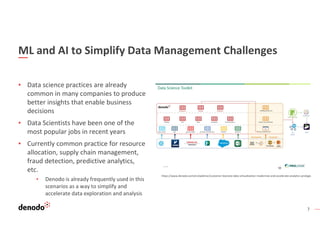
ML and AI to Simplify Data Management Challenges
▪ Data science practices are already
common in many companies to produce
better insights that enable business
decisions
▪ Data Scientists have been one of the
most popular jobs in recent years
▪ Currently common practice for resource
allocation, supply chain management,
fraud detection, predictive analytics,
etc.
▪ Denodo is already frequently used in this
scenarios as a way to simplify and
accelerate data exploration and analysis
https://www.denodo.com/en/webinar/customer-keynote-data-virtualization-modernize-and-accelerate-analytics-prologis
8
Artificial Intelligence in Data Management
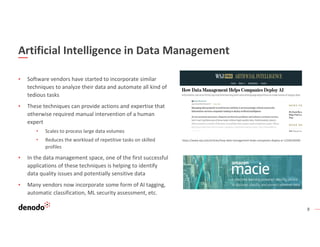
▪ Software vendors have started to incorporate similar
techniques to analyze their data and automate all kind of
tedious tasks
▪ These techniques can provide actions and expertise that
otherwise required manual intervention of a human
expert
• Scales to process large data volumes
• Reduces the workload of repetitive tasks on skilled
profiles
▪ In the data management space, one of the first successful
applications of these techniques is helping to identify
data quality issues and potentially sensitive data
▪ Many vendors now incorporate some form of AI tagging,
automatic classification, ML security assessment, etc.
https://www.wsj.com/articles/how-data-management-helps-companies-deploy-ai-11556530200
9
Application in Data Virtualization
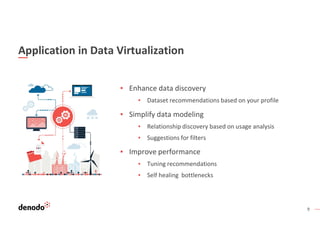
▪ Enhance data discovery
▪ Dataset recommendations based on your profile
▪ Simplify data modeling
▪ Relationship discovery based on usage analysis
▪ Suggestions for filters
▪ Improve performance
▪ Tuning recommendations
▪ Self healing bottlenecks
10
Welcome to a Hybrid
World
11
Denodo Global Cloud Survey 2020
• More than 75% of companies already have projects in cloud
• Over 15% are Cloud-First and/or are in “advanced” state
• Only 3.97% do not have plans for Cloud in the short term
• More than 53% have hybrid integration needs
• Key Use Cases include: Analytics (50%), Data Lake (31%), AI/ML (28%)
• Less than 9% of on-prem systems are decommissioned (Forrester estimates 8%)
• Key Technologies in Cloud Journey: Cloud Platform Tools (56%), Data Virtualization (49.5%),
Data Lake Technology (48%)
Source: Denodo Global Cloud Survey 2020
12
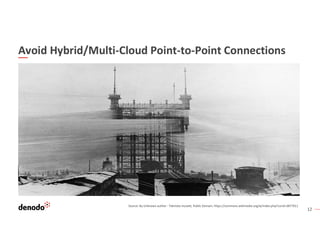
Avoid Hybrid/Multi-Cloud Point-to-Point Connections
Source: By Unknown author - Tekniska museet, Public Domain, https://commons.wikimedia.org/w/index.php?curid=3877011
13
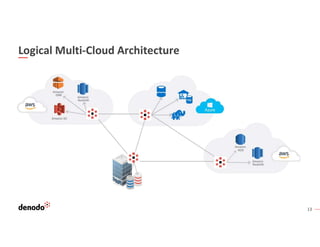
Logical Multi-Cloud Architecture
14
Voice Control and NLP
15
Voice Control and NLP
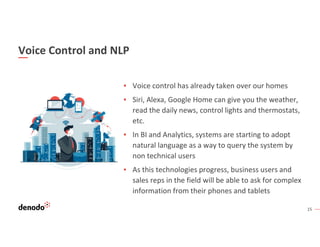
▪ Voice control has already taken over our homes
▪ Siri, Alexa, Google Home can give you the weather,
read the daily news, control lights and thermostats,
etc.
▪ In BI and Analytics, systems are starting to adopt
natural language as a way to query the system by
non technical users
▪ As this technologies progress, business users and
sales reps in the field will be able to ask for complex
information from their phones and tablets
16
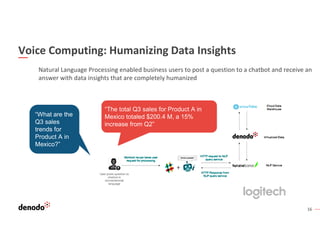
Voice Computing: Humanizing Data Insights
Natural Language Processing enabled business users to post a question to a chatbot and receive an
answer with data insights that are completely humanized
“The total Q3 sales for Product A in
Mexico totaled $200.4 M, a 15%
increase from Q2”
“What are the
Q3 sales
trends for
Product A in
Mexico?”
17
Data Monetization
and the API Economy
18
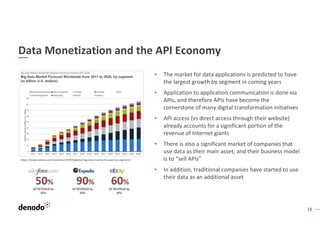
Data Monetization and the API Economy
▪ The market for data applications is predicted to have
the largest growth by segment in coming years
▪ Application to application communication is done via
APIs, and therefore APIs have become the
cornerstone of many digital transformation initiatives
▪ API access (vs direct access through their website)
already accounts for a significant portion of the
revenue of Internet giants
▪ There is also a significant market of companies that
use data as their main asset, and their business model
is to “sell APIs”
▪ In addition, traditional companies have started to use
their data as an additional asset
https://www.statista.com/statistics/255970/global-big-data-market-forecast-by-segment/
19
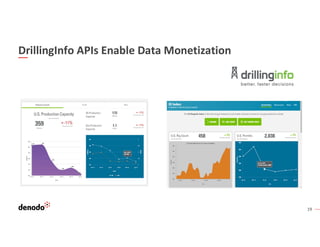
DrillingInfo APIs Enable Data Monetization
20
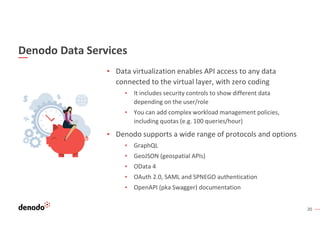
Denodo Data Services
▪ Data virtualization enables API access to any data
connected to the virtual layer, with zero coding
▪ It includes security controls to show different data
depending on the user/role
▪ You can add complex workload management policies,
including quotas (e.g. 100 queries/hour)
▪ Denodo supports a wide range of protocols and options
▪ GraphQL
▪ GeoJSON (geospatial APIs)
▪ OData 4
▪ OAuth 2.0, SAML and SPNEGO authentication
▪ OpenAPI (pka Swagger) documentation
21
Data Fabrics and Adaptive
Data Architectures
22
Data fabric focuses on automating the process integration,
transformation, preparation, curation, security, governance, and
orchestration to enable analytics and insights quickly for business
success. It minimizes complexity by automating processes,
workflows, and pipelines, generating code and streamlining data
to accelerate various use cases such as customer 360, data
science, fraud detection, internet-of-things (IoT) analytics, risk
analytics, and healthcare insights.”
The Forrester Wave™: Enterprise Data Fabric, Q2 2020
23
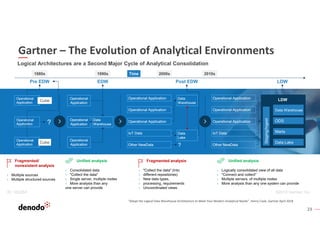
Gartner – The Evolution of Analytical Environments
Logical Architectures are a Second Major Cycle of Analytical Consolidation
Operational ApplicationOperational Application
IoT DataIoT Data
Other NewDataOther NewData
Operational
Application
Operational
Application
Operational
Application
Operational
Application
CubeCube
Operational
Application
Operational
Application
CubeCube
?? Operational ApplicationOperational Application
Operational ApplicationOperational Application
IoT DataIoT Data
Other NewDataOther NewData
1980s
Pre EDW
1990s
EDW
2010s2000s
Post EDW
Time
LDW
Operational
Application
Operational
Application
Operational
Application
Operational
Application
Operational
Application
Operational
Application
Data
Warehouse
Data
Warehouse
Data
Warehouse
Data
Warehouse
Data
Lake
Data
Lake
??
LDWLDW
Data WarehouseData Warehouse
Data LakeData Lake
MartsMarts
ODSODS
Staging/IngestStaging/Ingest
Unified analysis
› Consolidated data
› "Collect the data"
› Single server, multiple nodes
› More analysis than any
one server can provide
©2018 Gartner, Inc.
Unified analysis
› Logically consolidated view of all data
› "Connect and collect"
› Multiple servers, of multiple nodes
› More analysis than any one system can provide
ID: 342254
Fragmented/
nonexistent analysis
› Multiple sources
› Multiple structured sources
Fragmented analysis
› "Collect the data" (Into
› different repositories)
› New data types,
› processing, requirements
› Uncoordinated views
“Adopt the Logical Data Warehouse Architecture to Meet Your Modern Analytical Needs”. Henry Cook, Gartner April 2018
24
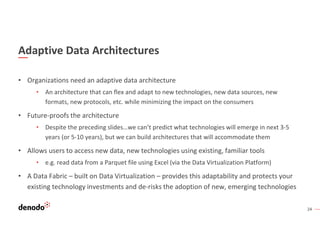
Adaptive Data Architectures
• Organizations need an adaptive data architecture
• An architecture that can flex and adapt to new technologies, new data sources, new
formats, new protocols, etc. while minimizing the impact on the consumers
• Future-proofs the architecture
• Despite the preceding slides…we can’t predict what technologies will emerge in next 3-5
years (or 5-10 years), but we can build architectures that will accommodate them
• Allows users to access new data, new technologies using existing, familiar tools
• e.g. read data from a Parquet file using Excel (via the Data Virtualization Platform)
• A Data Fabric – built on Data Virtualization – provides this adaptability and protects your
existing technology investments and de-risks the adoption of new, emerging technologies
25
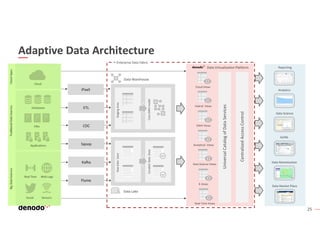
Adaptive Data Architecture
Reporting
Analytics
Data Science
Data Market Place
Data Monetization
AI/ML
iPaaS
Kafka
ETL
CDC
Sqoop
Flume
RawDataZoneStagingArea
CuratedDataZoneCoreDWHmodel
Data Warehouse
Data Lake
Data Virtualization Platform
Analytical Views
Data Science Views
λ Views
Real-Time Views
DWH Views
Hybrid Views
Cloud Views
UniversalCatalogofDataServices
CentralizedAccessControl
Enterprise Data Fabric
27
Next Steps
Access Denodo Platform in the Cloud!
Take a Test Drive today!
www.denodo.com/TestDrive
GET STARTED TODAY
www.denodo.com info@denodo.com
© Copyright Denodo Technologies. All rights reserved
Unless otherwise specified, no part of this PDF file may be reproduced or utilized in any for or by any means, electronic or mechanical, including photocopying and microfilm,
without prior the written authorization from Denodo Technologies.

Future of Data Strategy

  • 1.
  • 2.
    Speaker Paul Moxon SVP DataArchitecture & Chief Evangelist Denodo
  • 3.
    3 Attributed to NielsBohr (Bulletin of the Atomic Scientist, 1971) …It’s Difficult to Make Predictions, Especially About the Future.”
  • 4.
    4 Analysts: “Predict” TheFuture By Looking At The Present
  • 5.
    5 But The FutureCan Hold Surprises… Motorola Razr 2007 Apple iPhone 2007
  • 6.
    6 ML and AIas to Simplify Data Management Challenges
  • 7.
    7 ML and AIto Simplify Data Management Challenges ▪ Data science practices are already common in many companies to produce better insights that enable business decisions ▪ Data Scientists have been one of the most popular jobs in recent years ▪ Currently common practice for resource allocation, supply chain management, fraud detection, predictive analytics, etc. ▪ Denodo is already frequently used in this scenarios as a way to simplify and accelerate data exploration and analysis https://www.denodo.com/en/webinar/customer-keynote-data-virtualization-modernize-and-accelerate-analytics-prologis
  • 8.
    8 Artificial Intelligence inData Management ▪ Software vendors have started to incorporate similar techniques to analyze their data and automate all kind of tedious tasks ▪ These techniques can provide actions and expertise that otherwise required manual intervention of a human expert • Scales to process large data volumes • Reduces the workload of repetitive tasks on skilled profiles ▪ In the data management space, one of the first successful applications of these techniques is helping to identify data quality issues and potentially sensitive data ▪ Many vendors now incorporate some form of AI tagging, automatic classification, ML security assessment, etc. https://www.wsj.com/articles/how-data-management-helps-companies-deploy-ai-11556530200
  • 9.
    9 Application in DataVirtualization ▪ Enhance data discovery ▪ Dataset recommendations based on your profile ▪ Simplify data modeling ▪ Relationship discovery based on usage analysis ▪ Suggestions for filters ▪ Improve performance ▪ Tuning recommendations ▪ Self healing bottlenecks
  • 10.
    10 Welcome to aHybrid World
  • 11.
    11 Denodo Global CloudSurvey 2020 • More than 75% of companies already have projects in cloud • Over 15% are Cloud-First and/or are in “advanced” state • Only 3.97% do not have plans for Cloud in the short term • More than 53% have hybrid integration needs • Key Use Cases include: Analytics (50%), Data Lake (31%), AI/ML (28%) • Less than 9% of on-prem systems are decommissioned (Forrester estimates 8%) • Key Technologies in Cloud Journey: Cloud Platform Tools (56%), Data Virtualization (49.5%), Data Lake Technology (48%) Source: Denodo Global Cloud Survey 2020
  • 12.
    12 Avoid Hybrid/Multi-Cloud Point-to-PointConnections Source: By Unknown author - Tekniska museet, Public Domain, https://commons.wikimedia.org/w/index.php?curid=3877011
  • 13.
  • 14.
  • 15.
    15 Voice Control andNLP ▪ Voice control has already taken over our homes ▪ Siri, Alexa, Google Home can give you the weather, read the daily news, control lights and thermostats, etc. ▪ In BI and Analytics, systems are starting to adopt natural language as a way to query the system by non technical users ▪ As this technologies progress, business users and sales reps in the field will be able to ask for complex information from their phones and tablets
  • 16.
    16 Voice Computing: HumanizingData Insights Natural Language Processing enabled business users to post a question to a chatbot and receive an answer with data insights that are completely humanized “The total Q3 sales for Product A in Mexico totaled $200.4 M, a 15% increase from Q2” “What are the Q3 sales trends for Product A in Mexico?”
  • 17.
  • 18.
    18 Data Monetization andthe API Economy ▪ The market for data applications is predicted to have the largest growth by segment in coming years ▪ Application to application communication is done via APIs, and therefore APIs have become the cornerstone of many digital transformation initiatives ▪ API access (vs direct access through their website) already accounts for a significant portion of the revenue of Internet giants ▪ There is also a significant market of companies that use data as their main asset, and their business model is to “sell APIs” ▪ In addition, traditional companies have started to use their data as an additional asset https://www.statista.com/statistics/255970/global-big-data-market-forecast-by-segment/
  • 19.
    19 DrillingInfo APIs EnableData Monetization
  • 20.
    20 Denodo Data Services ▪Data virtualization enables API access to any data connected to the virtual layer, with zero coding ▪ It includes security controls to show different data depending on the user/role ▪ You can add complex workload management policies, including quotas (e.g. 100 queries/hour) ▪ Denodo supports a wide range of protocols and options ▪ GraphQL ▪ GeoJSON (geospatial APIs) ▪ OData 4 ▪ OAuth 2.0, SAML and SPNEGO authentication ▪ OpenAPI (pka Swagger) documentation
  • 21.
    21 Data Fabrics andAdaptive Data Architectures
  • 22.
    22 Data fabric focuseson automating the process integration, transformation, preparation, curation, security, governance, and orchestration to enable analytics and insights quickly for business success. It minimizes complexity by automating processes, workflows, and pipelines, generating code and streamlining data to accelerate various use cases such as customer 360, data science, fraud detection, internet-of-things (IoT) analytics, risk analytics, and healthcare insights.” The Forrester Wave™: Enterprise Data Fabric, Q2 2020
  • 23.
    23 Gartner – TheEvolution of Analytical Environments Logical Architectures are a Second Major Cycle of Analytical Consolidation Operational ApplicationOperational Application Operational ApplicationOperational Application Operational ApplicationOperational Application IoT DataIoT Data Other NewDataOther NewData Operational Application Operational Application Operational Application Operational Application CubeCube Operational Application Operational Application CubeCube ?? Operational ApplicationOperational Application Operational ApplicationOperational Application Operational ApplicationOperational Application IoT DataIoT Data Other NewDataOther NewData 1980s Pre EDW 1990s EDW 2010s2000s Post EDW Time LDW Operational Application Operational Application Operational Application Operational Application Operational Application Operational Application Data Warehouse Data Warehouse Data Warehouse Data Warehouse Data Lake Data Lake ?? LDWLDW Data WarehouseData Warehouse Data LakeData Lake MartsMarts ODSODS Staging/IngestStaging/Ingest Unified analysis › Consolidated data › "Collect the data" › Single server, multiple nodes › More analysis than any one server can provide ©2018 Gartner, Inc. Unified analysis › Logically consolidated view of all data › "Connect and collect" › Multiple servers, of multiple nodes › More analysis than any one system can provide ID: 342254 Fragmented/ nonexistent analysis › Multiple sources › Multiple structured sources Fragmented analysis › "Collect the data" (Into › different repositories) › New data types, › processing, requirements › Uncoordinated views “Adopt the Logical Data Warehouse Architecture to Meet Your Modern Analytical Needs”. Henry Cook, Gartner April 2018
  • 24.
    24 Adaptive Data Architectures •Organizations need an adaptive data architecture • An architecture that can flex and adapt to new technologies, new data sources, new formats, new protocols, etc. while minimizing the impact on the consumers • Future-proofs the architecture • Despite the preceding slides…we can’t predict what technologies will emerge in next 3-5 years (or 5-10 years), but we can build architectures that will accommodate them • Allows users to access new data, new technologies using existing, familiar tools • e.g. read data from a Parquet file using Excel (via the Data Virtualization Platform) • A Data Fabric – built on Data Virtualization – provides this adaptability and protects your existing technology investments and de-risks the adoption of new, emerging technologies
  • 25.
    25 Adaptive Data Architecture Reporting Analytics DataScience Data Market Place Data Monetization AI/ML iPaaS Kafka ETL CDC Sqoop Flume RawDataZoneStagingArea CuratedDataZoneCoreDWHmodel Data Warehouse Data Lake Data Virtualization Platform Analytical Views Data Science Views λ Views Real-Time Views DWH Views Hybrid Views Cloud Views UniversalCatalogofDataServices CentralizedAccessControl Enterprise Data Fabric
  • 27.
    27 Next Steps Access DenodoPlatform in the Cloud! Take a Test Drive today! www.denodo.com/TestDrive GET STARTED TODAY
  • 28.
    www.denodo.com info@denodo.com © CopyrightDenodo Technologies. All rights reserved Unless otherwise specified, no part of this PDF file may be reproduced or utilized in any for or by any means, electronic or mechanical, including photocopying and microfilm, without prior the written authorization from Denodo Technologies.