Five In-depth Technology and Architecture Sessions
on Data Virtualization
Session 5: Security
Today’s Speaker
■ Jesus Barrasa
Senior Solutions Architect, Denodo
Architect-to-Architect Series
■ Series of five webinars over 3 months
■ Deeper look into Denodo Platform
■ Architectural Overview
■ Performance
■ Scalability
■ Data Discovery and Governance
■ Security (today’s session)
Denodo Express
■ Denodo Express
■ Free to Download
■ Fully functioning Data Virtualization Platform
■ Single user, supports common data sources
■ Many of the same capabilities of Denodo
Platform
■ Performance, Data Discovery, Governance,
internal Security, Publishing, …
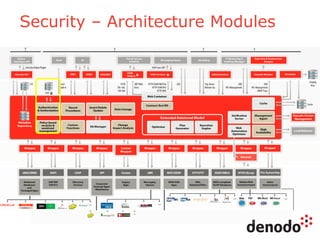
Security – Architecture Modules
Security
■ Authentication & Authorization
■ Built-in User/Role Management Module
■ Integration with external entitlement servers
(LDAP/AD)
■ Multi-level access controls
■ Database, View, Row, Column, and Cell
■ Policy-based Security and Workload
Management
■ Enforcement of custom policies for query
execution according to security & workload
considerations
Overview
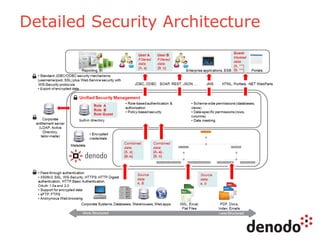
■ Unified security management through Data
Virtualization
• Data Virtualization offers an abstraction layer that
decouples data sources from consumer applications
■ Single point for accessing all the information avoiding
point-to-point connections to sources
• As a single point of access, Security can be enforced in
this layer:
■ Access restrictions to sources are enforced here
■ They can be defined in terms of the canonical model (e.g.
access restrictions to “Bill”, to “Order”, and so on) with a
fine granularity
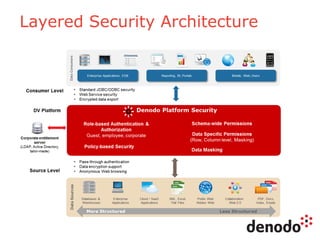
Layered Security Architecture
Detailed Security Architecture
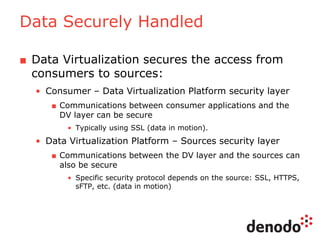
Data Securely Handled
■ Data Virtualization secures the access from
consumers to sources:
• Consumer – Data Virtualization Platform security layer
■ Communications between consumer applications and the
DV layer can be secure
• Typically using SSL (data in motion).
• Data Virtualization Platform – Sources security layer
■ Communications between the DV layer and the sources can
also be secure
• Specific security protocol depends on the source: SSL, HTTPS,
sFTP, etc. (data in motion)
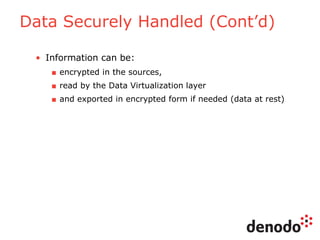
Data Securely Handled (Cont’d)
• Information can be:
■ encrypted in the sources,
■ read by the Data Virtualization layer
■ and exported in encrypted form if needed (data at rest)
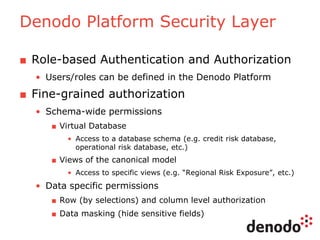
Denodo Platform Security Layer
■ Role-based Authentication and Authorization
• Users/roles can be defined in the Denodo Platform
■ Fine-grained authorization
• Schema-wide permissions
■ Virtual Database
• Access to a database schema (e.g. credit risk database,
operational risk database, etc.)
■ Views of the canonical model
• Access to specific views (e.g. “Regional Risk Exposure”, etc.)
• Data specific permissions
■ Row (by selections) and column level authorization
■ Data masking (hide sensitive fields)
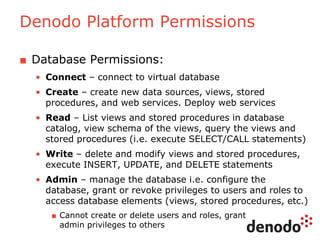
Denodo Platform Permissions
■ Database Permissions:
• Connect – connect to virtual database
• Create – create new data sources, views, stored
procedures, and web services. Deploy web services
• Read – List views and stored procedures in database
catalog, view schema of the views, query the views and
stored procedures (i.e. execute SELECT/CALL statements)
• Write – delete and modify views and stored procedures,
execute INSERT, UPDATE, and DELETE statements
• Admin – manage the database i.e. configure the
database, grant or revoke privileges to users and roles to
access database elements (views, stored procedures, etc.)
■ Cannot create or delete users and roles, grant
admin privileges to others
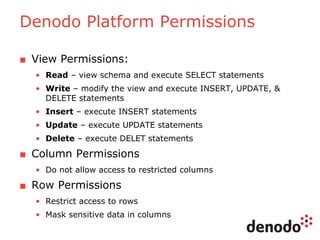
Denodo Platform Permissions
■ View Permissions:
• Read – view schema and execute SELECT statements
• Write – modify the view and execute INSERT, UPDATE, &
DELETE statements
• Insert – execute INSERT statements
• Update – execute UPDATE statements
• Delete – execute DELET statements
■ Column Permissions
• Do not allow access to restricted columns
■ Row Permissions
• Restrict access to rows
• Mask sensitive data in columns
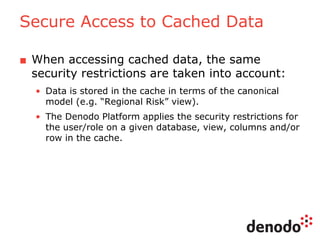
Secure Access to Cached Data
■ When accessing cached data, the same
security restrictions are taken into account:
• Data is stored in the cache in terms of the canonical
model (e.g. “Regional Risk” view).
• The Denodo Platform applies the security restrictions for
the user/role on a given database, view, columns and/or
row in the cache.
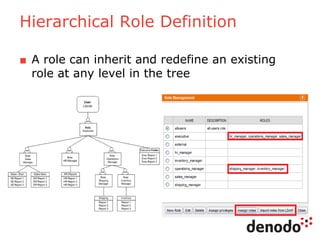
Hierarchical Role Definition
■ A role can inherit and redefine an existing
role at any level in the tree
Integration with Existing Security
Architecture
■ Seamless integration with existing security
policies:
• The Denodo Platform can import security definitions
from external directory services
■ LDAP and Microsoft Active Directory
• If needed, the Denodo Platform can pass through
security credentials directly to the sources
■ Pass-through authentication
■ User credentials defined at the consumer application level
can be used to authenticate directly in the sources
• It can enforce security policies defined in an external
entitlement management system
Integration with Existing Security
Architecture (Cont’d)
■ LDAP and Active Directory based
authentication
• The Denodo Platform delegates authentication to a
designated LDAP/Active Directory service.
■ Users don´t need to be defined in the Denodo Platform
built-in user management system.
■ The Denodo Platform queries the LDAP/AD server to check
the user role.
• Roles can be imported from LDAP/Active Directory and
used to constrain the access to any database or view
within the Data Virtualization Platform.
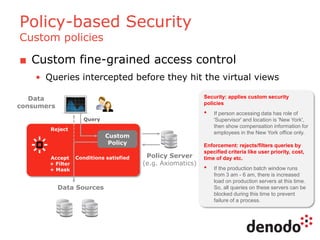
■ Custom fine-grained access control
• Queries intercepted before they hit the virtual views
Policy-based Security
Custom policies
Conditions satisfied
Data
consumers
Query
Accept
+ Filter
+ Mask
Reject
Policy Server
(e.g. Axiomatics)
Data Sources
Security: applies custom security
policies
• If person accessing data has role of
'Supervisor' and location is 'New York',
then show compensation information for
employees in the New York office only.
Enforcement: rejects/filters queries by
specified criteria like user priority, cost,
time of day etc.
• If the production batch window runs
from 3 am - 6 am, there is increased
load on production servers at this time.
So, all queries on these servers can be
blocked during this time to prevent
failure of a process.
Custom
Policy
Auditing
■ Audit trail of all the queries and actions
executed in the platform
• Configurable multi-level log for later analysis (based on
log4j)
■ Generation of events for any action that
causes any change in the data catalog
■ With this information it is possible to check at
any time who has accessed which resources,
what changes have been made or what
queries have been executed
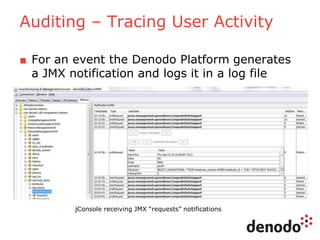
Auditing – Tracing User Activity
■ For an event the Denodo Platform generates
a JMX notification and logs it in a log file
jConsole receiving JMX “requests” notifications
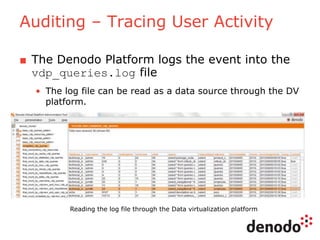
Auditing – Tracing User Activity
■ The Denodo Platform logs the event into the
vdp_queries.log file
• The log file can be read as a data source through the DV
platform.
Reading the log file through the Data virtualization platform
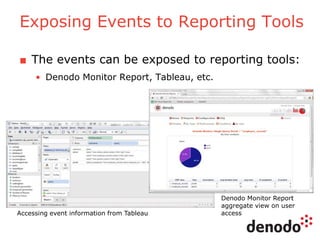
Exposing Events to Reporting Tools
■ The events can be exposed to reporting tools:
• Denodo Monitor Report, Tableau, etc.
Accessing event information from Tableau
Denodo Monitor Report
aggregate view on user
access
Security - Summary
■ Three layered security architecture
■ Consumer, Denodo Platform, Source
■ Fine grained access control
■ Database, View, Column, Row, Cell
■ Integration with existing security
architecture
■ Extensible using custom policies
■ Comprehensive auditing
■ Who, what, and when
Q&A
Data Virtualization – Next Steps
Move forward at your own pace
 Download Denodo Express –
The fastest way to Data Virtualization
 Denodo Community: Documents, Videos, Tutorials, and more.
 Attend Architect-to-Architect Series
 Performance
 Scalability
Move forward with one of our Data
Virtualization experts
 Phone: (+1) 877-556-2531 (NA)
 Phone: (+44) (0)20 7869 8053 (EMEA)
 Email: info@denodo.com | www.denodo.com
 Data Discovery and Governance
 Security
Five In-depth Technology and Architecture Sessions
on Data Virtualization
Thank You!

Denodo Data Virtualization Platform: Security (session 5 from Architect to Architect webinar series)

  • 1.
    Five In-depth Technologyand Architecture Sessions on Data Virtualization Session 5: Security
  • 2.
    Today’s Speaker ■ JesusBarrasa Senior Solutions Architect, Denodo
  • 3.
    Architect-to-Architect Series ■ Seriesof five webinars over 3 months ■ Deeper look into Denodo Platform ■ Architectural Overview ■ Performance ■ Scalability ■ Data Discovery and Governance ■ Security (today’s session)
  • 4.
    Denodo Express ■ DenodoExpress ■ Free to Download ■ Fully functioning Data Virtualization Platform ■ Single user, supports common data sources ■ Many of the same capabilities of Denodo Platform ■ Performance, Data Discovery, Governance, internal Security, Publishing, …
  • 5.
  • 6.
    Security ■ Authentication &Authorization ■ Built-in User/Role Management Module ■ Integration with external entitlement servers (LDAP/AD) ■ Multi-level access controls ■ Database, View, Row, Column, and Cell ■ Policy-based Security and Workload Management ■ Enforcement of custom policies for query execution according to security & workload considerations
  • 7.
    Overview ■ Unified securitymanagement through Data Virtualization • Data Virtualization offers an abstraction layer that decouples data sources from consumer applications ■ Single point for accessing all the information avoiding point-to-point connections to sources • As a single point of access, Security can be enforced in this layer: ■ Access restrictions to sources are enforced here ■ They can be defined in terms of the canonical model (e.g. access restrictions to “Bill”, to “Order”, and so on) with a fine granularity
  • 8.
  • 9.
  • 10.
    Data Securely Handled ■Data Virtualization secures the access from consumers to sources: • Consumer – Data Virtualization Platform security layer ■ Communications between consumer applications and the DV layer can be secure • Typically using SSL (data in motion). • Data Virtualization Platform – Sources security layer ■ Communications between the DV layer and the sources can also be secure • Specific security protocol depends on the source: SSL, HTTPS, sFTP, etc. (data in motion)
  • 11.
    Data Securely Handled(Cont’d) • Information can be: ■ encrypted in the sources, ■ read by the Data Virtualization layer ■ and exported in encrypted form if needed (data at rest)
  • 12.
    Denodo Platform SecurityLayer ■ Role-based Authentication and Authorization • Users/roles can be defined in the Denodo Platform ■ Fine-grained authorization • Schema-wide permissions ■ Virtual Database • Access to a database schema (e.g. credit risk database, operational risk database, etc.) ■ Views of the canonical model • Access to specific views (e.g. “Regional Risk Exposure”, etc.) • Data specific permissions ■ Row (by selections) and column level authorization ■ Data masking (hide sensitive fields)
  • 13.
    Denodo Platform Permissions ■Database Permissions: • Connect – connect to virtual database • Create – create new data sources, views, stored procedures, and web services. Deploy web services • Read – List views and stored procedures in database catalog, view schema of the views, query the views and stored procedures (i.e. execute SELECT/CALL statements) • Write – delete and modify views and stored procedures, execute INSERT, UPDATE, and DELETE statements • Admin – manage the database i.e. configure the database, grant or revoke privileges to users and roles to access database elements (views, stored procedures, etc.) ■ Cannot create or delete users and roles, grant admin privileges to others
  • 14.
    Denodo Platform Permissions ■View Permissions: • Read – view schema and execute SELECT statements • Write – modify the view and execute INSERT, UPDATE, & DELETE statements • Insert – execute INSERT statements • Update – execute UPDATE statements • Delete – execute DELET statements ■ Column Permissions • Do not allow access to restricted columns ■ Row Permissions • Restrict access to rows • Mask sensitive data in columns
  • 15.
    Secure Access toCached Data ■ When accessing cached data, the same security restrictions are taken into account: • Data is stored in the cache in terms of the canonical model (e.g. “Regional Risk” view). • The Denodo Platform applies the security restrictions for the user/role on a given database, view, columns and/or row in the cache.
  • 16.
    Hierarchical Role Definition ■A role can inherit and redefine an existing role at any level in the tree
  • 17.
    Integration with ExistingSecurity Architecture ■ Seamless integration with existing security policies: • The Denodo Platform can import security definitions from external directory services ■ LDAP and Microsoft Active Directory • If needed, the Denodo Platform can pass through security credentials directly to the sources ■ Pass-through authentication ■ User credentials defined at the consumer application level can be used to authenticate directly in the sources • It can enforce security policies defined in an external entitlement management system
  • 18.
    Integration with ExistingSecurity Architecture (Cont’d) ■ LDAP and Active Directory based authentication • The Denodo Platform delegates authentication to a designated LDAP/Active Directory service. ■ Users don´t need to be defined in the Denodo Platform built-in user management system. ■ The Denodo Platform queries the LDAP/AD server to check the user role. • Roles can be imported from LDAP/Active Directory and used to constrain the access to any database or view within the Data Virtualization Platform.
  • 19.
    ■ Custom fine-grainedaccess control • Queries intercepted before they hit the virtual views Policy-based Security Custom policies Conditions satisfied Data consumers Query Accept + Filter + Mask Reject Policy Server (e.g. Axiomatics) Data Sources Security: applies custom security policies • If person accessing data has role of 'Supervisor' and location is 'New York', then show compensation information for employees in the New York office only. Enforcement: rejects/filters queries by specified criteria like user priority, cost, time of day etc. • If the production batch window runs from 3 am - 6 am, there is increased load on production servers at this time. So, all queries on these servers can be blocked during this time to prevent failure of a process. Custom Policy
  • 20.
    Auditing ■ Audit trailof all the queries and actions executed in the platform • Configurable multi-level log for later analysis (based on log4j) ■ Generation of events for any action that causes any change in the data catalog ■ With this information it is possible to check at any time who has accessed which resources, what changes have been made or what queries have been executed
  • 21.
    Auditing – TracingUser Activity ■ For an event the Denodo Platform generates a JMX notification and logs it in a log file jConsole receiving JMX “requests” notifications
  • 22.
    Auditing – TracingUser Activity ■ The Denodo Platform logs the event into the vdp_queries.log file • The log file can be read as a data source through the DV platform. Reading the log file through the Data virtualization platform
  • 23.
    Exposing Events toReporting Tools ■ The events can be exposed to reporting tools: • Denodo Monitor Report, Tableau, etc. Accessing event information from Tableau Denodo Monitor Report aggregate view on user access
  • 24.
    Security - Summary ■Three layered security architecture ■ Consumer, Denodo Platform, Source ■ Fine grained access control ■ Database, View, Column, Row, Cell ■ Integration with existing security architecture ■ Extensible using custom policies ■ Comprehensive auditing ■ Who, what, and when
  • 25.
  • 26.
    Data Virtualization –Next Steps Move forward at your own pace  Download Denodo Express – The fastest way to Data Virtualization  Denodo Community: Documents, Videos, Tutorials, and more.  Attend Architect-to-Architect Series  Performance  Scalability Move forward with one of our Data Virtualization experts  Phone: (+1) 877-556-2531 (NA)  Phone: (+44) (0)20 7869 8053 (EMEA)  Email: info@denodo.com | www.denodo.com  Data Discovery and Governance  Security
  • 27.
    Five In-depth Technologyand Architecture Sessions on Data Virtualization Thank You!