Sonnets
What is it?
is a poetic form which originated in Italy
derives from the Italian word sonetto, meaning "little
song”
it signified a poem of fourteen lines that follows a
strict rhyme scheme and specific structure
Two main forms of sonnets are Petrarchan sonnet
and the English sonnet.
best-known sonnet writer is William
Shakespeare, who wrote 154 of them.
Petrarchan Sonnet
Also known as an Italian sonnet
Written in the rhythm of iambic pentameter
Composed of 2 main sections – an octave (an eight-
line unit) and a sestet (a six-line unit).
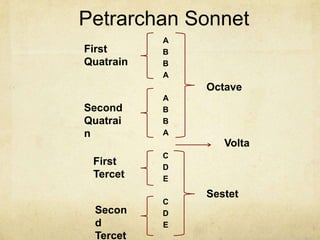
Octave has a rhyming pattern of a b b a a b b a and
the sestet rhymes c d e c d e (see next slide)
Octave contains two quatrains and the sestet
consists of two tercets.
Break at the end is called a volta – indicates turning
point or a different idea in the thought of the poem
Petrarchan Sonnet
A
B
B
A
A
B
B
A
C
D
E
C
D
E
Volta
Octave
Sestet
First
Quatrain
Second
Quatrai
n
First
Tercet
Secon
d
Tercet
On His Blindness by John
Milton
When I consider how my light is spent (A)
 Ere half my
days, in this dark world and wide, (B)
 And that one
talent which is death to hide, (B)
 Lodged with me
useless, though my soul more bent (A)
To serve
therewith my Maker, and present (A)
 My true
account, lest he returning chide; (B)
 "Doth God exact
day-labor, light denied?" (B)
 I fondly ask; but Patience to
prevent (A)
That murmur, soon replies, "God doth not
need (C)
 Either man's work or his own gifts; who best
(D)
 Bear his mild yoke, they serve him best. His state
(E)
Is Kingly. Thousands at his bidding speed (C)
 And
post o'er land and ocean without rest; (D)
 They also
serve who only stand and wait." (E)
Shakespearean Sonnet
Also known as an English Sonnet
consists of fourteen lines written in iambic pentameter
a pattern of an unstressed syllable followed by a
stressed syllable repeated five times.
The rhyme scheme in a Shakespearean sonnet is a-
b-a-b (First Quatrain), c-d-c-d (Second Quatrain),
e-f-e-f (Third Quatrain), g-g; the last two lines are a
rhyming couplet
The volta is at the end of the third quatrain
The rhyming couplet is often a summary of the
poem’s idea but with a subtle change in thought.
Futility by Wilfred Owen
The poem concentrates on the meaning of
existence and the futility (pointlessness) of war and
the inevitability of death
Narrator is having an existential crisis: What is the
point of being born if you are just going to die a
few years later?
The anonymity of the poem allows it to be
universal; it can be describing any soldier
This poem also serves as an elegy (song, poem or
speech that expresses grief for one who is dead;
usually in a melancholy tone)
Futility

Sonnets + Futility

  • 1.
  • 2.
    What is it? isa poetic form which originated in Italy derives from the Italian word sonetto, meaning "little song” it signified a poem of fourteen lines that follows a strict rhyme scheme and specific structure Two main forms of sonnets are Petrarchan sonnet and the English sonnet. best-known sonnet writer is William Shakespeare, who wrote 154 of them.
  • 3.
    Petrarchan Sonnet Also knownas an Italian sonnet Written in the rhythm of iambic pentameter Composed of 2 main sections – an octave (an eight- line unit) and a sestet (a six-line unit). Octave has a rhyming pattern of a b b a a b b a and the sestet rhymes c d e c d e (see next slide) Octave contains two quatrains and the sestet consists of two tercets. Break at the end is called a volta – indicates turning point or a different idea in the thought of the poem
  • 4.
  • 5.
    On His Blindnessby John Milton When I consider how my light is spent (A)
 Ere half my days, in this dark world and wide, (B)
 And that one talent which is death to hide, (B)
 Lodged with me useless, though my soul more bent (A)
To serve therewith my Maker, and present (A)
 My true account, lest he returning chide; (B)
 "Doth God exact day-labor, light denied?" (B)
 I fondly ask; but Patience to prevent (A)
That murmur, soon replies, "God doth not need (C)
 Either man's work or his own gifts; who best (D)
 Bear his mild yoke, they serve him best. His state (E)
Is Kingly. Thousands at his bidding speed (C)
 And post o'er land and ocean without rest; (D)
 They also serve who only stand and wait." (E)
  • 6.
    Shakespearean Sonnet Also knownas an English Sonnet consists of fourteen lines written in iambic pentameter a pattern of an unstressed syllable followed by a stressed syllable repeated five times. The rhyme scheme in a Shakespearean sonnet is a- b-a-b (First Quatrain), c-d-c-d (Second Quatrain), e-f-e-f (Third Quatrain), g-g; the last two lines are a rhyming couplet The volta is at the end of the third quatrain The rhyming couplet is often a summary of the poem’s idea but with a subtle change in thought.
  • 7.
    Futility by WilfredOwen The poem concentrates on the meaning of existence and the futility (pointlessness) of war and the inevitability of death Narrator is having an existential crisis: What is the point of being born if you are just going to die a few years later? The anonymity of the poem allows it to be universal; it can be describing any soldier This poem also serves as an elegy (song, poem or speech that expresses grief for one who is dead; usually in a melancholy tone)
  • 8.