WHAT IS THE POEM ABOUT? 
• How people look up to their nation 
• Even if you’re fighting for your country your country 
won’t remember you 
• Power of a nation’s flag 
• Desperation of society to feel a sense of belonging 
• Conflict 
• Explores how nation symbols bind nations together 
and how it forces people appart
TONE AND LANGUAGE 
The tone of the poem ‘Flag’ has a slow paced rhythm, it is casual 
and questioning. The last stanza shows a sense of desperation 
and possessive language. The poem’s tone builds up throughout 
the poem getting more powerful and independent. The poem is 
also very cynical ‘It’s just a piece of cloth’. This establishes the 
unimportance of the flag to the speaker and is repeated in each 
stanza apart from the last stanza. Alliteration is used to the writers 
advantage in this poem ‘ that will outlive the blood you bleed’. This 
shows how the country will outlive your death and carry on with 
that country’s journey. Rhetorical questions are used also to make 
the reader think, this symbolises a conversation. An example of 
this would be ‘What’s that unfurling from a pole?’. This sentence 
plays with the reader’s imagination. The poet uses language to its 
full potential to get his message across to the reader.
ATTITUDES, THEMES AND IDEAS 
This poem seems to be built on the idea that nationalism is a 
purely abstract idea (an idea that exists in the head rather than in 
physical, concrete reality). He draws on views of countries as 
"imagined communities" – groups of people bound by myths, 
stories and flags. We are all human and yet certain individuals, 
powerful leaders, will create divisions simply by giving meaning to 
a limp and fluttering piece of cloth. The poem is therefore about 
the power of symbolism. Agard admits that the flag is a powerful 
symbol – but he urges us to see it as just that: a symbol whose 
ideas are dangerous and an invention of mankind. The word that 
is repeated most in the poem, for example, is "just". This therefore 
becomes the most important idea in the poem. It seeks to lessen 
the power of the flag.
FORM AND STRUCTURE 
Form 
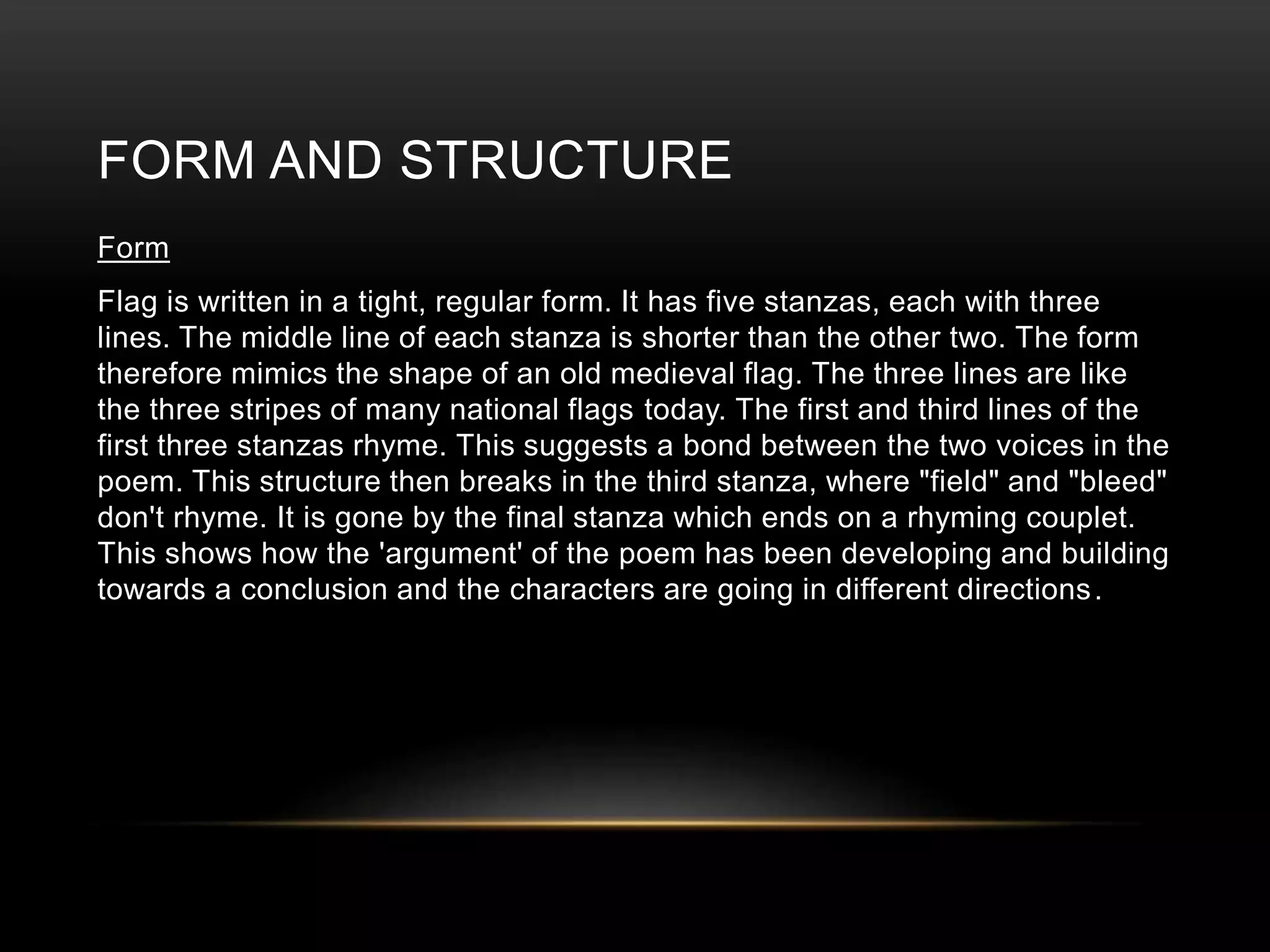
Flag is written in a tight, regular form. It has five stanzas, each with three 
lines. The middle line of each stanza is shorter than the other two. The form 
therefore mimics the shape of an old medieval flag. The three lines are like 
the three stripes of many national flags today. The first and third lines of the 
first three stanzas rhyme. This suggests a bond between the two voices in the 
poem. This structure then breaks in the third stanza, where "field" and "bleed" 
don't rhyme. It is gone by the final stanza which ends on a rhyming couplet. 
This shows how the 'argument' of the poem has been developing and building 
towards a conclusion and the characters are going in different directions.
LANGUAGE 
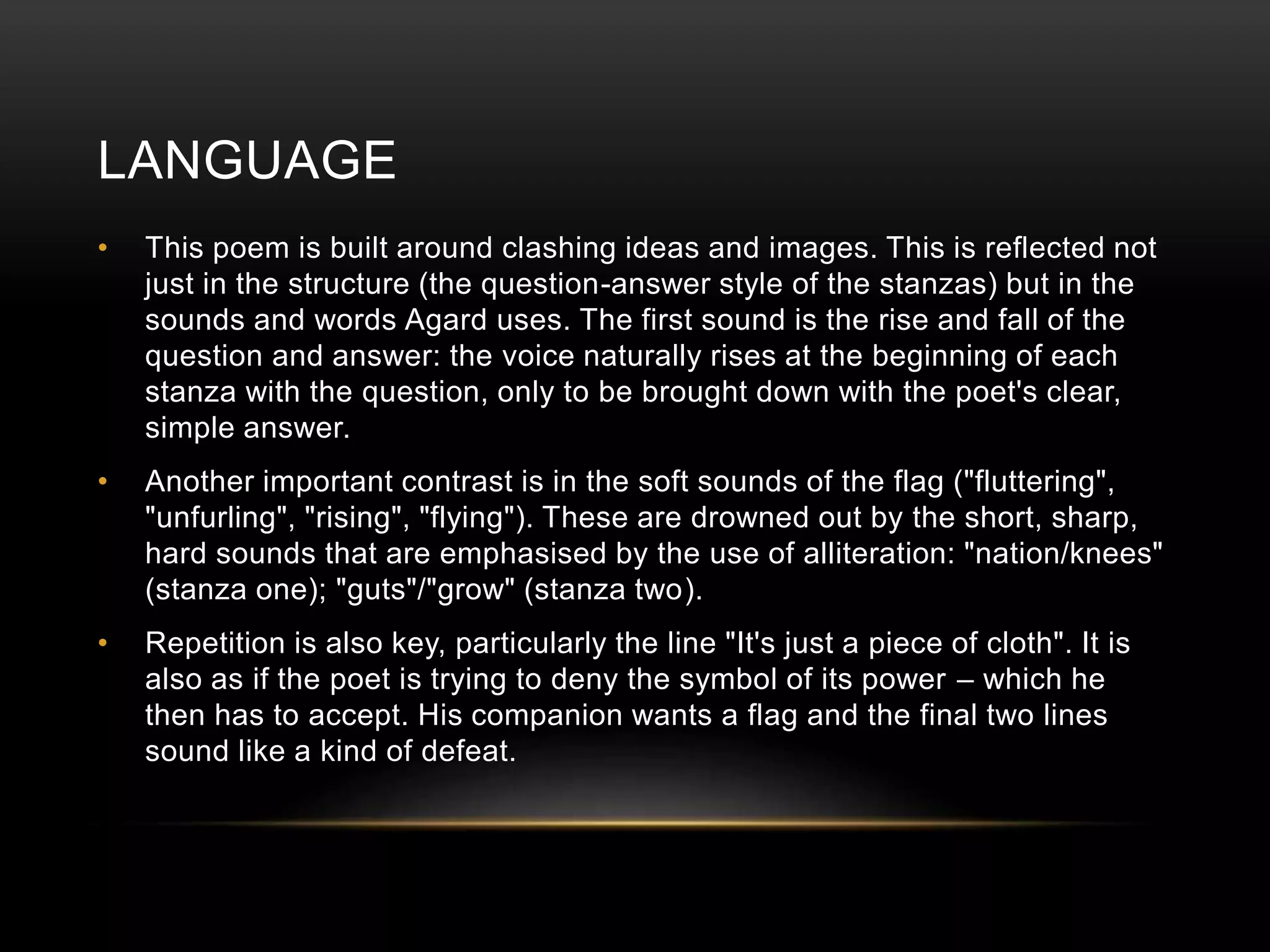
• This poem is built around clashing ideas and images. This is reflected not 
just in the structure (the question-answer style of the stanzas) but in the 
sounds and words Agard uses. The first sound is the rise and fall of the 
question and answer: the voice naturally rises at the beginning of each 
stanza with the question, only to be brought down with the poet's clear, 
simple answer. 
• Another important contrast is in the soft sounds of the flag ("fluttering", 
"unfurling", "rising", "flying"). These are drowned out by the short, sharp, 
hard sounds that are emphasised by the use of alliteration: "nation/knees" 
(stanza one); "guts"/"grow" (stanza two). 
• Repetition is also key, particularly the line "It's just a piece of cloth". It is 
also as if the poet is trying to deny the symbol of its power – which he 
then has to accept. His companion wants a flag and the final two lines 
sound like a kind of defeat.
IMAGERY 
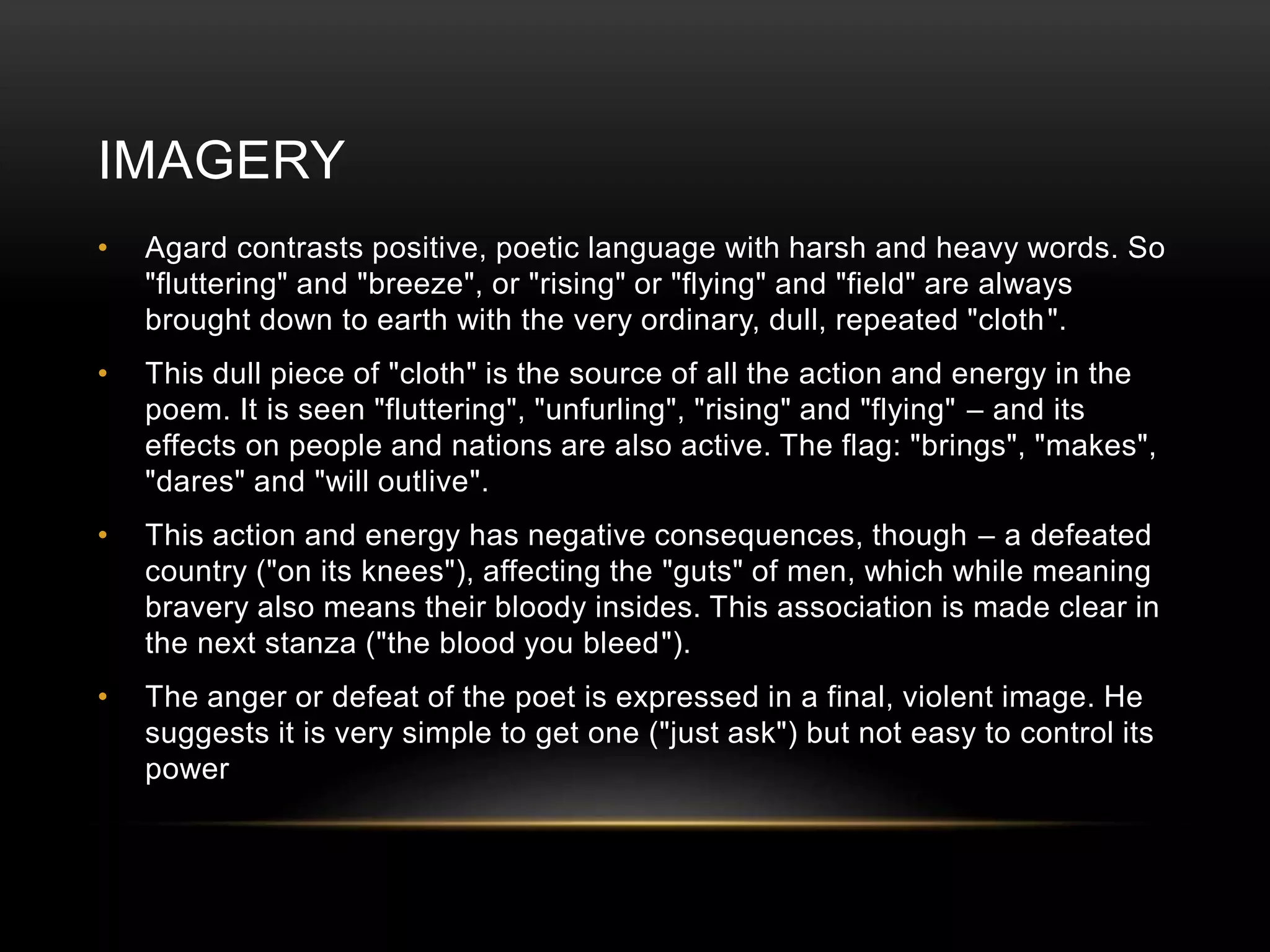
• Agard contrasts positive, poetic language with harsh and heavy words. So 
"fluttering" and "breeze", or "rising" or "flying" and "field" are always 
brought down to earth with the very ordinary, dull, repeated "cloth". 
• This dull piece of "cloth" is the source of all the action and energy in the 
poem. It is seen "fluttering", "unfurling", "rising" and "flying" – and its 
effects on people and nations are also active. The flag: "brings", "makes", 
"dares" and "will outlive". 
• This action and energy has negative consequences, though – a defeated 
country ("on its knees"), affecting the "guts" of men, which while meaning 
bravery also means their bloody insides. This association is made clear in 
the next stanza ("the blood you bleed"). 
• The anger or defeat of the poet is expressed in a final, violent image. He 
suggests it is very simple to get one ("just ask") but not easy to control its 
power

Flag revision PowerPoint

  • 2.
    WHAT IS THEPOEM ABOUT? • How people look up to their nation • Even if you’re fighting for your country your country won’t remember you • Power of a nation’s flag • Desperation of society to feel a sense of belonging • Conflict • Explores how nation symbols bind nations together and how it forces people appart
  • 3.
    TONE AND LANGUAGE The tone of the poem ‘Flag’ has a slow paced rhythm, it is casual and questioning. The last stanza shows a sense of desperation and possessive language. The poem’s tone builds up throughout the poem getting more powerful and independent. The poem is also very cynical ‘It’s just a piece of cloth’. This establishes the unimportance of the flag to the speaker and is repeated in each stanza apart from the last stanza. Alliteration is used to the writers advantage in this poem ‘ that will outlive the blood you bleed’. This shows how the country will outlive your death and carry on with that country’s journey. Rhetorical questions are used also to make the reader think, this symbolises a conversation. An example of this would be ‘What’s that unfurling from a pole?’. This sentence plays with the reader’s imagination. The poet uses language to its full potential to get his message across to the reader.
  • 4.
    ATTITUDES, THEMES ANDIDEAS This poem seems to be built on the idea that nationalism is a purely abstract idea (an idea that exists in the head rather than in physical, concrete reality). He draws on views of countries as "imagined communities" – groups of people bound by myths, stories and flags. We are all human and yet certain individuals, powerful leaders, will create divisions simply by giving meaning to a limp and fluttering piece of cloth. The poem is therefore about the power of symbolism. Agard admits that the flag is a powerful symbol – but he urges us to see it as just that: a symbol whose ideas are dangerous and an invention of mankind. The word that is repeated most in the poem, for example, is "just". This therefore becomes the most important idea in the poem. It seeks to lessen the power of the flag.
  • 5.
    FORM AND STRUCTURE Form Flag is written in a tight, regular form. It has five stanzas, each with three lines. The middle line of each stanza is shorter than the other two. The form therefore mimics the shape of an old medieval flag. The three lines are like the three stripes of many national flags today. The first and third lines of the first three stanzas rhyme. This suggests a bond between the two voices in the poem. This structure then breaks in the third stanza, where "field" and "bleed" don't rhyme. It is gone by the final stanza which ends on a rhyming couplet. This shows how the 'argument' of the poem has been developing and building towards a conclusion and the characters are going in different directions.
  • 6.
    LANGUAGE • Thispoem is built around clashing ideas and images. This is reflected not just in the structure (the question-answer style of the stanzas) but in the sounds and words Agard uses. The first sound is the rise and fall of the question and answer: the voice naturally rises at the beginning of each stanza with the question, only to be brought down with the poet's clear, simple answer. • Another important contrast is in the soft sounds of the flag ("fluttering", "unfurling", "rising", "flying"). These are drowned out by the short, sharp, hard sounds that are emphasised by the use of alliteration: "nation/knees" (stanza one); "guts"/"grow" (stanza two). • Repetition is also key, particularly the line "It's just a piece of cloth". It is also as if the poet is trying to deny the symbol of its power – which he then has to accept. His companion wants a flag and the final two lines sound like a kind of defeat.
  • 7.
    IMAGERY • Agardcontrasts positive, poetic language with harsh and heavy words. So "fluttering" and "breeze", or "rising" or "flying" and "field" are always brought down to earth with the very ordinary, dull, repeated "cloth". • This dull piece of "cloth" is the source of all the action and energy in the poem. It is seen "fluttering", "unfurling", "rising" and "flying" – and its effects on people and nations are also active. The flag: "brings", "makes", "dares" and "will outlive". • This action and energy has negative consequences, though – a defeated country ("on its knees"), affecting the "guts" of men, which while meaning bravery also means their bloody insides. This association is made clear in the next stanza ("the blood you bleed"). • The anger or defeat of the poet is expressed in a final, violent image. He suggests it is very simple to get one ("just ask") but not easy to control its power