FUTILITY by Wilfred Owen
By: Anouk de Laferrere, Juana Zufriategui, Bianca Ieraci and Sofía
Mele
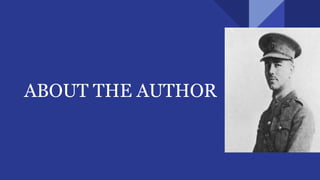
ABOUT THE AUTHOR
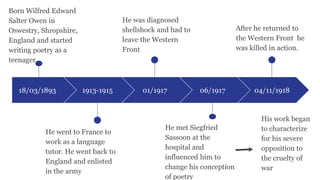
18/03/1893
Born Wilfred Edward
Salter Owen in
Oswestry, Shropshire,
England and started
writing poetry as a
teenager
1913-1915
He went to France to
work as a language
tutor. He went back to
England and enlisted
in the army
01/1917
He was diagnosed
shellshock and had to
leave the Western
Front
06/1917
He met Siegfried
Sassoon at the
hospital and
influenced him to
change his conception
of poetry
04/11/1918
After he returned to
the Western Front he
was killed in action.
His work began
to characterize
for his severe
opposition to
the cruelty of
war
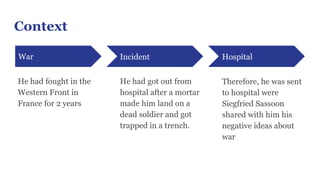
Context
War
He had fought in the
Western Front in
France for 2 years
Incident
He had got out from
hospital after a mortar
made him land on a
dead soldier and got
trapped in a trench.
Hospital
Therefore, he was sent
to hospital were
Siegfried Sassoon
shared with him his
negative ideas about
war
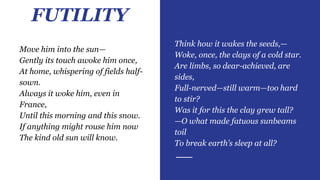
FUTILITY
Think how it wakes the seeds,—
Woke, once, the clays of a cold star.
Are limbs, so dear-achieved, are
sides,
Full-nerved—still warm—too hard
to stir?
Was it for this the clay grew tall?
—O what made fatuous sunbeams
toil
To break earth’s sleep at all?
Move him into the sun—
Gently its touch awoke him once,
At home, whispering of fields half-
sown.
Always it woke him, even in
France,
Until this morning and this snow.
If anything might rouse him now
The kind old sun will know.
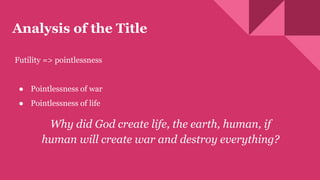
Analysis of the Title
Futility => pointlessness
● Pointlessness of war
● Pointlessness of life
Why did God create life, the earth, human, if
human will create war and destroy everything?
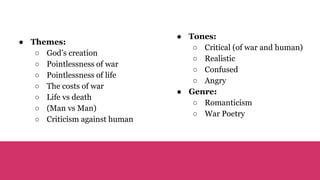
● Themes:
○ God’s creation
○ Pointlessness of war
○ Pointlessness of life
○ The costs of war
○ Life vs death
○ (Man vs Man)
○ Criticism against human
● Tones:
○ Critical (of war and human)
○ Realistic
○ Confused
○ Angry
● Genre:
○ Romanticism
○ War Poetry
Analysis - Literary Devices
● Personification of the “sun” as God
○ “Gently its touch awoke him once”
○ “The kind old sun will know”
● Synecdoche : “limbs” as man
● Enjambment : eternal creation being constantly destroyed
● Semantic field of nature to refer to God’s creation including human
○ “sun”,”fields”,”snow”,”seeds”,”clay”,”earth”
● Repetition of “clay” - Biblical reference
● Symbolism of “seeds”
● Symbolism of “sides”
● Oxymoron : “the clays of a cold star”
Important Quotes
● “It always woke him, even in France”
● “Until this morning and this snow-...-The kind old sun will know”
● “Was it for this the clay grew tall?”
● “Are limbs, so dear-achieved, are sides,
Full-nerved—still warm—too hard to stir?”
● “-O what made fatuous sunbeams toil- To break earth’s sleep at all?”
Connections to real life
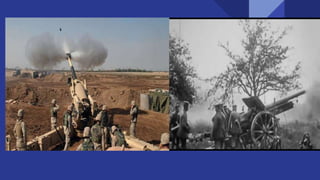
Although the surroundings and the technology have changed,
people have not. The fact that we still fight for something, as a piece
of land, is nonsense. Why can't we talk calmly and achieve a
diplomatic agreement instead of battling with no objective. Millions
of lives are lost in a war, cities are ruined and fall apart into pieces,
civils are injured and killed. This happened then in WW1 and is
happening in the Middle East with the objective of obtaining a
resource, oil.
What does the poem teach us?
The writer all throughout the poem makes us question ourselves and think why
God created the world including life, if his own creation would destroy it as human
causes war. The poem makes us understand that human should appreciate the life
that God gave to him instead of causing wars and destroying everything that he
created.
Besides, it teaches us that we are all humans regardless of our cultural, social,
political or economic diversities. Therefore, we should not fight against each other
at war, at the end we are all the same.
Our opinion
It is great how the author ponders God's power to create life, setting it against
extinction. We can notice that the poet feels frustrated at the pointlessness of
creating life for it to be destroyed by war. We like the title as it is very significant
because “futility” is a word that probably could sum up war as something that
has no effective result, people will kill other similar people.
At the last stanza, Owen used the word “fatuous” as his anger is coming out
hinting at the pointlessness of war. What we understood is that war doesn’t
value the importance of life.
We also enjoyed how the poet could express his contempt for war and its
horrible consequences in a metaphorical way.

Futility

  • 1.
    FUTILITY by WilfredOwen By: Anouk de Laferrere, Juana Zufriategui, Bianca Ieraci and Sofía Mele
  • 2.
  • 3.
    18/03/1893 Born Wilfred Edward SalterOwen in Oswestry, Shropshire, England and started writing poetry as a teenager 1913-1915 He went to France to work as a language tutor. He went back to England and enlisted in the army 01/1917 He was diagnosed shellshock and had to leave the Western Front 06/1917 He met Siegfried Sassoon at the hospital and influenced him to change his conception of poetry 04/11/1918 After he returned to the Western Front he was killed in action. His work began to characterize for his severe opposition to the cruelty of war
  • 4.
    Context War He had foughtin the Western Front in France for 2 years Incident He had got out from hospital after a mortar made him land on a dead soldier and got trapped in a trench. Hospital Therefore, he was sent to hospital were Siegfried Sassoon shared with him his negative ideas about war
  • 5.
    FUTILITY Think how itwakes the seeds,— Woke, once, the clays of a cold star. Are limbs, so dear-achieved, are sides, Full-nerved—still warm—too hard to stir? Was it for this the clay grew tall? —O what made fatuous sunbeams toil To break earth’s sleep at all? Move him into the sun— Gently its touch awoke him once, At home, whispering of fields half- sown. Always it woke him, even in France, Until this morning and this snow. If anything might rouse him now The kind old sun will know.
  • 6.
    Analysis of theTitle Futility => pointlessness ● Pointlessness of war ● Pointlessness of life Why did God create life, the earth, human, if human will create war and destroy everything?
  • 7.
    ● Themes: ○ God’screation ○ Pointlessness of war ○ Pointlessness of life ○ The costs of war ○ Life vs death ○ (Man vs Man) ○ Criticism against human ● Tones: ○ Critical (of war and human) ○ Realistic ○ Confused ○ Angry ● Genre: ○ Romanticism ○ War Poetry
  • 8.
    Analysis - LiteraryDevices ● Personification of the “sun” as God ○ “Gently its touch awoke him once” ○ “The kind old sun will know” ● Synecdoche : “limbs” as man ● Enjambment : eternal creation being constantly destroyed ● Semantic field of nature to refer to God’s creation including human ○ “sun”,”fields”,”snow”,”seeds”,”clay”,”earth” ● Repetition of “clay” - Biblical reference ● Symbolism of “seeds” ● Symbolism of “sides” ● Oxymoron : “the clays of a cold star”
  • 9.
    Important Quotes ● “Italways woke him, even in France” ● “Until this morning and this snow-...-The kind old sun will know” ● “Was it for this the clay grew tall?” ● “Are limbs, so dear-achieved, are sides, Full-nerved—still warm—too hard to stir?” ● “-O what made fatuous sunbeams toil- To break earth’s sleep at all?”
  • 10.
    Connections to reallife Although the surroundings and the technology have changed, people have not. The fact that we still fight for something, as a piece of land, is nonsense. Why can't we talk calmly and achieve a diplomatic agreement instead of battling with no objective. Millions of lives are lost in a war, cities are ruined and fall apart into pieces, civils are injured and killed. This happened then in WW1 and is happening in the Middle East with the objective of obtaining a resource, oil.
  • 12.
    What does thepoem teach us? The writer all throughout the poem makes us question ourselves and think why God created the world including life, if his own creation would destroy it as human causes war. The poem makes us understand that human should appreciate the life that God gave to him instead of causing wars and destroying everything that he created. Besides, it teaches us that we are all humans regardless of our cultural, social, political or economic diversities. Therefore, we should not fight against each other at war, at the end we are all the same.
  • 13.
    Our opinion It isgreat how the author ponders God's power to create life, setting it against extinction. We can notice that the poet feels frustrated at the pointlessness of creating life for it to be destroyed by war. We like the title as it is very significant because “futility” is a word that probably could sum up war as something that has no effective result, people will kill other similar people. At the last stanza, Owen used the word “fatuous” as his anger is coming out hinting at the pointlessness of war. What we understood is that war doesn’t value the importance of life. We also enjoyed how the poet could express his contempt for war and its horrible consequences in a metaphorical way.