FUNDS
MANAGEMENT
The functions in this component support you in
creating and executing budgets. The purpose of
Funds Management is to budget all revenues and
expenditures for individual areas of responsibility,
to control future funds transactions in accordance
with the distributed budget, and to stop the budget
being exceeded. You can adapt the budget to
changes in conditions by entering releases,
supplements, returns, and transfers.
Funds Management is fully integrated with other
components of the SAP System, especially with the
Budget Control System (BCS). The components that are
integrated depend on the specific requirements of your
organization. A basic requirement for the use of Funds
Management is integration with the General Ledger
Accounting (FI-GL) component.
.
Integration
Integrating the components Materials Management and
Funds Management means that you can reproduce and
monitor a procurement transaction from the purchase
requisition through to the invoice for example.
Integration also ensures that all the data you need for
budget execution is available in Funds Management
without additional data entry.
Features
Funds Management enables you to:
Control revenues and expenditures and thus control
the funding of business transactions of an organization.
Closely control your budget, with the following
questions in mind:
What funds will the areas of responsibility receive?
Where do these funds come from (source of funds)?
What are the funds used for? (use of funds)
Control the finances of your organization by comparing
commitment and actual values with current budget
values.
DEFINITION of 'Audit'
An audit is an objective examination and
evaluation of the financial statements of an
organization to make sure that the records are a
fair and accurate representation of the
transactions they claim to represent. It can be
done internally by employees of the organization,
or externally by an outside firm.
Audit overview
Posting checking
Testing the existence and effectiveness of
management controls that prevent financial
statement misstatement
Casting checking
Physical examination and count
Confirmation
Inquiry
Observation
•inspection
•Year-end scrutiny
•Re-computation
•Tracing in subsequent period
•Bank reconciliation
•Vouching
•Verification of existence, ownership, title and value
of assets and determination of the extent and nature
of liabilities
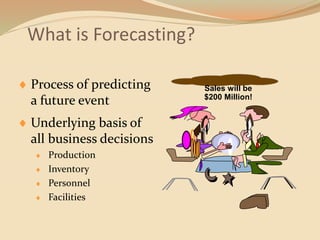
What is Forecasting?
 Process of predicting
a future event
 Underlying basis of
all business decisions
 Production
 Inventory
 Personnel
 Facilities
Sales will be
$200 Million!
Types of Forecasts by Time Horizon
 Short-range forecast
 Up to 1 year; usually less than 3 months
 Job scheduling, worker assignments
 Medium-range forecast
 3 months to 3 years
 Sales & production planning, budgeting
 Long-range forecast
 3+ years
 New product planning, facility location
Short-term vs. Longer-term
Forecasting
 Medium/long range forecasts deal with more
comprehensive issues and support management
decisions regarding planning and products, plants
and processes.
 Short-term forecasting usually employs different
methodologies than longer-term forecasting
 Short-term forecasts tend to be more accurate than
longer-term forecasts.
Types of Forecasts
 Economic forecasts
 Address business cycle, e.g., inflation rate, money
supply etc.
 Technological forecasts
 Predict rate of technological progress
 Predict acceptance of new product
 Demand forecasts
 Predict sales of existing product
Seven Steps in Forecasting
 Determine the use of the forecast
 Select the items to be forecasted
 Determine the time horizon of the forecast
 Select the forecasting model(s)
 Gather the data
 Make the forecast
 Validate and implement results
Realities of Forecasting
 Forecasts are seldom perfect
 Most forecasting methods assume that there is
some underlying stability in the system
 Both product family and aggregated product
forecasts are more accurate than individual product
forecasts
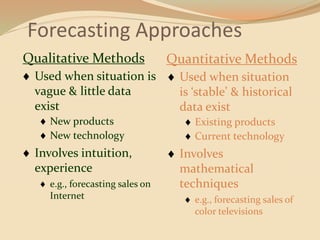
Forecasting Approaches
 Used when situation
is ‘stable’ & historical
data exist
 Existing products
 Current technology
 Involves
mathematical
techniques
 e.g., forecasting sales of
color televisions
Quantitative Methods
 Used when situation is
vague & little data
exist
 New products
 New technology
 Involves intuition,
experience
 e.g., forecasting sales on
Internet
Qualitative Methods
funds management

funds management

  • 1.
  • 2.
    The functions inthis component support you in creating and executing budgets. The purpose of Funds Management is to budget all revenues and expenditures for individual areas of responsibility, to control future funds transactions in accordance with the distributed budget, and to stop the budget being exceeded. You can adapt the budget to changes in conditions by entering releases, supplements, returns, and transfers.
  • 3.
    Funds Management isfully integrated with other components of the SAP System, especially with the Budget Control System (BCS). The components that are integrated depend on the specific requirements of your organization. A basic requirement for the use of Funds Management is integration with the General Ledger Accounting (FI-GL) component. . Integration
  • 4.
    Integrating the componentsMaterials Management and Funds Management means that you can reproduce and monitor a procurement transaction from the purchase requisition through to the invoice for example. Integration also ensures that all the data you need for budget execution is available in Funds Management without additional data entry.
  • 5.
    Features Funds Management enablesyou to: Control revenues and expenditures and thus control the funding of business transactions of an organization. Closely control your budget, with the following questions in mind: What funds will the areas of responsibility receive? Where do these funds come from (source of funds)? What are the funds used for? (use of funds) Control the finances of your organization by comparing commitment and actual values with current budget values.
  • 8.
    DEFINITION of 'Audit' Anaudit is an objective examination and evaluation of the financial statements of an organization to make sure that the records are a fair and accurate representation of the transactions they claim to represent. It can be done internally by employees of the organization, or externally by an outside firm.
  • 9.
    Audit overview Posting checking Testingthe existence and effectiveness of management controls that prevent financial statement misstatement Casting checking Physical examination and count Confirmation Inquiry Observation
  • 10.
    •inspection •Year-end scrutiny •Re-computation •Tracing insubsequent period •Bank reconciliation •Vouching •Verification of existence, ownership, title and value of assets and determination of the extent and nature of liabilities
  • 14.
    What is Forecasting? Process of predicting a future event  Underlying basis of all business decisions  Production  Inventory  Personnel  Facilities Sales will be $200 Million!
  • 15.
    Types of Forecastsby Time Horizon  Short-range forecast  Up to 1 year; usually less than 3 months  Job scheduling, worker assignments  Medium-range forecast  3 months to 3 years  Sales & production planning, budgeting  Long-range forecast  3+ years  New product planning, facility location
  • 17.
    Short-term vs. Longer-term Forecasting Medium/long range forecasts deal with more comprehensive issues and support management decisions regarding planning and products, plants and processes.  Short-term forecasting usually employs different methodologies than longer-term forecasting  Short-term forecasts tend to be more accurate than longer-term forecasts.
  • 18.
    Types of Forecasts Economic forecasts  Address business cycle, e.g., inflation rate, money supply etc.  Technological forecasts  Predict rate of technological progress  Predict acceptance of new product  Demand forecasts  Predict sales of existing product
  • 19.
    Seven Steps inForecasting  Determine the use of the forecast  Select the items to be forecasted  Determine the time horizon of the forecast  Select the forecasting model(s)  Gather the data  Make the forecast  Validate and implement results
  • 20.
    Realities of Forecasting Forecasts are seldom perfect  Most forecasting methods assume that there is some underlying stability in the system  Both product family and aggregated product forecasts are more accurate than individual product forecasts
  • 21.
    Forecasting Approaches  Usedwhen situation is ‘stable’ & historical data exist  Existing products  Current technology  Involves mathematical techniques  e.g., forecasting sales of color televisions Quantitative Methods  Used when situation is vague & little data exist  New products  New technology  Involves intuition, experience  e.g., forecasting sales on Internet Qualitative Methods