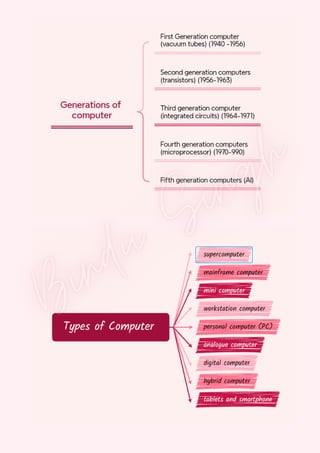
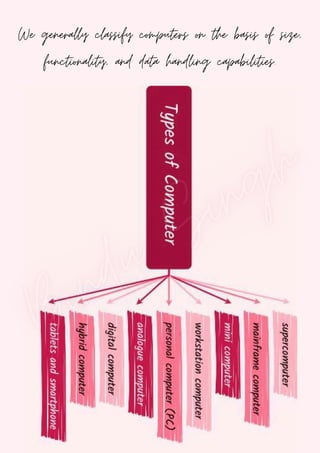
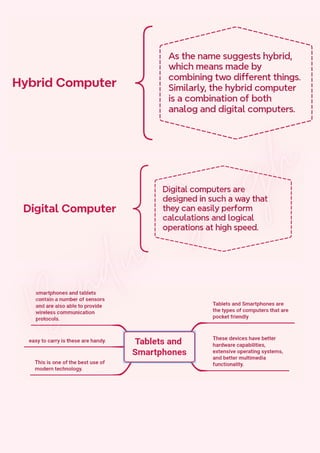
We generally classify computers on the basis of size,
functionality, and data handling capabilities.
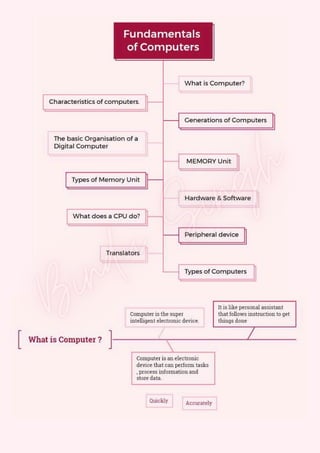
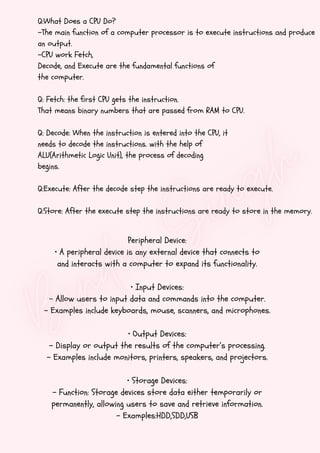
Q:What Does a CPU Do?
-The main function of a computer processor is to execute instructions and produce
an output.
-CPU work Fetch,
Decode, and Execute are the fundamental functions of
the computer.
Q: Fetch: the first CPU gets the instruction.
That means binary numbers that are passed from RAM to CPU.
Q: Decode: When the instruction is entered into the CPU, it
needs to decode the instructions. with the help of
ALU(Arithmetic Logic Unit), the process of decoding
begins.
Q:Execute: After the decode step the instructions are ready to execute.
Q:Store: After the execute step the instructions are ready to store in the memory.
Peripheral Device:
• A peripheral device is any external device that connects to
and interacts with a computer to expand its functionality.
• Input Devices:
– Allow users to input data and commands into the computer.
– Examples include keyboards, mouse, scanners, and microphones.
• Output Devices:
– Display or output the results of the computer’s processing.
– Examples include monitors, printers, speakers, and projectors.
• Storage Devices:
– Function: Storage devices store data either temporarily or
permanently, allowing users to save and retrieve information.
– Examples:HDD,SDD,USB
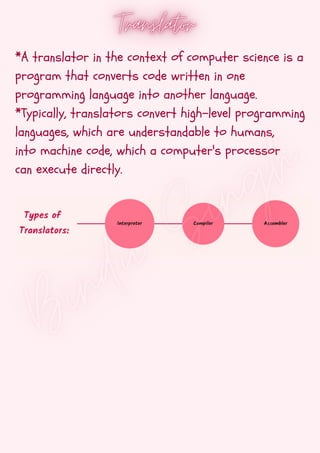
*A translator in the context of computer science is a
program that converts code written in one
programming language into another language.
*Typically, translators convert high-level programming
languages, which are understandable to humans,
into machine code, which a computer's processor
can execute directly.
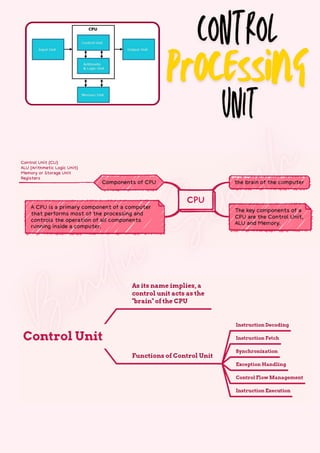
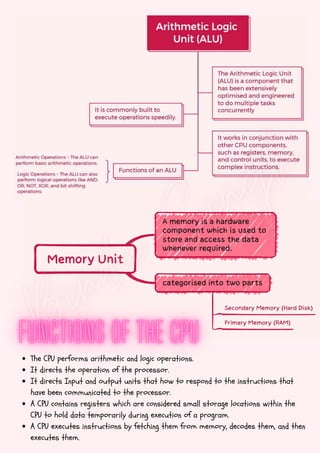
The CPU performs arithmetic and logic operations.
It directs the operation of the processor.
It directs Input and output units that how to respond to the instructions that
have been communicated to the processor.
A CPU contains registers which are considered small storage locations within the
CPU to hold data temporarily during execution of a program.
A CPU executes instructions by fetching them from memory, decodes them, and then
executes them.
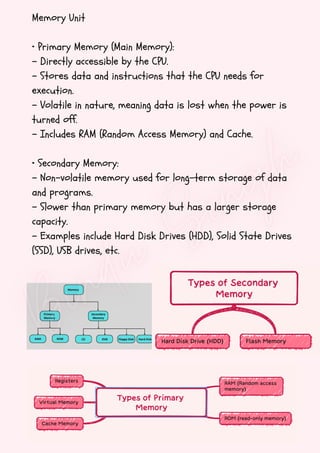
Memory Unit
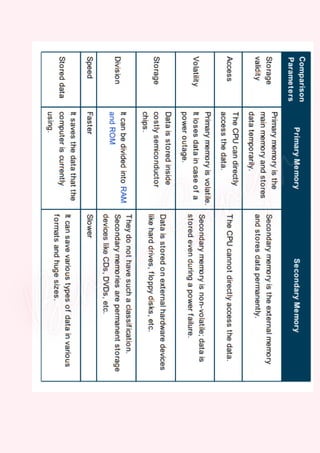
• Primary Memory (Main Memory):
– Directly accessible by the CPU.
– Stores data and instructions that the CPU needs for
execution.
– Volatile in nature, meaning data is lost when the power is
turned off.
– Includes RAM (Random Access Memory) and Cache.
• Secondary Memory:
– Non-volatile memory used for long-term storage of data
and programs.
– Slower than primary memory but has a larger storage
capacity.
– Examples include Hard Disk Drives (HDD), Solid State Drives
(SSD), USB drives, etc.
Fundamentals of Computers (pdf) |computer science

Fundamentals of Computers (pdf) |computer science

  • 9.
    We generally classifycomputers on the basis of size, functionality, and data handling capabilities.
  • 13.
    Q:What Does aCPU Do? -The main function of a computer processor is to execute instructions and produce an output. -CPU work Fetch, Decode, and Execute are the fundamental functions of the computer. Q: Fetch: the first CPU gets the instruction. That means binary numbers that are passed from RAM to CPU. Q: Decode: When the instruction is entered into the CPU, it needs to decode the instructions. with the help of ALU(Arithmetic Logic Unit), the process of decoding begins. Q:Execute: After the decode step the instructions are ready to execute. Q:Store: After the execute step the instructions are ready to store in the memory. Peripheral Device: • A peripheral device is any external device that connects to and interacts with a computer to expand its functionality. • Input Devices: – Allow users to input data and commands into the computer. – Examples include keyboards, mouse, scanners, and microphones. • Output Devices: – Display or output the results of the computer’s processing. – Examples include monitors, printers, speakers, and projectors. • Storage Devices: – Function: Storage devices store data either temporarily or permanently, allowing users to save and retrieve information. – Examples:HDD,SDD,USB
  • 14.
    *A translator inthe context of computer science is a program that converts code written in one programming language into another language. *Typically, translators convert high-level programming languages, which are understandable to humans, into machine code, which a computer's processor can execute directly.
  • 16.
    The CPU performsarithmetic and logic operations. It directs the operation of the processor. It directs Input and output units that how to respond to the instructions that have been communicated to the processor. A CPU contains registers which are considered small storage locations within the CPU to hold data temporarily during execution of a program. A CPU executes instructions by fetching them from memory, decodes them, and then executes them.
  • 17.
    Memory Unit • PrimaryMemory (Main Memory): – Directly accessible by the CPU. – Stores data and instructions that the CPU needs for execution. – Volatile in nature, meaning data is lost when the power is turned off. – Includes RAM (Random Access Memory) and Cache. • Secondary Memory: – Non-volatile memory used for long-term storage of data and programs. – Slower than primary memory but has a larger storage capacity. – Examples include Hard Disk Drives (HDD), Solid State Drives (SSD), USB drives, etc.