Standards
John D. McGregor
But first…
• http://www.acq.osd.mil/se/webinars/2009-
07-07-SECIE-Safety-in-Software-and-Human-
Intensive-Systems-Leveson-brief.pdf
Domain standards
• ISO 26262 - Functional Safety – Road Vehicles
• IEC 61508 -> ISO 26262
• IEC 61508 was not cancelled which means
that users of 26262 need to be familiar with
61508
Definitions
Skill is the learned capacity to carry out pre-determined results
Competence is the power to:
manage
make decisions
issue instructions
represent the organization
Qualification is proven by the relevant certificate.
Digression – architecture competence
• manage – the architecture and the architecture
process
• make decisions – architectural decisions
• issue instructions – to requirements people and
implementation people
• represent the organization – to other business
units, customers, and the profession
Safety
• Safety manager – cooperates with other team
members to assure that processes are defined
by the appropriate people in a project
• Safety assessor – evaluates projects and
process definitions from the outside to check
for compliance; documents equivalences and
exceptions
Requirements of the standard
• information related to functional safety is
identifiable
– Automotive Safety Integrity Level (ASIL)
• Requirements that logically belong together
should be arranged closely to one another
• Documentation could be formal, semi-formal
or informal
• Use cases for example are semi-formal
Requirements of the standard - 2
• ID – The specific ID number for each requirement is
automatically generated by DOORS.
• State – The state indicates the maturity of each
individual requirement. Rational DOORS enables the
maturity level to be chosen from a picklist.
• ASIL – The Automotive Safety Integrity Level (ASIL)
shows the safety rating of a function, requirement or
architectural element. These rating definitions can also
be chosen from a picklist.
Standards outline processes
Inter-relationships among items
Boundary of the item and the item's interfaces
Assumptions concerning the effects of the item's behavior on other items or
elements
Requirements either received from other items, or elements, or
environmental conditions
Requirements on other items, elements and the environment
The allocation and distribution of functions among the systems and elements
involved
Operating scenarios for each item, in case they impact the items ́ functionality
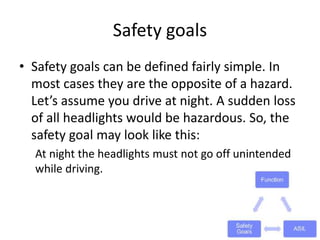
Safety goals
• Safety goals can be defined fairly simple. In
most cases they are the opposite of a hazard.
Let’s assume you drive at night. A sudden loss
of all headlights would be hazardous. So, the
safety goal may look like this:
At night the headlights must not go off unintended
while driving.
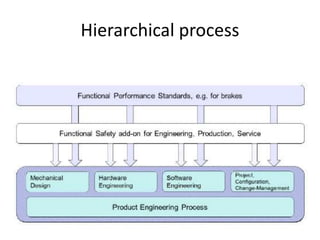
Hierarchical process
Software Systems Engineering
• ISO 15026 - System and Software Assurance
“System and software assurance focuses on the
management of risk and assurance of safety,
security, and dependability within the context of
system and software life cycles.”
Meta-model
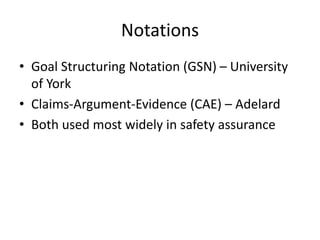
Notations
• Goal Structuring Notation (GSN) – University
of York
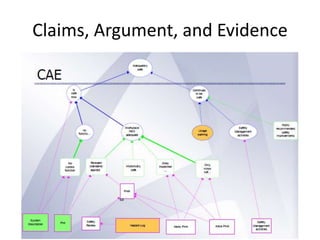
• Claims-Argument-Evidence (CAE) – Adelard
• Both used most widely in safety assurance
GSN
Claims, Argument, and Evidence
Internal standards
• In this case at Microsoft
• http://apparchguide.codeplex.com/wikipage?t
itle=Chapter%203%20-
%20Architecture%20and%20Design%20Guidel
ines
• http://public.dhe.ibm.com/common/ssi/ecm/
en/ral14048usen/RAL14048USEN.PDF
• http://www.adelard.com/asce/user-group/05-
Nov-
2008/Standards_update_OMG_15026.pdf
• http://ulir.ul.ie/bitstream/handle/10344/3124
/Finnegan_2013_process.pdf?sequence=2
DevOps
• http://www.slideshare.net/lenbass/design-
consequences-of-dev-ops-practices?related=2
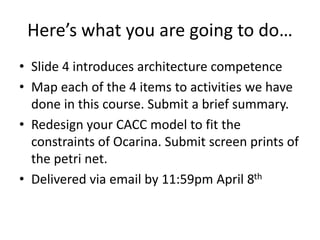
Here’s what you are going to do…
• Slide 4 introduces architecture competence
• Map each of the 4 items to activities we have
done in this course. Submit a brief summary.
• Redesign your CACC model to fit the
constraints of Ocarina. Submit screen prints of
the petri net.
• Delivered via email by 11:59pm April 8th

functional safety topic for engineers .pptx

  • 1.
  • 2.
  • 3.
    Domain standards • ISO26262 - Functional Safety – Road Vehicles • IEC 61508 -> ISO 26262 • IEC 61508 was not cancelled which means that users of 26262 need to be familiar with 61508
  • 4.
    Definitions Skill is thelearned capacity to carry out pre-determined results Competence is the power to: manage make decisions issue instructions represent the organization Qualification is proven by the relevant certificate.
  • 5.
    Digression – architecturecompetence • manage – the architecture and the architecture process • make decisions – architectural decisions • issue instructions – to requirements people and implementation people • represent the organization – to other business units, customers, and the profession
  • 6.
    Safety • Safety manager– cooperates with other team members to assure that processes are defined by the appropriate people in a project • Safety assessor – evaluates projects and process definitions from the outside to check for compliance; documents equivalences and exceptions
  • 7.
    Requirements of thestandard • information related to functional safety is identifiable – Automotive Safety Integrity Level (ASIL) • Requirements that logically belong together should be arranged closely to one another • Documentation could be formal, semi-formal or informal • Use cases for example are semi-formal
  • 8.
    Requirements of thestandard - 2 • ID – The specific ID number for each requirement is automatically generated by DOORS. • State – The state indicates the maturity of each individual requirement. Rational DOORS enables the maturity level to be chosen from a picklist. • ASIL – The Automotive Safety Integrity Level (ASIL) shows the safety rating of a function, requirement or architectural element. These rating definitions can also be chosen from a picklist.
  • 9.
  • 10.
    Inter-relationships among items Boundaryof the item and the item's interfaces Assumptions concerning the effects of the item's behavior on other items or elements Requirements either received from other items, or elements, or environmental conditions Requirements on other items, elements and the environment The allocation and distribution of functions among the systems and elements involved Operating scenarios for each item, in case they impact the items ́ functionality
  • 11.
    Safety goals • Safetygoals can be defined fairly simple. In most cases they are the opposite of a hazard. Let’s assume you drive at night. A sudden loss of all headlights would be hazardous. So, the safety goal may look like this: At night the headlights must not go off unintended while driving.
  • 12.
  • 13.
    Software Systems Engineering •ISO 15026 - System and Software Assurance “System and software assurance focuses on the management of risk and assurance of safety, security, and dependability within the context of system and software life cycles.”
  • 14.
  • 15.
    Notations • Goal StructuringNotation (GSN) – University of York • Claims-Argument-Evidence (CAE) – Adelard • Both used most widely in safety assurance
  • 16.
  • 17.
  • 18.
    Internal standards • Inthis case at Microsoft • http://apparchguide.codeplex.com/wikipage?t itle=Chapter%203%20- %20Architecture%20and%20Design%20Guidel ines
  • 19.
  • 20.
  • 21.
    Here’s what youare going to do… • Slide 4 introduces architecture competence • Map each of the 4 items to activities we have done in this course. Submit a brief summary. • Redesign your CACC model to fit the constraints of Ocarina. Submit screen prints of the petri net. • Delivered via email by 11:59pm April 8th