Engineering safe and secure software systems 1st Edition C. Warren Axelrod
Engineering safe and secure software systems 1st Edition C. Warren Axelrod
Engineering safe and secure software systems 1st Edition C. Warren Axelrod
Engineering safe and secure software systems 1st Edition C. Warren Axelrod
Engineering safe and secure software systems 1st Edition C. Warren Axelrod
1.
Visit https://ebookultra.com todownload the full version and
explore more ebooks or textbooks
Engineering safe and secure software systems 1st
Edition C. Warren Axelrod
_____ Click the link below to download _____
https://ebookultra.com/download/engineering-safe-and-secure-
software-systems-1st-edition-c-warren-axelrod/
Explore and download more ebooks or textbooks at ebookultra.com
2.
Here are somerecommended products that we believe you will be
interested in. You can click the link to download.
Computers Software Engineering and Digital Devices Richard
C. Dorf
https://ebookultra.com/download/computers-software-engineering-and-
digital-devices-richard-c-dorf/
Requirements Engineering for Software and Systems 2nd
Edition Phillip A. Laplante
https://ebookultra.com/download/requirements-engineering-for-software-
and-systems-2nd-edition-phillip-a-laplante/
Software Engineering and Computer Games 1st Edition Rucker
https://ebookultra.com/download/software-engineering-and-computer-
games-1st-edition-rucker/
Software Engineering Handbook 1st Edition Jessica Keyes
https://ebookultra.com/download/software-engineering-handbook-1st-
edition-jessica-keyes/
3.
Software Engineering 8ed.Edition Sommerville I.
https://ebookultra.com/download/software-engineering-8ed-edition-
sommerville-i/
Java Software and Embedded Systems 1st Edition Mattis
Hayes
https://ebookultra.com/download/java-software-and-embedded-
systems-1st-edition-mattis-hayes/
Lean for Systems Engineering with Lean Enablers for
Systems Engineering Wiley Series in Systems Engineering
and Management 1st Edition B. W. Oppenheim
https://ebookultra.com/download/lean-for-systems-engineering-with-
lean-enablers-for-systems-engineering-wiley-series-in-systems-
engineering-and-management-1st-edition-b-w-oppenheim/
Software Reliability Engineering More Reliable Software
Faster and Cheaper 2nd Edition John D. Musa
https://ebookultra.com/download/software-reliability-engineering-more-
reliable-software-faster-and-cheaper-2nd-edition-john-d-musa/
Software Build Systems Principles and Experience 1st
Edition Peter Smith
https://ebookultra.com/download/software-build-systems-principles-and-
experience-1st-edition-peter-smith/
5.
Engineering safe andsecure software systems 1st Edition
C. Warren Axelrod Digital Instant Download
Author(s): C. Warren Axelrod
ISBN(s): 9781608074730, 1608074730
Edition: 1
File Details: PDF, 2.30 MB
Year: 2012
Language: english
To Judy, David,Nicole, Elisabeth, Evan, and Jolie,
with wishes for a safer and more secure world for future generations
13.
vii
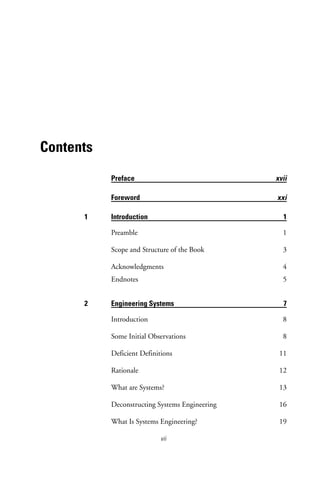
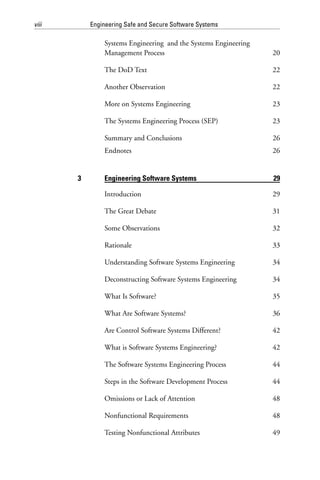
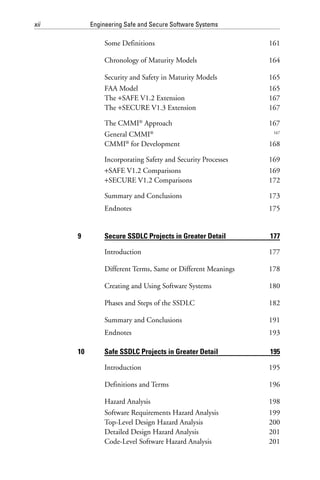
Contents
Preface xvii
Foreword xxi
1Introduction 1
Preamble 1
Scope and Structure of the Book 3
Acknowledgments 4
Endnotes 5
2 Engineering Systems 7
Introduction 8
Some Initial Observations 8
Deficient Definitions 11
Rationale 12
What are Systems? 13
Deconstructing Systems Engineering 16
What Is Systems Engineering? 19
14.
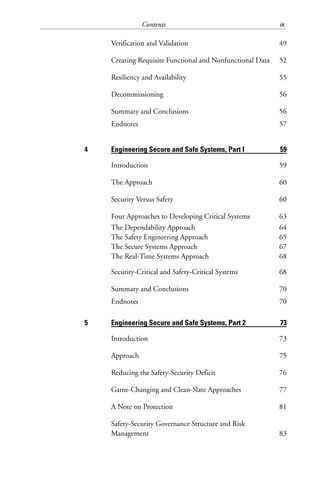
viii Engineering Safeand Secure Software Systems
Systems Engineering and the Systems Engineering
Management Process 20
The DoD Text 22
Another Observation 22
More on Systems Engineering 23
The Systems Engineering Process (SEP) 23
Summary and Conclusions 26
Endnotes 26
3 Engineering Software Systems 29
Introduction 29
The Great Debate 31
Some Observations 32
Rationale 33
Understanding Software Systems Engineering 34
Deconstructing Software Systems Engineering 34
What Is Software? 35
What Are Software Systems? 36
Are Control Software Systems Different? 42
What is Software Systems Engineering? 42
The Software Systems Engineering Process 44
Steps in the Software Development Process 44
Omissions or Lack of Attention 48
Nonfunctional Requirements 48
Testing Nonfunctional Attributes 49
15.
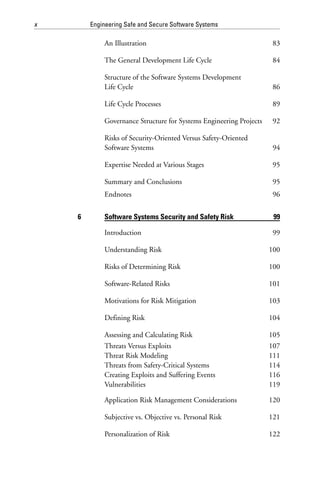
Contents ix
Verification andValidation 49
Creating Requisite Functional and Nonfunctional Data 52
Resiliency and Availability 55
Decommissioning 56
Summary and Conclusions 56
Endnotes 57
4 Engineering Secure and Safe Systems, Part I 59
Introduction 59
The Approach 60
Security Versus Safety 60
Four Approaches to Developing Critical Systems 63
The Dependability Approach 64
The Safety Engineering Approach 65
The Secure Systems Approach 67
The Real-Time Systems Approach 68
Security-Critical and Safety-Critical Systems 68
Summary and Conclusions 70
Endnotes 70
5 Engineering Secure and Safe Systems, Part 2 73
Introduction 73
Approach 75
Reducing the Safety-Security Deficit 76
Game-Changing and Clean-Slate Approaches 77
A Note on Protection 81
Safety-Security Governance Structure and Risk
Management 83
16.
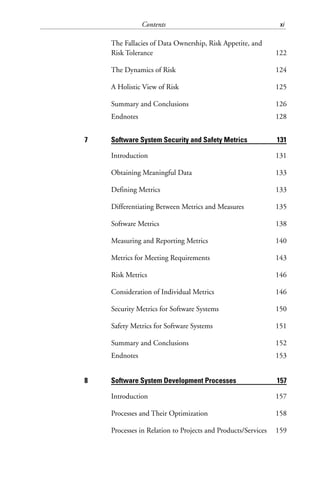
x Engineering Safeand Secure Software Systems
An Illustration 83
The General Development Life Cycle 84
Structure of the Software Systems Development
Life Cycle 86
Life Cycle Processes 89
Governance Structure for Systems Engineering Projects 92
Risks of Security-Oriented Versus Safety-Oriented
Software Systems 94
Expertise Needed at Various Stages 95
Summary and Conclusions 95
Endnotes 96
6 Software Systems Security and Safety Risk 99
Introduction 99
Understanding Risk 100
Risks of Determining Risk 100
Software-Related Risks 101
Motivations for Risk Mitigation 103
Defining Risk 104
Assessing and Calculating Risk 105
Threats Versus Exploits 107
Threat Risk Modeling 111
Threats from Safety-Critical Systems 114
Creating Exploits and Suffering Events 116
Vulnerabilities 119
Application Risk Management Considerations 120
Subjective vs. Objective vs. Personal Risk 121
Personalization of Risk 122
17.
Contents xi
The Fallaciesof Data Ownership, Risk Appetite, and
Risk Tolerance 122
The Dynamics of Risk 124
A Holistic View of Risk 125
Summary and Conclusions 126
Endnotes 128
7 Software System Security and Safety Metrics 131
Introduction 131
Obtaining Meaningful Data 133
Defining Metrics 133
Differentiating Between Metrics and Measures 135
Software Metrics 138
Measuring and Reporting Metrics 140
Metrics for Meeting Requirements 143
Risk Metrics 146
Consideration of Individual Metrics 146
Security Metrics for Software Systems 150
Safety Metrics for Software Systems 151
Summary and Conclusions 152
Endnotes 153
8 Software System Development Processes 157
Introduction 157
Processes and Their Optimization 158
Processes in Relation to Projects and Products/Services 159
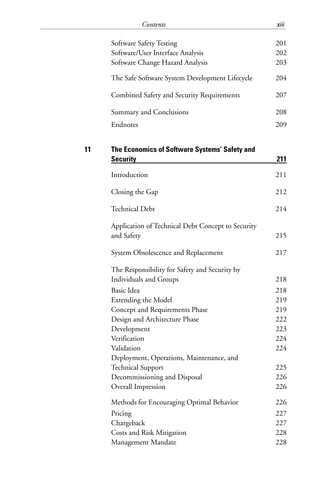
18.
xii Engineering Safeand Secure Software Systems
Some Definitions 161
Chronology of Maturity Models 164
Security and Safety in Maturity Models 165
FAA Model 165
The +SAFE V1.2 Extension 167
The +SECURE V1.3 Extension 167
The CMMI®
Approach 167
General CMMI® 167
CMMI®
for Development 168
Incorporating Safety and Security Processes 169
+SAFE V1.2 Comparisons 169
+SECURE V1.2 Comparisons 172
Summary and Conclusions 173
Endnotes 175
9 Secure SSDLC Projects in Greater Detail 177
Introduction 177
Different Terms, Same or Different Meanings 178
Creating and Using Software Systems 180
Phases and Steps of the SSDLC 182
Summary and Conclusions 191
Endnotes 193
10 Safe SSDLC Projects in Greater Detail 195
Introduction 195
Definitions and Terms 196
Hazard Analysis 198
Software Requirements Hazard Analysis 199
Top-Level Design Hazard Analysis 200
Detailed Design Hazard Analysis 201
Code-Level Software Hazard Analysis 201
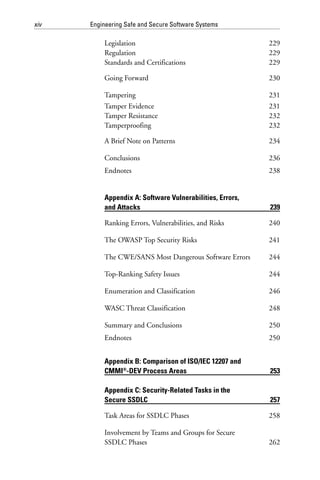
19.
Contents xiii
Software SafetyTesting 201
Software/User Interface Analysis 202
Software Change Hazard Analysis 203
The Safe Software System Development Lifecycle 204
Combined Safety and Security Requirements 207
Summary and Conclusions 208
Endnotes 209
11 The Economics of Software Systems’ Safety and
Security 211
Introduction 211
Closing the Gap 212
Technical Debt 214
Application of Technical Debt Concept to Security
and Safety 215
System Obsolescence and Replacement 217
The Responsibility for Safety and Security by
Individuals and Groups 218
Basic Idea 218
Extending the Model 219
Concept and Requirements Phase 219
Design and Architecture Phase 222
Development 223
Verification 224
Validation 224
Deployment, Operations, Maintenance, and
Technical Support 225
Decommissioning and Disposal 226
Overall Impression 226
Methods for Encouraging Optimal Behavior 226
Pricing 227
Chargeback 227
Costs and Risk Mitigation 228
Management Mandate 228
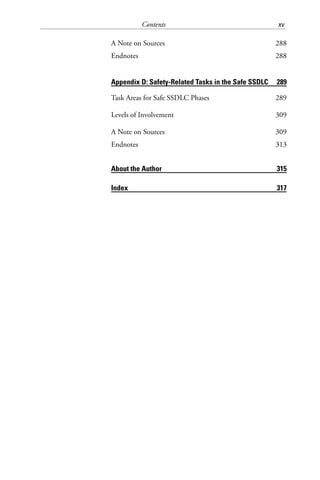
20.
xiv Engineering Safeand Secure Software Systems
Legislation 229
Regulation 229
Standards and Certifications 229
Going Forward 230
Tampering 231
Tamper Evidence 231
Tamper Resistance 232
Tamperproofing 232
A Brief Note on Patterns 234
Conclusions 236
Endnotes 238
Appendix A: Software Vulnerabilities, Errors,
and Attacks 239
Ranking Errors, Vulnerabilities, and Risks 240
The OWASP Top Security Risks 241
The CWE/SANS Most Dangerous Software Errors 244
Top-Ranking Safety Issues 244
Enumeration and Classification 246
WASC Threat Classification 248
Summary and Conclusions 250
Endnotes 250
Appendix B: Comparison of ISO/IEC 12207 and
CMMI®
-DEV Process Areas 253
Appendix C: Security-Related Tasks in the
Secure SSDLC 257
Task Areas for SSDLC Phases 258
Involvement by Teams and Groups for Secure
SSDLC Phases 262
21.
Contents xv
A Noteon Sources 288
Endnotes 288
Appendix D: Safety-Related Tasks in the Safe SSDLC 289
Task Areas for Safe SSDLC Phases 289
Levels of Involvement 309
A Note on Sources 309
Endnotes 313
About the Author 315
Index 317
23.
xvii
Preface
The best laidplans o’ Mice an’ Men, Gang oft agley ...
—Robert Burns, To a Mouse
The initial concept for this book arose some 3 to 4 years ago. However, it
was quite different from how the book turned out. I had spent much of the
previous decade working on application security, particularly software assur-
ance. Several years ago, I had the good fortune of being the technical lead on
a software assurance initiative for the banking and finance sector, supported
by the Financial Services Technology Consortium. The first phase of the proj-
ect provided insights from thought leaders from independent software vendors
(ISVs), information security tools and services vendors, industry and profes-
sional associations, academia, and a number of leading financial institutions. A
collection of state-of-the-art practices was assembled, with the intention of us-
ing the “best” approaches for assuring the quality of software through industry-
sponsored testing. This work provided a substantial amount of the research that
was behind the BITS publication Software Assurance Framework [1].
The ultimate goal of the software assurance initiative was to establish a
state-of-the-art testing facility for the financial services industry using methods,
tools, and services chosen from the initial research. Unfortunately, the financial
meltdown of 2008 interceded. Various mergers and restructurings took place,
so that attention was turned to other more pressing matters.
The financial services industry and other critical infrastructure sectors
continue to be in dire need of such testing laboratories to ensure that com-
monly used software meets agreed-upon security standards. Others, such as Joel
Brenner [2], also espouse such a concept as some form of Consumers-Union-
like autonomous testing service. But who would support and fund such an
effort?
24.
xviii Engineering Safeand Secure Software Systems
Perhaps an interesting indicator as to how such testing laboratories might
be created is the example of Huawei, the Chinese telecommunications giant,
which built the Cyber Security Evaluation Centre in England. The Centre’s
purpose is to assure potential British customers of Huawei products and services
that the company‘s technology can be trusted not only to do what customers
want them to do (and nothing more) but also that Huawei’s products cannot be
successfully attacked by cyber criminals, terrorists or foreign spies, as reported
in The Economist [3].
My initial book concept was to cover software assurance with particular
emphasis on requirements, context, and the like, with some, but relatively little
mention of the differences between developing security-critical and safety-criti-
cal software systems, and how to bring these diverse fields together. Then what
caused me to put so much more emphasis on the engineering of the security
and safety of software systems? It was a realization that professionals in the
software security and safety fields have minimal interaction and are generally
not familiar with the other engineers’ knowledge base and standard procedures.
This argument is supported from personal experience as well as from the ob-
servation that the majority of books and articles covering one area have little if
any mention of the other field. I first became aware of the difference in culture
and approach when I did some work with a small government contractor that
builds safety-critical software systems. Their approach was so different from
what I had been used to throughout an IT career in financial services. The ratio
of programming to testing appeared to be reversed for each type of system, with
security-critical information systems receiving much less testing relative to the
extensive verification and validation processes to which safety-critical control
systems are subjected.
A number of other factors began pointing to the need for developing a
book that would help security software engineers understand safety and vice
versa. However, the most influential event was a serendipitous conversation
at the 2010 IEEE International Conference on Homeland Security Technology
in Waltham, Massachusetts with Peter Gutgarts. He and Aaron Termin were
presenting on their topic “Security-Critical versus Safety-Critical Software.”
Peter Gutgarts and I discussed the subject at length and what I gained from
the conversation was the realization that so little attention was being paid to
combined safety and security aspects of critical software systems. These systems,
which include so-called cyber-physical systems, are rapidly becoming crucial to
the future of modern economies. Before our eyes, software systems are being
developed that merge sophisticated modern web applications with traditional
industrial control systems. Such cyber-physical systems offer the best—and the
worst—of both worlds. For example, the ability to monitor and control elec-
tricity meters remotely creates many new features, such as determining and
25.
Preface xix
reporting unusualactivities or cessation of service, but they also expose the elec-
tricity grid to hackers with malevolent and destructive intentions.
Today, the security of the smart grid and analogous systems for water and
natural gas distribution and the like are being discussed and are a clear concern
of both government and the private sector. Yet, beyond the talk, what is actu-
ally being done is woefully inadequate. Is this a case of the road to hell being
paved with good intentions? It seems that there is agreement in principle as to
the need, yet the lack of subject-matter expertise and processes for coordination
and collaboration are thwarting attempts to make it all happen. We have not yet
built the necessary bridges between security professionals and safety engineers
to enable fully coordinated efforts. The cultural differences and the goals of the
security and safety silos are such that they do not interact and do not under-
stand the needs of the other group.
Seeing the lack of interaction, in the field and in the literature, I deter-
mined that the software engineering field needs to initiate conversations that
will reduce and eliminate the lack of communication between information se-
curity professionals and software safety engineers.
Brenner [2] describes how, to their credit, the U.S. military found a way
to ensure that the efforts of diverse experts would be coordinated and consistent
across Defense Departments by creating the Joints Chiefs of Staff. As Brenner
puts it:
“Joint organization has paid extraordinary operational dividends but it
was a struggle to make it work. Overcoming intense service-level loyalties took
time... The [1986 Goldwater-Nichols Act] is one of the most important organi-
zational reforms in the history of the United State government...”
If the military can do it, so perhaps could the rest of government and the
private sector when it comes to coordinating the efforts to ensure that critical
software systems are both secure and safe. The need is there for solutions that
will overcome the security, safety, and other deficiencies in the software devel-
opment processes and the software systems that they produce.
The original direction of improving the software assurance processes and
building testing facilities continues to be extremely important and needs to
be addressed vigorously in short order. However, I chose to focus this book
on reducing the huge gap that exists between the software safety and security
engineering fields. No doubt others will revisit my original software-assurance
topics at a later date. For now, I will focus on what I see to be one of the most
pressing needs of today’s software engineering world—the collaboration be-
tween software security and safety engineers in the creation of complex systems
of systems, particularly cyber-physical systems.
While I have covered many concepts in the software systems safety-se-
curity space, this work should not be considered an end in itself. It provides a
starting point from which you can examine further the many complex topics
the book wasprinted thirty years before this, viz. in 1538. Afterwards in
pushing their researches farther, they resolved to consider Boccaccio as the
author of the work, from a misinterpreted passage in Chap. 2, No. 6, in the
“Atheism Overthrown” where the following words occur; “Hence
Boccaccio in his impious fables, contends that there is no distinction
between the law of Moses, of Christ and of Mahomet, because they are as
like each other as the three similar rings.17” But does Campannelle, in this
passage intend to say that Boccaccio was the author of “The Three
Impostors?” So far is this from being the case, that he answers elsewhere
the objections of the Atheists against Boccaccio and the book in question;
and Struvius himself, in the 9th paragraph of his dissertation on “Learned
Impostors” quotes a passage from Ernstius, which states that Campannelle
had told him that the book was written by Muret; now Muret having been
born in 1526, and the book been printed in 1538, he could only have been
12 years of age; at which time of life we cannot suppose it possible that he
was able to write a work of this description. It follows therefore that this
book, said to have been written in Latin and printed in Germany, never
existed. At no period has there been a printed work, however rarely to be
met with, in reference to which very authentic and circumstantial
information could not be found.
Although the works of Michael Servetus may never be met with, it has
always been well known that they were printed, and moreover where they
were printed. Before the publication of the two modern editions of the
“Cymbalum Mundi,” composed by Bonnaventure de Perrieres, writing
under the assumed name of Thomas du Clevier, who says that he had
translated it from the Latin, and of which work only two ancient copies
remain, the one in the King’s library and the other in that of M. Bigot at
Rouen;—before the publication of the the modern editions, it was an
ascertained fact that the work had been printed, and the date and name of
the bookseller were known. The case is exactly the same as regards “The
Blessings of Christianity, or the Scourge of the Faith,” the author of which,
Geoffrey Vallee a native of Orleans, was hanged and burned at Greve, on
the 9th February 1573, after having adjured his errors. It is a small octavo
work of thirty pages, without date, or the name of the place where it was
printed; a trifle, feebly reasoned, and now become so rare that perhaps the
28.
1
2
3
4
5
6
7
8
9
10
copy belonging toMonsieur the Abbe d’Estrees is the only one to be found.
But although all these works had absolutely perished, no one could doubt
their previous existence, the facts on record concerning them being as true,
as those concerning ‘The Three Impostors’ are apocryphal.
Daniel George Morof, who died suddenly on the 30th of June 1691. ↑
Librum de tribus impostoribus absit ut Papæ tribuam, aut Papæ oppugnatoribus; jam
olim inimici Frederici Barbarossæ Imperatoris famam sparserant libri talis, quasi jussu
ipsius scripti, sed ab eo tempore, nemo est qui viderit; quare fabulam esse arbitror. ↑
Apud Nevizanum 1. Sylvae nupt. 2. n. 121. ↑
Doubtless Averroes here alludes to that law of Mahomet which wisely prohibits the
use of pork in a hot and pestilential climate.—Translator’s Note. ↑
Disseminavit iste impius haereticus in Hispania, [such is the language made use of by
Alvaro Pelagius], quod tres deceptores fuerunt in mundo, scilicet, Moises, qui decepterat
Judaeos, et Christus, qui decepterat Christianos, et Mahometus, qui decepit Sarrazenos. ↑
Et sic falsa est Porphirii sententia, qui dixit tres fuisse garrulatores qui totum mundum
ad se converterunt; primus fuit Moises in populo Judaico, secundus Mahometus, tertius
Christus. ↑
Qui in quæstionem vertere presumunt, dicentes; quis in hec mundo majorem gentium
aut populorum sequelam habuit, an Christus, an Moises, an Mahometus? ↑
Every classical scholar must have heard of the demon of Socrates. The belief in the
existence of such agencies was sufficiently prevalent in the East 2000 years ago, and the
Jews were in this respect, as credulous as their neighbors. We read in Acts, c. iv. v. 7 , that
the leaders of the Sanhedrim enquired of the Apostle Peter, “By what power or by what
name, have ye done this;” evidently acknowledging their belief that it was possible to work
miracles by the invocation of some mysterious power. The Apostle, himself a Jew, seems to
understand their creed; but he answers them in a way for which they were not altogether
prepared.—Translator’s Note. ↑
Ædeficabat sine pecunia, judicabat sine conscientia, scribebat sine scientia. ↑
Non Blandratum, non Alciatum, non Ochinum ad Mahotnetismum impulerunt; non
Valleum ad atheismi professionem induxerunt; non alium quemdam ad spargendum
29.
11
12
13
14
15
16
17
libellum de tribusimpostoribus, quorum secundus esset Christus Dominus, duo alii Moises
et Mahometes, pellexerunt. ↑
Vincentii Panurgii epistola tribus impostoribus, ad clarissimum virum Joannem—
Baptistam Morinum Medicum. ↑
Isaac de Peyrere published his Pre-Adamite doctrine in 1655. This set of fanatics, who
were persuaded by their lenders that the general race of mankind had lost nothing of their
innocence by the fall of Adam, made their appearance, (both men and women) in the
streets of Munster, and elsewhere, in the same robeless condition as our first parents were,
when they wandered in the bowers of Paradise before the eating of that forbidden fruit,
which
“Brought death into the world and all our woe.”
The magistrates of the city attempted to put them down but failed; and the military had
some difficulty in extinguishing this absurdity.—Translator’s Note. ↑
Monstrum illud hominis, diis inferis a secretis scelus, nefarii illius tractatus de tribus
impostoribus author quantumvis ab omni Religione alienus, adeo ut nec Judaeus, nec
Turca, nec Christianus fuerit, plane tamen athœus non erat. ↑
Consult Bayle’s Dictionary on this subject, article, “Trabea.” ↑
Quid vel hac sola dubitatione in Christiana schola cogitara potest perniciosius? ↑
Nefarium tillud rium impostorum commentum sen liber contra Christum, Moisem et
Mahometan Capomi nuper ab illis qui Evangelo Calvini so adductissimos profitentur typis
excussus est. ↑
Hinc Boccaccius in fabellis probare contendit non posse discerni inter legem Christi,
Moisis et Mahometis, quia eadem signa habent uti tres annuli consimiles. ↑
30.
ANSWER
TO THE DISSERTATIONOF MONSIEUR DE LA
MONNOYE ON THE WORK ENTITLED
“THE THREE IMPOSTORS.”
An attempt at discussion, which you will find at the end of the new edition
of “Menagiana,” which has just been published in this country, affords me
the opportunity of giving some information to the public on a subject which
appears to call into exercise the ingenuity of almost all the learned; and at
the same time of vindicating the character of many eminent men, and men
of distinguished merit, who have been attacked as the authors of the work
which forms the subject of a disquisition attributed to M. de la Monnoye.
Without doubt this new book is already in your possession; you will
perceive that I allude to “The Three Impostors.” The author of the
dissertation upholds the non-existence of such a book, and attempts to
establish his point by bringing forward conjectures, without advancing any
evidence capable in the smallest degree of influencing the opinions of those
who are accustomed to examine before they decide. I will not undertake to
refute seriatim the articles contained in a dissertation, the substance of
which is to be found in a Latin discourse by M. Burkhard Gotthelf Struve,
on “Learned Impostors,” printed for the second time at Geneva, by Muller
in 1706, and which M. de la Monnoye must have seen, because he quotes
from it. He will acknowledge that I am quite prepared to overturn his
arguments, when I inform him that I have read this celebrated little work,
and that I have it in my library. I will give you and the public an account of
the way in which I discovered it, and as it is in my possession, I will subjoin
a short but faithful description of it.
Being at Frankfort on the Main in 1706, I called one day in company with a
Jew, and a friend named Frecht, at that time a student in Theology, on an
eminent bookseller in whose establishment almost every work was to be
31.
met with. Wewere examining his catalogue when there entered a German
officer, who addressed himself to the proprietor in German, and asked him
if he was ready to agree to his proposals, or if another merchant should be
sought after. Frecht, who formerly was acquainted with the officer, saluted
him and was recognised. This gave an opportunity to my friend of asking
the officer, whose name was Trawsendorff, what transaction he had with the
bookseller. Trawsendorff told him that he had two manuscripts and a very
old book in his possession, by the sale of which he expected to raise a sum
of money against the approaching campaign, and that the bookseller higgled
on 50 Rix-dollars, being unwilling to advance more than 450 for the three
works, which he, (the officer), valued at 500. This great sum of money
demanded for two manuscripts and a little book excited the curiosity of
Frecht, who asked of his friend if he might see the productions which he
wished to sell at so dear a rate. Trawsendorff immediately drew from his
pocket a parchment envelope, tied with a silk thread, which he opened, and
from which he took the three books. We went into the parlour of the
bookseller to examine them at our leisure, and the first which Frecht looked
at had been printed, but had a title written in Italian instead of its real title,
which had been defaced. It ran thus; “Spaccio della Bestia triumphante,”
and did not appear to be of an ancient date. It struck me as being the same
work which Toland translated into English, and printed some years ago, and
the copies of which sell very high.
The second we looked at was an old Latin manuscript written in a character
very difficult to decypher, without any title; but at the top of the first page
there were written these words, “Fredric the Emperor wishes health to Otho,
his most illustrious and dearest friend.1”
The work opens with a letter, the first lines of which are as follows; “I will
send you as soon as possible a copy of the work on the three most
celebrated deceivers of mankind, a work written at my request by a very
learned man, and transcribed by my order for my library; and along with it
another work written in the same pure and polished style, for, &c.”2 The
third was also a Latin manuscript without a title, commencing with a
quotation from Cicero.
32.
Frecht having glancedover the books in a hurried way, fixed his attention
upon the second, of which he had often heard, and in respect to which he
had read many conflicting histories; and without looking into the other two,
he took Trawsendorff aside and told him that he would easily find
purchasers of the three works. He spoke little of the Italian work, and by
reading a few passages he showed him that the other was a demonstration
of Atheism. As the bookseller still held to his terms, and would not come up
to the officer’s demand, we went all three to the lodgings of Frecht, who
having an object in view called for wine, and while begging Trawsendorff
to inform us how he came by the works, he made him swallow so many
bumpers that he soon became half intoxicated, so that Frecht had little
difficulty in persuading him to leave with him the manuscript of “The Three
most celebrated Deceivers of Mankind;” but he made him take a solemn
oath that he would not copy it. On this condition, the work was to be left
with us from Wednesday till Sunday night, when Trawsendorff was to call
again and take his share of a few bottles of Frecht’s wine, which seemed to
be much to his taste.
As I had quite as much desire as Frecht to be acquainted with the book, we
sat down immediately to read it over, determining to sleep very little until
Sunday night. It was not very large—an octavo work of ten sections,
exclusive of the prefatory letter, but in so small a character, and so full of
contractions, besides being without points, that we had much difficulty in
decyphering the first page in two hours. After this however we read it more
easily, which made me suggest to my friend a plan (rather Jesuitical)
whereby he might obtain a copy of this celebrated work without breaking
his oath which he had taken on compulsion;—that it was likely that
Trawsendorff, when he insisted that it should not be copied, only meant that
he should not transcribe the words—in short that we were quite at liberty to
translate it. To which Frecht consented after some scruples, and we set to
work immediately. On Sunday we were in possession of the work a little
before midnight. Trawsendorff afterwards got his 500 rix-dollars for the
work from a bookseller who had been commissioned by a Prince of the
House of Saxe to purchase it. The Prince knew that it had been stolen from
the Royal Library at Munich, when the Germans obtained possession of the
city after the defeat of the French and Bavarians at Hochstet, and
33.
Trawsendorff acknowledged tous that, being alone in the library of the
Elector, the parchment envelope with its yellow silk thread attracted his
attention, and that he could not resist the temptation to steal it: expecting
that it contained some rare production, in which he was not disappointed.
To complete the history of this treatise, I will give you the conjectures
which Frecht and I made as to its origin. We agreed at once that the
“Illustrissimo Otho” to whom it was sent, was “Otho the Illustrious,” Duke
of Bavaria, son of Louis I. and grandson of “Otho the Great,” Count of
Schiven and Witelspach, to whom the Emperor Frederick Barbarossa had
given Bavaria as a reward for his fidelity, after he took it away from “Henry
the Lion,” as a punishment for his ingratitude. “Otho the Illustrious”
succeeded his father Louis I., in 1230, under the reign of Fredrick II.,
grandson of Frederick Barbarossa, who had at that time quarrelled with the
Count of Rome on his return from Jerusalem. This led us to think that the
letters F. I. S. D. which followed the “Amico meo carissimo,” denoted
Fredericus Imperator Salutem Dicit, and that the treatise was written
posterior to the year 1230, by the order of this Emperor, inflamed as he was
against all Religions in consequence of the bad treatment he had met with
from the head of his own, viz. Pope Gregory IX. by whom he had been
excommunicated before he set out, and who persecuted him even in Syria
by intriguing to such an extent, that the Emperor’s army refused to obey his
orders. This Prince on his return besieged the Pope at Rome, after having
ravaged the neighboring territory, and thereafter made a peace with him
which was of no long duration, and which was followed by an animosity so
bitter between him and the Holy Pontiff, that it only ceased at the death of
the latter, who died heart-broken that Frederick triumphed in spite of his
empty fulminations, and that he had unmasked the vices of the Papal Chair
in satirical verses which he circulated in every quarter,—in Germany, Italy,
and France. But we could not discover who was the “doctissimus vir,” with
whom Otho appears to have held converse on the subject in the library, and
apparently in the company of the Emperor; unless indeed it were the
celebrated Pierre des Vignes, the secretary, or as others maintain, the
chancellor of Frederick II. His discourse “On Sovereign Power,” and his
“Letters,” give proof of his learning, and the zeal which he had for the
interests of his master, and of his own hatred of Pope Gregory IX, and the
34.
Ecclesiastics and establishedChurches of his day. It is true, that in one letter
he attempts to exculpate his master from the charges against him as the
author of this book: but this strengthens the supposition, and inclines us to
think he only pleaded for Frederick, to cloak his own share in so scandalous
a work. At all events we must believe that he would have confessed the
truth when Frederick, on suspicion that he had conspired against his life,
condemned him to lose his eyes, and handed him over to the inhabitants of
Pisa, his cruel enemies; and where despair hurried on his death in an
infamous dungeon where he could hold intercourse with no one.
In this way we can repel the false charges brought against Averroes,
Boccaccio, Dolet, Aretino, Servetus, Ochinus, Postel, Pompanacius,
Campannelle, Poggio, Pulci, Muret, Vanini, Milton, and many others; the
book having been written by a learned man in high repute at the court of
this Emperor, and by his order. As to the printing of the book they can bring
forward no proof whatever; and it is impossible to conceive that Frederick,
surrounded as he was by enemies, would have circulated a work which gave
fair opportunity of proclaiming his infidelity. It is probable therefore that
there are only two copies, the original one and that sent to Otho of Bavaria.
This will suffice as to the discovery of the book, and its date; we come now
to what it contains.
It is divided into six books or chapters, every one of which contains several
paragraphs. The first Chapter has for its title “Of God,” and contains six
paragraphs in which the author, wishing to appear free from party or
educational prejudices, shows that although mankind have a real interest in
ascertaining the truth, nevertheless they found upon opinions and
imaginations alone; and meeting with people whose interest it is to keep
them in this state, they are made to rest, contented in it, although they could
easily shake off the yoke by making the slightest use of their reason. He
passes next to the ideas which men entertain of the Divinity, and prove that
they are injurious, inasmuch as they have led to the creation of the most
fearful and imperfect being whom it is possible to conceive of; and he then
blames the ignorance of the people, or rather their foolish credulity in
35.
putting faith inthe visions of Prophets and Apostles, of whom he draws a
portrait suited to the ideas which he entertains of them.
The second Chapter treats of the reasons which have led men to believe in a
divinity. It is divided into eleven paragraphs, where he proves that the
ignorance of physical causes has given birth to a fear natural enough at the
sight of a thousand terrible accidents, and has led them to believe in the
existence of some invisible Power; a doubt, and a fear, of which subtle
politicians have taken advantage, for their own interest, and which have
given rise to a belief in this Existence, which has been confirmed by others
who have found it for their own benefit to maintain it; although it is merely
grounded on the folly of the common people, always admirers of the
extraordinary, the sublime, and the marvellous. He next inquires into the
nature of the Divinity, and overturns the vulgar belief in final causes, as
contrary to sound philosophy. In fine, he makes it appear that such ideas of
the Divinity are only formed after having decided what is perfect, good,
evil, virtue, vice, according to imagination, and often as false as possible. In
his tenth paragraph the author explains his own opinion as to the Divinity,
which is conformable to the system of the Pantheists, saying that the word
God represents an infinite Being, one of whose attributes is that he is of
unlimited extension, and consequently that he is infinite and eternal. In the
eleventh paragraph he treats with ridicule the popular opinion which is
given to the Deity, a resemblance to the kings of the earth; and passing to
the sacred books, he speaks of them in a very unfavourable manner.
The third Chapter has for its title “The signification of the word Theology,
and how, and for what purpose so many religions have been introduced into
the world.”—This chapter contains twenty-three paragraphs. In the ninth he
examines the origin of religions; and brings forward examples and
reasonings which, so far from being divine, are altogether the work of
politicians. In the tenth paragraph he undertakes to expose the imposture of
Moses, showing what he was, and how he managed to establish the Jewish
religion. In the eleventh paragraph he inquires into the impostures of
several politicians such as Numa, and Alexander the Great. In the twelfth he
examines the birth of Jesus Christ; in the thirteenth and following he
considers his morality, which he does not think more pure than that of a
36.
great number ofancient philosophers; in the nineteenth he inquires whether
his reputation after his death is sufficient to warrant his believing in his
divinity. Lastly, in the twenty-second and twenty-third paragraphs, he
considers the imposture of Mahomet, of whom he does not say so much,
because he has not to encounter so many advocates of his doctrine as that of
the two others.
The fourth Chapter treats of truth evident and obvious to the senses, and
consists only of six paragraphs, where he demonstrates what really is the
divinity, and what are his attributes: he rejects the belief in a life to come,
and the existence of spirits.
The fifth Chapter treats “Of the Soul.” It consists of seven paragraphs in
which, after having exposed the vulgar opinions, he gives those of the
Philosophers of antiquity, and concludes by showing the nature of the Soul
according to his own system.
In the sixth and last Chapter of seven paragraphs, he discourses on the
Spirits called Demons, and shows the origin and falsity of the opinions as to
their existence.—Such is the anatomy of this celebrated work. I might have
given it in a manner more extended and more minute; but besides that this
letter is already too long, I think that enough has been said to give insight
into the nature of its contents. A thousand other reasons which you will well
enough understand, have prevented me from entering upon it to so great a
length as I could have done; “Est modus in rebus.3”
Now although this book were ready to be printed with the preface in which
I have given its history, and its discovery, with some conjectures as to its
origin, and a few remarks which may be placed at its conclusion, yet I do
not believe that it will live to see the day when men will be compelled all at
once to quit their opinions and their imaginations, as they have quited their
syllogisms, their canons, and their other antiquated modes. As for me I will
not expose myself to the Theological stylus4, which I fear as much as Fra-
Poulo feared the Roman stylus, to afford to a few learned men the pleasure
of reading this little treatise; but neither will I be so superstitious, on my
death bed, as to make it be thrown into the flames, which we are informed
37.
1
2
3
4
was done bySalvius, the Swedish ambassador at the peace of Munster.
Those who come after me may do what seems them good—they cannot
disturb me in the tomb. Before I descend to that, I remain with much
respect, your most obedient servant,
J. L. R. L.
Leyden, 1st January 1716.
[This letter was written by M. Pierre Frederick Arpe, of Kiel in Holstein;
the author of an apology for Vanini, printed in octavo at Rotterdam, 1712]
F. I. S. D. namely, Fredericus Imperator Salutem Dicit Othoni illustrissimo amico meo
carrissimo. ↑
Quod de tribus famosissimis nationum deceptoribus in ordinem jussu meo digessit
doctissimus ille vir quorum sermonem de illa re in museo meo habustiæ exscribi curavi;
atque Codicem illum stylo aeque vero ac puro scriptum ad te quam primum mitto; etenum,
&c. ↑
There is a measure in every thing. ↑
This phrase is frequently employed to express ecclesiastical criticism. Its first
application however had a more pungent meaning.—The individual here alluded to having
boldly assailed the errors of the Church was attacked one evening by an assassin.
Fortunately the blow did not prove fatal; but the weapon (a stylus, or dagger, which is also
the Latin name for a pen) having been left in the wound—on his recovery he wore it in his
girdle labelled, “The Theological Stylus,” or Pen of the Church. The trenchant powers of
this instrument have more frequently been employed to repress truth, than to refute
argument. ↑
38.
COPY OF THESECOND PART, VOL. I, ARTICLE IX.
OF, “LITERARY MEMOIRS.” PUBLISHED AT THE
HAGUE BY HENRY DU SAUZET, 1716.
It is impossible in the present day to doubt the existence of “The Three
Impostors,” since we find several manuscript copies of it. If M. de la
Monnoye had observed the agreement of it with an extract published at
Leyden, 1st. Jan. 1716,—the same division into six chapters—the same
titles, and the same subjects of which they treat, he would have exclaimed
against the forgery of this work, improperly attributed to Pierre des Vignes,
the Secretary and Chancellor of Frederick II. This judicious critic long ago
observed the difference between the Gothic style of Pierre des Vignes in his
Epistles, and that of the letter pretended to be addressed to the Duke of
Bavaria, “Otho the illustrious,” when they sent him the work. A more
important point has not escaped the notice of the learned. This treatise is
written and argued in the method and upon the principles of the New
Philosophy, which was not introduced until about the middle of the
seventeenth century, after Descartes, Gassendi, Bernier, and some others
had explained its principles in a juster and clearer way than did the ancient
philosophers, who wished to preserve their secrets, as they affected a
mysterious obscurity in favor of the initiated. The author himself, in the
fifteen chapter of his work, names Descartes, and combats the arguments of
this great man on the subject of the soul. Neither Pierre des Vignes, nor any
of those whom they have attempted to pass off as the author of this book,
could have reasoned according to the principles of the new Philosophy,
which was not introduced till after they had written. To whom then must the
work be attributed? We must conclude that it cannot be of the same date as
the short letter printed at Leyden, 1717. But another difficulty occurs.
Tentzelius, who wrote in 1689, also gives an extract from this book upon
the credit of a pretended ocular witness. But without attempting to fix the
date of this book, which is said to have been composed in Latin and printed;
the small French manuscript treatise, whether it had ever been written in
39.
that language orwhether it is translated from the Latin, (which is difficult to
believe,) cannot be of a very ancient date.
This is not the only book composed under this title and upon the same
subject. A man whose character and profession ought to have led him to
engage in matters more decorous, composed a great work (in French) under
the same title. In his preface he says that it is long since he had heard of
“The Three Impostors,” but that he had never found any part of it, whether
there had never existed such a work, or whether it be lost; therefore he
attempts to restore it by writing on the same subject. His work is very long,
very wearisome, and very badly written; with little principles and less
argument. It is a confused jumble of all the invectives and calumnies
circulated against the Three Legislators. The manuscript was in two
volumes folio, thick, and legible enough, although in small characters—the
book is divided into a great many chapters. Another similar manuscript was
found after the death of a nobleman. This gave rise to an attempt to seize
the author who having been informed of it took care that nothing should be
found among his papers to convict him. Afterwards he lived in a monastery
under penance. In 1733 he recovered his liberty and enjoyed a revenue of
250 livres from the Abbey of St. Liquarie, in addition to a reserved one of
350 livres from his benefice. His name was Guillaume, Cure of Fresne-sur-
Berny, and the brother of a labourer in the Netherlands. He was at one time
Regent of the College of Montaigu; in his youth he had been a dragoon, and
then he became a Capuchin.
40.
CONTENTS OF TREATISE.
CHAP.I. Of God. The false ideas which men have formed of the Divinity.
Instead of consulting reason and common sense, they have had the
weakness to believe in the opinions, reveries, and visions of parties whose
interest it was to deceive them, and to keep them in ignorance and
superstition.
CHAP. II. On the reasons which have led men to believe in a Divinity. From
the ignorance as to physical causes, and the terror produced by accidents,
rational enough but extraordinary or fearful, has arisen the belief in some
invisible power; a belief, of which Politicians and Impostors have not failed
to take advantage. Enquiry into the nature of God. Belief in final causes
refuted as contrary to sound Natural Philosophy.
CHAP. III. On the meaning of the word Theology. How, and for what
purpose, so many Religions have been introduced into the world. All
Religions the work of Politicians. Method which Moses took to establish
the Jewish Religion. Enquiry into the Nativity of Jesus Christ. His Politics
—his Morality—and his Reputation after his death. Artifices of Mahomet to
established his Religion. Success of this impostor greater than that of
Christ.
CHAP. IV. Truth evident and obvious to the senses. Idea of an universal
Being. Attributes ascribed to him in all religious systems, generally
incompatible with his essence, and unsuited to the nature of man. Notion of
a life to come and of the existence of Spirits, combated and rejected.
CHAP. V. On the Soul. Different opinions of the Ancient Philosophers on
the nature of the Soul. Arguments of Descartes refuted. Author’s exposition
on the subject.
CHAP. VI. On the Spirits named Demons. Origin and falsity of the opinions
as to their existence.
Chap. I.—Of GOD.
§1.
Although it is important that all men should know the truth, there are
nevertheless few who enjoy this advantage; some are incapable of finding it
out unassisted, and others will not put themselves to the trouble. It is not to
be wondered at therefore, if the world is filled with vain and absurd
opinions; and nothing is more adapted to spread them than ignorance,
which is the sole originator of the false ideas which prevail as to the
Divinity, the Soul, the existence of Spirits, and almost all the other subjects
which go to make up Theology. Custom is powerful—men rest contented in
the prejudices of their birth, and leave the care of the most essential matters
to interested parties, who make it a rule to uphold with bigotry the received
opinions, and who dare not overturn them lest in so doing they should
destroy themselves.
§ 2.
What renders the evil without remedy is this, that, after having established
these false ideas of the Divinity, they neglect no plan to compel the people
to believe in them, without permitting any one to examine for himself. On
the contrary, they have excited a hatred against philosophers—the truly
learned, lest the doctrines which they would teach should lead to the
exposure of those errors in which they have plunged mankind. The
advocates of these foolish notions have succeeded so well, that it is
dangerous to combat them. It is too much the interest of those impostors
that the people be ignorant, to permit them to become enlightened. Thus the
44.
truth must eitherbe kept in abeyance, or its promoters be prepared to be
sacrificed at the shrine of a false philosophy, and to suffer from the rage of
grovelling and interested minds.
§ 3.
If the people could understand into what an abyss they are sunk by
ignorance, they would speedily shake off the yoke of their unworthy
leaders, for it is impossible not to discover the truth when reason is left to
its unrestrained exercise.
These deceivers are so well aware of this, that to prevent the good effects
which Truth would infallibly produce, they have painted it as a monster
incapable of giving rise to any virtuous sentiment; although, in general
terms, they condemn unreasonable people, they would nevertheless be
much disconcerted if the truth were heard. Thus these sworn enemies to
common sense are perpetually falling into contradictions, and it is difficult
to discover at what they are aiming. If it be true that reason is the only light
which men ought to follow, and if the people are not so incapable of
judging as they wish us to believe, it ought to be the object of those who
instruct them to endeavour to rectify the false reasonings, and to uproot
their prejudices; then their eyes would be gradually opened and their minds
convinced that the Deity is by no means what is generally supposed.
§ 4.
To attain this, there is no need for lofty speculations, nor for penetrating far
into the mysteries of nature. It requires only a little common sense to
perceive that the Deity is neither choleric nor jealous; that justice and mercy
are alike falsely considered as his attributes; and that, all that the Prophets
and Apostles have said give us no information either as to his nature, or to
his essence.
45.
In short tospeak plainly and to put the matter on its proper footing, it will
be allowed that these teachers were neither more able nor better instructed
than the rest of mankind; so far from that being the case, what they advance
regarding the Deity is so gross that the people must be altogether ignorant
to credit it. Although this is apparent enough we will attempt to explain it
more at length, by inquiring, if there is any evidence that the Prophets and
Apostles were differently constituted from other men.
§ 5.
It is agreed, that as far as descent, and the common duties of life are
implicated, they possessed no quality to mark them out from the rest of
mankind. They were begotten by men, they were born of women, and they
sustained themselves as we do in the present day. In reference to their
minds, people would have us believe that God dealt with these prophets in a
way differing from that wherein he deals with ordinary mortals, and that he
disclosed himself to them in a manner quite exclusive. Many persons
consider this matter as a proved and ascertained fact, without reflecting that
every man may meet his counterpart, and that we have one common origin;
endeavouring at the same time to persuade us that these men were cast in no
common mould and that they were selected by the Deity to proclaim his
oracles. Now, apart from the consideration that these inspired people were
gifted with only an average intellect, and with an understanding not much
above the common, what do we find in their writings to justify us in
forming so exalted an opinion of them? The matter of which they treat is for
the most part so obscure that no one can comprehend it, and thrown
together with so little order that it is easy to perceive they did not
understand it themselves; the whole showing that they were both knaves
and fools. Their impudence in boasting that whatever they announced to the
people came immediately from God, gave rise to the respect which was
paid to them. This assertion on their part was equally absurd and ridiculous,
seeing that according to their own declaration God only spoke to them in
dreams. There is nothing more natural than that a man should dream; but a
man must be very impudent, very vain, and very stupid, to say that God
46.
speaks to himin this manner, and a poor and credulous fool must he be who
should yield credence to such an assertion, and receive the dreams of such
visionaries for heavenly oracles. Suppose for a moment that the Deity were
to hold intercourse with a man by dreams, or visions, or in any other way
we can think of; nobody is obliged to believe this on the mere assertion of a
fellow-creature equally subject to error with himself, and moreover, fallible
in the way of lying and imposture. Accordingly we find that under the
ancient law, the prophets were held in far less repute than they are at the
present day. When people got wearied of their babble, which often only
tended to spread revolt and to turn aside subjects from obedience to their
sovereigns, they silenced them by punishment. Jesus Christ himself did not
escape chastisement, for he had not, like Moses1, an army at his back to
defend his opinions. Add to this, that the prophets were so much
accustomed to contradict each other, that out of four hundred of them not
one true or truth-speaking man could be found.2 Moreover it is certain that
the drift of their prophesies, like that of the laws promulgated by the most
celebrated legislators, was to immortalize their memory by persuading
people that they had conferences with the Divinity. The most subtle
politicians have invariably played the same game, although this ruse has not
succeeded with every one as it did with Moses.
§ 6.
This being settled, let us examine for a little the idea which the Prophets
have formed of the Deity. According to their account, God is a being purely
corporeal. Michael saw him seated; Daniel beheld him clothed in white, and
under the form of an Old Man; Ezekiel perceived him as a Fire: so much for
the Old Testament. With respect to the New, the disciples of Jesus Christ
imagined that they saw him in the form of a Dove; the Apostles, like
Tongues of Fire; and finally, St. Paul beheld him as a Light, which dazzled
and blinded him. Then as to their contradictory statements; in the Book of
Genesis3 we are informed that man is the master of his own actions, and
that it only depends upon himself to do what is right. St. Paul on the other
hand asserts that man has no control over his evil propensities without the
47.
1
2
3
4
5
particular grace ofGod. Samuel4 declares that the Deity repented of the evil
which he had brought on men: and Jeremiah5 affirms that he repented, or on
certain conditions that he would repent, of the good which he had done
them. Such are the false and contradictory ideas which those pretenders to
inspiration give us of the divinity; and which they wish us to adopt without
reflecting that they represent the Deity as a sensitive Being, material, and
subject to like passions with ourselves. Next they inform us that God has
nothing in common with matter, and that his nature is altogether
incomprehensible by us. It would be important to learn how these manifest
and irrational contradictions can be reconciled; and whether we ought to put
much faith in the evidence of a people who, in spite of the sermons of
Moses, were stupid enough to believe that a calf was their God! Without
dwelling on the reveries of a people cradled in bondage and brought up in
absurdity, it is sufficient to remark, that ignorance has produced a belief in
all the impostures and errors which prevail amongst us at the present day.
Moses put to death in one day 24,000 men, because they resisted his laws. ↑
We read in the Book of Kings, chap. xxii, v. 6 , that Ahab, the King of Israel
consulted 400 prophets who were all false, as the result of their vaticinations showed. ↑
Genesis, chap. iv, v. 7. ↑
I. Samuel chap. xv, v. 11 . ↑
Jeremiah, chap. xviii, v. 10. ↑
ON THE REASONSWHICH HAVE LED MANKIND
TO BELIEVE IN A DIVINITY.
§ 1.
Those who are ignorant of physical causes have a natural fear1, proceeding
from a restlessness in their minds, as to whether there exists a Being or an
Agency invisible to them, who has the power to injure them or to do them
good. Hence the tendency which they have to feign unseen causes, which
are only the phantoms of their imagination—whom they deprecate in
adversity and thank in prosperity. They make Gods of them for this
purpose; and this chimerical fear of invisible Powers is the source of those
Religions which every one forms after his own fashion. Those whose
interest it is that the people should rest contentedly fettered by such
reveries, have fostered their spread—have founded laws upon them—and
finally reduced the people by the terrors of futurity to a blind obedience.
§ 2.
The origin of the Gods being discovered, men next imagined that they
resembled themselves, and that they invariably acted with a certain end in
view. Thus they unanimously said and believed, that God only works for
man’s behoof; and reciprocally, that man is only created for God. This
prejudice is general even in the present day, and when we reflect on the
influence which it must necessarily have on the manners and opinions of
men we may clearly perceive that from it have arisen those false ideas
which men have formed to themselves, of good and evil, of merit and
50.
Welcome to ourwebsite – the ideal destination for book lovers and
knowledge seekers. With a mission to inspire endlessly, we offer a
vast collection of books, ranging from classic literary works to
specialized publications, self-development books, and children's
literature. Each book is a new journey of discovery, expanding
knowledge and enriching the soul of the reade
Our website is not just a platform for buying books, but a bridge
connecting readers to the timeless values of culture and wisdom. With
an elegant, user-friendly interface and an intelligent search system,
we are committed to providing a quick and convenient shopping
experience. Additionally, our special promotions and home delivery
services ensure that you save time and fully enjoy the joy of reading.
Let us accompany you on the journey of exploring knowledge and
personal growth!
ebookultra.com








![xvii
Preface
The best laid plans o’ Mice an’ Men, Gang oft agley ...
—Robert Burns, To a Mouse
The initial concept for this book arose some 3 to 4 years ago. However, it
was quite different from how the book turned out. I had spent much of the
previous decade working on application security, particularly software assur-
ance. Several years ago, I had the good fortune of being the technical lead on
a software assurance initiative for the banking and finance sector, supported
by the Financial Services Technology Consortium. The first phase of the proj-
ect provided insights from thought leaders from independent software vendors
(ISVs), information security tools and services vendors, industry and profes-
sional associations, academia, and a number of leading financial institutions. A
collection of state-of-the-art practices was assembled, with the intention of us-
ing the “best” approaches for assuring the quality of software through industry-
sponsored testing. This work provided a substantial amount of the research that
was behind the BITS publication Software Assurance Framework [1].
The ultimate goal of the software assurance initiative was to establish a
state-of-the-art testing facility for the financial services industry using methods,
tools, and services chosen from the initial research. Unfortunately, the financial
meltdown of 2008 interceded. Various mergers and restructurings took place,
so that attention was turned to other more pressing matters.
The financial services industry and other critical infrastructure sectors
continue to be in dire need of such testing laboratories to ensure that com-
monly used software meets agreed-upon security standards. Others, such as Joel
Brenner [2], also espouse such a concept as some form of Consumers-Union-
like autonomous testing service. But who would support and fund such an
effort?](https://image.slidesharecdn.com/52379-250316083813-218191a5/85/Engineering-safe-and-secure-software-systems-1st-Edition-C-Warren-Axelrod-23-320.jpg)
![xviii Engineering Safe and Secure Software Systems
Perhaps an interesting indicator as to how such testing laboratories might
be created is the example of Huawei, the Chinese telecommunications giant,
which built the Cyber Security Evaluation Centre in England. The Centre’s
purpose is to assure potential British customers of Huawei products and services
that the company‘s technology can be trusted not only to do what customers
want them to do (and nothing more) but also that Huawei’s products cannot be
successfully attacked by cyber criminals, terrorists or foreign spies, as reported
in The Economist [3].
My initial book concept was to cover software assurance with particular
emphasis on requirements, context, and the like, with some, but relatively little
mention of the differences between developing security-critical and safety-criti-
cal software systems, and how to bring these diverse fields together. Then what
caused me to put so much more emphasis on the engineering of the security
and safety of software systems? It was a realization that professionals in the
software security and safety fields have minimal interaction and are generally
not familiar with the other engineers’ knowledge base and standard procedures.
This argument is supported from personal experience as well as from the ob-
servation that the majority of books and articles covering one area have little if
any mention of the other field. I first became aware of the difference in culture
and approach when I did some work with a small government contractor that
builds safety-critical software systems. Their approach was so different from
what I had been used to throughout an IT career in financial services. The ratio
of programming to testing appeared to be reversed for each type of system, with
security-critical information systems receiving much less testing relative to the
extensive verification and validation processes to which safety-critical control
systems are subjected.
A number of other factors began pointing to the need for developing a
book that would help security software engineers understand safety and vice
versa. However, the most influential event was a serendipitous conversation
at the 2010 IEEE International Conference on Homeland Security Technology
in Waltham, Massachusetts with Peter Gutgarts. He and Aaron Termin were
presenting on their topic “Security-Critical versus Safety-Critical Software.”
Peter Gutgarts and I discussed the subject at length and what I gained from
the conversation was the realization that so little attention was being paid to
combined safety and security aspects of critical software systems. These systems,
which include so-called cyber-physical systems, are rapidly becoming crucial to
the future of modern economies. Before our eyes, software systems are being
developed that merge sophisticated modern web applications with traditional
industrial control systems. Such cyber-physical systems offer the best—and the
worst—of both worlds. For example, the ability to monitor and control elec-
tricity meters remotely creates many new features, such as determining and](https://image.slidesharecdn.com/52379-250316083813-218191a5/85/Engineering-safe-and-secure-software-systems-1st-Edition-C-Warren-Axelrod-24-320.jpg)
![Preface xix
reporting unusual activities or cessation of service, but they also expose the elec-
tricity grid to hackers with malevolent and destructive intentions.
Today, the security of the smart grid and analogous systems for water and
natural gas distribution and the like are being discussed and are a clear concern
of both government and the private sector. Yet, beyond the talk, what is actu-
ally being done is woefully inadequate. Is this a case of the road to hell being
paved with good intentions? It seems that there is agreement in principle as to
the need, yet the lack of subject-matter expertise and processes for coordination
and collaboration are thwarting attempts to make it all happen. We have not yet
built the necessary bridges between security professionals and safety engineers
to enable fully coordinated efforts. The cultural differences and the goals of the
security and safety silos are such that they do not interact and do not under-
stand the needs of the other group.
Seeing the lack of interaction, in the field and in the literature, I deter-
mined that the software engineering field needs to initiate conversations that
will reduce and eliminate the lack of communication between information se-
curity professionals and software safety engineers.
Brenner [2] describes how, to their credit, the U.S. military found a way
to ensure that the efforts of diverse experts would be coordinated and consistent
across Defense Departments by creating the Joints Chiefs of Staff. As Brenner
puts it:
“Joint organization has paid extraordinary operational dividends but it
was a struggle to make it work. Overcoming intense service-level loyalties took
time... The [1986 Goldwater-Nichols Act] is one of the most important organi-
zational reforms in the history of the United State government...”
If the military can do it, so perhaps could the rest of government and the
private sector when it comes to coordinating the efforts to ensure that critical
software systems are both secure and safe. The need is there for solutions that
will overcome the security, safety, and other deficiencies in the software devel-
opment processes and the software systems that they produce.
The original direction of improving the software assurance processes and
building testing facilities continues to be extremely important and needs to
be addressed vigorously in short order. However, I chose to focus this book
on reducing the huge gap that exists between the software safety and security
engineering fields. No doubt others will revisit my original software-assurance
topics at a later date. For now, I will focus on what I see to be one of the most
pressing needs of today’s software engineering world—the collaboration be-
tween software security and safety engineers in the creation of complex systems
of systems, particularly cyber-physical systems.
While I have covered many concepts in the software systems safety-se-
curity space, this work should not be considered an end in itself. It provides a
starting point from which you can examine further the many complex topics](https://image.slidesharecdn.com/52379-250316083813-218191a5/85/Engineering-safe-and-secure-software-systems-1st-Edition-C-Warren-Axelrod-25-320.jpg)

![1
2
3
4
5
6
7
8
9
10
copy belonging to Monsieur the Abbe d’Estrees is the only one to be found.
But although all these works had absolutely perished, no one could doubt
their previous existence, the facts on record concerning them being as true,
as those concerning ‘The Three Impostors’ are apocryphal.
Daniel George Morof, who died suddenly on the 30th of June 1691. ↑
Librum de tribus impostoribus absit ut Papæ tribuam, aut Papæ oppugnatoribus; jam
olim inimici Frederici Barbarossæ Imperatoris famam sparserant libri talis, quasi jussu
ipsius scripti, sed ab eo tempore, nemo est qui viderit; quare fabulam esse arbitror. ↑
Apud Nevizanum 1. Sylvae nupt. 2. n. 121. ↑
Doubtless Averroes here alludes to that law of Mahomet which wisely prohibits the
use of pork in a hot and pestilential climate.—Translator’s Note. ↑
Disseminavit iste impius haereticus in Hispania, [such is the language made use of by
Alvaro Pelagius], quod tres deceptores fuerunt in mundo, scilicet, Moises, qui decepterat
Judaeos, et Christus, qui decepterat Christianos, et Mahometus, qui decepit Sarrazenos. ↑
Et sic falsa est Porphirii sententia, qui dixit tres fuisse garrulatores qui totum mundum
ad se converterunt; primus fuit Moises in populo Judaico, secundus Mahometus, tertius
Christus. ↑
Qui in quæstionem vertere presumunt, dicentes; quis in hec mundo majorem gentium
aut populorum sequelam habuit, an Christus, an Moises, an Mahometus? ↑
Every classical scholar must have heard of the demon of Socrates. The belief in the
existence of such agencies was sufficiently prevalent in the East 2000 years ago, and the
Jews were in this respect, as credulous as their neighbors. We read in Acts, c. iv. v. 7 , that
the leaders of the Sanhedrim enquired of the Apostle Peter, “By what power or by what
name, have ye done this;” evidently acknowledging their belief that it was possible to work
miracles by the invocation of some mysterious power. The Apostle, himself a Jew, seems to
understand their creed; but he answers them in a way for which they were not altogether
prepared.—Translator’s Note. ↑
Ædeficabat sine pecunia, judicabat sine conscientia, scribebat sine scientia. ↑
Non Blandratum, non Alciatum, non Ochinum ad Mahotnetismum impulerunt; non
Valleum ad atheismi professionem induxerunt; non alium quemdam ad spargendum](https://image.slidesharecdn.com/52379-250316083813-218191a5/85/Engineering-safe-and-secure-software-systems-1st-Edition-C-Warren-Axelrod-28-320.jpg)
![1
2
3
4
was done by Salvius, the Swedish ambassador at the peace of Munster.
Those who come after me may do what seems them good—they cannot
disturb me in the tomb. Before I descend to that, I remain with much
respect, your most obedient servant,
J. L. R. L.
Leyden, 1st January 1716.
[This letter was written by M. Pierre Frederick Arpe, of Kiel in Holstein;
the author of an apology for Vanini, printed in octavo at Rotterdam, 1712]
F. I. S. D. namely, Fredericus Imperator Salutem Dicit Othoni illustrissimo amico meo
carrissimo. ↑
Quod de tribus famosissimis nationum deceptoribus in ordinem jussu meo digessit
doctissimus ille vir quorum sermonem de illa re in museo meo habustiæ exscribi curavi;
atque Codicem illum stylo aeque vero ac puro scriptum ad te quam primum mitto; etenum,
&c. ↑
There is a measure in every thing. ↑
This phrase is frequently employed to express ecclesiastical criticism. Its first
application however had a more pungent meaning.—The individual here alluded to having
boldly assailed the errors of the Church was attacked one evening by an assassin.
Fortunately the blow did not prove fatal; but the weapon (a stylus, or dagger, which is also
the Latin name for a pen) having been left in the wound—on his recovery he wore it in his
girdle labelled, “The Theological Stylus,” or Pen of the Church. The trenchant powers of
this instrument have more frequently been employed to repress truth, than to refute
argument. ↑](https://image.slidesharecdn.com/52379-250316083813-218191a5/85/Engineering-safe-and-secure-software-systems-1st-Edition-C-Warren-Axelrod-37-320.jpg)