Agile Process Framework for Projects in the
Safety Critical Field
Dr. Hans Tschürtz
Christoph Schmiedinger
© Christoph SCHMIEDINGER, Hans TSCHÜRTZ 15.11.2016 Slide 2
Introduction
> Change in the domain of safety-critical applications
> Safety compliance, quality, and reliability are a matter of
course
> Increasing focus on functional requirements
> Demand of more flexibility
> Safety specifications recommend sequential development models
> IEC 61508, ISO 26262, …
> Prejudices against agile approaches
© Christoph SCHMIEDINGER, Hans TSCHÜRTZ 15.11.2016 Slide 3
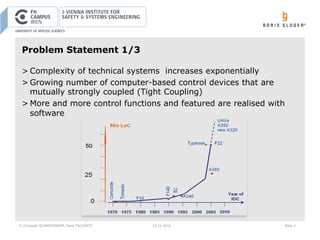
Problem Statement 1/3
> Complexity of technical systems increases exponentially
> Growing number of computer-based control devices that are
mutually strongly coupled (Tight Coupling)
> More and more control functions and featured are realised with
software
© Christoph SCHMIEDINGER, Hans TSCHÜRTZ 15.11.2016 Slide 4
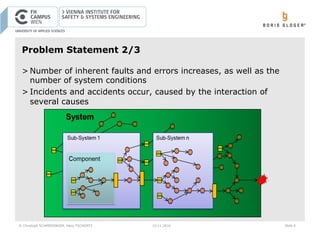
Problem Statement 2/3
> Number of inherent faults and errors increases, as well as the
number of system conditions
> Incidents and accidents occur, caused by the interaction of
several causes
© Christoph SCHMIEDINGER, Hans TSCHÜRTZ 15.11.2016 Slide 5
Problem Statement 3/3
> „Seldom does a single hazard cause an accident. More often, an accident occurs as
the result of a sequence of causes termed initiating and contributory hazards.“
[FAA System Safety Handbook]
> “[…] the probability of any one specific combination of failures will be extremely low,
but as experience shows, this is precisely what leads to major accidents.”
[Holzmann: Conquering Complexity]
> “System failure can come from the interaction of sub-systems deficiencies which
individually do not produce an end system failure but may do in combination.”
[Sundaram P., Hartfelder D.: Rigor in Automotive Safety Critical System Development]
Caused by
”Flawed Requirements“
© Christoph SCHMIEDINGER, Hans TSCHÜRTZ 15.11.2016 Slide 6
What do we need?
> A flexible approach that meets new challenges while suitable for
managing complex systems
> Identification of hazards in early stages
> Continuous evaluation of the development direction
> Preventive avoidance of hazards instead of controlling them
> Possibility for changes in every development stage
> Skilled people that have
> knowledge in engineering disciplines and safety
> the ability to imagine a holistic picture of the whole system on
organisational and on engineering level
© Christoph SCHMIEDINGER, Hans TSCHÜRTZ 15.11.2016 Slide 7
But now: let‘s start!
© Christoph SCHMIEDINGER, Hans TSCHÜRTZ 15.11.2016 Slide 8
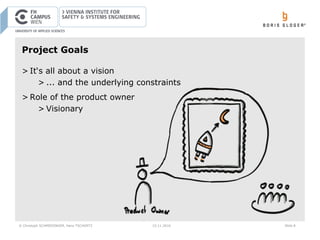
Project Goals
> It‘s all about a vision
> ... and the underlying constraints
> Role of the product owner
> Visionary
© Christoph SCHMIEDINGER, Hans TSCHÜRTZ 15.11.2016 Slide 9
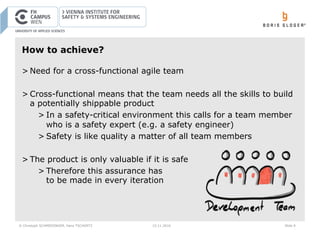
How to achieve?
> Need for a cross-functional agile team
> Cross-functional means that the team needs all the skills to build
a potentially shippable product
> In a safety-critical environment this calls for a team member
who is a safety expert (e.g. a safety engineer)
> Safety is like quality a matter of all team members
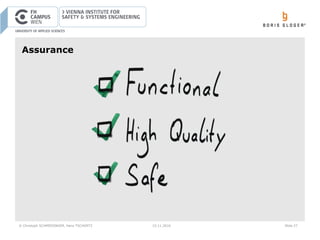
> The product is only valuable if it is safe
> Therefore this assurance has
to be made in every iteration
© Christoph SCHMIEDINGER, Hans TSCHÜRTZ 15.11.2016 Slide 10
Skills of the safety expert
> Knowledge of relevant norms and standards (e.g. ISO 26262)
> Knowledge of safety and hazard analyse methods
> ....
© Christoph SCHMIEDINGER, Hans TSCHÜRTZ 15.11.2016 Slide 11
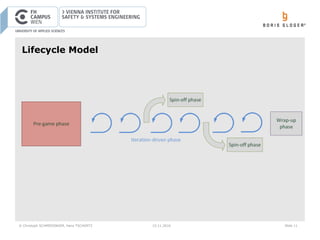
Lifecycle Model
© Christoph SCHMIEDINGER, Hans TSCHÜRTZ 15.11.2016 Slide 12
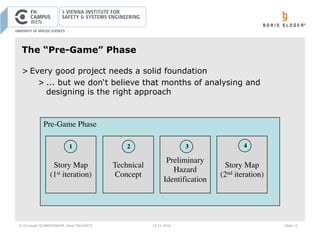
The “Pre-Game” Phase
> Every good project needs a solid foundation
> ... but we don‘t believe that months of analysing and
designing is the right approach
Pre-Game Phase
Story Map
(1st iteration)
Technical
Concept
1 2
Preliminary
Hazard
Identification
Story Map
(2nd iteration)
3 4
© Christoph SCHMIEDINGER, Hans TSCHÜRTZ 15.11.2016 Slide 13
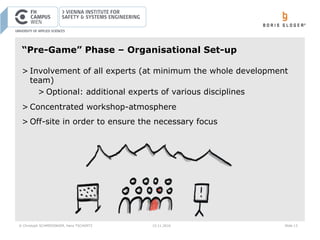
“Pre-Game” Phase – Organisational Set-up
> Involvement of all experts (at minimum the whole development
team)
> Optional: additional experts of various disciplines
> Concentrated workshop-atmosphere
> Off-site in order to ensure the necessary focus
© Christoph SCHMIEDINGER, Hans TSCHÜRTZ 15.11.2016 Slide 14
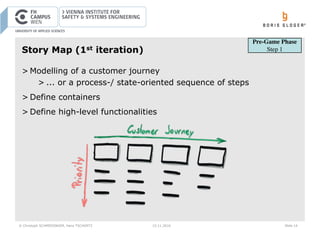
Story Map (1st iteration)
> Modelling of a customer journey
> ... or a process-/ state-oriented sequence of steps
> Define containers
> Define high-level functionalities
Pre-Game Phase
Step 1
© Christoph SCHMIEDINGER, Hans TSCHÜRTZ 15.11.2016 Slide 15
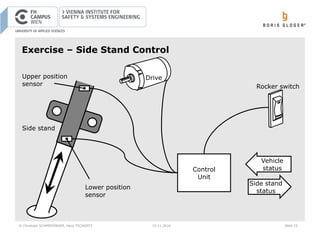
Exercise – Side Stand Control
Control
Unit
Lower position
sensor
Upper position
sensor
Vehicle
status
Rocker switch
Side stand
status
Drive
Side stand
© Christoph SCHMIEDINGER, Hans TSCHÜRTZ 15.11.2016 Slide 16
Exercise – Legal requirements
> Council Directive 93/31/EEC
on stands for two-wheel motor vehicles
> The vehicle shall be designed in such a way that it cannot be
propelled by its engine when the prop stand is extended.
> The side stand shall not retract automatically if the angle of lean
is altered unexpectedly or the vehicle is being left unattended in
its parking position.
© Christoph SCHMIEDINGER, Hans TSCHÜRTZ 15.11.2016 Slide 17
Technical Concept
> Input: Story Map
> Use of the Shell Model
> Modelling of a system architecture
> Interfaces, controller, drivers, sensors, actors, …
Pre-Game Phase
Step 2
© Christoph SCHMIEDINGER, Hans TSCHÜRTZ 15.11.2016 Slide 18
Preliminary Hazard Identification
> Input: Technical concept and hazard checklist (if available)
> Activities
> Identify hazards and their possible causes
> Assign risk to causes
> Identify Automotive Safety Integrity Level (ASIL)
> Specify countermeasures when risk is too high
> Output: Safety Concept (including safety requirements)
Pre-Game Phase
Step 3
© Christoph SCHMIEDINGER, Hans TSCHÜRTZ 15.11.2016 Slide 19
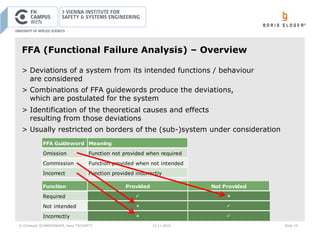
FFA (Functional Failure Analysis) – Overview
> Deviations of a system from its intended functions / behaviour
are considered
> Combinations of FFA guidewords produce the deviations,
which are postulated for the system
> Identification of the theoretical causes and effects
resulting from those deviations
> Usually restricted on borders of the (sub-)system under consideration
FFA Guideword Meaning
Omission Function not provided when required
Commission Function provided when not intended
Incorrect Function provided incorrectly
Function Provided Not Provided
Required ü û
Not intended û ü
Incorrectly û ü
© Christoph SCHMIEDINGER, Hans TSCHÜRTZ 15.11.2016 Slide 20
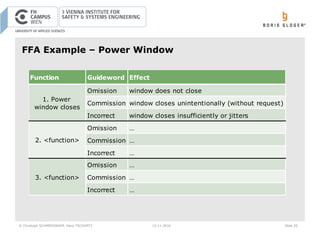
FFA Example – Power Window
Function Guideword Effect
Omission window does not close
Commission window closes unintentionally (without request)
Incorrect window closes insufficiently or jitters
Omission …
Commission …
Incorrect …
Omission …
Commission …
Incorrect …
1. Power
window closes
2. <function>
3. <function>
© Christoph SCHMIEDINGER, Hans TSCHÜRTZ 15.11.2016 Slide 21
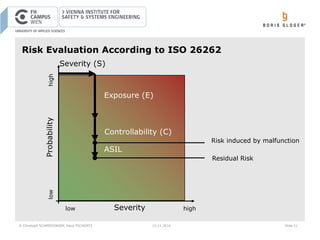
Risk Evaluation According to ISO 26262
Severity
Probability
low high
lowhigh
Severity (S)
Exposure (E)
Controllability (C)
ASIL
Risk induced by malfunction
Residual Risk
© Christoph SCHMIEDINGER, Hans TSCHÜRTZ 15.11.2016 Slide 22
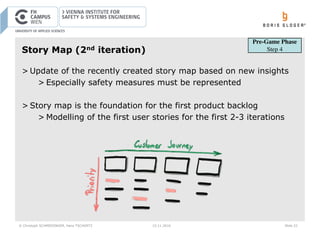
Story Map (2nd iteration)
> Update of the recently created story map based on new insights
> Especially safety measures must be represented
> Story map is the foundation for the first product backlog
> Modelling of the first user stories for the first 2-3 iterations
Pre-Game Phase
Step 4
© Christoph SCHMIEDINGER, Hans TSCHÜRTZ 15.11.2016 Slide 23
The Foundation is laid
... but what‘s next?
© Christoph SCHMIEDINGER, Hans TSCHÜRTZ 15.11.2016 Slide 24
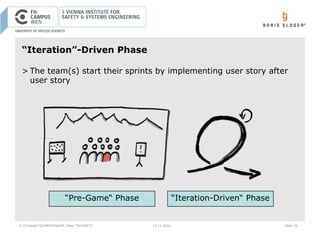
“Iteration”-Driven Phase
> The team(s) start their sprints by implementing user story after
user story
“Pre-Game“ Phase “Iteration-Driven“ Phase
© Christoph SCHMIEDINGER, Hans TSCHÜRTZ 15.11.2016 Slide 25
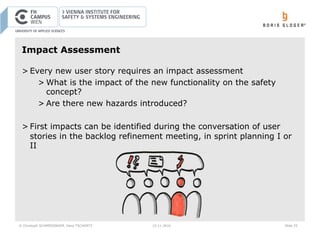
Impact Assessment
> Every new user story requires an impact assessment
> What is the impact of the new functionality on the safety
concept?
> Are there new hazards introduced?
> First impacts can be identified during the conversation of user
stories in the backlog refinement meeting, in sprint planning I or
II
© Christoph SCHMIEDINGER, Hans TSCHÜRTZ 15.11.2016 Slide 26
Iteration Work
> Within the iteration all the necessary actions are performed
> Update of the safety concept (safety case, ...)
> Derive of new safety requirements/measures
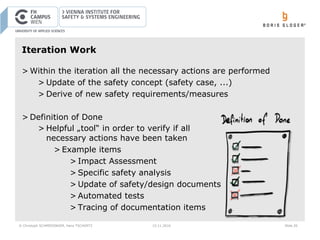
> Definition of Done
> Helpful „tool“ in order to verify if all
necessary actions have been taken
> Example items
> Impact Assessment
> Specific safety analysis
> Update of safety/design documents
> Automated tests
> Tracing of documentation items
© Christoph SCHMIEDINGER, Hans TSCHÜRTZ 15.11.2016 Slide 27
Assurance
© Christoph SCHMIEDINGER, Hans TSCHÜRTZ 15.11.2016 Slide 28
Preconditions and Success Factors
> Agile model needs a great deal of discipline
> Well organized way of working
> Interdisciplinary development teams
> Preliminary workshop activities are crucial for the success of the
project
> Transition of the organisation to agile approaches
> Responsible usage of modern technical practices
© Christoph SCHMIEDINGER, Hans TSCHÜRTZ 15.11.2016 Slide 29
Learning Outcomes
> Efficient pre-project Workshop
> Story Mapping, Shell Modelling and Safety Analyses
> Interdisciplinary Teams
> Need for safety engineer
> Impact Assessment & Definition of Done
> It’s all about discipline
> Christoph Schmiedinger christoph.schmiedinger@borisgloger.com
> Dr. Hans Tschürtz hans.tschuertz@fh-campuswien.ac.at
Thank you for your attention.
Safe Systems for a Safer World!

Agile Process Framefork for Projects in the Safety Critical Field

  • 1.
    Agile Process Frameworkfor Projects in the Safety Critical Field Dr. Hans Tschürtz Christoph Schmiedinger
  • 2.
    © Christoph SCHMIEDINGER,Hans TSCHÜRTZ 15.11.2016 Slide 2 Introduction > Change in the domain of safety-critical applications > Safety compliance, quality, and reliability are a matter of course > Increasing focus on functional requirements > Demand of more flexibility > Safety specifications recommend sequential development models > IEC 61508, ISO 26262, … > Prejudices against agile approaches
  • 3.
    © Christoph SCHMIEDINGER,Hans TSCHÜRTZ 15.11.2016 Slide 3 Problem Statement 1/3 > Complexity of technical systems increases exponentially > Growing number of computer-based control devices that are mutually strongly coupled (Tight Coupling) > More and more control functions and featured are realised with software
  • 4.
    © Christoph SCHMIEDINGER,Hans TSCHÜRTZ 15.11.2016 Slide 4 Problem Statement 2/3 > Number of inherent faults and errors increases, as well as the number of system conditions > Incidents and accidents occur, caused by the interaction of several causes
  • 5.
    © Christoph SCHMIEDINGER,Hans TSCHÜRTZ 15.11.2016 Slide 5 Problem Statement 3/3 > „Seldom does a single hazard cause an accident. More often, an accident occurs as the result of a sequence of causes termed initiating and contributory hazards.“ [FAA System Safety Handbook] > “[…] the probability of any one specific combination of failures will be extremely low, but as experience shows, this is precisely what leads to major accidents.” [Holzmann: Conquering Complexity] > “System failure can come from the interaction of sub-systems deficiencies which individually do not produce an end system failure but may do in combination.” [Sundaram P., Hartfelder D.: Rigor in Automotive Safety Critical System Development] Caused by ”Flawed Requirements“
  • 6.
    © Christoph SCHMIEDINGER,Hans TSCHÜRTZ 15.11.2016 Slide 6 What do we need? > A flexible approach that meets new challenges while suitable for managing complex systems > Identification of hazards in early stages > Continuous evaluation of the development direction > Preventive avoidance of hazards instead of controlling them > Possibility for changes in every development stage > Skilled people that have > knowledge in engineering disciplines and safety > the ability to imagine a holistic picture of the whole system on organisational and on engineering level
  • 7.
    © Christoph SCHMIEDINGER,Hans TSCHÜRTZ 15.11.2016 Slide 7 But now: let‘s start!
  • 8.
    © Christoph SCHMIEDINGER,Hans TSCHÜRTZ 15.11.2016 Slide 8 Project Goals > It‘s all about a vision > ... and the underlying constraints > Role of the product owner > Visionary
  • 9.
    © Christoph SCHMIEDINGER,Hans TSCHÜRTZ 15.11.2016 Slide 9 How to achieve? > Need for a cross-functional agile team > Cross-functional means that the team needs all the skills to build a potentially shippable product > In a safety-critical environment this calls for a team member who is a safety expert (e.g. a safety engineer) > Safety is like quality a matter of all team members > The product is only valuable if it is safe > Therefore this assurance has to be made in every iteration
  • 10.
    © Christoph SCHMIEDINGER,Hans TSCHÜRTZ 15.11.2016 Slide 10 Skills of the safety expert > Knowledge of relevant norms and standards (e.g. ISO 26262) > Knowledge of safety and hazard analyse methods > ....
  • 11.
    © Christoph SCHMIEDINGER,Hans TSCHÜRTZ 15.11.2016 Slide 11 Lifecycle Model
  • 12.
    © Christoph SCHMIEDINGER,Hans TSCHÜRTZ 15.11.2016 Slide 12 The “Pre-Game” Phase > Every good project needs a solid foundation > ... but we don‘t believe that months of analysing and designing is the right approach Pre-Game Phase Story Map (1st iteration) Technical Concept 1 2 Preliminary Hazard Identification Story Map (2nd iteration) 3 4
  • 13.
    © Christoph SCHMIEDINGER,Hans TSCHÜRTZ 15.11.2016 Slide 13 “Pre-Game” Phase – Organisational Set-up > Involvement of all experts (at minimum the whole development team) > Optional: additional experts of various disciplines > Concentrated workshop-atmosphere > Off-site in order to ensure the necessary focus
  • 14.
    © Christoph SCHMIEDINGER,Hans TSCHÜRTZ 15.11.2016 Slide 14 Story Map (1st iteration) > Modelling of a customer journey > ... or a process-/ state-oriented sequence of steps > Define containers > Define high-level functionalities Pre-Game Phase Step 1
  • 15.
    © Christoph SCHMIEDINGER,Hans TSCHÜRTZ 15.11.2016 Slide 15 Exercise – Side Stand Control Control Unit Lower position sensor Upper position sensor Vehicle status Rocker switch Side stand status Drive Side stand
  • 16.
    © Christoph SCHMIEDINGER,Hans TSCHÜRTZ 15.11.2016 Slide 16 Exercise – Legal requirements > Council Directive 93/31/EEC on stands for two-wheel motor vehicles > The vehicle shall be designed in such a way that it cannot be propelled by its engine when the prop stand is extended. > The side stand shall not retract automatically if the angle of lean is altered unexpectedly or the vehicle is being left unattended in its parking position.
  • 17.
    © Christoph SCHMIEDINGER,Hans TSCHÜRTZ 15.11.2016 Slide 17 Technical Concept > Input: Story Map > Use of the Shell Model > Modelling of a system architecture > Interfaces, controller, drivers, sensors, actors, … Pre-Game Phase Step 2
  • 18.
    © Christoph SCHMIEDINGER,Hans TSCHÜRTZ 15.11.2016 Slide 18 Preliminary Hazard Identification > Input: Technical concept and hazard checklist (if available) > Activities > Identify hazards and their possible causes > Assign risk to causes > Identify Automotive Safety Integrity Level (ASIL) > Specify countermeasures when risk is too high > Output: Safety Concept (including safety requirements) Pre-Game Phase Step 3
  • 19.
    © Christoph SCHMIEDINGER,Hans TSCHÜRTZ 15.11.2016 Slide 19 FFA (Functional Failure Analysis) – Overview > Deviations of a system from its intended functions / behaviour are considered > Combinations of FFA guidewords produce the deviations, which are postulated for the system > Identification of the theoretical causes and effects resulting from those deviations > Usually restricted on borders of the (sub-)system under consideration FFA Guideword Meaning Omission Function not provided when required Commission Function provided when not intended Incorrect Function provided incorrectly Function Provided Not Provided Required ü û Not intended û ü Incorrectly û ü
  • 20.
    © Christoph SCHMIEDINGER,Hans TSCHÜRTZ 15.11.2016 Slide 20 FFA Example – Power Window Function Guideword Effect Omission window does not close Commission window closes unintentionally (without request) Incorrect window closes insufficiently or jitters Omission … Commission … Incorrect … Omission … Commission … Incorrect … 1. Power window closes 2. <function> 3. <function>
  • 21.
    © Christoph SCHMIEDINGER,Hans TSCHÜRTZ 15.11.2016 Slide 21 Risk Evaluation According to ISO 26262 Severity Probability low high lowhigh Severity (S) Exposure (E) Controllability (C) ASIL Risk induced by malfunction Residual Risk
  • 22.
    © Christoph SCHMIEDINGER,Hans TSCHÜRTZ 15.11.2016 Slide 22 Story Map (2nd iteration) > Update of the recently created story map based on new insights > Especially safety measures must be represented > Story map is the foundation for the first product backlog > Modelling of the first user stories for the first 2-3 iterations Pre-Game Phase Step 4
  • 23.
    © Christoph SCHMIEDINGER,Hans TSCHÜRTZ 15.11.2016 Slide 23 The Foundation is laid ... but what‘s next?
  • 24.
    © Christoph SCHMIEDINGER,Hans TSCHÜRTZ 15.11.2016 Slide 24 “Iteration”-Driven Phase > The team(s) start their sprints by implementing user story after user story “Pre-Game“ Phase “Iteration-Driven“ Phase
  • 25.
    © Christoph SCHMIEDINGER,Hans TSCHÜRTZ 15.11.2016 Slide 25 Impact Assessment > Every new user story requires an impact assessment > What is the impact of the new functionality on the safety concept? > Are there new hazards introduced? > First impacts can be identified during the conversation of user stories in the backlog refinement meeting, in sprint planning I or II
  • 26.
    © Christoph SCHMIEDINGER,Hans TSCHÜRTZ 15.11.2016 Slide 26 Iteration Work > Within the iteration all the necessary actions are performed > Update of the safety concept (safety case, ...) > Derive of new safety requirements/measures > Definition of Done > Helpful „tool“ in order to verify if all necessary actions have been taken > Example items > Impact Assessment > Specific safety analysis > Update of safety/design documents > Automated tests > Tracing of documentation items
  • 27.
    © Christoph SCHMIEDINGER,Hans TSCHÜRTZ 15.11.2016 Slide 27 Assurance
  • 28.
    © Christoph SCHMIEDINGER,Hans TSCHÜRTZ 15.11.2016 Slide 28 Preconditions and Success Factors > Agile model needs a great deal of discipline > Well organized way of working > Interdisciplinary development teams > Preliminary workshop activities are crucial for the success of the project > Transition of the organisation to agile approaches > Responsible usage of modern technical practices
  • 29.
    © Christoph SCHMIEDINGER,Hans TSCHÜRTZ 15.11.2016 Slide 29 Learning Outcomes > Efficient pre-project Workshop > Story Mapping, Shell Modelling and Safety Analyses > Interdisciplinary Teams > Need for safety engineer > Impact Assessment & Definition of Done > It’s all about discipline
  • 30.
    > Christoph Schmiedingerchristoph.schmiedinger@borisgloger.com > Dr. Hans Tschürtz hans.tschuertz@fh-campuswien.ac.at Thank you for your attention. Safe Systems for a Safer World!