Alerts Management System for M-Learning
Design Documents Version 0.3
1
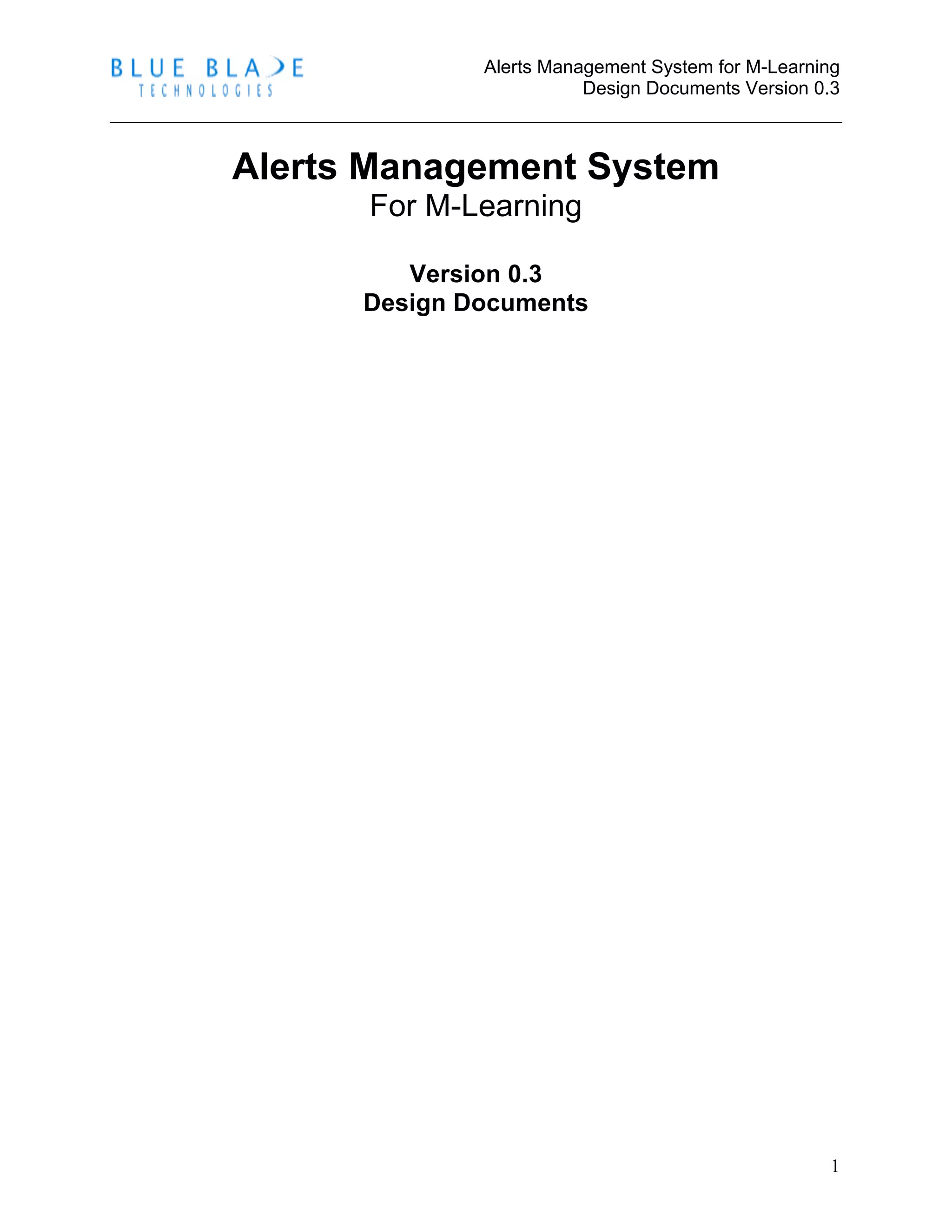
Alerts Management System
For M-Learning
Version 0.3
Design Documents
Alerts Management System for M-Learning
Design Documents Version 0.3
2
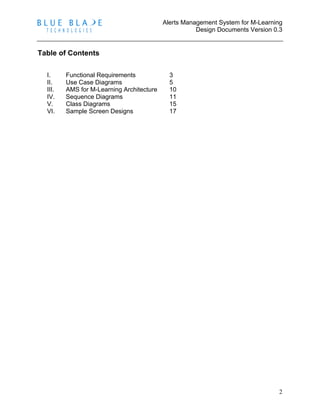
Table of Contents
I. Functional Requirements 3
II. Use Case Diagrams 5
III. AMS for M-Learning Architecture 10
IV. Sequence Diagrams 11
V. Class Diagrams 15
VI. Sample Screen Designs 17
Alerts Management System for M-Learning
Design Documents Version 0.3
3
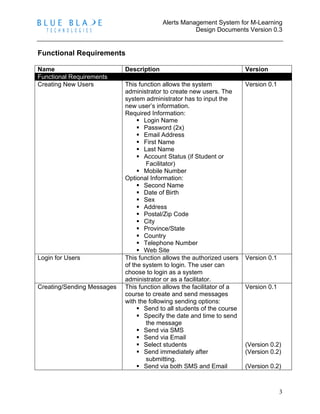
Functional Requirements
Name Description Version
Functional Requirements
Creating New Users This function allows the system
administrator to create new users. The
system administrator has to input the
new user’s information.
Required Information:
 Login Name
 Password (2x)
 Email Address
 First Name
 Last Name
 Account Status (if Student or
Facilitator)
 Mobile Number
Optional Information:
 Second Name
 Date of Birth
 Sex
 Address
 Postal/Zip Code
 City
 Province/State
 Country
 Telephone Number
 Web Site
Version 0.1
Login for Users This function allows the authorized users
of the system to login. The user can
choose to login as a system
administrator or as a facilitator.
Version 0.1
Creating/Sending Messages This function allows the facilitator of a
course to create and send messages
with the following sending options:
 Send to all students of the course
 Specify the date and time to send
the message
 Send via SMS
 Send via Email
 Select students
 Send immediately after
submitting.
 Send via both SMS and Email
Version 0.1
(Version 0.2)
(Version 0.2)
(Version 0.2)
Alerts Management System for M-Learning
Design Documents Version 0.3
4
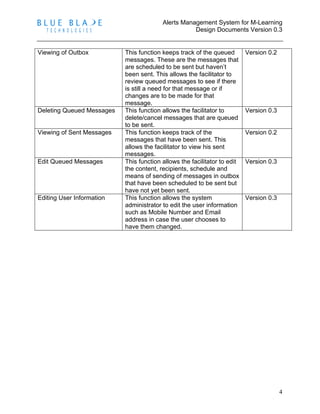
Viewing of Outbox This function keeps track of the queued
messages. These are the messages that
are scheduled to be sent but haven’t
been sent. This allows the facilitator to
review queued messages to see if there
is still a need for that message or if
changes are to be made for that
message.
Version 0.2
Deleting Queued Messages This function allows the facilitator to
delete/cancel messages that are queued
to be sent.
Version 0.3
Viewing of Sent Messages This function keeps track of the
messages that have been sent. This
allows the facilitator to view his sent
messages.
Version 0.2
Edit Queued Messages This function allows the facilitator to edit
the content, recipients, schedule and
means of sending of messages in outbox
that have been scheduled to be sent but
have not yet been sent.
Version 0.3
Editing User Information This function allows the system
administrator to edit the user information
such as Mobile Number and Email
address in case the user chooses to
have them changed.
Version 0.3
Alerts Management System for M-Learning
Design Documents Version 0.3
5
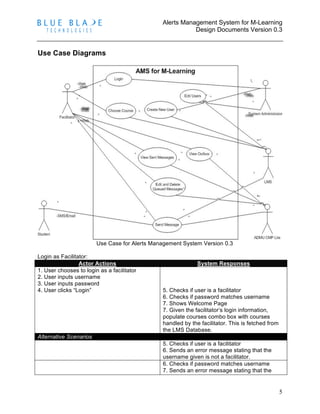
Use Case Diagrams
Use Case for Alerts Management System Version 0.3
Login as Facilitator:
Actor Actions System Responses
1. User chooses to login as a facilitator
2. User inputs username
3. User inputs password
4. User clicks “Login” 5. Checks if user is a facilitator
6. Checks if password matches username
7. Shows Welcome Page
7. Given the facilitator’s login information,
populate courses combo box with courses
handled by the facilitator. This is fetched from
the LMS Database.
Alternative Scenarios
5. Checks if user is a facilitator
6. Sends an error message stating that the
username given is not a facilitator.
6. Checks if password matches username
7. Sends an error message stating that the
Alerts Management System for M-Learning
Design Documents Version 0.3
6
password is incorrect
Login as System Administrator:
Actor Actions System Responses
1. User chooses to login as a system
administrator
2. User inputs username
3. User inputs password
4. User clicks “Login”
5. Checks if user is a system administrator
6. Checks if password matches username
7. Shows Add New User page
Alternative Scenarios
5. Checks if user is a system administrator
6. Sends an error message stating that the
username given is not a system administrator
6. Checks if password matches username
7. Sends an error message stating that the
password is incorrect
Log Out:
Actor Actions System Responses
1. User clicks Log Off
3. Clicks Yes
2. Shows confirmation window (Are You Sure
You want to log off?)
4. Log off user from the system
Alternative Scenarios
3. Clicks No
2. Shows confirmation window (Are You Sure
You want to log off?)
4. Retains current page the user is at
Create New Message:
Actor Actions System Responses
1. Facilitator Login (See Login as facilitator
use case)
3. Facilitator determines course to send
messages to.
5. Facilitator clicks “Send New Message”
7. Facilitator writes message.
8. Facilitator clicks “Specify Send Date” radio
button.
10. Facilitator picks Date and Time.
11. Facilitator clicks “Specified Students” radio
button
13. Facilitator picks recipients
14. Facilitator specifies means of sending
2. Show Welcome page.
4. The application connects to the database
used by the LMS and extracts the student ids
of the enrolled student in the given course from
the LMS.
6. Show Send New Message page
9. Enables Date Picker
12. Enables List of Students, List of recipients
and add button.
Alerts Management System for M-Learning
Design Documents Version 0.3
7
(SMS, Email or both)
15. Facilitator clicks “Submit”
16. Facilitator clicks “Send”
16. Student receives message
17. Show Message Confirmation page
18. Show Welcome page
19. Marks the message as queued
20. Waits for specified time and date
21. Sends message to students in the selected
course
Alternative Scenarios
8. Facilitator clicks “Send Immediately” radio
button.
11. Facilitator clicks “All Students” radio button
10. Facilitator clicks “Cancel”
12. Facilitator clicks “Yes”
11. Show Cancel Confirmation
13. Cancel writing of message
14. Show Welcome Page
10. Facilitator clicks “Cancel”
12. Facilitator clicks “No”
11. Show Cancel Confirmation
13. Show Send New Message Page with
retained fields.
10. Facilitator clicks “Submit”
12. Facilitator clicks “Cancel”
11. Show Message Confirmation Page
12. Show Send New Message Page with
retained fields.
Add New User
Actor Actions System Responses
1. System Administrator logs into system. (see
Login as System Administrator use case)
3. System Administrator fills up fields
4. System Administrator clicks “Add” button
8. System Administrator clicks “Add”
2. Show Create New User page
5. Checks if all required fields are filled up.
6. Checks if email address is the right format.
6. Checks if mobile number is in the right
format (11 digits and starts with 0).
7. Shows New User Confirmation
9. The application connects to the database
used by the LMS and adds user to LMS
Database.
10. Extracts the user id given by the LMS.
11. Adds user to Alerts Management System
Database.
Alternative Scenarios
8. System Administrator clicks “No”
7. Shows New User Confirmation
9. Shows Create New User page with the fields
retained.
5. Checks if all required fields are filled up.
6. Sends error message stating that the
required information is not complete.
6. Checks if email address is the right format.
6. Checks if mobile number is in the right
format (11 digits and starts with 0).
Alerts Management System for M-Learning
Design Documents Version 0.3
8
7. Sends an error message stating that email or
mobile number is not the right format.
View Outbox: (with delete Queued Messages)
Actor Actions System Responses
1. Facilitator Login (see Login Use Case)
3. Choose Course
4. Click “Outbox”
6. Click “Next 10 Messages”
8.Click “Back to Main Page”
2. Show Welcome Page
5. Show Outbox (Message details retrieved
from database).
7. Shows next 10 messages sorted by time it
will be sent out to recepients.
9. Show Welcome Page
Alternative Scenarios
6. Click “Previous 10 Messages” 7. Shows previous 10 messages
6. Check Message
7. Click “Delete Selected Messages”
9. Clicks OK
8.Sends Confirmation
9. Deletes Messages
6. Check Message
7. Click “Delete Selected Messages”
9. Clicks Cancel
8.Sends Confirmation
9. Returns to Outbox
View Sent Messages
Actor Actions System Responses
1. Facilitator Login (see Login Use Case)
3. Choose Course
4. Click “Sent Messages”
6. Click “Next 10 Messages”
8. Click “Back to Main Page”
2. Show Welcome Page
5. Show Sent Messages (Message details
retrieved from database.
7. Show next 10 messages.
9. Show Welcome Page
Alternative Scenarios
6. Click “Previous 10 Messages” 7. Shows previous 10 messages
Edit Queued Messages
Actor Actions System Responses
1. Facilitator Login (see Login Use Case)
3. Choose Course
4. Click “Outbox”
6. Click Edit Button on message to edit
8. Creates necessary edits
9. Clicks “Ok”
11. Clicks “Ok”
2. Show Welcome Page
5. Show Outbox (Message details retrieved
from database.
7. Show Edit Message Screen already filled
with the details of the message being edited
10. Asks for confirmation
11. Changes content of message
12. Shows Outbox with confirmation message
Alternative Scenarios
9. Clicks “Cancel” 10. Message is not edited
9. Clicks “Ok”
11. Clicks “Cancel”
10. Asks for confirmation
12. Show Create Message Screen already
Alerts Management System for M-Learning
Design Documents Version 0.3
9
filled with the details of the Message Being
edited
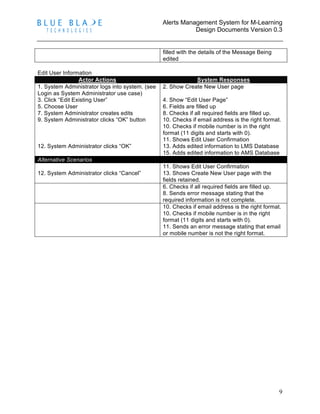
Edit User Information
Actor Actions System Responses
1. System Administrator logs into system. (see
Login as System Administrator use case)
3. Click “Edit Existing User”
5. Choose User
7. System Administrator creates edits
9. System Administrator clicks “OK” button
12. System Administrator clicks “OK”
2. Show Create New User page
4. Show “Edit User Page”
6. Fields are filled up
8. Checks if all required fields are filled up.
10. Checks if email address is the right format.
10. Checks if mobile number is in the right
format (11 digits and starts with 0).
11. Shows Edit User Confirmation
13. Adds edited information to LMS Database
15. Adds edited information to AMS Database
Alternative Scenarios
12. System Administrator clicks “Cancel”
11. Shows Edit User Confirmation
13. Shows Create New User page with the
fields retained.
6. Checks if all required fields are filled up.
8. Sends error message stating that the
required information is not complete.
10. Checks if email address is the right format.
10. Checks if mobile number is in the right
format (11 digits and starts with 0).
11. Sends an error message stating that email
or mobile number is not the right format.

Functional requirements

  • 1.
    Alerts Management Systemfor M-Learning Design Documents Version 0.3 1 Alerts Management System For M-Learning Version 0.3 Design Documents
  • 2.
    Alerts Management Systemfor M-Learning Design Documents Version 0.3 2 Table of Contents I. Functional Requirements 3 II. Use Case Diagrams 5 III. AMS for M-Learning Architecture 10 IV. Sequence Diagrams 11 V. Class Diagrams 15 VI. Sample Screen Designs 17
  • 3.
    Alerts Management Systemfor M-Learning Design Documents Version 0.3 3 Functional Requirements Name Description Version Functional Requirements Creating New Users This function allows the system administrator to create new users. The system administrator has to input the new user’s information. Required Information:  Login Name  Password (2x)  Email Address  First Name  Last Name  Account Status (if Student or Facilitator)  Mobile Number Optional Information:  Second Name  Date of Birth  Sex  Address  Postal/Zip Code  City  Province/State  Country  Telephone Number  Web Site Version 0.1 Login for Users This function allows the authorized users of the system to login. The user can choose to login as a system administrator or as a facilitator. Version 0.1 Creating/Sending Messages This function allows the facilitator of a course to create and send messages with the following sending options:  Send to all students of the course  Specify the date and time to send the message  Send via SMS  Send via Email  Select students  Send immediately after submitting.  Send via both SMS and Email Version 0.1 (Version 0.2) (Version 0.2) (Version 0.2)
  • 4.
    Alerts Management Systemfor M-Learning Design Documents Version 0.3 4 Viewing of Outbox This function keeps track of the queued messages. These are the messages that are scheduled to be sent but haven’t been sent. This allows the facilitator to review queued messages to see if there is still a need for that message or if changes are to be made for that message. Version 0.2 Deleting Queued Messages This function allows the facilitator to delete/cancel messages that are queued to be sent. Version 0.3 Viewing of Sent Messages This function keeps track of the messages that have been sent. This allows the facilitator to view his sent messages. Version 0.2 Edit Queued Messages This function allows the facilitator to edit the content, recipients, schedule and means of sending of messages in outbox that have been scheduled to be sent but have not yet been sent. Version 0.3 Editing User Information This function allows the system administrator to edit the user information such as Mobile Number and Email address in case the user chooses to have them changed. Version 0.3
  • 5.
    Alerts Management Systemfor M-Learning Design Documents Version 0.3 5 Use Case Diagrams Use Case for Alerts Management System Version 0.3 Login as Facilitator: Actor Actions System Responses 1. User chooses to login as a facilitator 2. User inputs username 3. User inputs password 4. User clicks “Login” 5. Checks if user is a facilitator 6. Checks if password matches username 7. Shows Welcome Page 7. Given the facilitator’s login information, populate courses combo box with courses handled by the facilitator. This is fetched from the LMS Database. Alternative Scenarios 5. Checks if user is a facilitator 6. Sends an error message stating that the username given is not a facilitator. 6. Checks if password matches username 7. Sends an error message stating that the
  • 6.
    Alerts Management Systemfor M-Learning Design Documents Version 0.3 6 password is incorrect Login as System Administrator: Actor Actions System Responses 1. User chooses to login as a system administrator 2. User inputs username 3. User inputs password 4. User clicks “Login” 5. Checks if user is a system administrator 6. Checks if password matches username 7. Shows Add New User page Alternative Scenarios 5. Checks if user is a system administrator 6. Sends an error message stating that the username given is not a system administrator 6. Checks if password matches username 7. Sends an error message stating that the password is incorrect Log Out: Actor Actions System Responses 1. User clicks Log Off 3. Clicks Yes 2. Shows confirmation window (Are You Sure You want to log off?) 4. Log off user from the system Alternative Scenarios 3. Clicks No 2. Shows confirmation window (Are You Sure You want to log off?) 4. Retains current page the user is at Create New Message: Actor Actions System Responses 1. Facilitator Login (See Login as facilitator use case) 3. Facilitator determines course to send messages to. 5. Facilitator clicks “Send New Message” 7. Facilitator writes message. 8. Facilitator clicks “Specify Send Date” radio button. 10. Facilitator picks Date and Time. 11. Facilitator clicks “Specified Students” radio button 13. Facilitator picks recipients 14. Facilitator specifies means of sending 2. Show Welcome page. 4. The application connects to the database used by the LMS and extracts the student ids of the enrolled student in the given course from the LMS. 6. Show Send New Message page 9. Enables Date Picker 12. Enables List of Students, List of recipients and add button.
  • 7.
    Alerts Management Systemfor M-Learning Design Documents Version 0.3 7 (SMS, Email or both) 15. Facilitator clicks “Submit” 16. Facilitator clicks “Send” 16. Student receives message 17. Show Message Confirmation page 18. Show Welcome page 19. Marks the message as queued 20. Waits for specified time and date 21. Sends message to students in the selected course Alternative Scenarios 8. Facilitator clicks “Send Immediately” radio button. 11. Facilitator clicks “All Students” radio button 10. Facilitator clicks “Cancel” 12. Facilitator clicks “Yes” 11. Show Cancel Confirmation 13. Cancel writing of message 14. Show Welcome Page 10. Facilitator clicks “Cancel” 12. Facilitator clicks “No” 11. Show Cancel Confirmation 13. Show Send New Message Page with retained fields. 10. Facilitator clicks “Submit” 12. Facilitator clicks “Cancel” 11. Show Message Confirmation Page 12. Show Send New Message Page with retained fields. Add New User Actor Actions System Responses 1. System Administrator logs into system. (see Login as System Administrator use case) 3. System Administrator fills up fields 4. System Administrator clicks “Add” button 8. System Administrator clicks “Add” 2. Show Create New User page 5. Checks if all required fields are filled up. 6. Checks if email address is the right format. 6. Checks if mobile number is in the right format (11 digits and starts with 0). 7. Shows New User Confirmation 9. The application connects to the database used by the LMS and adds user to LMS Database. 10. Extracts the user id given by the LMS. 11. Adds user to Alerts Management System Database. Alternative Scenarios 8. System Administrator clicks “No” 7. Shows New User Confirmation 9. Shows Create New User page with the fields retained. 5. Checks if all required fields are filled up. 6. Sends error message stating that the required information is not complete. 6. Checks if email address is the right format. 6. Checks if mobile number is in the right format (11 digits and starts with 0).
  • 8.
    Alerts Management Systemfor M-Learning Design Documents Version 0.3 8 7. Sends an error message stating that email or mobile number is not the right format. View Outbox: (with delete Queued Messages) Actor Actions System Responses 1. Facilitator Login (see Login Use Case) 3. Choose Course 4. Click “Outbox” 6. Click “Next 10 Messages” 8.Click “Back to Main Page” 2. Show Welcome Page 5. Show Outbox (Message details retrieved from database). 7. Shows next 10 messages sorted by time it will be sent out to recepients. 9. Show Welcome Page Alternative Scenarios 6. Click “Previous 10 Messages” 7. Shows previous 10 messages 6. Check Message 7. Click “Delete Selected Messages” 9. Clicks OK 8.Sends Confirmation 9. Deletes Messages 6. Check Message 7. Click “Delete Selected Messages” 9. Clicks Cancel 8.Sends Confirmation 9. Returns to Outbox View Sent Messages Actor Actions System Responses 1. Facilitator Login (see Login Use Case) 3. Choose Course 4. Click “Sent Messages” 6. Click “Next 10 Messages” 8. Click “Back to Main Page” 2. Show Welcome Page 5. Show Sent Messages (Message details retrieved from database. 7. Show next 10 messages. 9. Show Welcome Page Alternative Scenarios 6. Click “Previous 10 Messages” 7. Shows previous 10 messages Edit Queued Messages Actor Actions System Responses 1. Facilitator Login (see Login Use Case) 3. Choose Course 4. Click “Outbox” 6. Click Edit Button on message to edit 8. Creates necessary edits 9. Clicks “Ok” 11. Clicks “Ok” 2. Show Welcome Page 5. Show Outbox (Message details retrieved from database. 7. Show Edit Message Screen already filled with the details of the message being edited 10. Asks for confirmation 11. Changes content of message 12. Shows Outbox with confirmation message Alternative Scenarios 9. Clicks “Cancel” 10. Message is not edited 9. Clicks “Ok” 11. Clicks “Cancel” 10. Asks for confirmation 12. Show Create Message Screen already
  • 9.
    Alerts Management Systemfor M-Learning Design Documents Version 0.3 9 filled with the details of the Message Being edited Edit User Information Actor Actions System Responses 1. System Administrator logs into system. (see Login as System Administrator use case) 3. Click “Edit Existing User” 5. Choose User 7. System Administrator creates edits 9. System Administrator clicks “OK” button 12. System Administrator clicks “OK” 2. Show Create New User page 4. Show “Edit User Page” 6. Fields are filled up 8. Checks if all required fields are filled up. 10. Checks if email address is the right format. 10. Checks if mobile number is in the right format (11 digits and starts with 0). 11. Shows Edit User Confirmation 13. Adds edited information to LMS Database 15. Adds edited information to AMS Database Alternative Scenarios 12. System Administrator clicks “Cancel” 11. Shows Edit User Confirmation 13. Shows Create New User page with the fields retained. 6. Checks if all required fields are filled up. 8. Sends error message stating that the required information is not complete. 10. Checks if email address is the right format. 10. Checks if mobile number is in the right format (11 digits and starts with 0). 11. Sends an error message stating that email or mobile number is not the right format.