FUNCTIONS’ IN C
                  By-Nilam Desai
WHAT IS FUNCTION?
 A function in C language is a block of code that
  performs a specific task.
 It has a name and it is reusable i.e. it can be
  executed from as many different parts in a 
  C Program as required.
 It also optionally returns a value to the calling
  program
FUNCTION PROPERTIES
 Every function has a unique name. This name is
  used to call function from “main()” function. A
  function can be called from within another
  function.
 A function is independent and it can perform its
  task without intervention from or interfering
  with other parts of the program.
 A function performs a specific task. A task is a
  distinct job that your program must perform as a
  part of its overall operation, such as adding two
  or more integer, sorting an array into numerical
  order, or calculating a cube root etc.
PROPERTIES CONT…
   A function returns a value to the calling
    program. This is optional and depends upon the
    task your function is going to accomplish.
    Suppose you want to just show few lines through
    function then it is not necessary to return a
    value. But if you are calculating area of rectangle
    and wanted to use result somewhere in program
    then you have to send back (return) value to the
    calling function.
TYPES OF C FUNCTION
   Inbuilt function: they are already defined in C
    library.
       i.e. Printf, scanf, clrscr etc. 
   User define function: programmer will create it
    based on program requirements.
       i.e. main
GENERAL STRUCTURE OF A C
FUNCTION
   <return type> FunctionName (Argument1, Argument2,
    Argument3……)
    {
    Statement1;
    Statement2;
    Statement3;
    }
   Example
       void main()
        {
         }

       int sum (int x, int y)
        {
        int result;
        result = x + y;
        return (result);
        }
FUNCTION PROTOTYPE AND
FUNCTION DEFINITION
 Function prototype tells compiler that we are
  going to use a function which will have given
  name, return type and parameters.
 Function definition on the other hand is just
  writing logic of any function.
       For example you have one function prototype in C
        program for adding two integer numbers
           int add(int, int)
       but along with prototype you also have to write logic
        how that function will behave (respect to above
        prototype; how you will utilize those two passed
        integer value and how you will return value) when
        you will call that function.
FUNCTION PROTOTYPE AND
FUNCTION DEFINITION EXAMPLE
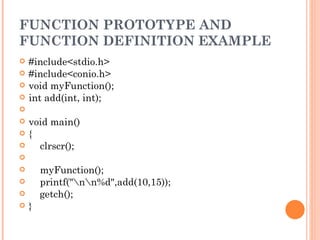
   #include<stdio.h>
   #include<conio.h>
   void myFunction();
   int add(int, int);
    
   void main()
   {
       clrscr();
    
       myFunction();
       printf("nn%d",add(10,15));
       getch();
   }
EXAMPLE CONT…
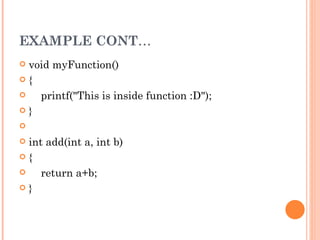
 void myFunction()
{

     printf("This is inside function :D");

}

 

 int add(int a, int b)

{

     return a+b;

}
EXPLANATION
    We will start from line no. 4 & 5. In these two
    lines we have function prototype, line no. 4 has
    a simple function prototype which doesn’t have
    parameters or return type. It’s very simple to
    declare a prototype, see line no. 17 & 4, both
    line are same except prototype requires
    semicolon (;) at the end. Code block (line no.
    17-20) is function definition for our first function
    prototype (i.e. line no. 4). In this block we are
    defining behavior of that function and in my code
    it’s just printing a simple message for
    demonstration.
   Similarly we have second function prototype
    (line no. 5) and it has parameters and return
    type. Code block (line no. 22 – 25) is definition of
    above function prototype. One important point
    for function prototype having parameters; in
    prototype, variable name for parameters is
    optional (see line no. 5). There is no variable
    name for int parameters, its (int, int). But in
    that prototype’s function definition you must
    provide parameter variable name (see line no.
    22). We have (int a, int b) parameter name.

   One more important thing, if you writing
    function definition above main() function then
    you don’t need to write prototype of that function.
    But it’s a good practice to keep all the functions
    below main() function.
ADVANTAGES OF USING
FUNCTIONS:

 It makes possible top down modular
  programming. In this style of programming, the
  high level logic of the overall problem is solved
  first while the details of each lower level
  functions is addressed later.
 The length of the source program can be reduced
  by using functions at appropriate places.
 It becomes uncomplicated to locate and separate
  a faulty function for further study.
ADVANTAGES CONT…
 A function may be used later by many other
  programs this means that a c programmer can
  use function written by others, instead of
  starting over from scratch.
 A function can be used to keep away from
  rewriting the same block of codes which we are
  going use two or more locations in a program.
  This is especially useful if the code involved is
  long or complicated.
TYPES OF USER DEFINED
FUNCTIONS:
 Functions with no arguments and no return
  values.
 Functions with arguments and no return values.

 Functions with arguments and return values.

 Functions that return multiple values.

 Functions with no arguments and return values.
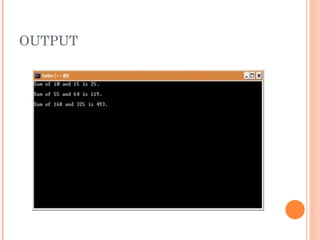
OUTPUT
EXPLANATION
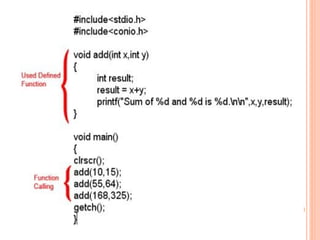
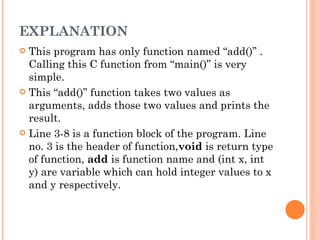
 This program has only function named “add()” .
  Calling this C function from “main()” is very
  simple.
 This “add()” function takes two values as
  arguments, adds those two values and prints the
  result.
 Line 3-8 is a function block of the program. Line
  no. 3 is the header of function,void is return type
  of function, add is function name and (int x, int
  y) are variable which can hold integer values to x
  and y respectively.
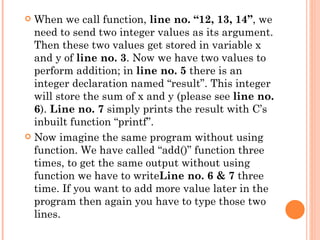
 When we call function, line no. “12, 13, 14”, we
  need to send two integer values as its argument.
  Then these two values get stored in variable x
  and y of line no. 3. Now we have two values to
  perform addition; in line no. 5 there is an
  integer declaration named “result”. This integer
  will store the sum of x and y (please see line no.
  6). Line no. 7 simply prints the result with C’s
  inbuilt function “printf”.
 Now imagine the same program without using
  function. We have called “add()” function three
  times, to get the same output without using
  function we have to writeLine no. 6 & 7 three
  time. If you want to add more value later in the
  program then again you have to type those two
  lines.
NESTING OF FUNCTION
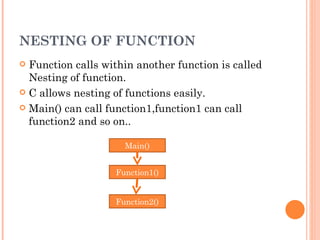
 Function calls within another function is called
  Nesting of function.
 C allows nesting of functions easily.

 Main() can call function1,function1 can call
  function2 and so on..

                     Main()


                   Function1()


                   Function2()
RULES FOR PASSING ARRAY AS
FUNCTION PARAMETER OR
ARGUMENT
 The function prototype must show that the
  argument is an array.
 In function definition the formal argument must
  be an array if the argument list have an array as
  parameter.
 Function call must have only the name of an
  array .indexing of the array is not required to
  pass an whole array.

Function

  • 1.
    FUNCTIONS’ IN C By-Nilam Desai
  • 2.
    WHAT IS FUNCTION? A function in C language is a block of code that performs a specific task.  It has a name and it is reusable i.e. it can be executed from as many different parts in a  C Program as required.  It also optionally returns a value to the calling program
  • 3.
    FUNCTION PROPERTIES  Everyfunction has a unique name. This name is used to call function from “main()” function. A function can be called from within another function.  A function is independent and it can perform its task without intervention from or interfering with other parts of the program.  A function performs a specific task. A task is a distinct job that your program must perform as a part of its overall operation, such as adding two or more integer, sorting an array into numerical order, or calculating a cube root etc.
  • 4.
    PROPERTIES CONT…  A function returns a value to the calling program. This is optional and depends upon the task your function is going to accomplish. Suppose you want to just show few lines through function then it is not necessary to return a value. But if you are calculating area of rectangle and wanted to use result somewhere in program then you have to send back (return) value to the calling function.
  • 5.
    TYPES OF CFUNCTION  Inbuilt function: they are already defined in C library.  i.e. Printf, scanf, clrscr etc.   User define function: programmer will create it based on program requirements.  i.e. main
  • 6.
    GENERAL STRUCTURE OFA C FUNCTION  <return type> FunctionName (Argument1, Argument2, Argument3……) { Statement1; Statement2; Statement3; }  Example  void main() { }  int sum (int x, int y) { int result; result = x + y; return (result); }
  • 7.
    FUNCTION PROTOTYPE AND FUNCTIONDEFINITION  Function prototype tells compiler that we are going to use a function which will have given name, return type and parameters.  Function definition on the other hand is just writing logic of any function.  For example you have one function prototype in C program for adding two integer numbers  int add(int, int)  but along with prototype you also have to write logic how that function will behave (respect to above prototype; how you will utilize those two passed integer value and how you will return value) when you will call that function.
  • 8.
    FUNCTION PROTOTYPE AND FUNCTIONDEFINITION EXAMPLE  #include<stdio.h>  #include<conio.h>  void myFunction();  int add(int, int);     void main()  {      clrscr();         myFunction();      printf("nn%d",add(10,15));  getch();  }
  • 9.
    EXAMPLE CONT…  voidmyFunction() {      printf("This is inside function :D"); }    int add(int a, int b) {      return a+b; }
  • 10.
    EXPLANATION  We will start from line no. 4 & 5. In these two lines we have function prototype, line no. 4 has a simple function prototype which doesn’t have parameters or return type. It’s very simple to declare a prototype, see line no. 17 & 4, both line are same except prototype requires semicolon (;) at the end. Code block (line no. 17-20) is function definition for our first function prototype (i.e. line no. 4). In this block we are defining behavior of that function and in my code it’s just printing a simple message for demonstration.
  • 11.
    Similarly we have second function prototype (line no. 5) and it has parameters and return type. Code block (line no. 22 – 25) is definition of above function prototype. One important point for function prototype having parameters; in prototype, variable name for parameters is optional (see line no. 5). There is no variable name for int parameters, its (int, int). But in that prototype’s function definition you must provide parameter variable name (see line no. 22). We have (int a, int b) parameter name.  One more important thing, if you writing function definition above main() function then you don’t need to write prototype of that function. But it’s a good practice to keep all the functions below main() function.
  • 12.
    ADVANTAGES OF USING FUNCTIONS: It makes possible top down modular programming. In this style of programming, the high level logic of the overall problem is solved first while the details of each lower level functions is addressed later.  The length of the source program can be reduced by using functions at appropriate places.  It becomes uncomplicated to locate and separate a faulty function for further study.
  • 13.
    ADVANTAGES CONT…  Afunction may be used later by many other programs this means that a c programmer can use function written by others, instead of starting over from scratch.  A function can be used to keep away from rewriting the same block of codes which we are going use two or more locations in a program. This is especially useful if the code involved is long or complicated.
  • 14.
    TYPES OF USERDEFINED FUNCTIONS:  Functions with no arguments and no return values.  Functions with arguments and no return values.  Functions with arguments and return values.  Functions that return multiple values.  Functions with no arguments and return values.
  • 16.
  • 17.
    EXPLANATION  This programhas only function named “add()” . Calling this C function from “main()” is very simple.  This “add()” function takes two values as arguments, adds those two values and prints the result.  Line 3-8 is a function block of the program. Line no. 3 is the header of function,void is return type of function, add is function name and (int x, int y) are variable which can hold integer values to x and y respectively.
  • 18.
     When wecall function, line no. “12, 13, 14”, we need to send two integer values as its argument. Then these two values get stored in variable x and y of line no. 3. Now we have two values to perform addition; in line no. 5 there is an integer declaration named “result”. This integer will store the sum of x and y (please see line no. 6). Line no. 7 simply prints the result with C’s inbuilt function “printf”.  Now imagine the same program without using function. We have called “add()” function three times, to get the same output without using function we have to writeLine no. 6 & 7 three time. If you want to add more value later in the program then again you have to type those two lines.
  • 19.
    NESTING OF FUNCTION Function calls within another function is called Nesting of function.  C allows nesting of functions easily.  Main() can call function1,function1 can call function2 and so on.. Main() Function1() Function2()
  • 20.
    RULES FOR PASSINGARRAY AS FUNCTION PARAMETER OR ARGUMENT  The function prototype must show that the argument is an array.  In function definition the formal argument must be an array if the argument list have an array as parameter.  Function call must have only the name of an array .indexing of the array is not required to pass an whole array.