By: Shobhit Upadhyay
Functions
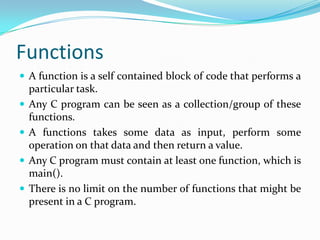
 A function is a self contained block of code that performs a
particular task.
 Any C program can be seen as a collection/group of these
functions.
 A functions takes some data as input, perform some
operation on that data and then return a value.
 Any C program must contain at least one function, which is
main().
 There is no limit on the number of functions that might be
present in a C program.
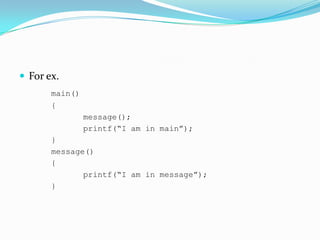
 For ex.
main()
{
message();
printf(“I am in main”);
}
message()
{
printf(“I am in message”);
}
Function Prototype
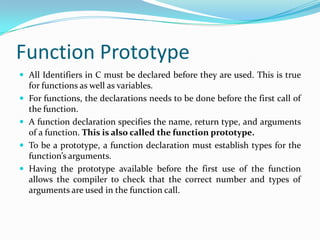
 All Identifiers in C must be declared before they are used. This is true
for functions as well as variables.
 For functions, the declarations needs to be done before the first call of
the function.
 A function declaration specifies the name, return type, and arguments
of a function. This is also called the function prototype.
 To be a prototype, a function declaration must establish types for the
function’s arguments.
 Having the prototype available before the first use of the function
allows the compiler to check that the correct number and types of
arguments are used in the function call.
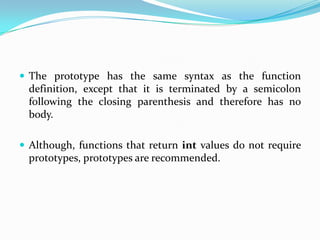
 The prototype has the same syntax as the function
definition, except that it is terminated by a semicolon
following the closing parenthesis and therefore has no
body.
 Although, functions that return int values do not require
prototypes, prototypes are recommended.
Function Definition
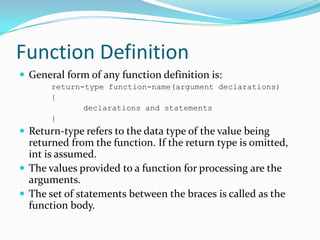
 General form of any function definition is:
return-type function-name(argument declarations)
{
declarations and statements
}
 Return-type refers to the data type of the value being
returned from the function. If the return type is omitted,
int is assumed.
 The values provided to a function for processing are the
arguments.
 The set of statements between the braces is called as the
function body.
Arguments – Call by Value
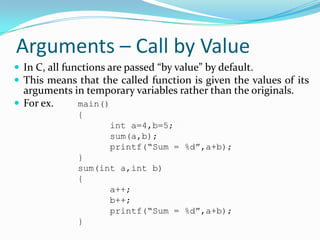
 In C, all functions are passed “by value” by default.
 This means that the called function is given the values of its
arguments in temporary variables rather than the originals.
 For ex. main()
{
int a=4,b=5;
sum(a,b);
printf(“Sum = %d”,a+b);
}
sum(int a,int b)
{
a++;
b++;
printf(“Sum = %d”,a+b);
}
Arguments – Call by Reference
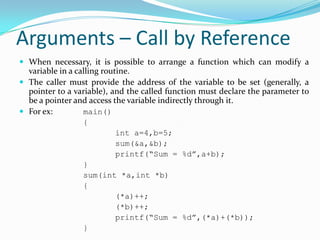
 When necessary, it is possible to arrange a function which can modify a
variable in a calling routine.
 The caller must provide the address of the variable to be set (generally, a
pointer to a variable), and the called function must declare the parameter to
be a pointer and access the variable indirectly through it.
 For ex: main()
{
int a=4,b=5;
sum(&a,&b);
printf(“Sum = %d”,a+b);
}
sum(int *a,int *b)
{
(*a)++;
(*b)++;
printf(“Sum = %d”,(*a)+(*b));
}
Recursion
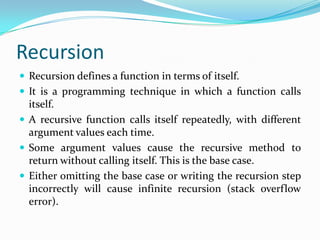
 Recursion defines a function in terms of itself.
 It is a programming technique in which a function calls
itself.
 A recursive function calls itself repeatedly, with different
argument values each time.
 Some argument values cause the recursive method to
return without calling itself. This is the base case.
 Either omitting the base case or writing the recursion step
incorrectly will cause infinite recursion (stack overflow
error).
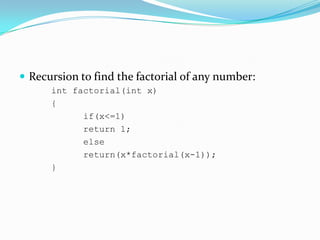
 Recursion to find the factorial of any number:
int factorial(int x)
{
if(x<=1)
return 1;
else
return(x*factorial(x-1));
}
External Variables
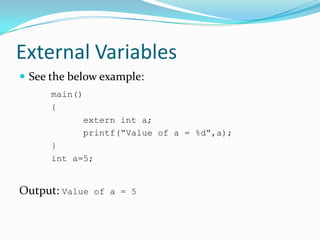
 See the below example:
main()
{
extern int a;
printf(“Value of a = %d”,a);
}
int a=5;
Output: Value of a = 5
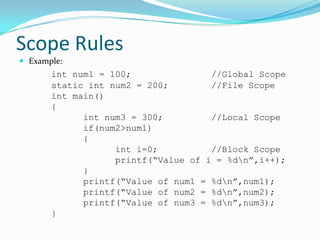
Scope Rules
 Example:
int num1 = 100; //Global Scope
static int num2 = 200; //File Scope
int main()
{
int num3 = 300; //Local Scope
if(num2>num1)
{
int i=0; //Block Scope
printf(“Value of i = %dn”,i++);
}
printf(“Value of num1 = %dn”,num1);
printf(“Value of num2 = %dn”,num2);
printf(“Value of num3 = %dn”,num3);
}
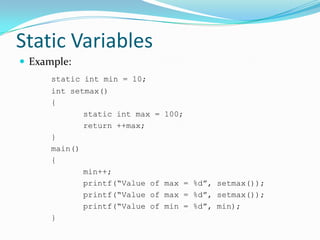
Static Variables
 Example:
static int min = 10;
int setmax()
{
static int max = 100;
return ++max;
}
main()
{
min++;
printf(“Value of max = %d”, setmax());
printf(“Value of min = %d”, min);
}
functionsinc-130108032745-phpapp01.pdf

functionsinc-130108032745-phpapp01.pdf

  • 1.
  • 2.
    Functions  A functionis a self contained block of code that performs a particular task.  Any C program can be seen as a collection/group of these functions.  A functions takes some data as input, perform some operation on that data and then return a value.  Any C program must contain at least one function, which is main().  There is no limit on the number of functions that might be present in a C program.
  • 3.
     For ex. main() { message(); printf(“Iam in main”); } message() { printf(“I am in message”); }
  • 4.
    Function Prototype  AllIdentifiers in C must be declared before they are used. This is true for functions as well as variables.  For functions, the declarations needs to be done before the first call of the function.  A function declaration specifies the name, return type, and arguments of a function. This is also called the function prototype.  To be a prototype, a function declaration must establish types for the function’s arguments.  Having the prototype available before the first use of the function allows the compiler to check that the correct number and types of arguments are used in the function call.
  • 5.
     The prototypehas the same syntax as the function definition, except that it is terminated by a semicolon following the closing parenthesis and therefore has no body.  Although, functions that return int values do not require prototypes, prototypes are recommended.
  • 6.
    Function Definition  Generalform of any function definition is: return-type function-name(argument declarations) { declarations and statements }  Return-type refers to the data type of the value being returned from the function. If the return type is omitted, int is assumed.  The values provided to a function for processing are the arguments.  The set of statements between the braces is called as the function body.
  • 7.
    Arguments – Callby Value  In C, all functions are passed “by value” by default.  This means that the called function is given the values of its arguments in temporary variables rather than the originals.  For ex. main() { int a=4,b=5; sum(a,b); printf(“Sum = %d”,a+b); } sum(int a,int b) { a++; b++; printf(“Sum = %d”,a+b); }
  • 8.
    Arguments – Callby Reference  When necessary, it is possible to arrange a function which can modify a variable in a calling routine.  The caller must provide the address of the variable to be set (generally, a pointer to a variable), and the called function must declare the parameter to be a pointer and access the variable indirectly through it.  For ex: main() { int a=4,b=5; sum(&a,&b); printf(“Sum = %d”,a+b); } sum(int *a,int *b) { (*a)++; (*b)++; printf(“Sum = %d”,(*a)+(*b)); }
  • 9.
    Recursion  Recursion definesa function in terms of itself.  It is a programming technique in which a function calls itself.  A recursive function calls itself repeatedly, with different argument values each time.  Some argument values cause the recursive method to return without calling itself. This is the base case.  Either omitting the base case or writing the recursion step incorrectly will cause infinite recursion (stack overflow error).
  • 10.
     Recursion tofind the factorial of any number: int factorial(int x) { if(x<=1) return 1; else return(x*factorial(x-1)); }
  • 11.
    External Variables  Seethe below example: main() { extern int a; printf(“Value of a = %d”,a); } int a=5; Output: Value of a = 5
  • 12.
    Scope Rules  Example: intnum1 = 100; //Global Scope static int num2 = 200; //File Scope int main() { int num3 = 300; //Local Scope if(num2>num1) { int i=0; //Block Scope printf(“Value of i = %dn”,i++); } printf(“Value of num1 = %dn”,num1); printf(“Value of num2 = %dn”,num2); printf(“Value of num3 = %dn”,num3); }
  • 13.
    Static Variables  Example: staticint min = 10; int setmax() { static int max = 100; return ++max; } main() { min++; printf(“Value of max = %d”, setmax()); printf(“Value of max = %d”, setmax()); printf(“Value of min = %d”, min); }