TELKOMNIKA, Vol.17, No.5, October 2019, pp.2169~2178
ISSN: 1693-6930, accredited First Grade by Kemenristekdikti, Decree No: 21/E/KPT/2018
DOI: 10.12928/TELKOMNIKA.v17i5.12803 ◼ 2169
Received October 30, 2018; Revised April 3, 2019; Accepted May 1, 2019
Full-duplex user-centric communication using
non-orthogonal multiple access
Sock Theng Ooi*1
, Razali Ngah2
, Marwan Hadri Azmi3
Wireless Communication Centre, School of Electrical Engineering,
Faculty of Engineering, Universiti Teknologi Malaysia, Malaysia
*Corresponding author, e-mail: socktheng81@gmail.com1
, razalin@fke.utm.my2
, hadri@fke.utm.my3
Abstract
This paper proposes an improved user-centric Non-Orthogonal Multiple Access (NOMA)
communication in two-base station networks with in-band full duplex (IBFD) user. We derive
the achievable rates of the proposed user-centric NOMA systems. For benchmarking purposes, we also
derive the achievable rate for the user-centric system deploying conventional NOMA schemes, Orthogonal
Multiple Access (OMA) schemes and point-point communication systems. We then analyze and simulate
the performance of the proposed and all the benchmarked systems. We found that our proposed
user-centric NOMA approach has a 64% improvement in the total achievable rate when compared to
the benchmarked approach under similar power constraint.
Keywords: achievable rates, in-band fullduplex (IBFD), non-orthogonal multiple access (NOMA),
successive interference cancellation (SIC), user-centric network (UCN)
Copyright © 2019 Universitas Ahmad Dahlan. All rights reserved.
1. Introduction
Over the last few years, wireless terminals are equipped with a more advanced function
as transmitter and receiver, e.g., base stations, relays, or mobiles, due the advancement of
the modern wireless communication systems [1]. With these unique and advanced features
possess by the wireless terminals, it drives the quest for the use of in-band full duplex (IBFD)
wireless transceivers. Conventionally, the terminal operates using half-duplex modes, where it
can only transmit or receive at one time. Therefore, with the IBFD, the wireless terminals are
able to transmit and receive simultaneously over the same frequency band. This new full-duplex
capability provides a promising potential that can lead to a two-fold spectral efficiency gain [2].
The fifth generation (5G) mobile system is expected to be deployed widely in the near
future [3]. Stronger multiple access (MA) schemes have been identified as one of the key
techniques to support large-scale heterogeneous traffic and users in the upcoming 5G systems.
In recent years, non-orthogonal multiple access (NOMA) have gained a lot of research interest
due to its promising capabilities to achieve higher spectrum efficiency, and to support massive
connectivity [4-13]. Unlike the conventional multiple access that are based on the orthogonality
of the resources in either time, code or frequency domains (i.e. TDMA, CDMA, OFDMA), NOMA
has been shown to accommodate more users by allocating them on the non-orthogonal
resource, which consequently attain high spectrally efficient radio access and network
capacity [14-16]. Power domain (PD) NOMA schemes result in non-orthogonality among users,
where multiple users share the same frequency resources simultaneously by utilizing
superposition coding at the transmitter and successive interference cancellation (SIC) at
the receiver [17, 18]. Although NOMA has recognized as a promising multiple access technique
for 5G but most of the researchers have focused on downlink traffic only [19, 20]. Uplink traffic
begins to attract the attention since the emergence of new mobile and Internet-of-Things (IoT)
applications. Uplink traffic plays a significant role when the IoT experiences massive growth,
which incur intensive uplink traffic by sensing and monitoring characteristic [21].
Apart from a more advanced IBFD capability and stronger MA schemes, user-centric
network (UCN) has also been identified to become new key enabler for 5G networks to provide
ubiquitous high-speed connectivity to mobile users. Traditional cell-centric networks construct
the network, where each handset communicates with only one specific cell site at a time. Under
UCN architecture, multiple cell sites that located around the mobile user are cooperating to
◼ ISSN: 1693-6930
TELKOMNIKA Vol. 17, No. 5, October 2019: 2169-2178
2170
provide high data rates to the users in every transmission, letting the mobile user to experience
like the networks is always following it. Furthermore, UCN could intelligently recognize
the mobile user’s wireless communication and then can flexibly organize the required cell group
and resource to serve the mobile users [22-25]. In [20], a local anchor based dual connectivity is
proposed for UCN as it showed that the average user spectrum efficiency achieves an increase
of 5% gains over the current LTE system while providing seamless coverage and borderless
service to a mobile user. In another set of works, there are also studies in both traffics using
coordinating multiple points (CoMP) approach with IBFD in 5G [1, 24].
Motivated by the challenging requirements of 5G systems to provide high-speed
connectivity, this paper proposes a new user-centric NOMA communication in two-base station
networks with IBFD user. The achievable rates of the proposed system are derived. We then
analyze and simulate the performance of the system, and compared it with the performances of
state-of-the art orthogonal multiple access (OMA) and point-point communication systems.
The rest of the paper is organized as follows. In section 2, we present the system model for
the proposed user-centric NOMA scheme and all benchmarked systems. Section 3 then derives
the theoretical achievable rate for all studied and benchmarked schemes in this work. Section 4
presents and discusses the simulation results in terms of the achievable rate attained by all
schemes. Finally, the conclusions are presented in section 5.
2. System Model
Consider a user centric architecture in which two base stations, 𝐵𝑆𝑖 for i∈{1,2,u} are
supporting a user cooperatively using non-orthogonal multiple access (NOMA) schemes. Each
base station has it owns independent messages to be forwarded to the user. The studied
network topology consisting these three nodes is illustrated in Figure 1, where the distance
between the two base stations is normalized to one. The user is located in a straight line
between the two base stations with the distance of d1 from BS1. All the nodes in the considered
scenario are equipped with a single antenna. The channel modeling used in this paper is
described as follows. The channel gain between node i and node j is modeled as 𝛾𝑖𝑗 =
1
𝐿 𝑖𝑗
,
where 𝐿𝑖𝑗 = 𝑑𝑖𝑗
𝛼
denotes the path loss, 𝑑𝑖𝑗 is the distance between node i and node j, and α is
the path loss exponent parameter. Using subscripts 1, 2 and u to denote the 𝐵𝑆1, 𝐵𝑆2 and
the user node, respectively, the channel gains for all the links in Figure 1 are
𝛾1𝑢 = 𝛾 𝑢1 =
1
𝑑1𝑢
𝛼 =
1
𝑑 𝑢1
𝛼 , 𝛾12 = 𝛾21 = 1, 𝛾2𝑢 = 𝛾 𝑢2 =
1
𝑑2𝑢
𝛼 =
1
𝑑 𝑢2
𝛼.
Figure 1. Effects of selecting different switching under dynamic condition
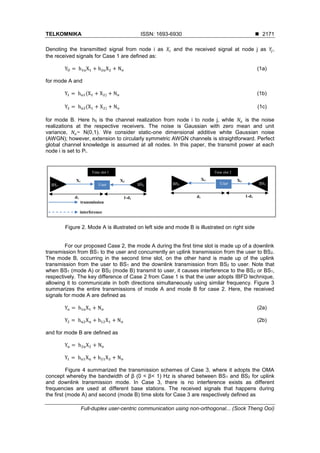
In this work, two NOMA schemes are developed, named case 1 and case 2 schemes.
Case 1 is the conventional NOMA schemes that consist of mode A and mode B, as in Figure 2.
Mode A is a downlink transmission whereby the user receives two distinct messages from both
base stations during first time slot. Mode B is the uplink transmission, which occurs in
the second time slot to concurrently forward distinct messages from user to both base stations.
TELKOMNIKA ISSN: 1693-6930 ◼
Full-duplex user-centric communication using non-orthogonal... (Sock Theng Ooi)
2171
Denoting the transmitted signal from node i as 𝑋𝑖 and the received signal at node j as 𝑌𝑗,
the received signals for Case 1 are defined as:
YU = h1uX1 + h2uX2 + No (1a)
for mode A and
Y1 = hu1(X1 + X2) + No (1b)
Y2 = hu2(X1 + X2) + No (1c)
for mode B. Here hij is the channel realization from node i to node j, while 𝑁𝑜 is the noise
realizations at the respective receivers. The noise is Gaussian with zero mean and unit
variance, 𝑁𝑜~ N(0,1). We consider static-one dimensional additive white Gaussian noise
(AWGN); however, extension to circularly symmetric AWGN channels is straightforward. Perfect
global channel knowledge is assumed at all nodes. In this paper, the transmit power at each
node i is set to Pi.
Figure 2. Mode A is illustrated on left side and mode B is illustrated on right side
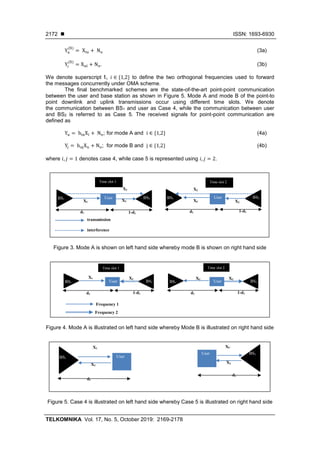
For our proposed Case 2, the mode A during the first time slot is made up of a downlink
transmission from BS1 to the user and concurrently an uplink transmission from the user to BS2.
The mode B, occurring in the second time slot, on the other hand is made up of the uplink
transmission from the user to BS1 and the downlink transmission from BS2 to user. Note that
when BS1 (mode A) or BS2 (mode B) transmit to user, it causes interference to the BS2 or BS1,
respectively. The key difference of Case 2 from Case 1 is that the user adopts IBFD technique,
allowing it to communicate in both directions simultaneously using similar frequency. Figure 3
summarizes the entire transmissions of mode A and mode B for case 2. Here, the received
signals for mode A are defined as
Yu = h1uX1 + No (2a)
Y2 = hu2Xu + h12X1 + No (2b)
and for mode B are defined as
Yu = h2uX2 + No
Y1 = hu1Xu + h21X2 + No
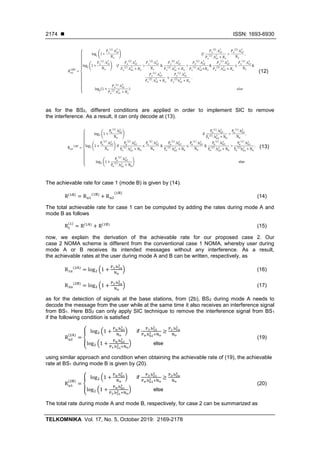
Figure 4 summarized the transmission schemes of Case 3, where it adopts the OMA
concept whereby the bandwidth of β (0 < β< 1) Hz is shared between BS1 and BS2 for uplink
and downlink transmission mode. In Case 3, there is no interference exists as different
frequencies are used at different base stations. The received signals that happens during
the first (mode A) and second (mode B) time slots for Case 3 are respectively defined as
BS1 BS2
d1 1-d1
User
X1 X2
BS1 BS2
d1 1-d1
User
XU XU
transmission
interference
Time slot 1 Time slot 2
◼ ISSN: 1693-6930
TELKOMNIKA Vol. 17, No. 5, October 2019: 2169-2178
2172
Yu
(fi)
= Xiu + No (3a)
Yi
(fi)
= Xui + No. (3b)
We denote superscript fi, 𝑖 ∈ {1,2} to define the two orthogonal frequencies used to forward
the messages concurrently under OMA scheme.
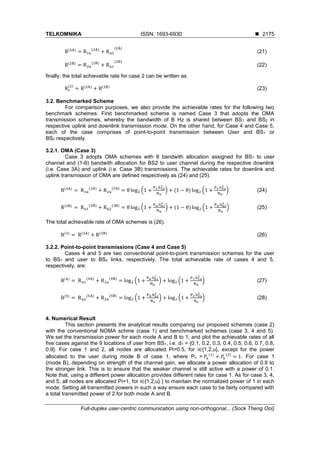
The final benchmarked schemes are the state-of-the-art point-point communication
between the user and base station as shown in Figure 5. Mode A and mode B of the point-to
point downlink and uplink transmissions occur using different time slots. We denote
the communication between BS1 and user as Case 4, while the communication between user
and BS2 is referred to as Case 5. The received signals for point-point communication are
defined as
Yu = hiuXi + No; for mode A and i ∈ {1,2} (4a)
Yj = hujXu + No; for mode B and j ∈ {1,2} (4b)
where 𝑖, 𝑗 = 1 denotes case 4, while case 5 is represented using 𝑖, 𝑗 = 2.
Figure 3. Mode A is shown on left hand side whereby mode B is shown on right hand side
Figure 4. Mode A is illustrated on left hand side whereby Mode B is illustrated on right hand side
Figure 5. Case 4 is illustrated on left hand side whereby Case 5 is illustrated on right hand side
BS1 BS2
d1 1-d1
User
X2
X2XU
BS1 BS2
d1 1-d1
User
X1
XUX1
interference
transmission
Time slot 1 Time slot 2
BS1 BS2
d1 1-d1
User
X1 X2
BS1 BS2
d1 1-d1
User
XU XU
Frequency 1
Frequency 2
Time slot 1 Time slot 2
BS2
d1
User
XU
BS1 BS2
d1
User
X2
XU
X1
TELKOMNIKA ISSN: 1693-6930 ◼
Full-duplex user-centric communication using non-orthogonal... (Sock Theng Ooi)
2173
3. Achievable Rates
This section derives the achievable rate for the proposed NOMA schemes and
the benchmarked schemes of Orthogonal Multiple Access and Point-to-Point communications to
evaluate and analyze their performances.
3.1. NOMA (Case 1 and Case 2)
Successive Interference Cancellation (SIC) is the key physical layer techniques used to
concurrently decode two or more signals under NOMA schemes. The first step for the receiver
to decode two concurrent signals using SIC is to start with the decoding of messages
corresponding to the stronger signals, while treating the weaker signal as an interference. Once
this is correctly performed, only then the receiver can cancel out the stronger signals and
decode the message corresponding to the weaker signal in the second step. Before we begin
the derivation of the achievable rate, let us define the received signal power at node j
from node i
Pij = Pi hij
2
. (5)
using (5), the signal-to-interference-noise ratio (SNIR) and signal-to-noise ratio (SNR)
parameters at receiver node j, assuming the stronger and weaker signals are transmitted from
node s and w, respectively are
SNIRsj =
Psj
Pwj+No
, (6)
SNRwj =
Pwj
No
. (7)
for a normalized bandwidth B=1, the achievable rates at node j for the stronger and weaker
channels when adopting SIC techniques are
Rs = log2(1 + SNIRsj) (8)
Rw = log2(1 + SNRwj), (9)
which gives the total achievable rates at node j when using SIC to be
RSIC = Rs + Rw (10)
throughout this derivation, we use a normalized bandwidth of 1. Let us now use the concept of
SIC to derive the achievable rates for the proposed NOMA schemes of case 1 and case 2.
For the conventional NOMA of Case 1 (mode A), the user is receiving signals concurrently from
both BSs. Denoting the base stations with stronger and weaker signals using subscript s and w,
respectively, the achievable rates of Case 1 (mode A) are (11)
R(1A)
= log2 (1 +
Ps.hsu
2
Pw.hwu
2 +No
) + log2 (1 +
Pw.hwu
2
No
) (11)
for 𝑠, 𝑤 ∈ {1,2} and 𝑠 ≠ 𝑤. During mode B, the user is forwarding the same message to both
base stations simultaneously using superimposed power allocation signal that consist of
respective message from both base stations. Defining the power allocation at the user as
𝑃𝑢 = 𝑃𝑢
(1)
+ 𝑃𝑢
(2)
, where 𝑃𝑢 is the total transmit power at user and 𝑃𝑢
(𝑗)
is the power used to
forward messages from user to base station j. Upon receiving the message at BS1, BS1 applies
SIC technique to remove the interference signal from BS2 if the certain condition is satisfied.
Therefore, the achievable rate at BS1 can be written as (12)
◼ ISSN: 1693-6930
TELKOMNIKA Vol. 17, No. 5, October 2019: 2169-2178
2174
(12)
as for the BS2, different conditions are applied in order to implement SIC to remove
the interference. As a result, it can only decode at (13).
(13)
The achievable rate for case 1 (mode B) is given by (14).
R(1B)
= Ru1
(1B)
+ Ru2
(1B)
(14)
The total achievable rate for case 1 can be computed by adding the rates during mode A and
mode B as follows
Rt
(1)
= R(1A)
+ R(1B)
(15)
now, we explain the derivation of the achievable rate for our proposed case 2. Our
case 2 NOMA scheme is different from the conventional case 1 NOMA, whereby user during
mode A or B receives its intended messages without any interference. As a result,
the achievable rates at the user during mode A and B can be written, respectively, as
R1u
(2A)
= log2 (1 +
P1.h1u
2
No
) (16)
R2u
(2B)
= log2 (1 +
P2.h2u
2
No
) (17)
as for the detection of signals at the base stations, from (2b), BS2 during mode A needs to
decode the message from the user while at the same time it also receives an interference signal
from BS1. Here BS2 can only apply SIC technique to remove the interference signal from BS1
if the following condition is satisfied
Ru2
(2A)
= {
log2 (1 +
Pu.hu2
2
No
) if
P1.h12
2
Pu.hu2
2 +No
≥
P1.h1u
2
No
log2 (1 +
Pu.hu2
2
P1.h12
2 +No
) else
(19)
using similar approach and condition when obtaining the achievable rate of (19), the achievable
rate at BS1 during mode B is given by (20).
Ru1
(2B)
= {
log2 (1 +
Pu.hu1
2
No
) if
P2.h21
2
Pu.hu1
2 +No
≥
P2.h2u
2
No
log2 (1 +
Pu.hu1
2
P2.h21
2 +No
) else
(20)
The total rate during mode A and mode B, respectively, for case 2 can be summarized as
TELKOMNIKA ISSN: 1693-6930 ◼
Full-duplex user-centric communication using non-orthogonal... (Sock Theng Ooi)
2175
R(2A)
= R1u
(2A)
+ Ru2
(2A)
(21)
R(2B)
= R2u
(2B)
+ Ru1
(2B)
(22)
finally, the total achievable rate for case 2 can be written as
Rt
(2)
= R(2A)
+ R(2B)
(23)
3.2. Benchmarked Scheme
For comparison purposes, we also provide the achievable rates for the following two
benchmark schemes. First benchmarked scheme is named Case 3 that adopts the OMA
transmission schemes, whereby the bandwidth of B Hz is shared between BS1 and BS2 in
respective uplink and downlink transmission mode. On the other hand, for Case 4 and Case 5,
each of the case comprises of point-to-point transmission between User and BS1 or
BS2 respectively.
3.2.1. OMA (Case 3)
Case 3 adopts OMA schemes with θ bandwith allocation assigned for BS1 to user
channel and (1-θ) bandwith allocation for BS2 to user channel during the respective downlink
(i.e. Case 3A) and uplink (i.e. Case 3B) transmissions. The achievable rates for downlink and
uplink transmission of OMA are defined respectively as (24) and (25).
R(3A)
= R1u
(3A)
+ R2u
(3A)
= θ log2 (1 +
P1.h1u
2
No
) + (1 − θ) log2 (1 +
P2.h2u
2
No
) (24)
R(3B)
= Ru1
(3B)
+ Ru2
(3B)
= θ log2 (1 +
Pu.hu1
2
No
) + (1 − θ) log2 (1 +
Pu.hu2
2
No
) (25)
The total achievable rate of OMA schemes is (26).
R(3)
= R(3A)
+ R(3B)
(26)
3.2.2. Point-to-point transmissions (Case 4 and Case 5)
Cases 4 and 5 are two conventional point-to-point transmission schemes for the user
to BS1 and user to BS2 links, respectively. The total achievable rate of cases 4 and 5,
respectively, are:
R(4)
= Ru1
(4A)
+ R1u
(4B)
= log2 (1 +
Pu.hu1
2
No
) + log2 (1 +
P1.h1u
2
No
) (27)
R(5)
= Ru2
(5A)
+ R2u
(5B)
= log2 (1 +
Pu.hu2
2
No
) + log2 (1 +
P2.h2u
2
No
) (28)
4. Numerical Result
This section presents the analytical results comparing our proposed schemes (case 2)
with the conventional NOMA schme (case 1) and benchmarked schemes (case 3, 4 and 5).
We set the transmission power for each mode A and B to 1, and plot the achievable rates of all
five cases against the 9 locations of user from BS1, i.e. d1 = {0.1, 0.2, 0.3, 0.4, 0.5, 0.6, 0.7, 0.8,
0.9}. For case 1 and 2, all nodes are allocated Pi=0.5, for i∈{1,2,u}, except for the power
allocated to the user during mode B of case 1, where Pu = 𝑃𝑢
(1)
+ 𝑃𝑢
(2)
= 1. For case 1
(mode B), depending on strength of the channel gain, we allocate a power allocation of 0.9 to
the stronger link. This is to ensure that the weaker channel is still active with a power of 0.1.
Note that, using a different power allocation provides different rates for case 1. As for case 3, 4,
and 5, all nodes are allocated Pi=1, for i∈{1,2,u} } to maintain the normalized power of 1 in each
mode. Setting all transmitted powers in such a way ensure each case to be fairly compared with
a total transmitted power of 2 for both mode A and B.
◼ ISSN: 1693-6930
TELKOMNIKA Vol. 17, No. 5, October 2019: 2169-2178
2176
Figure 6 presents the achievable rates of mode A in case 1, R(1A), case 2,
R1u
(2A) + R2u
(2B), case 3, R(3A), case 4, R(4A) and case 5, R(5A). We can see our proposed scheme
(case 2), IBFD technique under NOMA scheme attains the highest achievable rates among
the 5 cases in mode A. From Figure 6, it shows that our proposed scheme successfully
improves 64 percent based on R1u
(2A) + R2u
(2B), 8.934 bps/Hz compare with other schemes that
attaining the same achievable rate, 5.434 bps/Hz when located at d1 = 0.5. Furthermore, it is
suspected that d1=0.5 is the cell edge of both BSs due to the symmetry U shape for the user
centric NOMA and OMA schemes obtain the lowest achievable rate at d1=0.5. At point-to point
concept, the user gains higher achievable when his location is close to BS1(d2=0). However due
to the reception signal is getting faded when he is getting away from BS1, the achievable rate
reaches the lowest when it reaches d1=1.0.
Figure 7 presents the achievable rates of mode B in case 1, R(1B), case 2,
Ru2
(2A) + Ru1
(2B), case 3, R(3B), case 4, R(4B) and case 5, R(5B). We can see that at uplink
transmission, all cases remain the same shape with symmetry U shape for the user centric
NOMA and OMA schemes. Besides that, Figure 7 also shows that the achievable rate stays
the same in both downlink and uplink obtained by OMA Case 3, point-to point case 4 and
case 5 as mentioned that its reciprocal relationship with its downlink transmission. From Figure
7, the conventional NOMA case 1 has lowest rate, 3.197 bps/Hz compared to other schemes,
5.434bps/Hz at d1=0.5 except for case 2. The reason being is both base stations are allocated
with the 0.9 and 0.1 power allocations to ensure the base station with weaker channels can only
decode its signal by treating the signals to the stronger base station as interference. As a result,
we notice that it is better to adopt OMA and point-to point scheme than NOMA case 1 especially
at low point location, d1=0.5. Again, Figure 7 shows that our proposed scheme successfully
improves 44 percent based on Ru2
(2A) + Ru1
(2B), 7.828 bps/Hz compare with other schemes that
attaining the same achievable rate, 5.434 bps/Hz at d1 = 0.5.
Figure 6. The achievable rates in downlink transmission
Figure 7. The achievable rates in uplink transmission
TELKOMNIKA ISSN: 1693-6930 ◼
Full-duplex user-centric communication using non-orthogonal... (Sock Theng Ooi)
2177
Finally, Figure 8 presents the total achievable rates of 𝑅(1)
, 𝑅(2)
, 𝑅(3)
, 𝑅(4)
and 𝑅(5)
for
every case 1, 2, 3, 4 and 5, respectively. We can see that NOMA with IBFD user improves
the performance at about 54 percentage when compared to OMA, hand-off point-to-point
communication at d1=0.5. This indicates the superiority of our proposed case 2 specially to
improve the achievable rates at the cell boundries.
Figure 8. The total achievable rates
5. Conclusion
Through this research work, we have shown that our proposed scheme at case 2 excels
in the achievable rate compare with the conventional NOMA scheme and other benchmarked
schemes under similar power constraint in mode A and mode B. From the angle of spectral
efficiency, our proposed scheme has successfully offered frequency sharing among the users
and BS while attaining good achievable rates for both uplink and downlink along the distance.
Although point- to-point communication leads ahead when they placed near to the BS but this is
not practical for our future resource allocation with the explosive growth of the data traffic.
The insights obtained from this initial study will be enhanced to the future works.
Acknowledgements
Authors would like to express utmost gratitude to the Ministry of Education (MOE) in
Malaysia and Universiti Teknologi Malaysia (UTM) for providing finiancial support for this
research through HiCOE grant(R.J130000.7823.4J215). The grant is managed by Research
Management Centre (RMC) at UTM.
References
[1] Sabharwal A, Schniter P, Guo D, Bliss DW, Rangarajan S, Wichman R. In-Band Full-Duplex
Wireless: Challenges and Opportunities. IEEE Journal on Selected Areas in Communications. 2014;
32(9): 1637-1652.
[2] Goyal S, Liu P, Hua S, Panwar S. Analyzing a Full-Duplex Cellular System. 47th
Annual Conference
on Information Sciences and Systems. 2013: 20-22.
[3] Andrews JG, Buzzi S, et al. What Will 5G Be?. IEEE Journal on Selected Areas in Communications.
2014; 32(6): 1065-1082.
[4] Tse D, Viswanath P. Fundamentals of Wireless Communication. Cambridge University Press. 2005:
166-217.
[5] Caire G, Shamai S. On The Achievable Throughput of a Multi-Antenna Gaussian Broadcast Channel.
IEEE Trans. Info. Theory. 2003; 49(7): 1692–1706.
[6] Higuchi K, Kishiyama Y. Non-Orthogonal Access with Successive Interference Cancellation for
Future Radio Access. IEICE TRANS.Commun. 2015; E98-B: 403-414.
◼ ISSN: 1693-6930
TELKOMNIKA Vol. 17, No. 5, October 2019: 2169-2178
2178
[7] Endo Y, Kishiyama Y, Higuchi K. Uplink Non-Orthogonal Access with MMSE-SIC In The Presence of
Intercell Interference. International Symposium on Wireless Communication Systems. 2012:
261–265.
[8] Benjebbour A, Saito Y, Kishiyama Y, Li A, Harada A, Nakamura T. Concept and Practical
Considerations of Non-Orthogonal Multiple Access (NOMA) For Future Radio Access. Proc. IEEE
ISPACS. 2013: 770–774.
[9] Saito Y, Benjebbour A, Kishiyama Y, Nakamura T. System-Level Performance Evaluation Of
Downlink Non-Orthogonal Multiple Access (NOMA). Proc. IEEE PIMRC 2013. 2013: 611–615.
[10] Benjebbovu A, Li A, Saito Y, Kishiyama Y, Harada A, Nakamura T. System-Level Performance Of
Downlink NOMA for Future LTE Enhancements. IEEE Globecom. 2013: 66–70.
[11] Higuchi K, Kishiyama Y. Non-Orthogonal Access with Random Beamforming and Intra-Beam SIC For
Cellular MIMO Downlink. Proc. IEEE VTC2013-Fall. 2013: 1–5.
[12] Li A, Benjebbour A, Harada A. Benjebbour and A.Harada. Performance Evaluation Of
Non-Orthogonal Multiple Access Combined With Opportunistic Beamforming. Proc. IEEE VTC Spring
2014. Seoul. 2014: 1-5.
[13] Choi J. Non-Orthogonal Multiple Access In Downlink Coordinated Two Point Systems. IEEE
Communication Letters. 2014; 18(2): 313-316.
[14] Beylerian A, Ohtsuki T. Coordinated NOMA (CO-NOMA). IEEE Global Communications Conference
(GLOBECOM). Washington. 2016: 1-5.
[15] Dai L, Wang B, Yuan Y, Han S, Chih-Lin I, Wang Z. Non-Orthogonal Multiple Access for 5G:
Solutions, Challenges, Opportunities, and Future Research Trends. IEEE Communications
Magazine. 2015; 53(9): 74-81.
[16] Song L, Li Y, Ding Z, Poor HV. Resource Management in Non-Orthogonal Multiple Access Networks
for 5G and Beyond. IEEE Network. 2017; 33: 8-14.
[17] Saito Y, Kishiyama Y, Benjebbour A, Nakamura T, Li A, Higuchi K. Non-Orthogonal Multiple Access
(NOMA) for Cellular Future Radio Access. IEEE 77th
Vehicular Technology Conference (VTC Spring).
Dresden. 2013: 1-5.
[18] Wunder G, Kasparick M, et al. System-Level Interfaces And Performance Evaluation Methodology for
5G Physical Layer Based On Non-Orthogonal Waveforms. Asilomar Conference on Signals, Systems
and Computers. Pacific Grove. 2013: 1659-163.
[19] Han T, Gong J, et al. On Downlink NOMA in Heterogeneous Networks with Non-Uniform Small Cell
Deployment. IEEE Access. 2018; 6: 31099–31109.
[20] Choi J. Non-Orthogonal Multiple Access in Downlink Coordinated Two-Point Systems. IEEE
Communications Letters. 2014; 18(2): 313-316.
[21] Thomsen H, Popovski P, et al. CoMPflex: CoMP for In-Band Wireless Full Duplex. IEEE Wireless
Communications Letters. 2016; 5(2): 144-147.
[22] Guy Daniels. [Updated] SK Telecom and Ericsson Demonstrate 5G Elastic Cell Technology. Telecom
TV: 5G. 21 July 2014.
[23] Zhang H, Meng N, Liu Y, Zhang X. Performance Evaluation for Local Anchor-Based Dual
Connectivity in 5G User-Centric Network. IEEE Access. 2016; 4: 5721-5729.
[24] Pan C, Elkashlan M, Wang J, Yuan J, Hanzo L. User-Centric C-RAN Architecture for Ultra-Dense 5G
Networks: Challenges and Methodologies. IEEE Communications Magazine. 2018; 56(6): 14-20.
[25] Liu Y, Li X, Yu FR, Ji H, Zhang H, Leung VC. Grouping and Cooperating among Access Points in
User-Centric Ultra Dense Networks with Non-Orthogonal Multiple Access. IEEE Journal on Selected
Areas in Communications. 2017; 35(10): 2295-2311.

Full-duplex user-centric communication using non-orthogonal multiple access

  • 1.
    TELKOMNIKA, Vol.17, No.5,October 2019, pp.2169~2178 ISSN: 1693-6930, accredited First Grade by Kemenristekdikti, Decree No: 21/E/KPT/2018 DOI: 10.12928/TELKOMNIKA.v17i5.12803 ◼ 2169 Received October 30, 2018; Revised April 3, 2019; Accepted May 1, 2019 Full-duplex user-centric communication using non-orthogonal multiple access Sock Theng Ooi*1 , Razali Ngah2 , Marwan Hadri Azmi3 Wireless Communication Centre, School of Electrical Engineering, Faculty of Engineering, Universiti Teknologi Malaysia, Malaysia *Corresponding author, e-mail: socktheng81@gmail.com1 , razalin@fke.utm.my2 , hadri@fke.utm.my3 Abstract This paper proposes an improved user-centric Non-Orthogonal Multiple Access (NOMA) communication in two-base station networks with in-band full duplex (IBFD) user. We derive the achievable rates of the proposed user-centric NOMA systems. For benchmarking purposes, we also derive the achievable rate for the user-centric system deploying conventional NOMA schemes, Orthogonal Multiple Access (OMA) schemes and point-point communication systems. We then analyze and simulate the performance of the proposed and all the benchmarked systems. We found that our proposed user-centric NOMA approach has a 64% improvement in the total achievable rate when compared to the benchmarked approach under similar power constraint. Keywords: achievable rates, in-band fullduplex (IBFD), non-orthogonal multiple access (NOMA), successive interference cancellation (SIC), user-centric network (UCN) Copyright © 2019 Universitas Ahmad Dahlan. All rights reserved. 1. Introduction Over the last few years, wireless terminals are equipped with a more advanced function as transmitter and receiver, e.g., base stations, relays, or mobiles, due the advancement of the modern wireless communication systems [1]. With these unique and advanced features possess by the wireless terminals, it drives the quest for the use of in-band full duplex (IBFD) wireless transceivers. Conventionally, the terminal operates using half-duplex modes, where it can only transmit or receive at one time. Therefore, with the IBFD, the wireless terminals are able to transmit and receive simultaneously over the same frequency band. This new full-duplex capability provides a promising potential that can lead to a two-fold spectral efficiency gain [2]. The fifth generation (5G) mobile system is expected to be deployed widely in the near future [3]. Stronger multiple access (MA) schemes have been identified as one of the key techniques to support large-scale heterogeneous traffic and users in the upcoming 5G systems. In recent years, non-orthogonal multiple access (NOMA) have gained a lot of research interest due to its promising capabilities to achieve higher spectrum efficiency, and to support massive connectivity [4-13]. Unlike the conventional multiple access that are based on the orthogonality of the resources in either time, code or frequency domains (i.e. TDMA, CDMA, OFDMA), NOMA has been shown to accommodate more users by allocating them on the non-orthogonal resource, which consequently attain high spectrally efficient radio access and network capacity [14-16]. Power domain (PD) NOMA schemes result in non-orthogonality among users, where multiple users share the same frequency resources simultaneously by utilizing superposition coding at the transmitter and successive interference cancellation (SIC) at the receiver [17, 18]. Although NOMA has recognized as a promising multiple access technique for 5G but most of the researchers have focused on downlink traffic only [19, 20]. Uplink traffic begins to attract the attention since the emergence of new mobile and Internet-of-Things (IoT) applications. Uplink traffic plays a significant role when the IoT experiences massive growth, which incur intensive uplink traffic by sensing and monitoring characteristic [21]. Apart from a more advanced IBFD capability and stronger MA schemes, user-centric network (UCN) has also been identified to become new key enabler for 5G networks to provide ubiquitous high-speed connectivity to mobile users. Traditional cell-centric networks construct the network, where each handset communicates with only one specific cell site at a time. Under UCN architecture, multiple cell sites that located around the mobile user are cooperating to
  • 2.
    ◼ ISSN: 1693-6930 TELKOMNIKAVol. 17, No. 5, October 2019: 2169-2178 2170 provide high data rates to the users in every transmission, letting the mobile user to experience like the networks is always following it. Furthermore, UCN could intelligently recognize the mobile user’s wireless communication and then can flexibly organize the required cell group and resource to serve the mobile users [22-25]. In [20], a local anchor based dual connectivity is proposed for UCN as it showed that the average user spectrum efficiency achieves an increase of 5% gains over the current LTE system while providing seamless coverage and borderless service to a mobile user. In another set of works, there are also studies in both traffics using coordinating multiple points (CoMP) approach with IBFD in 5G [1, 24]. Motivated by the challenging requirements of 5G systems to provide high-speed connectivity, this paper proposes a new user-centric NOMA communication in two-base station networks with IBFD user. The achievable rates of the proposed system are derived. We then analyze and simulate the performance of the system, and compared it with the performances of state-of-the art orthogonal multiple access (OMA) and point-point communication systems. The rest of the paper is organized as follows. In section 2, we present the system model for the proposed user-centric NOMA scheme and all benchmarked systems. Section 3 then derives the theoretical achievable rate for all studied and benchmarked schemes in this work. Section 4 presents and discusses the simulation results in terms of the achievable rate attained by all schemes. Finally, the conclusions are presented in section 5. 2. System Model Consider a user centric architecture in which two base stations, 𝐵𝑆𝑖 for i∈{1,2,u} are supporting a user cooperatively using non-orthogonal multiple access (NOMA) schemes. Each base station has it owns independent messages to be forwarded to the user. The studied network topology consisting these three nodes is illustrated in Figure 1, where the distance between the two base stations is normalized to one. The user is located in a straight line between the two base stations with the distance of d1 from BS1. All the nodes in the considered scenario are equipped with a single antenna. The channel modeling used in this paper is described as follows. The channel gain between node i and node j is modeled as 𝛾𝑖𝑗 = 1 𝐿 𝑖𝑗 , where 𝐿𝑖𝑗 = 𝑑𝑖𝑗 𝛼 denotes the path loss, 𝑑𝑖𝑗 is the distance between node i and node j, and α is the path loss exponent parameter. Using subscripts 1, 2 and u to denote the 𝐵𝑆1, 𝐵𝑆2 and the user node, respectively, the channel gains for all the links in Figure 1 are 𝛾1𝑢 = 𝛾 𝑢1 = 1 𝑑1𝑢 𝛼 = 1 𝑑 𝑢1 𝛼 , 𝛾12 = 𝛾21 = 1, 𝛾2𝑢 = 𝛾 𝑢2 = 1 𝑑2𝑢 𝛼 = 1 𝑑 𝑢2 𝛼. Figure 1. Effects of selecting different switching under dynamic condition In this work, two NOMA schemes are developed, named case 1 and case 2 schemes. Case 1 is the conventional NOMA schemes that consist of mode A and mode B, as in Figure 2. Mode A is a downlink transmission whereby the user receives two distinct messages from both base stations during first time slot. Mode B is the uplink transmission, which occurs in the second time slot to concurrently forward distinct messages from user to both base stations.
  • 3.
    TELKOMNIKA ISSN: 1693-6930◼ Full-duplex user-centric communication using non-orthogonal... (Sock Theng Ooi) 2171 Denoting the transmitted signal from node i as 𝑋𝑖 and the received signal at node j as 𝑌𝑗, the received signals for Case 1 are defined as: YU = h1uX1 + h2uX2 + No (1a) for mode A and Y1 = hu1(X1 + X2) + No (1b) Y2 = hu2(X1 + X2) + No (1c) for mode B. Here hij is the channel realization from node i to node j, while 𝑁𝑜 is the noise realizations at the respective receivers. The noise is Gaussian with zero mean and unit variance, 𝑁𝑜~ N(0,1). We consider static-one dimensional additive white Gaussian noise (AWGN); however, extension to circularly symmetric AWGN channels is straightforward. Perfect global channel knowledge is assumed at all nodes. In this paper, the transmit power at each node i is set to Pi. Figure 2. Mode A is illustrated on left side and mode B is illustrated on right side For our proposed Case 2, the mode A during the first time slot is made up of a downlink transmission from BS1 to the user and concurrently an uplink transmission from the user to BS2. The mode B, occurring in the second time slot, on the other hand is made up of the uplink transmission from the user to BS1 and the downlink transmission from BS2 to user. Note that when BS1 (mode A) or BS2 (mode B) transmit to user, it causes interference to the BS2 or BS1, respectively. The key difference of Case 2 from Case 1 is that the user adopts IBFD technique, allowing it to communicate in both directions simultaneously using similar frequency. Figure 3 summarizes the entire transmissions of mode A and mode B for case 2. Here, the received signals for mode A are defined as Yu = h1uX1 + No (2a) Y2 = hu2Xu + h12X1 + No (2b) and for mode B are defined as Yu = h2uX2 + No Y1 = hu1Xu + h21X2 + No Figure 4 summarized the transmission schemes of Case 3, where it adopts the OMA concept whereby the bandwidth of β (0 < β< 1) Hz is shared between BS1 and BS2 for uplink and downlink transmission mode. In Case 3, there is no interference exists as different frequencies are used at different base stations. The received signals that happens during the first (mode A) and second (mode B) time slots for Case 3 are respectively defined as BS1 BS2 d1 1-d1 User X1 X2 BS1 BS2 d1 1-d1 User XU XU transmission interference Time slot 1 Time slot 2
  • 4.
    ◼ ISSN: 1693-6930 TELKOMNIKAVol. 17, No. 5, October 2019: 2169-2178 2172 Yu (fi) = Xiu + No (3a) Yi (fi) = Xui + No. (3b) We denote superscript fi, 𝑖 ∈ {1,2} to define the two orthogonal frequencies used to forward the messages concurrently under OMA scheme. The final benchmarked schemes are the state-of-the-art point-point communication between the user and base station as shown in Figure 5. Mode A and mode B of the point-to point downlink and uplink transmissions occur using different time slots. We denote the communication between BS1 and user as Case 4, while the communication between user and BS2 is referred to as Case 5. The received signals for point-point communication are defined as Yu = hiuXi + No; for mode A and i ∈ {1,2} (4a) Yj = hujXu + No; for mode B and j ∈ {1,2} (4b) where 𝑖, 𝑗 = 1 denotes case 4, while case 5 is represented using 𝑖, 𝑗 = 2. Figure 3. Mode A is shown on left hand side whereby mode B is shown on right hand side Figure 4. Mode A is illustrated on left hand side whereby Mode B is illustrated on right hand side Figure 5. Case 4 is illustrated on left hand side whereby Case 5 is illustrated on right hand side BS1 BS2 d1 1-d1 User X2 X2XU BS1 BS2 d1 1-d1 User X1 XUX1 interference transmission Time slot 1 Time slot 2 BS1 BS2 d1 1-d1 User X1 X2 BS1 BS2 d1 1-d1 User XU XU Frequency 1 Frequency 2 Time slot 1 Time slot 2 BS2 d1 User XU BS1 BS2 d1 User X2 XU X1
  • 5.
    TELKOMNIKA ISSN: 1693-6930◼ Full-duplex user-centric communication using non-orthogonal... (Sock Theng Ooi) 2173 3. Achievable Rates This section derives the achievable rate for the proposed NOMA schemes and the benchmarked schemes of Orthogonal Multiple Access and Point-to-Point communications to evaluate and analyze their performances. 3.1. NOMA (Case 1 and Case 2) Successive Interference Cancellation (SIC) is the key physical layer techniques used to concurrently decode two or more signals under NOMA schemes. The first step for the receiver to decode two concurrent signals using SIC is to start with the decoding of messages corresponding to the stronger signals, while treating the weaker signal as an interference. Once this is correctly performed, only then the receiver can cancel out the stronger signals and decode the message corresponding to the weaker signal in the second step. Before we begin the derivation of the achievable rate, let us define the received signal power at node j from node i Pij = Pi hij 2 . (5) using (5), the signal-to-interference-noise ratio (SNIR) and signal-to-noise ratio (SNR) parameters at receiver node j, assuming the stronger and weaker signals are transmitted from node s and w, respectively are SNIRsj = Psj Pwj+No , (6) SNRwj = Pwj No . (7) for a normalized bandwidth B=1, the achievable rates at node j for the stronger and weaker channels when adopting SIC techniques are Rs = log2(1 + SNIRsj) (8) Rw = log2(1 + SNRwj), (9) which gives the total achievable rates at node j when using SIC to be RSIC = Rs + Rw (10) throughout this derivation, we use a normalized bandwidth of 1. Let us now use the concept of SIC to derive the achievable rates for the proposed NOMA schemes of case 1 and case 2. For the conventional NOMA of Case 1 (mode A), the user is receiving signals concurrently from both BSs. Denoting the base stations with stronger and weaker signals using subscript s and w, respectively, the achievable rates of Case 1 (mode A) are (11) R(1A) = log2 (1 + Ps.hsu 2 Pw.hwu 2 +No ) + log2 (1 + Pw.hwu 2 No ) (11) for 𝑠, 𝑤 ∈ {1,2} and 𝑠 ≠ 𝑤. During mode B, the user is forwarding the same message to both base stations simultaneously using superimposed power allocation signal that consist of respective message from both base stations. Defining the power allocation at the user as 𝑃𝑢 = 𝑃𝑢 (1) + 𝑃𝑢 (2) , where 𝑃𝑢 is the total transmit power at user and 𝑃𝑢 (𝑗) is the power used to forward messages from user to base station j. Upon receiving the message at BS1, BS1 applies SIC technique to remove the interference signal from BS2 if the certain condition is satisfied. Therefore, the achievable rate at BS1 can be written as (12)
  • 6.
    ◼ ISSN: 1693-6930 TELKOMNIKAVol. 17, No. 5, October 2019: 2169-2178 2174 (12) as for the BS2, different conditions are applied in order to implement SIC to remove the interference. As a result, it can only decode at (13). (13) The achievable rate for case 1 (mode B) is given by (14). R(1B) = Ru1 (1B) + Ru2 (1B) (14) The total achievable rate for case 1 can be computed by adding the rates during mode A and mode B as follows Rt (1) = R(1A) + R(1B) (15) now, we explain the derivation of the achievable rate for our proposed case 2. Our case 2 NOMA scheme is different from the conventional case 1 NOMA, whereby user during mode A or B receives its intended messages without any interference. As a result, the achievable rates at the user during mode A and B can be written, respectively, as R1u (2A) = log2 (1 + P1.h1u 2 No ) (16) R2u (2B) = log2 (1 + P2.h2u 2 No ) (17) as for the detection of signals at the base stations, from (2b), BS2 during mode A needs to decode the message from the user while at the same time it also receives an interference signal from BS1. Here BS2 can only apply SIC technique to remove the interference signal from BS1 if the following condition is satisfied Ru2 (2A) = { log2 (1 + Pu.hu2 2 No ) if P1.h12 2 Pu.hu2 2 +No ≥ P1.h1u 2 No log2 (1 + Pu.hu2 2 P1.h12 2 +No ) else (19) using similar approach and condition when obtaining the achievable rate of (19), the achievable rate at BS1 during mode B is given by (20). Ru1 (2B) = { log2 (1 + Pu.hu1 2 No ) if P2.h21 2 Pu.hu1 2 +No ≥ P2.h2u 2 No log2 (1 + Pu.hu1 2 P2.h21 2 +No ) else (20) The total rate during mode A and mode B, respectively, for case 2 can be summarized as
  • 7.
    TELKOMNIKA ISSN: 1693-6930◼ Full-duplex user-centric communication using non-orthogonal... (Sock Theng Ooi) 2175 R(2A) = R1u (2A) + Ru2 (2A) (21) R(2B) = R2u (2B) + Ru1 (2B) (22) finally, the total achievable rate for case 2 can be written as Rt (2) = R(2A) + R(2B) (23) 3.2. Benchmarked Scheme For comparison purposes, we also provide the achievable rates for the following two benchmark schemes. First benchmarked scheme is named Case 3 that adopts the OMA transmission schemes, whereby the bandwidth of B Hz is shared between BS1 and BS2 in respective uplink and downlink transmission mode. On the other hand, for Case 4 and Case 5, each of the case comprises of point-to-point transmission between User and BS1 or BS2 respectively. 3.2.1. OMA (Case 3) Case 3 adopts OMA schemes with θ bandwith allocation assigned for BS1 to user channel and (1-θ) bandwith allocation for BS2 to user channel during the respective downlink (i.e. Case 3A) and uplink (i.e. Case 3B) transmissions. The achievable rates for downlink and uplink transmission of OMA are defined respectively as (24) and (25). R(3A) = R1u (3A) + R2u (3A) = θ log2 (1 + P1.h1u 2 No ) + (1 − θ) log2 (1 + P2.h2u 2 No ) (24) R(3B) = Ru1 (3B) + Ru2 (3B) = θ log2 (1 + Pu.hu1 2 No ) + (1 − θ) log2 (1 + Pu.hu2 2 No ) (25) The total achievable rate of OMA schemes is (26). R(3) = R(3A) + R(3B) (26) 3.2.2. Point-to-point transmissions (Case 4 and Case 5) Cases 4 and 5 are two conventional point-to-point transmission schemes for the user to BS1 and user to BS2 links, respectively. The total achievable rate of cases 4 and 5, respectively, are: R(4) = Ru1 (4A) + R1u (4B) = log2 (1 + Pu.hu1 2 No ) + log2 (1 + P1.h1u 2 No ) (27) R(5) = Ru2 (5A) + R2u (5B) = log2 (1 + Pu.hu2 2 No ) + log2 (1 + P2.h2u 2 No ) (28) 4. Numerical Result This section presents the analytical results comparing our proposed schemes (case 2) with the conventional NOMA schme (case 1) and benchmarked schemes (case 3, 4 and 5). We set the transmission power for each mode A and B to 1, and plot the achievable rates of all five cases against the 9 locations of user from BS1, i.e. d1 = {0.1, 0.2, 0.3, 0.4, 0.5, 0.6, 0.7, 0.8, 0.9}. For case 1 and 2, all nodes are allocated Pi=0.5, for i∈{1,2,u}, except for the power allocated to the user during mode B of case 1, where Pu = 𝑃𝑢 (1) + 𝑃𝑢 (2) = 1. For case 1 (mode B), depending on strength of the channel gain, we allocate a power allocation of 0.9 to the stronger link. This is to ensure that the weaker channel is still active with a power of 0.1. Note that, using a different power allocation provides different rates for case 1. As for case 3, 4, and 5, all nodes are allocated Pi=1, for i∈{1,2,u} } to maintain the normalized power of 1 in each mode. Setting all transmitted powers in such a way ensure each case to be fairly compared with a total transmitted power of 2 for both mode A and B.
  • 8.
    ◼ ISSN: 1693-6930 TELKOMNIKAVol. 17, No. 5, October 2019: 2169-2178 2176 Figure 6 presents the achievable rates of mode A in case 1, R(1A), case 2, R1u (2A) + R2u (2B), case 3, R(3A), case 4, R(4A) and case 5, R(5A). We can see our proposed scheme (case 2), IBFD technique under NOMA scheme attains the highest achievable rates among the 5 cases in mode A. From Figure 6, it shows that our proposed scheme successfully improves 64 percent based on R1u (2A) + R2u (2B), 8.934 bps/Hz compare with other schemes that attaining the same achievable rate, 5.434 bps/Hz when located at d1 = 0.5. Furthermore, it is suspected that d1=0.5 is the cell edge of both BSs due to the symmetry U shape for the user centric NOMA and OMA schemes obtain the lowest achievable rate at d1=0.5. At point-to point concept, the user gains higher achievable when his location is close to BS1(d2=0). However due to the reception signal is getting faded when he is getting away from BS1, the achievable rate reaches the lowest when it reaches d1=1.0. Figure 7 presents the achievable rates of mode B in case 1, R(1B), case 2, Ru2 (2A) + Ru1 (2B), case 3, R(3B), case 4, R(4B) and case 5, R(5B). We can see that at uplink transmission, all cases remain the same shape with symmetry U shape for the user centric NOMA and OMA schemes. Besides that, Figure 7 also shows that the achievable rate stays the same in both downlink and uplink obtained by OMA Case 3, point-to point case 4 and case 5 as mentioned that its reciprocal relationship with its downlink transmission. From Figure 7, the conventional NOMA case 1 has lowest rate, 3.197 bps/Hz compared to other schemes, 5.434bps/Hz at d1=0.5 except for case 2. The reason being is both base stations are allocated with the 0.9 and 0.1 power allocations to ensure the base station with weaker channels can only decode its signal by treating the signals to the stronger base station as interference. As a result, we notice that it is better to adopt OMA and point-to point scheme than NOMA case 1 especially at low point location, d1=0.5. Again, Figure 7 shows that our proposed scheme successfully improves 44 percent based on Ru2 (2A) + Ru1 (2B), 7.828 bps/Hz compare with other schemes that attaining the same achievable rate, 5.434 bps/Hz at d1 = 0.5. Figure 6. The achievable rates in downlink transmission Figure 7. The achievable rates in uplink transmission
  • 9.
    TELKOMNIKA ISSN: 1693-6930◼ Full-duplex user-centric communication using non-orthogonal... (Sock Theng Ooi) 2177 Finally, Figure 8 presents the total achievable rates of 𝑅(1) , 𝑅(2) , 𝑅(3) , 𝑅(4) and 𝑅(5) for every case 1, 2, 3, 4 and 5, respectively. We can see that NOMA with IBFD user improves the performance at about 54 percentage when compared to OMA, hand-off point-to-point communication at d1=0.5. This indicates the superiority of our proposed case 2 specially to improve the achievable rates at the cell boundries. Figure 8. The total achievable rates 5. Conclusion Through this research work, we have shown that our proposed scheme at case 2 excels in the achievable rate compare with the conventional NOMA scheme and other benchmarked schemes under similar power constraint in mode A and mode B. From the angle of spectral efficiency, our proposed scheme has successfully offered frequency sharing among the users and BS while attaining good achievable rates for both uplink and downlink along the distance. Although point- to-point communication leads ahead when they placed near to the BS but this is not practical for our future resource allocation with the explosive growth of the data traffic. The insights obtained from this initial study will be enhanced to the future works. Acknowledgements Authors would like to express utmost gratitude to the Ministry of Education (MOE) in Malaysia and Universiti Teknologi Malaysia (UTM) for providing finiancial support for this research through HiCOE grant(R.J130000.7823.4J215). The grant is managed by Research Management Centre (RMC) at UTM. References [1] Sabharwal A, Schniter P, Guo D, Bliss DW, Rangarajan S, Wichman R. In-Band Full-Duplex Wireless: Challenges and Opportunities. IEEE Journal on Selected Areas in Communications. 2014; 32(9): 1637-1652. [2] Goyal S, Liu P, Hua S, Panwar S. Analyzing a Full-Duplex Cellular System. 47th Annual Conference on Information Sciences and Systems. 2013: 20-22. [3] Andrews JG, Buzzi S, et al. What Will 5G Be?. IEEE Journal on Selected Areas in Communications. 2014; 32(6): 1065-1082. [4] Tse D, Viswanath P. Fundamentals of Wireless Communication. Cambridge University Press. 2005: 166-217. [5] Caire G, Shamai S. On The Achievable Throughput of a Multi-Antenna Gaussian Broadcast Channel. IEEE Trans. Info. Theory. 2003; 49(7): 1692–1706. [6] Higuchi K, Kishiyama Y. Non-Orthogonal Access with Successive Interference Cancellation for Future Radio Access. IEICE TRANS.Commun. 2015; E98-B: 403-414.
  • 10.
    ◼ ISSN: 1693-6930 TELKOMNIKAVol. 17, No. 5, October 2019: 2169-2178 2178 [7] Endo Y, Kishiyama Y, Higuchi K. Uplink Non-Orthogonal Access with MMSE-SIC In The Presence of Intercell Interference. International Symposium on Wireless Communication Systems. 2012: 261–265. [8] Benjebbour A, Saito Y, Kishiyama Y, Li A, Harada A, Nakamura T. Concept and Practical Considerations of Non-Orthogonal Multiple Access (NOMA) For Future Radio Access. Proc. IEEE ISPACS. 2013: 770–774. [9] Saito Y, Benjebbour A, Kishiyama Y, Nakamura T. System-Level Performance Evaluation Of Downlink Non-Orthogonal Multiple Access (NOMA). Proc. IEEE PIMRC 2013. 2013: 611–615. [10] Benjebbovu A, Li A, Saito Y, Kishiyama Y, Harada A, Nakamura T. System-Level Performance Of Downlink NOMA for Future LTE Enhancements. IEEE Globecom. 2013: 66–70. [11] Higuchi K, Kishiyama Y. Non-Orthogonal Access with Random Beamforming and Intra-Beam SIC For Cellular MIMO Downlink. Proc. IEEE VTC2013-Fall. 2013: 1–5. [12] Li A, Benjebbour A, Harada A. Benjebbour and A.Harada. Performance Evaluation Of Non-Orthogonal Multiple Access Combined With Opportunistic Beamforming. Proc. IEEE VTC Spring 2014. Seoul. 2014: 1-5. [13] Choi J. Non-Orthogonal Multiple Access In Downlink Coordinated Two Point Systems. IEEE Communication Letters. 2014; 18(2): 313-316. [14] Beylerian A, Ohtsuki T. Coordinated NOMA (CO-NOMA). IEEE Global Communications Conference (GLOBECOM). Washington. 2016: 1-5. [15] Dai L, Wang B, Yuan Y, Han S, Chih-Lin I, Wang Z. Non-Orthogonal Multiple Access for 5G: Solutions, Challenges, Opportunities, and Future Research Trends. IEEE Communications Magazine. 2015; 53(9): 74-81. [16] Song L, Li Y, Ding Z, Poor HV. Resource Management in Non-Orthogonal Multiple Access Networks for 5G and Beyond. IEEE Network. 2017; 33: 8-14. [17] Saito Y, Kishiyama Y, Benjebbour A, Nakamura T, Li A, Higuchi K. Non-Orthogonal Multiple Access (NOMA) for Cellular Future Radio Access. IEEE 77th Vehicular Technology Conference (VTC Spring). Dresden. 2013: 1-5. [18] Wunder G, Kasparick M, et al. System-Level Interfaces And Performance Evaluation Methodology for 5G Physical Layer Based On Non-Orthogonal Waveforms. Asilomar Conference on Signals, Systems and Computers. Pacific Grove. 2013: 1659-163. [19] Han T, Gong J, et al. On Downlink NOMA in Heterogeneous Networks with Non-Uniform Small Cell Deployment. IEEE Access. 2018; 6: 31099–31109. [20] Choi J. Non-Orthogonal Multiple Access in Downlink Coordinated Two-Point Systems. IEEE Communications Letters. 2014; 18(2): 313-316. [21] Thomsen H, Popovski P, et al. CoMPflex: CoMP for In-Band Wireless Full Duplex. IEEE Wireless Communications Letters. 2016; 5(2): 144-147. [22] Guy Daniels. [Updated] SK Telecom and Ericsson Demonstrate 5G Elastic Cell Technology. Telecom TV: 5G. 21 July 2014. [23] Zhang H, Meng N, Liu Y, Zhang X. Performance Evaluation for Local Anchor-Based Dual Connectivity in 5G User-Centric Network. IEEE Access. 2016; 4: 5721-5729. [24] Pan C, Elkashlan M, Wang J, Yuan J, Hanzo L. User-Centric C-RAN Architecture for Ultra-Dense 5G Networks: Challenges and Methodologies. IEEE Communications Magazine. 2018; 56(6): 14-20. [25] Liu Y, Li X, Yu FR, Ji H, Zhang H, Leung VC. Grouping and Cooperating among Access Points in User-Centric Ultra Dense Networks with Non-Orthogonal Multiple Access. IEEE Journal on Selected Areas in Communications. 2017; 35(10): 2295-2311.