MERGERS IN THE INDIAN
BANKING SECTOR
DEBAPRIYA ACHARYA
SAMIRAN CHATTERJEE
ASMITA DASGUPTA
MONONITA MITRA
Introduction
Strategic tools for
exploiting synergies
Useful tool for the growth and
expansion
Combine into one company
for survival
Shareholders of the transferor company
receive shares as per the agreed
exchange ratio.
Four notable mergers in the Indian Banking Sector:
2004
2008
2010
2014
.
• Global Trust Bank (GTB) was
promoted in 1990s by Ramesh Geli.
• As of March 2003, the bank had an
accumulated losses to the tune of
Rs 2.65 billion.
• Hence, to protect the interest of
GTB’s depositors, on July 26, RBI
announced the merger of GTB
with Oriental Bank of Commerce
(OBC).
• The foundation of OBC bank dates
back to 1943.
• The bank was nationalized on 15
April 1980. At that time OBC
ranked 19th among the 20
nationalized banks.
• On 14 August 2004, OBC
amalgamated GTB.
• The Merger brought with it 103
branches, which increased OBC's
branch total to 1092. and an
additional 276 ATMs and a
workforce of 1400 employees.
Post Merger Benefits:
Under this
scheme, all
GTB
depositors will
become OBC
deposit
holders
Increase OBC’s
reach and
presence in
South India .
OBC’s risk
weighted
assets are
expected to
increase by
approximately
60 billion.
On the
technology
front, OBC will
gain too.
Post Merger Challenges:
•Profit of OBC
bound to
decrease.
•OBC can
reduce the
impact by
utilizing its
unrealized
profits
•OBC have to
maintain the
reputed
customer
service of GTB
.
• One of the largest merger in the
financial history.
• The Centurion Bank of
Punjab (CBoP) was an Indian
private sector bank that provided
retail and corporate banking
services.
• On 29 June 2005, the Centurion
Bank merged with Bank of
Punjab. The combined bank took
as its name Centurion Bank of
Punjab.
• Amalgamation of CBoP with HDFC
Bank Limited became effective
from May 23, 2008.
• HDFC bank is the 5th largest in
India.
• It is the largest public sector bank
in India.
• It merged with CBoP in 2005
• The combined entity had a
nationwide network of 1,148
branches , a strong deposit base
of around Rs. 1,200 billion and
net advances of around Rs. 850
billion.
• CBoP had around 400 branches at
180 locations with over 7,500
employees. After merger HDFC
bank acquired all these.
Post Merger Benefits
Gross profit
margin, Net profit
margin, Return on
capital employed,
Return on equity
and Debt equity
ratio showed
increasing trend
Distribution
network
expanded from
761 branches in
327 cities to
1,412 branches
in 528 Indian
cities. ATMs had
been increased
from 1,977 to
3,295.
Net profit margin, Operating profit margin,
Return on capital employed, Return on
equity and Debt-Equity ratio no significant
difference before after merger has been
observed
Post merger challenges
Immediate drop
in the share price
of HDFC Bank
after the merger
The asset and
loan quality of
Centurion Bank
of Punjab was
bad
Cost associated with the
amalgamation was huge
 The merger of ICICI Bank and Bank of Rajasthan is substantially to enhance
the network of ICICI Banks Branch which is already the largest private sector
bank in India which especially strengthen its presence in northern and
western India
 To enhance the ability of the merged entity to capitalize on the growth
opportunities in the Indian economy it would combine Bank of Rajasthan's
branch franchise with ICICI Bank's strong capital base.
 The ICICI Bank has become a drawing card in insurance and asset
management through its subsidiaries. The strategic focus of the bank has
shifted to balance sheet growth and market share heighten in order to
improvise returns and profitability index. The merger with Bank of
Rajasthan could be one of the strategic moves of ICICI bank to attain its
vision.
Post Merger Benefits
The liquidity
position i.e the
quick ratio has
increased after
merger.
Debt equity ratio
is also improving,
Net Profit margin
is increasing year
by year.
Return on net worth has been
increased after merger and the EPS
has taken a good move after merger.
Hence, the merger is good for both
the banks.
As BOR have
branches in the
interior rural area
of Rajasthan,
number of loans
disbursed to
agricultural
workers and the
low profile people,
there may be
problem of
recovery.
In the amalgamation of ICICI bank
and BOR, the issue related to the
fear in the minds of employees of
being sacked by the transferee bank
should be considered as major
challenge after merger.
The negatives for
ICICI bank are the
potential risks
arising from BOR’s
Non-performing
loans and that BOR
is trading at
expensive
valuations and the
deal was
expensive.
 Kotak, with 641 branches and relatively deeper presence in the West and
North.it had a wide product portfolio, including agricultural finance and
consumer loans, and a robust capital position.
 ING Vysya has a strong customer franchise for over 8 decades, with a
national branch network of 573 branches and deep presence in South India.
It is particularly noted for a best-in-class SME Business, as also for serving
large international corporates in India
 The combined Kotak will have 1,214 branches, with a wide-spread pan-India
network, getting both breadth and depth given the strong geographic
complementarity between Kotak and ING Vysya
 Kotak’s strong capital position potentially avoids capital raising and attendant
dilution in the near to medium term for ING Vysya shareholders
 The acquisition will make Kotak Mahindra Bank the fourth largest private
sector lender in the country,
Post Merger Benefits
Revenue Synergies
& cost efficiency:
 Less need for
branch expansion.
 Save on product
introduction costs.
 Save on overlap of
infrastructure.
Benefits To Customers:
After the acquisition, the prevailing
interest rate of the acquiring bank is
applicable on all savings accounts. So the
account holders of the acquired bank
could gain if the rate is higher than that
offered by their existing bank
Benefits to
Employees:
 Experience,
expertise and
diversity of
employees is a
significant asset for
ING Vysya.
 ING Vysya
employees will have
growth
opportunities
across Kotak group.
 Kotak employees
would be part of a
larger and deeper
pan India franchise.
The brokerage
firm sees
workforce
reduction as
unrealistic,
integration a
distraction in a
growth-focused
market.
Kotak's return
ratios became
lower under the
merged entity
given lower
profitability at
ING Vysya
This transaction after all has taken a
lot of time, possibly because of
operating/cultural differences (ING
Vysya is a restructured but still old
private sector bank, which is a
challenge).
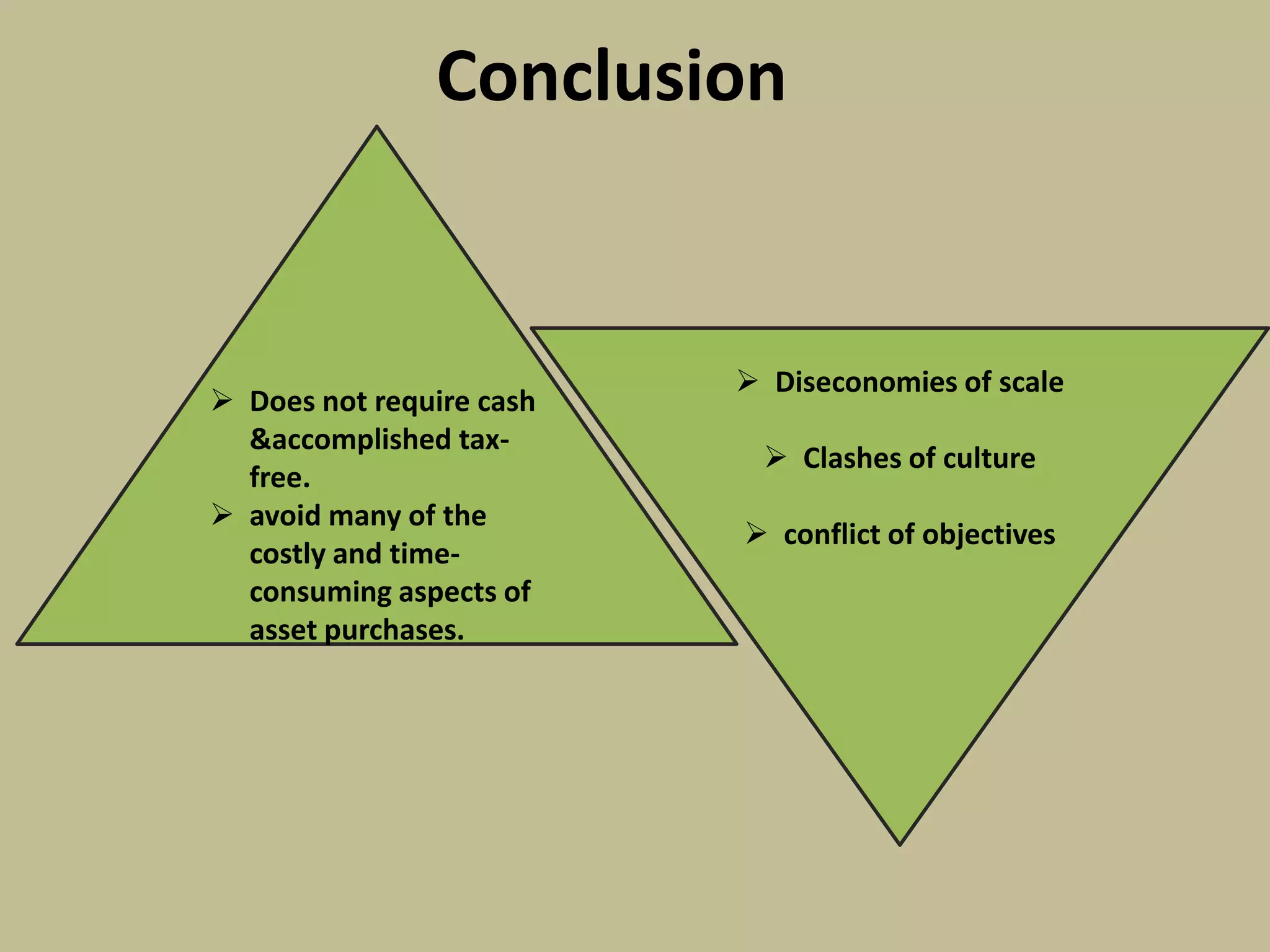
Conclusion
 Does not require cash
&accomplished tax-
free.
 avoid many of the
costly and time-
consuming aspects of
asset purchases.
 Diseconomies of scale
 Clashes of culture
 conflict of objectives
Thank you

Full n final

  • 1.
    MERGERS IN THEINDIAN BANKING SECTOR DEBAPRIYA ACHARYA SAMIRAN CHATTERJEE ASMITA DASGUPTA MONONITA MITRA
  • 2.
    Introduction Strategic tools for exploitingsynergies Useful tool for the growth and expansion Combine into one company for survival Shareholders of the transferor company receive shares as per the agreed exchange ratio.
  • 4.
    Four notable mergersin the Indian Banking Sector: 2004 2008 2010 2014
  • 5.
    . • Global TrustBank (GTB) was promoted in 1990s by Ramesh Geli. • As of March 2003, the bank had an accumulated losses to the tune of Rs 2.65 billion. • Hence, to protect the interest of GTB’s depositors, on July 26, RBI announced the merger of GTB with Oriental Bank of Commerce (OBC). • The foundation of OBC bank dates back to 1943. • The bank was nationalized on 15 April 1980. At that time OBC ranked 19th among the 20 nationalized banks. • On 14 August 2004, OBC amalgamated GTB. • The Merger brought with it 103 branches, which increased OBC's branch total to 1092. and an additional 276 ATMs and a workforce of 1400 employees.
  • 6.
    Post Merger Benefits: Underthis scheme, all GTB depositors will become OBC deposit holders Increase OBC’s reach and presence in South India . OBC’s risk weighted assets are expected to increase by approximately 60 billion. On the technology front, OBC will gain too.
  • 7.
    Post Merger Challenges: •Profitof OBC bound to decrease. •OBC can reduce the impact by utilizing its unrealized profits •OBC have to maintain the reputed customer service of GTB
  • 8.
    . • One ofthe largest merger in the financial history. • The Centurion Bank of Punjab (CBoP) was an Indian private sector bank that provided retail and corporate banking services. • On 29 June 2005, the Centurion Bank merged with Bank of Punjab. The combined bank took as its name Centurion Bank of Punjab. • Amalgamation of CBoP with HDFC Bank Limited became effective from May 23, 2008. • HDFC bank is the 5th largest in India. • It is the largest public sector bank in India. • It merged with CBoP in 2005 • The combined entity had a nationwide network of 1,148 branches , a strong deposit base of around Rs. 1,200 billion and net advances of around Rs. 850 billion. • CBoP had around 400 branches at 180 locations with over 7,500 employees. After merger HDFC bank acquired all these.
  • 9.
    Post Merger Benefits Grossprofit margin, Net profit margin, Return on capital employed, Return on equity and Debt equity ratio showed increasing trend Distribution network expanded from 761 branches in 327 cities to 1,412 branches in 528 Indian cities. ATMs had been increased from 1,977 to 3,295. Net profit margin, Operating profit margin, Return on capital employed, Return on equity and Debt-Equity ratio no significant difference before after merger has been observed
  • 10.
    Post merger challenges Immediatedrop in the share price of HDFC Bank after the merger The asset and loan quality of Centurion Bank of Punjab was bad Cost associated with the amalgamation was huge
  • 11.
     The mergerof ICICI Bank and Bank of Rajasthan is substantially to enhance the network of ICICI Banks Branch which is already the largest private sector bank in India which especially strengthen its presence in northern and western India  To enhance the ability of the merged entity to capitalize on the growth opportunities in the Indian economy it would combine Bank of Rajasthan's branch franchise with ICICI Bank's strong capital base.  The ICICI Bank has become a drawing card in insurance and asset management through its subsidiaries. The strategic focus of the bank has shifted to balance sheet growth and market share heighten in order to improvise returns and profitability index. The merger with Bank of Rajasthan could be one of the strategic moves of ICICI bank to attain its vision.
  • 12.
    Post Merger Benefits Theliquidity position i.e the quick ratio has increased after merger. Debt equity ratio is also improving, Net Profit margin is increasing year by year. Return on net worth has been increased after merger and the EPS has taken a good move after merger. Hence, the merger is good for both the banks.
  • 13.
    As BOR have branchesin the interior rural area of Rajasthan, number of loans disbursed to agricultural workers and the low profile people, there may be problem of recovery. In the amalgamation of ICICI bank and BOR, the issue related to the fear in the minds of employees of being sacked by the transferee bank should be considered as major challenge after merger. The negatives for ICICI bank are the potential risks arising from BOR’s Non-performing loans and that BOR is trading at expensive valuations and the deal was expensive.
  • 14.
     Kotak, with641 branches and relatively deeper presence in the West and North.it had a wide product portfolio, including agricultural finance and consumer loans, and a robust capital position.  ING Vysya has a strong customer franchise for over 8 decades, with a national branch network of 573 branches and deep presence in South India. It is particularly noted for a best-in-class SME Business, as also for serving large international corporates in India  The combined Kotak will have 1,214 branches, with a wide-spread pan-India network, getting both breadth and depth given the strong geographic complementarity between Kotak and ING Vysya  Kotak’s strong capital position potentially avoids capital raising and attendant dilution in the near to medium term for ING Vysya shareholders  The acquisition will make Kotak Mahindra Bank the fourth largest private sector lender in the country,
  • 15.
    Post Merger Benefits RevenueSynergies & cost efficiency:  Less need for branch expansion.  Save on product introduction costs.  Save on overlap of infrastructure. Benefits To Customers: After the acquisition, the prevailing interest rate of the acquiring bank is applicable on all savings accounts. So the account holders of the acquired bank could gain if the rate is higher than that offered by their existing bank Benefits to Employees:  Experience, expertise and diversity of employees is a significant asset for ING Vysya.  ING Vysya employees will have growth opportunities across Kotak group.  Kotak employees would be part of a larger and deeper pan India franchise.
  • 16.
    The brokerage firm sees workforce reductionas unrealistic, integration a distraction in a growth-focused market. Kotak's return ratios became lower under the merged entity given lower profitability at ING Vysya This transaction after all has taken a lot of time, possibly because of operating/cultural differences (ING Vysya is a restructured but still old private sector bank, which is a challenge).
  • 17.
    Conclusion  Does notrequire cash &accomplished tax- free.  avoid many of the costly and time- consuming aspects of asset purchases.  Diseconomies of scale  Clashes of culture  conflict of objectives
  • 18.