BBA
Minor project
Analyzing Mergers and Acquisitions
in Banking Sector in India in the
Last Ten Years
Concept of Mergers and acquisition
 Merger: When two or more companies combine
together and form a single company which leads to
the survival of one company and the other losing
their corporate existence.
 Acquisition: is the acquiring of ownership in the
property. It involves the acquiring of the shares,
assets and liabilities of a company by some other
company. The combining companies survives
independently.
Types of mergers:
1. Vertical merger: Combination of two companies which
are operating in the same industry but at different stages
of production or distribution system.
2. Horizontal merger: Rival companies competing in the
same industry tends to share the same product line and
thereby take the mutual benefits of stability and support
from each other.
3. Co-generic merger: The acquirer and targets are related
through basic technologies, production processes and
markets.
4. Conglomerate merger: It involve firms engaged in
unrelated type of business activities.
Types of acquisition:
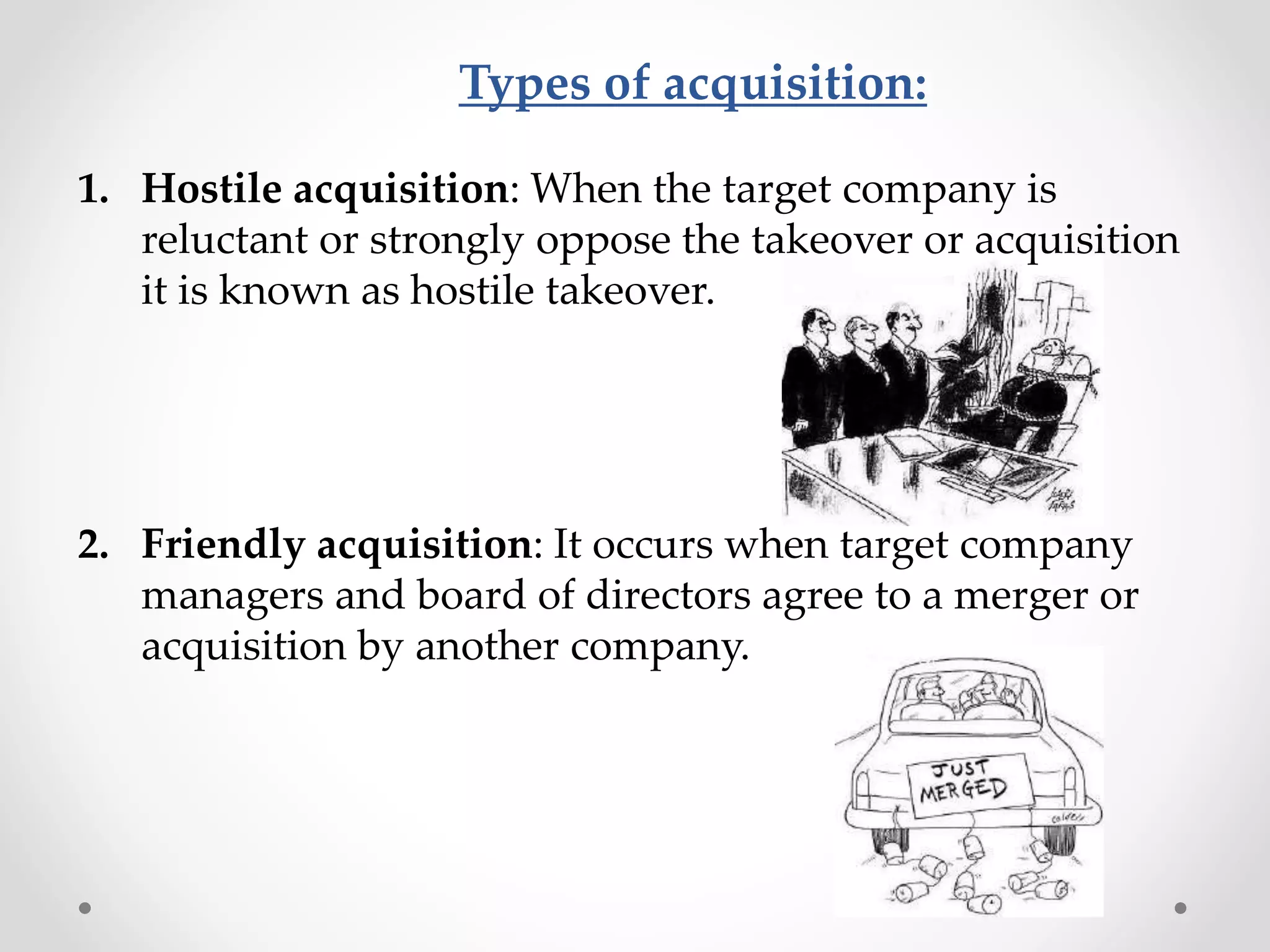
1. Hostile acquisition: When the target company is
reluctant or strongly oppose the takeover or acquisition
it is known as hostile takeover.
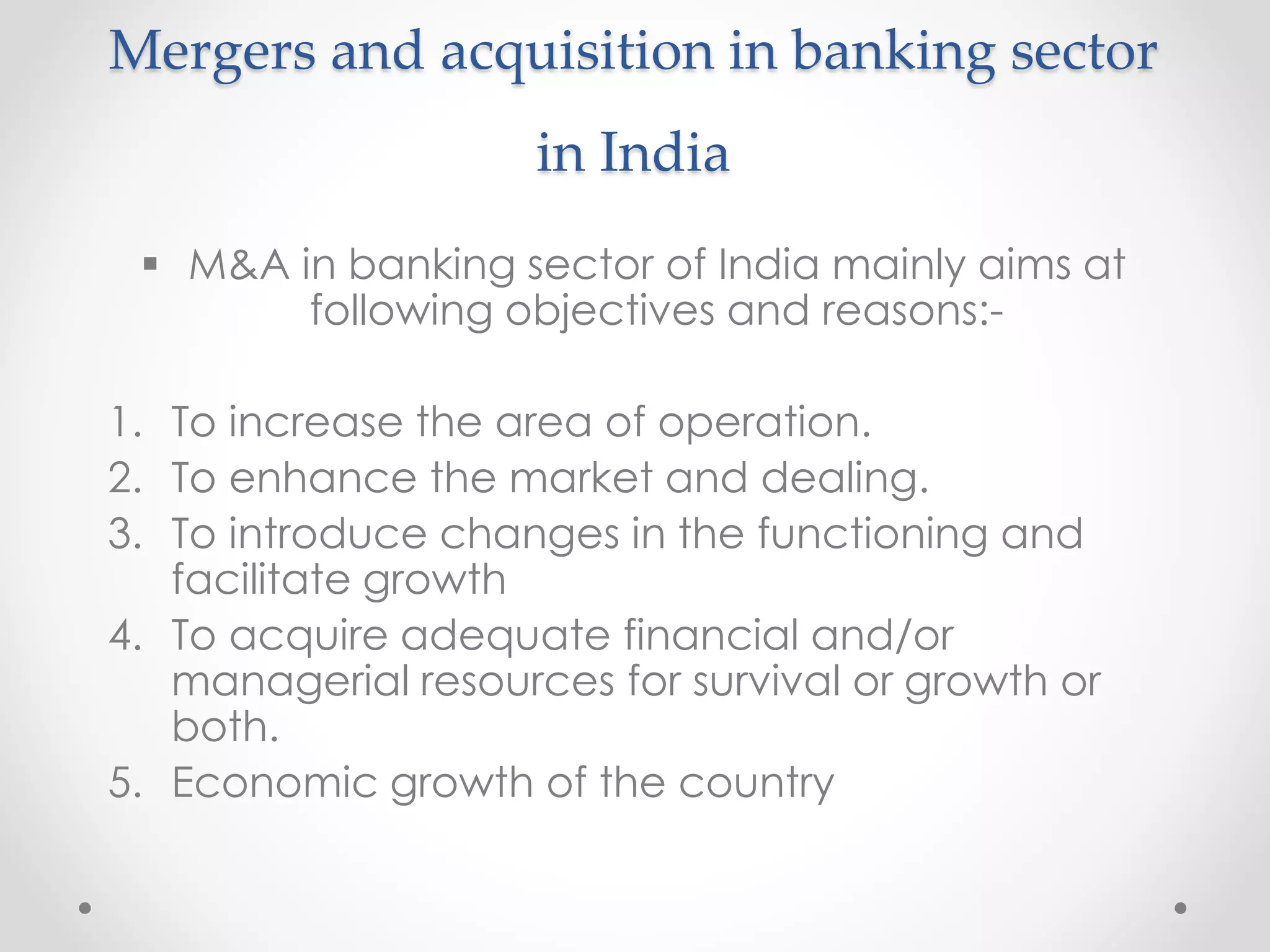
2. Friendly acquisition: It occurs when target company
managers and board of directors agree to a merger or
acquisition by another company.
Mergers and acquisition in banking sector
in India
 M&A in banking sector of India mainly aims at
following objectives and reasons:-
1. To increase the area of operation.
2. To enhance the market and dealing.
3. To introduce changes in the functioning and
facilitate growth
4. To acquire adequate financial and/or
managerial resources for survival or growth or
both.
5. Economic growth of the country
 HDFC bank acquires Centurion bank of Punjab (May 2008)
 Intent: For HDFC bank, this provided the oppurtunity to add
scale, geography (northern and southern states). For CBoP HDFC
bank would exploit its underutilized branch network.
 Benefits: the deal created an entity with an asset size of
Rs1,09,718crores (7th largest in India) and improved distribution
with 1,148 branches and 2,358 ATM’s.
 Drawbacks: The merged entity couldn’t lend home loans given the
conflict of interest with parent HDFC and may even sell down
CBoP’s home-loan book to it.
 Bank of Baroda Acquires South Gujarat local area Bank (June ‘04)
 Intent: SGLAB had suffered net losses in consecutive years and
witnessed a significant decline in its capital and reserves. RBI passed a
moratorium for the time period of six months and decided that all
seven branches of SGLAB functions as branches of bank of baroda.
 Benefits: The clients of SGLAB were effectively transeffered to BoB,
deriving the advantage of dealing with a more secure and bigger
bank. It also contributed in strengthening its position in gujrat.
 Drawbacks: the merger of the two banks caused a lot of financial and
managerial work, which created a sort of jeopardy.
 United western bank merger with IDBI (October 2006)
 Intent: likely to add value to the latter over the long term
and to help IDBI (industrial development bank of India) to
expand its retail presence. To introduce the synergies to the
participating banks.
 Benefits: IDBI’s is helped to diversify its credit profile. IDBI
also got exposure to agriculture credit. It also facilitates in
the inrease in the workforce.
 Drawbacks: the merger was a forced merger and thus has
its negative consequences. It lead to unemployement just
after the merger took place.
 Oriental bank of commerce acquires Global trust bank Ltd
(August ’04)
 Intent: For Oriental bank of commerce there was an apparent
synergy post-merger as the weakness of global trust bank had
been bad assets and the OBC lay in recovery. Also helped
significantly in increasing the area of operation.
 Benefit: OBC gained from the 104 branches and 276 ATM’s of
GTB, a workforce of 1400 employees and one million customer.
The merger also filled up OBC’s lacuna – Computerization and
high-end technology.
 Drawbacks: The merger resulted in a low CAR for OBC, which
was detrimental to solvency.
Conclusion
• Mergers and acquisition are of utter importance for the
development and growth of the countries economy.
• It aims towards business restructuring and increasing
competitiveness and shareholders value via increased
efficiency
• It introduces synergies in the companies which get merged
or undergo acquisition.
• It aims towards improving efficiencies, lowering costs and
increase revenue.
• It provide various opportunities, benefits in different terms

BBA Minor project

  • 1.
    BBA Minor project Analyzing Mergersand Acquisitions in Banking Sector in India in the Last Ten Years
  • 2.
    Concept of Mergersand acquisition  Merger: When two or more companies combine together and form a single company which leads to the survival of one company and the other losing their corporate existence.  Acquisition: is the acquiring of ownership in the property. It involves the acquiring of the shares, assets and liabilities of a company by some other company. The combining companies survives independently.
  • 3.
    Types of mergers: 1.Vertical merger: Combination of two companies which are operating in the same industry but at different stages of production or distribution system. 2. Horizontal merger: Rival companies competing in the same industry tends to share the same product line and thereby take the mutual benefits of stability and support from each other. 3. Co-generic merger: The acquirer and targets are related through basic technologies, production processes and markets. 4. Conglomerate merger: It involve firms engaged in unrelated type of business activities.
  • 4.
    Types of acquisition: 1.Hostile acquisition: When the target company is reluctant or strongly oppose the takeover or acquisition it is known as hostile takeover. 2. Friendly acquisition: It occurs when target company managers and board of directors agree to a merger or acquisition by another company.
  • 5.
    Mergers and acquisitionin banking sector in India  M&A in banking sector of India mainly aims at following objectives and reasons:- 1. To increase the area of operation. 2. To enhance the market and dealing. 3. To introduce changes in the functioning and facilitate growth 4. To acquire adequate financial and/or managerial resources for survival or growth or both. 5. Economic growth of the country
  • 6.
     HDFC bankacquires Centurion bank of Punjab (May 2008)  Intent: For HDFC bank, this provided the oppurtunity to add scale, geography (northern and southern states). For CBoP HDFC bank would exploit its underutilized branch network.  Benefits: the deal created an entity with an asset size of Rs1,09,718crores (7th largest in India) and improved distribution with 1,148 branches and 2,358 ATM’s.  Drawbacks: The merged entity couldn’t lend home loans given the conflict of interest with parent HDFC and may even sell down CBoP’s home-loan book to it.
  • 7.
     Bank ofBaroda Acquires South Gujarat local area Bank (June ‘04)  Intent: SGLAB had suffered net losses in consecutive years and witnessed a significant decline in its capital and reserves. RBI passed a moratorium for the time period of six months and decided that all seven branches of SGLAB functions as branches of bank of baroda.  Benefits: The clients of SGLAB were effectively transeffered to BoB, deriving the advantage of dealing with a more secure and bigger bank. It also contributed in strengthening its position in gujrat.  Drawbacks: the merger of the two banks caused a lot of financial and managerial work, which created a sort of jeopardy.
  • 8.
     United westernbank merger with IDBI (October 2006)  Intent: likely to add value to the latter over the long term and to help IDBI (industrial development bank of India) to expand its retail presence. To introduce the synergies to the participating banks.  Benefits: IDBI’s is helped to diversify its credit profile. IDBI also got exposure to agriculture credit. It also facilitates in the inrease in the workforce.  Drawbacks: the merger was a forced merger and thus has its negative consequences. It lead to unemployement just after the merger took place.
  • 9.
     Oriental bankof commerce acquires Global trust bank Ltd (August ’04)  Intent: For Oriental bank of commerce there was an apparent synergy post-merger as the weakness of global trust bank had been bad assets and the OBC lay in recovery. Also helped significantly in increasing the area of operation.  Benefit: OBC gained from the 104 branches and 276 ATM’s of GTB, a workforce of 1400 employees and one million customer. The merger also filled up OBC’s lacuna – Computerization and high-end technology.  Drawbacks: The merger resulted in a low CAR for OBC, which was detrimental to solvency.
  • 10.
    Conclusion • Mergers andacquisition are of utter importance for the development and growth of the countries economy. • It aims towards business restructuring and increasing competitiveness and shareholders value via increased efficiency • It introduces synergies in the companies which get merged or undergo acquisition. • It aims towards improving efficiencies, lowering costs and increase revenue. • It provide various opportunities, benefits in different terms