1© FSG |
The Systems Tools Matrix
APRIL 2016
2© FSG |
Using the Systems Tool Matrix
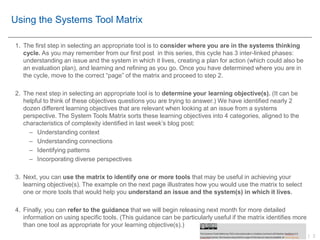
1. The first step in selecting an appropriate tool is to consider where you are in the systems thinking
cycle. As you may remember from our first post in this series, this cycle has 3 inter-linked phases:
understanding an issue and the system in which it lives, creating a plan for action (which could also be
an evaluation plan), and learning and refining as you go. Once you have determined where you are in
the cycle, move to the correct “page” of the matrix and proceed to step 2.
2. The next step in selecting an appropriate tool is to determine your learning objective(s). (It can be
helpful to think of these objectives questions you are trying to answer.) We have identified nearly 2
dozen different learning objectives that are relevant when looking at an issue from a systems
perspective. The System Tools Matrix sorts these learning objectives into 4 categories, aligned to the
characteristics of complexity identified in last week’s blog post:
– Understanding context
– Understanding connections
– Identifying patterns
– Incorporating diverse perspectives
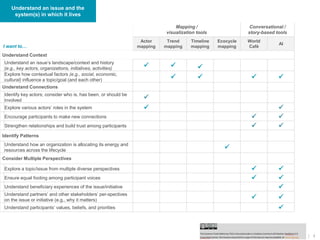
3. Next, you can use the matrix to identify one or more tools that may be useful in achieving your
learning objective(s). The example on the next page illustrates how you would use the matrix to select
one or more tools that would help you understand an issue and the system(s) in which it lives.
4. Finally, you can refer to the guidance that we will begin releasing next month for more detailed
information on using specific tools. (This guidance can be particularly useful if the matrix identifies more
than one tool as appropriate for your learning objective(s).)
3© FSG |
Step 2: Use the color-coded matrices on the following pages to match
your learning objectives to one or more systems tools.
Mapping / visualization tools Conversational / Story-Based
Trend
mapping
Actor
mapping
Timeline
mapping
Ecocycle
mapping
World Café AI
<Sample learning objective>   
<Sample learning objective> 
<Sample learning objective>   
<Sample learning objective>  
<Sample learning objective>   
How to Use the System Tools Matrix: Step 1
Understand an issue and the
system(s) in which it lives
Create a
plan for action
Learn and refine
as you go
[What is it?] [What should it be?] [How is it working?]
Step 1: Select the segment of the System Thinking Framework
that best matches where your client is in their journey
How to Use the System Tools Matrix: Step 2
4© FSG |
Mapping /
visualization tools
Conversational /
story-based tools
I want to…
Actor
mapping
Trend
mapping
Timeline
mapping
Ecocycle
mapping
World
Café
AI
Understand Context
Understand an issue’s landscape/context and history
(e.g., key actors, organizations, initiatives, activities)   
Explore how contextual factors (e.g., social, economic,
cultural) influence a topic/goal (and each other)    
Understand Connections
Identify key actors; consider who is, has been, or should be
involved 
Explore various actors’ roles in the system  
Encourage participants to make new connections  
Strengthen relationships and build trust among participants  
Identify Patterns
Understand how an organization is allocating its energy and
resources across the lifecycle 
Consider Multiple Perspectives
Explore a topic/issue from multiple diverse perspectives  
Ensure equal footing among participant voices  
Understand beneficiary experiences of the issue/initiative 
Understand partners’ and other stakeholders’ per-spectives
on the issue or initiative (e.g., why it matters)  
Understand participants’ values, beliefs, and priorities 
Understand an issue and the
system(s) in which it lives
5© FSG |
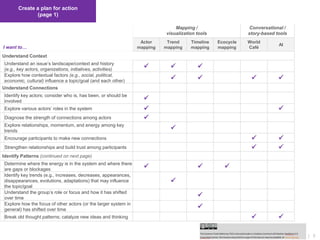
Create a plan for action
(page 1)
Mapping /
visualization tools
Conversational /
story-based tools
I want to…
Actor
mapping
Trend
mapping
Timeline
mapping
Ecocycle
mapping
World
Café
AI
Understand Context
Understand an issue’s landscape/context and history
(e.g., key actors, organizations, initiatives, activities)   
Explore how contextual factors (e.g., social, political,
economic, cultural) influence a topic/goal (and each other)    
Understand Connections
Identify key actors; consider who is, has been, or should be
involved 
Explore various actors’ roles in the system  
Diagnose the strength of connections among actors 
Explore relationships, momentum, and energy among key
trends 
Encourage participants to make new connections  
Strengthen relationships and build trust among participants  
Identify Patterns (continued on next page)
Determine where the energy is in the system and where there
are gaps or blockages   
Identify key trends (e.g., increases, decreases, appearances,
disappearances, evolutions, adaptations) that may influence
the topic/goal

Understand the group’s role or focus and how it has shifted
over time 
Explore how the focus of other actors (or the larger system in
general) has shifted over time 
Break old thought patterns; catalyze new ideas and thinking  
6© FSG |
Create a plan for action
(page 2)
Mapping /
visualization tools
Conversational /
story-based tools
I want to…
Actor
mapping
Trend
mapping
Timeline
mapping
Ecocycle
mapping
World
Café
AI
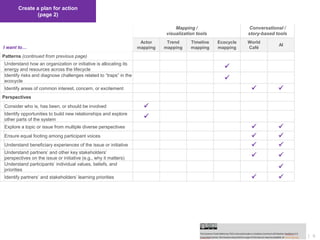
Patterns (continued from previous page)
Understand how an organization or initiative is allocating its
energy and resources across the lifecycle 
Identify risks and diagnose challenges related to “traps” in the
ecocycle 
Identify areas of common interest, concern, or excitement  
Perspectives
Consider who is, has been, or should be involved 
Identify opportunities to build new relationships and explore
other parts of the system 
Explore a topic or issue from multiple diverse perspectives  
Ensure equal footing among participant voices  
Understand beneficiary experiences of the issue or initiative  
Understand partners’ and other key stakeholders’
perspectives on the issue or initiative (e.g., why it matters)  
Understand participants’ individual values, beliefs, and
priorities 
Identify partners’ and stakeholders’ learning priorities  
7© FSG |
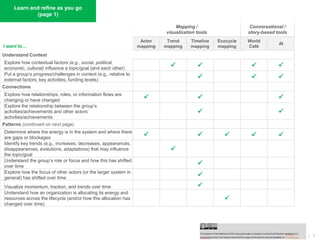
Learn and refine as you go
(page 1)
Mapping /
visualization tools
Conversational /
story-based tools
I want to…
Actor
mapping
Trend
mapping
Timeline
mapping
Ecocycle
mapping
World
Café
AI
Understand Context
Explore how contextual factors (e.g., social, political,
economic, cultural) influence a topic/goal (and each other)    
Put a group’s progress/challenges in context (e.g., relative to
external factors, key activities, funding levels)   
Connections
Explore how relationships, roles, or information flows are
changing or have changed   
Explore the relationship between the group’s
activities/achievements and other actors’
activities/achievements
 
Patterns (continued on next page)
Determine where the energy is in the system and where there
are gaps or blockages     
Identify key trends (e.g., increases, decreases, appearances,
disappearances, evolutions, adaptations) that may influence
the topic/goal

Understand the group’s role or focus and how this has shifted
over time 
Explore how the focus of other actors (or the larger system in
general) has shifted over time 
Visualize momentum, traction, and trends over time 
Understand how an organization is allocating its energy and
resources across the lifecycle (and/or how this allocation has
changed over time)

8© FSG |
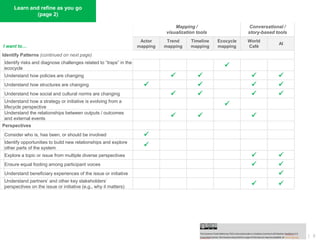
Learn and refine as you go
(page 2)
Mapping /
visualization tools
Conversational /
story-based tools
I want to…
Actor
mapping
Trend
mapping
Timeline
mapping
Ecocycle
mapping
World
Café
AI
Identify Patterns (continued on next page)
Identify risks and diagnose challenges related to “traps” in the
ecocycle 
Understand how policies are changing    
Understand how structures are changing    
Understand how social and cultural norms are changing    
Understand how a strategy or initiative is evolving from a
lifecycle perspective 
Understand the relationships between outputs / outcomes
and external events   
Perspectives
Consider who is, has been, or should be involved 
Identify opportunities to build new relationships and explore
other parts of the system 
Explore a topic or issue from multiple diverse perspectives  
Ensure equal footing among participant voices  
Understand beneficiary experiences of the issue or initiative 
Understand partners’ and other key stakeholders’
perspectives on the issue or initiative (e.g., why it matters)  
9© FSG |

FSG Systems Tools Matrix

  • 1.
    1© FSG | TheSystems Tools Matrix APRIL 2016
  • 2.
    2© FSG | Usingthe Systems Tool Matrix 1. The first step in selecting an appropriate tool is to consider where you are in the systems thinking cycle. As you may remember from our first post in this series, this cycle has 3 inter-linked phases: understanding an issue and the system in which it lives, creating a plan for action (which could also be an evaluation plan), and learning and refining as you go. Once you have determined where you are in the cycle, move to the correct “page” of the matrix and proceed to step 2. 2. The next step in selecting an appropriate tool is to determine your learning objective(s). (It can be helpful to think of these objectives questions you are trying to answer.) We have identified nearly 2 dozen different learning objectives that are relevant when looking at an issue from a systems perspective. The System Tools Matrix sorts these learning objectives into 4 categories, aligned to the characteristics of complexity identified in last week’s blog post: – Understanding context – Understanding connections – Identifying patterns – Incorporating diverse perspectives 3. Next, you can use the matrix to identify one or more tools that may be useful in achieving your learning objective(s). The example on the next page illustrates how you would use the matrix to select one or more tools that would help you understand an issue and the system(s) in which it lives. 4. Finally, you can refer to the guidance that we will begin releasing next month for more detailed information on using specific tools. (This guidance can be particularly useful if the matrix identifies more than one tool as appropriate for your learning objective(s).)
  • 3.
    3© FSG | Step2: Use the color-coded matrices on the following pages to match your learning objectives to one or more systems tools. Mapping / visualization tools Conversational / Story-Based Trend mapping Actor mapping Timeline mapping Ecocycle mapping World Café AI <Sample learning objective>    <Sample learning objective>  <Sample learning objective>  <Sample learning objective>    <Sample learning objective>   <Sample learning objective>    <Sample learning objective>    How to Use the System Tools Matrix: Step 1 Understand an issue and the system(s) in which it lives Create a plan for action Learn and refine as you go [What is it?] [What should it be?] [How is it working?] Step 1: Select the segment of the System Thinking Framework that best matches where your client is in their journey How to Use the System Tools Matrix: Step 2
  • 4.
    4© FSG | Mapping/ visualization tools Conversational / story-based tools I want to… Actor mapping Trend mapping Timeline mapping Ecocycle mapping World Café AI Understand Context Understand an issue’s landscape/context and history (e.g., key actors, organizations, initiatives, activities)    Explore how contextual factors (e.g., social, economic, cultural) influence a topic/goal (and each other)     Understand Connections Identify key actors; consider who is, has been, or should be involved  Explore various actors’ roles in the system   Encourage participants to make new connections   Strengthen relationships and build trust among participants   Identify Patterns Understand how an organization is allocating its energy and resources across the lifecycle  Consider Multiple Perspectives Explore a topic/issue from multiple diverse perspectives   Ensure equal footing among participant voices   Understand beneficiary experiences of the issue/initiative  Understand partners’ and other stakeholders’ per-spectives on the issue or initiative (e.g., why it matters)   Understand participants’ values, beliefs, and priorities  Understand an issue and the system(s) in which it lives
  • 5.
    5© FSG | Createa plan for action (page 1) Mapping / visualization tools Conversational / story-based tools I want to… Actor mapping Trend mapping Timeline mapping Ecocycle mapping World Café AI Understand Context Understand an issue’s landscape/context and history (e.g., key actors, organizations, initiatives, activities)    Explore how contextual factors (e.g., social, political, economic, cultural) influence a topic/goal (and each other)     Understand Connections Identify key actors; consider who is, has been, or should be involved  Explore various actors’ roles in the system   Diagnose the strength of connections among actors  Explore relationships, momentum, and energy among key trends  Encourage participants to make new connections   Strengthen relationships and build trust among participants   Identify Patterns (continued on next page) Determine where the energy is in the system and where there are gaps or blockages    Identify key trends (e.g., increases, decreases, appearances, disappearances, evolutions, adaptations) that may influence the topic/goal  Understand the group’s role or focus and how it has shifted over time  Explore how the focus of other actors (or the larger system in general) has shifted over time  Break old thought patterns; catalyze new ideas and thinking  
  • 6.
    6© FSG | Createa plan for action (page 2) Mapping / visualization tools Conversational / story-based tools I want to… Actor mapping Trend mapping Timeline mapping Ecocycle mapping World Café AI Patterns (continued from previous page) Understand how an organization or initiative is allocating its energy and resources across the lifecycle  Identify risks and diagnose challenges related to “traps” in the ecocycle  Identify areas of common interest, concern, or excitement   Perspectives Consider who is, has been, or should be involved  Identify opportunities to build new relationships and explore other parts of the system  Explore a topic or issue from multiple diverse perspectives   Ensure equal footing among participant voices   Understand beneficiary experiences of the issue or initiative   Understand partners’ and other key stakeholders’ perspectives on the issue or initiative (e.g., why it matters)   Understand participants’ individual values, beliefs, and priorities  Identify partners’ and stakeholders’ learning priorities  
  • 7.
    7© FSG | Learnand refine as you go (page 1) Mapping / visualization tools Conversational / story-based tools I want to… Actor mapping Trend mapping Timeline mapping Ecocycle mapping World Café AI Understand Context Explore how contextual factors (e.g., social, political, economic, cultural) influence a topic/goal (and each other)     Put a group’s progress/challenges in context (e.g., relative to external factors, key activities, funding levels)    Connections Explore how relationships, roles, or information flows are changing or have changed    Explore the relationship between the group’s activities/achievements and other actors’ activities/achievements   Patterns (continued on next page) Determine where the energy is in the system and where there are gaps or blockages      Identify key trends (e.g., increases, decreases, appearances, disappearances, evolutions, adaptations) that may influence the topic/goal  Understand the group’s role or focus and how this has shifted over time  Explore how the focus of other actors (or the larger system in general) has shifted over time  Visualize momentum, traction, and trends over time  Understand how an organization is allocating its energy and resources across the lifecycle (and/or how this allocation has changed over time) 
  • 8.
    8© FSG | Learnand refine as you go (page 2) Mapping / visualization tools Conversational / story-based tools I want to… Actor mapping Trend mapping Timeline mapping Ecocycle mapping World Café AI Identify Patterns (continued on next page) Identify risks and diagnose challenges related to “traps” in the ecocycle  Understand how policies are changing     Understand how structures are changing     Understand how social and cultural norms are changing     Understand how a strategy or initiative is evolving from a lifecycle perspective  Understand the relationships between outputs / outcomes and external events    Perspectives Consider who is, has been, or should be involved  Identify opportunities to build new relationships and explore other parts of the system  Explore a topic or issue from multiple diverse perspectives   Ensure equal footing among participant voices   Understand beneficiary experiences of the issue or initiative  Understand partners’ and other key stakeholders’ perspectives on the issue or initiative (e.g., why it matters)  
  • 9.