INTRODUCTION TO
FORENSIC SCIENCE
MANSI PANDEY​
LEARNING OUTCOME
FORENSIC
SCIENCE
2
INTRODUCTION
HISTORY AND
DEVELOPMENT
NEED OF FORENSIC
SCIENCE
OBJECTIVE OF FORENSIC
SCIENCE
INTRODUCTION
FORENSIC
SCIENCE
3
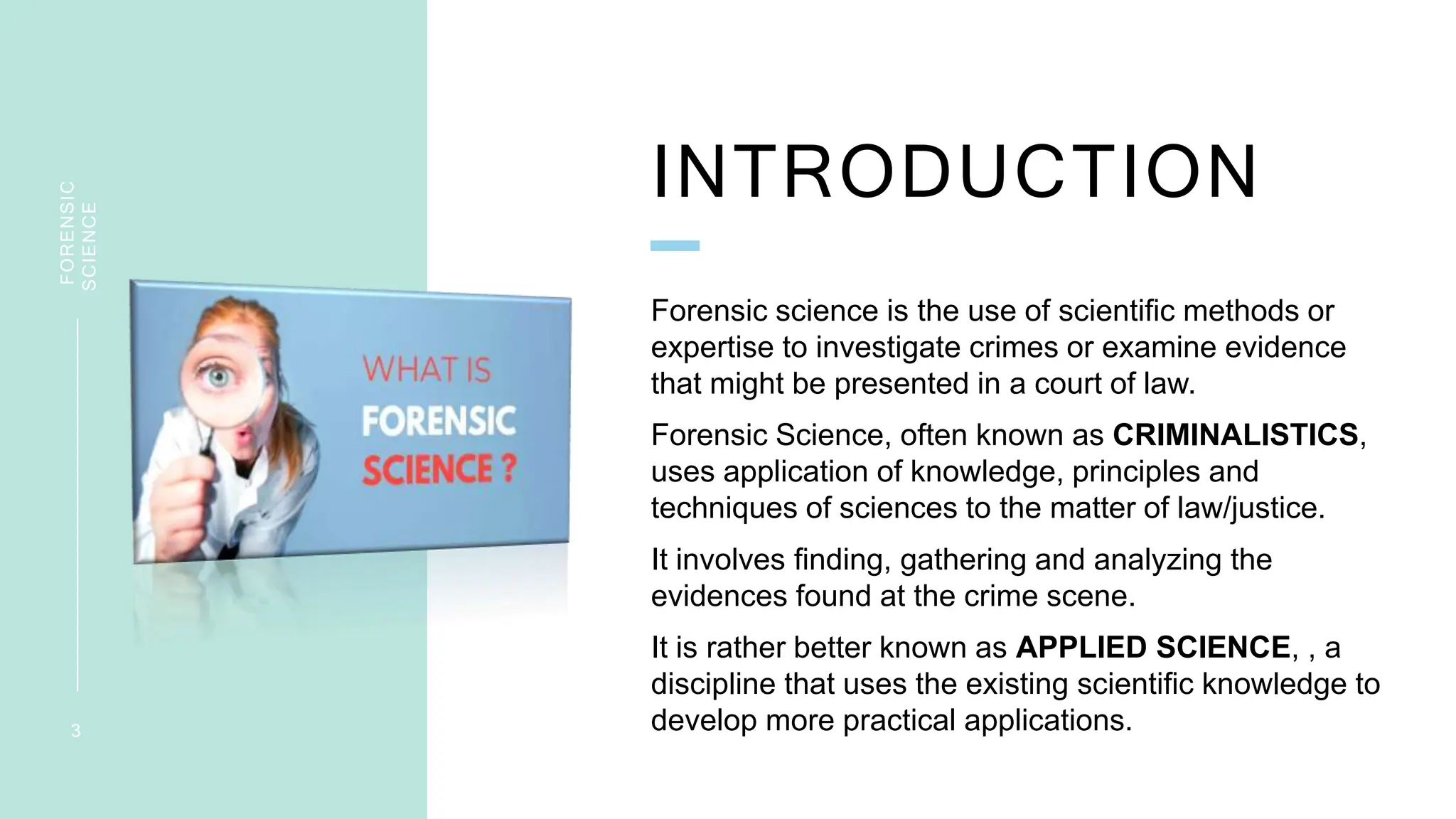
Forensic science is the use of scientific methods or
expertise to investigate crimes or examine evidence
that might be presented in a court of law.
Forensic Science, often known as CRIMINALISTICS,
uses application of knowledge, principles and
techniques of sciences to the matter of law/justice.
It involves finding, gathering and analyzing the
evidences found at the crime scene.
It is rather better known as APPLIED SCIENCE, , a
discipline that uses the existing scientific knowledge to
develop more practical applications.
“OBSERVATION,
REASON AND
EXPERIMENT MAKE UP
WHAT WE CALL THE
SCIENTIFIC METHOD.”
RICHARD P. FEYNMAN
FORENSIC
SCIENCE
4
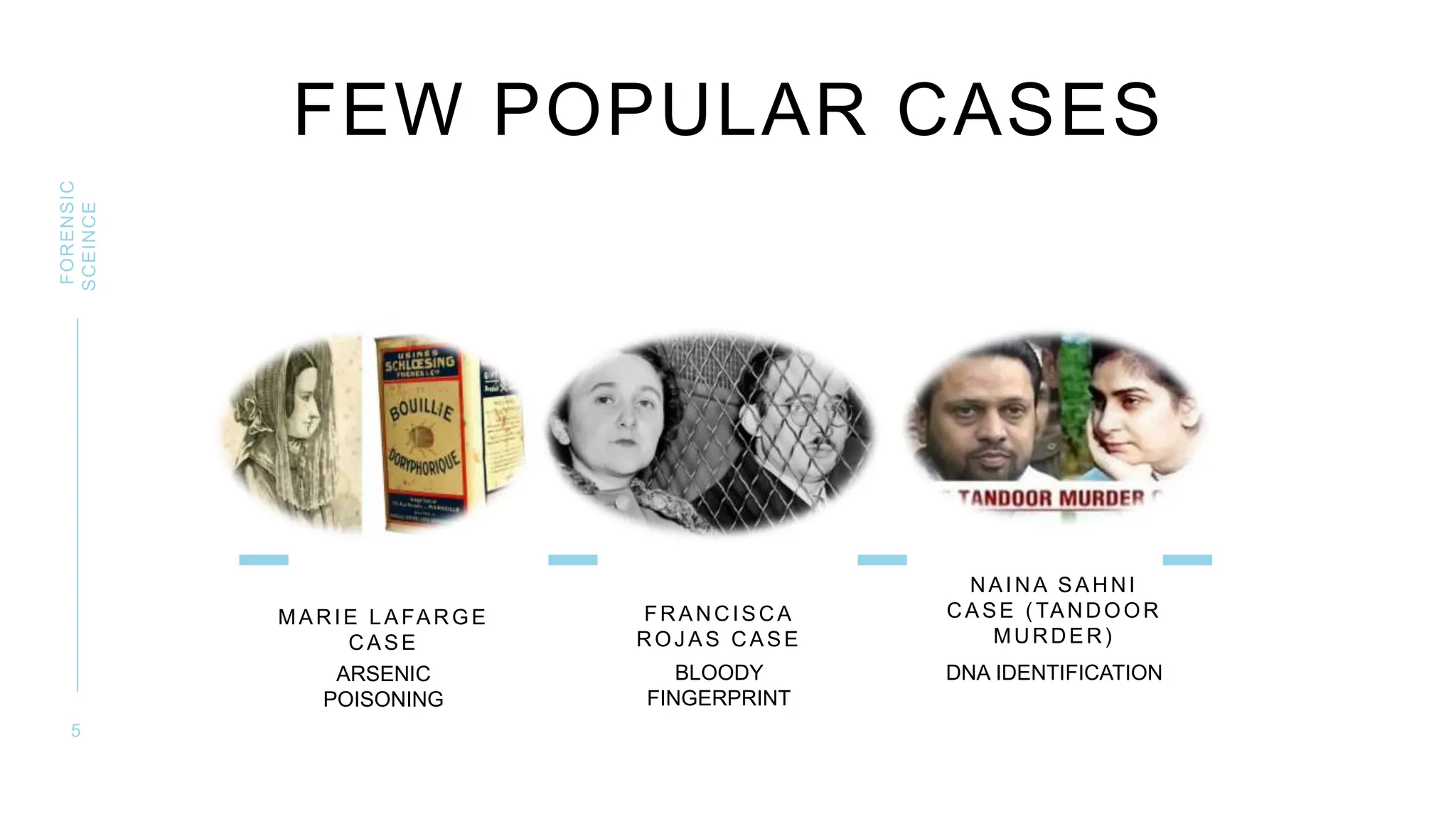
FEW POPULAR CASES
FORENSIC
SCEINCE
5
MARIE LAFARGE
CASE
ARSENIC
POISONING
FRANCISCA
ROJAS CASE
BLOODY
FINGERPRINT
NAINA SAHNI
CASE (TANDOOR
MURDER)
DNA IDENTIFICATION
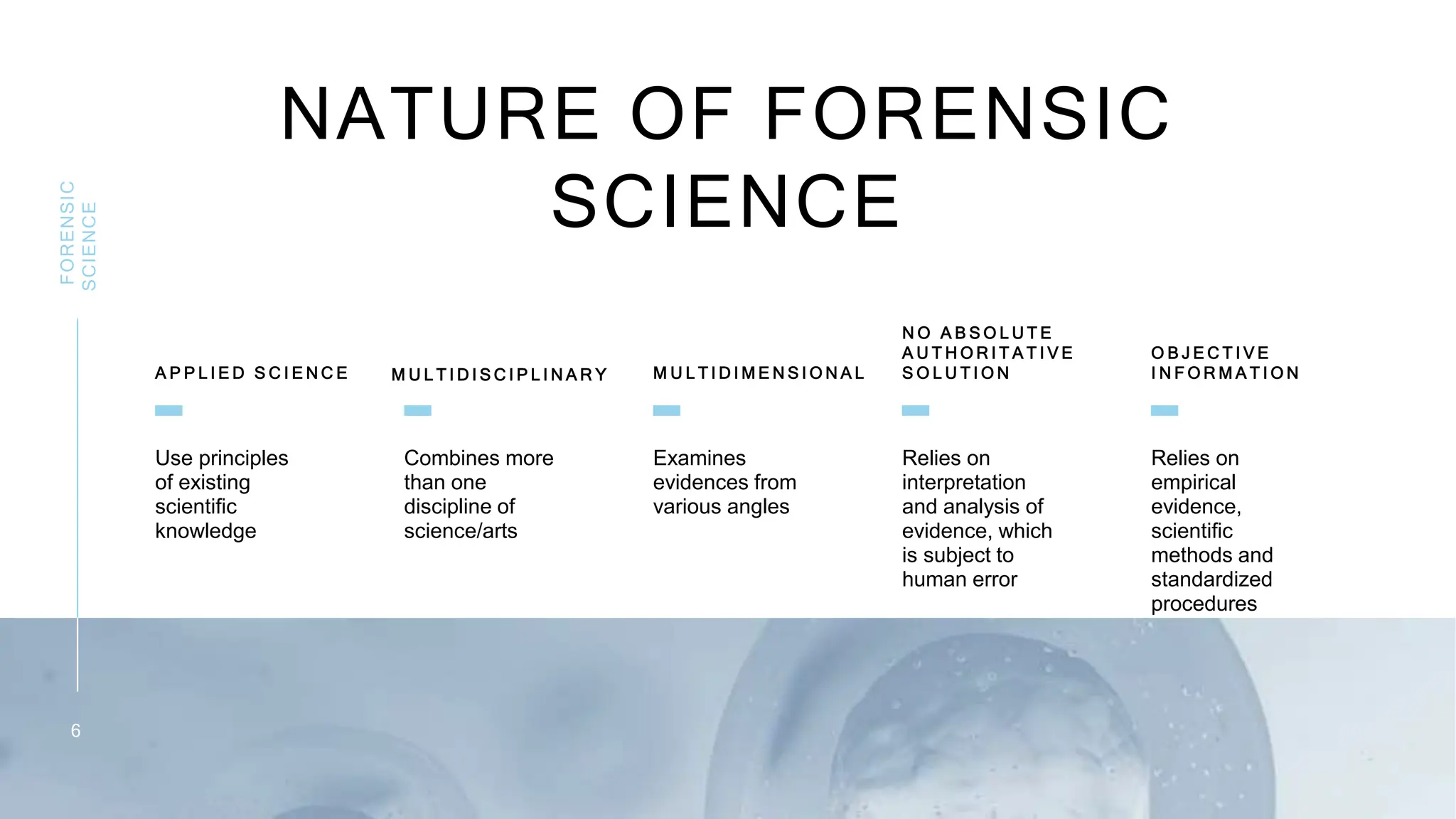
NATURE OF FORENSIC
SCIENCE
FORENSIC
SCIENCE
A P P L I E D S C I E N C E
Use principles
of existing
scientific
knowledge
M U L T I D I S C I P L I N A R Y
Combines more
than one
discipline of
science/arts
M U L T I D I M E N S I O N A L
Examines
evidences from
various angles
N O A B S O L U T E
A U T H O R I T A T I V E
S O L U T I O N
Relies on
interpretation
and analysis of
evidence, which
is subject to
human error
O B J E C T I V E
I N F O R M A T I O N
Relies on
empirical
evidence,
scientific
methods and
standardized
procedures
6
HISTORY AND
DEVELOPMENT
FORENSIC
SCIENCE
7
SCIENTISTS FROM OTHER
COUNTRIES
Mathieu Orfila- Father of Toxicology
Alphonse Bertillon- Father of Anthropometry
Francis Galton- Father of Fingerprints
Dr. Leone Lattes- Italian Serologist
Calvin Goddard- Father of Forensic Ballistics
Albert S. Osborn- Father of Questioned
Documents
Hans Gross- Founding Father of Criminal
Profiling
Edmond Locard- Sherlock Holmes of France
DEVELOPMENT IN INDIA
PRE-INDEPENDENCE HISTORY
POST-INDEPENDENCE HISTORY
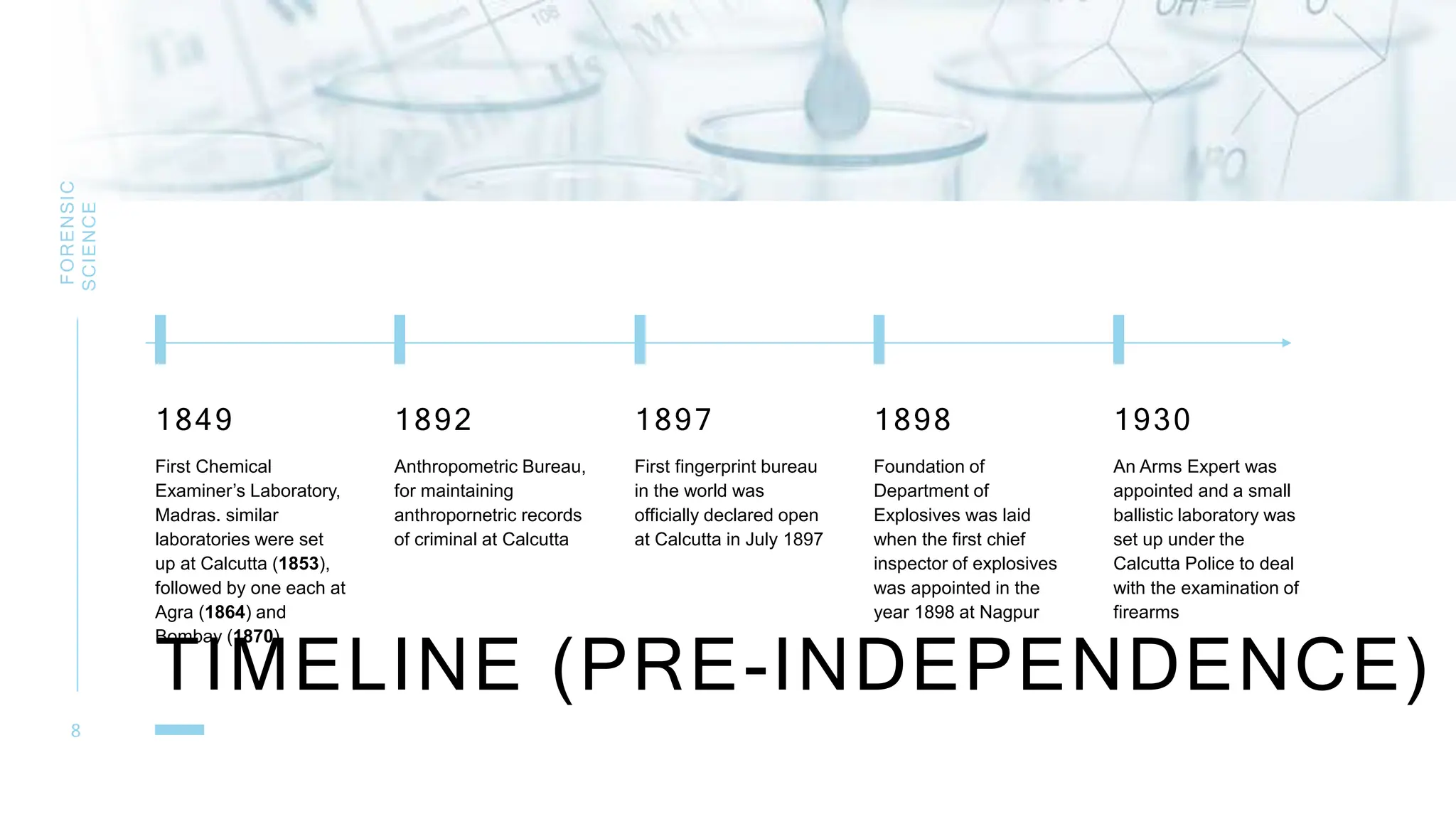
TIMELINE (PRE-INDEPENDENCE)
FORENSIC
SCIENCE
8
1849
First Chemical
Examiner’s Laboratory,
Madras. similar
laboratories were set
up at Calcutta (1853),
followed by one each at
Agra (1864) and
Bombay (1870)
1892
Anthropometric Bureau,
for maintaining
anthropornetric records
of criminal at Calcutta
1897
First fingerprint bureau
in the world was
officially declared open
at Calcutta in July 1897
1898
Foundation of
Department of
Explosives was laid
when the first chief
inspector of explosives
was appointed in the
year 1898 at Nagpur
1930
An Arms Expert was
appointed and a small
ballistic laboratory was
set up under the
Calcutta Police to deal
with the examination of
firearms
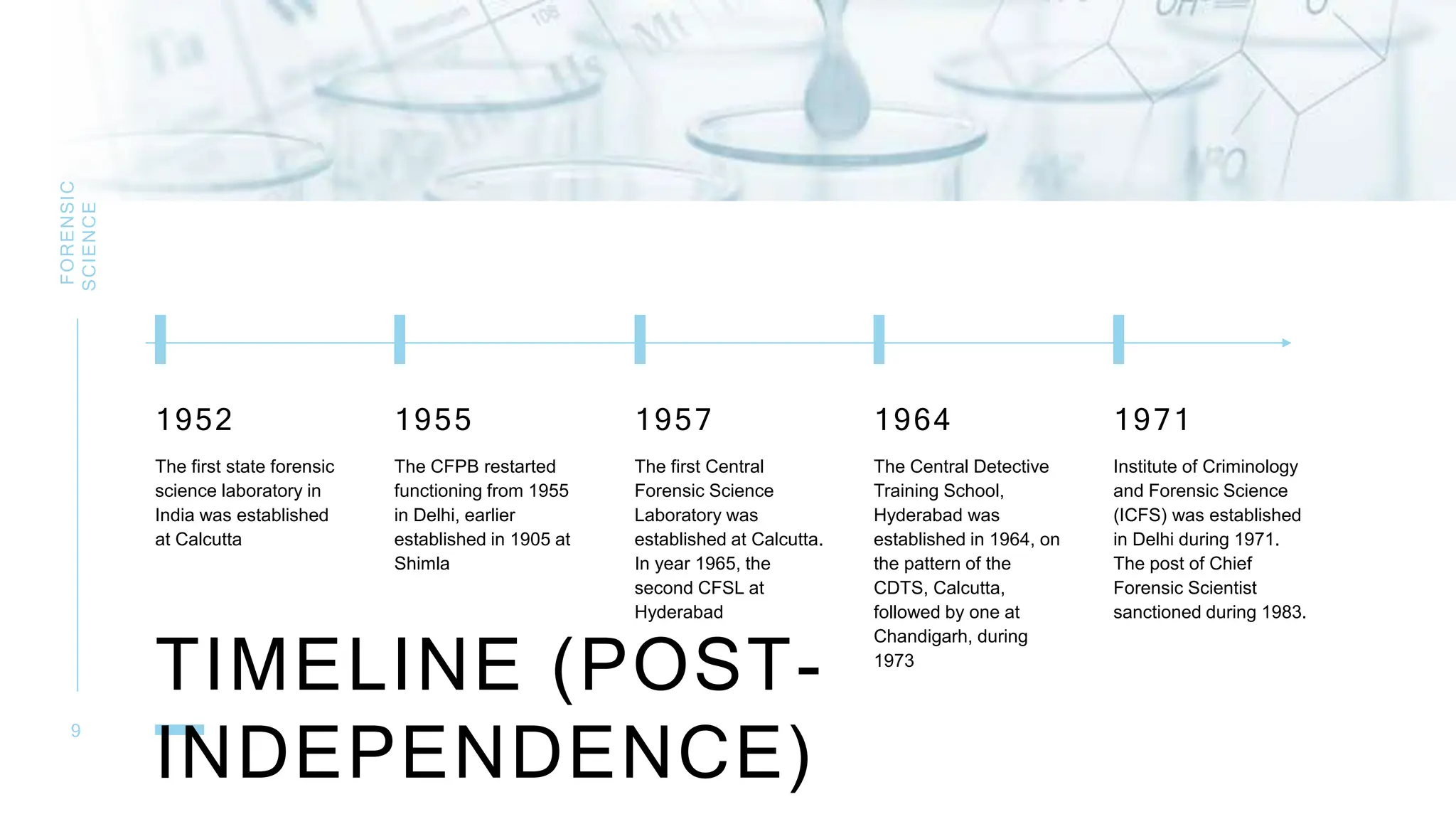
TIMELINE (POST-
INDEPENDENCE)
FORENSIC
SCIENCE
9
1952
The first state forensic
science laboratory in
India was established
at Calcutta
1955
The CFPB restarted
functioning from 1955
in Delhi, earlier
established in 1905 at
Shimla
1957
The first Central
Forensic Science
Laboratory was
established at Calcutta.
In year 1965, the
second CFSL at
Hyderabad
1964
The Central Detective
Training School,
Hyderabad was
established in 1964, on
the pattern of the
CDTS, Calcutta,
followed by one at
Chandigarh, during
1973
1971
Institute of Criminology
and Forensic Science
(ICFS) was established
in Delhi during 1971.
The post of Chief
Forensic Scientist
sanctioned during 1983.
NEED OF
FORENSIC
FORENSIC
SCIENCE
1 0
L EGAL A ND J USTICE
A CCOUNTABILITY
EVIDENCE AUTHENTICATION
CRIME SCENE RECONSTRUCTION
SUPPORTING INVESTIGATIONS
P REVENTION A ND DE TERRENCE O F
CRIMES
DETERRENCE FACTOR
CRIME PREVENTION STRATEGIES
IDENTIFICATION OF VULNERABILITIES
S CIENTIFIC A DV ANCEMENTS
TECHNOLOGICAL INNOVATIONS
INTERDISCIPLINARY COLLABORATION
RESEARCH AND DEVELOPMENT
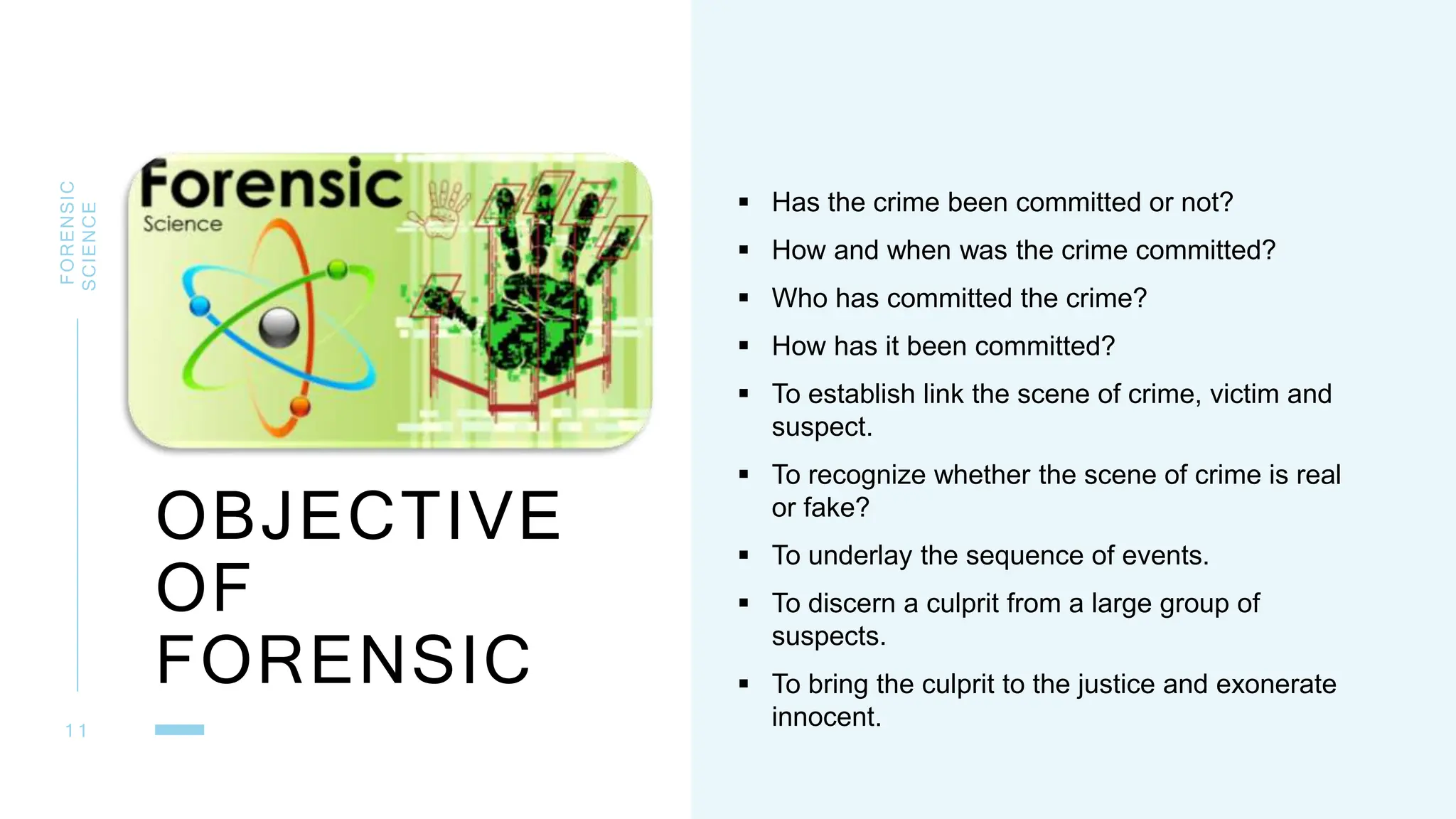
OBJECTIVE
OF
FORENSIC
FORENSIC
SCIENCE
1 1
 Has the crime been committed or not?
 How and when was the crime committed?
 Who has committed the crime?
 How has it been committed?
 To establish link the scene of crime, victim and
suspect.
 To recognize whether the scene of crime is real
or fake?
 To underlay the sequence of events.
 To discern a culprit from a large group of
suspects.
 To bring the culprit to the justice and exonerate
innocent.
SUMMARY
FORENSIC
SCIENCE
1 2
Forensic science is growing rapidly and so is
the rate of crimes in our society and for this
reason, all the investigative agencies are
looking towards it because of its expertise in
solving a crime scientifically which could not be
made possible otherwise. By the help of
forensic science, we can punish the suspect
and exclude the innocent.
THANK YOU
MANSI PANDEY​
IMANSIIPANDEYY@GMAIL.COM

TOPIC: INTRODUCTION TO FORENSIC SCIENCE.pptx

  • 1.
  • 2.
  • 3.
    INTRODUCTION FORENSIC SCIENCE 3 Forensic science isthe use of scientific methods or expertise to investigate crimes or examine evidence that might be presented in a court of law. Forensic Science, often known as CRIMINALISTICS, uses application of knowledge, principles and techniques of sciences to the matter of law/justice. It involves finding, gathering and analyzing the evidences found at the crime scene. It is rather better known as APPLIED SCIENCE, , a discipline that uses the existing scientific knowledge to develop more practical applications.
  • 4.
    “OBSERVATION, REASON AND EXPERIMENT MAKEUP WHAT WE CALL THE SCIENTIFIC METHOD.” RICHARD P. FEYNMAN FORENSIC SCIENCE 4
  • 5.
    FEW POPULAR CASES FORENSIC SCEINCE 5 MARIELAFARGE CASE ARSENIC POISONING FRANCISCA ROJAS CASE BLOODY FINGERPRINT NAINA SAHNI CASE (TANDOOR MURDER) DNA IDENTIFICATION
  • 6.
    NATURE OF FORENSIC SCIENCE FORENSIC SCIENCE AP P L I E D S C I E N C E Use principles of existing scientific knowledge M U L T I D I S C I P L I N A R Y Combines more than one discipline of science/arts M U L T I D I M E N S I O N A L Examines evidences from various angles N O A B S O L U T E A U T H O R I T A T I V E S O L U T I O N Relies on interpretation and analysis of evidence, which is subject to human error O B J E C T I V E I N F O R M A T I O N Relies on empirical evidence, scientific methods and standardized procedures 6
  • 7.
    HISTORY AND DEVELOPMENT FORENSIC SCIENCE 7 SCIENTISTS FROMOTHER COUNTRIES Mathieu Orfila- Father of Toxicology Alphonse Bertillon- Father of Anthropometry Francis Galton- Father of Fingerprints Dr. Leone Lattes- Italian Serologist Calvin Goddard- Father of Forensic Ballistics Albert S. Osborn- Father of Questioned Documents Hans Gross- Founding Father of Criminal Profiling Edmond Locard- Sherlock Holmes of France DEVELOPMENT IN INDIA PRE-INDEPENDENCE HISTORY POST-INDEPENDENCE HISTORY
  • 8.
    TIMELINE (PRE-INDEPENDENCE) FORENSIC SCIENCE 8 1849 First Chemical Examiner’sLaboratory, Madras. similar laboratories were set up at Calcutta (1853), followed by one each at Agra (1864) and Bombay (1870) 1892 Anthropometric Bureau, for maintaining anthropornetric records of criminal at Calcutta 1897 First fingerprint bureau in the world was officially declared open at Calcutta in July 1897 1898 Foundation of Department of Explosives was laid when the first chief inspector of explosives was appointed in the year 1898 at Nagpur 1930 An Arms Expert was appointed and a small ballistic laboratory was set up under the Calcutta Police to deal with the examination of firearms
  • 9.
    TIMELINE (POST- INDEPENDENCE) FORENSIC SCIENCE 9 1952 The firststate forensic science laboratory in India was established at Calcutta 1955 The CFPB restarted functioning from 1955 in Delhi, earlier established in 1905 at Shimla 1957 The first Central Forensic Science Laboratory was established at Calcutta. In year 1965, the second CFSL at Hyderabad 1964 The Central Detective Training School, Hyderabad was established in 1964, on the pattern of the CDTS, Calcutta, followed by one at Chandigarh, during 1973 1971 Institute of Criminology and Forensic Science (ICFS) was established in Delhi during 1971. The post of Chief Forensic Scientist sanctioned during 1983.
  • 10.
    NEED OF FORENSIC FORENSIC SCIENCE 1 0 LEGAL A ND J USTICE A CCOUNTABILITY EVIDENCE AUTHENTICATION CRIME SCENE RECONSTRUCTION SUPPORTING INVESTIGATIONS P REVENTION A ND DE TERRENCE O F CRIMES DETERRENCE FACTOR CRIME PREVENTION STRATEGIES IDENTIFICATION OF VULNERABILITIES S CIENTIFIC A DV ANCEMENTS TECHNOLOGICAL INNOVATIONS INTERDISCIPLINARY COLLABORATION RESEARCH AND DEVELOPMENT
  • 11.
    OBJECTIVE OF FORENSIC FORENSIC SCIENCE 1 1  Hasthe crime been committed or not?  How and when was the crime committed?  Who has committed the crime?  How has it been committed?  To establish link the scene of crime, victim and suspect.  To recognize whether the scene of crime is real or fake?  To underlay the sequence of events.  To discern a culprit from a large group of suspects.  To bring the culprit to the justice and exonerate innocent.
  • 12.
    SUMMARY FORENSIC SCIENCE 1 2 Forensic scienceis growing rapidly and so is the rate of crimes in our society and for this reason, all the investigative agencies are looking towards it because of its expertise in solving a crime scientifically which could not be made possible otherwise. By the help of forensic science, we can punish the suspect and exclude the innocent.
  • 13.