ABSTRACT

            ENABLING SMART GRID COMMUNICATIONS via MPLS

                                          by
                                  Apoorv Ranjan Khare


A clean green future, resistant to blackouts and capable of handling the increasing energy

demands, is surely the need of the hour. To accomplish this, the existing conventional

electric grid needs to be transformed to a "Smart Grid" that works efficiently.

       For monitoring and control, the grid needs a robust, reliable, self-healing, and

secure WAN. The challenges to overcome are fiber cut, components failure and/or

natural disaster, which will result in link or node failures, and in turn affect the overall

grid performance. Such a WAN is intolerant of service disruption time of even sub-

milliseconds. To realize such a critical network, different network recovery models are

required for various classes of service.

       In this thesis, Multiprotocol Label Switching (MPLS) network recovery models

are proposed to enable grid communications. Four network recovery models were

simulated through Network Simulator (ns2), and the performances of individual models

w
were compared against each other. The service disruption times and number of lost

packets of these models were evaluated, analyzed and used for suggesting appropriate

models for five different classes of service.
ENABLING SMART GRID COMMUNICATIONS via MPLS


                           by
                   Apoorv Ranjan Khare


                            A Thesis
                   Submitted to the Faculty of
             New Jersey Institute of Technology
 in Partial Fulfillment of the Requirements for the Degree of
          Master of Science in Telecommunications

    Department of Electrical and Computer Engineering


                       January 2010
APPROVAL PAGE

           ENABLING SMART GRID COMMUNICATIONS via MPLS

                               Apoorv Ranjan Khare


Dr. Nirwan Ansari, Thesis Advisor                                  Date
Professor of Electrical and Computer Engineering, NJIT


Dr. Edwin Hou, Committee Member                                    Date
Associate Professor of Electrical and Computer Engineering, NJIT


Dr. Mengchu Zhou, Committee Member                                 Date
Professor of Electrical and Computer Engineering, NJIT
BIOGRAPHICAL SKETCH


Author:               Apoorv Ranjan Khare

Degree:               Master of Science

Date:                 January 2010

Date of Birth:        September 29, 1984

Place of Birth:       Jabalpur, India


Undergraduate and Graduate Education:

   •    Master of Science in Telecommunication,
        New Jersey Institute of Technology, Newark, NJ, 2010

   •    Bachelor of Engineering in Electronics and Telecommunication,
        National Institute of Technology, Raipur, India, 2007

Major:                Telecommunications


                                           iv
This thesis is dedicated in memory of my
             Grand Ma (Dadi)


                   v
ACKNOWLEDGMENT


I owe my deepest gratitude to my thesis advisor, Dr Nirwan Ansari whose patience,

encouragement and reassurance, helped me to explore this new area of Smart Grid. I

would like to thank Dr. Edwin Hou, and Dr Mengchu Zhou for actively participating in

my committee and providing me valuable support and guidance from their own areas of

expertise.

       I would also appreciate the timely help and suggestions from Mr. Pitipatana

Sakarindr, doctoral candidate at NJIT whose insights to power communication networks

are second to none. My special thanks to Mr. Chao Zhang, also a doctoral candidate at

NJIT, for sharing his knowledge and experience he gained in Siemens. I am obliged to

Ms Christian Callergari from University of Pisa, Italy for her generosity to share some of

the ns2 patches for MPLS models.

       I am indebted to my parents, uncle and aunt, without their motivation, enthusiasm

and research experience this thesis would not have completed. Last but not the least,

special gratitude to my sisters Mayooree, Ritu, and Hansa, and roommates for their

cooperation while writing this thesis.


                                            vi
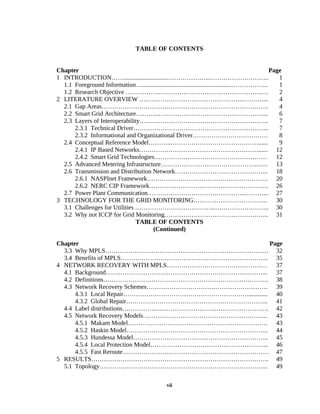
TABLE OF CONTENTS


Chapter                                                                                        Page
1 INTRODUCTION……............................………………..………………………..                                   1
  1.1 Foreground Information….........................................................……………...    1
  1.2 Research Objective …………….…………………………………………..…                                                2
2 LITERATURE OVERVIEW …………………………………………..………....                                                   4
  2.1 Gap Areas……………………………………………………………………..                                                       4
  2.2 Smart Grid Architecture……….……………………………………………...                                             6
  2.3 Layers of Interoperability……………………………………………………..                                            7
      2.3.1 Technical Driver………………………………………………………..                                               7
      2.3.2 Informational and Organizational Driver………………………………                                   8
  2.4 Conceptual Reference Model………..……………………………………......                                         9
      2.4.1 IP Based Networks…………………………………………………...... 12
      2.4.2 Smart Grid Technologies……………………………………………… 12
  2.5 Advanced Metering Infrastructure………………………………………..….. 13
  2.6 Transmission and Distribution Network……………………………………... 18
      2.6.1 NASPInet Framework…………………………………………………. 20
      2.6.2 NERC CIP Framework………………………………………………… 26
  2.7 Power Plant Communication………………………………………..………... 27
3 TECHNOLOGY FOR THE GRID MONITORING……………………………... 30
  3.1 Challenges for Utilities ………………………………...…………………….. 30
  3.2 Why not ICCP for Grid Monitoring………………………………………….. 31
                               TABLE OF CONTENTS
                                    (Continued)

Chapter                                                 Page
  3.3 Why MPLS…………………………………………………………………… 32
  3.4 Benefits of MPLS…………………………………………………………….. 35
4 NETWORK RECOVERY WITH MPLS………………………………………… 37
  4.1 Background…………………………………………………………………... 37
  4.2 Definitions……………………………………………………………………. 38
  4.3 Network Recovery Schemes…………………………………………………. 39
      4.3.1 Local Repair……………………………………………………............ 40
      4.3.2 Global Repair………………………………………………………….. 41
  4.4 Label distributions……………………………………………………………. 42
  4.5 Network Recovery Models…………………………………………………... 43
      4.5.1 Makam Model…………………………………………………………. 43
      4.5.2 Haskin Model………………………………………………………….. 44
      4.5.3 Hundessa Model……………………………………………………….. 45
      4.5.4 Local Protection Model………………………………………………... 46
      4.5.5 Fast Reroute……………………………………………………………. 47
5 RESULTS…………………………………………………………………………. 49
  5.1 Topology……………………………………………………………………... 49

                                                vii
5.2 Simulation Setup……………………………………………………………...   50
6 CONCLUSION…………………………………………………………………....          54
  REFERENCES ……………………………………………………………………            55


                        viii
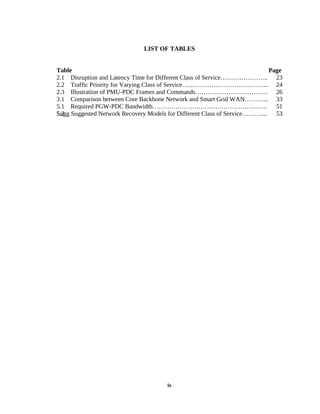
LIST OF TABLES


Table                                                                      Page
2.1 Disruption and Latency Time for Different Class of Service………………….. 23
2.2 Traffic Priority for Varying Class of Service…………………………………... 24
2.3 Illustration of PMU-PDC Frames and Commands…………………………….. 26
3.1 Comparison between Core Backbone Network and Smart Grid WAN………... 33
5.1 Required PGW-PDC Bandwidth………………………………………………. 51
Sugg
5.2 Suggested Network Recovery Models for Different Class of Service……….... 53


                                      ix
LIST OF FIGURES


Figure                                                                                                                     Page
2.1 GWAC eight layer model provides a context for determining Smart Grid

      interoperability requirements…………………………………………………...                                                                     8
2.2   Smart Grid Domains……………………………………………………………                                                                              10
2.3   Conceptual Reference Diagram of Smart Grid Domains………………………                                                            11
2.4   Information exchange in C12.21 and C12.22…………………………………..                                                               16
2.5   Complex Power Transmission Network with 137 BA with AC and DC

      transmission lines................................................................................................     19
2.6   Proposed NASPInet WAN..................................................................................                21
2.7   PMU Frame Transmission Order………………………………………………                                                                         25
2.8   Existing WAMS, using ICCP for grid monitoring……………………………..                                                             29
3.1   Existing ICCP protocol for data exchange between utilities…………………...                                                   32
3.2   Technology for the grid monitoring: suggested technology adheres to

      NASPInet and NERC CIP requirements……………………………………….                                                                     34
3.3   Suggested NASPInet WAN, with MPLS technology for grid monitoring……..                                                   35
4.1   Makam model with end-to-end backup path…………………………………...                                                                44
4.2   Haskin Model…………………………………………………………………..                                                                                45
4.3   Hundessa Model……………………………………………………………......                                                                            46
4.4   Local Protection Model…………………………………………………...........                                                                   47
4.5   Fast Reroute with link failure…………………………………………………..                                                                    48
5.1   Topology of 25PGWs…………………………………………………………..                                                                             50
                                   LIST OF FIGURES
                                      (Continued)

Figure                                                                  Page
5.2 Service disruption time for different MPLS models…………………………...        52
5.3 Suggested Network Recovery Models for Different Class of Service………… 53


                                                              x

Front Matter Smart Grid Communications

  • 1.
    ABSTRACT ENABLING SMART GRID COMMUNICATIONS via MPLS by Apoorv Ranjan Khare A clean green future, resistant to blackouts and capable of handling the increasing energy demands, is surely the need of the hour. To accomplish this, the existing conventional electric grid needs to be transformed to a "Smart Grid" that works efficiently. For monitoring and control, the grid needs a robust, reliable, self-healing, and secure WAN. The challenges to overcome are fiber cut, components failure and/or natural disaster, which will result in link or node failures, and in turn affect the overall grid performance. Such a WAN is intolerant of service disruption time of even sub- milliseconds. To realize such a critical network, different network recovery models are required for various classes of service. In this thesis, Multiprotocol Label Switching (MPLS) network recovery models are proposed to enable grid communications. Four network recovery models were simulated through Network Simulator (ns2), and the performances of individual models w were compared against each other. The service disruption times and number of lost packets of these models were evaluated, analyzed and used for suggesting appropriate models for five different classes of service.
  • 2.
    ENABLING SMART GRIDCOMMUNICATIONS via MPLS by Apoorv Ranjan Khare A Thesis Submitted to the Faculty of New Jersey Institute of Technology in Partial Fulfillment of the Requirements for the Degree of Master of Science in Telecommunications Department of Electrical and Computer Engineering January 2010
  • 4.
    APPROVAL PAGE ENABLING SMART GRID COMMUNICATIONS via MPLS Apoorv Ranjan Khare Dr. Nirwan Ansari, Thesis Advisor Date Professor of Electrical and Computer Engineering, NJIT Dr. Edwin Hou, Committee Member Date Associate Professor of Electrical and Computer Engineering, NJIT Dr. Mengchu Zhou, Committee Member Date Professor of Electrical and Computer Engineering, NJIT
  • 6.
    BIOGRAPHICAL SKETCH Author: Apoorv Ranjan Khare Degree: Master of Science Date: January 2010 Date of Birth: September 29, 1984 Place of Birth: Jabalpur, India Undergraduate and Graduate Education: • Master of Science in Telecommunication, New Jersey Institute of Technology, Newark, NJ, 2010 • Bachelor of Engineering in Electronics and Telecommunication, National Institute of Technology, Raipur, India, 2007 Major: Telecommunications iv
  • 7.
    This thesis isdedicated in memory of my Grand Ma (Dadi) v
  • 8.
    ACKNOWLEDGMENT I owe mydeepest gratitude to my thesis advisor, Dr Nirwan Ansari whose patience, encouragement and reassurance, helped me to explore this new area of Smart Grid. I would like to thank Dr. Edwin Hou, and Dr Mengchu Zhou for actively participating in my committee and providing me valuable support and guidance from their own areas of expertise. I would also appreciate the timely help and suggestions from Mr. Pitipatana Sakarindr, doctoral candidate at NJIT whose insights to power communication networks are second to none. My special thanks to Mr. Chao Zhang, also a doctoral candidate at NJIT, for sharing his knowledge and experience he gained in Siemens. I am obliged to Ms Christian Callergari from University of Pisa, Italy for her generosity to share some of the ns2 patches for MPLS models. I am indebted to my parents, uncle and aunt, without their motivation, enthusiasm and research experience this thesis would not have completed. Last but not the least, special gratitude to my sisters Mayooree, Ritu, and Hansa, and roommates for their cooperation while writing this thesis. vi
  • 9.
    TABLE OF CONTENTS Chapter Page 1 INTRODUCTION……............................………………..……………………….. 1 1.1 Foreground Information….........................................................……………... 1 1.2 Research Objective …………….…………………………………………..… 2 2 LITERATURE OVERVIEW …………………………………………..……….... 4 2.1 Gap Areas…………………………………………………………………….. 4 2.2 Smart Grid Architecture……….……………………………………………... 6 2.3 Layers of Interoperability…………………………………………………….. 7 2.3.1 Technical Driver……………………………………………………….. 7 2.3.2 Informational and Organizational Driver……………………………… 8 2.4 Conceptual Reference Model………..……………………………………...... 9 2.4.1 IP Based Networks…………………………………………………...... 12 2.4.2 Smart Grid Technologies……………………………………………… 12 2.5 Advanced Metering Infrastructure………………………………………..….. 13 2.6 Transmission and Distribution Network……………………………………... 18 2.6.1 NASPInet Framework…………………………………………………. 20 2.6.2 NERC CIP Framework………………………………………………… 26 2.7 Power Plant Communication………………………………………..………... 27 3 TECHNOLOGY FOR THE GRID MONITORING……………………………... 30 3.1 Challenges for Utilities ………………………………...…………………….. 30 3.2 Why not ICCP for Grid Monitoring………………………………………….. 31 TABLE OF CONTENTS (Continued) Chapter Page 3.3 Why MPLS…………………………………………………………………… 32 3.4 Benefits of MPLS…………………………………………………………….. 35 4 NETWORK RECOVERY WITH MPLS………………………………………… 37 4.1 Background…………………………………………………………………... 37 4.2 Definitions……………………………………………………………………. 38 4.3 Network Recovery Schemes…………………………………………………. 39 4.3.1 Local Repair……………………………………………………............ 40 4.3.2 Global Repair………………………………………………………….. 41 4.4 Label distributions……………………………………………………………. 42 4.5 Network Recovery Models…………………………………………………... 43 4.5.1 Makam Model…………………………………………………………. 43 4.5.2 Haskin Model………………………………………………………….. 44 4.5.3 Hundessa Model……………………………………………………….. 45 4.5.4 Local Protection Model………………………………………………... 46 4.5.5 Fast Reroute……………………………………………………………. 47 5 RESULTS…………………………………………………………………………. 49 5.1 Topology……………………………………………………………………... 49 vii
  • 10.
    5.2 Simulation Setup……………………………………………………………... 50 6 CONCLUSION………………………………………………………………….... 54 REFERENCES …………………………………………………………………… 55 viii
  • 11.
    LIST OF TABLES Table Page 2.1 Disruption and Latency Time for Different Class of Service………………….. 23 2.2 Traffic Priority for Varying Class of Service…………………………………... 24 2.3 Illustration of PMU-PDC Frames and Commands…………………………….. 26 3.1 Comparison between Core Backbone Network and Smart Grid WAN………... 33 5.1 Required PGW-PDC Bandwidth………………………………………………. 51 Sugg 5.2 Suggested Network Recovery Models for Different Class of Service……….... 53 ix
  • 12.
    LIST OF FIGURES Figure Page 2.1 GWAC eight layer model provides a context for determining Smart Grid interoperability requirements…………………………………………………... 8 2.2 Smart Grid Domains…………………………………………………………… 10 2.3 Conceptual Reference Diagram of Smart Grid Domains……………………… 11 2.4 Information exchange in C12.21 and C12.22………………………………….. 16 2.5 Complex Power Transmission Network with 137 BA with AC and DC transmission lines................................................................................................ 19 2.6 Proposed NASPInet WAN.................................................................................. 21 2.7 PMU Frame Transmission Order……………………………………………… 25 2.8 Existing WAMS, using ICCP for grid monitoring…………………………….. 29 3.1 Existing ICCP protocol for data exchange between utilities…………………... 32 3.2 Technology for the grid monitoring: suggested technology adheres to NASPInet and NERC CIP requirements………………………………………. 34 3.3 Suggested NASPInet WAN, with MPLS technology for grid monitoring…….. 35 4.1 Makam model with end-to-end backup path…………………………………... 44 4.2 Haskin Model………………………………………………………………….. 45 4.3 Hundessa Model……………………………………………………………...... 46 4.4 Local Protection Model…………………………………………………........... 47 4.5 Fast Reroute with link failure………………………………………………….. 48 5.1 Topology of 25PGWs………………………………………………………….. 50 LIST OF FIGURES (Continued) Figure Page 5.2 Service disruption time for different MPLS models…………………………... 52 5.3 Suggested Network Recovery Models for Different Class of Service………… 53 x