Chapter 2
Friendship
By: Serena Robinson
Chapter Focus
This chapter documents how social media is
incorporated into teen friendship practices in the
context of their everyday peer groups.
It concentrates on the role technology plays in
establishing, reinforcing, complicating, and
damaging friendship-driven social bonds (p.80-
81).
Social media intersects with four types of everyday peer
negotiations:
Making friends
Performing friendships
Articulating friendship hierarchies
Peers and Friendship
The peer relations of children and teens are
structured by a developmental logic supported by
educational institutions organized by rigid age
boundaries (p. 83).
We share a cultural consensus that the ability to
socialize with peers and make friendships is a
key component of growing up.
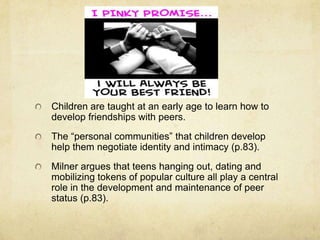
Children are taught at an early age to learn how to
develop friendships with peers.
The “personal communities” that children develop
help them negotiate identity and intimacy (p.83).
Milner argues that teens hanging out, dating and
mobilizing tokens of popular culture all play a central
role in the development and maintenance of peer
status (p.83).
Mediated teen social worlds began with the
telephone and continue to today’s popular social
media.
Teens use all types of media available to display
their social identities and interact with their peers.
Most common form of social media amongst
teens is instant messaging, cell phones, and
social network sites.
When teens are involved in
friendship-driven practices,
online and offline are not
separate worlds.
They are just considered
different settings where one
can still interact with friends
and peers.
Social media mirror, magnify,
and extend everyday social
worlds (p.84).
Teens use social media to continue what they
have always been doing:
Socialize with friends
Negotiate peer groups
Flirt
Share stories
Hang out
Making Friends
Teens may select their friends, but their choice is
configured by the social, cultural and economic
conditions around them (p.88).
Most friendships among American teens are of
approximately the same age.
This is due to age-stratified school systems and
other cultural forces segregating youth by age.
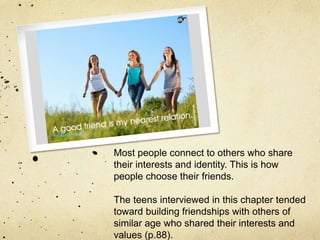
Most people connect to others who share
their interests and identity. This is how
people choose their friends.
The teens interviewed in this chapter tended
toward building friendships with others of
similar age who shared their interests and
values (p.88).
Social media makes it possible for teens to move
beyond geographic restrictions and connect with
new people.
While this could be beneficial to many research
shows that developing friendships online is not a
normative practice.
A survey of U.S. teens indicate that most teens
use social media to socialize with people they
already know or would like to know better(p.89).
They use social media as additional channels of
communication to interact with classmates and
turn acquaintances into friendships.
Social networking sites like Facebook can be
helpful in getting to know classmates better.
“Facebook makes it easier to talk to people at
school that you may not see a lot or know very
well.” –Melanie 15-year old from Kansas
Performing Friendships
Most social network sites require confirmation for
people to list one another and requires a “Friend
request” where the recipient is required to accept
or reject the request.
Teens must determine their own boundaries
concerning whom to accept and whom to reject.
Teens have different strategies for choosing
whom to mark as friends.
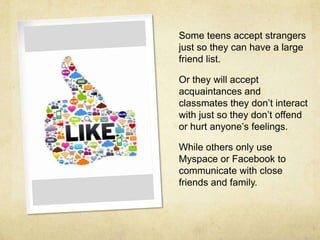
Some teens accept strangers
just so they can have a large
friend list.
Or they will accept
acquaintances and
classmates they don’t interact
with just so they don’t offend
or hurt anyone’s feelings.
While others only use
Myspace or Facebook to
communicate with close
friends and family.
Friending rules:
It is socially unacceptable to delete a Friend one knows.
This only happens after a fight or breakup.
Now it is ok to move from an open profile to a closed one
and delete strangers.
By facing decisions about how to circumscribe
their Friends lists, teens are forced to consider
their relationships, the dynamics of their peer
group, and the ways in which their decisions may
affect others (p.100).
It forces teens to navigate their social lives in
new ways.
Friendship Hierarchies
Displaying friendship hierarchies online are
controversial and more fraught than the simple
articulation of Friend connections (p.100).
MySpace had a feature called “Top Friends” or
“Top 8” which forced teens to indicate whom they
were closest to among their friends.
This only created social drama because many
teens would get upset over who should make the
list and be in the first position.
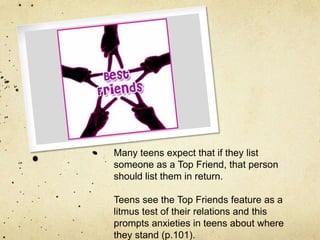
Many teens expect that if they list
someone as a Top Friend, that person
should list them in return.
Teens see the Top Friends feature as a
litmus test of their relations and this
prompts anxieties in teens about where
they stand (p.101).
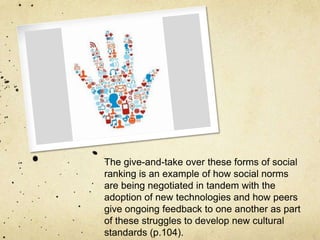
The give-and-take over these forms of social
ranking is an example of how social norms
are being negotiated in tandem with the
adoption of new technologies and how peers
give ongoing feedback to one another as part
of these struggles to develop new cultural
standards (p.104).
Status, Attention, and
Drama
Teens use social media to develop and maintain
friendships but at the same time use it to seek
attention and create drama.
Often the motivation is to relieve insecurities
about popularity and friendship.
New communication channels including mobile
phones, IM, and social network sites have all
been used to gossip.
Some teens believe that the new media tend to
replace the older media as a tool for gossip.
“The Internet has taken the place of phones… it
spreads all rumors and gossip” (p.105).
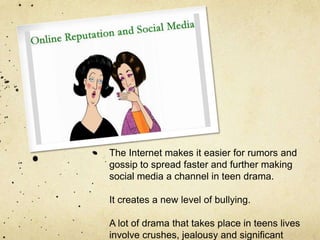
The Internet makes it easier for rumors and
gossip to spread faster and further making
social media a channel in teen drama.
It creates a new level of bullying.
A lot of drama that takes place in teens lives
involve crushes, jealousy and significant
Gossip, drama, bullying and posing are
unavoidable side effects of teens everyday
negotiations over friendship and peer status
(p.112).
It has been going on long before the Internet but
certain features of social media reinforce these
dynamics.
The public, persistent, searchable and
spreadable nature of mediated information
affects the way rumors flow and how dramas
play out (p.112).
While there is a dark side to what takes place,
teens still enjoy the friendship opportunities
social media provides.
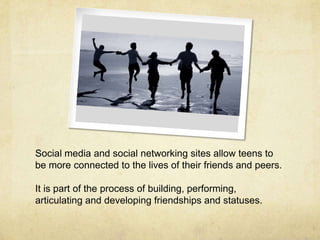
Social media and social networking sites allow teens to
be more connected to the lives of their friends and peers.
It is part of the process of building, performing,
articulating and developing friendships and statuses.

Friendship

  • 1.
  • 2.
    Chapter Focus This chapterdocuments how social media is incorporated into teen friendship practices in the context of their everyday peer groups. It concentrates on the role technology plays in establishing, reinforcing, complicating, and damaging friendship-driven social bonds (p.80- 81).
  • 3.
    Social media intersectswith four types of everyday peer negotiations: Making friends Performing friendships Articulating friendship hierarchies
  • 4.
    Peers and Friendship Thepeer relations of children and teens are structured by a developmental logic supported by educational institutions organized by rigid age boundaries (p. 83). We share a cultural consensus that the ability to socialize with peers and make friendships is a key component of growing up.
  • 5.
    Children are taughtat an early age to learn how to develop friendships with peers. The “personal communities” that children develop help them negotiate identity and intimacy (p.83). Milner argues that teens hanging out, dating and mobilizing tokens of popular culture all play a central role in the development and maintenance of peer status (p.83).
  • 6.
    Mediated teen socialworlds began with the telephone and continue to today’s popular social media. Teens use all types of media available to display their social identities and interact with their peers. Most common form of social media amongst teens is instant messaging, cell phones, and social network sites.
  • 7.
    When teens areinvolved in friendship-driven practices, online and offline are not separate worlds. They are just considered different settings where one can still interact with friends and peers. Social media mirror, magnify, and extend everyday social worlds (p.84).
  • 8.
    Teens use socialmedia to continue what they have always been doing: Socialize with friends Negotiate peer groups Flirt Share stories Hang out
  • 9.
    Making Friends Teens mayselect their friends, but their choice is configured by the social, cultural and economic conditions around them (p.88). Most friendships among American teens are of approximately the same age. This is due to age-stratified school systems and other cultural forces segregating youth by age.
  • 10.
    Most people connectto others who share their interests and identity. This is how people choose their friends. The teens interviewed in this chapter tended toward building friendships with others of similar age who shared their interests and values (p.88).
  • 11.
    Social media makesit possible for teens to move beyond geographic restrictions and connect with new people. While this could be beneficial to many research shows that developing friendships online is not a normative practice. A survey of U.S. teens indicate that most teens use social media to socialize with people they already know or would like to know better(p.89).
  • 12.
    They use socialmedia as additional channels of communication to interact with classmates and turn acquaintances into friendships. Social networking sites like Facebook can be helpful in getting to know classmates better. “Facebook makes it easier to talk to people at school that you may not see a lot or know very well.” –Melanie 15-year old from Kansas
  • 13.
    Performing Friendships Most socialnetwork sites require confirmation for people to list one another and requires a “Friend request” where the recipient is required to accept or reject the request. Teens must determine their own boundaries concerning whom to accept and whom to reject. Teens have different strategies for choosing whom to mark as friends.
  • 14.
    Some teens acceptstrangers just so they can have a large friend list. Or they will accept acquaintances and classmates they don’t interact with just so they don’t offend or hurt anyone’s feelings. While others only use Myspace or Facebook to communicate with close friends and family.
  • 15.
    Friending rules: It issocially unacceptable to delete a Friend one knows. This only happens after a fight or breakup. Now it is ok to move from an open profile to a closed one and delete strangers.
  • 16.
    By facing decisionsabout how to circumscribe their Friends lists, teens are forced to consider their relationships, the dynamics of their peer group, and the ways in which their decisions may affect others (p.100). It forces teens to navigate their social lives in new ways.
  • 17.
    Friendship Hierarchies Displaying friendshiphierarchies online are controversial and more fraught than the simple articulation of Friend connections (p.100). MySpace had a feature called “Top Friends” or “Top 8” which forced teens to indicate whom they were closest to among their friends. This only created social drama because many teens would get upset over who should make the list and be in the first position.
  • 18.
    Many teens expectthat if they list someone as a Top Friend, that person should list them in return. Teens see the Top Friends feature as a litmus test of their relations and this prompts anxieties in teens about where they stand (p.101).
  • 19.
    The give-and-take overthese forms of social ranking is an example of how social norms are being negotiated in tandem with the adoption of new technologies and how peers give ongoing feedback to one another as part of these struggles to develop new cultural standards (p.104).
  • 20.
    Status, Attention, and Drama Teensuse social media to develop and maintain friendships but at the same time use it to seek attention and create drama. Often the motivation is to relieve insecurities about popularity and friendship.
  • 21.
    New communication channelsincluding mobile phones, IM, and social network sites have all been used to gossip. Some teens believe that the new media tend to replace the older media as a tool for gossip. “The Internet has taken the place of phones… it spreads all rumors and gossip” (p.105).
  • 22.
    The Internet makesit easier for rumors and gossip to spread faster and further making social media a channel in teen drama. It creates a new level of bullying. A lot of drama that takes place in teens lives involve crushes, jealousy and significant
  • 23.
    Gossip, drama, bullyingand posing are unavoidable side effects of teens everyday negotiations over friendship and peer status (p.112). It has been going on long before the Internet but certain features of social media reinforce these dynamics.
  • 24.
    The public, persistent,searchable and spreadable nature of mediated information affects the way rumors flow and how dramas play out (p.112). While there is a dark side to what takes place, teens still enjoy the friendship opportunities social media provides.
  • 25.
    Social media andsocial networking sites allow teens to be more connected to the lives of their friends and peers. It is part of the process of building, performing, articulating and developing friendships and statuses.