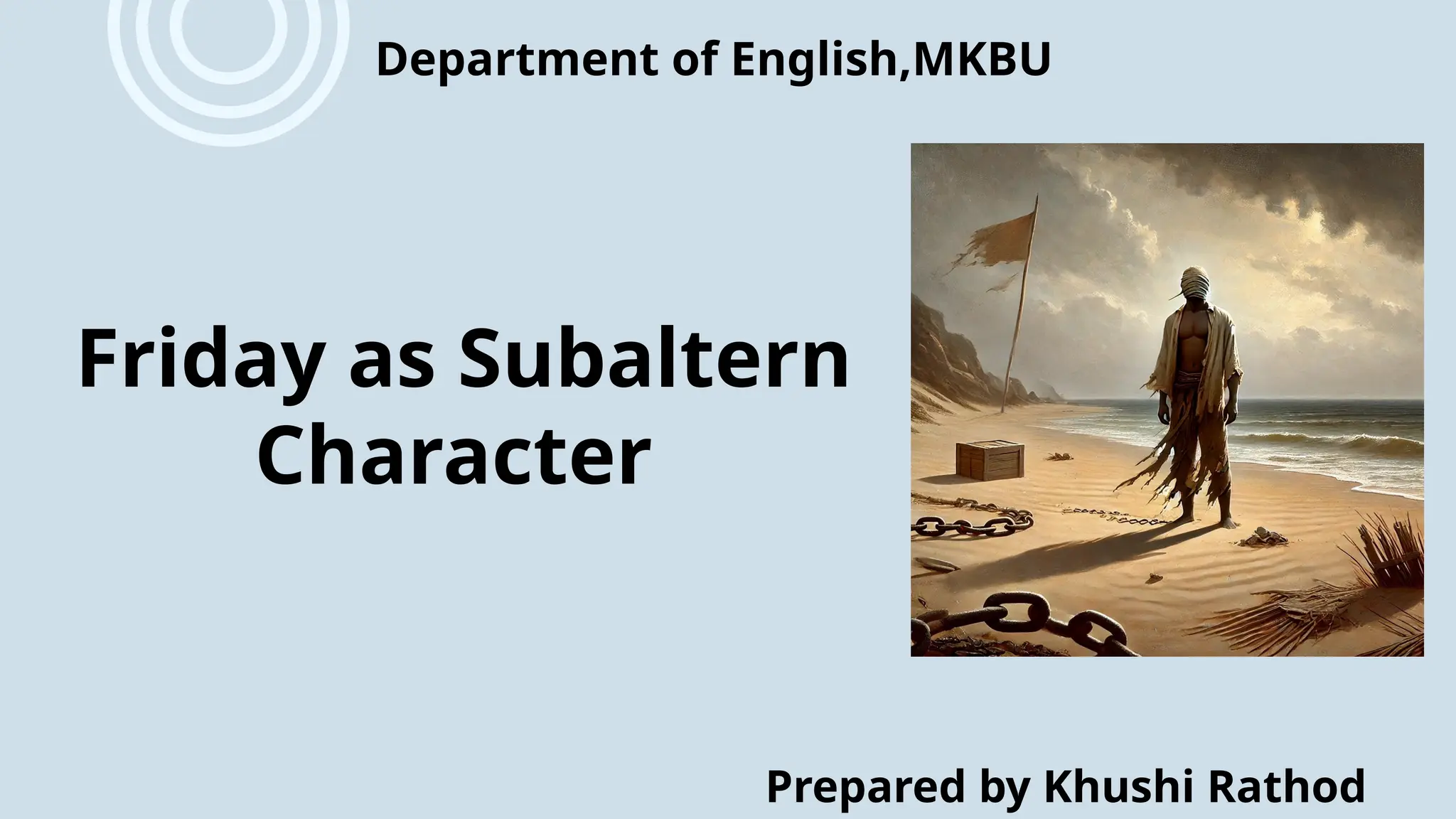
Friday as Subaltern
Character
Prepared by Khushi Rathod
Department of English,MKBU
Personal Information
Name : Khushi R Rathod
Roll No : 16
Enrollment No : 5108230039
Semester : 3
Paper No : 203
Paper Code : 22408
Paper Name : The Postcolonial Studies
Topic : Friday as Subaltern Character
Presented at : Smt. S.B.Gardi, Department of English,MKBU
E-mail : khushirathod1863@gmail.com
Research Question:
How does J.M. Coetzee’s portrayal of Friday in Foe reflect the
characteristics of a subaltern figure, and in what ways does his
silence challenge dominant narrative of colonialism?
Hypothesis:
Friday in J.M. Coetzee’s Foe represents a quintessential subaltern
character whose imposed silence underscores the systemic erasure
of marginalized voices in colonial discourse. Through his
voicelessness, Coetzee critiques the limitations of language and
narrative authority, demonstrating how colonial power structures
deny the subaltern the ability to articulate their experiences and
agency.
Table of contents
● Introduction of J. M.
Coetzee
● Foe
● Subaltern Theory
● Friday’s Silenced Identity
● Friday as a Subaltern
● The Symbolic Muteness of Friday
● Critique of the Narratives Around
Friday
● Broader Implications in
Postcolonial Studies
● Conclusion
● References
Birth and Background:
● Born on February 9, 1940, in Cape
Town, South Africa.
● Studied literature and linguistics,
shaping his academic and literary
career.
Themes in His Work:
● Colonialism and Postcolonialism
● Power and Oppression
● Animal Ethics
● Identity and Silence
Writing Style:
● Minimalist and introspective prose.
● Combines realism, allegory, and
metafiction.
● Challenges traditional narratives
and explores the ethics of
storytelling.
J. M. Coetzee Notable Novels:
● Dusklands (1974)
● Waiting for the Barbarians (1980)
● Life & Times of Michael K (1983)
● Foe (1986)
● Disgrace (1999)
Recognition:
● Nobel Prize in Literature (2003).
● Two-time Booker Prize winner (Life &
Times of Michael K, Disgrace).
● Global acclaim for his ethical and
philosophical depth.
Legacy:
● Considered a master of exploring
human suffering and moral ambiguity.
● His works remain central to
discussions on power, justice, and
identity in literature.
(Britannica)
Foe
Originally published : 1986
Author : J. M. Coetzee
Genres : Novel, Allegory, Didactic fiction, Parallel novel
Original language : English
Contains : 4 Chapters
Central themes: Power, colonialism, and voicelessness
● A postmodern retelling of Robinson Crusoe
(Coetzee)
Definition of Subaltern
● Subaltern refers to groups of people who are marginalized, oppressed, or
excluded from hegemonic power structures, often lacking agency within the
dominant socio-political and cultural discourses.
● Antonio Gramsci initially coined the term to describe non-elite social groups
subordinated under dominant forces.
● In postcolonial studies, the term has been further developed by theorists
like Ranajit Guha and Gayatri Chakravorty Spivak, who emphasize the
subaltern's lack of representation within colonial, nationalist, or elitist
historiographies​ (SPIVAK)
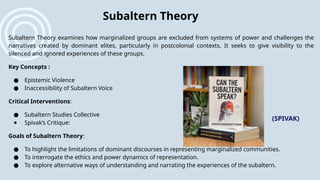
Subaltern Theory
Subaltern Theory examines how marginalized groups are excluded from systems of power and challenges the
narratives created by dominant elites, particularly in postcolonial contexts. It seeks to give visibility to the
silenced and ignored experiences of these groups.
Key Concepts :
● Epistemic Violence
● Inaccessibility of Subaltern Voice
Critical Interventions:
● Subaltern Studies Collective
● Spivak’s Critique:
Goals of Subaltern Theory:
● To highlight the limitations of dominant discourses in representing marginalized communities.
● To interrogate the ethics and power dynamics of representation.
● To explore alternative ways of understanding and narrating the experiences of the subaltern.
Subaltern Theory
(SPIVAK)
Friday’s Silenced Identity:
Friday’s Muted Voice :
1. Mutilation of the Tongue
○ Friday’s tongue is chopped off, a stark metaphor for the colonial erasure
of identity and autonomy.
2. Silence as Subaltern Voicelessness
○ Friday’s inability to speak parallels the systematic silencing of oppressed
groups under colonial rule.
○ His silence is symbolic of the native people’s stories that remain untold,
as their history was overwritten by the dominant colonial discourse.
(Devaraj and Soundarraj)
The Role of Language and Communication
1. Power Dynamics in Language
○ Crusoe’s casual response about Friday’s limited
vocabulary—"as many as he needs"—underscores
the colonial dismissal of native intellect and
autonomy​
2. Susan’s Complicity in Subaltern Silencing
○ Despite her attempts to “teach” Friday and give him
a voice, Susan inadvertently replicates colonial
attitudes by presuming to speak for him.
○ The tension between Susan’s desire to represent
Friday and her failure to bridge the gap highlights
the ethical complexities of representing the voiceless​
.
(Devaraj and Soundarraj)
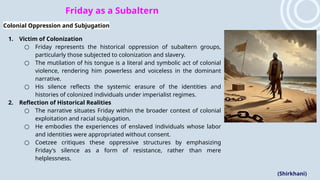
Friday as a Subaltern
Colonial Oppression and Subjugation
1. Victim of Colonization
○ Friday represents the historical oppression of subaltern groups,
particularly those subjected to colonization and slavery.
○ The mutilation of his tongue is a literal and symbolic act of colonial
violence, rendering him powerless and voiceless in the dominant
narrative.
○ His silence reflects the systemic erasure of the identities and
histories of colonized individuals under imperialist regimes​
.
2. Reflection of Historical Realities
○ The narrative situates Friday within the broader context of colonial
exploitation and racial subjugation.
○ He embodies the experiences of enslaved individuals whose labor
and identities were appropriated without consent.
○ Coetzee critiques these oppressive structures by emphasizing
Friday's silence as a form of resistance, rather than mere
helplessness​
.
(Shirkhani)
Representation of the "Other"
1. Constructed Through the Colonial Gaze
○ Friday’s identity is shaped by the perspectives of Cruso and Susan Barton, who view him
through the lens of colonial and patriarchal dominance.
○ Susan, in particular, seeks to "civilize" him by imposing her language and narrative
frameworks, further marginalizing his autonomy.
○ Cruso reduces Friday to a laborer, denying him any personal agency or subjectivity
beyond his utility on the island​
.
2. Lack of Agency and Autonomy
○ Friday’s silence challenges the dominant characters' efforts to define and control his
identity.
○ While Cruso and Susan attempt to reconstruct Friday’s story, their efforts reveal the
impossibility of authentically representing the subaltern within colonial discourse.
○ Friday’s silence is portrayed as an active rejection of these narratives, allowing him to
resist assimilation and maintain his unique identity​
.
(Shirkhani)
The Symbolic Muteness of Friday
Ambiguity and Interpretive Challenges
1. Limits of Representation
○ Friday’s silence challenges the ability of the dominant colonial narrative to fully represent or define
subaltern experiences.
○ His inaccessibility as a character reveals the inadequacy of Western literary traditions in capturing
the complexities of subaltern identities.
○ Coetzee positions Friday’s muteness as a counter-narrative to colonial attempts at domination,
forcing readers to confront the gaps and silences within historical and fictional accounts​Critique of
Western Narratives.
○ Western narratives often seek to essentialize and categorize the "Other," stripping away their
agency and individuality.
○ Friday’s silence resists these tendencies by remaining elusive and refusing to conform to Susan
Barton’s or Foe’s interpretations.
○ This muteness serves as a critique of colonial authorship, which prioritizes control over authentic
representation. (Shirkhani)
Silence as Resistance
● Friday’s refusal to speak is not a sign of passivity but an act of
resistance against colonial systems of representation.
● By remaining silent, he denies Susan and Cruso the power to
fully appropriate his story or identity, thereby safeguarding his
autonomy.
● His silence disrupts the colonial framework, where language is
a tool of domination, and highlights the limitations of colonial
discourse
(Shirkhani)
Critique of the Narratives Around Friday
Susan Barton’s Role
1. Attempt to Recover Friday’s Voice
○ Susan attempts to “recover” Friday’s voice and narrate his story, reflecting her desire to fill the gap in the
narrative caused by his muteness.
○ However, her efforts are fraught with ethical dilemmas as they mirror the colonial imposition of identity on
subaltern subjects.
2. Ethical Dilemma of Speaking for the Subaltern
○ Susan acknowledges the impossibility of authentically representing Friday’s story:
“The story of Friday’s tongue is a story unable to be told by me” (Coetzee).
○ Her fixation on telling his story, despite knowing its inaccessibility, reflects a paradox: her attempts to
liberate him inadvertently reinforce his subalternity by denying his agency to self-represent​
.
3. Does Her Mediation Reinforce or Challenge Subalternity?
○ While Susan’s efforts highlight the gaps in colonial narratives, her actions are complicit in the epistemic
violence of speaking for Friday rather than enabling him to speak.
○ She manipulates his silence to fit her narrative needs, admitting:
“What he is to the world is what I make of him”​
(Coetzee).
(Neimneh)
Cruso’s Influence
1. Cruso as a Colonizer
○ Cruso exercises control over Friday by reducing him to a laborer devoid of agency. He refrains
from teaching Friday English, rationalizing that it is unnecessary on the island:
“This is not England; we have no need of a great stock of words” (Coetzee).
○ His dismissal of Friday’s muteness as unimportant reinforces the colonial erasure of the
subaltern voice​
.
2. Control over Labor and Existence
○ Cruso forces Friday to engage in meaningless labor, such as tending barren terraces without
seeds, symbolizing the exploitative futility of colonial projects.
○ This domination reduces Friday to a tool within Cruso’s framework, denying him autonomy or
individuality​
.
3. Symbolic Role in Friday’s Oppression
○ Cruso’s speculations about the cause of Friday’s mutilation—whether by slavers or as
punishment—illustrate the historical and systemic nature of colonial violence.
○ His ultimate indifference to Friday’s history underscores the erasure of subaltern identities in
colonial narratives​
(Neimneh)
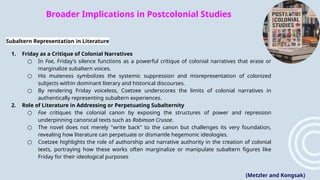
Broader Implications in Postcolonial Studies
Subaltern Representation in Literature
1. Friday as a Critique of Colonial Narratives
○ In Foe, Friday's silence functions as a powerful critique of colonial narratives that erase or
marginalize subaltern voices.
○ His muteness symbolizes the systemic suppression and misrepresentation of colonized
subjects within dominant literary and historical discourses.
○ By rendering Friday voiceless, Coetzee underscores the limits of colonial narratives in
authentically representing subaltern experiences​
.
2. Role of Literature in Addressing or Perpetuating Subalternity
○ Foe critiques the colonial canon by exposing the structures of power and repression
underpinning canonical texts such as Robinson Crusoe.
○ The novel does not merely "write back" to the canon but challenges its very foundation,
revealing how literature can perpetuate or dismantle hegemonic ideologies.
○ Coetzee highlights the role of authorship and narrative authority in the creation of colonial
texts, portraying how these works often marginalize or manipulate subaltern figures like
Friday for their ideological purposes​
(Metzler and Kongsak)
The Role of Silence in Postcolonial Discourse
1. Relevance of Friday’s Silence
○ Friday’s silence is not merely an absence of voice but a deliberate absence that challenges the
reader to confront the ethics and limitations of representation.
○ His muteness resists the colonial imposition of identity and disrupts the narrative framework
that seeks to assimilate or co-opt subaltern voices.
○ The novel highlights silence as a form of agency, where the refusal to speak becomes an act of
defiance against colonial authority​
.
2. Ethics of Representation in Postcolonial Literature
○ Coetzee critiques the act of "speaking for" the subaltern through characters like Susan Barton,
who attempts to narrate Friday’s story but ultimately replicates colonial power dynamics.
○ This raises critical questions about the ethics of representation: Can the subaltern truly be
represented within frameworks designed by hegemonic power?
○ Friday’s silence underscores the dangers of appropriating subaltern experiences for narrative
or ideological ends, emphasizing the need for authentic, self-representative voices​
(Metzler and Kongsak)
Conclusion
● In J.M. Coetzee's Foe, Friday embodies the subaltern, his silence
symbolizing the systemic erasure of marginalized voices under
colonial rule.
● Through his voicelessness, Coetzee critiques the limitations of
dominant narratives and the ethical dilemmas of representation, as
seen in Susan Barton’s failed attempts to articulate Friday's story.
● Friday’s muteness resists colonial frameworks, highlighting the
need for self-representation and exposing the inadequacy of
traditional literary and historical discourses in capturing subaltern
experiences.
● This challenges readers to confront the gaps and silences inherent
in postcolonial narratives.
Britannica, The Editors of Encyclopaedia. "J.M. Coetzee". Encyclopedia Britannica, 12 Oct. 2024,
https://www.britannica.com/biography/J-M-Coetzee. Accessed 20 November 2024.
Coetzee, J M. Foe. Spain, Penguin Books Limited, 2015.
Devaraj, Jockim, and Rajkumaran Soundarraj. “(PDF) J.M. Coetzee's Foe: A Critique of Silence
and Violence of the English Canonical Text.” ResearchGate, 9 March 2023,
https://www.researchgate.net/publication/369112525_JM_Coetzee's_Foe_A_Critique_of_Sil
ence_and_Violence_of_the_English_Canonical_Text
. Accessed 20 November 2024.
References
Metzler, Tobias, and Sasikarn Kongsak. “Author-ities: Postcolonial Challenges in J. M. Coetzee’s Foe.”
Thaiscience.Info, 2016, https://www.thaiscience.info/journals/Article/SUIJ/10984821.pdf. Accessed 20 November
2024.
Neimneh, Shadi. “(PDF) Postcolonial Feminism: Silence and Storytelling in J. M. Coetzee's Foe.” ResearchGate, 2014,
https://www.researchgate.net/publication/263849320_Postcolonial_Feminism_Silence_and_Storytelling_in_J
_M_Coetzee's_Foe. Accessed 20 November 2024.
Shirkhani, Ahmad. “Silence as a Subaltern Strategy of Resistance in Coetzee’s Foe.” The Islamic University College
Journal, 1997, https://iu-juic.com/index.php/juic/article/download/2804/2648. Accessed 20 November 2024.
Thank You

Friday as Subaltern Character | J.M. Coetzee

  • 1.
    Friday as Subaltern Character Preparedby Khushi Rathod Department of English,MKBU
  • 2.
    Personal Information Name :Khushi R Rathod Roll No : 16 Enrollment No : 5108230039 Semester : 3 Paper No : 203 Paper Code : 22408 Paper Name : The Postcolonial Studies Topic : Friday as Subaltern Character Presented at : Smt. S.B.Gardi, Department of English,MKBU E-mail : khushirathod1863@gmail.com
  • 3.
    Research Question: How doesJ.M. Coetzee’s portrayal of Friday in Foe reflect the characteristics of a subaltern figure, and in what ways does his silence challenge dominant narrative of colonialism? Hypothesis: Friday in J.M. Coetzee’s Foe represents a quintessential subaltern character whose imposed silence underscores the systemic erasure of marginalized voices in colonial discourse. Through his voicelessness, Coetzee critiques the limitations of language and narrative authority, demonstrating how colonial power structures deny the subaltern the ability to articulate their experiences and agency.
  • 4.
    Table of contents ●Introduction of J. M. Coetzee ● Foe ● Subaltern Theory ● Friday’s Silenced Identity ● Friday as a Subaltern ● The Symbolic Muteness of Friday ● Critique of the Narratives Around Friday ● Broader Implications in Postcolonial Studies ● Conclusion ● References
  • 5.
    Birth and Background: ●Born on February 9, 1940, in Cape Town, South Africa. ● Studied literature and linguistics, shaping his academic and literary career. Themes in His Work: ● Colonialism and Postcolonialism ● Power and Oppression ● Animal Ethics ● Identity and Silence Writing Style: ● Minimalist and introspective prose. ● Combines realism, allegory, and metafiction. ● Challenges traditional narratives and explores the ethics of storytelling. J. M. Coetzee Notable Novels: ● Dusklands (1974) ● Waiting for the Barbarians (1980) ● Life & Times of Michael K (1983) ● Foe (1986) ● Disgrace (1999) Recognition: ● Nobel Prize in Literature (2003). ● Two-time Booker Prize winner (Life & Times of Michael K, Disgrace). ● Global acclaim for his ethical and philosophical depth. Legacy: ● Considered a master of exploring human suffering and moral ambiguity. ● His works remain central to discussions on power, justice, and identity in literature. (Britannica)
  • 6.
    Foe Originally published :1986 Author : J. M. Coetzee Genres : Novel, Allegory, Didactic fiction, Parallel novel Original language : English Contains : 4 Chapters Central themes: Power, colonialism, and voicelessness ● A postmodern retelling of Robinson Crusoe (Coetzee)
  • 7.
    Definition of Subaltern ●Subaltern refers to groups of people who are marginalized, oppressed, or excluded from hegemonic power structures, often lacking agency within the dominant socio-political and cultural discourses. ● Antonio Gramsci initially coined the term to describe non-elite social groups subordinated under dominant forces. ● In postcolonial studies, the term has been further developed by theorists like Ranajit Guha and Gayatri Chakravorty Spivak, who emphasize the subaltern's lack of representation within colonial, nationalist, or elitist historiographies​ (SPIVAK) Subaltern Theory
  • 8.
    Subaltern Theory examineshow marginalized groups are excluded from systems of power and challenges the narratives created by dominant elites, particularly in postcolonial contexts. It seeks to give visibility to the silenced and ignored experiences of these groups. Key Concepts : ● Epistemic Violence ● Inaccessibility of Subaltern Voice Critical Interventions: ● Subaltern Studies Collective ● Spivak’s Critique: Goals of Subaltern Theory: ● To highlight the limitations of dominant discourses in representing marginalized communities. ● To interrogate the ethics and power dynamics of representation. ● To explore alternative ways of understanding and narrating the experiences of the subaltern. Subaltern Theory (SPIVAK)
  • 9.
    Friday’s Silenced Identity: Friday’sMuted Voice : 1. Mutilation of the Tongue ○ Friday’s tongue is chopped off, a stark metaphor for the colonial erasure of identity and autonomy. 2. Silence as Subaltern Voicelessness ○ Friday’s inability to speak parallels the systematic silencing of oppressed groups under colonial rule. ○ His silence is symbolic of the native people’s stories that remain untold, as their history was overwritten by the dominant colonial discourse. (Devaraj and Soundarraj)
  • 10.
    The Role ofLanguage and Communication 1. Power Dynamics in Language ○ Crusoe’s casual response about Friday’s limited vocabulary—"as many as he needs"—underscores the colonial dismissal of native intellect and autonomy​ 2. Susan’s Complicity in Subaltern Silencing ○ Despite her attempts to “teach” Friday and give him a voice, Susan inadvertently replicates colonial attitudes by presuming to speak for him. ○ The tension between Susan’s desire to represent Friday and her failure to bridge the gap highlights the ethical complexities of representing the voiceless​ . (Devaraj and Soundarraj)
  • 11.
    Friday as aSubaltern Colonial Oppression and Subjugation 1. Victim of Colonization ○ Friday represents the historical oppression of subaltern groups, particularly those subjected to colonization and slavery. ○ The mutilation of his tongue is a literal and symbolic act of colonial violence, rendering him powerless and voiceless in the dominant narrative. ○ His silence reflects the systemic erasure of the identities and histories of colonized individuals under imperialist regimes​ . 2. Reflection of Historical Realities ○ The narrative situates Friday within the broader context of colonial exploitation and racial subjugation. ○ He embodies the experiences of enslaved individuals whose labor and identities were appropriated without consent. ○ Coetzee critiques these oppressive structures by emphasizing Friday's silence as a form of resistance, rather than mere helplessness​ . (Shirkhani)
  • 12.
    Representation of the"Other" 1. Constructed Through the Colonial Gaze ○ Friday’s identity is shaped by the perspectives of Cruso and Susan Barton, who view him through the lens of colonial and patriarchal dominance. ○ Susan, in particular, seeks to "civilize" him by imposing her language and narrative frameworks, further marginalizing his autonomy. ○ Cruso reduces Friday to a laborer, denying him any personal agency or subjectivity beyond his utility on the island​ . 2. Lack of Agency and Autonomy ○ Friday’s silence challenges the dominant characters' efforts to define and control his identity. ○ While Cruso and Susan attempt to reconstruct Friday’s story, their efforts reveal the impossibility of authentically representing the subaltern within colonial discourse. ○ Friday’s silence is portrayed as an active rejection of these narratives, allowing him to resist assimilation and maintain his unique identity​ . (Shirkhani)
  • 13.
    The Symbolic Mutenessof Friday Ambiguity and Interpretive Challenges 1. Limits of Representation ○ Friday’s silence challenges the ability of the dominant colonial narrative to fully represent or define subaltern experiences. ○ His inaccessibility as a character reveals the inadequacy of Western literary traditions in capturing the complexities of subaltern identities. ○ Coetzee positions Friday’s muteness as a counter-narrative to colonial attempts at domination, forcing readers to confront the gaps and silences within historical and fictional accounts​Critique of Western Narratives. ○ Western narratives often seek to essentialize and categorize the "Other," stripping away their agency and individuality. ○ Friday’s silence resists these tendencies by remaining elusive and refusing to conform to Susan Barton’s or Foe’s interpretations. ○ This muteness serves as a critique of colonial authorship, which prioritizes control over authentic representation. (Shirkhani)
  • 14.
    Silence as Resistance ●Friday’s refusal to speak is not a sign of passivity but an act of resistance against colonial systems of representation. ● By remaining silent, he denies Susan and Cruso the power to fully appropriate his story or identity, thereby safeguarding his autonomy. ● His silence disrupts the colonial framework, where language is a tool of domination, and highlights the limitations of colonial discourse (Shirkhani)
  • 15.
    Critique of theNarratives Around Friday Susan Barton’s Role 1. Attempt to Recover Friday’s Voice ○ Susan attempts to “recover” Friday’s voice and narrate his story, reflecting her desire to fill the gap in the narrative caused by his muteness. ○ However, her efforts are fraught with ethical dilemmas as they mirror the colonial imposition of identity on subaltern subjects. 2. Ethical Dilemma of Speaking for the Subaltern ○ Susan acknowledges the impossibility of authentically representing Friday’s story: “The story of Friday’s tongue is a story unable to be told by me” (Coetzee). ○ Her fixation on telling his story, despite knowing its inaccessibility, reflects a paradox: her attempts to liberate him inadvertently reinforce his subalternity by denying his agency to self-represent​ . 3. Does Her Mediation Reinforce or Challenge Subalternity? ○ While Susan’s efforts highlight the gaps in colonial narratives, her actions are complicit in the epistemic violence of speaking for Friday rather than enabling him to speak. ○ She manipulates his silence to fit her narrative needs, admitting: “What he is to the world is what I make of him”​ (Coetzee). (Neimneh)
  • 16.
    Cruso’s Influence 1. Crusoas a Colonizer ○ Cruso exercises control over Friday by reducing him to a laborer devoid of agency. He refrains from teaching Friday English, rationalizing that it is unnecessary on the island: “This is not England; we have no need of a great stock of words” (Coetzee). ○ His dismissal of Friday’s muteness as unimportant reinforces the colonial erasure of the subaltern voice​ . 2. Control over Labor and Existence ○ Cruso forces Friday to engage in meaningless labor, such as tending barren terraces without seeds, symbolizing the exploitative futility of colonial projects. ○ This domination reduces Friday to a tool within Cruso’s framework, denying him autonomy or individuality​ . 3. Symbolic Role in Friday’s Oppression ○ Cruso’s speculations about the cause of Friday’s mutilation—whether by slavers or as punishment—illustrate the historical and systemic nature of colonial violence. ○ His ultimate indifference to Friday’s history underscores the erasure of subaltern identities in colonial narratives​ (Neimneh)
  • 17.
    Broader Implications inPostcolonial Studies Subaltern Representation in Literature 1. Friday as a Critique of Colonial Narratives ○ In Foe, Friday's silence functions as a powerful critique of colonial narratives that erase or marginalize subaltern voices. ○ His muteness symbolizes the systemic suppression and misrepresentation of colonized subjects within dominant literary and historical discourses. ○ By rendering Friday voiceless, Coetzee underscores the limits of colonial narratives in authentically representing subaltern experiences​ . 2. Role of Literature in Addressing or Perpetuating Subalternity ○ Foe critiques the colonial canon by exposing the structures of power and repression underpinning canonical texts such as Robinson Crusoe. ○ The novel does not merely "write back" to the canon but challenges its very foundation, revealing how literature can perpetuate or dismantle hegemonic ideologies. ○ Coetzee highlights the role of authorship and narrative authority in the creation of colonial texts, portraying how these works often marginalize or manipulate subaltern figures like Friday for their ideological purposes​ (Metzler and Kongsak)
  • 18.
    The Role ofSilence in Postcolonial Discourse 1. Relevance of Friday’s Silence ○ Friday’s silence is not merely an absence of voice but a deliberate absence that challenges the reader to confront the ethics and limitations of representation. ○ His muteness resists the colonial imposition of identity and disrupts the narrative framework that seeks to assimilate or co-opt subaltern voices. ○ The novel highlights silence as a form of agency, where the refusal to speak becomes an act of defiance against colonial authority​ . 2. Ethics of Representation in Postcolonial Literature ○ Coetzee critiques the act of "speaking for" the subaltern through characters like Susan Barton, who attempts to narrate Friday’s story but ultimately replicates colonial power dynamics. ○ This raises critical questions about the ethics of representation: Can the subaltern truly be represented within frameworks designed by hegemonic power? ○ Friday’s silence underscores the dangers of appropriating subaltern experiences for narrative or ideological ends, emphasizing the need for authentic, self-representative voices​ (Metzler and Kongsak)
  • 19.
    Conclusion ● In J.M.Coetzee's Foe, Friday embodies the subaltern, his silence symbolizing the systemic erasure of marginalized voices under colonial rule. ● Through his voicelessness, Coetzee critiques the limitations of dominant narratives and the ethical dilemmas of representation, as seen in Susan Barton’s failed attempts to articulate Friday's story. ● Friday’s muteness resists colonial frameworks, highlighting the need for self-representation and exposing the inadequacy of traditional literary and historical discourses in capturing subaltern experiences. ● This challenges readers to confront the gaps and silences inherent in postcolonial narratives.
  • 20.
    Britannica, The Editorsof Encyclopaedia. "J.M. Coetzee". Encyclopedia Britannica, 12 Oct. 2024, https://www.britannica.com/biography/J-M-Coetzee. Accessed 20 November 2024. Coetzee, J M. Foe. Spain, Penguin Books Limited, 2015. Devaraj, Jockim, and Rajkumaran Soundarraj. “(PDF) J.M. Coetzee's Foe: A Critique of Silence and Violence of the English Canonical Text.” ResearchGate, 9 March 2023, https://www.researchgate.net/publication/369112525_JM_Coetzee's_Foe_A_Critique_of_Sil ence_and_Violence_of_the_English_Canonical_Text . Accessed 20 November 2024. References
  • 21.
    Metzler, Tobias, andSasikarn Kongsak. “Author-ities: Postcolonial Challenges in J. M. Coetzee’s Foe.” Thaiscience.Info, 2016, https://www.thaiscience.info/journals/Article/SUIJ/10984821.pdf. Accessed 20 November 2024. Neimneh, Shadi. “(PDF) Postcolonial Feminism: Silence and Storytelling in J. M. Coetzee's Foe.” ResearchGate, 2014, https://www.researchgate.net/publication/263849320_Postcolonial_Feminism_Silence_and_Storytelling_in_J _M_Coetzee's_Foe. Accessed 20 November 2024. Shirkhani, Ahmad. “Silence as a Subaltern Strategy of Resistance in Coetzee’s Foe.” The Islamic University College Journal, 1997, https://iu-juic.com/index.php/juic/article/download/2804/2648. Accessed 20 November 2024.
  • 22.