French Revolution Timeline

   ALL THE GOOD STUFF IN ORDER!
1770’s

 Even though France was
  the center of
  Enlightenment
  ideas, they’re still stuck
  in the Old Regime
  which includes the
  estates system.
 Louis XVI becomes king
  (1774).
1789

 Bad weather has effected crops, the price of bread has
    doubled.
   The government is in debt from Louis XVI’s spending.
   The Estates – General is called to approve tax reform.
   Third Estate breaks off and creates the National
    Assembly. They take the Tennis Court Oath.
   On July 14 they storm the Bastille.
   The Great Fear spreads through out France, and
    women march to Paris demanding bread.
   The Declaration of the Rights of Man is written.
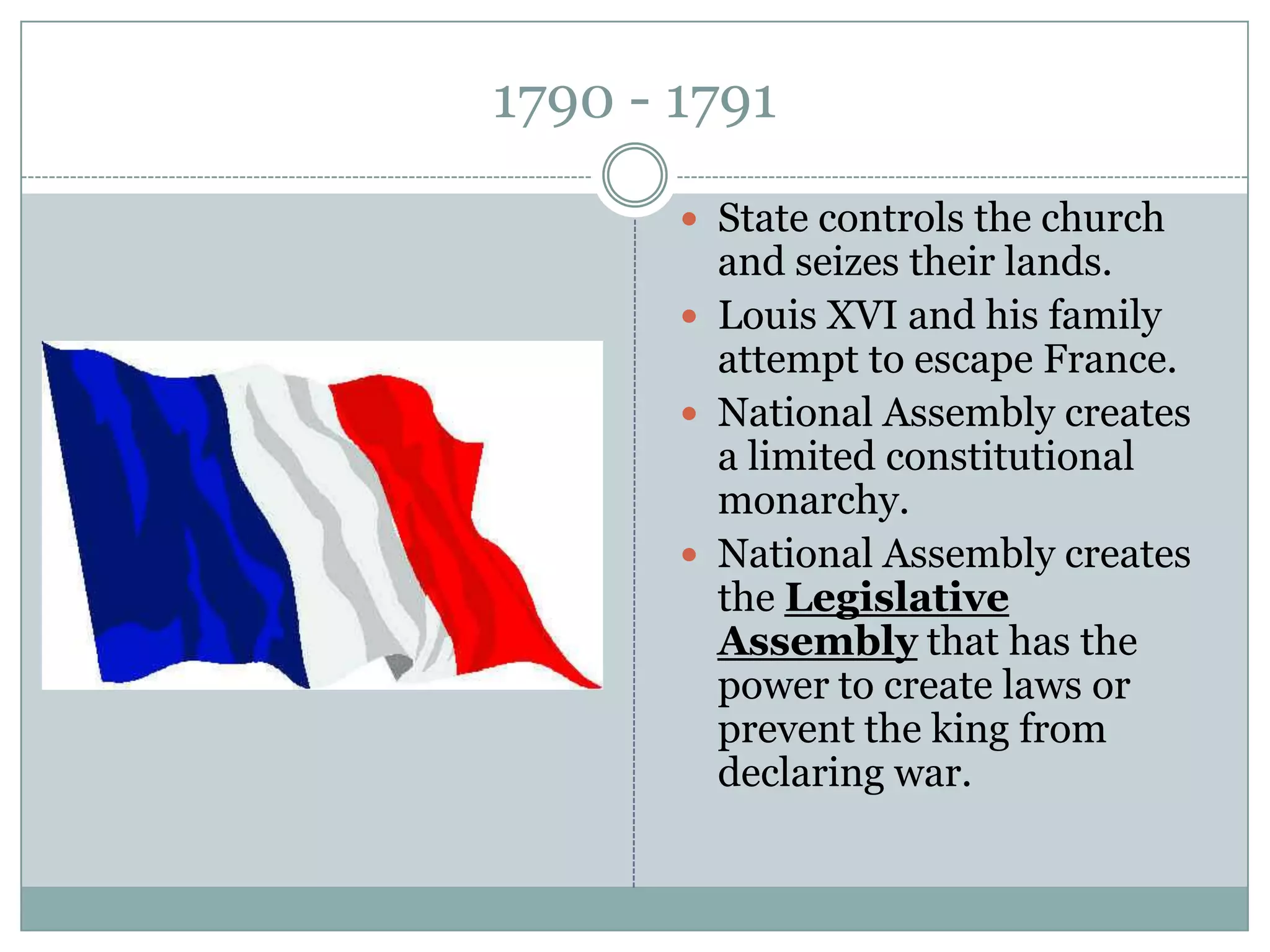
1790 - 1791
        State controls the church
         and seizes their lands.
        Louis XVI and his family
         attempt to escape France.
        National Assembly creates
         a limited constitutional
         monarchy.
        National Assembly creates
         the Legislative
         Assembly that has the
         power to create laws or
         prevent the king from
         declaring war.
1792

 War with Austria.
 National Convention
  takes over – it is voted to
  get rid of the monarchy
  and create a new
  constitution for France.
 The radical phase of the
  revolution is beginning.
1793 - 1794
 Louis XVI is put on trial by
  the National Convention.
  They find him guilty and
  execute him by guillotine.
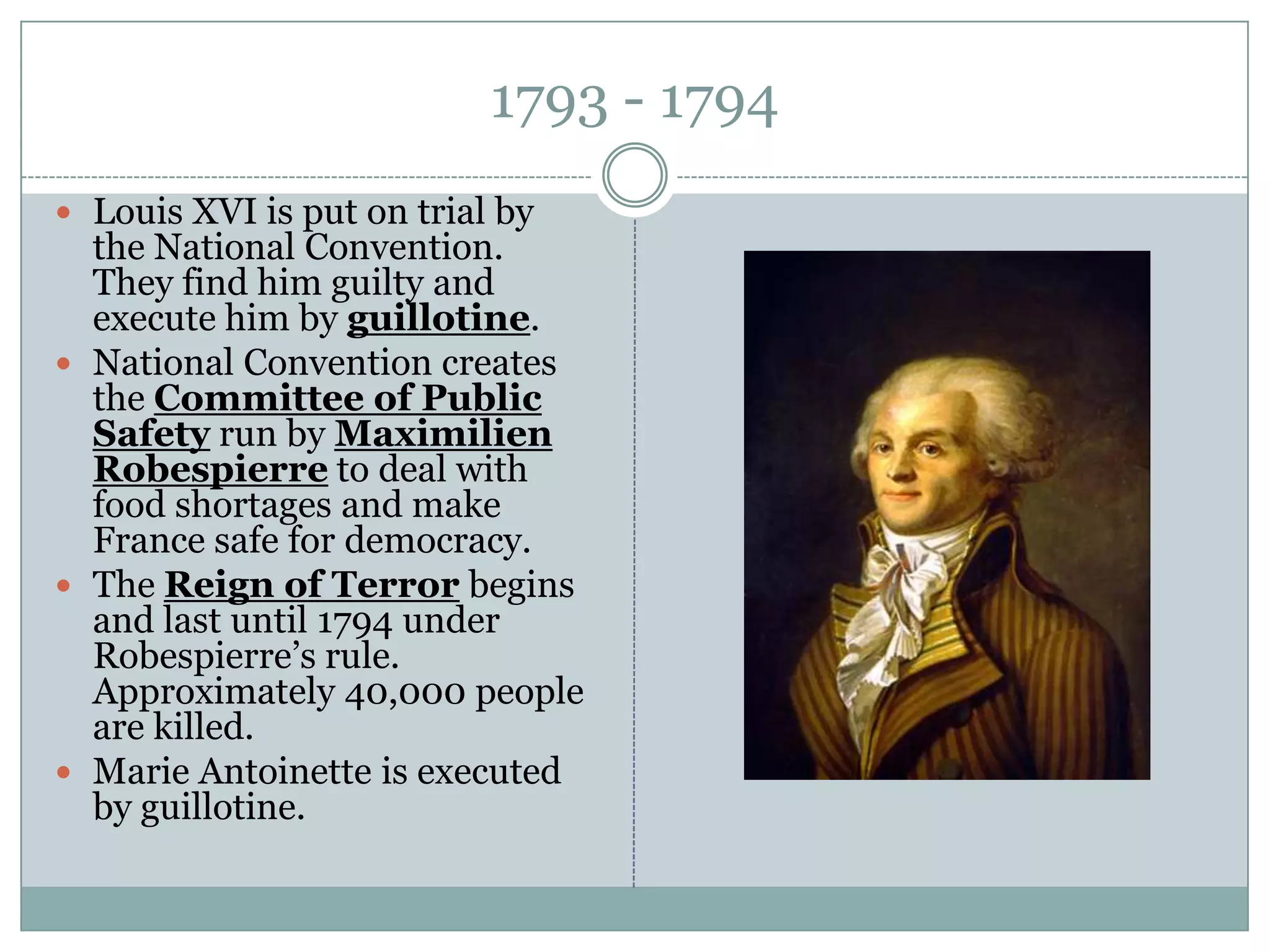
 National Convention creates
  the Committee of Public
  Safety run by Maximilien
  Robespierre to deal with
  food shortages and make
  France safe for democracy.
 The Reign of Terror begins
  and last until 1794 under
  Robespierre’s rule.
  Approximately 40,000 people
  are killed.
 Marie Antoinette is executed
  by guillotine.
Moderates Take Over

 After Robespierre’s execution most people in France
  no longer wanted revolution.
 Many of the issues of the revolution were still not
  resolved, such as food shortages.
 A group of moderates took over in 1795 and wrote a
  new constitution.
 The new government was made up of a group of five
  men known as the Directory. They were supposed
  to share the power evenly, but they were very
  corrupt.
1795 - 1799

        The Directory holds
         power, but they’re weak.
         They’re facing growing
         discontent amongst the
         people.
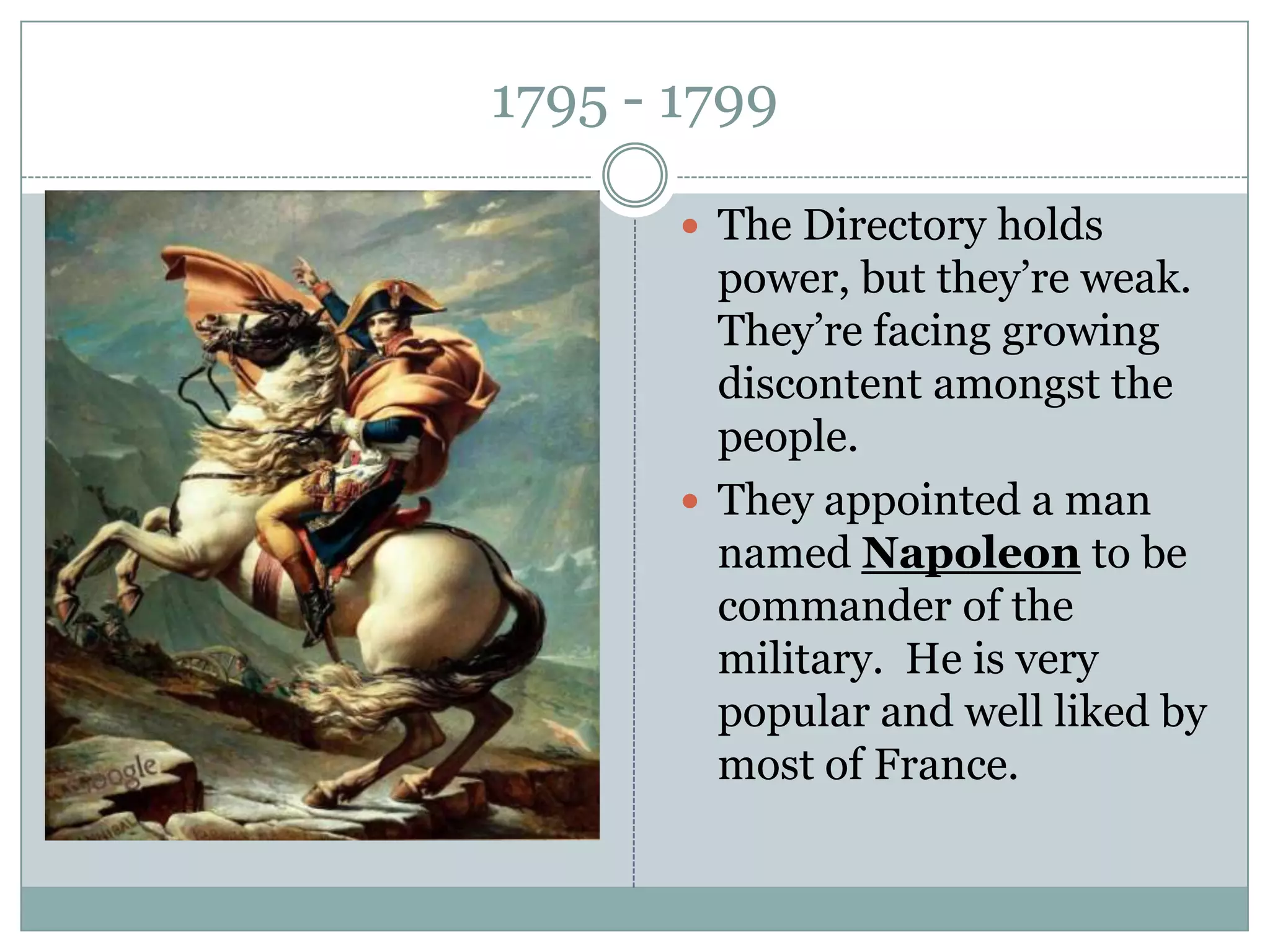
        They appointed a man
         named Napoleon to be
         commander of the
         military. He is very
         popular and well liked by
         most of France.
Important Vocabulary

 National Assembly – a group of representatives
  from the Third Estate that formed their own group in
  protest of the Estates-General.
 Legislative Assembly – a group of representatives
  that decided if and when the king could declare war
  and if laws were allowed to pass (this was part of the
  limited and constitutional monarchy).
 Limited Monarchy – when the king is still in
  power but his power is controlled by the constitution
  and Legislative Assembly
1799 - 1804

 In a coup d’etat Napoleon overthrows the Directory
    and becomes one of three consuls to rule France.
   A plebiscite is taken in which the people support
    Napoleon’s constitution which gives all the power to
    Napoleon.
   Napoleon creates his Napoleonic Code which
    makes changes to
    government, education, society, and the economy.
   Concordat between Napoleon and the Pope is
    signed.
   Napoleon crowns himself emperor of France.
1804 - 1812

 Napoleon’s conquests/expansion of the French
  empire take place.
 Continental System is put into place, which leads
  to the Peninsular War and Napoleon’s failed
  invasion of Russia.
 Due to Russia’s use of scorched earth policy
  Napoleon’s troops are greatly weakened.
 Napoleon and his diminished troops return to Paris.
  The Third Coalition notices how weak Napoleon
  has become.
1814 - 1821

 1814 – Paris falls to Third Coalition troops.
  Napoleon is exiled to Elba.
 1815 – Napoleon escapes from Elba and Louis XVIII
  flees France. The Hundred Days begins and ends
  when Napoleon loses the Battle of Waterloo
  against the Third Coalition forces.
 1815 – 1821 – Napoleon is banished to St. Helena
  and lives out the rest of his life there.
Congress of Vienna (1814 – 1815)

 After Napoleon’s 2nd banishment the Congress of
  Vienna met to peacefully re-order Europe.
 Klemens von Metternich the minister from
  Austria came in with very strong views about
  legitimacy (the belief that monarchs had the right
  to rule and should be returned to their thrones) and
  that the powers in Europe should be balanced.
 The lands France conquered were returned, most
  monarchs were put back into place and an alliance
  system was formed that remained in place until
  World War I.
What should you know for the test?

 Vocabulary!
 Know the causes behind major events and what
  happened.
 Knowledge of specific dates isn’t needed, but order of
  major events is.
 Study vocabulary from your unit outline and look at
  the objectives you should know. All the information
  you are being tested on comes from your notes.
 Remember all PowerPoints are available on the wiki.

French revolution timeline cp

  • 1.
    French Revolution Timeline ALL THE GOOD STUFF IN ORDER!
  • 2.
    1770’s  Even thoughFrance was the center of Enlightenment ideas, they’re still stuck in the Old Regime which includes the estates system.  Louis XVI becomes king (1774).
  • 3.
    1789  Bad weatherhas effected crops, the price of bread has doubled.  The government is in debt from Louis XVI’s spending.  The Estates – General is called to approve tax reform.  Third Estate breaks off and creates the National Assembly. They take the Tennis Court Oath.  On July 14 they storm the Bastille.  The Great Fear spreads through out France, and women march to Paris demanding bread.  The Declaration of the Rights of Man is written.
  • 4.
    1790 - 1791  State controls the church and seizes their lands.  Louis XVI and his family attempt to escape France.  National Assembly creates a limited constitutional monarchy.  National Assembly creates the Legislative Assembly that has the power to create laws or prevent the king from declaring war.
  • 5.
    1792  War withAustria.  National Convention takes over – it is voted to get rid of the monarchy and create a new constitution for France.  The radical phase of the revolution is beginning.
  • 6.
    1793 - 1794 Louis XVI is put on trial by the National Convention. They find him guilty and execute him by guillotine.  National Convention creates the Committee of Public Safety run by Maximilien Robespierre to deal with food shortages and make France safe for democracy.  The Reign of Terror begins and last until 1794 under Robespierre’s rule. Approximately 40,000 people are killed.  Marie Antoinette is executed by guillotine.
  • 7.
    Moderates Take Over After Robespierre’s execution most people in France no longer wanted revolution.  Many of the issues of the revolution were still not resolved, such as food shortages.  A group of moderates took over in 1795 and wrote a new constitution.  The new government was made up of a group of five men known as the Directory. They were supposed to share the power evenly, but they were very corrupt.
  • 8.
    1795 - 1799  The Directory holds power, but they’re weak. They’re facing growing discontent amongst the people.  They appointed a man named Napoleon to be commander of the military. He is very popular and well liked by most of France.
  • 9.
    Important Vocabulary  NationalAssembly – a group of representatives from the Third Estate that formed their own group in protest of the Estates-General.  Legislative Assembly – a group of representatives that decided if and when the king could declare war and if laws were allowed to pass (this was part of the limited and constitutional monarchy).  Limited Monarchy – when the king is still in power but his power is controlled by the constitution and Legislative Assembly
  • 10.
    1799 - 1804 In a coup d’etat Napoleon overthrows the Directory and becomes one of three consuls to rule France.  A plebiscite is taken in which the people support Napoleon’s constitution which gives all the power to Napoleon.  Napoleon creates his Napoleonic Code which makes changes to government, education, society, and the economy.  Concordat between Napoleon and the Pope is signed.  Napoleon crowns himself emperor of France.
  • 11.
    1804 - 1812 Napoleon’s conquests/expansion of the French empire take place.  Continental System is put into place, which leads to the Peninsular War and Napoleon’s failed invasion of Russia.  Due to Russia’s use of scorched earth policy Napoleon’s troops are greatly weakened.  Napoleon and his diminished troops return to Paris. The Third Coalition notices how weak Napoleon has become.
  • 12.
    1814 - 1821 1814 – Paris falls to Third Coalition troops. Napoleon is exiled to Elba.  1815 – Napoleon escapes from Elba and Louis XVIII flees France. The Hundred Days begins and ends when Napoleon loses the Battle of Waterloo against the Third Coalition forces.  1815 – 1821 – Napoleon is banished to St. Helena and lives out the rest of his life there.
  • 13.
    Congress of Vienna(1814 – 1815)  After Napoleon’s 2nd banishment the Congress of Vienna met to peacefully re-order Europe.  Klemens von Metternich the minister from Austria came in with very strong views about legitimacy (the belief that monarchs had the right to rule and should be returned to their thrones) and that the powers in Europe should be balanced.  The lands France conquered were returned, most monarchs were put back into place and an alliance system was formed that remained in place until World War I.
  • 14.
    What should youknow for the test?  Vocabulary!  Know the causes behind major events and what happened.  Knowledge of specific dates isn’t needed, but order of major events is.  Study vocabulary from your unit outline and look at the objectives you should know. All the information you are being tested on comes from your notes.  Remember all PowerPoints are available on the wiki.