MANGALORE UNIVERSITY
JNANA KAVERI PG CENTER
BIO CHEMESTRY
FREE RADICALS
PRESENTING BY GUIDE
NIDA FIRDOS Dr. K.K.DHARMAPPA
1st MSc Biochemistry DEPARTMENT OF BIOCHEMISTY
INTRODUCTION
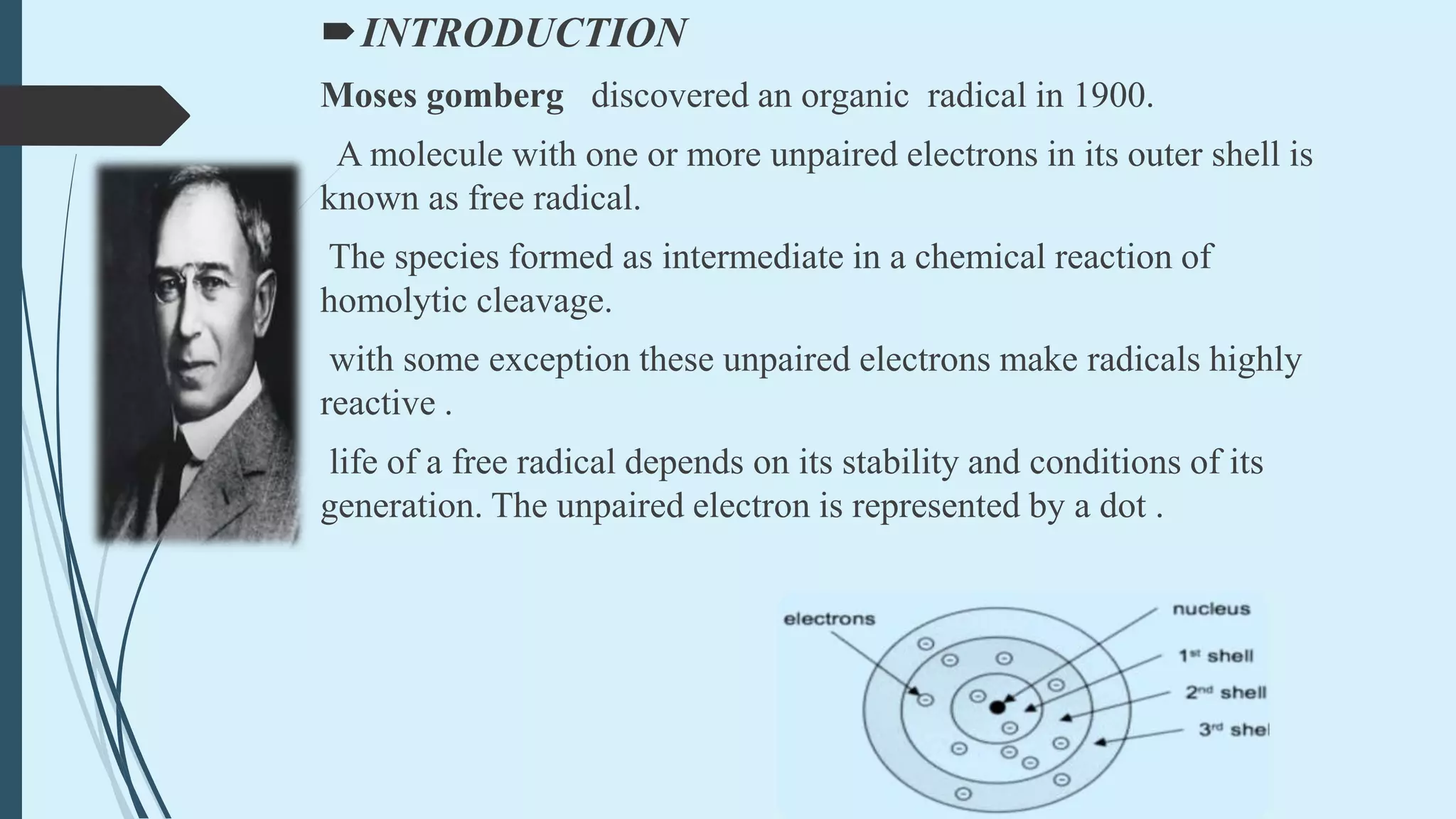
Moses gomberg discovered an organic radical in 1900.
A molecule with one or more unpaired electrons in its outer shell is
known as free radical.
The species formed as intermediate in a chemical reaction of
homolytic cleavage.
with some exception these unpaired electrons make radicals highly
reactive .
life of a free radical depends on its stability and conditions of its
generation. The unpaired electron is represented by a dot .
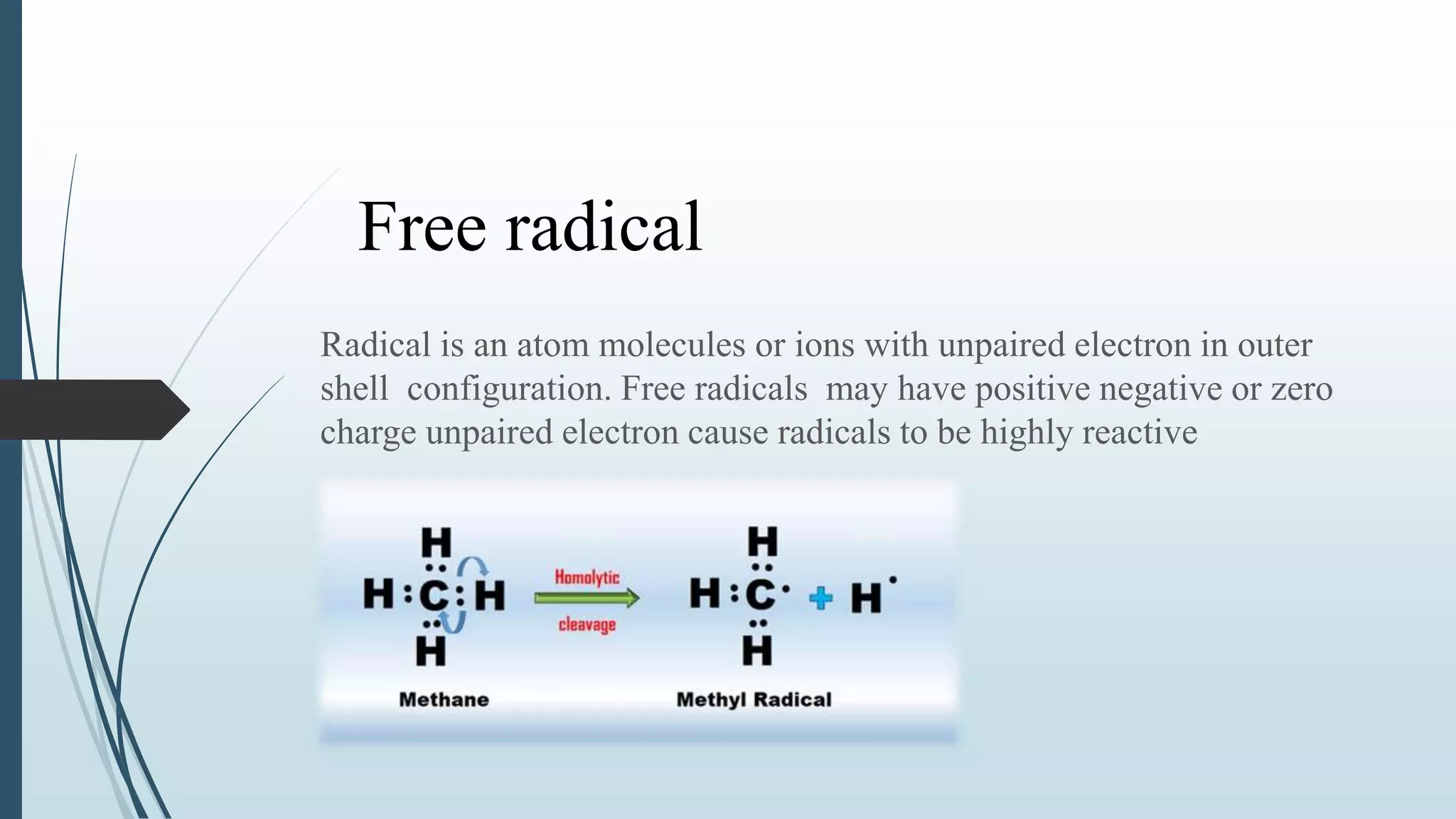
Free radical
Radical is an atom molecules or ions with unpaired electron in outer
shell configuration. Free radicals may have positive negative or zero
charge unpaired electron cause radicals to be highly reactive
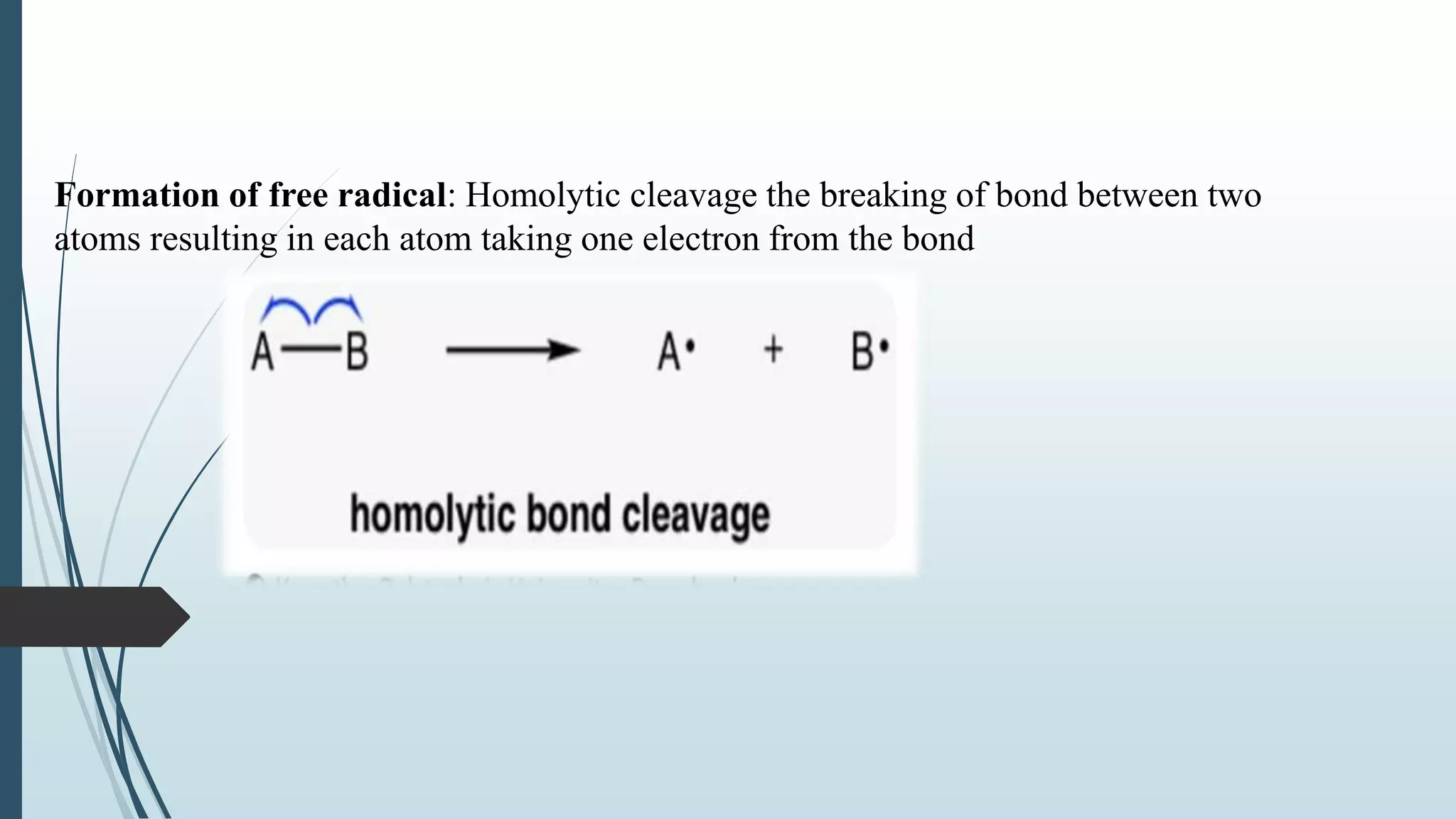
Formation of free radical: Homolytic cleavage the breaking of bond between two
atoms resulting in each atom taking one electron from the bond
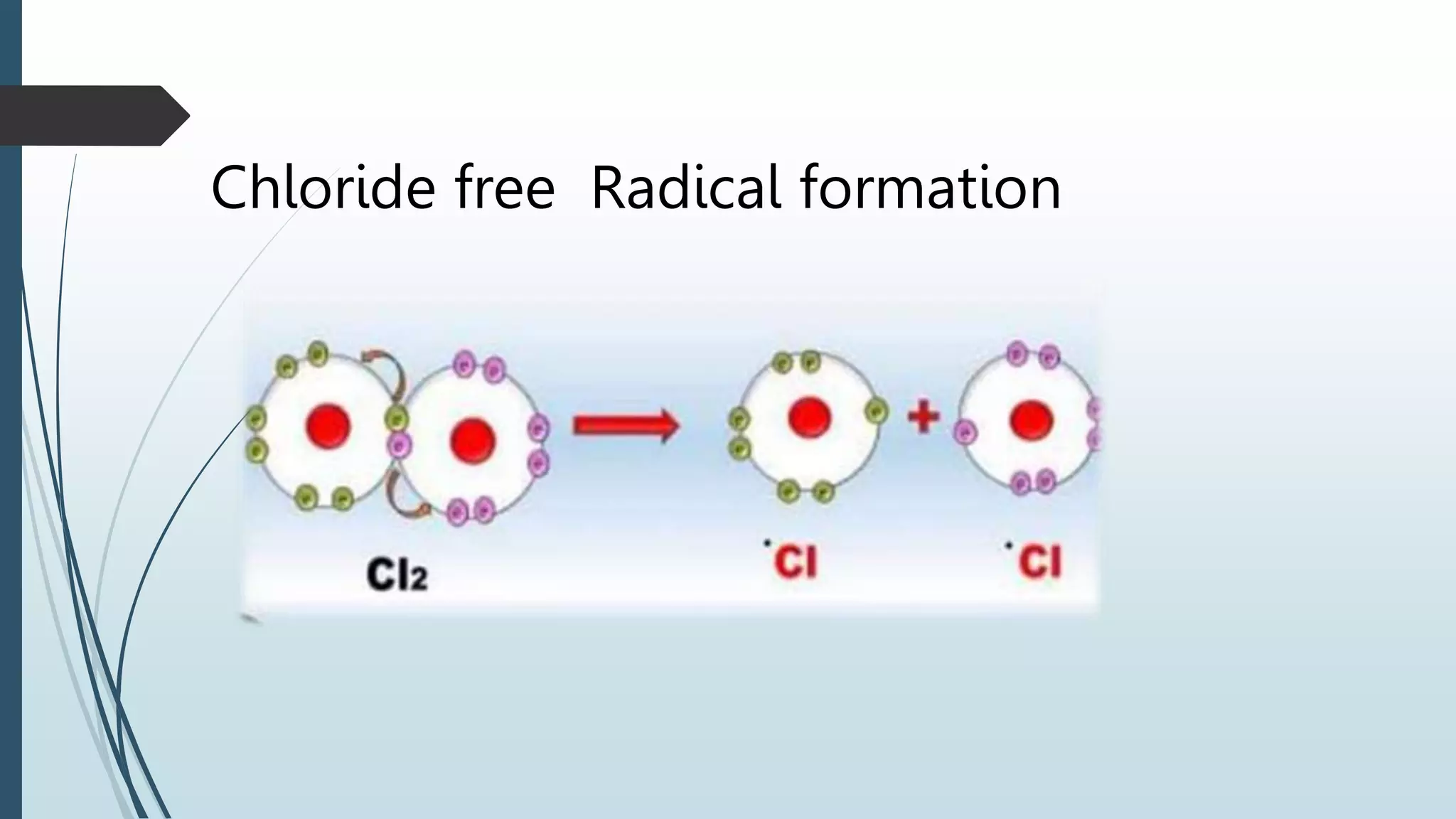
Chloride free Radical formation
Externally generated sources of free radical
SOME INTERNAL SOURCE OF FREE RADICAL
1.Mitochondria
2.Xanthine oxidase
3.Peroxisomes
4.Inflammation
5.Phagocytosis
The reaction of free radicals on biomolecules
Lipid•
Lipid peroxidation and its products are toxic to various cells. Aldehyde and
other product including gaseous hydrocarbon such as ethane and pentane.
Lipid hydroperoxide and some of their degradation products are highly
cytotoxic, which causes extensive damage to enzyme and membrane. DNA can
be damaged, lipid peroxidation has mutagenic effect also.
Proteins•
Protein molecule undergo substantial modification through oxidative reaction.
Amino acid, the building block of peptide and protein are also target of free
radical attack, leads to physical changes in the protein themselves.
 Carbohydrates• No biological substance is impervious of free
radical attack; therefore, it is not surprising that glucose and
other monosaccharides undergo oxidation when condition are
appropriate
 Nucleic acids
 DNA is also prone to oxygen derived free radical’s damage.
 The DNA damage induced by OH includes both base alteration
and strand breaks.
 Cytosine and thymine are the most susceptible to OH damage
followed by adenine, guanine and deoxy ribose sugar moieties.
carcinogenesis
Free radical produce DNA damage and accumulated damage leads to somatic
mutations and malignancy
Aging process:
Reactive oxygen metabolites (ROM) play a role in degenerative brain disorders
such as multiple sclerosis, Alzheimer's dementia
Acute inflammation:
At the inflammatory site, activated macrophages produces free radical.
Neutralizing Agents.
Antioxidant:
An antioxidant is a molecule stable enough to donate an electron to a rampaging
free radicals and neutralizing it thus reducing its capacity to damage.
This antioxidants delay or inhibit cellular damage mainly through their free radical
scavenging property.
There are two types of antioxidants:
1. Preventive antioxidants – they will inhibit the initial production of free radical, they
are catalase, glutathione peroxidase and EDTA.
2. Chain breaking antioxidant – they can inhibit propagative face. They include super
oxide dismutase, uric acid and vitamin E.
 Metal carrier protein :
 It binds to the metal ions helps in transportation and storing. They
hide the free radical, ions enable to generate free radical.
 Scavenging enzymes:
 Converts free radical into harmless substance.
Beneficial role of free radicals
 Deliberate in vivo production of certain type of free radical
(hydroxyl radical, nitric oxide radical) is carried out by some cells.
Example: activated phagocytes(neutrophils, monocytes,
macrophages) this play very important role immunity and it’s a part
of the mechanism by which foreign organisms are eliminated.
 Moreover, free radicals are also said to be play an important
positive role in the process of fertilization, cellular differentiation
and organization and also in programmed cell death.
Conclusion
 A radical is simply an atom with one or more unpaired electron in
its outer orbit.
 Free radical has short life
 Free radical are unstable
 Free radicals have unpaired electron causes radical to be highly
reactive.
 Cancer is the major cause of death, are salient free radical disease.
 In living organism, free radicals’ superoxide and nitric oxide and
they are reaction product regulate many processes, such as control
of vascular tone and thus blood pressure.
Reference
Text book of Biochemistry 7th edition : D M Vasudevan shree
Kumari SKannan Vaidyanathan
Text book of Biochemistry 4th edition: S Singh
THANK YOU

free radical ppt nw.pptx

  • 1.
    MANGALORE UNIVERSITY JNANA KAVERIPG CENTER BIO CHEMESTRY FREE RADICALS PRESENTING BY GUIDE NIDA FIRDOS Dr. K.K.DHARMAPPA 1st MSc Biochemistry DEPARTMENT OF BIOCHEMISTY
  • 2.
    INTRODUCTION Moses gomberg discoveredan organic radical in 1900. A molecule with one or more unpaired electrons in its outer shell is known as free radical. The species formed as intermediate in a chemical reaction of homolytic cleavage. with some exception these unpaired electrons make radicals highly reactive . life of a free radical depends on its stability and conditions of its generation. The unpaired electron is represented by a dot .
  • 3.
    Free radical Radical isan atom molecules or ions with unpaired electron in outer shell configuration. Free radicals may have positive negative or zero charge unpaired electron cause radicals to be highly reactive
  • 4.
    Formation of freeradical: Homolytic cleavage the breaking of bond between two atoms resulting in each atom taking one electron from the bond
  • 5.
  • 6.
  • 7.
    SOME INTERNAL SOURCEOF FREE RADICAL 1.Mitochondria 2.Xanthine oxidase 3.Peroxisomes 4.Inflammation 5.Phagocytosis
  • 8.
    The reaction offree radicals on biomolecules Lipid• Lipid peroxidation and its products are toxic to various cells. Aldehyde and other product including gaseous hydrocarbon such as ethane and pentane. Lipid hydroperoxide and some of their degradation products are highly cytotoxic, which causes extensive damage to enzyme and membrane. DNA can be damaged, lipid peroxidation has mutagenic effect also. Proteins• Protein molecule undergo substantial modification through oxidative reaction. Amino acid, the building block of peptide and protein are also target of free radical attack, leads to physical changes in the protein themselves.
  • 9.
     Carbohydrates• Nobiological substance is impervious of free radical attack; therefore, it is not surprising that glucose and other monosaccharides undergo oxidation when condition are appropriate  Nucleic acids  DNA is also prone to oxygen derived free radical’s damage.  The DNA damage induced by OH includes both base alteration and strand breaks.  Cytosine and thymine are the most susceptible to OH damage followed by adenine, guanine and deoxy ribose sugar moieties.
  • 10.
    carcinogenesis Free radical produceDNA damage and accumulated damage leads to somatic mutations and malignancy Aging process: Reactive oxygen metabolites (ROM) play a role in degenerative brain disorders such as multiple sclerosis, Alzheimer's dementia Acute inflammation: At the inflammatory site, activated macrophages produces free radical.
  • 11.
    Neutralizing Agents. Antioxidant: An antioxidantis a molecule stable enough to donate an electron to a rampaging free radicals and neutralizing it thus reducing its capacity to damage. This antioxidants delay or inhibit cellular damage mainly through their free radical scavenging property. There are two types of antioxidants: 1. Preventive antioxidants – they will inhibit the initial production of free radical, they are catalase, glutathione peroxidase and EDTA. 2. Chain breaking antioxidant – they can inhibit propagative face. They include super oxide dismutase, uric acid and vitamin E.
  • 12.
     Metal carrierprotein :  It binds to the metal ions helps in transportation and storing. They hide the free radical, ions enable to generate free radical.  Scavenging enzymes:  Converts free radical into harmless substance.
  • 13.
    Beneficial role offree radicals  Deliberate in vivo production of certain type of free radical (hydroxyl radical, nitric oxide radical) is carried out by some cells. Example: activated phagocytes(neutrophils, monocytes, macrophages) this play very important role immunity and it’s a part of the mechanism by which foreign organisms are eliminated.  Moreover, free radicals are also said to be play an important positive role in the process of fertilization, cellular differentiation and organization and also in programmed cell death.
  • 14.
    Conclusion  A radicalis simply an atom with one or more unpaired electron in its outer orbit.  Free radical has short life  Free radical are unstable  Free radicals have unpaired electron causes radical to be highly reactive.  Cancer is the major cause of death, are salient free radical disease.  In living organism, free radicals’ superoxide and nitric oxide and they are reaction product regulate many processes, such as control of vascular tone and thus blood pressure.
  • 15.
    Reference Text book ofBiochemistry 7th edition : D M Vasudevan shree Kumari SKannan Vaidyanathan Text book of Biochemistry 4th edition: S Singh
  • 16.