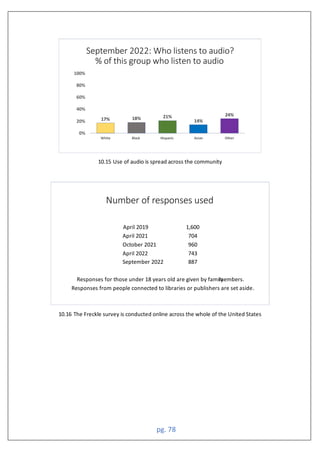
pg. 1
pg. 2
pg. 3
The Freckle Project
The Freckle Report, 2022
Third analysis of public library services
“Libraries need books”
The progress of public libraries
US, UK and Australia
Tim Coates
September 2022
pg. 4
Freckle Report 2022:
In printed form ISBN - 978-1-84381-069-8
As a pdf ISBN - 978-1-84381-070-4
Freckle Report 2021:
In printed form ISBN --978-1-84381-064-3
As a pdf: ISBN -- 978-1-84381-065-0
The Freckle report 2020:
in printed form: ISBN – 978-1-84381-062-9
as a pdf: ISBN -- 978-1-84381-063-6
The combined reports, 2020 and 2021 in one edition
In printed form ISBN -- 978-1-84381-066-7
As a pdf ISBN -- 978-1-84381-067-4
Website - www.freckle.us
tim@freckle.us
© Freckle project 2020
© Freckle project 2021
©Freckle project 2022
© Tim Coates 2020
©Tim Coates 2021
©Tim Coates 2022
Tim Coates is the author of this work
These reportsare subject to the enacted copyright laws in the United States, in Australia, in the United Kingdom
and in Europe. They may not be copied or quoted in whole or in part without the written permission of the
Freckle Project: tim@freckle.us.
pg. 5
About the author: Tim Coates
Tim Coates hasworked in the book industry for morethan 40 years: in retailing,
libraries and publishing. He has been managing director of several large book
retailers, including Waterstone's, the leading UK bookstore group, and of WH
Smith in Europe. Hehas been UK generalmanager of YBP, the academic division
of Baker and Taylor, and now part of EBSCO. He has consulted for library
authorities and library suppliers in the US and the UK. He is frequently called
upon to write reports for local and national government bodies on the public
library sector.
On three occasions he has been named ‘The best bookseller’: once by Peter
Mayer of Penguin Books, New York, once by Paul Hamlyn, of Hamlyn Octopus
and Reed international, the publisher of illustrated booksand onceby theBritish
Book trade press. He has frequently appeared in lists of most influential people
in the publishing industry.
He is an author of fiction, of drama and of historical worksand an editor of over
40 historical papers about both the US and the UK, and to be found as
‘uncovered editions’ and ‘argonaut papers’
He currentlyworksas a lead adviser on both public and academic libraries in the
Freckle project in the US
His published work on the library service includes
- On the closure of English Public Libraries- Public Library Quarterly, October 2018, Taylor and Francis
- The Good Library Manual – Berkshire publishing 2010 ISBN 9781933782881
- The scandalous decline of British public libraries, 2008, Brill, Logos,
- (DOI: https://doi.org/10.2959/logo.2008.19.1.5)
- Britain’s plain-speaking bookman 2005, Brill, Logos
- ( DOI: https://doi.org/10.2959/logo.2005.16.3.148)
- Evidence to the House of Commons Select Committee on Libraries, 2005 ISBN 021502267X
- Who’s in Charge, Responsibility for the public library service. 2002 Libri and Laser, UK
- Various articles in the UK Bookseller
- Various articles in the UK Guardian
- Freckle Reports: 2020, 2021, 2022
He holds Masters degrees from Oxford and from Stirling Universities.
pg. 6
Tim Coates is grateful for their contribution and their support to John Chrastka
and his colleagues at the EveryLibrary Institute in Chicago, and Freckle partners
in London, San Francisco and New York.
He is also especially grateful to Crosby Kemper with his colleagues at the IMLS
for their reading and discussion of previous reports and his understanding and
encouragement to publish with the intention of jointly addressing many of the
issues that are raised.
Sources of material for the evidence in this report
1. The Freckle analysis: ‘Wheredid you get that book?’ Consumer Survey in
the US, conducted in April 2019 through September 2022
2. IMLS: (The US Institute of museums and library services) the sequence of
annual data to 2020, most recently published in 2022 (referred to as
‘IMLS’)
3. CIPFA (The UK Chartered Institute of public finance administration) the
sequence of annual data to 2020, most recently published in 2022
(referred to as ‘CIPFA’) This report refers to GB (Great Britain) which
means England, Scotland and Wales combined)
4. NSLA: (The National State Libraries of Australia) the sequence of annual
data to 2021, most recently published in 2022 (referred to as ‘NSLA’)
5. Pew Research Center – “Book Reading 2016”
6. US and UK census data
Expressions
In the United States, libraries refer to ‘patrons’ and to ‘circulations’. In Australia those are
‘customers’ and ‘loans’. In the UK they are ‘visitors’ and ‘issues’. Everyone refers to ‘readers’
This report uses all of those, but they are interchangeable.
pg. 7
pg. 8
pg. 9
Sections of the report
Page
1. Headlines ……….11
2. Investment in public libraries ……… 13
3. Recommendations ……… 27
4. What matters with libraries ……… 29
5. Reading, Diversity and Libraries ……… 33
6. How libraries can be successful ……….41
7. Public Libraries in the United States ……….47
8. Public libraries in Australia ……….63
9. Public Libraries in the United Kingdom ……….67
10.Consumer survey “Where did you get that book?” ……….73
11.Recommendations from previous reports ……….79
pg. 10
pg. 11
1. Headlines
Since 2010, the number of available public library books in US
libraries has been reduced by 140 million.
• The public library service, which is profoundly important, is in trouble, in decline,
and at risk. This is not for the reasons often offered, such as lack of funds or
developing technology, or changing social needs or political pressures.
• It is not because reading habits have changed, or that people’s desire and need to
read have diminished.
• Nor is it, as is so frequently said, because of the invention of the iPhone, 15 years
ago.
• The problems arise from three overriding causes:
• the management of the service has become confused about and unfocussed
on the purpose of public libraries, to the point of being damaging,
• there is no recognition of the problems by those responsible, and
• there is no leadership or mechanism for improvement.
• Public libraries, only a decade ago were a service that offered buildings in which
many items could be read and from which books could be borrowed. They were
phenomenally popular
• Now they attempt to offer three services
• The traditional library
• A community service of varied activities, initiatives and functions,
often concentrating on those whom the service either regards to be
disadvantaged or to be of political merit.
• A digital service of both literacy and content
All three of these are different and require separate skills and budget. They
barely overlap. It turns out there is insufficient resource for any to be
exceptionally good, and they are not. Actually, they often conflict with each
other: digital use drives down use of the library buildings; community activities
can detract from the facility to read privately. The public use of all the service
has fallen.
• In persistent pursuit of identifying and trying to craft public library service to the
needs of those whom they regard as ‘underserved’ the library profession appear
to have neglected the library service they should provide to all. This is
undoubtedly a cause of the decline in general public library use. The first
endeavour, which is, of course, full of value, should not have precluded the
second, which is also important and which creates the volume of use upon which
political support and library funding depends.
• Most recent figures for the US show
o Annual funding of $15bn and rising
pg. 12
o Continuing decline in the use of most libraries and their services
o A reduction in book collections of 140 million books over a decade
o Failure, notwithstanding their endeavors, to address diverse audiences
o The public of all backgrounds overwhelmingly continue to want libraries to
provide books and access to them
• As publishing technology and supply chains have improved, libraries and the
service they give should have got better. In fact, they have become worse.
• The processes and practices of library collection management and library book
processing are long out of date. They are slow, expensive and wasteful and detract
from the good experience of library patrons.
• The public library service, in the USA, and elsewhere, like many individuals and
institutions, made great efforts during the lockdowns of the Covid pandemic to
adapt services to the special needs of the moment in their communities. During
the pandemic, reading among the population increased, but IMLS figures reporting
libraries own experience, show that use of library services fell. It should have
grown.
• The reality is that public libraries, their profession and their management have
become distracted from the role that people expect them to fulfil. What they do is
not what the general public wants.
• Without some movement and initiative to reverse decline, the service is in peril: it
may never recover properly from the impact of the pandemic. Funders should act.
Recommendations in this report are intended to help them and provide an agenda.
pg. 13
2. Investment in public libraries
This reportanalysesten yearsof public library performance dataand fouryearsof consumer
figures. It is the third of three reports1
.
To those who fund or allocate money to public libraries, locally,
or on behalf of state or federal bodies…
Public libraries need to change and change quickly. Despite extremely good and regular
funding over many years, the use of them is falling. They have moved away from what was
once a verysuccessfulcourse.Without a change in their managementapproach, one cannot
reasonably foresee them returning to the levels of popularity they enjoyed evenbefore the
pandemic.
The public still want them to functionas theyusedto do, and whentheyworkproperly,they
are immensely useful and fundamental.
This report and the two that preceded it, show some surprising figures and all three draw
unusual conclusions. They not only attempt to demonstrate the problems and explain what
has happened. Theyalso try to give clear recommendationsforthe actions that are needed
to put matters right.
As previous reports have said, it is unfortunate that criticisms of library operations, and the
library profession, however constructively expressed, are generally met with defence and
denial. Improvement will not come easily.
The only way repairs can be made is if those who provide funds, at the moment they make
their allocations and their budgets, insist on seeing some change and require that it comes
about. That is the important role that only a fundercan play. It is to be hopedthat anyone in
that position,readingthis,can find the strengthtodrive hardbargains at the time of planning
and budgetingand also ensure that the promisesthat are made at that point are seento be
fulfilled.
Each library needsafirmplanto increase itsuse above the levelitexperiencedin2018,before
the pandemic,andthento continue to grow all the time.And these planshave tobe made to
work.Suchplans shouldall involve significant improvementtoand diversificationof the book
collections. That is what people want and that is what will make them use their local library.
---o---
1 Freckle reports, 2020 ISBN978-1-84381-062-9, Freckle report 2021, ISBN 978-1-84381-064-3 and now
Freckle report 2022 (the current document) ISBN 978-1-84381-069-8
pg. 14
If you were to read the press or social media about US public libraries, the impression made
is that they are not properly funded and have to plead with politicians for the money they
receive;thatstaff are inadequatelypaidandthat publishersare mean,harshand exploitative
in their dealings with libraries. Yet at the same time, we are told, public libraries are an
inventive,thriving,essential,almostmagical and righteousservice intheir local communities.
We readthat theyhave farmore toofferthanmere booksandthattheyare valued,equitable
and trusted and contribute enormously to the reading culture of the country.
A perusal of their own figuresrevealsthat almost all of these observationsare either untrue
or mistaken
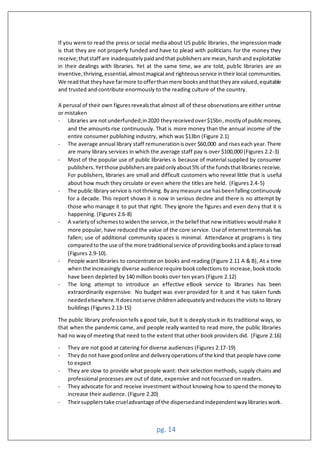
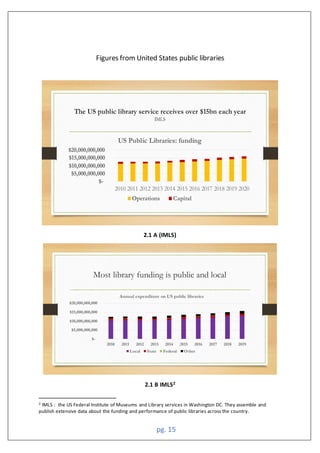
- Libraries are notunderfunded;in2020 theyreceivedover$15bn,mostlyof publicmoney,
and the amounts rise continuously. That is more money than the annual income of the
entire consumer publishing industry, which was $13bn (Figure 2.1)
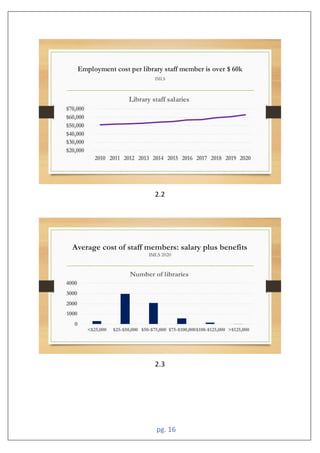
- The average annual library staff remunerationisover $60,000 and riseseach year.There
are many library services in which the average staff pay is over $100,000 (Figures 2.2-3)
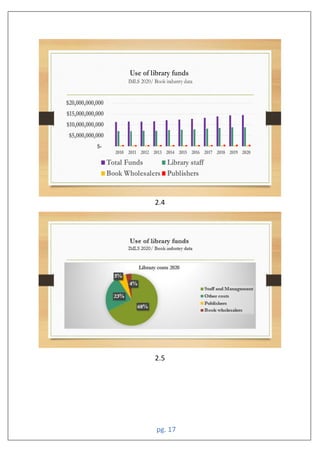
- Most of the popular use of public libraries is because of material supplied by consumer
publishers.Yetthose publishersare paidonlyabout5% of the fundsthatlibraries receive.
For publishers, libraries are small and difficult customers who reveal little that is useful
about how much they circulate or even where the titles are held. (Figures 2.4-5)
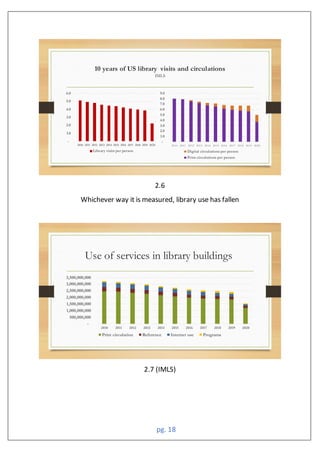
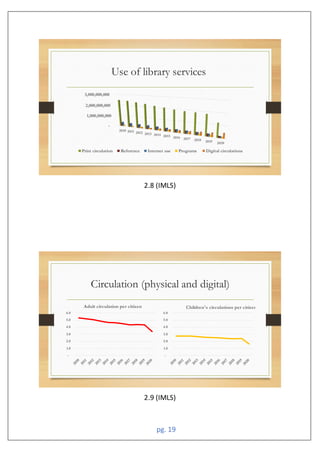
- The public library service is notthriving. Byanymeasure use hasbeenfallingcontinuously
for a decade. This report shows it is now in serious decline and there is no attempt by
those who manage it to put that right. They ignore the figures and even deny that it is
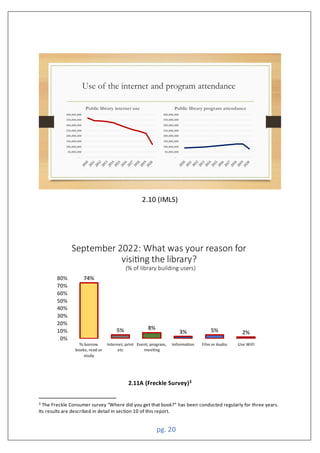
happening. (Figures 2.6-8)
- A varietyof schemestowidenthe service,in the belief that new initiatives wouldmake it
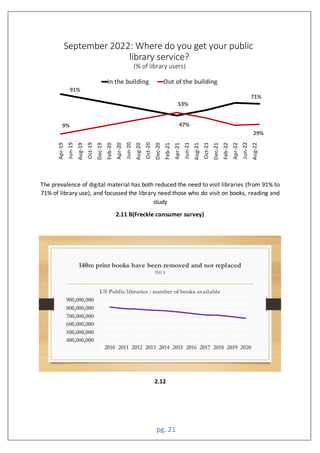
more popular, have reduced the value of the core service. Use of internetterminals has
fallen; use of additional community spaces is minimal. Attendance at programs is tiny
comparedtothe use of the more traditionalservice of providingbooksandaplace toread
(Figures 2.9-10).
- People wantlibraries to concentrate on books and reading (Figure 2.11 A & B), At a time
whenthe increasingly diverse audience require bookcollections to increase,bookstocks
have been depleted by 140 million books over ten years (Figure 2.12)
- The long attempt to introduce an effective eBook service to libraries has been
extraordinarily expensive. No budget was ever provided for it and it has taken funds
neededelsewhere.Itdoesnotserve childrenadequatelyandreducesthe visits to library
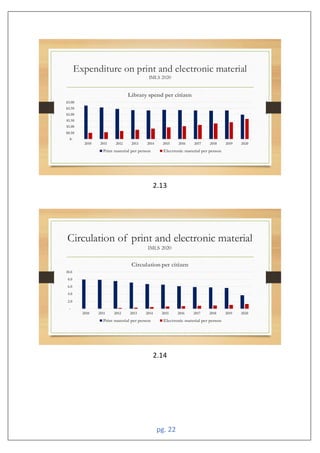
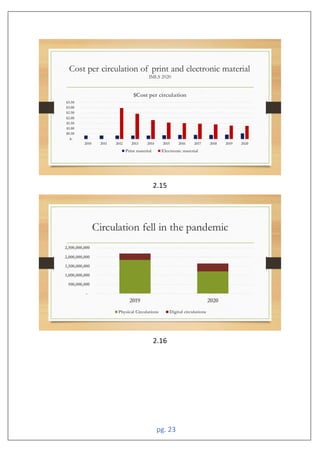
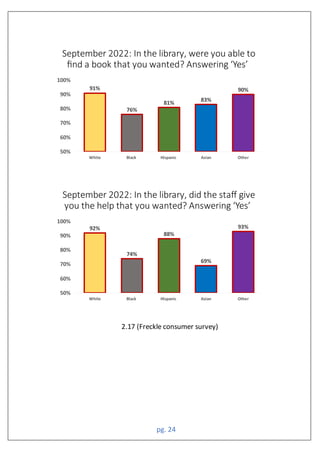
buildings (Figures 2.13-15)
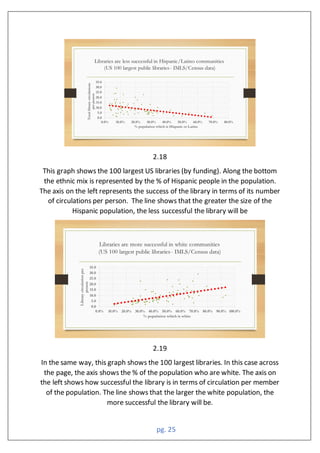
The public library professiontells a good tale, but it is deeplystuck in its traditional ways, so
that when the pandemic came, and people really wanted to read more, the public libraries
had no wayof meeting that need to the extent that other book providers did. (Figure 2.16)
- They are not good at catering for diverse audiences (Figures 2.17-19)
- Theydo not have goodonline and deliveryoperationsof the kind that people have come
to expect
- They are slow to provide what people want: their selection methods, supply chains and
professional processes are out of date, expensive and not focussed on readers.
- They advocate for and receive investment without knowing how to spend the moneyto
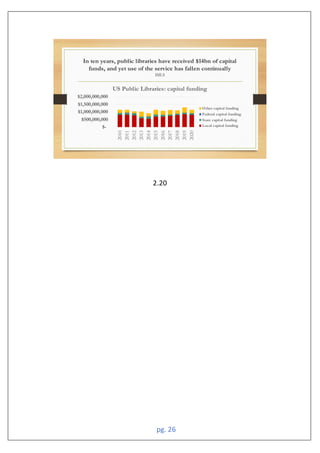
increase their audience. (Figure 2.20)
- Theirsupplierstake crueladvantage of the dispersedandindependentwaylibrarieswork.
pg. 15
Figures from United States public libraries
2.1 A (IMLS)
2.1 B IMLS2
2 IMLS : the US Federal Institute of Museums and Library services in Washington DC. They assemble and
publish extensive data about the funding and performance of public libraries across the country.
pg. 16
2.2
2.3
pg. 17
2.4
2.5
pg. 18
2.6
Whichever way it is measured, library use has fallen
2.7 (IMLS)
pg. 19
2.8 (IMLS)
2.9 (IMLS)
pg. 20
2.10 (IMLS)
2.11A (Freckle Survey)3
3 The Freckle Consumer survey “Where did you get that book?” has been conducted regularly for three years.
Its results are described in detail in section 10 of this report.
o borrow
boo s read or
study
nternet print
et
vent program
mee ng
nforma on ilm or udio se i i
pg. 21
The prevalence of digital material has both reduced the need to visit libraries (from 91% to
71% of library use), and focussed the library need those who do visit on books, reading and
study
2.11 B(Freckle consumer survey)
2.12
pr
un
ug
t
e
eb
pr
un
ug
t
e
eb
pr
un
ug
t
e
eb
pr
un
ug
n the building ut of the building
pg. 22
2.13
2.14
pg. 23
2.15
2.16
pg. 24
2.17 (Freckle consumer survey)
hite la ispani sian ther
pg. 25
2.18
This graph shows the 100 largest US libraries (by funding). Along the bottom
the ethnic mix is represented by the % of Hispanic people in the population.
The axis on the left represents the success of the library in terms of its number
of circulations per person. The line shows that the greater the size of the
Hispanic population, the less successful the library will be
2.19
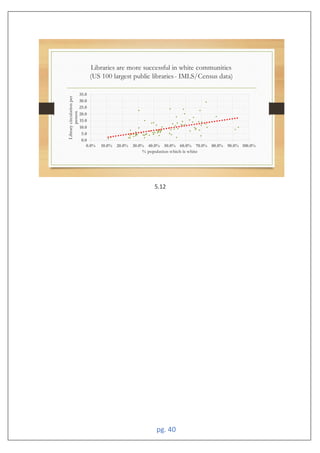
In the same way, this graph shows the 100 largest libraries. In this case across
the page, the axis shows the % of the population who are white. The axis on
the left shows how successful the library is in terms of circulation per member
of the population. The line shows that the larger the white population, the
more successful the library will be.
pg. 26
2.20
pg. 27
3. Recommendations
- “The numbers aren't surprising. We have been seeing the decline in
public library usage from the IMLS data. What is of continual interest is
that the other services that libraries offer have also seen decline. It
speaks not to just funding but rather to the need of the public libraries
need to reinvent themselves (which they have already attempted
repeatedly) or instead to re-focuson core services to see how to improve
those.”
A senior industry executive, April 2022
This report concentrates on practical issues by:
a. Showing library managers how to interpret the published figures
available to them
b. Demonstrating, by showing examples, the strategic issues that face
individual libraries and how they can be dealt with
c. Raising the problems associated with established library practices and
procedures and showing how they can be avoided.
d. Proposing an agenda for change to be adopted by senior library
managers
e. Suggesting the curriculum that should be offered by library schools.
The recommendations are
1. That public libraries accept and follow that their purpose is to help
people of all ages and backgrounds to find what they want to read and
to provide a place to readand study that is well equipped, safe, expert,
dignified and welcoming.
2. That they provide constant timely public data to show that they do
that and that their service improves all the time.
3. That the entire range of existing library practices and collection
processes be replacedby the simplest possible means of providing the
reading material required. For example, there should be no more
plastic jackets, there should be only one label on a library book and
pg. 28
there shouldbe far more newcopies of titles. There should be just one
national universal catalog shared with the book industry. (Section 6)
4. Libraries currently spend over $40 pa per citizen. Each library should
spend at least $4.00 per resident on new printed books and $1.50 per
resident, on other formats: eBooks and audio. This makes a minimum
of $5.50 per resident per year (at 2020 values) on books. (The current
average is half this; 4,000 libraries in the US spend less than $2 per
resident on books). This can be achieved by savings in collection and
supply chain management.
5. That libraries specifically devote their book expenditure on
a. Meeting the diverse andspecial needs of their local communities
b. Restoring their reference collections
c. Acquiring multiple copies of appropriate back and mid list titles,
especially for children
6. There should be one unified technology strategy for public libraries,
withthe means to implement it, to support these purposes. This could
be undertaken by a small set of the very largest libraries (New York,
Los Angeles, Chicago) acting together as a leading group.
7. There should be one national purchasing consortium that creates
library supply contracts with the largest publishers instead of
wholesalers
8. That library schools transformtheir curriculumtomeet these newaims
and provide mid-career refreshment courses to do the same.
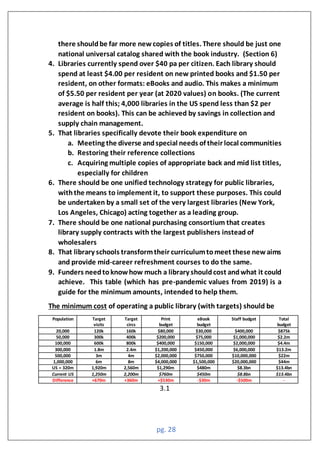
9. Funders needtoknowhow much a library shouldcost andwhat it could
achieve. This table (which has pre-pandemic values from 2019) is a
guide for the minimum amounts, intended to help them.
The minimum cost of operating a public library (with targets) should be
Population Target
visits
Target
circs
Print
budget
eBook
budget
Staff budget Total
budget
20,000 120k 160k $80,000 $30,000 $400,000 $875k
50,000 300k 400k $200,000 $75,000 $1,000,000 $2.2m
100,000 600k 800k $400,000 $150,000 $2,000,000 $4.4m
300,000 1.8m 2.4m $1,200,000 $450,000 $6,000,000 $13.2m
500,000 3m 4m $2,000,000 $750,000 $10,000,000 $22m
1,000,000 6m 8m $4,000,000 $1,500,000 $20,000,000 $44m
US = 320m 1,920m 2,560m $1,290m $480m $8.3bn $13.4bn
Current US 1,250m 2,200m $760m $450m $8.8bn $13.4bn
Difference +670m +360m +$530m -$30m -$500m -
3.1
pg. 29
4. What matters with libraries
What matters with public libraries is whether people choose to use them. That is the test
of the impact of all their services, policies and principles. Even ten years ago, they were
extremely popular. Yet the figures show increasingly, that the public no longer find public
libraries to be so useful.
If they were clear in what their service is, and if it was effectively managed, the library
service in the US would not have produced the poor results they have, year after year for
over a decade, without noticing and without remedy. These figures are reflected widely in
libraries across the country.
People still want libraries to provide books, reading and information and welcoming
dignified buildings. To do these well is not easy. Other services are a management
distraction.
Instead of increasing the book collections to meet the needs of diverse audiences, the
public libraries have removed huge numbers of books from library collections. It was the
opposite of what was needed.
Quite naturally, those who fund libraries encourage them to offer additional community
and educational services. Yet, without proper resource, when they are attempted, these
often dilute the quality of the core offer. Libraries must learn either to resist such
developments or manage them more effectively.
Currently there is not even a recognition that the library service has problems, let alone
any approach to solving them. Funders should be frustrated.
It is only fair to advocate for and request public money, if the service can show that such
funding will increase the use of public libraries or at least limit its decline. At present
advocacy for public libraries does not do that.
There is no confident, clearly stated, publicly recognisable, strategy for what is offered to
the public and there is no efficient management of costs and expenditure
Any child of six can tell you clearly and simply what a library is for, but it is hard to find a
senior library professional who can do the same
The strategy for eBooks should be part of the overall plan for providing books – not a rival
to printed books. There needs to be a defined and budgeted plan, working with
publishers, of a kind that does not exist at present.
eBooks add little to the depth of a library collection. They are a good extra format, like
paperback, illustrated or audio editions, of books which are available in print. There are
many books, often illustrated non-fi tion or hildren’s boo s that are not available as
eBooks; and most titles that are only eBooks are self-published. People may be
inconvenienced but they are rarely deprived if they cannot obtain an eBook. A library can
address individual needs of this kind easily and quickly without huge budget expense.
pg. 30
t is as if the publi library approa h to e oo s followed a zeitgeist that said ‘we must ta e
part in this development’ without thin ing exa tly what the library publi need would be
and how they could work with publishers best to address it. Nor did they have a budget
with which to do it. Public library purchasing of eBook licenses has benefited suppliers
greatly; but, by removing printed books, has done a lot of damage to the reputation of the
service over several years. That is what the figures show.
At the same time, out-dated library practices, like fitting books in plastic jackets, time
intensive cataloging and processing methods, placing requested books on hold, and other
work demarcations and protections should have long ceased. They give the public little
value. The public want more books to be readily available. That is where the
concentration should have been.
Public library methods of collection management place far too much emphasis upon the
titles that libraries hold and circulate. They need to give far more consideration to the
needs of readers for titles that they do not hold. It is from those that growth of use will
come. Only a few of these will come from bestseller lists or wholesaler recommendations
– mostly they lie elsewhere.
Librarians need a better, measured, understanding of the library needs of their whole and
diverse public audience, not just theirpatrons. Librarians do not sufficiently acknowledge
their fundamental responsibility to the entirety of the reading public.
ddressing ‘diversity’ does not mean ommenting on the ra e or ba ground of librarians
authors or publishers or the characters in fiction; it means understanding and meeting all
the various reading needs of people in the community. That is completely different.
Generally, reading in every international culture is 50% non-fiction; 25% fiction and 25%
for children: that is the starting point for building diverse collections and presentations.
Instead of understanding and working with publishers, whose support they need, the
library management waste time and money by engaging them in legal actions.
Overall, in the US, the service needs to reduce staff and management cost by about 6%
and spend that money (c.$500m) on more printed books each year. It is not hard to work
out figures appropriate to any individual library.
The point of criticising the library service is to help the management, and to give those
who provide public funds to libraries ways to seek improvement.
Libraries need clear, simple plans
- For making improvements to book and reading collections
- For making the service more diverse
- For offering digital services to the public
- For developing and making use of technology
pg. 31
- For defining, marketing and funding a valid role for libraries in the
community
- For sensible cost control
- For removing outdated library practices
- For management training
- For giving proper account for performance and the use of public money
There is no visible, accepted, leadership that can create a viable future for public libraries
in America. Without that there will just be slow decline.
Library professionals will not like these comments and other observations in
this report, but they are intended to offer a genuine way forward, that will
reverse the decline. There is much that librarians appear not to see from their
own experience.
The library profession is important in the operation of public libraries, but they
should not be the only source of management.
Library vendors, who profit greatly from the dispersed management that
librarians enjoy, gain much from the inefficient operation and will attempt to
dismiss what is said here: but their profits benefit them and not the public, and
that money would be better spent in libraries.
Taxpayers and those local and national politicians and individuals who fund
public libraries, if they were made more aware of the performance figures,
could and should reasonably be exasperated and frustrated with the way that
the service is operated.
They should be much more demanding of those who manage public libraries,
seeking
- That use of the library buildings (which incur most of the cost and use
most of the funds) be seen to increase
- That costs of operating the service be seen to decrease or that there is
an increase in value for money.
- That levels of satisfaction and the long-standing reputation of the public
library service be measured in detail and shown to be sustained and to
improve
Contrary to the current fashion of the library profession these important
objectives will NOT be achieved:
pg. 32
- By adding services intended to be of general community benefit but in
which librarians have no specialist training, expertise or experience.
- By reducing the investment in print books, which is already too low, in
order to offer eBook or any other services.
- By seeking conflict with book publishers, upon whose support and
cooperation they depend, as they have been doing.
- By pleading that they are entitled to funds because of their heritage, but
irrespective of and without reporting, the falling public use of the
service.
- By ignoring, denying and neither analysing nor properly comprehending,
figures that show falling use
In contrast, increased public use WILL be achieved by
- Concentrating their resource and activities on those services for which
public libraries have a fabulous, immense and envied reputation.
- Improving the book collections for white and especially for non-white
communities
- Increasing significantly the numbers of new copies of books on display in
the libraries clearly categorised for the public to understand
- Eliminating the outdated and expensive practices of selecting, collecting
and processing books, placing them in plastic covers and labelling them,
cataloging and reserving them in ways particular and peculiar to public
libraries
- Seeking, willingly and urgently, productive economies of scale and
supply chain improvements across the library sector in ways that do not
happen at present. This should include practical ways of working in
unison, more closely and constructively, together and with the largest
publishers upon whom libraries rely for their service
- Creating a unified app, web presence and technology which reflects the
immense asset base of the public library service across the country.
- Actively avoiding practices that require the service of library specialist
vendors who are costly and predatory.
- Publishing proper management measurements that are transparent,
timely and available to funders, publishers, authors and the public
pg. 33
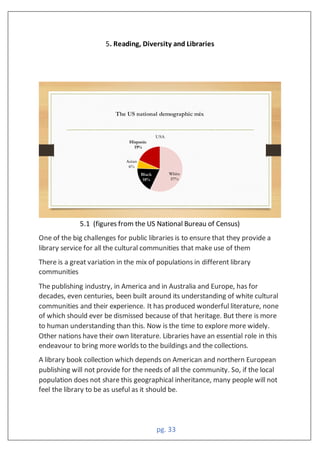
5. Reading, Diversity and Libraries
5.1 (figures from the US National Bureau of Census)
One of the big challenges for public libraries is to ensure that they provide a
library service for all the cultural communities that make use of them
There is a great variation in the mix of populations in different library
communities
The publishing industry, in America and in Australia and Europe, has for
decades, even centuries, been built around its understanding of white cultural
communities and their experience. It has produced wonderful literature, none
of which should ever be dismissed because of that heritage. But there is more
to human understanding than this. Now is the time to explore more widely.
Other nations have their own literature. Libraries have an essential role in this
endeavour to bring more worlds to the buildings and the collections.
A library book collection which depends on American and northern European
publishing will not provide for the needs of all the community. So, if the local
population does not share this geographical inheritance, many people will not
feel the library to be as useful as it should be.
pg. 34
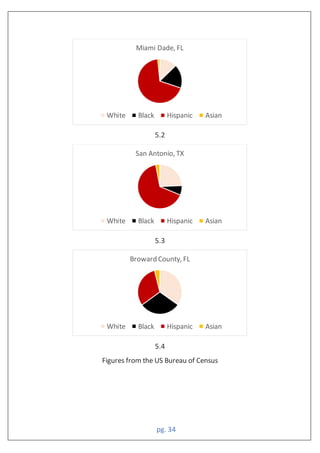
5.2
5.3
5.4
Figures from the US Bureau of Census
Miami Dade, FL
White Black Hispanic Asian
San Antonio, TX
White Black Hispanic Asian
Broward County, FL
White Black Hispanic Asian
pg. 35
5.5
5.6
5.7
Allen County, IN
White Black Hispanic Asian
Johnson County, KS
White Black Hispanic Asian
Palm Beach, FL
White Black Hispanic Asian
pg. 36
Library % White Circs/pp Library Visits/pp
Miami-Dade, FL 12.9% 1.4 1.2
San Antonio, TX 24.0% 2.8 1.2
Broward County, FL 34.8% 3.3 1.7
USA 57.0% 5.0 2.2
Allen County, IN 73.1% 8.9 3.4
Johnson County, KS 79.4% 12.5 2.3
Palm Beach, FL 93.5% 8.1 2.5
5.8
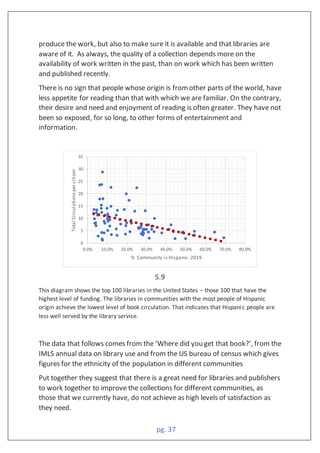
This table and the diagramsabove highlight aselection from among the largestlibraryservices
in the country. They show both the extent of variation of population and also how it tends to
be the communities with large white populations who achieve the highest level of book
circulation and library visits. Figures from the IMLS and the US Bureau of Census.
In the same way that a library provides for a whole range of interests based on
the education and culture of the people in their country, increasingly that need
is expanding to meet the needs of people from other countries and histories.
Being successful addressing diverse audiences is not just about the numbers of
librarians of color4
, nor is it, as publishers often say, about the color of authors
or characters in books, or even of people working in a publisher’s office.
It is about whether the book industry can meet the real reading needs of
people who live and have families in the communities they serve
Those are the measures that really matter.
We think of the sections of a library, for children, for literature, for history, for
self-help, for reference, for the arts, for domestic life, like design and food, and
so on. These now have to address, through writing and books, not just
traditional American interests, but those of all the cultures of the
neighborhood. And they have to do it with high quality and style
This is not easy at all. And it depends on being able to find the same high
standard of publication, say for a Sri Lankan or a Mandarin speaking
community, as for an American one. Libraries depend on publishers not only to
4 The ALA report for 2022 says this “Our membership is still largely white (88.7% vs. 72% for the general
population) with 3.7% reporting their ethnicity as Hispanic or Latino. In describing their race/family origin, ALA
members reported being 4.5% Black or African American, 3.7% Asian, 1.1% American Indian or Alaska Native,
0.2% Native Hawaiian or Other Pacific Islander, and 3.8% Other.”
pg. 37
produce the work, but also to make sure it is available and that libraries are
aware of it. As always, the quality of a collection depends more on the
availability of work written in the past, than on work which has been written
and published recently.
There is no sign that people whose origin is fromother parts of the world, have
less appetite for reading than that with which we are familiar. On the contrary,
their desire and need and enjoyment of reading is often greater. They have not
been so exposed, for so long, to other forms of entertainment and
information.
5.9
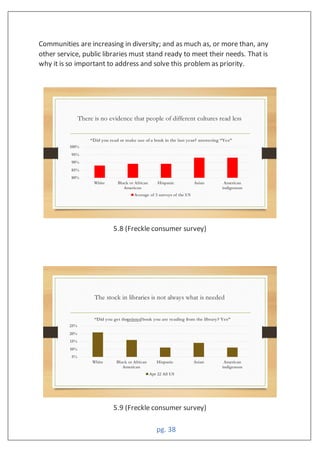
This diagram shows the top 100 libraries in the United States – those 100 that have the
highest level of funding. The libraries in communities with the most people of Hispanic
origin achieve the lowest level of book circulation. That indicates that Hispanic people are
less well served by the library service.
The data that follows comes from the ‘Where did you get that book?’, from the
IMLS annual data on library use and from the US bureau of census which gives
figures for the ethnicity of the population in different communities
Put together they suggest that there is a great need for libraries and publishers
to work together to improve the collections for different communities, as
those that we currently have, do not achieve as high levels of satisfaction as
they need.
0
5
10
15
20
25
30
35
0.0% 10.0% 20.0% 30.0% 40.0% 50.0% 60.0% 70.0% 80.0%
Total
Circulations
per
citizen
% Community is Hispanic- 2019
pg. 38
Communities are increasing in diversity; and as much as, or more than, any
other service, public libraries must stand ready to meet their needs. That is
why it is so important to address and solve this problem as priority.
5.8 (Freckle consumer survey)
5.9 (Freckle consumer survey)
pg. 39
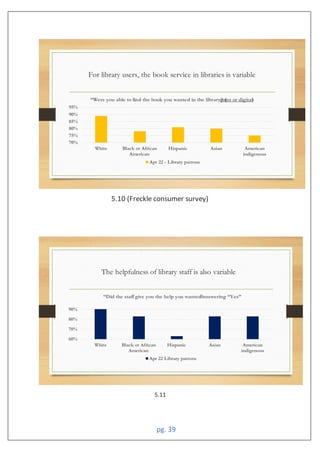
5.10 (Freckle consumer survey)
5.11
pg. 40
5.12
pg. 41
6. How libraries can be successful
Reading and public libraries
If you work with books -authors, publishers, booksellers, librarians- you should
never ever think that people don’t want to read. They always do. Every one of
them. You might not know when or where or what they will read about – but
they will. Never preach, never judge, but always know that people want books.
It’s a private matter for them. Don’t try to persuade them to read by offering
them other entertainments and enticements: it doesn’t work and there is no
need. Your job is to put as many books as possible in front of them so they can
see them. And to be helpful when they ask. Don’t turn a library into a family
playground. It puts off your more serious customers.
Libraries don’t teach literacy. That is highly specialised skill. Librarians are not
teachers. A library’s role is to provide the material to read when someone is
literate or even learning how to read and to help them find what they might
want. That is true for adults and children of all backgrounds.
It is not the role of libraries to be innovative about reading. Publishers do that-
it is their skill. Libraries should use the inventiveness of authors and publishers
to please the readers who come to them
Itis the roleof libraries alwaysto seek to be helpfuland informativeand to make
their buildings attractive, welcoming,dignified and goodforreadersto find what
they might need and enjoy. Librariesshould be lovely places just to sit and read.
Recommendations for increasing public library use
Offer more books
1. Treble the number of books on display. At least. More titles, more
copies. Less exposed carpet, more shelves, less empty spaces. (Don’t
reduce the areas dedicated to private reading). Good layout design of
library spaces is key. Treble the stock on display.
Use Display signs
2. Use display classifications and header cards in words intended to be
helpful to patrons (not Dewey classes). These should change at any time
and all the time, to meet fashionable reading interests. For example, if
the Olympics merit a section of display, then do it. If local politics is a
pg. 42
current interest, then give it a section. If mountain walking is a local
hobby, then give it a section. Don’t worry about duplicating copies in
different sections (or in multiple branches). Display headings are the
most helpful and useful service a library can give. Don’t use bland
expressions like ‘hot picks’ – give a proper description of why the books
have been displayed together.
3. The two most popular reasons for choosing a book to read are ‘It is by an
author whose work I want to read’ or ‘It is on a subject about which I
want to read’. Those, and having the book available, are the most
important ways of helping readers to find what they want. That’s what
the display classifications should do.
6.1 Freckle survey: What made you choose that book? The presence of titles and the
signposting of book displays are the most important influences.
4. Make the displays abundant, colorful, attractive, informative,
authoritative and interesting. Each branch should ensure that every
classification meets those requirements and every branch should have
the means and the control to make sure that it does. Displays should be
reviewed constantly.
ll respondents
pg. 43
Title Selection
5. Title selection or ‘collection management’ is about building up the
quality of every shelf and display in the library. It should include worksof
authority, works by well-known authors, works to initiate people to the
subject and so on. Many of these titles will not be newly published.
6. When spending the budget for title selection it is wise to keep at least
half to be spent on replacement copies of books that have been held for
some time, but are becoming worn. This is especially true of children’s
books.
7. Good selection management means seeking out the specialist publishers
of particular topics and making use of their expertise and enthusiasm.
8. Supplier systems that recommend titles on the basis of use, are of very
limited value. They do not make for good collections.
9. The displays must include, in depth, books in all languages and cultures
relevant to the community. This might mean searching for and making
use of publishers and distributors who are expert in particular cultures.
Appropriate enthusiasm and stock knowledge is unlikely to come from a
broad wholesaler or library supplier. Library suppliers cannot emphasise
everything they do: a specialist publisher can. That is important to the
energy that accompanies a good display.
10.The individual branch stock should be so good that shared collections
between branch libraries are rarely needed. Patrons should find what
they want to read on the shelves, and not be told they have to wait, or
that it will come from another branch library. Aim for 95% instant
satisfaction at least.
Book Processing, acquisition, cataloging, handling and distribution
11.Library processing as it operates at present is mostly unnecessary; it can
be improved by using the following guides:
12. A book should have only one unobtrusive library label which is a
barcodecontaining the ISBN and a universalcopy number. That label can
also contain the Thema classification from Onix5
5 The ‘Onix’ feed is a standard international publisher file which gives data about every title that is available,
both new and old. It is created early in the process of life of the book and is constantly revised both before and
after publication. It is edited by industry experts to ensure the classification and the descriptions are reliable. It
uses a classification system called Thema which is designed to be appropriate for both retailers and libraries.
pg. 44
13.The single library label should be applied to a new book, on arrival, or
handling, in a branch
14.Library catalogs should use full industry Onix feeds for description and
for content
15.The catalog classification should only be the ‘Thema’ code in the onix
feed.
16.There should be no Marc records in public libraries. The catalog record in
Onix is sufficient.
17.Accession into the library system should be on
a. Placement of the order,
b. Delivery, or,
c. First use in a branch and application of the library label
18.Self-service should be by barcode scanning of the single library label
19.There should be no RFID
20.There should be no specialist library suppliers or book processing
21.Supply contracts should be established by Consortia. As much as
possible they should set up supply and distribution arrangements
directly with publishers and trade wholesalers who will not carry out
library processing.
22.There should be no local warehousing or in-house distribution. It is
normally cheaper and faster to acquire a copy than to transfer one.
23.Libraries should reduce the amount of plastic book protection to an
absolute minimum; use it only if really needed. It is often cheaper to buy
new copies than to use plastic covering, which is unattractive and spoils
the book design. The plastic only protects the exterior. When books are
grubby, if it is possible, replace them with new copies straight away.
Patron membership
24.Patron membership should require only a reliable means of contact
25.More patron membership detail is helpful but only if the patron wishes
to give it
26.Libraries should operate discretionary money deposits on items or with
patrons when there is risk.
27.There should be no automatic fines.
https://bisg.org/general/custom.asp?page=ONIXforBooks&msclkid=0dfc06f2c3a211ecba35d2e15e1af08b, For
libraries, the onix feed should be embedded in the library catalog through the library management system.
pg. 45
28.Libraries should acquire material for patrons but set limits on the cost
per patron and per title.
The library website and app
29.The library website or App exists to help patrons find whatever they
want, irrespective of whether the library currently holds copies or what
format they are in. It should enable a patron both to find a title and then
show clearly how they can obtain it quickly, whatever it takes. If the
library will pay for a request, then fine; if the patron needs to make a
contribution to the cost, then both those should be dealt with straight
away on the website using a formula that represents the library policy.
30.The website should not be just a presentation of current holdings of the
library. It should show every publication in every format. The onix feed
will supply that.
31.The library website and App should be part of the library management
system, not separate from it.
eBooks
32.The eBook collection is a supplement to the print book collection, not an
alternative to it. That means that both print, eBook and audio all need
separate budgets. There needs to be one strategy which aims to give a
reader the book they want. The job is to make sure that the patron
firstly can obtain the title in some form and then, if budgets allow or the
patron wishes to pay, to obtain it in another form that they prefer.
Straight away.
33.Do not reduce the print book budget in order to buy eBooks or audio.
That risks reduction in library visits and a failure to meet patrons’ needs.
The amount of material available in print far exceeds the available titles
in either eBook or audio form.
The Library Management System (ILMS)
34.A library management system should comprise standard universally
interchangeable files of
a. Patrons
b. Locations
c. The industry onix feed and local holdings of each ISBN
d. Transactions and histories
pg. 46
e. Supply contracts
f. Events, calendars and histories
g. Analytics
35.The ILMS should contain the complete library website and app for all
materials, files and transactions
36.Libraries should share non-personally identifiable circulation data with
publishers and authors through the contracting consortium
Measuring success
37.The measure is how quickly all patrons obtain what they want. If a
branch library can achieve a success rate of 95%, then use of libraries
will rise by more than 50% within a few months.
38.The ILMS should measure not only how many transactions are made but
also how many patrons have used the service.
pg. 47
7. Public Libraries in the United States
In this section the intention is to show library managers how they can read the
published figures and use them to make improvements to their own service.
The figures shown here are actual figures from the IMLS annual publications.
There are libraries of different sizes
The figures are like hospital blood tests. They don’t provide a diagnosis. But
they do indicate where problems and the solutions to them might lie. They
don’t tell everything, but they are enough to be the basis of analysis. They are
important and should not be ignored. They should be an essential part of
annual budgeting and planning. In every case the strategy should be to
allocate available funds to widen the patron base and to increase each patrons’
use.
These are the libraries included in these illustrations
• Miami Dade, FL (6 months in lockdown in 2020)
• Kansas City, MO (3 months in lockdown in 2020)
• Columbus Metropolitan, OH (9 months in lockdown in 2020)
• New York Public Library, NY (9 months in lockdown in 2020)
• Sacramento, CA (3 months in lockdown in 2020)
• Grand County Public Libraries, CO (9 months in lockdown in 2020)
• Lucy Robbins Welles libraries, CT (3 months in lockdown in 2020)
• Appalachian Regional Libraries, NC (3 months in lockdown in 2020)
pg. 48
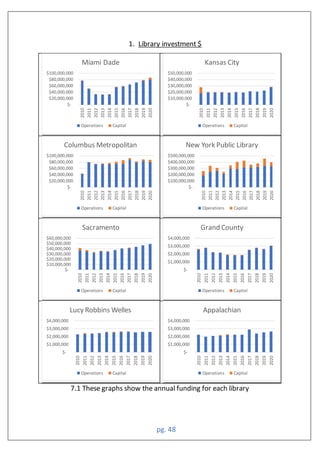
1. Library investment $
7.1 These graphs show the annual funding for each library
$-
$20,000,000
$40,000,000
$60,000,000
$80,000,000
$100,000,000
2010
2011
2012
2013
2014
2015
2016
2017
2018
2019
2020
Miami Dade
Operations Capital
$-
$10,000,000
$20,000,000
$30,000,000
$40,000,000
$50,000,000
2010
2011
2012
2013
2014
2015
2016
2017
2018
2019
2020
Kansas City
Operations Capital
$-
$20,000,000
$40,000,000
$60,000,000
$80,000,000
$100,000,000
2010
2011
2012
2013
2014
2015
2016
2017
2018
2019
2020
Columbus Metropolitan
Operations Capital
$-
$100,000,000
$200,000,000
$300,000,000
$400,000,000
$500,000,000
2010
2011
2012
2013
2014
2015
2016
2017
2018
2019
2020
New York Public Library
Operations Capital
$-
$10,000,000
$20,000,000
$30,000,000
$40,000,000
$50,000,000
$60,000,000
2010
2011
2012
2013
2014
2015
2016
2017
2018
2019
2020
Sacramento
Operations Capital
$-
$1,000,000
$2,000,000
$3,000,000
$4,000,000
2010
2011
2012
2013
2014
2015
2016
2017
2018
2019
2020
Grand County
Operations Capital
$-
$1,000,000
$2,000,000
$3,000,000
$4,000,000
2010
2011
2012
2013
2014
2015
2016
2017
2018
2019
2020
Lucy Robbins Welles
Operations Capital
$-
$1,000,000
$2,000,000
$3,000,000
$4,000,000
2010
2011
2012
2013
2014
2015
2016
2017
2018
2019
2020
Appalachian
Operations Capital
pg. 49
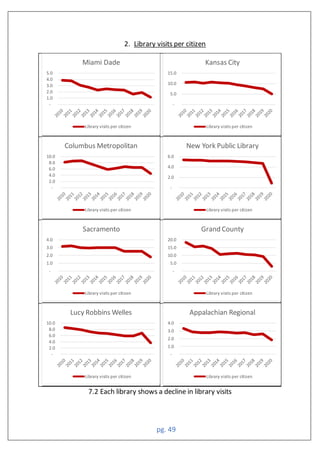
2. Library visits per citizen
7.2 Each library shows a decline in library visits
-
1.0
2.0
3.0
4.0
5.0
Miami Dade
Library visits per citizen
-
5.0
10.0
15.0
Kansas City
Library visits per citizen
-
2.0
4.0
6.0
8.0
10.0
Columbus Metropolitan
Library visits per citizen
-
2.0
4.0
6.0
New York Public Library
Library visits per citizen
-
1.0
2.0
3.0
4.0
Sacramento
Library visits per citizen
-
5.0
10.0
15.0
20.0
Grand County
Library visits per citizen
-
2.0
4.0
6.0
8.0
10.0
Lucy Robbins Welles
Library visits per citizen
-
1.0
2.0
3.0
4.0
Appalachian Regional
Library visits per citizen
pg. 50
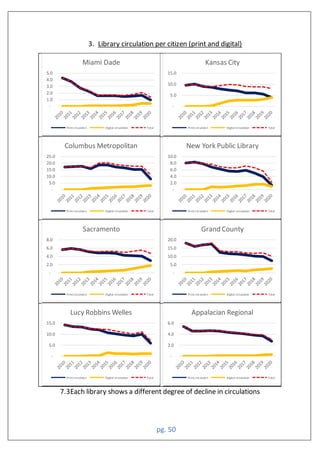
3. Library circulation per citizen (print and digital)
7.3Each library shows a different degree of decline in circulations
-
1.0
2.0
3.0
4.0
5.0
Miami Dade
Print circulaton Digital circulation Total
-
5.0
10.0
15.0
Kansas City
Print circulaton Digital circulation Total
-
5.0
10.0
15.0
20.0
25.0
Columbus Metropolitan
Print circulaton Digital circulation Total
-
2.0
4.0
6.0
8.0
10.0
New York Public Library
Print circulaton Digital circulation Total
-
2.0
4.0
6.0
8.0
Sacramento
Print circulaton Digital circulation Total
-
5.0
10.0
15.0
20.0
Grand County
Print circulaton Digital circulation Total
-
5.0
10.0
15.0
Lucy Robbins Welles
Print circulaton Digital circulation Total
-
2.0
4.0
6.0
Appalacian Regional
Print circulaton Digital circulation Total
pg. 51
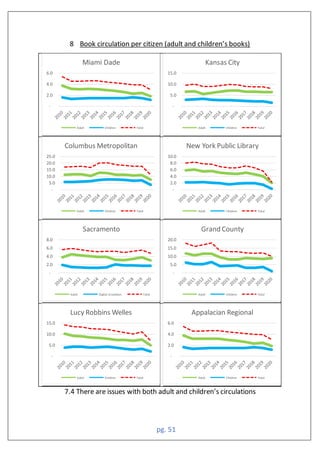
8 Book circulation per citizen (adult and children’s books)
7.4 There are issues with both adult and children’s circulations
-
2.0
4.0
6.0
Miami Dade
Adult Children Total
-
5.0
10.0
15.0
Kansas City
Adult Children Total
-
5.0
10.0
15.0
20.0
25.0
Columbus Metropolitan
Adult Children Total
-
2.0
4.0
6.0
8.0
10.0
New York Public Library
Adult Children Total
-
2.0
4.0
6.0
8.0
Sacramento
Adult Digital circulation Total
-
5.0
10.0
15.0
20.0
Grand County
Adult Children Total
-
5.0
10.0
15.0
Lucy Robbins Welles
Adult Children Total
-
2.0
4.0
6.0
Appalacian Regional
Adult Children Total
pg. 52
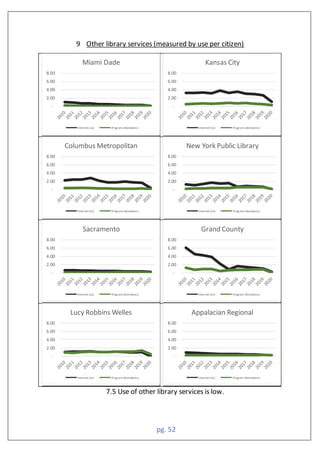
9 Other library services (measured by use per citizen)
7.5 Use of other library services is low.
-
2.00
4.00
6.00
8.00
Miami Dade
Internet use Program attendance
-
2.00
4.00
6.00
8.00
Kansas City
Internet Use Program attendance
-
2.00
4.00
6.00
8.00
Columbus Metropolitan
Internet Use Program attendance
-
2.00
4.00
6.00
8.00
New York Public Library
Internet Use Program attendance
-
2.00
4.00
6.00
8.00
Sacramento
Internet Use Program Attendance
-
2.00
4.00
6.00
8.00
Grand County
Internet Use Program Attendance
-
2.00
4.00
6.00
8.00
Lucy Robbins Welles
Internet Use Program Attendance
-
2.00
4.00
6.00
8.00
Appalacian Regional
Internet Use Program Attendance
pg. 53
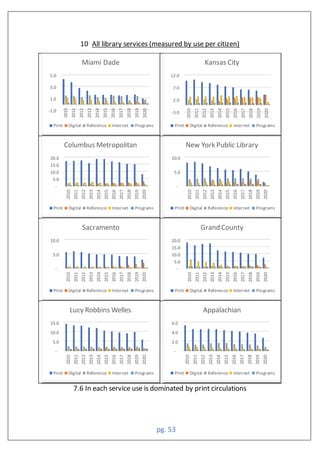
10 All library services (measured by use per citizen)
7.6 In each service use is dominated by print circulations
-1.0
1.0
3.0
5.0
2010
2011
2012
2013
2014
2015
2016
2017
2018
2019
2020
Miami Dade
Print Digital Reference Internet Programs
-3.0
2.0
7.0
12.0
2010
2011
2012
2013
2014
2015
2016
2017
2018
2019
2020
Kansas City
Print Digital Reference Internet Programs
-
5.0
10.0
15.0
20.0
2010
2011
2012
2013
2014
2015
2016
2017
2018
2019
2020
Columbus Metropolitan
Print Digital Reference Internet Programs
-
5.0
10.0
2010
2011
2012
2013
2014
2015
2016
2017
2018
2019
2020
New York Public Library
Print Digital Reference Internet Programs
-
5.0
10.0
2010
2011
2012
2013
2014
2015
2016
2017
2018
2019
2020
Sacramento
Print Digital Reference Internet Programs
-
5.0
10.0
15.0
20.0
2010
2011
2012
2013
2014
2015
2016
2017
2018
2019
2020
Grand County
Print Digital Reference Internet Programs
-
5.0
10.0
15.0
2010
2011
2012
2013
2014
2015
2016
2017
2018
2019
2020
Lucy Robbins Welles
Print Digital Reference Internet Programs
-
2.0
4.0
6.0
2010
2011
2012
2013
2014
2015
2016
2017
2018
2019
2020
Appalachian
Print Digital Reference Internet Programs
pg. 54
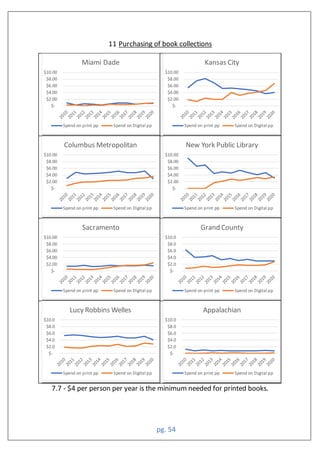
11 Purchasing of book collections
7.7 - $4 per person per year is the minimum needed for printed books.
$-
$2.00
$4.00
$6.00
$8.00
$10.00
Miami Dade
Spend on print pp Spend on Digital pp
$-
$2.00
$4.00
$6.00
$8.00
$10.00
Kansas City
Spend on print pp Spend on Digital pp
$-
$2.00
$4.00
$6.00
$8.00
$10.00
Columbus Metropolitan
Spend on print pp Spend on Digital pp
$-
$2.00
$4.00
$6.00
$8.00
$10.00
New York Public Library
Spend on print pp Spend on Digital pp
$-
$2.00
$4.00
$6.00
$8.00
$10.00
Sacramento
Spend on print pp Spend on Digital pp
$-
$2.0
$4.0
$6.0
$8.0
$10.0
Grand County
Spend on print pp Spend on Digital pp
$-
$2.0
$4.0
$6.0
$8.0
$10.0
Lucy Robbins Welles
Spend on print pp Spend on Digital pp
$-
$2.0
$4.0
$6.0
$8.0
$10.0
Appalachian
Spend on print pp Spend on Digital pp
pg. 55
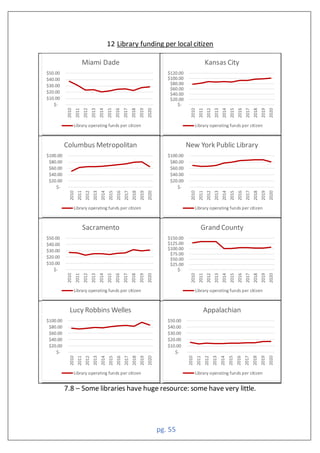
12 Library funding per local citizen
7.8 – Some libraries have huge resource: some have very little.
$-
$10.00
$20.00
$30.00
$40.00
$50.00
2010
2011
2012
2013
2014
2015
2016
2017
2018
2019
2020
Miami Dade
Library operating funds per citizen
$-
$20.00
$40.00
$60.00
$80.00
$100.00
$120.00
2010
2011
2012
2013
2014
2015
2016
2017
2018
2019
2020
Kansas City
Library operating funds per citizen
$-
$20.00
$40.00
$60.00
$80.00
$100.00
2010
2011
2012
2013
2014
2015
2016
2017
2018
2019
2020
Columbus Metropolitan
Library operating funds per citizen
$-
$20.00
$40.00
$60.00
$80.00
$100.00
2010
2011
2012
2013
2014
2015
2016
2017
2018
2019
2020
New York Public Library
Library operating funds per citizen
$-
$10.00
$20.00
$30.00
$40.00
$50.00
2010
2011
2012
2013
2014
2015
2016
2017
2018
2019
2020
Sacramento
Library operating funds per citizen
$-
$25.00
$50.00
$75.00
$100.00
$125.00
$150.00
2010
2011
2012
2013
2014
2015
2016
2017
2018
2019
2020
Grand County
Library operating funds per citizen
$-
$20.00
$40.00
$60.00
$80.00
$100.00
2010
2011
2012
2013
2014
2015
2016
2017
2018
2019
2020
Lucy Robbins Welles
Library operating funds per citizen
$-
$10.00
$20.00
$30.00
$40.00
$50.00
2010
2011
2012
2013
2014
2015
2016
2017
2018
2019
2020
Appalachian
Library operating funds per citizen
pg. 56
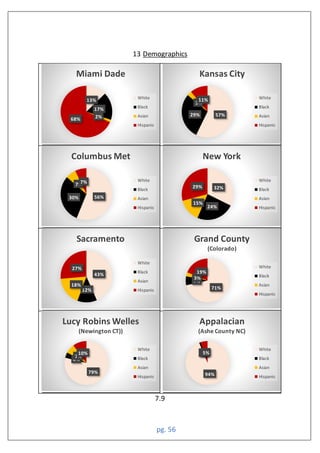
13 Demographics
7.9
13%
17%
2%
68%
Miami Dade
White
Black
Asian
Hispanic
57%
29%
3%
11%
Kansas City
White
Black
Asian
Hispanic
56%
30%
7%
7%
Columbus Met
White
Black
Asian
Hispanic
32%
24%
15%
29%
New York
White
Black
Asian
Hispanic
43%
12%
18%
27%
Sacramento
White
Black
Asian
Hispanic 71%
7%
3%
19%
Grand County
(Colorado)
White
Black
Asian
Hispanic
79%
4%
7%
10%
Lucy Robins Welles
(Newington CT))
White
Black
Asian
Hispanic 94%
1%
0%
5%
Appalacian
(Ashe County NC)
White
Black
Asian
Hispanic
pg. 57
Conclusions and actions
Against these simple principles below that each library can assess its own
performance and define the strategy that it needs:
The logic for how to improve the performance of public libraries is
straightforward
- The main and overriding reason people use and visit libraries is to read
and to borrow books.
- The two factors that persuade them are 1. That the library is likely to
have what they want and 2. That the library will be welcoming, helpful,
dignified and friendly
Therefore, the absolute priority for spending the library budget for both
operations and capital is to ensure these two factors are true in every building
all the time. Spending on anything that does not provide these is secondary
There needs to be constant measurement of expenditure and patron response
to ensure that there are high levels of satisfaction and increasing use
All the observations on these following pages are made simply from an
examination of the published figures, both by the IMLS and by the American
Bureau of Census.
Miami Dade
- The library service in Miami Dade is well funded with rising annual
payments for most of the last decade
- Use of the service is very low
- The book fund has been tiny and circulations are very small
- Use of other library services (programs, digital etc) is also very small
- The library strategy needs to address how better to meet the reading
needs of all the diverse local population
pg. 58
- The spend on print books needs to rise from $2m to $8m per annum,
out of the total spend of $80m
- The performance needs continually to measure how the local and
diverse communities respond to such an investment in materials and to
show continual increase.
Kansas City
- The library service in Kansas City has been extremely well funded with
rising annual payments for most of the last decade to a level of over
$100 per citizen which is much more than twice the national average.
- Use of the service has been falling consistently during the decade
- The book fund is adequate but there has been a marked shift from print
books to eBooks in recent years
- Use of other library services (programs, digital etc) has fallen
- The consequence of the shift from print to digital has been to reduce the
circulation of print books. Even more, it has reduced the use of the
library buildings
- The library strategy might consider how once again to restore the
reputation of the libraries themselves as a place of reading and high-
quality collections.
- This is particularly true of children’s books.
- The spend on print books could realistically be restored to above $1-
$1.5m (Out of $22m) and not be allowed to fall below that.
- It would be sensible to have constant performance measurement to
ensure that use of the libraries rises continually across the community.
Columbus Metropolitan
- The library service in Columbus has been extremely well funded at
almost twice the national average level
- There has been significant capital expenditure in recent years of over
$160m which is had added a large area of extra space to the libraries
pg. 59
- Yet library visits and library circulations have declined over the decade
- During the period of investment there has been little increase in the
book stock, to fill the extra space
- Print book purchasing remained at around $4 per person, even while
extra funds were being spent. That is only an adequate amount, and
unlikely to drive much growth
- One would imagine that the investors would like to see an increase in
use of the libraries in return for their expenditure and that might be
achieved by increasing the print book fund to $6m and measuring in
detail the response to book collections from all parts of the local and
diverse community.
New York Public Library
- The New York Public Library is extremely well funded. Total operating
cost has risen to around $300m per annum which is about $80 per
citizen.
- NYPL has been the driving force in the development of the SimplyE
eBook platform
- Average remuneration for workers in NYPL is over $100,000 per annum
- Over the decade there has also been capital expenditure of over $800m
- Use of all the services have been in decline throughout the decade,
which must be disappointing to those responsible
- The collections are huge, but they need both constant refreshment and
an attention to the diverse community of the city.
- Growth in the service would probably come if the expenditure on print
collections was raised back to $6-$8 per citizen, which is well within the
means of the service. It needs to explore the diverse publishing which
exists in New York, which would for sure be very grateful for the support
It might also be possible for NYPL to act as a resource for technical
improvement for the whole library service. If they could work with other
libraries in the city and, for example, those in Los Angeles and Chicago, they
could, within their own resources, form a group of sufficient scale to lead
urgent improvements to both digital content and library management
information systems, that are so dearly needed.
pg. 60
Sacramento
- The Sacramento City Public Library has funding which is below the
national average, but has been rising
- Use of the service is comparatively low and library visits have been
falling
- The purchasing of print books is well below the level to achieve popular
service, especially for a diverse community.
- The library management might consider making a significant increase in
the purchase of print books in order to raise the level of use of library
buildings.
- They should be able to afford to lift the print budget from $2.3m to $4m
within a couple of years without seeking additional overall funds
- They would need to monitor the acquisitions constantly and the
response in the local communities in order to ensure they achieve the
growth that is possible.
Grand County
- The funding of the libraries of Grand County Colorado is extremely high -
nearly three times the national average
- Yet both use of the libraries and circulation of reading material has fallen
constantly
- The use of other library services, like the internet and attendance at
programs has been small has fallen
- In particular the use of libraries by children has fallen a lot
- It is almost as if the management and funders had not noticed what was
happening
- Expenditure on materials, out of the total spend, is very small which
means that the libraries almost certainly have little to attract readers to
use them
- The purchase of eBook licences, which has been very costly, has
produced very little result.
pg. 61
- The funders might find that if they were to double, or more, the
expenditure on print books, they would find that the libraries would
become attractive once more and be better used.
-
Lucy Robbins Welles
- The funding of the libraries of Lucy Robbins Welles library in Connecticut
is about twice the national average level
- There has been a fairly constant decline over the decade in both library
visits and circulations
- Other services – internet use and library programs, which have low use,
have not replaced the use of book circulations
- There has been a large investment in eBooks, but is has not visibly
increased either circulation or library use
- The library management might consider measuring to ensure that the
use of their print book collections grows faster in response to the
acquisitions that they make.
- They could easily increase the size of the print book fund within the
overall cost of the service – and that should produce positive results. It
might help to start with an increase in the purchasing of children’s books
-
-
Appalachian Region
- The funding of the libraries of Appalachian regional libraries is less than
half the national average
pg. 62
- It is not surprising that use of all the services in the libraries is low and
falling
- In particular the book fund is very small
- If the local people want to improve their library service the starting point
would be to increase the print book funds for both adults and children.
- The print fund should be at least $500,000 – at present it is less than
$200,000
pg. 63
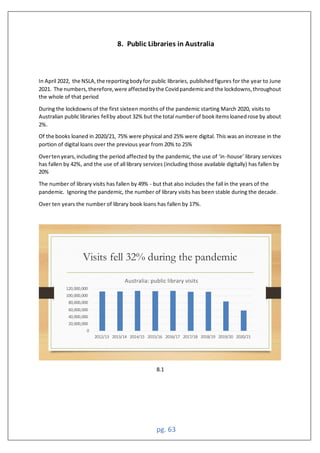
8. Public Libraries in Australia
In April 2022, the NSLA,the reportingbodyfor public libraries, publishedfigures for the year to June
2021. The numbers,therefore,were affectedbythe Covidpandemicand the lockdowns,throughout
the whole of that period
During the lockdowns of the first sixteen months of the pandemic starting March 2020, visits to
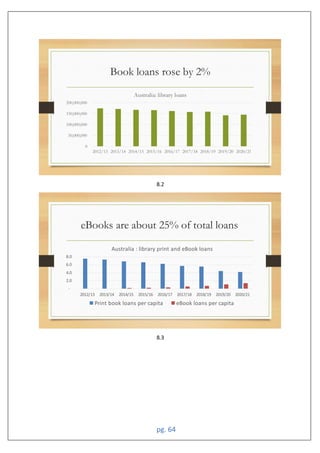
Australian public libraries fellby about 32% but the total numberof bookitemsloanedrose by about
2%.
Of the books loaned in 2020/21, 75% were physical and 25% were digital. This was an increase in the
portion of digital loans over the previous year from 20% to 25%
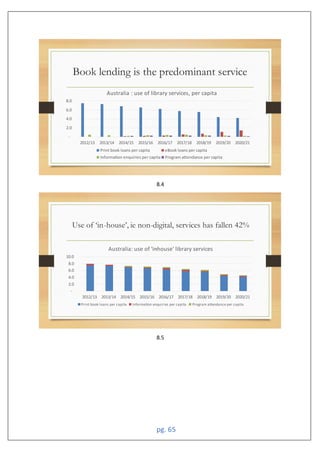
Overtenyears,including the period affected by the pandemic, the use of ‘in-house’ library services
has fallen by 42%, and the use of all library services (including those available digitally) has fallen by
20%
The number of library visits has fallen by 49% - but that also includes the fall in the years of the
pandemic. Ignoring the pandemic, the number of library visits has been stable during the decade.
Over ten years the number of library book loans has fallen by 17%.
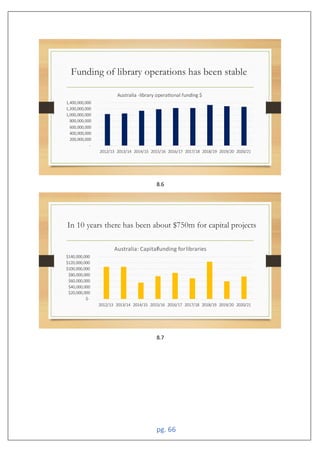
8.1
0
20,000,000
40,000,000
60,000,000
0,000,000
100,000,000
120,000,000
2012 1 201 14 2014 1 201 16 2016 17 2017 1 201 1 201 20 2020 21
Australia: public library visits
pg. 64
8.2
8.3
2.0
4.0
6.0
.0
2012 1 201 14 2014 1 201 16 2016 17 2017 1 201 1 201 20 2020 21
Australia : library print and eBook loans
Print book loans per capita eBook loans per capita
pg. 65
8.4
8.5
2.0
4.0
6.0
.0
2012 1 201 14 2014 1 201 16 2016 17 2017 1 201 1 201 20 2020 21
Australia : use of library services, per capita
Print book loans per capita eBook loans per capita
Informa on en uiries per capita Program a endance per capita
2.0
4.0
6.0
.0
10.0
2012 1 201 14 2014 1 201 16 2016 17 2017 1 201 1 201 20 2020 21
Australia: use of inhouse library services
Print book loans per capita Informa on en uiries per capita Program a endance per capita
pg. 66
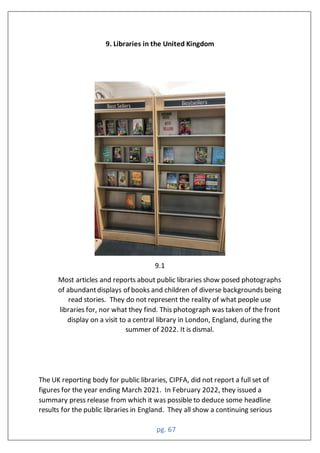
8.6
8.7
200,000,000
400,000,000
600,000,000
00,000,000
1,000,000,000
1,200,000,000
1,400,000,000
2012 1 201 14 2014 1 201 16 2016 17 2017 1 201 1 201 20 2020 21
Australia library opera onal funding
20,000,000
40,000,000
60,000,000
0,000,000
100,000,000
120,000,000
140,000,000
2012 1 201 14 2014 1 201 16 2016 17 2017 1 201 1 201 20 2020 21
Australia: Capitalfunding forlibraries
pg. 67
9. Libraries in the United Kingdom
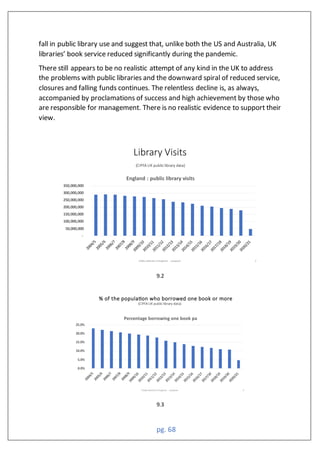
9.1
Most articles and reports about public libraries show posed photographs
of abundantdisplays of books and children of diverse backgrounds being
read stories. They do not represent the reality of what people use
libraries for, nor what they find. This photograph was taken of the front
display on a visit to a central library in London, England, during the
summer of 2022. It is dismal.
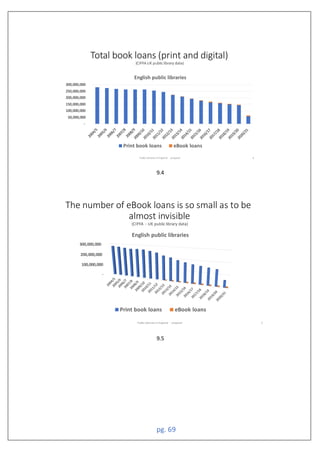
The UK reporting body for public libraries, CIPFA, did not report a full set of
figures for the year ending March 2021. In February 2022, they issued a
summary press release from which it was possible to deduce some headline
results for the public libraries in England. They all show a continuing serious
pg. 68
fall in public library use and suggest that, unlike both the US and Australia, UK
libraries’ book service reduced significantly during the pandemic.
There still appears to be no realistic attempt of any kind in the UK to address
the problems with public libraries and the downward spiral of reduced service,
closures and falling funds continues. The relentless decline is, as always,
accompanied by proclamations of success and high achievement by those who
are responsible for management. There is no realistic evidence to support their
view.
9.2
9.3
Public Libraries in England proposal 2
ngland publi library visits
Public Libraries in England proposal
er entage borrowing one boo pa
pg. 69
9.4
9.5
Public Libraries in England proposal 4
nglish publi libraries
rint boo loans e oo loans
Public Libraries in England proposal
nglish publi libraries
rint boo loans e oo loans
pg. 70
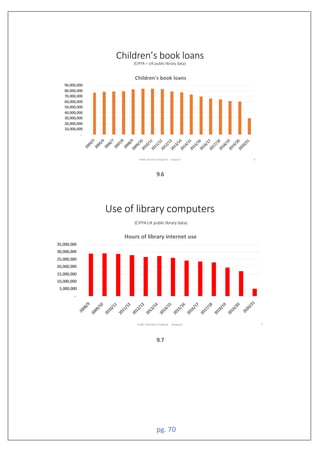
9.6
9.7
Public Libraries in England proposal 6
hildren s boo loans
Public Libraries in England proposal 7
ours of library internet use
pg. 71
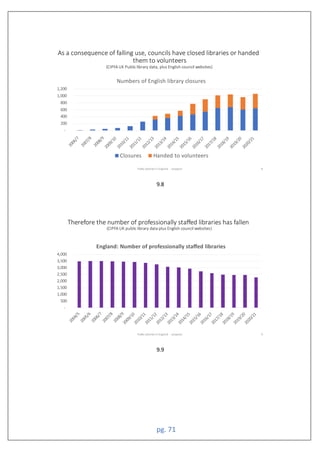
9.8
9.9
200
400
600
00
1,000
1,200
Numbers of English library closures
Closures anded to volunteers
Public Libraries in England proposal
00
1,000
1, 00
2,000
2, 00
,000
, 00
4,000
ngland umber of professionally sta ed libraries
Public Libraries in England proposal
pg. 72
When giving advice to an English local council politician, this is what was said
Public Libraries
A council should have a very clear idea what public libraries are for:
They are to help people find and enjoy what they want to read-
It’sas simple as that. Whenit is done well,people love and use theirlibraries a great deal.That is the
contribution they make to the community and the purposes of a local council.
pg. 73
10 onsumer survey ‘ here did you get that boo ?’
In September2022 there wasa neweditionof the consumersurvey‘Where did you get your book?’
conductedin the UnitedStates.These surveysare conductedbythe Freckle projectworkingwiththe
EveryLibrary Institute in Chicago.
Combined with the four previous surveys in 2019, April and October 2021 and April 2022 they
include the responses of almost 5,000 Americans. With the IMLS data for 2020, they present a clear
and consistent picture of
- What people use public libraries for
- Where libraries fit in the ability of Americans to get the books they want to read
- The changing formats in which people read
- The level of service provided in public libraries
- How the Covid pandemic affected both reading habits and the use of public libraries
Results about the use of libraries are included in Section 2. This section is a copy of slides which
describe reading and publishing more generally.
The period observed has witnessed remarkable change, and that is captured in the figures
10.1: Books have not lost their appeal
10.2 Reading is wide across the whole community
ead a boo at h a movie lay a omputer
game
at h a series
ll respondents
hite la ispani sian ther
pg. 74
10.3 There has been a big shift from reading print to using eBooks and listening to audio
10.4 Rise in the use of audio
10.5 Rise in the use of eBooks
printed boo n boo n audio boo
re pandemi ow
pr
un
ug
t
e
eb
pr
un
ug
t
e
eb
pr
un
ug
t
e
eb
pr
un
ug
ll readers using audio
pr
un
ug
t
e
eb
pr
un
ug
t
e
eb
pr
un
ug
t
e
eb
pr
un
ug
All American readers using audio
pg. 75
10.6 Fall in the use of printed books
10.7 There have been significant changes in where people find their books
10.8 People read for many reasons, but mostly for their own pleasure
pr
un
ug
t
e
eb
pr
un
ug
t
e
eb
pr
un
ug
t
e
eb
pr
un
ug
ll readers reading print boo s
n internet
boo store
library boo store riend or family
re andemi ow
6
1
14
2
n oyment du a on nforma on or
Pre pandemic Now
pg. 76
10.9 The move to digital reading has brought an increase in the influence of publishers’ marketing
10.10 Children are the least likely to use eBooks
10.11 Children are the least likely to use the new move to audio
2 22 24
7
1
ll respondents
Pre pandemic Now
ess than
ess than
pg. 77
10.12 Children are the most likely to read in print
10.13 White people are the most likely to read in print
10.14 White people are the least likely to read eBooks
ess than
hite la ispani sian ther
pg. 78
10.15 Use of audio is spread across the community
10.16 The Freckle survey is conducted online across the whole of the United States
hite la ispani sian ther
April 201 1,600
April 2021 704
October 2021 60
April 2022 74
September 2022 7
Responses for those under 1 years old are given by family
members.
Responses from people connected to libraries or publishers are set aside.
pg. 79
11. Recommendations from previous reports
From The Freckle report 2020
Summary and action points
Executive comment
1. Use of public libraries is falling across the English-speaking world. In the
US, the fall is 22% in 7 years; in Australia it is 21% in the same time. In
Great Britain (GB) use of public libraries has fallen 70% over 20 years.
The decline is persistent, widespread and serious.
2. The fall has come primarily from a long term move away from the
central service of offering printed material in welcoming library buildings
3. The evidence here shows that the fall in use eventually brings
disinclination to provide public funds. In turn that reduces the quality of
what is offered and use falls further. Ultimately libraries are closed.
Once started it is a hard cycle to break
4. It is to be seen, therefore, that falls are not initially a direct consequence
of levels of funding, but rather that they are the public response to how
the service is presented.
5. Directors, funders and professional librarians do not appear to be taking
serious enough notice of this evidence of decline. They need to change
priorities and the way budgets are spent in order urgently to reverse the
fall. If they do not, the long-term provision of public libraries will be in
doubt.
Summary
6. Endeavours of the past twenty years have been made to broaden the
service of public libraries and to stress their contribution to
communities. They have provided free internet terminals, offered
learning programs, and introduced electronic access to traditional
material.
pg. 80
7. Yet, following these significant developments, use of the service has
gone down, not up. These and other changes have never come close to
matching the original, huge and continuing appeal, to all age groups, of a
public library as a private place to read, study and access as much
printed material as the library can sensibly hold or obtain.
8. Focus on these new activities appears to have led to a falling in the
experience, attention, commitment and resource for acquiring and
providing printed reading material and that has led to a reduction in its
use.
9. This decline far exceeds the current or potential gains made by the new
services and has led to the overall significant reduction in patron
numbers. The new services, particularly and noticeably the offer of
digital material have not been effectively marketed as part of what
public libraries do.
10.The virtue of private reading is rarely proclaimed. Most reading is not in
itself a community activity but the contribution to communities from
people who read is immense. That point is not often made, yet it is, and
always has been, the single greatest value of public libraries. They help
people to find what they enjoy reading. That is the way they benefit
society.
11.Public funding authorities in GB – where the library situation is worst -
are demonstrating that, whatever its theoretical social merit, there
comes a point at which a government funded authority cannot
reasonably pay for a public library service that is not sufficiently used.
Appeals that ‘measurement of use is not a fair reflection of the service
we give’ no longer work.
12.No impact or output measure or social analysis of the value of libraries
has been found that is superior to the simple uestion ‘Do people use
it?’
13.Nor is it sufficient to say, for example, that ‘use of a new facility has
increased dramatically’ when, if it is set against the whole service, that
growth has a tiny effect.
pg. 81
14.The argument ‘We need more money’ will not be sufficient, unless it is
supported by credible and appealing evidence about how such money
should be used efficiently to increase overall use of the service.
15.The survey reported here found that 0 of people ‘read or make use
of’ books and that the greatest use of public libraries is by people who
read for pleasure – yet the same survey shows that less than twenty
percent of people who read, actively use the public library
16.Increasing use is much more likely to occur among people who enjoy
reading, than among people who don’t read at all. That is because of the
immense and valuable reputation that the public library service still
holds
17.Therefore, it is important that those responsible for public libraries
understand the reasons for decline, particularly among the reading
public, and address them so that use increases.
Action points
1. Public libraries need to restore their levels of purchasing of print
material to at least that of ten years ago. It has fallen ever since, and
that needs to be reversed.
2. Public library management has a number of major ‘management
information gaps’ that need to be filled urgently- see section A
3. Public library strategy is currently aimed first at pleasing funders and
library professionals, rather than the public- that priority is wrong and
has to be reversed quickly- see section B
4. Advocacy for public libraries has to demonstrate that public library
needs are being met and the reputation of public libraries is understood
and that planning and funding are designed to increase library use- see
section C
5. Marketing of public libraries and their services has to be directed at the
public and not just at the library profession, or its funders- see section D
6. The public library service shares an objective to promote reading with
authors, academics and publishers and it should work in partnership and
not in conflict with them - see section E
pg. 82
7. The management training of public librarians needs to be focussed on
increasing the use of each branch library. That means providing a
worthwhile and enjoyable experience that the public recognise and want
to use. Primary among those patrons will be those who want to use the
library for reading. – see section F
8. There is a need to improve the supply chain of reading material to
patrons so that it matches or is better than the best of alternative
sources – see section G
9. There is a concern about the care of readers with eyesight problems -
see section H
10.The public library service in England needs radical change – see section I
Recommendations for a public library website or App
A ‘unified’ digital service for public libraries should not just provide access to
digital material. It should giveaccess to printed and all kindsof resourcein every
library. It should offer all the services that are available.
hat shoulda library ppand e oo servi e loo li e tobe ‘ est for readers’?
• Should be as good as Kindle, but free
• Should be on one website and one app, not many
• Should provide non-personally identifiable information for the public,
authors and publishers about what is being read and where.
• Should be a high-quality reader platform, constantly improving and
competitive.
• Should contain all available and forthcoming titles, resources, holdings
and materials in public libraries, both digital and print, not just those for
which licences have been acquired
• Should hold secure membership information and authorisation to access
material
pg. 83
• Should allow people to join.
• Should contain information about local library events and activities
• Should contain information about services available at local libraries
• Should discover print, audio, documents and other related editions and
locate all library holdings wherever they are and deliver them
• Should offer ‘click and collect’ and other delivery service
• Should transact a deal at the moment a reader requires it
• Should contain back office functions, such as accounting, HR and payroll.
• Will be the service that operates the library.
From the Freckle report 2021
Summary: conclusions and recommendations
Conclusions:
Why don’t public libraries address their fall in use? (part 2)
In the US there has been a fall of 31% in public library building use in 8 years up
to 2018. In Australia the fall is 22% in 10 years. In the UK there has been a fall
every year making 70% since the year 2000.
Continuous decline of this nature shows that the public library service ignores
the figures it does have and does not strive to find the figures it should have, in
order to manage the service efficiently and effectively. This is wrong.
Consumer surveys: Where did you get that book? (part 3)
During the pandemic lockdowns : -
There was an increase in the number of people reading
pg. 84
There was a remarkable shift of reading of print books to eBooks after several
years when the figures had been stable.
There was a significant contribution to reading achieved by public libraries and
an increase in library performance and circulation especially of digital content.
What are public libraries for and how should they be measured? (part 4)
The public library service urgently needs consistent, recognisable, timely
measures of its usefulness and its performance within the wider and diverse
community. Only these will provide both the information needed to manage
the service effectively and the evidence needed by funders and the public to
support the service in the future. It does not have them at present. Without
them it is at risk.
There appears to be no mechanism within the public library service for making
these and other improvements – there needs to be
Serving diverse communities (part 5)
There is a big opportunity for public libraries to lead the way forward in
addressing diverse audiences and pulling the publishing industry with them.
Public libraries in the US – data up to 2018 (part 6)
The fall in use of public library buildings in the United States has occurred in
almost every state and size of library and is not caused by shortage of funding.
Before the pandemic, the investment in digital material was slow to deliver
circulation that matched that of physical material and that it was relatively
expensive. The cost per circulation for digital material was three times that of
printed books.
The average stock turn for print material was six time greater than that of
digital material. It would have been many times cheaper to give a patron the
money to buy an eBook than to license a copy for the library.
Initiatives to introduce eBooks and other programs and services did not
reverse the decline in use of library buildings, nor did they make up for the fall
that had occurred in circulation of print materials
Public Libraries in Australia (part 7)
pg. 85
In Australia, the fall in the use of public libraries has been persistent and
widespread. It has not been caused by a lack of funding. Nor has it been
remedied or offset by the introduction of other services
Public Libraries in the UK (part 8)
Over the past decade more than one quarter of public libraries in the UK have
either closed or been handed over to volunteers to run. There is reduced
funding in most places. That follows a decade in which library use followed the
same pattern of decline we are now seeing in the US and Australia. There is
still no credible attempt to improve the situation either from the library
profession or the administrative sector. Public libraries are likely to continue to
close down and the service to the public diminish.
Strategy after the lockdowns end (part 9)
Building print and eBook collections for the particular diverse communities –
black, Asian, indigenous, and so on- is the highest priority of all, in all those
places where there is a significant diverse population.
This is a task in which libraries can play an important role for publishers- they
can stress the need to meet all the reading needs of a small community- in a
way that publishers cannot readily do.
Relations with publishers (part 10)
Public libraries don’t buy enough books to have major influence over publisher
policy. This report believes that a more constructive relationship between
publishers and librarians could and should be built on a common desire to
please readers, but also a recognition that their operating and financial models
are very different.
The way to achieve this is to improve the information flow between libraries,
publishers and authors about what libraries hold and what they circulate.
Recommendations
It is characteristic of the public library service that management of libraries is
dispersed and independent. This is an agreeable way to work and brings
great pride, but it often means that the service misses important
opportunities and is sometimes taken advantage of by corporations who
supply them with goods and services.
pg. 86
1. There needs to be a clear, succinct, statement of the purpose of public
libraries. It needs to accord with what the public wants and be
recognisable to them. It needs to be understood within the library
profession and management. Libraries are essentially about helping
people to find what they want to read.
2. Library performance should be monitored against such a statement by
consumer survey of the kind that has been used in this report.
3. Library consortia need to have more stature and more resource and
wor withea h other t present there isn’t a produ tive data driven
national working dialog with large publishers, authors or suppliers.
4. There needs to be a unified, appropriate and believable set of timely
management performance data. It should be freely publicly available
and inform everything. Library management systems should be used
more and better to achieve this
5. The decline of the use of the servicesoffered in library buildings needs
to be reversed as a priority. This will be achieved by diversifying
collections and improving supply chains.
6. Expenditure ondigital materials shouldnever diminishthe expenditure
on physical materials: they are both essential to the quality of service

Freckle Report for May 2022 from the Freckle Project

  • 1.
  • 2.
  • 3.
    pg. 3 The FreckleProject The Freckle Report, 2022 Third analysis of public library services “Libraries need books” The progress of public libraries US, UK and Australia Tim Coates September 2022
  • 4.
    pg. 4 Freckle Report2022: In printed form ISBN - 978-1-84381-069-8 As a pdf ISBN - 978-1-84381-070-4 Freckle Report 2021: In printed form ISBN --978-1-84381-064-3 As a pdf: ISBN -- 978-1-84381-065-0 The Freckle report 2020: in printed form: ISBN – 978-1-84381-062-9 as a pdf: ISBN -- 978-1-84381-063-6 The combined reports, 2020 and 2021 in one edition In printed form ISBN -- 978-1-84381-066-7 As a pdf ISBN -- 978-1-84381-067-4 Website - www.freckle.us tim@freckle.us © Freckle project 2020 © Freckle project 2021 ©Freckle project 2022 © Tim Coates 2020 ©Tim Coates 2021 ©Tim Coates 2022 Tim Coates is the author of this work These reportsare subject to the enacted copyright laws in the United States, in Australia, in the United Kingdom and in Europe. They may not be copied or quoted in whole or in part without the written permission of the Freckle Project: tim@freckle.us.
  • 5.
    pg. 5 About theauthor: Tim Coates Tim Coates hasworked in the book industry for morethan 40 years: in retailing, libraries and publishing. He has been managing director of several large book retailers, including Waterstone's, the leading UK bookstore group, and of WH Smith in Europe. Hehas been UK generalmanager of YBP, the academic division of Baker and Taylor, and now part of EBSCO. He has consulted for library authorities and library suppliers in the US and the UK. He is frequently called upon to write reports for local and national government bodies on the public library sector. On three occasions he has been named ‘The best bookseller’: once by Peter Mayer of Penguin Books, New York, once by Paul Hamlyn, of Hamlyn Octopus and Reed international, the publisher of illustrated booksand onceby theBritish Book trade press. He has frequently appeared in lists of most influential people in the publishing industry. He is an author of fiction, of drama and of historical worksand an editor of over 40 historical papers about both the US and the UK, and to be found as ‘uncovered editions’ and ‘argonaut papers’ He currentlyworksas a lead adviser on both public and academic libraries in the Freckle project in the US His published work on the library service includes - On the closure of English Public Libraries- Public Library Quarterly, October 2018, Taylor and Francis - The Good Library Manual – Berkshire publishing 2010 ISBN 9781933782881 - The scandalous decline of British public libraries, 2008, Brill, Logos, - (DOI: https://doi.org/10.2959/logo.2008.19.1.5) - Britain’s plain-speaking bookman 2005, Brill, Logos - ( DOI: https://doi.org/10.2959/logo.2005.16.3.148) - Evidence to the House of Commons Select Committee on Libraries, 2005 ISBN 021502267X - Who’s in Charge, Responsibility for the public library service. 2002 Libri and Laser, UK - Various articles in the UK Bookseller - Various articles in the UK Guardian - Freckle Reports: 2020, 2021, 2022 He holds Masters degrees from Oxford and from Stirling Universities.
  • 6.
    pg. 6 Tim Coatesis grateful for their contribution and their support to John Chrastka and his colleagues at the EveryLibrary Institute in Chicago, and Freckle partners in London, San Francisco and New York. He is also especially grateful to Crosby Kemper with his colleagues at the IMLS for their reading and discussion of previous reports and his understanding and encouragement to publish with the intention of jointly addressing many of the issues that are raised. Sources of material for the evidence in this report 1. The Freckle analysis: ‘Wheredid you get that book?’ Consumer Survey in the US, conducted in April 2019 through September 2022 2. IMLS: (The US Institute of museums and library services) the sequence of annual data to 2020, most recently published in 2022 (referred to as ‘IMLS’) 3. CIPFA (The UK Chartered Institute of public finance administration) the sequence of annual data to 2020, most recently published in 2022 (referred to as ‘CIPFA’) This report refers to GB (Great Britain) which means England, Scotland and Wales combined) 4. NSLA: (The National State Libraries of Australia) the sequence of annual data to 2021, most recently published in 2022 (referred to as ‘NSLA’) 5. Pew Research Center – “Book Reading 2016” 6. US and UK census data Expressions In the United States, libraries refer to ‘patrons’ and to ‘circulations’. In Australia those are ‘customers’ and ‘loans’. In the UK they are ‘visitors’ and ‘issues’. Everyone refers to ‘readers’ This report uses all of those, but they are interchangeable.
  • 7.
  • 8.
  • 9.
    pg. 9 Sections ofthe report Page 1. Headlines ……….11 2. Investment in public libraries ……… 13 3. Recommendations ……… 27 4. What matters with libraries ……… 29 5. Reading, Diversity and Libraries ……… 33 6. How libraries can be successful ……….41 7. Public Libraries in the United States ……….47 8. Public libraries in Australia ……….63 9. Public Libraries in the United Kingdom ……….67 10.Consumer survey “Where did you get that book?” ……….73 11.Recommendations from previous reports ……….79
  • 10.
  • 11.
    pg. 11 1. Headlines Since2010, the number of available public library books in US libraries has been reduced by 140 million. • The public library service, which is profoundly important, is in trouble, in decline, and at risk. This is not for the reasons often offered, such as lack of funds or developing technology, or changing social needs or political pressures. • It is not because reading habits have changed, or that people’s desire and need to read have diminished. • Nor is it, as is so frequently said, because of the invention of the iPhone, 15 years ago. • The problems arise from three overriding causes: • the management of the service has become confused about and unfocussed on the purpose of public libraries, to the point of being damaging, • there is no recognition of the problems by those responsible, and • there is no leadership or mechanism for improvement. • Public libraries, only a decade ago were a service that offered buildings in which many items could be read and from which books could be borrowed. They were phenomenally popular • Now they attempt to offer three services • The traditional library • A community service of varied activities, initiatives and functions, often concentrating on those whom the service either regards to be disadvantaged or to be of political merit. • A digital service of both literacy and content All three of these are different and require separate skills and budget. They barely overlap. It turns out there is insufficient resource for any to be exceptionally good, and they are not. Actually, they often conflict with each other: digital use drives down use of the library buildings; community activities can detract from the facility to read privately. The public use of all the service has fallen. • In persistent pursuit of identifying and trying to craft public library service to the needs of those whom they regard as ‘underserved’ the library profession appear to have neglected the library service they should provide to all. This is undoubtedly a cause of the decline in general public library use. The first endeavour, which is, of course, full of value, should not have precluded the second, which is also important and which creates the volume of use upon which political support and library funding depends. • Most recent figures for the US show o Annual funding of $15bn and rising
  • 12.
    pg. 12 o Continuingdecline in the use of most libraries and their services o A reduction in book collections of 140 million books over a decade o Failure, notwithstanding their endeavors, to address diverse audiences o The public of all backgrounds overwhelmingly continue to want libraries to provide books and access to them • As publishing technology and supply chains have improved, libraries and the service they give should have got better. In fact, they have become worse. • The processes and practices of library collection management and library book processing are long out of date. They are slow, expensive and wasteful and detract from the good experience of library patrons. • The public library service, in the USA, and elsewhere, like many individuals and institutions, made great efforts during the lockdowns of the Covid pandemic to adapt services to the special needs of the moment in their communities. During the pandemic, reading among the population increased, but IMLS figures reporting libraries own experience, show that use of library services fell. It should have grown. • The reality is that public libraries, their profession and their management have become distracted from the role that people expect them to fulfil. What they do is not what the general public wants. • Without some movement and initiative to reverse decline, the service is in peril: it may never recover properly from the impact of the pandemic. Funders should act. Recommendations in this report are intended to help them and provide an agenda.
  • 13.
    pg. 13 2. Investmentin public libraries This reportanalysesten yearsof public library performance dataand fouryearsof consumer figures. It is the third of three reports1 . To those who fund or allocate money to public libraries, locally, or on behalf of state or federal bodies… Public libraries need to change and change quickly. Despite extremely good and regular funding over many years, the use of them is falling. They have moved away from what was once a verysuccessfulcourse.Without a change in their managementapproach, one cannot reasonably foresee them returning to the levels of popularity they enjoyed evenbefore the pandemic. The public still want them to functionas theyusedto do, and whentheyworkproperly,they are immensely useful and fundamental. This report and the two that preceded it, show some surprising figures and all three draw unusual conclusions. They not only attempt to demonstrate the problems and explain what has happened. Theyalso try to give clear recommendationsforthe actions that are needed to put matters right. As previous reports have said, it is unfortunate that criticisms of library operations, and the library profession, however constructively expressed, are generally met with defence and denial. Improvement will not come easily. The only way repairs can be made is if those who provide funds, at the moment they make their allocations and their budgets, insist on seeing some change and require that it comes about. That is the important role that only a fundercan play. It is to be hopedthat anyone in that position,readingthis,can find the strengthtodrive hardbargains at the time of planning and budgetingand also ensure that the promisesthat are made at that point are seento be fulfilled. Each library needsafirmplanto increase itsuse above the levelitexperiencedin2018,before the pandemic,andthento continue to grow all the time.And these planshave tobe made to work.Suchplans shouldall involve significant improvementtoand diversificationof the book collections. That is what people want and that is what will make them use their local library. ---o--- 1 Freckle reports, 2020 ISBN978-1-84381-062-9, Freckle report 2021, ISBN 978-1-84381-064-3 and now Freckle report 2022 (the current document) ISBN 978-1-84381-069-8
  • 14.
    pg. 14 If youwere to read the press or social media about US public libraries, the impression made is that they are not properly funded and have to plead with politicians for the money they receive;thatstaff are inadequatelypaidandthat publishersare mean,harshand exploitative in their dealings with libraries. Yet at the same time, we are told, public libraries are an inventive,thriving,essential,almostmagical and righteousservice intheir local communities. We readthat theyhave farmore toofferthanmere booksandthattheyare valued,equitable and trusted and contribute enormously to the reading culture of the country. A perusal of their own figuresrevealsthat almost all of these observationsare either untrue or mistaken - Libraries are notunderfunded;in2020 theyreceivedover$15bn,mostlyof publicmoney, and the amounts rise continuously. That is more money than the annual income of the entire consumer publishing industry, which was $13bn (Figure 2.1) - The average annual library staff remunerationisover $60,000 and riseseach year.There are many library services in which the average staff pay is over $100,000 (Figures 2.2-3) - Most of the popular use of public libraries is because of material supplied by consumer publishers.Yetthose publishersare paidonlyabout5% of the fundsthatlibraries receive. For publishers, libraries are small and difficult customers who reveal little that is useful about how much they circulate or even where the titles are held. (Figures 2.4-5) - The public library service is notthriving. Byanymeasure use hasbeenfallingcontinuously for a decade. This report shows it is now in serious decline and there is no attempt by those who manage it to put that right. They ignore the figures and even deny that it is happening. (Figures 2.6-8) - A varietyof schemestowidenthe service,in the belief that new initiatives wouldmake it more popular, have reduced the value of the core service. Use of internetterminals has fallen; use of additional community spaces is minimal. Attendance at programs is tiny comparedtothe use of the more traditionalservice of providingbooksandaplace toread (Figures 2.9-10). - People wantlibraries to concentrate on books and reading (Figure 2.11 A & B), At a time whenthe increasingly diverse audience require bookcollections to increase,bookstocks have been depleted by 140 million books over ten years (Figure 2.12) - The long attempt to introduce an effective eBook service to libraries has been extraordinarily expensive. No budget was ever provided for it and it has taken funds neededelsewhere.Itdoesnotserve childrenadequatelyandreducesthe visits to library buildings (Figures 2.13-15) The public library professiontells a good tale, but it is deeplystuck in its traditional ways, so that when the pandemic came, and people really wanted to read more, the public libraries had no wayof meeting that need to the extent that other book providers did. (Figure 2.16) - They are not good at catering for diverse audiences (Figures 2.17-19) - Theydo not have goodonline and deliveryoperationsof the kind that people have come to expect - They are slow to provide what people want: their selection methods, supply chains and professional processes are out of date, expensive and not focussed on readers. - They advocate for and receive investment without knowing how to spend the moneyto increase their audience. (Figure 2.20) - Theirsupplierstake crueladvantage of the dispersedandindependentwaylibrarieswork.
  • 15.
    pg. 15 Figures fromUnited States public libraries 2.1 A (IMLS) 2.1 B IMLS2 2 IMLS : the US Federal Institute of Museums and Library services in Washington DC. They assemble and publish extensive data about the funding and performance of public libraries across the country.
  • 16.
  • 17.
  • 18.
    pg. 18 2.6 Whichever wayit is measured, library use has fallen 2.7 (IMLS)
  • 19.
  • 20.
    pg. 20 2.10 (IMLS) 2.11A(Freckle Survey)3 3 The Freckle Consumer survey “Where did you get that book?” has been conducted regularly for three years. Its results are described in detail in section 10 of this report. o borrow boo s read or study nternet print et vent program mee ng nforma on ilm or udio se i i
  • 21.
    pg. 21 The prevalenceof digital material has both reduced the need to visit libraries (from 91% to 71% of library use), and focussed the library need those who do visit on books, reading and study 2.11 B(Freckle consumer survey) 2.12 pr un ug t e eb pr un ug t e eb pr un ug t e eb pr un ug n the building ut of the building
  • 22.
  • 23.
  • 24.
    pg. 24 2.17 (Freckleconsumer survey) hite la ispani sian ther hite la ispani sian ther
  • 25.
    pg. 25 2.18 This graphshows the 100 largest US libraries (by funding). Along the bottom the ethnic mix is represented by the % of Hispanic people in the population. The axis on the left represents the success of the library in terms of its number of circulations per person. The line shows that the greater the size of the Hispanic population, the less successful the library will be 2.19 In the same way, this graph shows the 100 largest libraries. In this case across the page, the axis shows the % of the population who are white. The axis on the left shows how successful the library is in terms of circulation per member of the population. The line shows that the larger the white population, the more successful the library will be.
  • 26.
  • 27.
    pg. 27 3. Recommendations -“The numbers aren't surprising. We have been seeing the decline in public library usage from the IMLS data. What is of continual interest is that the other services that libraries offer have also seen decline. It speaks not to just funding but rather to the need of the public libraries need to reinvent themselves (which they have already attempted repeatedly) or instead to re-focuson core services to see how to improve those.” A senior industry executive, April 2022 This report concentrates on practical issues by: a. Showing library managers how to interpret the published figures available to them b. Demonstrating, by showing examples, the strategic issues that face individual libraries and how they can be dealt with c. Raising the problems associated with established library practices and procedures and showing how they can be avoided. d. Proposing an agenda for change to be adopted by senior library managers e. Suggesting the curriculum that should be offered by library schools. The recommendations are 1. That public libraries accept and follow that their purpose is to help people of all ages and backgrounds to find what they want to read and to provide a place to readand study that is well equipped, safe, expert, dignified and welcoming. 2. That they provide constant timely public data to show that they do that and that their service improves all the time. 3. That the entire range of existing library practices and collection processes be replacedby the simplest possible means of providing the reading material required. For example, there should be no more plastic jackets, there should be only one label on a library book and
  • 28.
    pg. 28 there shouldbefar more newcopies of titles. There should be just one national universal catalog shared with the book industry. (Section 6) 4. Libraries currently spend over $40 pa per citizen. Each library should spend at least $4.00 per resident on new printed books and $1.50 per resident, on other formats: eBooks and audio. This makes a minimum of $5.50 per resident per year (at 2020 values) on books. (The current average is half this; 4,000 libraries in the US spend less than $2 per resident on books). This can be achieved by savings in collection and supply chain management. 5. That libraries specifically devote their book expenditure on a. Meeting the diverse andspecial needs of their local communities b. Restoring their reference collections c. Acquiring multiple copies of appropriate back and mid list titles, especially for children 6. There should be one unified technology strategy for public libraries, withthe means to implement it, to support these purposes. This could be undertaken by a small set of the very largest libraries (New York, Los Angeles, Chicago) acting together as a leading group. 7. There should be one national purchasing consortium that creates library supply contracts with the largest publishers instead of wholesalers 8. That library schools transformtheir curriculumtomeet these newaims and provide mid-career refreshment courses to do the same. 9. Funders needtoknowhow much a library shouldcost andwhat it could achieve. This table (which has pre-pandemic values from 2019) is a guide for the minimum amounts, intended to help them. The minimum cost of operating a public library (with targets) should be Population Target visits Target circs Print budget eBook budget Staff budget Total budget 20,000 120k 160k $80,000 $30,000 $400,000 $875k 50,000 300k 400k $200,000 $75,000 $1,000,000 $2.2m 100,000 600k 800k $400,000 $150,000 $2,000,000 $4.4m 300,000 1.8m 2.4m $1,200,000 $450,000 $6,000,000 $13.2m 500,000 3m 4m $2,000,000 $750,000 $10,000,000 $22m 1,000,000 6m 8m $4,000,000 $1,500,000 $20,000,000 $44m US = 320m 1,920m 2,560m $1,290m $480m $8.3bn $13.4bn Current US 1,250m 2,200m $760m $450m $8.8bn $13.4bn Difference +670m +360m +$530m -$30m -$500m - 3.1
  • 29.
    pg. 29 4. Whatmatters with libraries What matters with public libraries is whether people choose to use them. That is the test of the impact of all their services, policies and principles. Even ten years ago, they were extremely popular. Yet the figures show increasingly, that the public no longer find public libraries to be so useful. If they were clear in what their service is, and if it was effectively managed, the library service in the US would not have produced the poor results they have, year after year for over a decade, without noticing and without remedy. These figures are reflected widely in libraries across the country. People still want libraries to provide books, reading and information and welcoming dignified buildings. To do these well is not easy. Other services are a management distraction. Instead of increasing the book collections to meet the needs of diverse audiences, the public libraries have removed huge numbers of books from library collections. It was the opposite of what was needed. Quite naturally, those who fund libraries encourage them to offer additional community and educational services. Yet, without proper resource, when they are attempted, these often dilute the quality of the core offer. Libraries must learn either to resist such developments or manage them more effectively. Currently there is not even a recognition that the library service has problems, let alone any approach to solving them. Funders should be frustrated. It is only fair to advocate for and request public money, if the service can show that such funding will increase the use of public libraries or at least limit its decline. At present advocacy for public libraries does not do that. There is no confident, clearly stated, publicly recognisable, strategy for what is offered to the public and there is no efficient management of costs and expenditure Any child of six can tell you clearly and simply what a library is for, but it is hard to find a senior library professional who can do the same The strategy for eBooks should be part of the overall plan for providing books – not a rival to printed books. There needs to be a defined and budgeted plan, working with publishers, of a kind that does not exist at present. eBooks add little to the depth of a library collection. They are a good extra format, like paperback, illustrated or audio editions, of books which are available in print. There are many books, often illustrated non-fi tion or hildren’s boo s that are not available as eBooks; and most titles that are only eBooks are self-published. People may be inconvenienced but they are rarely deprived if they cannot obtain an eBook. A library can address individual needs of this kind easily and quickly without huge budget expense.
  • 30.
    pg. 30 t isas if the publi library approa h to e oo s followed a zeitgeist that said ‘we must ta e part in this development’ without thin ing exa tly what the library publi need would be and how they could work with publishers best to address it. Nor did they have a budget with which to do it. Public library purchasing of eBook licenses has benefited suppliers greatly; but, by removing printed books, has done a lot of damage to the reputation of the service over several years. That is what the figures show. At the same time, out-dated library practices, like fitting books in plastic jackets, time intensive cataloging and processing methods, placing requested books on hold, and other work demarcations and protections should have long ceased. They give the public little value. The public want more books to be readily available. That is where the concentration should have been. Public library methods of collection management place far too much emphasis upon the titles that libraries hold and circulate. They need to give far more consideration to the needs of readers for titles that they do not hold. It is from those that growth of use will come. Only a few of these will come from bestseller lists or wholesaler recommendations – mostly they lie elsewhere. Librarians need a better, measured, understanding of the library needs of their whole and diverse public audience, not just theirpatrons. Librarians do not sufficiently acknowledge their fundamental responsibility to the entirety of the reading public. ddressing ‘diversity’ does not mean ommenting on the ra e or ba ground of librarians authors or publishers or the characters in fiction; it means understanding and meeting all the various reading needs of people in the community. That is completely different. Generally, reading in every international culture is 50% non-fiction; 25% fiction and 25% for children: that is the starting point for building diverse collections and presentations. Instead of understanding and working with publishers, whose support they need, the library management waste time and money by engaging them in legal actions. Overall, in the US, the service needs to reduce staff and management cost by about 6% and spend that money (c.$500m) on more printed books each year. It is not hard to work out figures appropriate to any individual library. The point of criticising the library service is to help the management, and to give those who provide public funds to libraries ways to seek improvement. Libraries need clear, simple plans - For making improvements to book and reading collections - For making the service more diverse - For offering digital services to the public - For developing and making use of technology
  • 31.
    pg. 31 - Fordefining, marketing and funding a valid role for libraries in the community - For sensible cost control - For removing outdated library practices - For management training - For giving proper account for performance and the use of public money There is no visible, accepted, leadership that can create a viable future for public libraries in America. Without that there will just be slow decline. Library professionals will not like these comments and other observations in this report, but they are intended to offer a genuine way forward, that will reverse the decline. There is much that librarians appear not to see from their own experience. The library profession is important in the operation of public libraries, but they should not be the only source of management. Library vendors, who profit greatly from the dispersed management that librarians enjoy, gain much from the inefficient operation and will attempt to dismiss what is said here: but their profits benefit them and not the public, and that money would be better spent in libraries. Taxpayers and those local and national politicians and individuals who fund public libraries, if they were made more aware of the performance figures, could and should reasonably be exasperated and frustrated with the way that the service is operated. They should be much more demanding of those who manage public libraries, seeking - That use of the library buildings (which incur most of the cost and use most of the funds) be seen to increase - That costs of operating the service be seen to decrease or that there is an increase in value for money. - That levels of satisfaction and the long-standing reputation of the public library service be measured in detail and shown to be sustained and to improve Contrary to the current fashion of the library profession these important objectives will NOT be achieved:
  • 32.
    pg. 32 - Byadding services intended to be of general community benefit but in which librarians have no specialist training, expertise or experience. - By reducing the investment in print books, which is already too low, in order to offer eBook or any other services. - By seeking conflict with book publishers, upon whose support and cooperation they depend, as they have been doing. - By pleading that they are entitled to funds because of their heritage, but irrespective of and without reporting, the falling public use of the service. - By ignoring, denying and neither analysing nor properly comprehending, figures that show falling use In contrast, increased public use WILL be achieved by - Concentrating their resource and activities on those services for which public libraries have a fabulous, immense and envied reputation. - Improving the book collections for white and especially for non-white communities - Increasing significantly the numbers of new copies of books on display in the libraries clearly categorised for the public to understand - Eliminating the outdated and expensive practices of selecting, collecting and processing books, placing them in plastic covers and labelling them, cataloging and reserving them in ways particular and peculiar to public libraries - Seeking, willingly and urgently, productive economies of scale and supply chain improvements across the library sector in ways that do not happen at present. This should include practical ways of working in unison, more closely and constructively, together and with the largest publishers upon whom libraries rely for their service - Creating a unified app, web presence and technology which reflects the immense asset base of the public library service across the country. - Actively avoiding practices that require the service of library specialist vendors who are costly and predatory. - Publishing proper management measurements that are transparent, timely and available to funders, publishers, authors and the public
  • 33.
    pg. 33 5. Reading,Diversity and Libraries 5.1 (figures from the US National Bureau of Census) One of the big challenges for public libraries is to ensure that they provide a library service for all the cultural communities that make use of them There is a great variation in the mix of populations in different library communities The publishing industry, in America and in Australia and Europe, has for decades, even centuries, been built around its understanding of white cultural communities and their experience. It has produced wonderful literature, none of which should ever be dismissed because of that heritage. But there is more to human understanding than this. Now is the time to explore more widely. Other nations have their own literature. Libraries have an essential role in this endeavour to bring more worlds to the buildings and the collections. A library book collection which depends on American and northern European publishing will not provide for the needs of all the community. So, if the local population does not share this geographical inheritance, many people will not feel the library to be as useful as it should be.
  • 34.
    pg. 34 5.2 5.3 5.4 Figures fromthe US Bureau of Census Miami Dade, FL White Black Hispanic Asian San Antonio, TX White Black Hispanic Asian Broward County, FL White Black Hispanic Asian
  • 35.
    pg. 35 5.5 5.6 5.7 Allen County,IN White Black Hispanic Asian Johnson County, KS White Black Hispanic Asian Palm Beach, FL White Black Hispanic Asian
  • 36.
    pg. 36 Library %White Circs/pp Library Visits/pp Miami-Dade, FL 12.9% 1.4 1.2 San Antonio, TX 24.0% 2.8 1.2 Broward County, FL 34.8% 3.3 1.7 USA 57.0% 5.0 2.2 Allen County, IN 73.1% 8.9 3.4 Johnson County, KS 79.4% 12.5 2.3 Palm Beach, FL 93.5% 8.1 2.5 5.8 This table and the diagramsabove highlight aselection from among the largestlibraryservices in the country. They show both the extent of variation of population and also how it tends to be the communities with large white populations who achieve the highest level of book circulation and library visits. Figures from the IMLS and the US Bureau of Census. In the same way that a library provides for a whole range of interests based on the education and culture of the people in their country, increasingly that need is expanding to meet the needs of people from other countries and histories. Being successful addressing diverse audiences is not just about the numbers of librarians of color4 , nor is it, as publishers often say, about the color of authors or characters in books, or even of people working in a publisher’s office. It is about whether the book industry can meet the real reading needs of people who live and have families in the communities they serve Those are the measures that really matter. We think of the sections of a library, for children, for literature, for history, for self-help, for reference, for the arts, for domestic life, like design and food, and so on. These now have to address, through writing and books, not just traditional American interests, but those of all the cultures of the neighborhood. And they have to do it with high quality and style This is not easy at all. And it depends on being able to find the same high standard of publication, say for a Sri Lankan or a Mandarin speaking community, as for an American one. Libraries depend on publishers not only to 4 The ALA report for 2022 says this “Our membership is still largely white (88.7% vs. 72% for the general population) with 3.7% reporting their ethnicity as Hispanic or Latino. In describing their race/family origin, ALA members reported being 4.5% Black or African American, 3.7% Asian, 1.1% American Indian or Alaska Native, 0.2% Native Hawaiian or Other Pacific Islander, and 3.8% Other.”
  • 37.
    pg. 37 produce thework, but also to make sure it is available and that libraries are aware of it. As always, the quality of a collection depends more on the availability of work written in the past, than on work which has been written and published recently. There is no sign that people whose origin is fromother parts of the world, have less appetite for reading than that with which we are familiar. On the contrary, their desire and need and enjoyment of reading is often greater. They have not been so exposed, for so long, to other forms of entertainment and information. 5.9 This diagram shows the top 100 libraries in the United States – those 100 that have the highest level of funding. The libraries in communities with the most people of Hispanic origin achieve the lowest level of book circulation. That indicates that Hispanic people are less well served by the library service. The data that follows comes from the ‘Where did you get that book?’, from the IMLS annual data on library use and from the US bureau of census which gives figures for the ethnicity of the population in different communities Put together they suggest that there is a great need for libraries and publishers to work together to improve the collections for different communities, as those that we currently have, do not achieve as high levels of satisfaction as they need. 0 5 10 15 20 25 30 35 0.0% 10.0% 20.0% 30.0% 40.0% 50.0% 60.0% 70.0% 80.0% Total Circulations per citizen % Community is Hispanic- 2019
  • 38.
    pg. 38 Communities areincreasing in diversity; and as much as, or more than, any other service, public libraries must stand ready to meet their needs. That is why it is so important to address and solve this problem as priority. 5.8 (Freckle consumer survey) 5.9 (Freckle consumer survey)
  • 39.
    pg. 39 5.10 (Freckleconsumer survey) 5.11
  • 40.
  • 41.
    pg. 41 6. Howlibraries can be successful Reading and public libraries If you work with books -authors, publishers, booksellers, librarians- you should never ever think that people don’t want to read. They always do. Every one of them. You might not know when or where or what they will read about – but they will. Never preach, never judge, but always know that people want books. It’s a private matter for them. Don’t try to persuade them to read by offering them other entertainments and enticements: it doesn’t work and there is no need. Your job is to put as many books as possible in front of them so they can see them. And to be helpful when they ask. Don’t turn a library into a family playground. It puts off your more serious customers. Libraries don’t teach literacy. That is highly specialised skill. Librarians are not teachers. A library’s role is to provide the material to read when someone is literate or even learning how to read and to help them find what they might want. That is true for adults and children of all backgrounds. It is not the role of libraries to be innovative about reading. Publishers do that- it is their skill. Libraries should use the inventiveness of authors and publishers to please the readers who come to them Itis the roleof libraries alwaysto seek to be helpfuland informativeand to make their buildings attractive, welcoming,dignified and goodforreadersto find what they might need and enjoy. Librariesshould be lovely places just to sit and read. Recommendations for increasing public library use Offer more books 1. Treble the number of books on display. At least. More titles, more copies. Less exposed carpet, more shelves, less empty spaces. (Don’t reduce the areas dedicated to private reading). Good layout design of library spaces is key. Treble the stock on display. Use Display signs 2. Use display classifications and header cards in words intended to be helpful to patrons (not Dewey classes). These should change at any time and all the time, to meet fashionable reading interests. For example, if the Olympics merit a section of display, then do it. If local politics is a
  • 42.
    pg. 42 current interest,then give it a section. If mountain walking is a local hobby, then give it a section. Don’t worry about duplicating copies in different sections (or in multiple branches). Display headings are the most helpful and useful service a library can give. Don’t use bland expressions like ‘hot picks’ – give a proper description of why the books have been displayed together. 3. The two most popular reasons for choosing a book to read are ‘It is by an author whose work I want to read’ or ‘It is on a subject about which I want to read’. Those, and having the book available, are the most important ways of helping readers to find what they want. That’s what the display classifications should do. 6.1 Freckle survey: What made you choose that book? The presence of titles and the signposting of book displays are the most important influences. 4. Make the displays abundant, colorful, attractive, informative, authoritative and interesting. Each branch should ensure that every classification meets those requirements and every branch should have the means and the control to make sure that it does. Displays should be reviewed constantly. ll respondents
  • 43.
    pg. 43 Title Selection 5.Title selection or ‘collection management’ is about building up the quality of every shelf and display in the library. It should include worksof authority, works by well-known authors, works to initiate people to the subject and so on. Many of these titles will not be newly published. 6. When spending the budget for title selection it is wise to keep at least half to be spent on replacement copies of books that have been held for some time, but are becoming worn. This is especially true of children’s books. 7. Good selection management means seeking out the specialist publishers of particular topics and making use of their expertise and enthusiasm. 8. Supplier systems that recommend titles on the basis of use, are of very limited value. They do not make for good collections. 9. The displays must include, in depth, books in all languages and cultures relevant to the community. This might mean searching for and making use of publishers and distributors who are expert in particular cultures. Appropriate enthusiasm and stock knowledge is unlikely to come from a broad wholesaler or library supplier. Library suppliers cannot emphasise everything they do: a specialist publisher can. That is important to the energy that accompanies a good display. 10.The individual branch stock should be so good that shared collections between branch libraries are rarely needed. Patrons should find what they want to read on the shelves, and not be told they have to wait, or that it will come from another branch library. Aim for 95% instant satisfaction at least. Book Processing, acquisition, cataloging, handling and distribution 11.Library processing as it operates at present is mostly unnecessary; it can be improved by using the following guides: 12. A book should have only one unobtrusive library label which is a barcodecontaining the ISBN and a universalcopy number. That label can also contain the Thema classification from Onix5 5 The ‘Onix’ feed is a standard international publisher file which gives data about every title that is available, both new and old. It is created early in the process of life of the book and is constantly revised both before and after publication. It is edited by industry experts to ensure the classification and the descriptions are reliable. It uses a classification system called Thema which is designed to be appropriate for both retailers and libraries.
  • 44.
    pg. 44 13.The singlelibrary label should be applied to a new book, on arrival, or handling, in a branch 14.Library catalogs should use full industry Onix feeds for description and for content 15.The catalog classification should only be the ‘Thema’ code in the onix feed. 16.There should be no Marc records in public libraries. The catalog record in Onix is sufficient. 17.Accession into the library system should be on a. Placement of the order, b. Delivery, or, c. First use in a branch and application of the library label 18.Self-service should be by barcode scanning of the single library label 19.There should be no RFID 20.There should be no specialist library suppliers or book processing 21.Supply contracts should be established by Consortia. As much as possible they should set up supply and distribution arrangements directly with publishers and trade wholesalers who will not carry out library processing. 22.There should be no local warehousing or in-house distribution. It is normally cheaper and faster to acquire a copy than to transfer one. 23.Libraries should reduce the amount of plastic book protection to an absolute minimum; use it only if really needed. It is often cheaper to buy new copies than to use plastic covering, which is unattractive and spoils the book design. The plastic only protects the exterior. When books are grubby, if it is possible, replace them with new copies straight away. Patron membership 24.Patron membership should require only a reliable means of contact 25.More patron membership detail is helpful but only if the patron wishes to give it 26.Libraries should operate discretionary money deposits on items or with patrons when there is risk. 27.There should be no automatic fines. https://bisg.org/general/custom.asp?page=ONIXforBooks&msclkid=0dfc06f2c3a211ecba35d2e15e1af08b, For libraries, the onix feed should be embedded in the library catalog through the library management system.
  • 45.
    pg. 45 28.Libraries shouldacquire material for patrons but set limits on the cost per patron and per title. The library website and app 29.The library website or App exists to help patrons find whatever they want, irrespective of whether the library currently holds copies or what format they are in. It should enable a patron both to find a title and then show clearly how they can obtain it quickly, whatever it takes. If the library will pay for a request, then fine; if the patron needs to make a contribution to the cost, then both those should be dealt with straight away on the website using a formula that represents the library policy. 30.The website should not be just a presentation of current holdings of the library. It should show every publication in every format. The onix feed will supply that. 31.The library website and App should be part of the library management system, not separate from it. eBooks 32.The eBook collection is a supplement to the print book collection, not an alternative to it. That means that both print, eBook and audio all need separate budgets. There needs to be one strategy which aims to give a reader the book they want. The job is to make sure that the patron firstly can obtain the title in some form and then, if budgets allow or the patron wishes to pay, to obtain it in another form that they prefer. Straight away. 33.Do not reduce the print book budget in order to buy eBooks or audio. That risks reduction in library visits and a failure to meet patrons’ needs. The amount of material available in print far exceeds the available titles in either eBook or audio form. The Library Management System (ILMS) 34.A library management system should comprise standard universally interchangeable files of a. Patrons b. Locations c. The industry onix feed and local holdings of each ISBN d. Transactions and histories
  • 46.
    pg. 46 e. Supplycontracts f. Events, calendars and histories g. Analytics 35.The ILMS should contain the complete library website and app for all materials, files and transactions 36.Libraries should share non-personally identifiable circulation data with publishers and authors through the contracting consortium Measuring success 37.The measure is how quickly all patrons obtain what they want. If a branch library can achieve a success rate of 95%, then use of libraries will rise by more than 50% within a few months. 38.The ILMS should measure not only how many transactions are made but also how many patrons have used the service.
  • 47.
    pg. 47 7. PublicLibraries in the United States In this section the intention is to show library managers how they can read the published figures and use them to make improvements to their own service. The figures shown here are actual figures from the IMLS annual publications. There are libraries of different sizes The figures are like hospital blood tests. They don’t provide a diagnosis. But they do indicate where problems and the solutions to them might lie. They don’t tell everything, but they are enough to be the basis of analysis. They are important and should not be ignored. They should be an essential part of annual budgeting and planning. In every case the strategy should be to allocate available funds to widen the patron base and to increase each patrons’ use. These are the libraries included in these illustrations • Miami Dade, FL (6 months in lockdown in 2020) • Kansas City, MO (3 months in lockdown in 2020) • Columbus Metropolitan, OH (9 months in lockdown in 2020) • New York Public Library, NY (9 months in lockdown in 2020) • Sacramento, CA (3 months in lockdown in 2020) • Grand County Public Libraries, CO (9 months in lockdown in 2020) • Lucy Robbins Welles libraries, CT (3 months in lockdown in 2020) • Appalachian Regional Libraries, NC (3 months in lockdown in 2020)
  • 48.
    pg. 48 1. Libraryinvestment $ 7.1 These graphs show the annual funding for each library $- $20,000,000 $40,000,000 $60,000,000 $80,000,000 $100,000,000 2010 2011 2012 2013 2014 2015 2016 2017 2018 2019 2020 Miami Dade Operations Capital $- $10,000,000 $20,000,000 $30,000,000 $40,000,000 $50,000,000 2010 2011 2012 2013 2014 2015 2016 2017 2018 2019 2020 Kansas City Operations Capital $- $20,000,000 $40,000,000 $60,000,000 $80,000,000 $100,000,000 2010 2011 2012 2013 2014 2015 2016 2017 2018 2019 2020 Columbus Metropolitan Operations Capital $- $100,000,000 $200,000,000 $300,000,000 $400,000,000 $500,000,000 2010 2011 2012 2013 2014 2015 2016 2017 2018 2019 2020 New York Public Library Operations Capital $- $10,000,000 $20,000,000 $30,000,000 $40,000,000 $50,000,000 $60,000,000 2010 2011 2012 2013 2014 2015 2016 2017 2018 2019 2020 Sacramento Operations Capital $- $1,000,000 $2,000,000 $3,000,000 $4,000,000 2010 2011 2012 2013 2014 2015 2016 2017 2018 2019 2020 Grand County Operations Capital $- $1,000,000 $2,000,000 $3,000,000 $4,000,000 2010 2011 2012 2013 2014 2015 2016 2017 2018 2019 2020 Lucy Robbins Welles Operations Capital $- $1,000,000 $2,000,000 $3,000,000 $4,000,000 2010 2011 2012 2013 2014 2015 2016 2017 2018 2019 2020 Appalachian Operations Capital
  • 49.
    pg. 49 2. Libraryvisits per citizen 7.2 Each library shows a decline in library visits - 1.0 2.0 3.0 4.0 5.0 Miami Dade Library visits per citizen - 5.0 10.0 15.0 Kansas City Library visits per citizen - 2.0 4.0 6.0 8.0 10.0 Columbus Metropolitan Library visits per citizen - 2.0 4.0 6.0 New York Public Library Library visits per citizen - 1.0 2.0 3.0 4.0 Sacramento Library visits per citizen - 5.0 10.0 15.0 20.0 Grand County Library visits per citizen - 2.0 4.0 6.0 8.0 10.0 Lucy Robbins Welles Library visits per citizen - 1.0 2.0 3.0 4.0 Appalachian Regional Library visits per citizen
  • 50.
    pg. 50 3. Librarycirculation per citizen (print and digital) 7.3Each library shows a different degree of decline in circulations - 1.0 2.0 3.0 4.0 5.0 Miami Dade Print circulaton Digital circulation Total - 5.0 10.0 15.0 Kansas City Print circulaton Digital circulation Total - 5.0 10.0 15.0 20.0 25.0 Columbus Metropolitan Print circulaton Digital circulation Total - 2.0 4.0 6.0 8.0 10.0 New York Public Library Print circulaton Digital circulation Total - 2.0 4.0 6.0 8.0 Sacramento Print circulaton Digital circulation Total - 5.0 10.0 15.0 20.0 Grand County Print circulaton Digital circulation Total - 5.0 10.0 15.0 Lucy Robbins Welles Print circulaton Digital circulation Total - 2.0 4.0 6.0 Appalacian Regional Print circulaton Digital circulation Total
  • 51.
    pg. 51 8 Bookcirculation per citizen (adult and children’s books) 7.4 There are issues with both adult and children’s circulations - 2.0 4.0 6.0 Miami Dade Adult Children Total - 5.0 10.0 15.0 Kansas City Adult Children Total - 5.0 10.0 15.0 20.0 25.0 Columbus Metropolitan Adult Children Total - 2.0 4.0 6.0 8.0 10.0 New York Public Library Adult Children Total - 2.0 4.0 6.0 8.0 Sacramento Adult Digital circulation Total - 5.0 10.0 15.0 20.0 Grand County Adult Children Total - 5.0 10.0 15.0 Lucy Robbins Welles Adult Children Total - 2.0 4.0 6.0 Appalacian Regional Adult Children Total
  • 52.
    pg. 52 9 Otherlibrary services (measured by use per citizen) 7.5 Use of other library services is low. - 2.00 4.00 6.00 8.00 Miami Dade Internet use Program attendance - 2.00 4.00 6.00 8.00 Kansas City Internet Use Program attendance - 2.00 4.00 6.00 8.00 Columbus Metropolitan Internet Use Program attendance - 2.00 4.00 6.00 8.00 New York Public Library Internet Use Program attendance - 2.00 4.00 6.00 8.00 Sacramento Internet Use Program Attendance - 2.00 4.00 6.00 8.00 Grand County Internet Use Program Attendance - 2.00 4.00 6.00 8.00 Lucy Robbins Welles Internet Use Program Attendance - 2.00 4.00 6.00 8.00 Appalacian Regional Internet Use Program Attendance
  • 53.
    pg. 53 10 Alllibrary services (measured by use per citizen) 7.6 In each service use is dominated by print circulations -1.0 1.0 3.0 5.0 2010 2011 2012 2013 2014 2015 2016 2017 2018 2019 2020 Miami Dade Print Digital Reference Internet Programs -3.0 2.0 7.0 12.0 2010 2011 2012 2013 2014 2015 2016 2017 2018 2019 2020 Kansas City Print Digital Reference Internet Programs - 5.0 10.0 15.0 20.0 2010 2011 2012 2013 2014 2015 2016 2017 2018 2019 2020 Columbus Metropolitan Print Digital Reference Internet Programs - 5.0 10.0 2010 2011 2012 2013 2014 2015 2016 2017 2018 2019 2020 New York Public Library Print Digital Reference Internet Programs - 5.0 10.0 2010 2011 2012 2013 2014 2015 2016 2017 2018 2019 2020 Sacramento Print Digital Reference Internet Programs - 5.0 10.0 15.0 20.0 2010 2011 2012 2013 2014 2015 2016 2017 2018 2019 2020 Grand County Print Digital Reference Internet Programs - 5.0 10.0 15.0 2010 2011 2012 2013 2014 2015 2016 2017 2018 2019 2020 Lucy Robbins Welles Print Digital Reference Internet Programs - 2.0 4.0 6.0 2010 2011 2012 2013 2014 2015 2016 2017 2018 2019 2020 Appalachian Print Digital Reference Internet Programs
  • 54.
    pg. 54 11 Purchasingof book collections 7.7 - $4 per person per year is the minimum needed for printed books. $- $2.00 $4.00 $6.00 $8.00 $10.00 Miami Dade Spend on print pp Spend on Digital pp $- $2.00 $4.00 $6.00 $8.00 $10.00 Kansas City Spend on print pp Spend on Digital pp $- $2.00 $4.00 $6.00 $8.00 $10.00 Columbus Metropolitan Spend on print pp Spend on Digital pp $- $2.00 $4.00 $6.00 $8.00 $10.00 New York Public Library Spend on print pp Spend on Digital pp $- $2.00 $4.00 $6.00 $8.00 $10.00 Sacramento Spend on print pp Spend on Digital pp $- $2.0 $4.0 $6.0 $8.0 $10.0 Grand County Spend on print pp Spend on Digital pp $- $2.0 $4.0 $6.0 $8.0 $10.0 Lucy Robbins Welles Spend on print pp Spend on Digital pp $- $2.0 $4.0 $6.0 $8.0 $10.0 Appalachian Spend on print pp Spend on Digital pp
  • 55.
    pg. 55 12 Libraryfunding per local citizen 7.8 – Some libraries have huge resource: some have very little. $- $10.00 $20.00 $30.00 $40.00 $50.00 2010 2011 2012 2013 2014 2015 2016 2017 2018 2019 2020 Miami Dade Library operating funds per citizen $- $20.00 $40.00 $60.00 $80.00 $100.00 $120.00 2010 2011 2012 2013 2014 2015 2016 2017 2018 2019 2020 Kansas City Library operating funds per citizen $- $20.00 $40.00 $60.00 $80.00 $100.00 2010 2011 2012 2013 2014 2015 2016 2017 2018 2019 2020 Columbus Metropolitan Library operating funds per citizen $- $20.00 $40.00 $60.00 $80.00 $100.00 2010 2011 2012 2013 2014 2015 2016 2017 2018 2019 2020 New York Public Library Library operating funds per citizen $- $10.00 $20.00 $30.00 $40.00 $50.00 2010 2011 2012 2013 2014 2015 2016 2017 2018 2019 2020 Sacramento Library operating funds per citizen $- $25.00 $50.00 $75.00 $100.00 $125.00 $150.00 2010 2011 2012 2013 2014 2015 2016 2017 2018 2019 2020 Grand County Library operating funds per citizen $- $20.00 $40.00 $60.00 $80.00 $100.00 2010 2011 2012 2013 2014 2015 2016 2017 2018 2019 2020 Lucy Robbins Welles Library operating funds per citizen $- $10.00 $20.00 $30.00 $40.00 $50.00 2010 2011 2012 2013 2014 2015 2016 2017 2018 2019 2020 Appalachian Library operating funds per citizen
  • 56.
    pg. 56 13 Demographics 7.9 13% 17% 2% 68% MiamiDade White Black Asian Hispanic 57% 29% 3% 11% Kansas City White Black Asian Hispanic 56% 30% 7% 7% Columbus Met White Black Asian Hispanic 32% 24% 15% 29% New York White Black Asian Hispanic 43% 12% 18% 27% Sacramento White Black Asian Hispanic 71% 7% 3% 19% Grand County (Colorado) White Black Asian Hispanic 79% 4% 7% 10% Lucy Robins Welles (Newington CT)) White Black Asian Hispanic 94% 1% 0% 5% Appalacian (Ashe County NC) White Black Asian Hispanic
  • 57.
    pg. 57 Conclusions andactions Against these simple principles below that each library can assess its own performance and define the strategy that it needs: The logic for how to improve the performance of public libraries is straightforward - The main and overriding reason people use and visit libraries is to read and to borrow books. - The two factors that persuade them are 1. That the library is likely to have what they want and 2. That the library will be welcoming, helpful, dignified and friendly Therefore, the absolute priority for spending the library budget for both operations and capital is to ensure these two factors are true in every building all the time. Spending on anything that does not provide these is secondary There needs to be constant measurement of expenditure and patron response to ensure that there are high levels of satisfaction and increasing use All the observations on these following pages are made simply from an examination of the published figures, both by the IMLS and by the American Bureau of Census. Miami Dade - The library service in Miami Dade is well funded with rising annual payments for most of the last decade - Use of the service is very low - The book fund has been tiny and circulations are very small - Use of other library services (programs, digital etc) is also very small - The library strategy needs to address how better to meet the reading needs of all the diverse local population
  • 58.
    pg. 58 - Thespend on print books needs to rise from $2m to $8m per annum, out of the total spend of $80m - The performance needs continually to measure how the local and diverse communities respond to such an investment in materials and to show continual increase. Kansas City - The library service in Kansas City has been extremely well funded with rising annual payments for most of the last decade to a level of over $100 per citizen which is much more than twice the national average. - Use of the service has been falling consistently during the decade - The book fund is adequate but there has been a marked shift from print books to eBooks in recent years - Use of other library services (programs, digital etc) has fallen - The consequence of the shift from print to digital has been to reduce the circulation of print books. Even more, it has reduced the use of the library buildings - The library strategy might consider how once again to restore the reputation of the libraries themselves as a place of reading and high- quality collections. - This is particularly true of children’s books. - The spend on print books could realistically be restored to above $1- $1.5m (Out of $22m) and not be allowed to fall below that. - It would be sensible to have constant performance measurement to ensure that use of the libraries rises continually across the community. Columbus Metropolitan - The library service in Columbus has been extremely well funded at almost twice the national average level - There has been significant capital expenditure in recent years of over $160m which is had added a large area of extra space to the libraries
  • 59.
    pg. 59 - Yetlibrary visits and library circulations have declined over the decade - During the period of investment there has been little increase in the book stock, to fill the extra space - Print book purchasing remained at around $4 per person, even while extra funds were being spent. That is only an adequate amount, and unlikely to drive much growth - One would imagine that the investors would like to see an increase in use of the libraries in return for their expenditure and that might be achieved by increasing the print book fund to $6m and measuring in detail the response to book collections from all parts of the local and diverse community. New York Public Library - The New York Public Library is extremely well funded. Total operating cost has risen to around $300m per annum which is about $80 per citizen. - NYPL has been the driving force in the development of the SimplyE eBook platform - Average remuneration for workers in NYPL is over $100,000 per annum - Over the decade there has also been capital expenditure of over $800m - Use of all the services have been in decline throughout the decade, which must be disappointing to those responsible - The collections are huge, but they need both constant refreshment and an attention to the diverse community of the city. - Growth in the service would probably come if the expenditure on print collections was raised back to $6-$8 per citizen, which is well within the means of the service. It needs to explore the diverse publishing which exists in New York, which would for sure be very grateful for the support It might also be possible for NYPL to act as a resource for technical improvement for the whole library service. If they could work with other libraries in the city and, for example, those in Los Angeles and Chicago, they could, within their own resources, form a group of sufficient scale to lead urgent improvements to both digital content and library management information systems, that are so dearly needed.
  • 60.
    pg. 60 Sacramento - TheSacramento City Public Library has funding which is below the national average, but has been rising - Use of the service is comparatively low and library visits have been falling - The purchasing of print books is well below the level to achieve popular service, especially for a diverse community. - The library management might consider making a significant increase in the purchase of print books in order to raise the level of use of library buildings. - They should be able to afford to lift the print budget from $2.3m to $4m within a couple of years without seeking additional overall funds - They would need to monitor the acquisitions constantly and the response in the local communities in order to ensure they achieve the growth that is possible. Grand County - The funding of the libraries of Grand County Colorado is extremely high - nearly three times the national average - Yet both use of the libraries and circulation of reading material has fallen constantly - The use of other library services, like the internet and attendance at programs has been small has fallen - In particular the use of libraries by children has fallen a lot - It is almost as if the management and funders had not noticed what was happening - Expenditure on materials, out of the total spend, is very small which means that the libraries almost certainly have little to attract readers to use them - The purchase of eBook licences, which has been very costly, has produced very little result.
  • 61.
    pg. 61 - Thefunders might find that if they were to double, or more, the expenditure on print books, they would find that the libraries would become attractive once more and be better used. - Lucy Robbins Welles - The funding of the libraries of Lucy Robbins Welles library in Connecticut is about twice the national average level - There has been a fairly constant decline over the decade in both library visits and circulations - Other services – internet use and library programs, which have low use, have not replaced the use of book circulations - There has been a large investment in eBooks, but is has not visibly increased either circulation or library use - The library management might consider measuring to ensure that the use of their print book collections grows faster in response to the acquisitions that they make. - They could easily increase the size of the print book fund within the overall cost of the service – and that should produce positive results. It might help to start with an increase in the purchasing of children’s books - - Appalachian Region - The funding of the libraries of Appalachian regional libraries is less than half the national average
  • 62.
    pg. 62 - Itis not surprising that use of all the services in the libraries is low and falling - In particular the book fund is very small - If the local people want to improve their library service the starting point would be to increase the print book funds for both adults and children. - The print fund should be at least $500,000 – at present it is less than $200,000
  • 63.
    pg. 63 8. PublicLibraries in Australia In April 2022, the NSLA,the reportingbodyfor public libraries, publishedfigures for the year to June 2021. The numbers,therefore,were affectedbythe Covidpandemicand the lockdowns,throughout the whole of that period During the lockdowns of the first sixteen months of the pandemic starting March 2020, visits to Australian public libraries fellby about 32% but the total numberof bookitemsloanedrose by about 2%. Of the books loaned in 2020/21, 75% were physical and 25% were digital. This was an increase in the portion of digital loans over the previous year from 20% to 25% Overtenyears,including the period affected by the pandemic, the use of ‘in-house’ library services has fallen by 42%, and the use of all library services (including those available digitally) has fallen by 20% The number of library visits has fallen by 49% - but that also includes the fall in the years of the pandemic. Ignoring the pandemic, the number of library visits has been stable during the decade. Over ten years the number of library book loans has fallen by 17%. 8.1 0 20,000,000 40,000,000 60,000,000 0,000,000 100,000,000 120,000,000 2012 1 201 14 2014 1 201 16 2016 17 2017 1 201 1 201 20 2020 21 Australia: public library visits
  • 64.
    pg. 64 8.2 8.3 2.0 4.0 6.0 .0 2012 1201 14 2014 1 201 16 2016 17 2017 1 201 1 201 20 2020 21 Australia : library print and eBook loans Print book loans per capita eBook loans per capita
  • 65.
    pg. 65 8.4 8.5 2.0 4.0 6.0 .0 2012 1201 14 2014 1 201 16 2016 17 2017 1 201 1 201 20 2020 21 Australia : use of library services, per capita Print book loans per capita eBook loans per capita Informa on en uiries per capita Program a endance per capita 2.0 4.0 6.0 .0 10.0 2012 1 201 14 2014 1 201 16 2016 17 2017 1 201 1 201 20 2020 21 Australia: use of inhouse library services Print book loans per capita Informa on en uiries per capita Program a endance per capita
  • 66.
    pg. 66 8.6 8.7 200,000,000 400,000,000 600,000,000 00,000,000 1,000,000,000 1,200,000,000 1,400,000,000 2012 1201 14 2014 1 201 16 2016 17 2017 1 201 1 201 20 2020 21 Australia library opera onal funding 20,000,000 40,000,000 60,000,000 0,000,000 100,000,000 120,000,000 140,000,000 2012 1 201 14 2014 1 201 16 2016 17 2017 1 201 1 201 20 2020 21 Australia: Capitalfunding forlibraries
  • 67.
    pg. 67 9. Librariesin the United Kingdom 9.1 Most articles and reports about public libraries show posed photographs of abundantdisplays of books and children of diverse backgrounds being read stories. They do not represent the reality of what people use libraries for, nor what they find. This photograph was taken of the front display on a visit to a central library in London, England, during the summer of 2022. It is dismal. The UK reporting body for public libraries, CIPFA, did not report a full set of figures for the year ending March 2021. In February 2022, they issued a summary press release from which it was possible to deduce some headline results for the public libraries in England. They all show a continuing serious
  • 68.
    pg. 68 fall inpublic library use and suggest that, unlike both the US and Australia, UK libraries’ book service reduced significantly during the pandemic. There still appears to be no realistic attempt of any kind in the UK to address the problems with public libraries and the downward spiral of reduced service, closures and falling funds continues. The relentless decline is, as always, accompanied by proclamations of success and high achievement by those who are responsible for management. There is no realistic evidence to support their view. 9.2 9.3 Public Libraries in England proposal 2 ngland publi library visits Public Libraries in England proposal er entage borrowing one boo pa
  • 69.
    pg. 69 9.4 9.5 Public Librariesin England proposal 4 nglish publi libraries rint boo loans e oo loans Public Libraries in England proposal nglish publi libraries rint boo loans e oo loans
  • 70.
    pg. 70 9.6 9.7 Public Librariesin England proposal 6 hildren s boo loans Public Libraries in England proposal 7 ours of library internet use
  • 71.
    pg. 71 9.8 9.9 200 400 600 00 1,000 1,200 Numbers ofEnglish library closures Closures anded to volunteers Public Libraries in England proposal 00 1,000 1, 00 2,000 2, 00 ,000 , 00 4,000 ngland umber of professionally sta ed libraries Public Libraries in England proposal
  • 72.
    pg. 72 When givingadvice to an English local council politician, this is what was said Public Libraries A council should have a very clear idea what public libraries are for: They are to help people find and enjoy what they want to read- It’sas simple as that. Whenit is done well,people love and use theirlibraries a great deal.That is the contribution they make to the community and the purposes of a local council.
  • 73.
    pg. 73 10 onsumersurvey ‘ here did you get that boo ?’ In September2022 there wasa neweditionof the consumersurvey‘Where did you get your book?’ conductedin the UnitedStates.These surveysare conductedbythe Freckle projectworkingwiththe EveryLibrary Institute in Chicago. Combined with the four previous surveys in 2019, April and October 2021 and April 2022 they include the responses of almost 5,000 Americans. With the IMLS data for 2020, they present a clear and consistent picture of - What people use public libraries for - Where libraries fit in the ability of Americans to get the books they want to read - The changing formats in which people read - The level of service provided in public libraries - How the Covid pandemic affected both reading habits and the use of public libraries Results about the use of libraries are included in Section 2. This section is a copy of slides which describe reading and publishing more generally. The period observed has witnessed remarkable change, and that is captured in the figures 10.1: Books have not lost their appeal 10.2 Reading is wide across the whole community ead a boo at h a movie lay a omputer game at h a series ll respondents hite la ispani sian ther
  • 74.
    pg. 74 10.3 Therehas been a big shift from reading print to using eBooks and listening to audio 10.4 Rise in the use of audio 10.5 Rise in the use of eBooks printed boo n boo n audio boo re pandemi ow pr un ug t e eb pr un ug t e eb pr un ug t e eb pr un ug ll readers using audio pr un ug t e eb pr un ug t e eb pr un ug t e eb pr un ug All American readers using audio
  • 75.
    pg. 75 10.6 Fallin the use of printed books 10.7 There have been significant changes in where people find their books 10.8 People read for many reasons, but mostly for their own pleasure pr un ug t e eb pr un ug t e eb pr un ug t e eb pr un ug ll readers reading print boo s n internet boo store library boo store riend or family re andemi ow 6 1 14 2 n oyment du a on nforma on or Pre pandemic Now
  • 76.
    pg. 76 10.9 Themove to digital reading has brought an increase in the influence of publishers’ marketing 10.10 Children are the least likely to use eBooks 10.11 Children are the least likely to use the new move to audio 2 22 24 7 1 ll respondents Pre pandemic Now ess than ess than
  • 77.
    pg. 77 10.12 Childrenare the most likely to read in print 10.13 White people are the most likely to read in print 10.14 White people are the least likely to read eBooks ess than hite la ispani sian ther hite la ispani sian ther
  • 78.
    pg. 78 10.15 Useof audio is spread across the community 10.16 The Freckle survey is conducted online across the whole of the United States hite la ispani sian ther April 201 1,600 April 2021 704 October 2021 60 April 2022 74 September 2022 7 Responses for those under 1 years old are given by family members. Responses from people connected to libraries or publishers are set aside.
  • 79.
    pg. 79 11. Recommendationsfrom previous reports From The Freckle report 2020 Summary and action points Executive comment 1. Use of public libraries is falling across the English-speaking world. In the US, the fall is 22% in 7 years; in Australia it is 21% in the same time. In Great Britain (GB) use of public libraries has fallen 70% over 20 years. The decline is persistent, widespread and serious. 2. The fall has come primarily from a long term move away from the central service of offering printed material in welcoming library buildings 3. The evidence here shows that the fall in use eventually brings disinclination to provide public funds. In turn that reduces the quality of what is offered and use falls further. Ultimately libraries are closed. Once started it is a hard cycle to break 4. It is to be seen, therefore, that falls are not initially a direct consequence of levels of funding, but rather that they are the public response to how the service is presented. 5. Directors, funders and professional librarians do not appear to be taking serious enough notice of this evidence of decline. They need to change priorities and the way budgets are spent in order urgently to reverse the fall. If they do not, the long-term provision of public libraries will be in doubt. Summary 6. Endeavours of the past twenty years have been made to broaden the service of public libraries and to stress their contribution to communities. They have provided free internet terminals, offered learning programs, and introduced electronic access to traditional material.
  • 80.
    pg. 80 7. Yet,following these significant developments, use of the service has gone down, not up. These and other changes have never come close to matching the original, huge and continuing appeal, to all age groups, of a public library as a private place to read, study and access as much printed material as the library can sensibly hold or obtain. 8. Focus on these new activities appears to have led to a falling in the experience, attention, commitment and resource for acquiring and providing printed reading material and that has led to a reduction in its use. 9. This decline far exceeds the current or potential gains made by the new services and has led to the overall significant reduction in patron numbers. The new services, particularly and noticeably the offer of digital material have not been effectively marketed as part of what public libraries do. 10.The virtue of private reading is rarely proclaimed. Most reading is not in itself a community activity but the contribution to communities from people who read is immense. That point is not often made, yet it is, and always has been, the single greatest value of public libraries. They help people to find what they enjoy reading. That is the way they benefit society. 11.Public funding authorities in GB – where the library situation is worst - are demonstrating that, whatever its theoretical social merit, there comes a point at which a government funded authority cannot reasonably pay for a public library service that is not sufficiently used. Appeals that ‘measurement of use is not a fair reflection of the service we give’ no longer work. 12.No impact or output measure or social analysis of the value of libraries has been found that is superior to the simple uestion ‘Do people use it?’ 13.Nor is it sufficient to say, for example, that ‘use of a new facility has increased dramatically’ when, if it is set against the whole service, that growth has a tiny effect.
  • 81.
    pg. 81 14.The argument‘We need more money’ will not be sufficient, unless it is supported by credible and appealing evidence about how such money should be used efficiently to increase overall use of the service. 15.The survey reported here found that 0 of people ‘read or make use of’ books and that the greatest use of public libraries is by people who read for pleasure – yet the same survey shows that less than twenty percent of people who read, actively use the public library 16.Increasing use is much more likely to occur among people who enjoy reading, than among people who don’t read at all. That is because of the immense and valuable reputation that the public library service still holds 17.Therefore, it is important that those responsible for public libraries understand the reasons for decline, particularly among the reading public, and address them so that use increases. Action points 1. Public libraries need to restore their levels of purchasing of print material to at least that of ten years ago. It has fallen ever since, and that needs to be reversed. 2. Public library management has a number of major ‘management information gaps’ that need to be filled urgently- see section A 3. Public library strategy is currently aimed first at pleasing funders and library professionals, rather than the public- that priority is wrong and has to be reversed quickly- see section B 4. Advocacy for public libraries has to demonstrate that public library needs are being met and the reputation of public libraries is understood and that planning and funding are designed to increase library use- see section C 5. Marketing of public libraries and their services has to be directed at the public and not just at the library profession, or its funders- see section D 6. The public library service shares an objective to promote reading with authors, academics and publishers and it should work in partnership and not in conflict with them - see section E
  • 82.
    pg. 82 7. Themanagement training of public librarians needs to be focussed on increasing the use of each branch library. That means providing a worthwhile and enjoyable experience that the public recognise and want to use. Primary among those patrons will be those who want to use the library for reading. – see section F 8. There is a need to improve the supply chain of reading material to patrons so that it matches or is better than the best of alternative sources – see section G 9. There is a concern about the care of readers with eyesight problems - see section H 10.The public library service in England needs radical change – see section I Recommendations for a public library website or App A ‘unified’ digital service for public libraries should not just provide access to digital material. It should giveaccess to printed and all kindsof resourcein every library. It should offer all the services that are available. hat shoulda library ppand e oo servi e loo li e tobe ‘ est for readers’? • Should be as good as Kindle, but free • Should be on one website and one app, not many • Should provide non-personally identifiable information for the public, authors and publishers about what is being read and where. • Should be a high-quality reader platform, constantly improving and competitive. • Should contain all available and forthcoming titles, resources, holdings and materials in public libraries, both digital and print, not just those for which licences have been acquired • Should hold secure membership information and authorisation to access material
  • 83.
    pg. 83 • Shouldallow people to join. • Should contain information about local library events and activities • Should contain information about services available at local libraries • Should discover print, audio, documents and other related editions and locate all library holdings wherever they are and deliver them • Should offer ‘click and collect’ and other delivery service • Should transact a deal at the moment a reader requires it • Should contain back office functions, such as accounting, HR and payroll. • Will be the service that operates the library. From the Freckle report 2021 Summary: conclusions and recommendations Conclusions: Why don’t public libraries address their fall in use? (part 2) In the US there has been a fall of 31% in public library building use in 8 years up to 2018. In Australia the fall is 22% in 10 years. In the UK there has been a fall every year making 70% since the year 2000. Continuous decline of this nature shows that the public library service ignores the figures it does have and does not strive to find the figures it should have, in order to manage the service efficiently and effectively. This is wrong. Consumer surveys: Where did you get that book? (part 3) During the pandemic lockdowns : - There was an increase in the number of people reading
  • 84.
    pg. 84 There wasa remarkable shift of reading of print books to eBooks after several years when the figures had been stable. There was a significant contribution to reading achieved by public libraries and an increase in library performance and circulation especially of digital content. What are public libraries for and how should they be measured? (part 4) The public library service urgently needs consistent, recognisable, timely measures of its usefulness and its performance within the wider and diverse community. Only these will provide both the information needed to manage the service effectively and the evidence needed by funders and the public to support the service in the future. It does not have them at present. Without them it is at risk. There appears to be no mechanism within the public library service for making these and other improvements – there needs to be Serving diverse communities (part 5) There is a big opportunity for public libraries to lead the way forward in addressing diverse audiences and pulling the publishing industry with them. Public libraries in the US – data up to 2018 (part 6) The fall in use of public library buildings in the United States has occurred in almost every state and size of library and is not caused by shortage of funding. Before the pandemic, the investment in digital material was slow to deliver circulation that matched that of physical material and that it was relatively expensive. The cost per circulation for digital material was three times that of printed books. The average stock turn for print material was six time greater than that of digital material. It would have been many times cheaper to give a patron the money to buy an eBook than to license a copy for the library. Initiatives to introduce eBooks and other programs and services did not reverse the decline in use of library buildings, nor did they make up for the fall that had occurred in circulation of print materials Public Libraries in Australia (part 7)
  • 85.
    pg. 85 In Australia,the fall in the use of public libraries has been persistent and widespread. It has not been caused by a lack of funding. Nor has it been remedied or offset by the introduction of other services Public Libraries in the UK (part 8) Over the past decade more than one quarter of public libraries in the UK have either closed or been handed over to volunteers to run. There is reduced funding in most places. That follows a decade in which library use followed the same pattern of decline we are now seeing in the US and Australia. There is still no credible attempt to improve the situation either from the library profession or the administrative sector. Public libraries are likely to continue to close down and the service to the public diminish. Strategy after the lockdowns end (part 9) Building print and eBook collections for the particular diverse communities – black, Asian, indigenous, and so on- is the highest priority of all, in all those places where there is a significant diverse population. This is a task in which libraries can play an important role for publishers- they can stress the need to meet all the reading needs of a small community- in a way that publishers cannot readily do. Relations with publishers (part 10) Public libraries don’t buy enough books to have major influence over publisher policy. This report believes that a more constructive relationship between publishers and librarians could and should be built on a common desire to please readers, but also a recognition that their operating and financial models are very different. The way to achieve this is to improve the information flow between libraries, publishers and authors about what libraries hold and what they circulate. Recommendations It is characteristic of the public library service that management of libraries is dispersed and independent. This is an agreeable way to work and brings great pride, but it often means that the service misses important opportunities and is sometimes taken advantage of by corporations who supply them with goods and services.
  • 86.
    pg. 86 1. Thereneeds to be a clear, succinct, statement of the purpose of public libraries. It needs to accord with what the public wants and be recognisable to them. It needs to be understood within the library profession and management. Libraries are essentially about helping people to find what they want to read. 2. Library performance should be monitored against such a statement by consumer survey of the kind that has been used in this report. 3. Library consortia need to have more stature and more resource and wor withea h other t present there isn’t a produ tive data driven national working dialog with large publishers, authors or suppliers. 4. There needs to be a unified, appropriate and believable set of timely management performance data. It should be freely publicly available and inform everything. Library management systems should be used more and better to achieve this 5. The decline of the use of the servicesoffered in library buildings needs to be reversed as a priority. This will be achieved by diversifying collections and improving supply chains. 6. Expenditure ondigital materials shouldnever diminishthe expenditure on physical materials: they are both essential to the quality of service