GETTING UP TO BEAD
An overview of opportunities for libraries in
state broadband and digital equity planning
Recorded May 17, 2022
Goals:
● To understand key
broadband and digital
equity funds in the
pipelines for states
● To provide state
libraries with action
items to prepare for
broadband and digital
equity policies
Agenda:
Agenda & Framework
Summary Funding
Overview
BEAD vs. DEA How to Engage
with BEAD
Digital Equity
Act
Middle Mile &
Tribal Broadband
Actionable
Next Steps
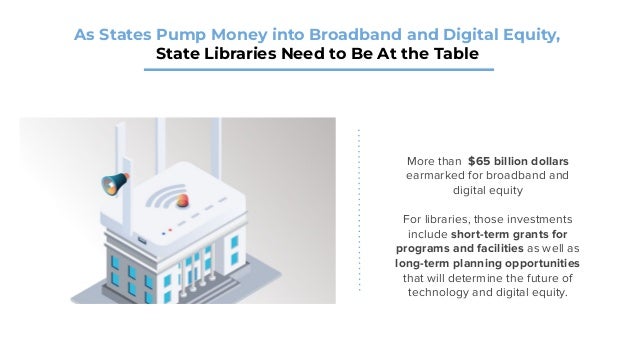
More than $65 billion dollars
earmarked for broadband and
digital equity
For libraries, those investments
include short-term grants for
programs and facilities as well as
long-term planning opportunities
that will determine the future of
technology and digital equity.
As States Pump Money into Broadband and Digital Equity,
State Libraries Need to Be At the Table
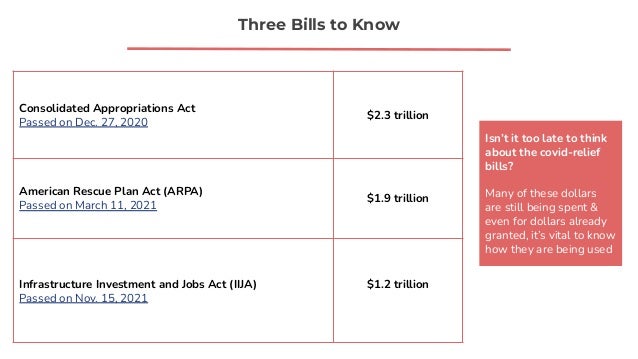
Consolidated Appropriations Act
Passed on Dec. 27, 2020
$2.3 trillion
American Rescue Plan Act (ARPA)
Passed on March 11, 2021
$1.9 trillion
Infrastructure Investment and Jobs Act (IIJA)
Passed on Nov. 15, 2021
$1.2 trillion
Three Bills to Know
Isn’t it too late to think
about the covid-relief
bills?
Many of these dollars
are still being spent &
even for dollars already
granted, it’s vital to know
how they are being used
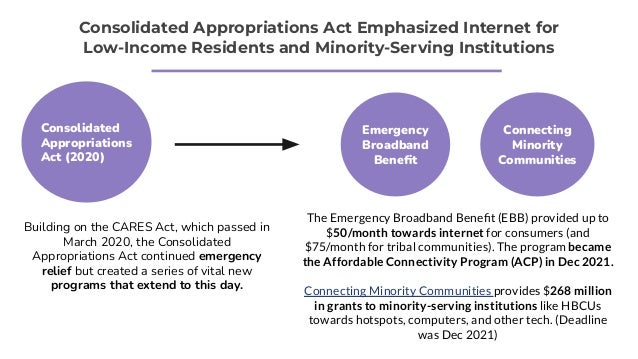
Building on the CARES Act, which passed in
March 2020, the Consolidated
Appropriations Act continued emergency
relief but created a series of vital new
programs that extend to this day.
Consolidated Appropriations Act Emphasized Internet for
Low-Income Residents and Minority-Serving Institutions
Consolidated
Appropriations
Act (2020)
The Emergency Broadband Benefit (EBB) provided up to
$50/month towards internet for consumers (and
$75/month for tribal communities). The program became
the Affordable Connectivity Program (ACP) in Dec 2021.
Connecting Minority Communities provides $268 million
in grants to minority-serving institutions like HBCUs
towards hotspots, computers, and other tech. (Deadline
was Dec 2021)
Emergency
Broadband
Benefit
Connecting
Minority
Communities
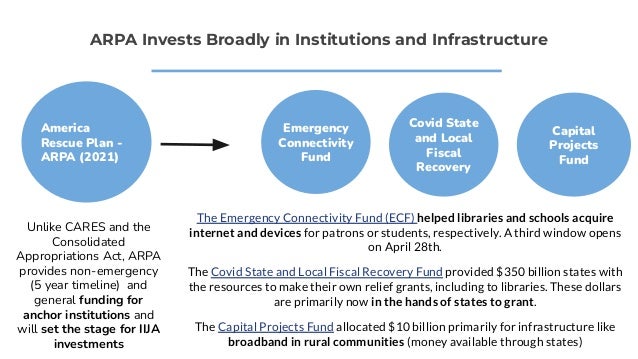
Unlike CARES and the
Consolidated
Appropriations Act, ARPA
provides non-emergency
(5 year timeline) and
general funding for
anchor institutions and
will set the stage for IIJA
investments
ARPA Invests Broadly in Institutions and Infrastructure
America
Rescue Plan -
ARPA (2021)
The Emergency Connectivity Fund (ECF) helped libraries and schools acquire
internet and devices for patrons or students, respectively. A third window opens
on April 28th.
The Covid State and Local Fiscal Recovery Fund provided $350 billion states with
the resources to make their own relief grants, including to libraries. These dollars
are primarily now in the hands of states to grant.
The Capital Projects Fund allocated $10 billion primarily for infrastructure like
broadband in rural communities (money available through states)
Emergency
Connectivity
Fund
Capital
Projects
Fund
Covid State
and Local
Fiscal
Recovery
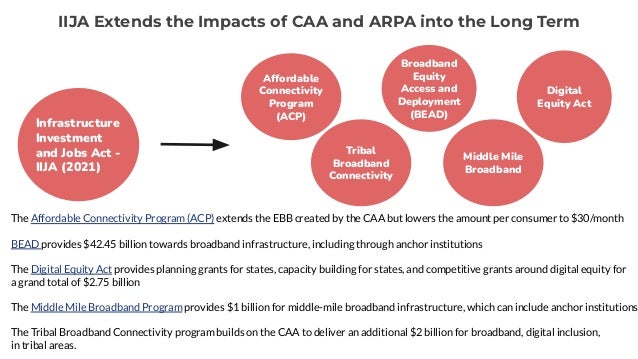
IIJA Extends the Impacts of CAA and ARPA into the Long Term
Infrastructure
Investment
and Jobs Act -
IIJA (2021)
The Affordable Connectivity Program (ACP) extends the EBB created by the CAA but lowers the amount per consumer to $30/month
BEAD provides $42.45 billion towards broadband infrastructure, including through anchor institutions
The Digital Equity Act provides planning grants for states, capacity building for states, and competitive grants around digital equity for
a grand total of $2.75 billion
The Middle Mile Broadband Program provides $1 billion for middle-mile broadband infrastructure, which can include anchor institutions
The Tribal Broadband Connectivity program builds on the CAA to deliver an additional $2 billion for broadband, digital inclusion,
in tribal areas.
Affordable
Connectivity
Program
(ACP)
Digital
Equity Act
Broadband
Equity
Access and
Deployment
(BEAD)
Tribal
Broadband
Connectivity
Middle Mile
Broadband
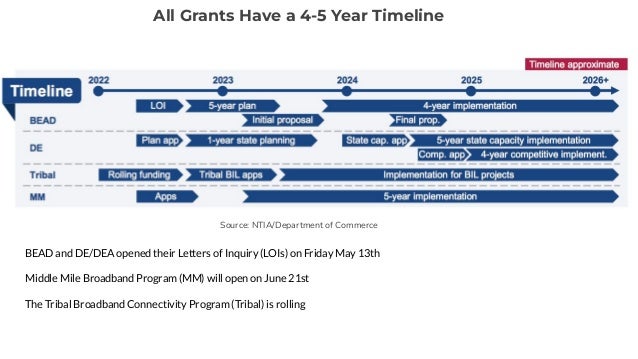
All Grants Have a 4-5 Year Timeline
BEAD and DE/DEA opened their Letters of Inquiry (LOIs) on Friday May 13th
Middle Mile Broadband Program (MM) will open on June 21st
The Tribal Broadband Connectivity Program (Tribal) is rolling
Source: NTIA/Department of Commerce
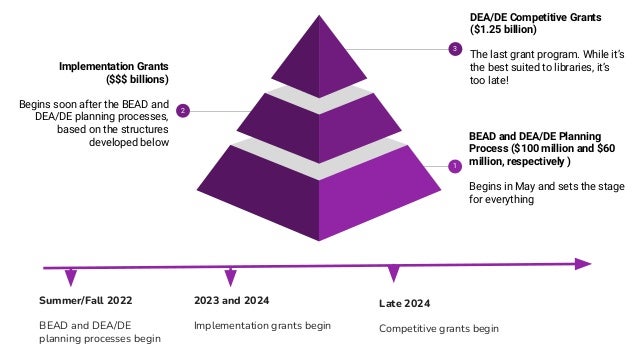
BEAD and DEA/DE Planning
Process ($100 million and $60
million, respectively )
Begins in May and sets the stage
for everything
1
Implementation Grants
($$$ billions)
Begins soon after the BEAD and
DEA/DE planning processes,
based on the structures
developed below
2
DEA/DE Competitive Grants
($1.25 billion)
The last grant program. While it’s
the best suited to libraries, it’s
too late!
3
Summer/Fall 2022
BEAD and DEA/DE
planning processes begin
2023 and 2024
Implementation grants begin
Late 2024
Competitive grants begin
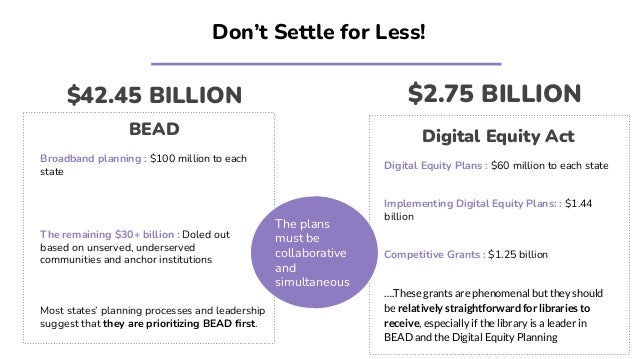
BEAD
Broadband planning : $100 million to each
state
The remaining $30+ billion : Doled out
based on unserved, underserved
communities and anchor institutions
Most states’ planning processes and leadership
suggest that they are prioritizing BEAD first.
Digital Equity Act
Digital Equity Plans : $60 million to each state
Implementing Digital Equity Plans: : $1.44
billion
Competitive Grants : $1.25 billion
….These grants are phenomenal but they should
be relatively straightforward for libraries to
receive, especially if the library is a leader in
BEAD and the Digital Equity Planning
Don’t Settle for Less!
$42.45 BILLION $2.75 BILLION
The plans
must be
collaborative
and
simultaneous
Libraries Have a Vested Interest in BEAD Because
It Will Determine The Future of Digital Equity
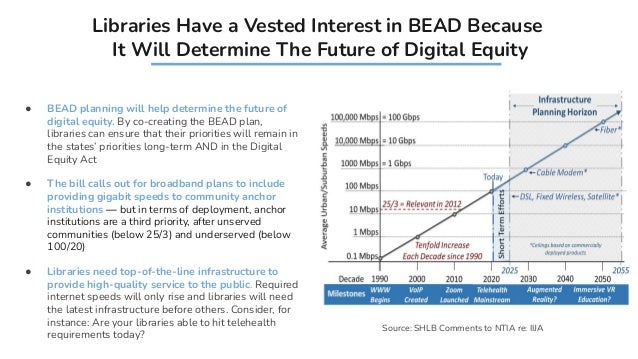
● BEAD planning will help determine the future of
digital equity. By co-creating the BEAD plan,
libraries can ensure that their priorities will remain in
the states’ priorities long-term AND in the Digital
Equity Act
● The bill calls out for broadband plans to include
providing gigabit speeds to community anchor
institutions — but in terms of deployment, anchor
institutions are a third priority, after unserved
communities (below 25/3) and underserved (below
100/20)
● Libraries need top-of-the-line infrastructure to
provide high-quality service to the public. Required
internet speeds will only rise and libraries will need
the latest infrastructure before others. Consider, for
instance: Are your libraries able to hit telehealth
requirements today?
Source: SHLB Comments to NTIA re: IIJA
What can libraries do to
engage with BEAD?
Engage with state broadband offices now
➔ Meet with newly appointed staff members
and understand their perspectives and
plans
Assess libraries’ current speeds and broadband
infrastructure
➔ Use tools like Toward Gigabit Libraries (see
video explainer)
Build coalitions with other anchor institutions
➔ Funding already groups anchor institutions
together, so libraries need to collaborate
with other schools and hospitals.
Collaborate with SHLB
The timeline is shorter, with a NOFO available in
May and funding available as early as fall 2022.
The total sum will be distributed over the next
few years.
The Digital Equity Act is Still Vital
● The Digital Equity Act calls out for digital
equity plans. Libraries could lead….or get left
behind. The Governor’s office will determine
who stewards the plan. Libraries are eligible to
steward the plan, but that’s not a given.
● Stakeholder engagement is mandatory. The
question is whether libraries will lead the
process or be led.
● Libraries will also be eligible for competitive
grants through the Digital Equity Act, which
will include digital literacy training, computer
labs, networking capability, and other core library
services. This could also support Digital
Navigators
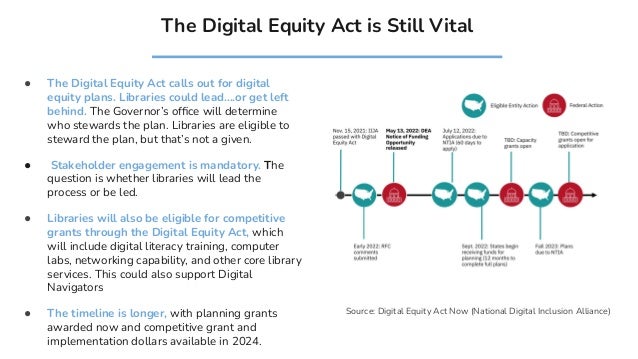
● The timeline is longer, with planning grants
awarded now and competitive grant and
implementation dollars available in 2024.
Source: Digital Equity Act Now (National Digital Inclusion Alliance)
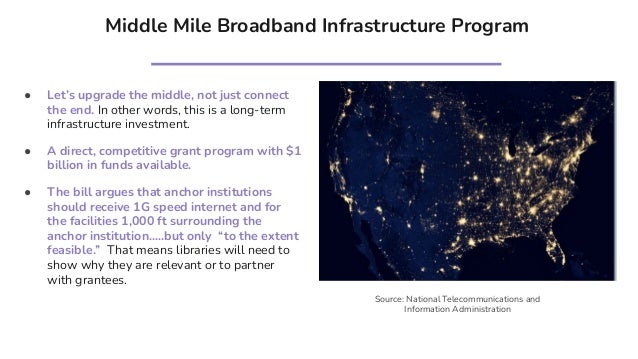
Middle Mile Broadband Infrastructure Program
● Let’s upgrade the middle, not just connect
the end. In other words, this is a long-term
infrastructure investment.
● A direct, competitive grant program with $1
billion in funds available.
● The bill argues that anchor institutions
should receive 1G speed internet and for
the facilities 1,000 ft surrounding the
anchor institution…..but only “to the extent
feasible.” That means libraries will need to
show why they are relevant or to partner
with grantees.
Source: National Telecommunications and
Information Administration
Tribal Broadband Connectivity Program
● Focused on both broadband and the digital
divide
● Established with an initial $980 million
from the Consolidated Appropriations Act
of 2021, this program got another $2 billion
from IIJA.
● The first $980 million was competitive, with
other 301 applications or $5.8 billion. The
next window has yet to open. The award
ceiling for the first round was $50 million.
Grants so far include feasibility studies,
computer equipment, and infrastructure
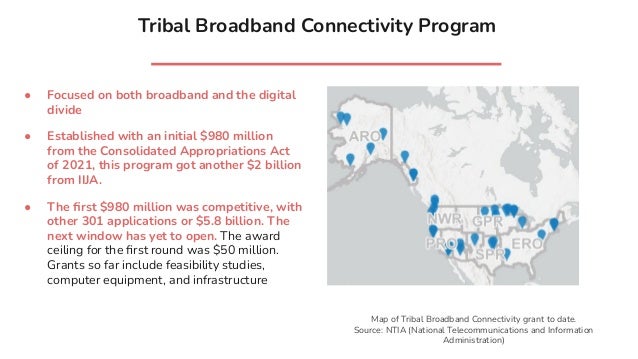
Map of Tribal Broadband Connectivity grant to date.
Source: NTIA (National Telecommunications and Information
Administration)
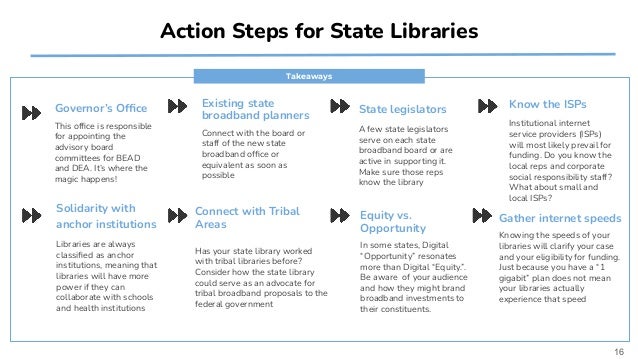
State legislators
A few state legislators
serve on each state
broadband board or are
active in supporting it.
Make sure those reps
know the library
Solidarity with
anchor institutions
Libraries are always
classified as anchor
institutions, meaning that
libraries will have more
power if they can
collaborate with schools
and health institutions
Governor’s Office
This office is responsible
for appointing the
advisory board
committees for BEAD
and DEA. It’s where the
magic happens!
Existing state
broadband planners
Connect with the board or
staff of the new state
broadband office or
equivalent as soon as
possible
Takeaways
16
Action Steps for State Libraries
Connect with Tribal
Areas
Has your state library worked
with tribal libraries before?
Consider how the state library
could serve as an advocate for
tribal broadband proposals to the
federal government
Equity vs.
Opportunity
In some states, Digital
“Opportunity” resonates
more than Digital “Equity.”.
Be aware of your audience
and how they might brand
broadband investments to
their constituents.
Gather internet speeds
Knowing the speeds of your
libraries will clarify your case
and your eligibility for funding.
Just because you have a “1
gigabit” plan does not mean
your libraries actually
experience that speed
Know the ISPs
Institutional internet
service providers (ISPs)
will most likely prevail for
funding. Do you know the
local reps and corporate
social responsibility staff?
What about small and
local ISPs?
Contact
Adam Echelman
Consultant - EveryLibrary
adamechelman@gmail.com

EveryLibrary BEAD & Digital Equity Act Presentation, General Copy, 5-17-22.pdf

  • 1.
    GETTING UP TOBEAD An overview of opportunities for libraries in state broadband and digital equity planning Recorded May 17, 2022
  • 2.
    Goals: ● To understandkey broadband and digital equity funds in the pipelines for states ● To provide state libraries with action items to prepare for broadband and digital equity policies Agenda: Agenda & Framework Summary Funding Overview BEAD vs. DEA How to Engage with BEAD Digital Equity Act Middle Mile & Tribal Broadband Actionable Next Steps
  • 3.
    More than $65billion dollars earmarked for broadband and digital equity For libraries, those investments include short-term grants for programs and facilities as well as long-term planning opportunities that will determine the future of technology and digital equity. As States Pump Money into Broadband and Digital Equity, State Libraries Need to Be At the Table
  • 4.
    Consolidated Appropriations Act Passedon Dec. 27, 2020 $2.3 trillion American Rescue Plan Act (ARPA) Passed on March 11, 2021 $1.9 trillion Infrastructure Investment and Jobs Act (IIJA) Passed on Nov. 15, 2021 $1.2 trillion Three Bills to Know Isn’t it too late to think about the covid-relief bills? Many of these dollars are still being spent & even for dollars already granted, it’s vital to know how they are being used
  • 5.
    Building on theCARES Act, which passed in March 2020, the Consolidated Appropriations Act continued emergency relief but created a series of vital new programs that extend to this day. Consolidated Appropriations Act Emphasized Internet for Low-Income Residents and Minority-Serving Institutions Consolidated Appropriations Act (2020) The Emergency Broadband Benefit (EBB) provided up to $50/month towards internet for consumers (and $75/month for tribal communities). The program became the Affordable Connectivity Program (ACP) in Dec 2021. Connecting Minority Communities provides $268 million in grants to minority-serving institutions like HBCUs towards hotspots, computers, and other tech. (Deadline was Dec 2021) Emergency Broadband Benefit Connecting Minority Communities
  • 6.
    Unlike CARES andthe Consolidated Appropriations Act, ARPA provides non-emergency (5 year timeline) and general funding for anchor institutions and will set the stage for IIJA investments ARPA Invests Broadly in Institutions and Infrastructure America Rescue Plan - ARPA (2021) The Emergency Connectivity Fund (ECF) helped libraries and schools acquire internet and devices for patrons or students, respectively. A third window opens on April 28th. The Covid State and Local Fiscal Recovery Fund provided $350 billion states with the resources to make their own relief grants, including to libraries. These dollars are primarily now in the hands of states to grant. The Capital Projects Fund allocated $10 billion primarily for infrastructure like broadband in rural communities (money available through states) Emergency Connectivity Fund Capital Projects Fund Covid State and Local Fiscal Recovery
  • 7.
    IIJA Extends theImpacts of CAA and ARPA into the Long Term Infrastructure Investment and Jobs Act - IIJA (2021) The Affordable Connectivity Program (ACP) extends the EBB created by the CAA but lowers the amount per consumer to $30/month BEAD provides $42.45 billion towards broadband infrastructure, including through anchor institutions The Digital Equity Act provides planning grants for states, capacity building for states, and competitive grants around digital equity for a grand total of $2.75 billion The Middle Mile Broadband Program provides $1 billion for middle-mile broadband infrastructure, which can include anchor institutions The Tribal Broadband Connectivity program builds on the CAA to deliver an additional $2 billion for broadband, digital inclusion, in tribal areas. Affordable Connectivity Program (ACP) Digital Equity Act Broadband Equity Access and Deployment (BEAD) Tribal Broadband Connectivity Middle Mile Broadband
  • 8.
    All Grants Havea 4-5 Year Timeline BEAD and DE/DEA opened their Letters of Inquiry (LOIs) on Friday May 13th Middle Mile Broadband Program (MM) will open on June 21st The Tribal Broadband Connectivity Program (Tribal) is rolling Source: NTIA/Department of Commerce
  • 9.
    BEAD and DEA/DEPlanning Process ($100 million and $60 million, respectively ) Begins in May and sets the stage for everything 1 Implementation Grants ($$$ billions) Begins soon after the BEAD and DEA/DE planning processes, based on the structures developed below 2 DEA/DE Competitive Grants ($1.25 billion) The last grant program. While it’s the best suited to libraries, it’s too late! 3 Summer/Fall 2022 BEAD and DEA/DE planning processes begin 2023 and 2024 Implementation grants begin Late 2024 Competitive grants begin
  • 10.
    BEAD Broadband planning :$100 million to each state The remaining $30+ billion : Doled out based on unserved, underserved communities and anchor institutions Most states’ planning processes and leadership suggest that they are prioritizing BEAD first. Digital Equity Act Digital Equity Plans : $60 million to each state Implementing Digital Equity Plans: : $1.44 billion Competitive Grants : $1.25 billion ….These grants are phenomenal but they should be relatively straightforward for libraries to receive, especially if the library is a leader in BEAD and the Digital Equity Planning Don’t Settle for Less! $42.45 BILLION $2.75 BILLION The plans must be collaborative and simultaneous
  • 11.
    Libraries Have aVested Interest in BEAD Because It Will Determine The Future of Digital Equity ● BEAD planning will help determine the future of digital equity. By co-creating the BEAD plan, libraries can ensure that their priorities will remain in the states’ priorities long-term AND in the Digital Equity Act ● The bill calls out for broadband plans to include providing gigabit speeds to community anchor institutions — but in terms of deployment, anchor institutions are a third priority, after unserved communities (below 25/3) and underserved (below 100/20) ● Libraries need top-of-the-line infrastructure to provide high-quality service to the public. Required internet speeds will only rise and libraries will need the latest infrastructure before others. Consider, for instance: Are your libraries able to hit telehealth requirements today? Source: SHLB Comments to NTIA re: IIJA
  • 12.
    What can librariesdo to engage with BEAD? Engage with state broadband offices now ➔ Meet with newly appointed staff members and understand their perspectives and plans Assess libraries’ current speeds and broadband infrastructure ➔ Use tools like Toward Gigabit Libraries (see video explainer) Build coalitions with other anchor institutions ➔ Funding already groups anchor institutions together, so libraries need to collaborate with other schools and hospitals. Collaborate with SHLB The timeline is shorter, with a NOFO available in May and funding available as early as fall 2022. The total sum will be distributed over the next few years.
  • 13.
    The Digital EquityAct is Still Vital ● The Digital Equity Act calls out for digital equity plans. Libraries could lead….or get left behind. The Governor’s office will determine who stewards the plan. Libraries are eligible to steward the plan, but that’s not a given. ● Stakeholder engagement is mandatory. The question is whether libraries will lead the process or be led. ● Libraries will also be eligible for competitive grants through the Digital Equity Act, which will include digital literacy training, computer labs, networking capability, and other core library services. This could also support Digital Navigators ● The timeline is longer, with planning grants awarded now and competitive grant and implementation dollars available in 2024. Source: Digital Equity Act Now (National Digital Inclusion Alliance)
  • 14.
    Middle Mile BroadbandInfrastructure Program ● Let’s upgrade the middle, not just connect the end. In other words, this is a long-term infrastructure investment. ● A direct, competitive grant program with $1 billion in funds available. ● The bill argues that anchor institutions should receive 1G speed internet and for the facilities 1,000 ft surrounding the anchor institution…..but only “to the extent feasible.” That means libraries will need to show why they are relevant or to partner with grantees. Source: National Telecommunications and Information Administration
  • 15.
    Tribal Broadband ConnectivityProgram ● Focused on both broadband and the digital divide ● Established with an initial $980 million from the Consolidated Appropriations Act of 2021, this program got another $2 billion from IIJA. ● The first $980 million was competitive, with other 301 applications or $5.8 billion. The next window has yet to open. The award ceiling for the first round was $50 million. Grants so far include feasibility studies, computer equipment, and infrastructure Map of Tribal Broadband Connectivity grant to date. Source: NTIA (National Telecommunications and Information Administration)
  • 16.
    State legislators A fewstate legislators serve on each state broadband board or are active in supporting it. Make sure those reps know the library Solidarity with anchor institutions Libraries are always classified as anchor institutions, meaning that libraries will have more power if they can collaborate with schools and health institutions Governor’s Office This office is responsible for appointing the advisory board committees for BEAD and DEA. It’s where the magic happens! Existing state broadband planners Connect with the board or staff of the new state broadband office or equivalent as soon as possible Takeaways 16 Action Steps for State Libraries Connect with Tribal Areas Has your state library worked with tribal libraries before? Consider how the state library could serve as an advocate for tribal broadband proposals to the federal government Equity vs. Opportunity In some states, Digital “Opportunity” resonates more than Digital “Equity.”. Be aware of your audience and how they might brand broadband investments to their constituents. Gather internet speeds Knowing the speeds of your libraries will clarify your case and your eligibility for funding. Just because you have a “1 gigabit” plan does not mean your libraries actually experience that speed Know the ISPs Institutional internet service providers (ISPs) will most likely prevail for funding. Do you know the local reps and corporate social responsibility staff? What about small and local ISPs?
  • 17.
    Contact Adam Echelman Consultant -EveryLibrary adamechelman@gmail.com