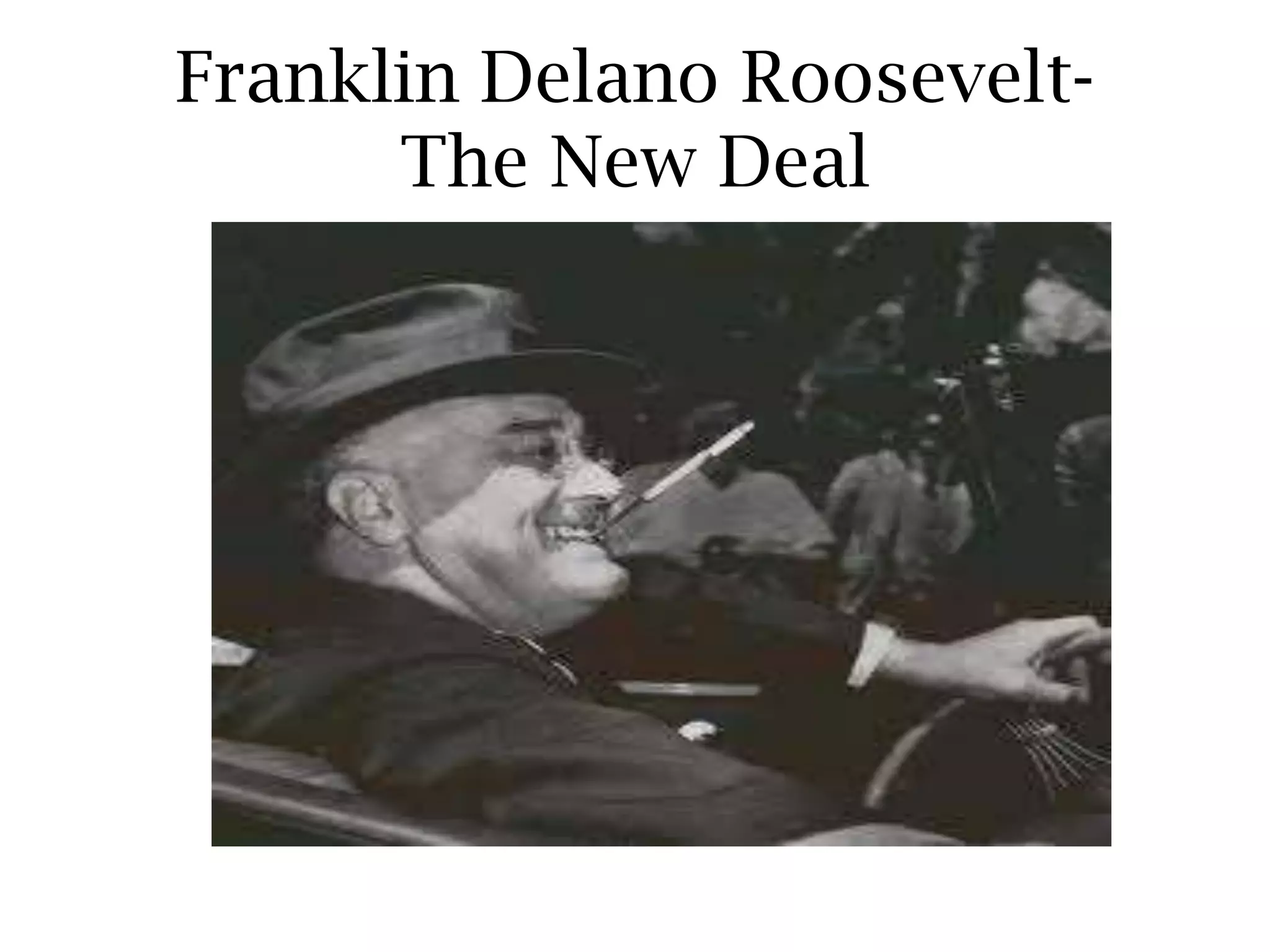
Franklin Delano Roosevelt-
The New Deal
TN Curriculum Standards:
• 2.0-Understand the economic climate in the U.S. during the
Depression Era.
• 4.0-Recognize the effects of the Great Depression on the United
States political and judicial system.
• 5.0-Investigate the causes, effects, and attempts to deal with the
Great Depression.
• 6.0-Understand the changes in American life as a result of the Great
Depression.
• SPI 8.6-Identify New Deal Programs/Initiatives
(i.e. Social Security, WPA, TVA, Indian
Reorganization Act, FDIC, CCC, Wagner/Fair Labor
Standards’ Act)
“The only thing we have
to fear is fear itself”
~Franklin Delano Roosevelt
Inaugural address March 1933
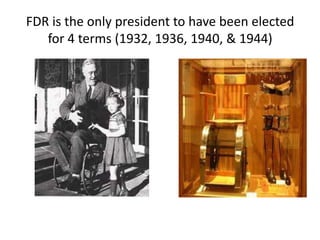
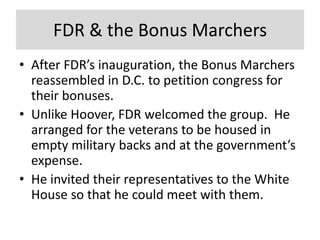
FDR is the only president to have been elected
for 4 terms (1932, 1936, 1940, & 1944)
FDR & the Bonus Marchers
• After FDR’s inauguration, the Bonus Marchers
reassembled in D.C. to petition congress for
their bonuses.
• Unlike Hoover, FDR welcomed the group. He
arranged for the veterans to be housed in
empty military backs and at the government’s
expense.
• He invited their representatives to the White
House so that he could meet with them.
FDR & The Bonus Marchers
• When FDR met with the delegates, he
explained to them that he supported
them, but he could not support giving them
their bonuses right now because the country
couldn’t afford it.
• He did promise to pass legislation that would
help them and others suffering from the
depression.
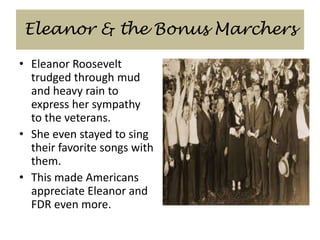
Eleanor & the Bonus Marchers
• Eleanor Roosevelt
trudged through mud
and heavy rain to
express her sympathy
to the veterans.
• She even stayed to sing
their favorite songs with
them.
• This made Americans
appreciate Eleanor and
FDR even more.
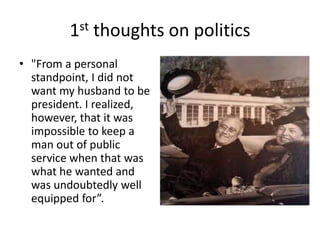
1st thoughts on politics
• "From a personal
standpoint, I did not
want my husband to be
president. I realized,
however, that it was
impossible to keep a
man out of public
service when that was
what he wanted and
was undoubtedly well
equipped for”.
Traitor to his class?
• FDR grew up wealthy and privileged, but he
was extremely sympathetic to the plight of the
hardworking poor.
• For this, they loved and supported him, even if
they did not agree with all of his policies.
• This made many elites view him as a traitor to
his class.
Addressing the nation
• FDR was well aware of the fears that
Americans had about his plan for economic
recovery.
• There was warring between Democrats and
Republicans and even Democrats and
Democrats. Opinion seemed to be divided by
region, religion, and culture.
• FDR used his “fireside chats” to calm the
nation’s fears.
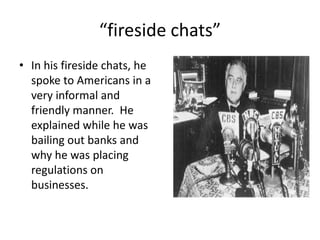
“fireside chats”
• In his fireside chats, he
spoke to Americans in a
very informal and
friendly manner. He
explained while he was
bailing out banks and
why he was placing
regulations on
businesses.
Federal Emergency Relief Agency
• The FERA provided more
than $500 million in funding
to feed the hungry and
create jobs.
• Approximately 4-5 million
households were served
through this program.
• These households received
$20- $30 in monthly
benefits.
• FERA also created jobs for
the unemployed by funding
public works initiatives.
• Those who worked under
the Civil Works
Administration (CWA)
usually earned between .40
and .60 cents and hour.
• Overall, the CWA paid out
checks over $800 million to
former unemployed
Americans.
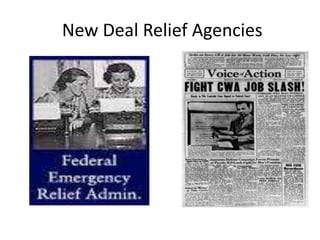
New Deal Relief Agencies
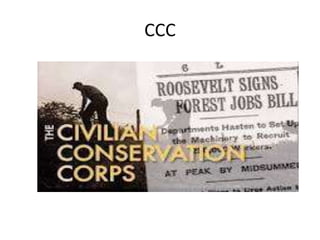
CCC
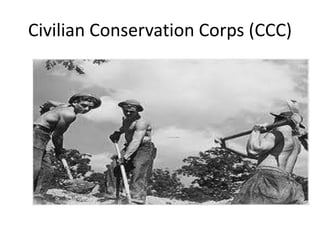
Civilian Conservation Corps (CCC)
• FDR was extremely concerned with conserving
the country’s natural resources.
• While the CCC, did provide employment for
more than 3 million men, it is best known for
its’ work in forestry.
• CCC employees checked for soil
erosion, tamed rivers, and planted more than
2 billion trees.
Civilian Conservation Corps (CCC)
Conserving resources
• FDR was also concerned with conserving
hydroelectric power.
• The Hoover Dam was completed under the
New Deal.
• It provided electricity for Nevada and flood
control and irrigation for Arizona and southern
California.
• Even with these benefits, the project was
most welcomed because it created jobs.
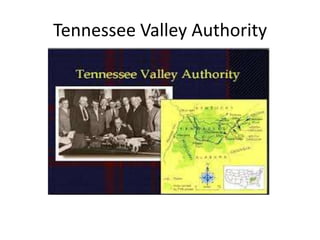
Tennessee Valley Authority
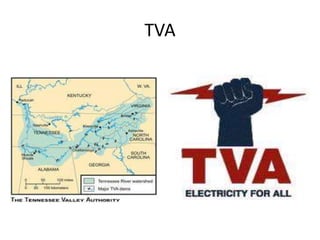
Tennessee Valley Authority (TVA)
• Although the benefits
of having the TVA
cannot be denied
now, FDR faced fierce
opposition for trying to
establish it in 1933.
• It was the most
controversial natural
resources development
project.
• It was created to
provide
impoverished, rural
communities with a
cheap source of
electricity.
• It improved the lives of
millions by bringing
electric power, flood
protection, and jobs.
TVA
Tennessee Valley Authority
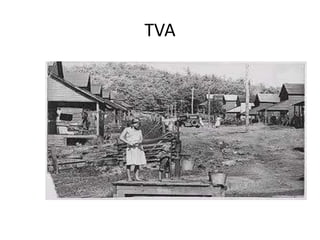
• 90% of rural Americans lacked electricity when FDR
took office.
• Private electric companies refused to build
transmission lines in these rural areas because they got
such a large amount of business from urban areas.
• Under FDR, low cost loans were made available to local
cooperatives for power plants and transmission lines.
• Now, rural Americans could enjoy the same types of
conveniences that urban Americans had been enjoying
for decades.
TVA
Let’s Check for Understanding-
remember to vote from your SAFE ZONE!!
Challenges to the New Deal
• Republicans and the business community
accused FDR of being too radical and anti-
business.
• They said that his New Deal policies would
undermine private
property, capitalism, economic prosperity, and
democracy as a whole.
• Democrats on the left said that he didn’t do
enough to attack greedy corporations.
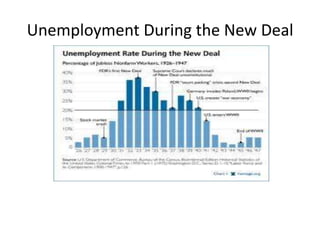
Unemployment During the New Deal
FDR vs. the Supreme Court
• The New Deal program benefitted business
leaders the most, but they still launched anti-New
Deal campaigns that spreaded fear and
resentment about regulations, taxes, and unions.
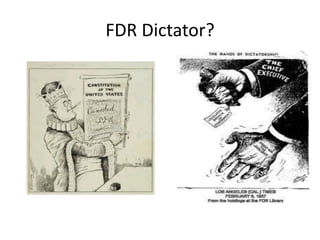
• They began to complain that FDR was using too
much power as president and becoming a
dictator.
• The Supreme Court (highest court in the land)
entered the debate and declared that FDR had
overstepped his powers. They declared his
measures unconstitutional.
FDR Dictator?
• “After Eleanor Roosevelt left the White House in
1945, she continued to be an influential figure in the
Democratic Party. President Truman appointed her a
member of the first U.S. delegation to the United
Nations in 1945 and she served as chairman of the
Human Rights commission.
• She gave public lectures and speeches, supported
organized labor, and worked on behalf of a variety of
causes, such as child welfare, displaced
persons, minority rights, and women's rights. She
continued to write books and her syndicated My Day
column”.

Franklin delano roosevelt

  • 1.
  • 2.
    TN Curriculum Standards: •2.0-Understand the economic climate in the U.S. during the Depression Era. • 4.0-Recognize the effects of the Great Depression on the United States political and judicial system. • 5.0-Investigate the causes, effects, and attempts to deal with the Great Depression. • 6.0-Understand the changes in American life as a result of the Great Depression. • SPI 8.6-Identify New Deal Programs/Initiatives (i.e. Social Security, WPA, TVA, Indian Reorganization Act, FDIC, CCC, Wagner/Fair Labor Standards’ Act)
  • 3.
    “The only thingwe have to fear is fear itself” ~Franklin Delano Roosevelt Inaugural address March 1933
  • 4.
    FDR is theonly president to have been elected for 4 terms (1932, 1936, 1940, & 1944)
  • 5.
    FDR & theBonus Marchers • After FDR’s inauguration, the Bonus Marchers reassembled in D.C. to petition congress for their bonuses. • Unlike Hoover, FDR welcomed the group. He arranged for the veterans to be housed in empty military backs and at the government’s expense. • He invited their representatives to the White House so that he could meet with them.
  • 6.
    FDR & TheBonus Marchers • When FDR met with the delegates, he explained to them that he supported them, but he could not support giving them their bonuses right now because the country couldn’t afford it. • He did promise to pass legislation that would help them and others suffering from the depression.
  • 7.
    Eleanor & theBonus Marchers • Eleanor Roosevelt trudged through mud and heavy rain to express her sympathy to the veterans. • She even stayed to sing their favorite songs with them. • This made Americans appreciate Eleanor and FDR even more.
  • 8.
    1st thoughts onpolitics • "From a personal standpoint, I did not want my husband to be president. I realized, however, that it was impossible to keep a man out of public service when that was what he wanted and was undoubtedly well equipped for”.
  • 9.
    Traitor to hisclass? • FDR grew up wealthy and privileged, but he was extremely sympathetic to the plight of the hardworking poor. • For this, they loved and supported him, even if they did not agree with all of his policies. • This made many elites view him as a traitor to his class.
  • 10.
    Addressing the nation •FDR was well aware of the fears that Americans had about his plan for economic recovery. • There was warring between Democrats and Republicans and even Democrats and Democrats. Opinion seemed to be divided by region, religion, and culture. • FDR used his “fireside chats” to calm the nation’s fears.
  • 11.
    “fireside chats” • Inhis fireside chats, he spoke to Americans in a very informal and friendly manner. He explained while he was bailing out banks and why he was placing regulations on businesses.
  • 12.
    Federal Emergency ReliefAgency • The FERA provided more than $500 million in funding to feed the hungry and create jobs. • Approximately 4-5 million households were served through this program. • These households received $20- $30 in monthly benefits. • FERA also created jobs for the unemployed by funding public works initiatives. • Those who worked under the Civil Works Administration (CWA) usually earned between .40 and .60 cents and hour. • Overall, the CWA paid out checks over $800 million to former unemployed Americans.
  • 13.
  • 14.
  • 15.
    Civilian Conservation Corps(CCC) • FDR was extremely concerned with conserving the country’s natural resources. • While the CCC, did provide employment for more than 3 million men, it is best known for its’ work in forestry. • CCC employees checked for soil erosion, tamed rivers, and planted more than 2 billion trees.
  • 16.
  • 17.
    Conserving resources • FDRwas also concerned with conserving hydroelectric power. • The Hoover Dam was completed under the New Deal. • It provided electricity for Nevada and flood control and irrigation for Arizona and southern California. • Even with these benefits, the project was most welcomed because it created jobs.
  • 18.
  • 19.
    Tennessee Valley Authority(TVA) • Although the benefits of having the TVA cannot be denied now, FDR faced fierce opposition for trying to establish it in 1933. • It was the most controversial natural resources development project. • It was created to provide impoverished, rural communities with a cheap source of electricity. • It improved the lives of millions by bringing electric power, flood protection, and jobs.
  • 20.
  • 21.
    Tennessee Valley Authority •90% of rural Americans lacked electricity when FDR took office. • Private electric companies refused to build transmission lines in these rural areas because they got such a large amount of business from urban areas. • Under FDR, low cost loans were made available to local cooperatives for power plants and transmission lines. • Now, rural Americans could enjoy the same types of conveniences that urban Americans had been enjoying for decades.
  • 22.
  • 23.
    Let’s Check forUnderstanding- remember to vote from your SAFE ZONE!!
  • 24.
    Challenges to theNew Deal • Republicans and the business community accused FDR of being too radical and anti- business. • They said that his New Deal policies would undermine private property, capitalism, economic prosperity, and democracy as a whole. • Democrats on the left said that he didn’t do enough to attack greedy corporations.
  • 25.
  • 26.
    FDR vs. theSupreme Court • The New Deal program benefitted business leaders the most, but they still launched anti-New Deal campaigns that spreaded fear and resentment about regulations, taxes, and unions. • They began to complain that FDR was using too much power as president and becoming a dictator. • The Supreme Court (highest court in the land) entered the debate and declared that FDR had overstepped his powers. They declared his measures unconstitutional.
  • 27.
  • 29.
    • “After EleanorRoosevelt left the White House in 1945, she continued to be an influential figure in the Democratic Party. President Truman appointed her a member of the first U.S. delegation to the United Nations in 1945 and she served as chairman of the Human Rights commission. • She gave public lectures and speeches, supported organized labor, and worked on behalf of a variety of causes, such as child welfare, displaced persons, minority rights, and women's rights. She continued to write books and her syndicated My Day column”.