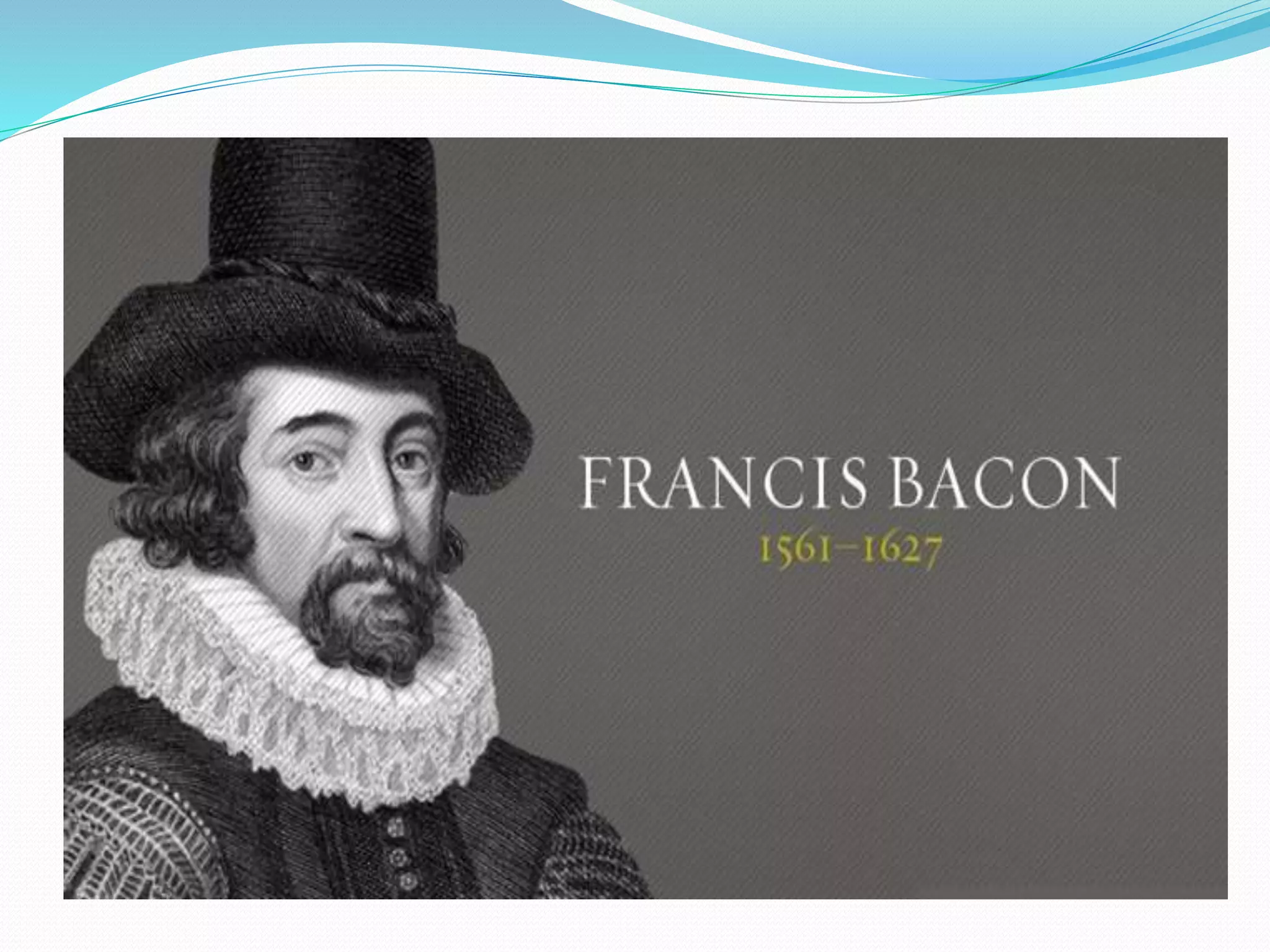
Francis Bacon:
 Nationality – English
 Lifespan - 1561-1626
 Birth - 22nd of January, 1561 (London)(Youngest of 8)
 Death - 9th of April,1626
 Parents - Sir Nicholas Bacon, Lady Anne Cooke
 Education - Trinity College (11), Cambridge Gray’s Inn,
London (Joined Law Programme)
 Religion – Protestant (Reject Roman Catholic Church)
 Character of Bacon - Intelligent, ambitious, arrogant, cold
and calculating
 Spouse- Alice Burnham, married twice
 As a Student while studying, he was strong in his
criticism of his teachers who he agreed were surely
men of wits but never explored beyond a few authors
as they only explored Aristotle.
 He favored the new Renaissance humanism over
Aristotelianism.
 Things turned difficult for the talented Francis when
his father passed away suddenly
 He was a good lawyer, and was among the able group
of men Queen Elizabeth gathered around her upon
her successation to throne.
 Accused of accepting bribes, was tried and found
guilty after he confessed.
 After his forced retirement then Bacon went on to
write essays in which he shared the wisdom of his life –
the wisdom coming from one who had seen much
struggle, rise, fame and the loss.
Bacon’s Essay Work:
 The original number of essays in Bacon's Essays
(1597)was 10
 Went on to 38 essays by the year 1612.
 His essays are his observations. (pearls of wisdom)
Background of Prose:
 The art of prose writing developed during the Middle
ages lost its glory and during Renaissance it again
achieved the highest position.
 Bacon evolved such a prose style which proved that
English can be used as a medium of expression. Due to
this he is regarded as the "Father of English Essay “
 Before Bacon, Prose had more ornate and figurative
style.
Bacon’s Style:
 Contributed to direct and simple style, That has been
admired from his own time to the present day.
 Aphoristic Style: Bacon's style is most remarkable for
its terseness and condensation. Although his
sentences are brief but they are extremely forceful. He
knows the art of making huge statements into
abridged form, which appears to be very captivating
and enchanting for readers. His essays express
compact and condensed thought
Bacon’s Style:
 Examples: : “Studies serve for delight, for ornament,
and for ability.”( Of Studies) This statement appears to
be very condensed and concise but the thought it
carries is quiet deep. It represents that study is an
activity which brings joy and happiness and enhances
our thinking ,writing ,reading and speaking abilities. It
also adds charm to our personality. Study is the most
finest way of gaining wisdom.
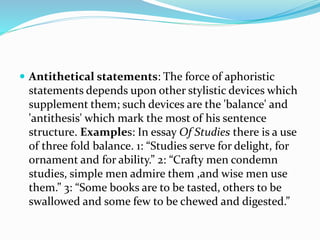
 Antithetical statements: The force of aphoristic
statements depends upon other stylistic devices which
supplement them; such devices are the 'balance' and
'antithesis' which mark the most of his sentence
structure. Examples: In essay Of Studies there is a use
of three fold balance. 1: “Studies serve for delight, for
ornament and for ability.” 2: “Crafty men condemn
studies, simple men admire them ,and wise men use
them.” 3: “Some books are to be tasted, others to be
swallowed and some few to be chewed and digested.”
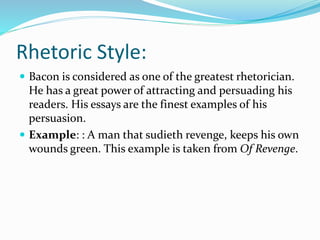
Rhetoric Style:
 Bacon is considered as one of the greatest rhetorician.
He has a great power of attracting and persuading his
readers. His essays are the finest examples of his
persuasion.
 Example: : A man that sudieth revenge, keeps his own
wounds green. This example is taken from Of Revenge.
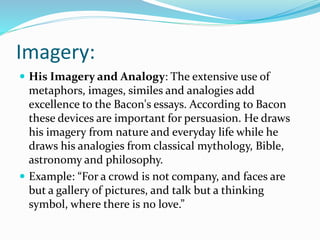
Imagery:
 His Imagery and Analogy: The extensive use of
metaphors, images, similes and analogies add
excellence to the Bacon's essays. According to Bacon
these devices are important for persuasion. He draws
his imagery from nature and everyday life while he
draws his analogies from classical mythology, Bible,
astronomy and philosophy.
 Example: “For a crowd is not company, and faces are
but a gallery of pictures, and talk but a thinking
symbol, where there is no love.”
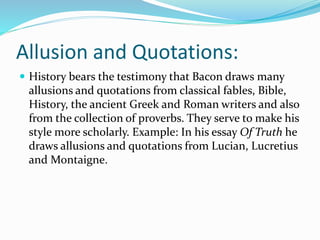
Allusion and Quotations:
 History bears the testimony that Bacon draws many
allusions and quotations from classical fables, Bible,
History, the ancient Greek and Roman writers and also
from the collection of proverbs. They serve to make his
style more scholarly. Example: In his essay Of Truth he
draws allusions and quotations from Lucian, Lucretius
and Montaigne.
Bacon's Regard for structure
 All his works including his essays show a strong
organic unity of structure like a tree with its various
branches. The purpose of the organisation and
structuring of the material of the essay is to present a
convincing argument and to persuade the reader of his
point of view.

Francis bacon

  • 2.
    Francis Bacon:  Nationality– English  Lifespan - 1561-1626  Birth - 22nd of January, 1561 (London)(Youngest of 8)  Death - 9th of April,1626  Parents - Sir Nicholas Bacon, Lady Anne Cooke  Education - Trinity College (11), Cambridge Gray’s Inn, London (Joined Law Programme)  Religion – Protestant (Reject Roman Catholic Church)  Character of Bacon - Intelligent, ambitious, arrogant, cold and calculating  Spouse- Alice Burnham, married twice
  • 3.
     As aStudent while studying, he was strong in his criticism of his teachers who he agreed were surely men of wits but never explored beyond a few authors as they only explored Aristotle.  He favored the new Renaissance humanism over Aristotelianism.  Things turned difficult for the talented Francis when his father passed away suddenly
  • 4.
     He wasa good lawyer, and was among the able group of men Queen Elizabeth gathered around her upon her successation to throne.  Accused of accepting bribes, was tried and found guilty after he confessed.  After his forced retirement then Bacon went on to write essays in which he shared the wisdom of his life – the wisdom coming from one who had seen much struggle, rise, fame and the loss.
  • 5.
    Bacon’s Essay Work: The original number of essays in Bacon's Essays (1597)was 10  Went on to 38 essays by the year 1612.  His essays are his observations. (pearls of wisdom)
  • 6.
    Background of Prose: The art of prose writing developed during the Middle ages lost its glory and during Renaissance it again achieved the highest position.  Bacon evolved such a prose style which proved that English can be used as a medium of expression. Due to this he is regarded as the "Father of English Essay “  Before Bacon, Prose had more ornate and figurative style.
  • 7.
    Bacon’s Style:  Contributedto direct and simple style, That has been admired from his own time to the present day.  Aphoristic Style: Bacon's style is most remarkable for its terseness and condensation. Although his sentences are brief but they are extremely forceful. He knows the art of making huge statements into abridged form, which appears to be very captivating and enchanting for readers. His essays express compact and condensed thought
  • 8.
    Bacon’s Style:  Examples:: “Studies serve for delight, for ornament, and for ability.”( Of Studies) This statement appears to be very condensed and concise but the thought it carries is quiet deep. It represents that study is an activity which brings joy and happiness and enhances our thinking ,writing ,reading and speaking abilities. It also adds charm to our personality. Study is the most finest way of gaining wisdom.
  • 9.
     Antithetical statements:The force of aphoristic statements depends upon other stylistic devices which supplement them; such devices are the 'balance' and 'antithesis' which mark the most of his sentence structure. Examples: In essay Of Studies there is a use of three fold balance. 1: “Studies serve for delight, for ornament and for ability.” 2: “Crafty men condemn studies, simple men admire them ,and wise men use them.” 3: “Some books are to be tasted, others to be swallowed and some few to be chewed and digested.”
  • 10.
    Rhetoric Style:  Baconis considered as one of the greatest rhetorician. He has a great power of attracting and persuading his readers. His essays are the finest examples of his persuasion.  Example: : A man that sudieth revenge, keeps his own wounds green. This example is taken from Of Revenge.
  • 11.
    Imagery:  His Imageryand Analogy: The extensive use of metaphors, images, similes and analogies add excellence to the Bacon's essays. According to Bacon these devices are important for persuasion. He draws his imagery from nature and everyday life while he draws his analogies from classical mythology, Bible, astronomy and philosophy.  Example: “For a crowd is not company, and faces are but a gallery of pictures, and talk but a thinking symbol, where there is no love.”
  • 12.
    Allusion and Quotations: History bears the testimony that Bacon draws many allusions and quotations from classical fables, Bible, History, the ancient Greek and Roman writers and also from the collection of proverbs. They serve to make his style more scholarly. Example: In his essay Of Truth he draws allusions and quotations from Lucian, Lucretius and Montaigne.
  • 13.
    Bacon's Regard forstructure  All his works including his essays show a strong organic unity of structure like a tree with its various branches. The purpose of the organisation and structuring of the material of the essay is to present a convincing argument and to persuade the reader of his point of view.