FRAME STRUCTURE
NAME : AFFAN AZAM
CMS : 54080
SPACE FRAME
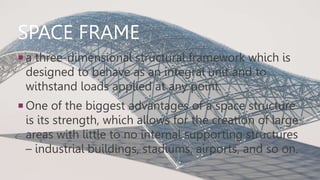
 a three-dimensional structural framework which is
designed to behave as an integral unit and to
withstand loads applied at any point.
 One of the biggest advantages of a space structure
is its strength, which allows for the creation of large
areas with little to no internal supporting structures
– industrial buildings, stadiums, airports, and so on.
CASE STUDY : LOUVRE PYRAMID
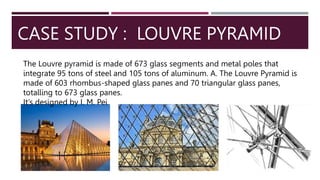
The Louvre pyramid is made of 673 glass segments and metal poles that
integrate 95 tons of steel and 105 tons of aluminum. A. The Louvre Pyramid is
made of 603 rhombus-shaped glass panes and 70 triangular glass panes,
totalling to 673 glass panes.
It’s designed by I. M. Pei
TRUSS STRUCTURE
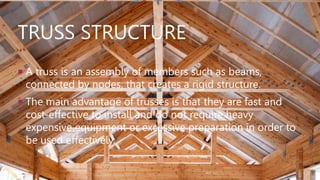
 A truss is an assembly of members such as beams,
connected by nodes, that creates a rigid structure.
 The main advantage of trusses is that they are fast and
cost-effective to install and do not require heavy
expensive equipment or excessive preparation in order to
be used effectively.
CASE STUDY : EIFFEL TOWER
 The Eiffel Tower is probably the most
famous truss structure in the World.
Constructed between 1887 and 1889.
 The Eiffel Tower is 984′ tall.
 Building material iron.
 The Eiffel Tower was built to be one
the main attractions at the Paris
World's Fair in 1889.
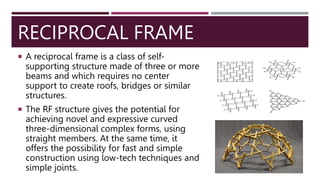
RECIPROCAL FRAME
 A reciprocal frame is a class of self-
supporting structure made of three or more
beams and which requires no center
support to create roofs, bridges or similar
structures.
 The RF structure gives the potential for
achieving novel and expressive curved
three-dimensional complex forms, using
straight members. At the same time, it
offers the possibility for fast and simple
construction using low-tech techniques and
simple joints.
CASE STUDY : RECIPROCAL FRAME BY NATHAN
MELENBRINK, SAMO PEDERSEN AND SHIBU RAMAN
 It a pavilion celebrating and displaying four
years of academic work.
 it serves not only as a showcase for their
portfolios of work, but also as the culmination of
that work.
 It consists of 3019 flat segments of notched,
eighteen-millimetre plywood.
 the pavilion’s mesh-like surface and its
reflection in the atrium’s floor. The slowly
shrinking radius of the pavilion plays on the
conventional exhibition experience.
THANK YOU

Frame structure.pptx

  • 1.
    FRAME STRUCTURE NAME :AFFAN AZAM CMS : 54080
  • 2.
    SPACE FRAME  athree-dimensional structural framework which is designed to behave as an integral unit and to withstand loads applied at any point.  One of the biggest advantages of a space structure is its strength, which allows for the creation of large areas with little to no internal supporting structures – industrial buildings, stadiums, airports, and so on.
  • 3.
    CASE STUDY :LOUVRE PYRAMID The Louvre pyramid is made of 673 glass segments and metal poles that integrate 95 tons of steel and 105 tons of aluminum. A. The Louvre Pyramid is made of 603 rhombus-shaped glass panes and 70 triangular glass panes, totalling to 673 glass panes. It’s designed by I. M. Pei
  • 4.
    TRUSS STRUCTURE  Atruss is an assembly of members such as beams, connected by nodes, that creates a rigid structure.  The main advantage of trusses is that they are fast and cost-effective to install and do not require heavy expensive equipment or excessive preparation in order to be used effectively.
  • 5.
    CASE STUDY :EIFFEL TOWER  The Eiffel Tower is probably the most famous truss structure in the World. Constructed between 1887 and 1889.  The Eiffel Tower is 984′ tall.  Building material iron.  The Eiffel Tower was built to be one the main attractions at the Paris World's Fair in 1889.
  • 6.
    RECIPROCAL FRAME  Areciprocal frame is a class of self- supporting structure made of three or more beams and which requires no center support to create roofs, bridges or similar structures.  The RF structure gives the potential for achieving novel and expressive curved three-dimensional complex forms, using straight members. At the same time, it offers the possibility for fast and simple construction using low-tech techniques and simple joints.
  • 7.
    CASE STUDY :RECIPROCAL FRAME BY NATHAN MELENBRINK, SAMO PEDERSEN AND SHIBU RAMAN  It a pavilion celebrating and displaying four years of academic work.  it serves not only as a showcase for their portfolios of work, but also as the culmination of that work.  It consists of 3019 flat segments of notched, eighteen-millimetre plywood.  the pavilion’s mesh-like surface and its reflection in the atrium’s floor. The slowly shrinking radius of the pavilion plays on the conventional exhibition experience.
  • 8.