Four types of title sequences
What is a title sequence?
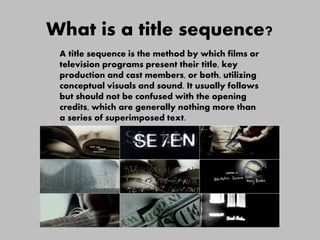
A title sequence is the method by which films or
television programs present their title, key
production and cast members, or both, utilizing
conceptual visuals and sound. It usually follows
but should not be confused with the opening
credits, which are generally nothing more than
a series of superimposed text.
Discrete title sequences
• Discrete title sequences are separately filmed clips
that are played before the movie starts.
• Usually there to set the mood and tone for the rest of
the film.
• It is known as a mini film, before the actual film.
• An example would be James Bond; Skyfall.
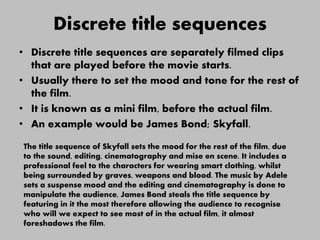
The title sequence of Skyfall sets the mood for the rest of the film, due
to the sound, editing, cinematography and mise en scene. It includes a
professional feel to the characters for wearing smart clothing, whilst
being surrounded by graves, weapons and blood. The music by Adele
sets a suspense mood and the editing and cinematography is done to
manipulate the audience, James Bond steals the title sequence by
featuring in it the most therefore allowing the audience to recognise
who will we expect to see most of in the actual film, it almost
foreshadows the film.
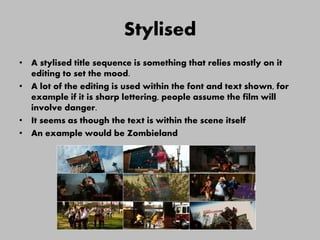
Stylised
• A stylised title sequence is something that relies mostly on it
editing to set the mood.
• A lot of the editing is used within the font and text shown, for
example if it is sharp lettering, people assume the film will
involve danger.
• It seems as though the text is within the scene itself
• An example would be Zombieland
Credits over a blank screen
• This is more of a suttle title sequence.
• It tends to involve a blank screen with a contrast
colour writing.
• The mood depends upon the colours and sound
involved to set the tone
• Sometimes this can be effective for thrillers as people
have to make their own judgement of the film by the
colours, font and sound involved.
Narrative opening
• This is also another simple but effective way of a title
sequence because there is someone actually
speaking to the audience.
• This allows the audience to make a judgement of this
character before they are introduced as an actual
character in the film
• This is done by the tone of their voice, whether their
male or female, young or old. It allows the audience
to get an insight to the character.

Four types of title sequences

  • 1.
    Four types oftitle sequences
  • 2.
    What is atitle sequence? A title sequence is the method by which films or television programs present their title, key production and cast members, or both, utilizing conceptual visuals and sound. It usually follows but should not be confused with the opening credits, which are generally nothing more than a series of superimposed text.
  • 3.
    Discrete title sequences •Discrete title sequences are separately filmed clips that are played before the movie starts. • Usually there to set the mood and tone for the rest of the film. • It is known as a mini film, before the actual film. • An example would be James Bond; Skyfall. The title sequence of Skyfall sets the mood for the rest of the film, due to the sound, editing, cinematography and mise en scene. It includes a professional feel to the characters for wearing smart clothing, whilst being surrounded by graves, weapons and blood. The music by Adele sets a suspense mood and the editing and cinematography is done to manipulate the audience, James Bond steals the title sequence by featuring in it the most therefore allowing the audience to recognise who will we expect to see most of in the actual film, it almost foreshadows the film.
  • 4.
    Stylised • A stylisedtitle sequence is something that relies mostly on it editing to set the mood. • A lot of the editing is used within the font and text shown, for example if it is sharp lettering, people assume the film will involve danger. • It seems as though the text is within the scene itself • An example would be Zombieland
  • 5.
    Credits over ablank screen • This is more of a suttle title sequence. • It tends to involve a blank screen with a contrast colour writing. • The mood depends upon the colours and sound involved to set the tone • Sometimes this can be effective for thrillers as people have to make their own judgement of the film by the colours, font and sound involved.
  • 6.
    Narrative opening • Thisis also another simple but effective way of a title sequence because there is someone actually speaking to the audience. • This allows the audience to make a judgement of this character before they are introduced as an actual character in the film • This is done by the tone of their voice, whether their male or female, young or old. It allows the audience to get an insight to the character.