Do Now
• How do scientists investigate a problem?
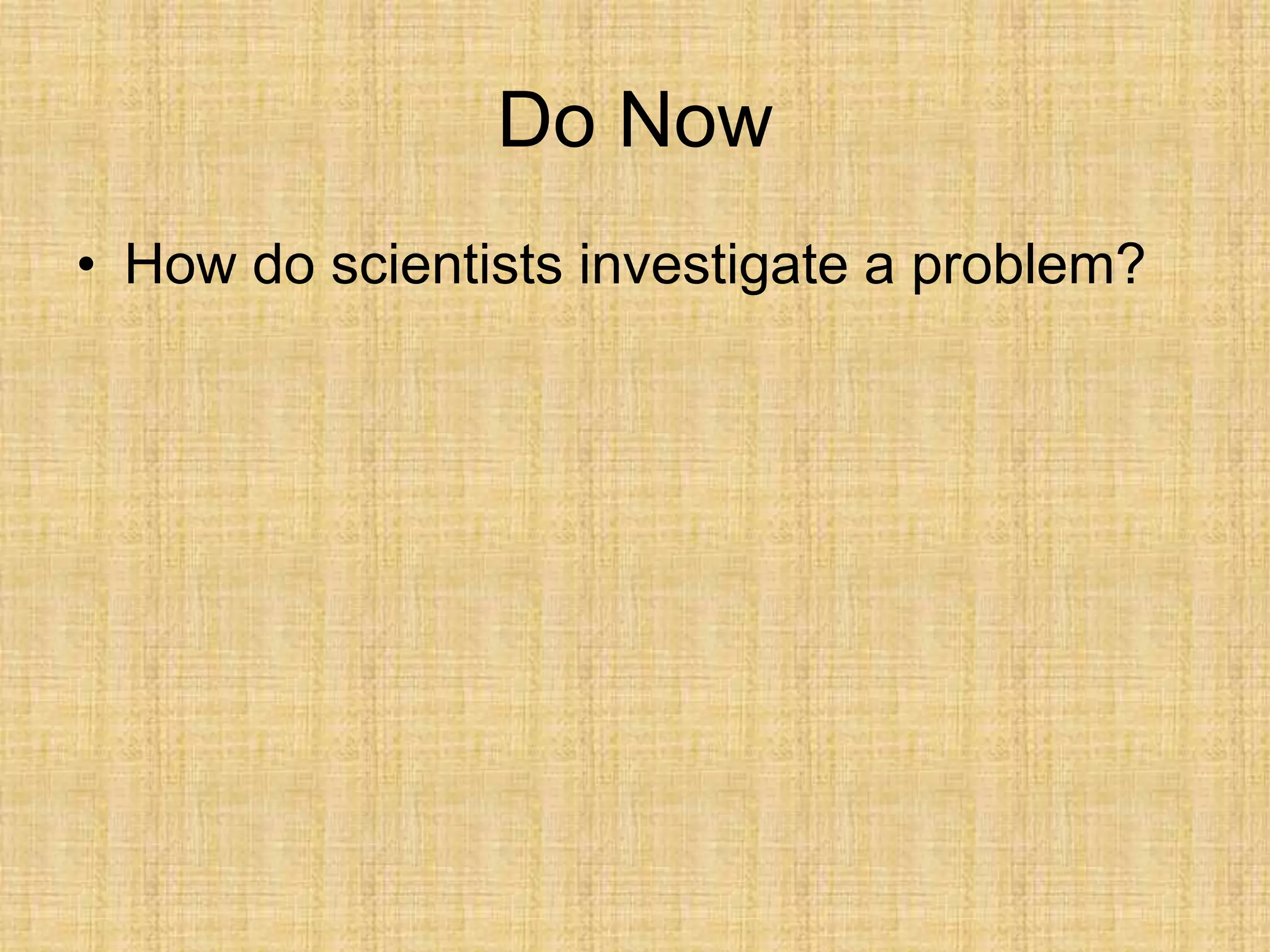
The Great Fossil Find!
Miss Chang
Day 1
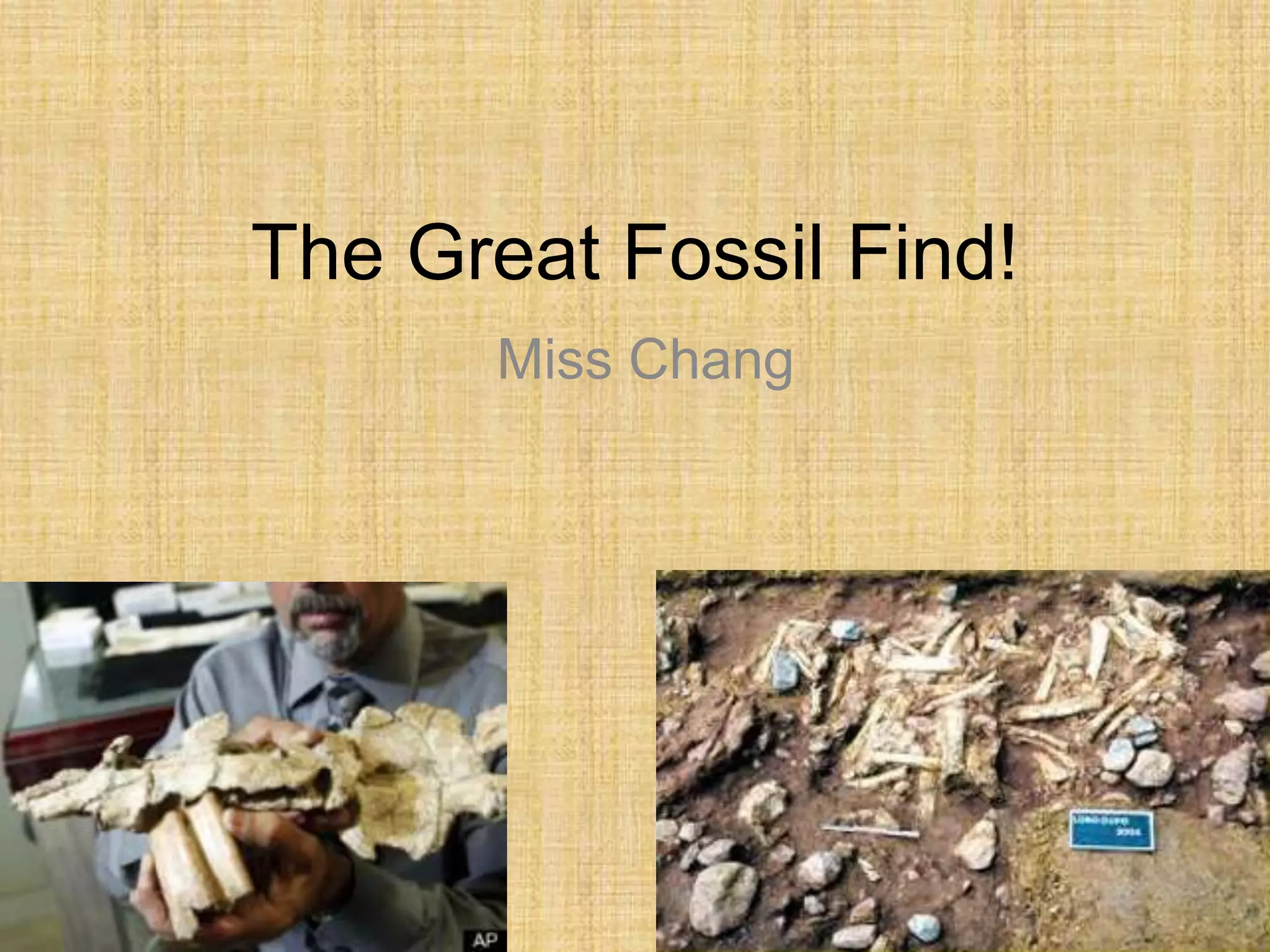
• In this activity, you and the members of
your team will play the roles of
paleontologists working in the field of
High Point Academy. One clear crisp
afternoon in April, you find 4 well-
preserved and complete fossil bones.
• Open your envelope, and remove 4 fossil
bones.
Day 1
• That night, in camp, after dinner, you and
your colleagues begin to assemble the 4
bones you found earlier. Since the bones
were all found together and in an
undisturbed layer, you assume that they
are all from the same animal. You spend
the rest of the evening trying different
arrangements of the bones in hopes of
identifying the animals.
• Take 3 minutes to arrange the 4 bones, and
make notes in your Day 1 data chart. What do
you think the animal is?
Day 2
• The next crisp and cool morning, you get
more work done at the dig behind High
Point Academy. The rock layers that hold
your fossils come apart easily and give up
3 fossil bones! With the day at the end, you
make your way back to camp for another
try at assembling this mystery animal.
• Open your envelope again, and remove 3
more bones. Take 3 minutes to assemble all
your bones, and make notes in your Day 2
data sheet.
Day 3
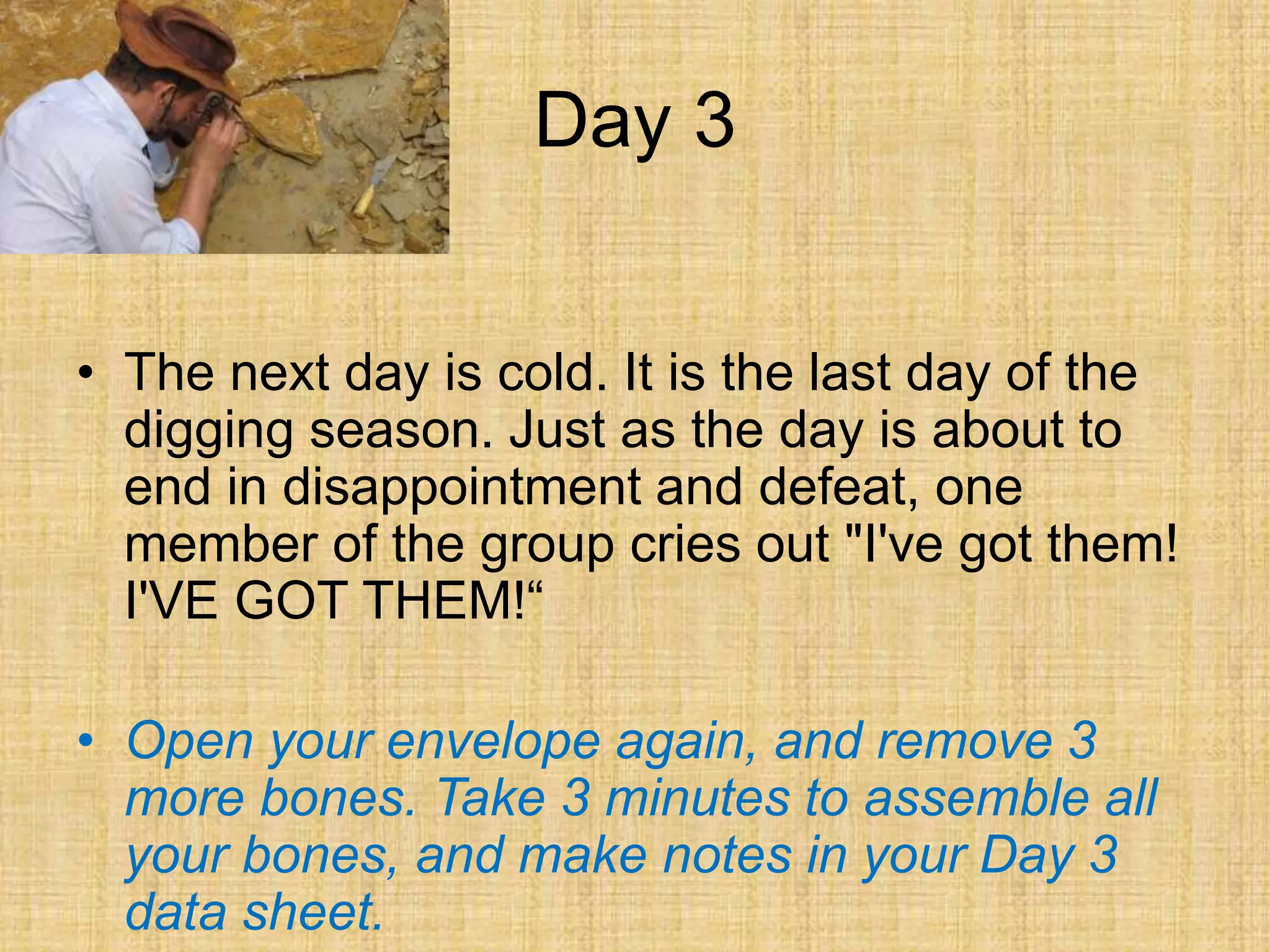
• The next day is cold. It is the last day of the
digging season. Just as the day is about to
end in disappointment and defeat, one
member of the group cries out "I've got them!
I'VE GOT THEM!“
• Open your envelope again, and remove 3
more bones. Take 3 minutes to assemble all
your bones, and make notes in your Day 3
data sheet.
Day 3
• Back in the lab at High Point Academy, you go
searching in the resource library, and you find
some partial skeleton drawings from another
group working at a different location but dealing
with the same geological period. They have found
a skeleton similar to yours, but with some
additional bones that you don't have. You use this
information to add to your own data.
• Take 3 minutes to look at the skeletons of the
teams around you. Apply these clues to your own
skeleton. Do you need to revise your sketch for
Day 3?
• In the library at school, you find a Skeletal
Resource Manual with drawings of
skeletons of some existing animals. You
notice some interesting similarities
between some of the drawings and your
unknown fossil.
• Use the drawings to assist you in your final
assembly of the fossil skeleton. Fill in the Day
4 data table with your final interpretation of
the skeleton.
Day 4
If you are done early…
• Answer these questions on the back of your data
table:
• 1. What was the general consensus on what the
creature was?
• 2. What clues led you to this? What clues
influenced you the most?
• 3. How did you work as scientists?
• 4. From looking at the fossil and the resource
manual, what could you say about how and where
this animal lived?
• 5. Is it possible for scientists to do studies about
things that happened millions of years ago?
Explain.
Communication
• What was the general consensus on
what the creature was?
• What clues led you to this? What clues
influenced you the most?
• How did you work as scientists?
Discussion Questions
• If this "Fossil Find" scenario is typical of
the work of scientists, what processes did
you go through as scientists?
• On the back of your data table sheet,
please list 3 goals that you learned out
of this experience.

The great fossil find!

  • 1.
    Do Now • Howdo scientists investigate a problem?
  • 2.
    The Great FossilFind! Miss Chang
  • 3.
    Day 1 • Inthis activity, you and the members of your team will play the roles of paleontologists working in the field of High Point Academy. One clear crisp afternoon in April, you find 4 well- preserved and complete fossil bones. • Open your envelope, and remove 4 fossil bones.
  • 4.
    Day 1 • Thatnight, in camp, after dinner, you and your colleagues begin to assemble the 4 bones you found earlier. Since the bones were all found together and in an undisturbed layer, you assume that they are all from the same animal. You spend the rest of the evening trying different arrangements of the bones in hopes of identifying the animals. • Take 3 minutes to arrange the 4 bones, and make notes in your Day 1 data chart. What do you think the animal is?
  • 5.
    Day 2 • Thenext crisp and cool morning, you get more work done at the dig behind High Point Academy. The rock layers that hold your fossils come apart easily and give up 3 fossil bones! With the day at the end, you make your way back to camp for another try at assembling this mystery animal. • Open your envelope again, and remove 3 more bones. Take 3 minutes to assemble all your bones, and make notes in your Day 2 data sheet.
  • 6.
    Day 3 • Thenext day is cold. It is the last day of the digging season. Just as the day is about to end in disappointment and defeat, one member of the group cries out "I've got them! I'VE GOT THEM!“ • Open your envelope again, and remove 3 more bones. Take 3 minutes to assemble all your bones, and make notes in your Day 3 data sheet.
  • 7.
    Day 3 • Backin the lab at High Point Academy, you go searching in the resource library, and you find some partial skeleton drawings from another group working at a different location but dealing with the same geological period. They have found a skeleton similar to yours, but with some additional bones that you don't have. You use this information to add to your own data. • Take 3 minutes to look at the skeletons of the teams around you. Apply these clues to your own skeleton. Do you need to revise your sketch for Day 3?
  • 8.
    • In thelibrary at school, you find a Skeletal Resource Manual with drawings of skeletons of some existing animals. You notice some interesting similarities between some of the drawings and your unknown fossil. • Use the drawings to assist you in your final assembly of the fossil skeleton. Fill in the Day 4 data table with your final interpretation of the skeleton. Day 4
  • 9.
    If you aredone early… • Answer these questions on the back of your data table: • 1. What was the general consensus on what the creature was? • 2. What clues led you to this? What clues influenced you the most? • 3. How did you work as scientists? • 4. From looking at the fossil and the resource manual, what could you say about how and where this animal lived? • 5. Is it possible for scientists to do studies about things that happened millions of years ago? Explain.
  • 10.
    Communication • What wasthe general consensus on what the creature was? • What clues led you to this? What clues influenced you the most? • How did you work as scientists?
  • 11.
    Discussion Questions • Ifthis "Fossil Find" scenario is typical of the work of scientists, what processes did you go through as scientists? • On the back of your data table sheet, please list 3 goals that you learned out of this experience.

Editor's Notes

  • #3 Hand out data tables and envelopes
  • #9 Hand out Resource Manual
  • #11 What parts of the scientific Method did we use?