The Customer Experience Management Maturity Model
Evolving Your CXM In The Age Of The Customer
Technology-empowered customers are changing the nature of business. How you respond — and
the customer experience (CX) you provide — determines whether you win in the age of the customer.
Simply put, CX is your greatest source of competitive advantage. To drive competitive gains, the often-
haphazard CX management (CXM) approach of the past won’t cut it anymore. Forrester’s CXM maturity
model spells out the activities, processes, and habits that define mature CXM.
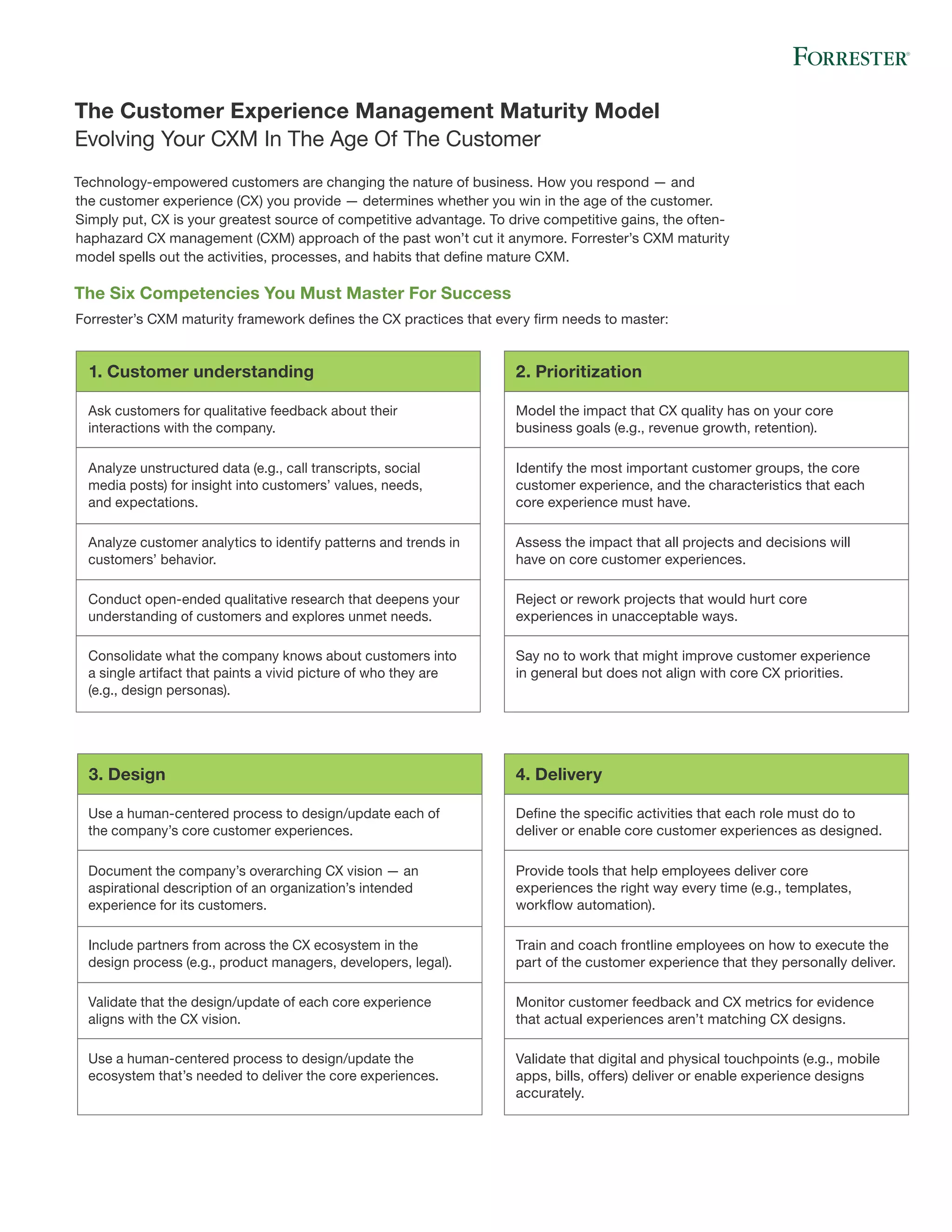
The Six Competencies You Must Master For Success
Forrester’s CXM maturity framework defines the CX practices that every firm needs to master:
Ask customers for qualitative feedback about their
interactions with the company.
Analyze unstructured data (e.g., call transcripts, social
media posts) for insight into customers’ values, needs,
and expectations.
Analyze customer analytics to identify patterns and trends in
customers’ behavior.
Consolidate what the company knows about customers into
a single artifact that paints a vivid picture of who they are
(e.g., design personas).
Conduct open-ended qualitative research that deepens your
understanding of customers and explores unmet needs.
1. Customer understanding
Identify the most important customer groups, the core
customer experience, and the characteristics that each
core experience must have.
Assess the impact that all projects and decisions will
have on core customer experiences.
Say no to work that might improve customer experience
in general but does not align with core CX priorities.
Reject or rework projects that would hurt core
experiences in unacceptable ways.
2. Prioritization
Document the company’s overarching CX vision — an
aspirational description of an organization’s intended
experience for its customers.
Include partners from across the CX ecosystem in the
design process (e.g., product managers, developers, legal).
Use a human-centered process to design/update the
ecosystem that’s needed to deliver the core experiences.
Validate that the design/update of each core experience
aligns with the CX vision.
3. Design
Model the impact that CX quality has on your core
business goals (e.g., revenue growth, retention).
Use a human-centered process to design/update each of
the company’s core customer experiences.
Define the specific activities that each role must do to
deliver or enable core customer experiences as designed.
Provide tools that help employees deliver core
experiences the right way every time (e.g., templates,
workflow automation).
Train and coach frontline employees on how to execute the
part of the customer experience that they personally deliver.
Validate that digital and physical touchpoints (e.g., mobile
apps, bills, offers) deliver or enable experience designs
accurately.
Monitor customer feedback and CX metrics for evidence
that actual experiences aren’t matching CX designs.
4. Delivery
© 2016 Forrester Research, Inc. All rights reserved. Forrester and CX Index are registered trademarks of Forrester Research, Inc.
FORRESTER.COM
CXM: Part Discipline, Part Empathy
To succeed at scale in CXM, you can’t follow CX practices in a disjointed or inconsistent way. Instead,
they must be well-defined, deeply ingrained organizational habits.
Each of the CXM practices requires:
Accountability. Job descriptions must lay out what each employee must do to enable good
CX, and someone has to make sure that they follow through.
Cadence. Mature firms schedule their CXM practices on a regular basis.
Rigor. Mature CXM defines what it means to do specific CX practices well.
Coordination. Poor CX is often a side effect of disjointed processes colliding in unanticipated
ways. Mature firms use checks and balances to stop collisions before they happen.
Mature firms are not only disciplined, but they also make empathy the central tenet of their corporate
culture. In empathetic cultures, employees notice, internalize, and are sensitive to the needs and feelings
of the entire ecosystem, including customers, other employees, and shareholders.
Next Steps To Advance CXM Maturity
The most effective way to advance your organization’s CXM maturity is to find existing pockets of
maturity and build on them. To do that:
❯❯ Take stock and strengthen CXM-like activities that already exist.
❯❯ Rate the accountability, cadence, rigor, and coordination of current efforts.
❯❯ Use every step forward on CXM discipline to foster empathy, too.
Explore More CX Resources
Curious how emotion impacts CX? Or how to best execute digital CX? Check out Forrester’s CX Cast for
a weekly dose of CX knowledge at forr.com/cx-cast.
If you’re ready to discuss your CX program, email us at forresterinfo@forrester.com.
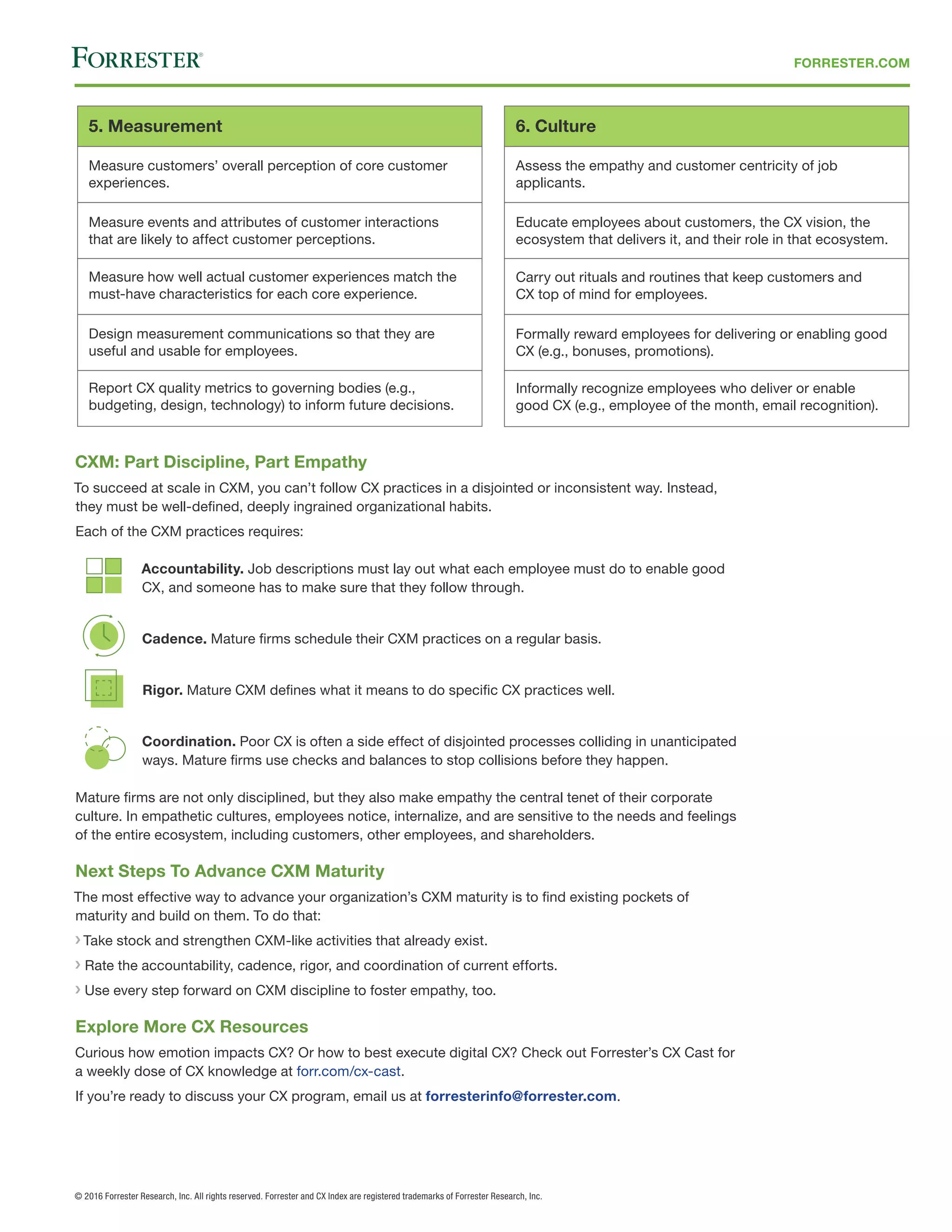
5. Measurement 6. Culture
Measure customers’ overall perception of core customer
experiences.
Measure events and attributes of customer interactions
that are likely to affect customer perceptions.
Measure how well actual customer experiences match the
must-have characteristics for each core experience.
Report CX quality metrics to governing bodies (e.g.,
budgeting, design, technology) to inform future decisions.
Design measurement communications so that they are
useful and usable for employees.
Assess the empathy and customer centricity of job
applicants.
Educate employees about customers, the CX vision, the
ecosystem that delivers it, and their role in that ecosystem.
Carry out rituals and routines that keep customers and
CX top of mind for employees.
Informally recognize employees who deliver or enable
good CX (e.g., employee of the month, email recognition).
Formally reward employees for delivering or enabling good
CX (e.g., bonuses, promotions).

Forrester the customer-experience-management-maturity-model

  • 1.
    The Customer ExperienceManagement Maturity Model Evolving Your CXM In The Age Of The Customer Technology-empowered customers are changing the nature of business. How you respond — and the customer experience (CX) you provide — determines whether you win in the age of the customer. Simply put, CX is your greatest source of competitive advantage. To drive competitive gains, the often- haphazard CX management (CXM) approach of the past won’t cut it anymore. Forrester’s CXM maturity model spells out the activities, processes, and habits that define mature CXM. The Six Competencies You Must Master For Success Forrester’s CXM maturity framework defines the CX practices that every firm needs to master: Ask customers for qualitative feedback about their interactions with the company. Analyze unstructured data (e.g., call transcripts, social media posts) for insight into customers’ values, needs, and expectations. Analyze customer analytics to identify patterns and trends in customers’ behavior. Consolidate what the company knows about customers into a single artifact that paints a vivid picture of who they are (e.g., design personas). Conduct open-ended qualitative research that deepens your understanding of customers and explores unmet needs. 1. Customer understanding Identify the most important customer groups, the core customer experience, and the characteristics that each core experience must have. Assess the impact that all projects and decisions will have on core customer experiences. Say no to work that might improve customer experience in general but does not align with core CX priorities. Reject or rework projects that would hurt core experiences in unacceptable ways. 2. Prioritization Document the company’s overarching CX vision — an aspirational description of an organization’s intended experience for its customers. Include partners from across the CX ecosystem in the design process (e.g., product managers, developers, legal). Use a human-centered process to design/update the ecosystem that’s needed to deliver the core experiences. Validate that the design/update of each core experience aligns with the CX vision. 3. Design Model the impact that CX quality has on your core business goals (e.g., revenue growth, retention). Use a human-centered process to design/update each of the company’s core customer experiences. Define the specific activities that each role must do to deliver or enable core customer experiences as designed. Provide tools that help employees deliver core experiences the right way every time (e.g., templates, workflow automation). Train and coach frontline employees on how to execute the part of the customer experience that they personally deliver. Validate that digital and physical touchpoints (e.g., mobile apps, bills, offers) deliver or enable experience designs accurately. Monitor customer feedback and CX metrics for evidence that actual experiences aren’t matching CX designs. 4. Delivery
  • 2.
    © 2016 ForresterResearch, Inc. All rights reserved. Forrester and CX Index are registered trademarks of Forrester Research, Inc. FORRESTER.COM CXM: Part Discipline, Part Empathy To succeed at scale in CXM, you can’t follow CX practices in a disjointed or inconsistent way. Instead, they must be well-defined, deeply ingrained organizational habits. Each of the CXM practices requires: Accountability. Job descriptions must lay out what each employee must do to enable good CX, and someone has to make sure that they follow through. Cadence. Mature firms schedule their CXM practices on a regular basis. Rigor. Mature CXM defines what it means to do specific CX practices well. Coordination. Poor CX is often a side effect of disjointed processes colliding in unanticipated ways. Mature firms use checks and balances to stop collisions before they happen. Mature firms are not only disciplined, but they also make empathy the central tenet of their corporate culture. In empathetic cultures, employees notice, internalize, and are sensitive to the needs and feelings of the entire ecosystem, including customers, other employees, and shareholders. Next Steps To Advance CXM Maturity The most effective way to advance your organization’s CXM maturity is to find existing pockets of maturity and build on them. To do that: ❯❯ Take stock and strengthen CXM-like activities that already exist. ❯❯ Rate the accountability, cadence, rigor, and coordination of current efforts. ❯❯ Use every step forward on CXM discipline to foster empathy, too. Explore More CX Resources Curious how emotion impacts CX? Or how to best execute digital CX? Check out Forrester’s CX Cast for a weekly dose of CX knowledge at forr.com/cx-cast. If you’re ready to discuss your CX program, email us at forresterinfo@forrester.com. 5. Measurement 6. Culture Measure customers’ overall perception of core customer experiences. Measure events and attributes of customer interactions that are likely to affect customer perceptions. Measure how well actual customer experiences match the must-have characteristics for each core experience. Report CX quality metrics to governing bodies (e.g., budgeting, design, technology) to inform future decisions. Design measurement communications so that they are useful and usable for employees. Assess the empathy and customer centricity of job applicants. Educate employees about customers, the CX vision, the ecosystem that delivers it, and their role in that ecosystem. Carry out rituals and routines that keep customers and CX top of mind for employees. Informally recognize employees who deliver or enable good CX (e.g., employee of the month, email recognition). Formally reward employees for delivering or enabling good CX (e.g., bonuses, promotions).