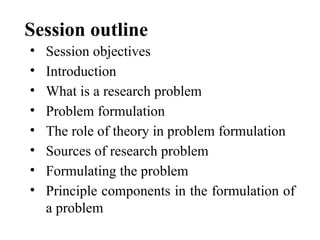
Session outline
• Sessionobjectives
• Introduction
• What is a research problem
• Problem formulation
• The role of theory in problem formulation
• Sources of research problem
• Formulating the problem
• Principle components in the formulation of
a problem
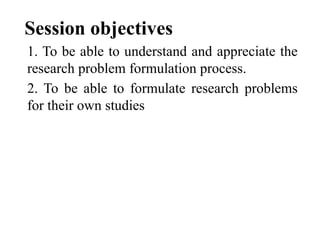
Session objectives
1. Tobe able to understand and appreciate the
research problem formulation process.
2. To be able to formulate research problems
for their own studies
5.
Introduction
• Research isan investigation or
experimentation that is aimed at a discovery
and interpretation of facts, revision of
theories or laws or practical application of
the new or revised theories or laws.
• Identification of research problem leads in
conducting a research.
6.
Introduction cont’d
• Toinitiate a research, the necessity for the
research, to be carried out should be
generated.
• The ideas and topics are developed while
consulting literatures, discussions with
experts and continuation of activities related
to the subject matter.
7.
Introduction cont’d
• Theseideas/topics generally called
research problems and are statements
about areas of concern, a condition to be
improved, a difficulty to be eliminated, or
a troubling question that exists in scholarly
literature, in theory, or in practice that
points to the need for meaningful
understanding and deliberate investigation.
8.
Introduction cont’d
• Aresearch problem does not state how to
do something, offer a vague or broad
proposition, or present a value question.
• The problem must be significant
researchable lead to further research and
suitable for you-the researcher.
• Formulation of the problem should lead to
empirical investigation.
9.
Introduction cont’d
• Formulationof research problem should
depict what is to be determined and scope
of the study.
• It also involves key concept definitions
questions to be asked.
10.
What is aresearch problem?
• It is the topic you would like to address,
investigate, or study, whether descriptively
or experimentally.
• It is the focus or reason for engaging in
your research.
• It is typically a topic, phenomenon, or
challenge that you are interested in and
with which you at least have familiar
applications
Problem formulation cont’d
•“Inquiry starts only when something is
unsatisfactory, when traditional beliefs are
inadequate or in question, when the facts
necessary, to resolve one’s uncertainties are
not known, when the most likely relevant
hypotheses are not even imagined. What
one has at the beginning of the inquiry is
merely the problem” Northrop (1966) (p.
17).
13.
Problem formulation cont’d
•The formulation of research problems also
has an important social function.
• Merton, Broom, and Cottrell (1959)
suggest, researchers must justify the
demands for attention and other scarce
resources that research makes:
14.
Problem formulation cont’d
•“In conferring upon the scientist the right to
claim that a question deserves the concerted
attention of others as well as himself, the
social institution of science exacts the
obligation that he justify the claim” (p. xix).
15.
Problem formulation cont’d
•Achieving significant research results is
perhaps the most powerful justification for
such claims, but this type of justification can
be offered only after the fact, and only in the
event that the research is successful.
16.
The role oftheory in problem
formulation
Theory plays a dual role in research.
• On the one hand, new theories solve
research problems by accounting for
unexplained phenomena and by
superseding questionable older theories.
17.
The role oftheory cont’d
• On the other hand, existing theory guides
researchers in formulating research
problems. In determining whether and in
what respects a phenomenon or a theory is
problematic, researchers consider the
context of accumulated theoretical as well
as empirical knowledge.
18.
Sources of researchproblem
• Classroom
• School
• Community
• Own teaching experiences
• Classroom lectures
• Class discussions
• Seminars/workshops/paper presentations
• Internet etc.
19.
Formulating the problem
•The selection of one appropriate
researchable problem out of the identified
problems requires evaluation of those
alternatives against certain criteria, which
may be grouped into:
20.
Formulating the prob.cont’d
Internal Criteria
Internal Criteria consists of:
• Researcher’s interest: The problem
should interest you and be a challenge to
you . Without interest and curiosity, you
may not develop sustained perseverance.
Interest in a problem depends upon your
educational background, experience,
outlook and sensitivity.
21.
Formulating the prob.cont’d
• Researcher’s own resource: In the case of
a research to be done by you on your own,
consideration of your own financial
resource is pertinent. If it is beyond your
means, you will not be able to complete the
work, unless you get some external
financial support. Time resource is more
important than finance. Research is a time
consuming process; hence it should be
properly utilized.
22.
Formulating the prob.cont’d
• Researcher’s competence: A mere interest
in a problem will not do. You must be
competent to plan and carry out a study of
the problem. You must possess adequate
knowledge of the subject-matter, relevant
methodology and statistical procedures.
23.
Formulating the prob.cont’d
External Criteria
• Research-ability of the problem: The
problem should be researchable, i.e.,
amendable for finding answers to the
questions involved in it through the
scientific method.
24.
Formulating the prob.cont’d
• Novelty of the problem: The problem
must have novelty. There is no use of
wasting one’s time and energy on a
problem already studied thoroughly by
others.
25.
Formulating the prob.cont’d
• Importance and urgency: Problems
requiring investigation are unlimited, but
available research efforts are very much
limited.
26.
Formulating the prob.cont’d
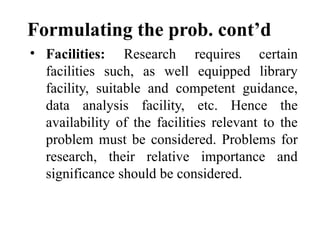
• Facilities: Research requires certain
facilities such, as well equipped library
facility, suitable and competent guidance,
data analysis facility, etc. Hence the
availability of the facilities relevant to the
problem must be considered. Problems for
research, their relative importance and
significance should be considered.
27.
Formulating the prob.cont’d
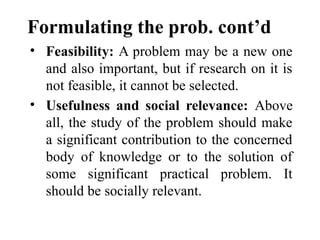
• Feasibility: A problem may be a new one
and also important, but if research on it is
not feasible, it cannot be selected.
• Usefulness and social relevance: Above
all, the study of the problem should make
a significant contribution to the concerned
body of knowledge or to the solution of
some significant practical problem. It
should be socially relevant.
28.
Principle components inthe
F. of a P.
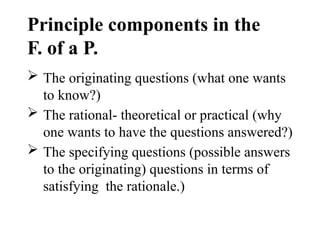
The originating questions (what one wants
to know?)
The rational- theoretical or practical (why
one wants to have the questions answered?)
The specifying questions (possible answers
to the originating) questions in terms of
satisfying the rationale.)
29.
The originating questions
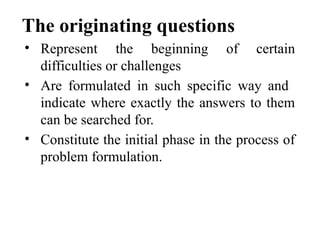
•Represent the beginning of certain
difficulties or challenges
• Are formulated in such specific way and
indicate where exactly the answers to them
can be searched for.
• Constitute the initial phase in the process of
problem formulation.
30.
Originating questions cont’d
•May be formulated in terms of broader
delimited categories of social variable but
do not indicate specifically which particular
variables in each class might be germane to
the issues.
• Usually derived from a general theoretical
orientation rather than a definite theory.
31.
Rationale of questions
•Is the statement of reasons why a particular
question is worth putting across.
• States what will happen to other parts of
knowledge or practice if the question posed
is answered, i.e., how the answer to the
question will contribute to theory and/ or
practice.
32.
Rationale cont’d
• Helpsto effect discrimination between
scientifically good and scientifically trivial
questions.
33.
Specifying questions
• Culminatethe process of formulating a
research problem.
• Involve the breaking down of originating
question with several specifying questions
related to particular aspects and their
consequences.
34.
Conclusion
• Research isa creative work and this
presentations is meant to give you an
outline about the identification and
formulation of research problems.
• Best selected problems serve their purpose
and prove the solution to many identified
and unidentified problems.
35.
References
American Psychological Association(2009).
Publication manual of the American
Psychological Association (6th Ed.).
Washington, D.C.: Author.
Gall, M. D., Gall, J. P., & Borg, W. R. (2006).
Educational research: An introduction
(8th Ed.). Boston: Allyn & Bacon.
36.
References cont’d
Kothari, C.R.(2006). Research methodology:
Methods & techniques. India: New Age
International Publishers.
American Psychological Association (2001).
Publication manual of the American
Psychological Association (5th Ed.).
Washington, D.C.: Author.