A Place for Ethics in School Leadership-Pam Presented by : Sharon Henry Pam Lemoine MayBelle Trahan EDLD 810 Spring, 2009
Phone Conversation-Pam
A Day in the Life…-Sharon So it begins…
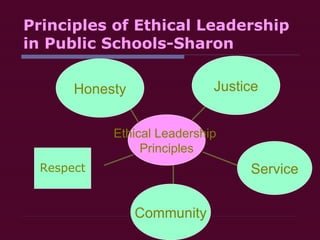
Principles of Ethical Leadership in Public Schools-Sharon Respect Community Service Honesty Justice Ethical Leadership  Principles
Honesty-Sharon
Justice-Pam The ethics of person:  What are leaders’ personal ethics?  Are they motivated by self-interest or altruism (Cuilla, 2005) Virtue Based Theories Stress more attention should be given to the development and training of moral values. Tell people what to be rather than what to do.   Rawls (1971)
Justice-Pam Three components within Rawls’ Theory of Justice: 1. The requirement that “institutions maintain the fair value of the        political liberties, so that  persons similarly motivated and endowed have, irrespective      of  their economic and social class, roughly equal chances to gain political office and      to influence the political decisions that shape their lives” (Rawls, 1971, p.225). - Political equality, including equal rights of liberty of thought and conscience - A fair measure of equality of opportunity - the  difference principle , whereby differences in income and wealth are regulated and limited by government
Justice-Pam 2. The  requirement that institutions maintain fair equality of opportunity, so that equally talented and motivated persons have roughly equal chances to obtain a good education and professional position  irrespective of their initial social class (Rawls,    1971, pp. 73, 301).
Justice-Pam 3. Insofar as they generate social or economic inequalities, social institutions must be    designed to the maximum benefit of those at the  bottom of these inequalities (Rawls,    1971, p. 76f).
Justice-Pam Political Liberalism (1993) The Law of Peoples (1999) A liberal theory of foreign Policy that seeks to provide  fundamental purposes to guide the  policies of liberal democratic societies. Dalla Costa (1998, P. 59) “ When the government is focused on competiveness, and  society is fixated on budgets, growth  assumes greater  importance than quality of life.” Ethical Egoism: a person should act so as to create the greatest  good for her/himself.  Related to transactional leadership of  Bass & Steidlmeier, 1999 Avolio & Locke, 2002.
Service-Maybelle PRINCIPALS OF RESPECT, SERVICE “ The ethics of means : what do leaders use to motivate followers to obtain their goals? What is the moral relationship between leaders and followers”  (Cuilla, 2005, p. xvi). Greenleaf (1970): servant leadership Leadership should be attentive to their followers and empathize with them. They should take care of them and nurture them, The servant leader also has the social responsibility to be concerned with the have-nots and to    recognize them as equal stakeholders in the organization
Service-Maybelle Heifetz (1997): leaders use authority to mobilize people to face tough issues. Leader provides a  holding environment  if trust, nurturance, and empathy.  “ To use the analogy of a pressure cooker, a leader needs to regulate the pressure by turning  up the heat while also allowing some steam to escape. If the pressure exceeds the cooker’s  capacity, the cooker can blow up. However, nothing cooks without some heat (p 49)” Leaders’ duties lie in assisting the follower in struggling with change and personal growth.
Service-Maybelle Burns (1978): transformational leadership Strong emphasis on followers’ needs, values, and morals Leaders move followers to higher levels of moral responsibility.   Move into Transformational leadership (1980’s and 90’s) Transforming leadership is complex. The leader looks for personal motives in followers The leader seeks to satisfy higher needs  Result is a relationship that converts followers into leaders and leaders into moral  agents. (Greenfield, 2004)
Community-Maybelle
Respect-Sharon Beauchamp & Bowie (1988): delineates “common principles that serve as guides for leaders in    distributing benefits and burdens in an organization” (cited in Northouse, 2007, p. 353)   To each person An equal share According to individual need According to that person’s rights According to individual effort According to societal contribution According to merit Altruism: actions are moral if their primary purpose is to promote the best interest of    others. Authentic transactional leadership is based on altruistic principles
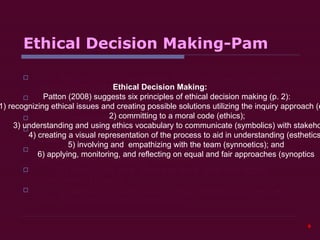
Ethical Decision Making-Pam Patton (2008) suggests six principles of ethical decision making (p. 2):   1) recognizing ethical issues and creating possible solutions utilizing the inquiry approach (empirics);    2) committing to a moral code (ethics);   3) understanding and using ethics vocabulary to communicate (symbolics) with stakeholders;   4) creating a visual representation of the process to aid in understanding (esthetics);   5) involving and  empathizing with the team (synnoetics); and    6) applying, monitoring, and reflecting on equal and fair approaches (synoptics) Ethical Decision Making: Patton (2008) suggests six principles of ethical decision making (p. 2):   1) recognizing ethical issues and creating possible solutions utilizing the inquiry approach (empirics);    2) committing to a moral code (ethics);   3) understanding and using ethics vocabulary to communicate (symbolics) with stakeholders;   4) creating a visual representation of the process to aid in understanding (esthetics);   5) involving and  empathizing with the team (synnoetics); and    6) applying, monitoring, and reflecting on equal and fair approaches (synoptics
Case Study-Sharon Mary Richards, New Principal Letter from PTO president, Mrs. Wright
Conclusion-Maybelle Resources

810 Presentation

  • 1.
    A Place forEthics in School Leadership-Pam Presented by : Sharon Henry Pam Lemoine MayBelle Trahan EDLD 810 Spring, 2009
  • 2.
  • 3.
    A Day inthe Life…-Sharon So it begins…
  • 4.
    Principles of EthicalLeadership in Public Schools-Sharon Respect Community Service Honesty Justice Ethical Leadership Principles
  • 5.
  • 6.
    Justice-Pam The ethicsof person: What are leaders’ personal ethics? Are they motivated by self-interest or altruism (Cuilla, 2005) Virtue Based Theories Stress more attention should be given to the development and training of moral values. Tell people what to be rather than what to do. Rawls (1971)
  • 7.
    Justice-Pam Three componentswithin Rawls’ Theory of Justice: 1. The requirement that “institutions maintain the fair value of the political liberties, so that persons similarly motivated and endowed have, irrespective of their economic and social class, roughly equal chances to gain political office and to influence the political decisions that shape their lives” (Rawls, 1971, p.225). - Political equality, including equal rights of liberty of thought and conscience - A fair measure of equality of opportunity - the difference principle , whereby differences in income and wealth are regulated and limited by government
  • 8.
    Justice-Pam 2. The requirement that institutions maintain fair equality of opportunity, so that equally talented and motivated persons have roughly equal chances to obtain a good education and professional position irrespective of their initial social class (Rawls, 1971, pp. 73, 301).
  • 9.
    Justice-Pam 3. Insofaras they generate social or economic inequalities, social institutions must be designed to the maximum benefit of those at the bottom of these inequalities (Rawls, 1971, p. 76f).
  • 10.
    Justice-Pam Political Liberalism(1993) The Law of Peoples (1999) A liberal theory of foreign Policy that seeks to provide fundamental purposes to guide the policies of liberal democratic societies. Dalla Costa (1998, P. 59) “ When the government is focused on competiveness, and society is fixated on budgets, growth assumes greater importance than quality of life.” Ethical Egoism: a person should act so as to create the greatest good for her/himself. Related to transactional leadership of Bass & Steidlmeier, 1999 Avolio & Locke, 2002.
  • 11.
    Service-Maybelle PRINCIPALS OFRESPECT, SERVICE “ The ethics of means : what do leaders use to motivate followers to obtain their goals? What is the moral relationship between leaders and followers” (Cuilla, 2005, p. xvi). Greenleaf (1970): servant leadership Leadership should be attentive to their followers and empathize with them. They should take care of them and nurture them, The servant leader also has the social responsibility to be concerned with the have-nots and to recognize them as equal stakeholders in the organization
  • 12.
    Service-Maybelle Heifetz (1997):leaders use authority to mobilize people to face tough issues. Leader provides a holding environment if trust, nurturance, and empathy. “ To use the analogy of a pressure cooker, a leader needs to regulate the pressure by turning up the heat while also allowing some steam to escape. If the pressure exceeds the cooker’s capacity, the cooker can blow up. However, nothing cooks without some heat (p 49)” Leaders’ duties lie in assisting the follower in struggling with change and personal growth.
  • 13.
    Service-Maybelle Burns (1978):transformational leadership Strong emphasis on followers’ needs, values, and morals Leaders move followers to higher levels of moral responsibility. Move into Transformational leadership (1980’s and 90’s) Transforming leadership is complex. The leader looks for personal motives in followers The leader seeks to satisfy higher needs Result is a relationship that converts followers into leaders and leaders into moral agents. (Greenfield, 2004)
  • 14.
  • 15.
    Respect-Sharon Beauchamp &Bowie (1988): delineates “common principles that serve as guides for leaders in distributing benefits and burdens in an organization” (cited in Northouse, 2007, p. 353) To each person An equal share According to individual need According to that person’s rights According to individual effort According to societal contribution According to merit Altruism: actions are moral if their primary purpose is to promote the best interest of others. Authentic transactional leadership is based on altruistic principles
  • 16.
    Ethical Decision Making-PamPatton (2008) suggests six principles of ethical decision making (p. 2): 1) recognizing ethical issues and creating possible solutions utilizing the inquiry approach (empirics); 2) committing to a moral code (ethics); 3) understanding and using ethics vocabulary to communicate (symbolics) with stakeholders; 4) creating a visual representation of the process to aid in understanding (esthetics); 5) involving and empathizing with the team (synnoetics); and 6) applying, monitoring, and reflecting on equal and fair approaches (synoptics) Ethical Decision Making: Patton (2008) suggests six principles of ethical decision making (p. 2): 1) recognizing ethical issues and creating possible solutions utilizing the inquiry approach (empirics); 2) committing to a moral code (ethics); 3) understanding and using ethics vocabulary to communicate (symbolics) with stakeholders; 4) creating a visual representation of the process to aid in understanding (esthetics); 5) involving and empathizing with the team (synnoetics); and 6) applying, monitoring, and reflecting on equal and fair approaches (synoptics
  • 17.
    Case Study-Sharon MaryRichards, New Principal Letter from PTO president, Mrs. Wright
  • 18.