Fingerprinting:
(pending topics)
Fingerprinting is a widely used method of personal identification.
It relies on the unique patterns of ridges and furrows on the
fingertips.
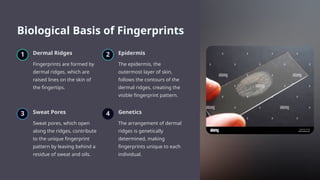
Biological Basis of Fingerprints
1 Dermal Ridges
Fingerprints are formed by
dermal ridges, which are
raised lines on the skin of
the fingertips.
2 Epidermis
The epidermis, the
outermost layer of skin,
follows the contours of the
dermal ridges, creating the
visible fingerprint pattern.
3 Sweat Pores
Sweat pores, which open
along the ridges, contribute
to the unique fingerprint
pattern by leaving behind a
residue of sweat and oils.
4 Genetics
The arrangement of dermal
ridges is genetically
determined, making
fingerprints unique to each
individual.
Formation of Ridges
1 Embryonic Development
Dermal ridges begin to form during the embryonic
stage, around the 10th week of gestation.
2 Pressure and Growth
The pressure of the developing fetus within the womb,
combined with the rapid growth of the fingertips, shapes
the ridges.
3 Unique Pattern
The final fingerprint pattern is established by the 16th
week of gestation, and remains relatively stable
throughout life.
Ridge Counting: Definition and Procedure
Definition
Ridge counting is a technique
used to quantify the number of
ridges between two specific
points on a fingerprint.
Procedure
The procedure involves drawing a
line between two designated
points on the fingerprint and
counting the number of ridges
that intersect the line.
Importance
Ridge counting is a fundamental
aspect of fingerprint analysis,
providing quantitative data that
helps in individual identification.
Detailed Ridge Counting Methodology
1. Identify Delta The delta is a triangular-shaped area on the fingerprint where
three ridges converge.
2. Locate Core The core is the center or most prominent point of the fingerprint
pattern.
3. Count Ridges Count the number of ridges that cross a straight line drawn from
the delta to the core.
4. Record Data Record the ridge count, along with other relevant information,
such as the fingerprint pattern type.
Podogram: Definition and
Significance
Footprint Image
A podogram is a detailed image of a
footprint, similar to a fingerprint,
capturing the unique pattern of ridges
on the sole of the foot.
Identification
Podograms can be used for
identification purposes, similar to
fingerprints, particularly in cases
where fingerprints are not available or
are difficult to obtain.
Biometrics
Podograms have emerged as a
biometric tool in various applications,
including security systems, personal
identification, and forensic
investigations.
Medical Applications
Podograms can provide valuable
insights into foot health and gait
analysis, aiding in the diagnosis and
treatment of foot-related conditions.
Podogram
Definition A diagram or record of the
footprint. It provides details
about the size, shape, and
other features of the footprint.
Usage Podo-grams are used to
compare footprints to known
standards and to identify
suspects.
Applications Podo-grams are used in
forensic science, medicine, and
other fields.
Podogram: Detailed Examination
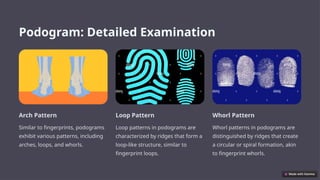
Arch Pattern
Similar to fingerprints, podograms
exhibit various patterns, including
arches, loops, and whorls.
Loop Pattern
Loop patterns in podograms are
characterized by ridges that form a
loop-like structure, similar to
fingerprint loops.
Whorl Pattern
Whorl patterns in podograms are
distinguished by ridges that create
a circular or spiral formation, akin
to fingerprint whorls.

Formation_of_ridges,_ridge_counting,_podogram[1].pptx

  • 1.
    Fingerprinting: (pending topics) Fingerprinting isa widely used method of personal identification. It relies on the unique patterns of ridges and furrows on the fingertips.
  • 2.
    Biological Basis ofFingerprints 1 Dermal Ridges Fingerprints are formed by dermal ridges, which are raised lines on the skin of the fingertips. 2 Epidermis The epidermis, the outermost layer of skin, follows the contours of the dermal ridges, creating the visible fingerprint pattern. 3 Sweat Pores Sweat pores, which open along the ridges, contribute to the unique fingerprint pattern by leaving behind a residue of sweat and oils. 4 Genetics The arrangement of dermal ridges is genetically determined, making fingerprints unique to each individual.
  • 3.
    Formation of Ridges 1Embryonic Development Dermal ridges begin to form during the embryonic stage, around the 10th week of gestation. 2 Pressure and Growth The pressure of the developing fetus within the womb, combined with the rapid growth of the fingertips, shapes the ridges. 3 Unique Pattern The final fingerprint pattern is established by the 16th week of gestation, and remains relatively stable throughout life.
  • 4.
    Ridge Counting: Definitionand Procedure Definition Ridge counting is a technique used to quantify the number of ridges between two specific points on a fingerprint. Procedure The procedure involves drawing a line between two designated points on the fingerprint and counting the number of ridges that intersect the line. Importance Ridge counting is a fundamental aspect of fingerprint analysis, providing quantitative data that helps in individual identification.
  • 5.
    Detailed Ridge CountingMethodology 1. Identify Delta The delta is a triangular-shaped area on the fingerprint where three ridges converge. 2. Locate Core The core is the center or most prominent point of the fingerprint pattern. 3. Count Ridges Count the number of ridges that cross a straight line drawn from the delta to the core. 4. Record Data Record the ridge count, along with other relevant information, such as the fingerprint pattern type.
  • 6.
    Podogram: Definition and Significance FootprintImage A podogram is a detailed image of a footprint, similar to a fingerprint, capturing the unique pattern of ridges on the sole of the foot. Identification Podograms can be used for identification purposes, similar to fingerprints, particularly in cases where fingerprints are not available or are difficult to obtain. Biometrics Podograms have emerged as a biometric tool in various applications, including security systems, personal identification, and forensic investigations. Medical Applications Podograms can provide valuable insights into foot health and gait analysis, aiding in the diagnosis and treatment of foot-related conditions.
  • 7.
    Podogram Definition A diagramor record of the footprint. It provides details about the size, shape, and other features of the footprint. Usage Podo-grams are used to compare footprints to known standards and to identify suspects. Applications Podo-grams are used in forensic science, medicine, and other fields.
  • 8.
    Podogram: Detailed Examination ArchPattern Similar to fingerprints, podograms exhibit various patterns, including arches, loops, and whorls. Loop Pattern Loop patterns in podograms are characterized by ridges that form a loop-like structure, similar to fingerprint loops. Whorl Pattern Whorl patterns in podograms are distinguished by ridges that create a circular or spiral formation, akin to fingerprint whorls.