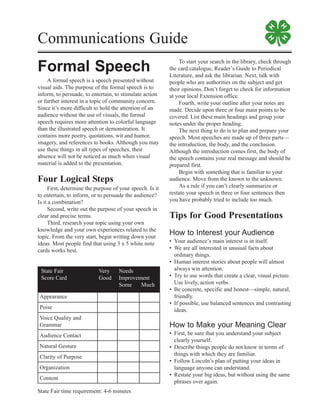
Communications Guide
Formal Speech
A formal speech is a speech presented without
visual aids. The purpose of the formal speech is to
inform, to persuade, to entertain, to stimulate action
or further interest in a topic of community concern.
Since it’s more difficult to hold the attention of an
audience without the use of visuals, the formal
speech requires more attention to colorful language
than the illustrated speech or demonstration. It
contains more poetry, quotations, wit and humor,
imagery, and references to books. Although you may
use these things in all types of speeches, their
absence will not be noticed as much when visual
material is added to the presentation.
Four Logical Steps
First, determine the purpose of your speech. Is it
to entertain, to inform, or to persuade the audience?
Is it a combination?
Second, write out the purpose of your speech in
clear and precise terms.
Third, research your topic using your own
knowledge and your own experiences related to the
topic. From the very start, begin writing down your
ideas. Most people find that using 3 x 5 white note
cards works best.
To start your search in the library, check through
the card catalogue, Reader’s Guide to Periodical
Literature, and ask the librarian. Next, talk with
people who are authorities on the subject and get
their opinions. Don’t forget to check for information
at your local Extension office.
Fourth, write your outline after your notes are
made. Decide upon three or four main points to be
covered. List these main headings and group your
notes under the proper heading.
The next thing to do is to plan and prepare your
speech. Most speeches are made up of three parts—
the introduction, the body, and the conclusion.
Although the introduction comes first, the body of
the speech contains your real message and should be
prepared first.
Begin with something that is familiar to your
audience. Move from the known to the unknown.
As a rule if you can’t clearly summarize or
restate your speech in three or four sentences then
you have probably tried to include too much.
Tips for Good Presentations
How to Interest your Audience
• Your audience’s main interest is in itself.
• We are all interested in unusual facts about
ordinary things.
• Human interest stories about people will almost
always win attention.
• Try to use words that create a clear, visual picture.
Use lively, action verbs.
• Be concrete, specific and honest—simple, natural,
friendly.
• If possible, use balanced sentences and contrasting
ideas.
How to Make your Meaning Clear
• First, be sure that you understand your subject
clearly yourself.
• Describe things people do not know in terms of
things with which they are familiar.
• Follow Lincoln’s plan of putting your ideas in
language anyone can understand.
• Restate your big ideas, but without using the same
phrases over again.
State Fair time requirement: 4-6 minutes
State Fair Very Needs
Score Card Good Improvement
Some Much
Appearance
Poise
Voice Quality and
Grammar
Audience Contact
Natural Gesture
Clarity of Purpose
Organization
Content
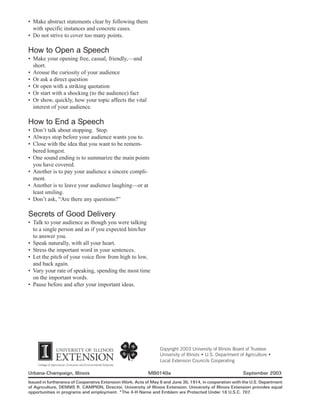
Issued in furtherance of Cooperative Extension Work, Acts of May 8 and June 30, 1914, in cooperation with the U.S. Department
of Agriculture, DENNIS R. CAMPION, Director, University of Illinois Extension. University of Illinois Extension provides equal
opportunities in programs and employment. *The 4-H Name and Emblem are Protected Under 18 U.S.C. 707.
Urbana-Champaign, Illinois MB0140a September 2003
Copyright 2003 University of Illinois Board of Trustees
University of Illinois • U.S. Department of Agriculture •
Local Extension Councils Cooperating*
• Make abstract statements clear by following them
with specific instances and concrete cases.
• Do not strive to cover too many points.
How to Open a Speech
• Make your opening free, casual, friendly,—and
short.
• Arouse the curiosity of your audience
• Or ask a direct question
• Or open with a striking quotation
• Or start with a shocking (to the audience) fact
• Or show, quickly, how your topic affects the vital
interest of your audience.
How to End a Speech
• Don’t talk about stopping. Stop.
• Always stop before your audience wants you to.
• Close with the idea that you want to be remem-
bered longest.
• One sound ending is to summarize the main points
you have covered.
• Another is to pay your audience a sincere compli-
ment.
• Another is to leave your audience laughing—or at
least smiling.
• Don’t ask, “Are there any questions?”
Secrets of Good Delivery
• Talk to your audience as though you were talking
to a single person and as if you expected him/her
to answer you.
• Speak naturally, with all your heart.
• Stress the important word in your sentences.
• Let the pitch of your voice flow from high to low,
and back again.
• Vary your rate of speaking, spending the most time
on the important words.
• Pause before and after your important ideas.

Formal speech

  • 1.
    Communications Guide Formal Speech Aformal speech is a speech presented without visual aids. The purpose of the formal speech is to inform, to persuade, to entertain, to stimulate action or further interest in a topic of community concern. Since it’s more difficult to hold the attention of an audience without the use of visuals, the formal speech requires more attention to colorful language than the illustrated speech or demonstration. It contains more poetry, quotations, wit and humor, imagery, and references to books. Although you may use these things in all types of speeches, their absence will not be noticed as much when visual material is added to the presentation. Four Logical Steps First, determine the purpose of your speech. Is it to entertain, to inform, or to persuade the audience? Is it a combination? Second, write out the purpose of your speech in clear and precise terms. Third, research your topic using your own knowledge and your own experiences related to the topic. From the very start, begin writing down your ideas. Most people find that using 3 x 5 white note cards works best. To start your search in the library, check through the card catalogue, Reader’s Guide to Periodical Literature, and ask the librarian. Next, talk with people who are authorities on the subject and get their opinions. Don’t forget to check for information at your local Extension office. Fourth, write your outline after your notes are made. Decide upon three or four main points to be covered. List these main headings and group your notes under the proper heading. The next thing to do is to plan and prepare your speech. Most speeches are made up of three parts— the introduction, the body, and the conclusion. Although the introduction comes first, the body of the speech contains your real message and should be prepared first. Begin with something that is familiar to your audience. Move from the known to the unknown. As a rule if you can’t clearly summarize or restate your speech in three or four sentences then you have probably tried to include too much. Tips for Good Presentations How to Interest your Audience • Your audience’s main interest is in itself. • We are all interested in unusual facts about ordinary things. • Human interest stories about people will almost always win attention. • Try to use words that create a clear, visual picture. Use lively, action verbs. • Be concrete, specific and honest—simple, natural, friendly. • If possible, use balanced sentences and contrasting ideas. How to Make your Meaning Clear • First, be sure that you understand your subject clearly yourself. • Describe things people do not know in terms of things with which they are familiar. • Follow Lincoln’s plan of putting your ideas in language anyone can understand. • Restate your big ideas, but without using the same phrases over again. State Fair time requirement: 4-6 minutes State Fair Very Needs Score Card Good Improvement Some Much Appearance Poise Voice Quality and Grammar Audience Contact Natural Gesture Clarity of Purpose Organization Content
  • 2.
    Issued in furtheranceof Cooperative Extension Work, Acts of May 8 and June 30, 1914, in cooperation with the U.S. Department of Agriculture, DENNIS R. CAMPION, Director, University of Illinois Extension. University of Illinois Extension provides equal opportunities in programs and employment. *The 4-H Name and Emblem are Protected Under 18 U.S.C. 707. Urbana-Champaign, Illinois MB0140a September 2003 Copyright 2003 University of Illinois Board of Trustees University of Illinois • U.S. Department of Agriculture • Local Extension Councils Cooperating* • Make abstract statements clear by following them with specific instances and concrete cases. • Do not strive to cover too many points. How to Open a Speech • Make your opening free, casual, friendly,—and short. • Arouse the curiosity of your audience • Or ask a direct question • Or open with a striking quotation • Or start with a shocking (to the audience) fact • Or show, quickly, how your topic affects the vital interest of your audience. How to End a Speech • Don’t talk about stopping. Stop. • Always stop before your audience wants you to. • Close with the idea that you want to be remem- bered longest. • One sound ending is to summarize the main points you have covered. • Another is to pay your audience a sincere compli- ment. • Another is to leave your audience laughing—or at least smiling. • Don’t ask, “Are there any questions?” Secrets of Good Delivery • Talk to your audience as though you were talking to a single person and as if you expected him/her to answer you. • Speak naturally, with all your heart. • Stress the important word in your sentences. • Let the pitch of your voice flow from high to low, and back again. • Vary your rate of speaking, spending the most time on the important words. • Pause before and after your important ideas.