Formal Speaking
Characteristics of Formal Speaking
❏ Politeness
❏ Objectiveness
❏ Effectiveness
❏ Standard English Language
❏ Clarity
Characteristics of Informal
Speaking
❏ Conversational tone
❏ Frequent personal pronouns (I, me, you) and contractions (you’d, we’ve)
❏ Informal expressions (what’s up?)
❏ Shorter sentences
❏ Personal feelings
When to Use Formal Language
❏ When your purpose is to explain a topic or idea to a teacher, a classmate,
or the public, use formal language
❏ Formal language is serious and interesting, as if you are teaching your
readers
❏ This language works best in explanatory essays, research reports, and
most other academic writing
When to Use Informal Language
❏ Other writing situations call for more casual, informal language.
❏ When your purpose is to share your personal thoughts and feelings or to
tell a story, use language that sounds more like you are talking with your
friends or classmates.
❏ This type of language works best for stories, personal narratives, and
social forms (blogs, microblogs, personal email).
What Should be avoided in formal
speaking?
❖ Casual Greetings: Based on-
a)How well you know the person
b)What degree of professionalism you are required to
maintain
❖ Slangs and Colloquialism
❖ Contractions
❖ Personal Pronouns
❖ Poor vocabulary
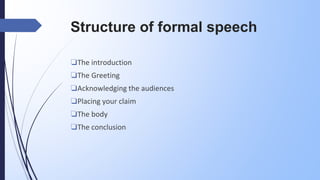
Structure of formal speech
❏The introduction
❏The Greeting
❏Acknowledging the audiences
❏Placing your claim
❏The body
❏The conclusion
Difference Between Formal & Informal
Speaking
Formal Speech Informal Speech
Its tone is serious. Its tone is casual.
It sounds polite. It sounds friendly.
When overused, it can come across
as cold and distant.
When overused, it can come across as
brash and rude.
The sentence structures are
complex.
The sentence structures are simple.
An extensive range of vocabulary is
used.
Simple words and general vocabulary is
used.
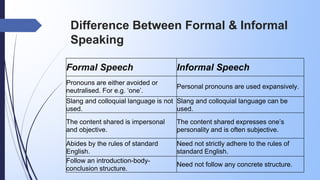
Difference Between Formal & Informal
Speaking
Formal Speech Informal Speech
Pronouns are either avoided or
neutralised. For e.g. ‘one’.
Personal pronouns are used expansively.
Slang and colloquial language is not
used.
Slang and colloquial language can be
used.
The content shared is impersonal
and objective.
The content shared expresses one’s
personality and is often subjective.
Abides by the rules of standard
English.
Need not strictly adhere to the rules of
standard English.
Follow an introduction-body-
conclusion structure.
Need not follow any concrete structure.
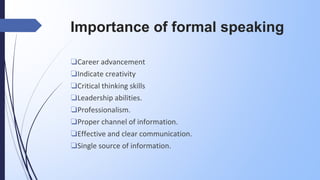
Importance of formal speaking
❏Career advancement
❏Indicate creativity
❏Critical thinking skills
❏Leadership abilities.
❏Professionalism.
❏Proper channel of information.
❏Effective and clear communication.
❏Single source of information.

Formal Speaking.pptx

  • 1.
  • 2.
    Characteristics of FormalSpeaking ❏ Politeness ❏ Objectiveness ❏ Effectiveness ❏ Standard English Language ❏ Clarity
  • 3.
    Characteristics of Informal Speaking ❏Conversational tone ❏ Frequent personal pronouns (I, me, you) and contractions (you’d, we’ve) ❏ Informal expressions (what’s up?) ❏ Shorter sentences ❏ Personal feelings
  • 4.
    When to UseFormal Language ❏ When your purpose is to explain a topic or idea to a teacher, a classmate, or the public, use formal language ❏ Formal language is serious and interesting, as if you are teaching your readers ❏ This language works best in explanatory essays, research reports, and most other academic writing
  • 5.
    When to UseInformal Language ❏ Other writing situations call for more casual, informal language. ❏ When your purpose is to share your personal thoughts and feelings or to tell a story, use language that sounds more like you are talking with your friends or classmates. ❏ This type of language works best for stories, personal narratives, and social forms (blogs, microblogs, personal email).
  • 6.
    What Should beavoided in formal speaking? ❖ Casual Greetings: Based on- a)How well you know the person b)What degree of professionalism you are required to maintain ❖ Slangs and Colloquialism ❖ Contractions ❖ Personal Pronouns ❖ Poor vocabulary
  • 7.
    Structure of formalspeech ❏The introduction ❏The Greeting ❏Acknowledging the audiences ❏Placing your claim ❏The body ❏The conclusion
  • 8.
    Difference Between Formal& Informal Speaking Formal Speech Informal Speech Its tone is serious. Its tone is casual. It sounds polite. It sounds friendly. When overused, it can come across as cold and distant. When overused, it can come across as brash and rude. The sentence structures are complex. The sentence structures are simple. An extensive range of vocabulary is used. Simple words and general vocabulary is used.
  • 9.
    Difference Between Formal& Informal Speaking Formal Speech Informal Speech Pronouns are either avoided or neutralised. For e.g. ‘one’. Personal pronouns are used expansively. Slang and colloquial language is not used. Slang and colloquial language can be used. The content shared is impersonal and objective. The content shared expresses one’s personality and is often subjective. Abides by the rules of standard English. Need not strictly adhere to the rules of standard English. Follow an introduction-body- conclusion structure. Need not follow any concrete structure.
  • 10.
    Importance of formalspeaking ❏Career advancement ❏Indicate creativity ❏Critical thinking skills ❏Leadership abilities. ❏Professionalism. ❏Proper channel of information. ❏Effective and clear communication. ❏Single source of information.