Formal language
vs.
Informal language
John Arnuld Santillano
Reporter/11-TAN
John Arnuld Santillano
Objectives:
1. Define formal and
informal language;
2. Differentiate formal and
informal language; and,
3. Learn of how this two
languages used
Formal language is less
personal than informal
language. It is used when
writing for professional or
academic purposes like
graduate school
assignments. Formal
language does not use
colloquialisms, contractions
or first-person pronouns
such as “I” or “We.”
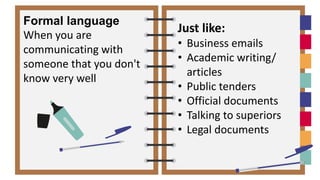
Just like:
• Business emails
• Academic writing/
articles
• Public tenders
• Official documents
• Talking to superiors
• Legal documents
Formal language
When you are
communicating with
someone that you don't
know very well
Informal language is
more casual and
spontaneous. It is used
when communicating
with friends or family
either in writing or in
conversation. The tone
of informal language is
more personal than
formal language.
Just like:
• Some business
correspondence
• Personal emails
• Social media
• Advertising
• Spontaneous speech
• Some meeting
minutes
Informal language
Situations that are more
relaxed and that involve
people that you know
well or know each other
well
What are the similarities of
formal and informal
language?
Both formal and informal
language have a purpose or
function (i.e., to tell/inform
someone about something).
Both formal and informal
language refer to the same thing,
which is communication between
two or more people.
Both formal and informal
language use words and
sentences to communicate
ideas and thoughts.
0
1
Here are 5 tips on how to
use formal and informal
language:
Know in which situations you
can use informal language
Using very formal English in everyday
situations can sound pompous, so always
think about the context and your target
audience.
01
02
Grammar
In formal language, grammar is
more complex and sentences are
generally longer.
03
Vocabulary
In formal language, words are
generally longer.
Require [formal] vs need [informal]
Purchase [formal] vs buy [informal]
For example:
For example:
• We regret to inform you that the
delivery will be delayed due to
adverse weather conditions
[formal]
• Sorry, but the delivery will be late
because of the weather [informal]
• Have you seen my glasses? [formal]
• Seen my glasses? [informal]
0
1
04
Pronunciation
Speech is generally slower in
formal language, allowing
for correct and clear
pronunciation, and the tone
of the voice is more serious.
05
Abbreviations and
acronyms
These are not used in
formal language.
For example:
• 'As soon as possible'
[formal] vs 'asap'
[informal]
• 'Advertisement' [formal]
vs 'ads' [informal]
• 'Photograph' [formal] vs
'photo' [informal]
Any questions ? Clarification?
Let's try this!
Choose whether Formal or Informal language:
• Our technician repaired the
fault on 12th June. Now it's
your turn to pay us.
• Although the fault was repaired
on 12th June, payment for this
intervention has still not been
received.
• If you lose it, then please
contact us as soon as possible.
.
• He had to get some money out
of a hole in the wall...
• He withdrew the amount from
an ATM.
• If you need any help give us a
call.
• Should you require any
assistance, please feel free to
contact us...
• Any loss of this document should
be reported immediately..
Thank you!
I hope you have
a bunch of
learning from this
lesson:)

formal vs informal.pptx

  • 1.
    Formal language vs. Informal language JohnArnuld Santillano Reporter/11-TAN John Arnuld Santillano
  • 2.
    Objectives: 1. Define formaland informal language; 2. Differentiate formal and informal language; and, 3. Learn of how this two languages used
  • 3.
    Formal language isless personal than informal language. It is used when writing for professional or academic purposes like graduate school assignments. Formal language does not use colloquialisms, contractions or first-person pronouns such as “I” or “We.”
  • 4.
    Just like: • Businessemails • Academic writing/ articles • Public tenders • Official documents • Talking to superiors • Legal documents Formal language When you are communicating with someone that you don't know very well
  • 5.
    Informal language is morecasual and spontaneous. It is used when communicating with friends or family either in writing or in conversation. The tone of informal language is more personal than formal language.
  • 6.
    Just like: • Somebusiness correspondence • Personal emails • Social media • Advertising • Spontaneous speech • Some meeting minutes Informal language Situations that are more relaxed and that involve people that you know well or know each other well
  • 7.
    What are thesimilarities of formal and informal language? Both formal and informal language have a purpose or function (i.e., to tell/inform someone about something). Both formal and informal language refer to the same thing, which is communication between two or more people. Both formal and informal language use words and sentences to communicate ideas and thoughts.
  • 8.
    0 1 Here are 5tips on how to use formal and informal language: Know in which situations you can use informal language Using very formal English in everyday situations can sound pompous, so always think about the context and your target audience. 01 02 Grammar In formal language, grammar is more complex and sentences are generally longer. 03 Vocabulary In formal language, words are generally longer. Require [formal] vs need [informal] Purchase [formal] vs buy [informal] For example: For example: • We regret to inform you that the delivery will be delayed due to adverse weather conditions [formal] • Sorry, but the delivery will be late because of the weather [informal] • Have you seen my glasses? [formal] • Seen my glasses? [informal]
  • 9.
    0 1 04 Pronunciation Speech is generallyslower in formal language, allowing for correct and clear pronunciation, and the tone of the voice is more serious. 05 Abbreviations and acronyms These are not used in formal language. For example: • 'As soon as possible' [formal] vs 'asap' [informal] • 'Advertisement' [formal] vs 'ads' [informal] • 'Photograph' [formal] vs 'photo' [informal]
  • 10.
    Any questions ?Clarification?
  • 11.
    Let's try this! Choosewhether Formal or Informal language: • Our technician repaired the fault on 12th June. Now it's your turn to pay us. • Although the fault was repaired on 12th June, payment for this intervention has still not been received. • If you lose it, then please contact us as soon as possible. . • He had to get some money out of a hole in the wall... • He withdrew the amount from an ATM. • If you need any help give us a call. • Should you require any assistance, please feel free to contact us... • Any loss of this document should be reported immediately..
  • 12.
    Thank you! I hopeyou have a bunch of learning from this lesson:)