© BLR®
—Business & Legal Resources 1202
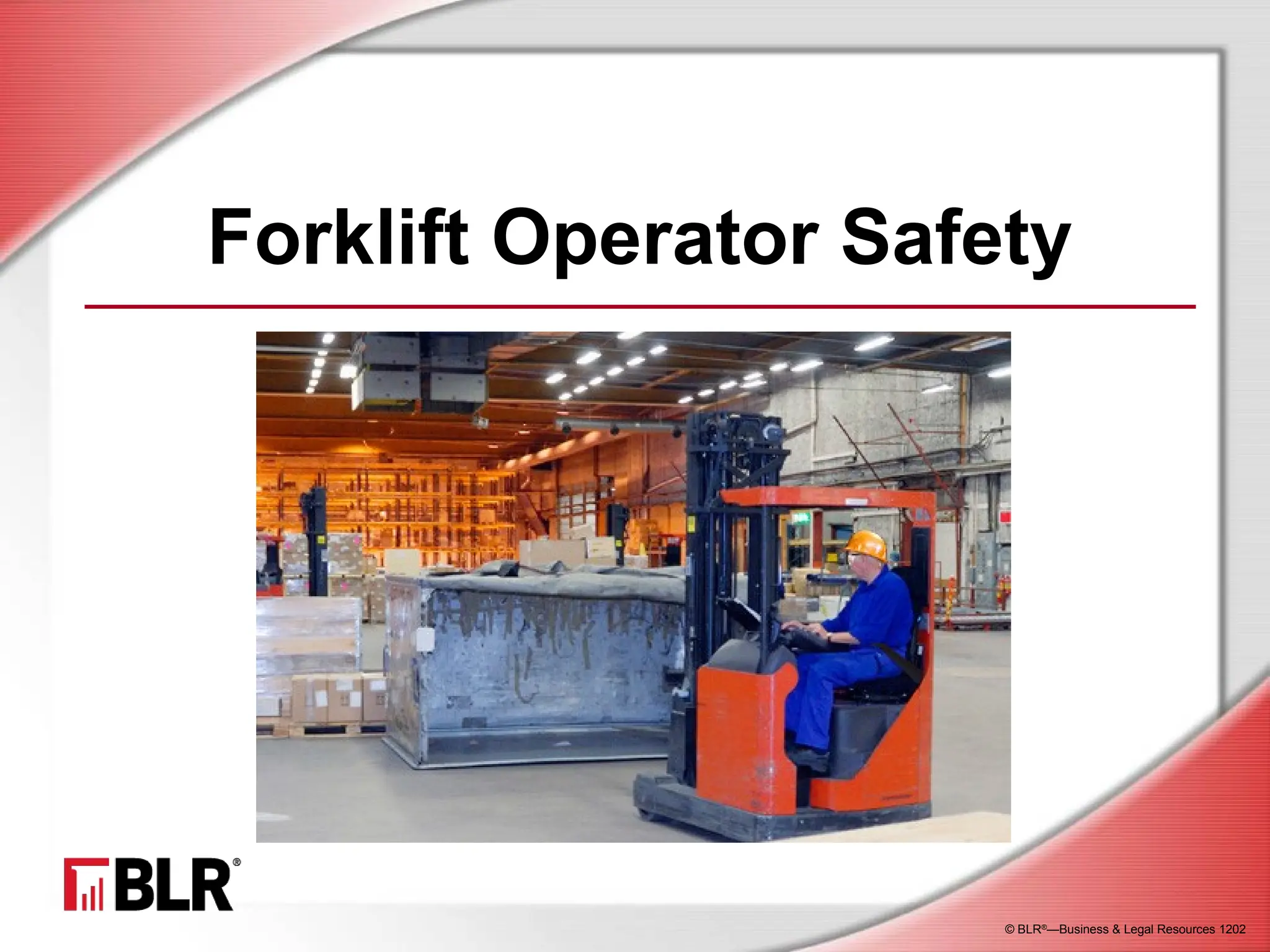
Forklift Operator Safety
© BLR®
—Business & Legal Resources 1202
Session Objectives
Understand how forklifts work
Operate a forklift safely and skillfully
Identify operating hazards
Apply general principles of safe operation
Properly inspect and maintain a forklift
© BLR®
—Business & Legal Resources 1202
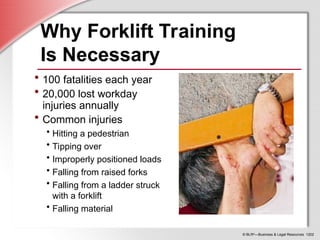
Why Forklift Training
Is Necessary
• 100 fatalities each year
• 20,000 lost workday
injuries annually
• Common injuries
• Hitting a pedestrian
• Tipping over
• Improperly positioned loads
• Falling from raised forks
• Falling from a ladder struck
with a forklift
• Falling material
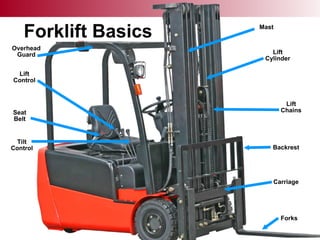
Forklift Basics
Seat
Belt
Lift
Control
Overhead
Guard
Tilt
Control
Forks
Carriage
Backrest
Lift
Chains
Lift
Cylinder
Mast
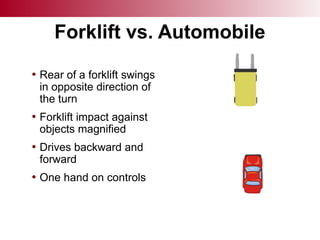
Forklift vs. Automobile
• Rear of a forklift swings
in opposite direction of
the turn
• Forklift impact against
objects magnified
• Drives backward and
forward
• One hand on controls
© BLR®
—Business & Legal Resources 1202
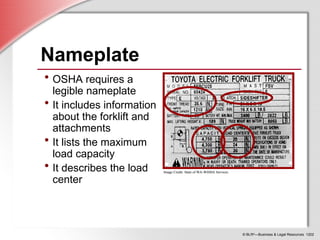
Nameplate
• OSHA requires a
legible nameplate
• It includes information
about the forklift and
attachments
• It lists the maximum
load capacity
• It describes the load
center
Image Credit: State of WA-WISHA Services
© BLR®
—Business & Legal Resources 1202
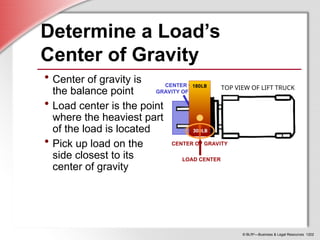
Determine a Load’s
Center of Gravity
• Center of gravity is
the balance point
• Load center is the point
where the heaviest part
of the load is located
• Pick up load on the
side closest to its
center of gravity
LOAD CENTER
CENTER OF
GRAVITY OF LOAD
TOP VIEW OF LIFT TRUCK
CENTER OF GRAVITY
180LB
300LB
© BLR®
—Business & Legal Resources 1202
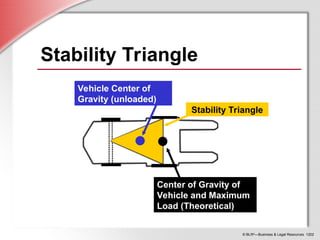
Stability Triangle
Vehicle Center of
Gravity (unloaded)
Center of Gravity of
Vehicle and Maximum
Load (Theoretical)
Stability Triangle
© BLR®
—Business & Legal Resources 1202
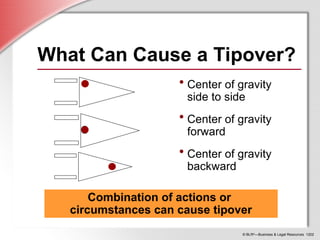
What Can Cause a Tipover?
• Center of gravity
side to side
• Center of gravity
forward
• Center of gravity
backward
Combination of actions or
circumstances can cause tipover
© BLR®
—Business & Legal Resources 1202
Image Credit: CDC
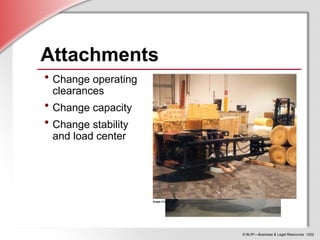
Attachments
• Change operating
clearances
• Change capacity
• Change stability
and load center
© BLR®
—Business & Legal Resources 1202
Operating Hazards—
Pedestrians
Accidents involving
pedestrians may be
caused by:
• Obstructed view
• Turning
• Speeding
• Pedestrian unaware
forklift is present
• Carrying passengers
and horseplay
© BLR®
—Business & Legal Resources 1202
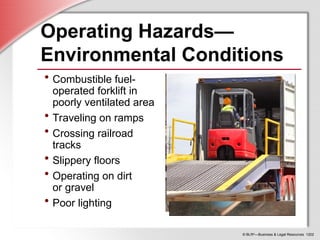
Operating Hazards—
Environmental Conditions
• Combustible fuel-
operated forklift in
poorly ventilated area
• Traveling on ramps
• Crossing railroad
tracks
• Slippery floors
• Operating on dirt
or gravel
• Poor lighting
© BLR®
—Business & Legal Resources 1202
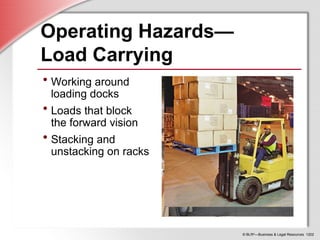
• Working around
loading docks
• Loads that block
the forward vision
• Stacking and
unstacking on racks
Operating Hazards—
Load Carrying
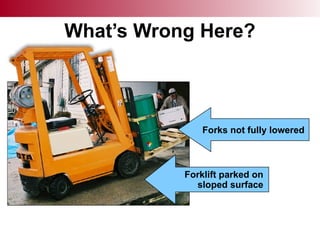
What’s Wrong Here?
Forklift parked on
sloped surface
Forks not fully lowered
© BLR®
—Business & Legal Resources 1202
Forklift Characteristics and
Hazards—Any Questions?
Do you understand:
• The characteristics
or basic features of
a forklift
• The stability of
forklifts
• The hazards specific
to our workplace
© BLR®
—Business & Legal Resources 1202
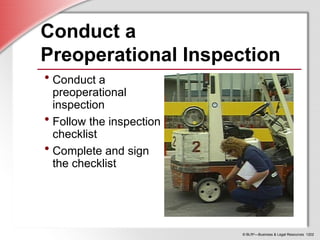
Conduct a
Preoperational Inspection
• Conduct a
preoperational
inspection
• Follow the inspection
checklist
• Complete and sign
the checklist
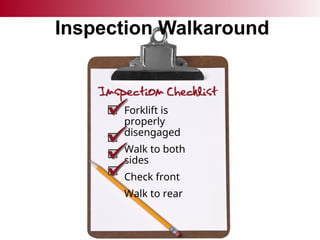
Inspection Walkaround
Forklift is
properly
disengaged
Walk to both
sides
Check front
Walk to rear
© BLR®
—Business & Legal Resources 1202
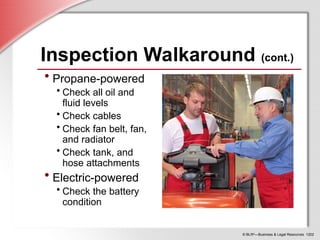
Inspection Walkaround (cont.)
• Propane-powered
• Check all oil and
fluid levels
• Check cables
• Check fan belt, fan,
and radiator
• Check tank, and
hose attachments
• Electric-powered
• Check the battery
condition
© BLR®
—Business & Legal Resources 1202
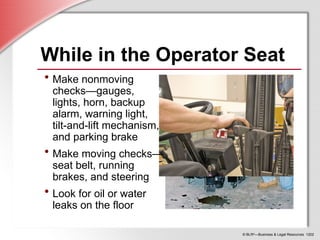
While in the Operator Seat
• Make nonmoving
checks—gauges,
lights, horn, backup
alarm, warning light,
tilt-and-lift mechanism,
and parking brake
• Make moving checks—
seat belt, running
brakes, and steering
• Look for oil or water
leaks on the floor
© BLR®
—Business & Legal Resources 1202
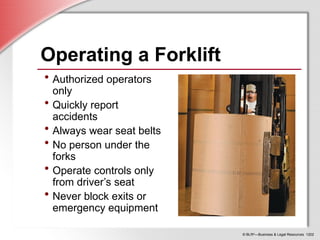
Operating a Forklift
• Authorized operators
only
• Quickly report
accidents
• Always wear seat belts
• No person under the
forks
• Operate controls only
from driver’s seat
• Never block exits or
emergency equipment
© BLR®
—Business & Legal Resources 1202
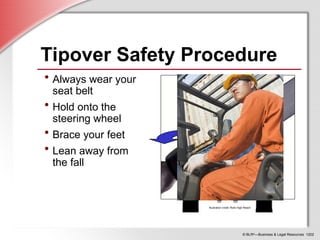
Tipover Safety Procedure
• Always wear your
seat belt
• Hold onto the
steering wheel
• Brace your feet
• Lean away from
the fall
Illustration credit: Rolls High Reach
© BLR®
—Business & Legal Resources 1202
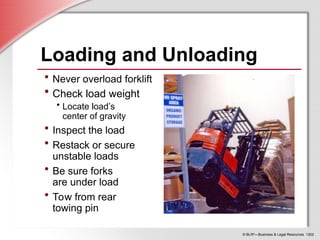
Loading and Unloading
• Never overload forklift
• Check load weight
• Locate load’s
center of gravity
• Inspect the load
• Restack or secure
unstable loads
• Be sure forks
are under load
• Tow from rear
towing pin
© BLR®
—Business & Legal Resources 1202
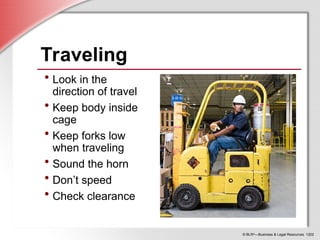
Traveling
• Look in the
direction of travel
• Keep body inside
cage
• Keep forks low
when traveling
• Sound the horn
• Don’t speed
• Check clearance
© BLR®
—Business & Legal Resources 1202
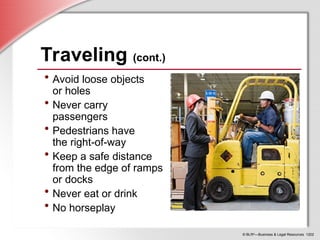
Traveling (cont.)
• Avoid loose objects
or holes
• Never carry
passengers
• Pedestrians have
the right-of-way
• Keep a safe distance
from the edge of ramps
or docks
• Never eat or drink
• No horseplay
© BLR®
—Business & Legal Resources 1202
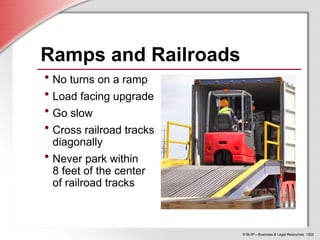
Ramps and Railroads
• No turns on a ramp
• Load facing upgrade
• Go slow
• Cross railroad tracks
diagonally
• Never park within
8 feet of the center
of railroad tracks
© BLR®
—Business & Legal Resources 1202
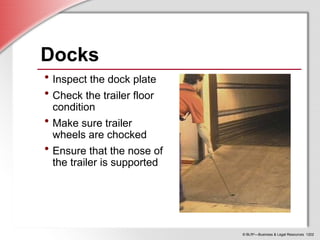
Docks
• Inspect the dock plate
• Check the trailer floor
condition
• Make sure trailer
wheels are chocked
• Ensure that the nose of
the trailer is supported
© BLR®
—Business & Legal Resources 1202
Parking
• Don’t block exits
or aisles
• Lower the forks
• Set gear to
neutral
• Set the parking
brake
• Turn off the key
© BLR®
—Business & Legal Resources 1202
Propane Refueling
• Fill in well-ventilated
area
• Highly flammable gas
—do not smoke
• Report leaks
immediately
• Distinct odor
• Hissing sound
• Frost on fittings
• Use gloves and safety
glasses
© BLR®
—Business & Legal Resources 1202
Battery Charging
• Charge batteries only
in protected areas with
ventilation
• Inspect battery
connectors for damage
• No smoking
• Immediately clean up
electrolyte spills
• Wear PPE
© 2008 Schumacher Electric Corp. All rights reserved.
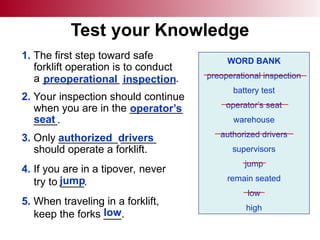
Test your Knowledge
1. The first step toward safe
forklift operation is to conduct
a _____________ _________.
2. Your inspection should continue
when you are in the _________
____.
3. Only __________ ______
should operate a forklift.
4. If you are in a tipover, never
try to ____.
5. When traveling in a forklift,
keep the forks ___.
WORD BANK
preoperational inspection
battery test
operator’s seat
warehouse
authorized drivers
supervisors
jump
remain seated
low
high
preoperational inspection
operator’s
seat
authorized drivers
jump
low
© BLR®
—Business & Legal Resources 1202
Inspection, Operation, and
Maintenance—Questions?
• Inspection procedures?
• Operating procedures?
• Vehicle maintenance?
© BLR®
—Business & Legal Resources 1202
Key Points to Remember
Facility hazards include pedestrians,
environmental conditions, and
loading/unloading
Position loads close to the vertical backrest
Always conduct and document a
preoperational inspection
Follow the safe operating rules of the road
Always refuel/recharge in ventilated areas
and wear proper PPE

Forklift-Operator-Safety-English Presentation.ppt

  • 1.
    © BLR® —Business &Legal Resources 1202 Forklift Operator Safety
  • 2.
    © BLR® —Business &Legal Resources 1202 Session Objectives Understand how forklifts work Operate a forklift safely and skillfully Identify operating hazards Apply general principles of safe operation Properly inspect and maintain a forklift
  • 3.
    © BLR® —Business &Legal Resources 1202 Why Forklift Training Is Necessary • 100 fatalities each year • 20,000 lost workday injuries annually • Common injuries • Hitting a pedestrian • Tipping over • Improperly positioned loads • Falling from raised forks • Falling from a ladder struck with a forklift • Falling material
  • 4.
  • 5.
    Forklift vs. Automobile •Rear of a forklift swings in opposite direction of the turn • Forklift impact against objects magnified • Drives backward and forward • One hand on controls
  • 6.
    © BLR® —Business &Legal Resources 1202 Nameplate • OSHA requires a legible nameplate • It includes information about the forklift and attachments • It lists the maximum load capacity • It describes the load center Image Credit: State of WA-WISHA Services Image Credit: State of WA-WISHA Services
  • 7.
    © BLR® —Business &Legal Resources 1202 Determine a Load’s Center of Gravity • Center of gravity is the balance point • Load center is the point where the heaviest part of the load is located • Pick up load on the side closest to its center of gravity LOAD CENTER CENTER OF GRAVITY OF LOAD TOP VIEW OF LIFT TRUCK CENTER OF GRAVITY 180LB 300LB
  • 8.
    © BLR® —Business &Legal Resources 1202 Stability Triangle Vehicle Center of Gravity (unloaded) Center of Gravity of Vehicle and Maximum Load (Theoretical) Stability Triangle
  • 9.
    © BLR® —Business &Legal Resources 1202 What Can Cause a Tipover? • Center of gravity side to side • Center of gravity forward • Center of gravity backward Combination of actions or circumstances can cause tipover
  • 10.
    © BLR® —Business &Legal Resources 1202 Image Credit: CDC Attachments • Change operating clearances • Change capacity • Change stability and load center
  • 11.
    © BLR® —Business &Legal Resources 1202 Operating Hazards— Pedestrians Accidents involving pedestrians may be caused by: • Obstructed view • Turning • Speeding • Pedestrian unaware forklift is present • Carrying passengers and horseplay
  • 12.
    © BLR® —Business &Legal Resources 1202 Operating Hazards— Environmental Conditions • Combustible fuel- operated forklift in poorly ventilated area • Traveling on ramps • Crossing railroad tracks • Slippery floors • Operating on dirt or gravel • Poor lighting
  • 13.
    © BLR® —Business &Legal Resources 1202 • Working around loading docks • Loads that block the forward vision • Stacking and unstacking on racks Operating Hazards— Load Carrying
  • 14.
    What’s Wrong Here? Forkliftparked on sloped surface Forks not fully lowered
  • 15.
    © BLR® —Business &Legal Resources 1202 Forklift Characteristics and Hazards—Any Questions? Do you understand: • The characteristics or basic features of a forklift • The stability of forklifts • The hazards specific to our workplace
  • 16.
    © BLR® —Business &Legal Resources 1202 Conduct a Preoperational Inspection • Conduct a preoperational inspection • Follow the inspection checklist • Complete and sign the checklist
  • 17.
    Inspection Walkaround Forklift is properly disengaged Walkto both sides Check front Walk to rear
  • 18.
    © BLR® —Business &Legal Resources 1202 Inspection Walkaround (cont.) • Propane-powered • Check all oil and fluid levels • Check cables • Check fan belt, fan, and radiator • Check tank, and hose attachments • Electric-powered • Check the battery condition
  • 19.
    © BLR® —Business &Legal Resources 1202 While in the Operator Seat • Make nonmoving checks—gauges, lights, horn, backup alarm, warning light, tilt-and-lift mechanism, and parking brake • Make moving checks— seat belt, running brakes, and steering • Look for oil or water leaks on the floor
  • 20.
    © BLR® —Business &Legal Resources 1202 Operating a Forklift • Authorized operators only • Quickly report accidents • Always wear seat belts • No person under the forks • Operate controls only from driver’s seat • Never block exits or emergency equipment
  • 21.
    © BLR® —Business &Legal Resources 1202 Tipover Safety Procedure • Always wear your seat belt • Hold onto the steering wheel • Brace your feet • Lean away from the fall Illustration credit: Rolls High Reach
  • 22.
    © BLR® —Business &Legal Resources 1202 Loading and Unloading • Never overload forklift • Check load weight • Locate load’s center of gravity • Inspect the load • Restack or secure unstable loads • Be sure forks are under load • Tow from rear towing pin
  • 23.
    © BLR® —Business &Legal Resources 1202 Traveling • Look in the direction of travel • Keep body inside cage • Keep forks low when traveling • Sound the horn • Don’t speed • Check clearance
  • 24.
    © BLR® —Business &Legal Resources 1202 Traveling (cont.) • Avoid loose objects or holes • Never carry passengers • Pedestrians have the right-of-way • Keep a safe distance from the edge of ramps or docks • Never eat or drink • No horseplay
  • 25.
    © BLR® —Business &Legal Resources 1202 Ramps and Railroads • No turns on a ramp • Load facing upgrade • Go slow • Cross railroad tracks diagonally • Never park within 8 feet of the center of railroad tracks
  • 26.
    © BLR® —Business &Legal Resources 1202 Docks • Inspect the dock plate • Check the trailer floor condition • Make sure trailer wheels are chocked • Ensure that the nose of the trailer is supported
  • 27.
    © BLR® —Business &Legal Resources 1202 Parking • Don’t block exits or aisles • Lower the forks • Set gear to neutral • Set the parking brake • Turn off the key
  • 28.
    © BLR® —Business &Legal Resources 1202 Propane Refueling • Fill in well-ventilated area • Highly flammable gas —do not smoke • Report leaks immediately • Distinct odor • Hissing sound • Frost on fittings • Use gloves and safety glasses
  • 29.
    © BLR® —Business &Legal Resources 1202 Battery Charging • Charge batteries only in protected areas with ventilation • Inspect battery connectors for damage • No smoking • Immediately clean up electrolyte spills • Wear PPE © 2008 Schumacher Electric Corp. All rights reserved.
  • 30.
    Test your Knowledge 1.The first step toward safe forklift operation is to conduct a _____________ _________. 2. Your inspection should continue when you are in the _________ ____. 3. Only __________ ______ should operate a forklift. 4. If you are in a tipover, never try to ____. 5. When traveling in a forklift, keep the forks ___. WORD BANK preoperational inspection battery test operator’s seat warehouse authorized drivers supervisors jump remain seated low high preoperational inspection operator’s seat authorized drivers jump low
  • 31.
    © BLR® —Business &Legal Resources 1202 Inspection, Operation, and Maintenance—Questions? • Inspection procedures? • Operating procedures? • Vehicle maintenance?
  • 32.
    © BLR® —Business &Legal Resources 1202 Key Points to Remember Facility hazards include pedestrians, environmental conditions, and loading/unloading Position loads close to the vertical backrest Always conduct and document a preoperational inspection Follow the safe operating rules of the road Always refuel/recharge in ventilated areas and wear proper PPE

Editor's Notes

  • #1 Slide Show Notes Operating a forklift is a big responsibility, and it’s one that requires you to pay attention to safety at all times. Forklifts are very useful for handling heavy materials, but remember that they are powerful machines that can be extremely dangerous if operated incorrectly. This session is designed to help you become a better and safer forklift operator. If you’re an experienced operator, this session may remind you of safe habits and work practices that you might have forgotten. If you’re a brand-new operator, this session will show you the operating practices you need to follow to be a safe operator. Reviewing this session by itself will not make you a good forklift driver—it’s up to you to put what you learn into practice so that you can become a safe and responsible operator. In order for the trainee to be certified as a forklift operator, this PowerPoint® session must be combined with training on a forklift at your workplace, training specific to conditions at the workplace, and any additional training specified in the forklift manufacturer’s instruction manual.
  • #2 Slide Show Notes This session covers the basic concepts of operating a forklift safely and prepares you for hands-on driver training. By the end of this session, you will be able to: Understand how a forklift works and how operating a forklift is different from driving a car; Understand the basic principles of operating a forklift safely and skillfully; Identify the hazards of operating a forklift in the workplace; Apply the general principles of safe forklift operation; and Know how to properly inspect and maintain a forklift.
  • #3 Slide Show Notes Why is it necessary to have special training in operating a forklift? Forklifts can be very dangerous—in an average year, 100 people die in forklift-related accidents. Tens of thousands of forklift-related injuries occur each year, and about 20,000 of these result in lost workdays. Common forklift-related injuries could result from: Hitting a pedestrian with a forklift, Forklift tipover, Improperly positioned loads, Falling from the forks or from a platform positioned on the forks, Falling from a ladder that is struck by a forklift, and Being struck by materials that fall from a forklift. Specialized forklift safety training helps reduce these types of injuries. Describe forklift-related incidents or close calls at your facility, if any.
  • #4 Slide Show Notes Now we’ll describe the basic features and characteristics of a forklift. This illustration shows the basic features of a typical forklift. Most forklifts have certain features in common. You need to know what these features are and how to use them properly and safely. Take a moment or two to study this illustration and identify the features of a typical forklift. Note that this illustration represents a typical forklift, however, features may vary depending on the manufacturer and model. Describe the components of a forklift at your facility, preferably with trainees looking at a forklift.
  • #5 Slide Show Notes Forklifts behave differently from cars in a number of important ways, especially in turning and when contacting objects. Unlike a car, the rear of a forklift swings in the opposite direction of the turn. As the diagram shows, when turning left, the rear of the forklift swings to the right. The impact of a forklift when hitting other objects is magnified, compared to a car, because of its greater mass. A forklift hitting an object at 5 miles per hour does the same damage as a car going 30 miles per hour. Forklifts are often driven backward, especially when unloading cargo or when carrying a load that obstructs the forward view, as opposed to a car, where reverse driving is rare. The final difference between a forklift and a car is that forklifts are operated with one hand on the wheel and the other hand on the controls, whereas a car is generally driven with both hands.
  • #6 Slide Show Notes This slide shows an example of a forklift nameplate. You need to know why the forklift nameplate is important. First of all, OSHA requires all forklifts to have legible nameplates that are specific to the forklift and any attachments it has. You should report any forklift that does not have a nameplate. The nameplate contains information about the weight of the forklift, the proper tire size and pressure, the type of fuel it uses, and any attachments it has. The nameplate lists the capacity and load center of the forklift— probably the most important information for you to know. The capacity is the maximum weight of a load that can be safely lifted to the forklift’s maximum height, assuming the center of gravity of the load is within the rated load center. The load center is the distance between the vertical face of the forks and the center of gravity of the load. Take a moment to study the nameplate shown here, and become familiar with how to find the important information you need for safe operation. Inspect your forklifts to be sure that they all carry accurate, legible nameplates. If possible, show trainees a nameplate on a forklift, or photocopy a nameplate from a forklift to show the employees how to find information on the nameplate.
  • #7 Slide Show Notes Let’s learn more about the center of gravity of a load and why it’s important to understand what it means. The center of gravity is the balance point of the load—that is, the exact point on which the entire load will balance. For loads that are composed of consistent material, the balance point will be near the center of the load. If the load is inconsistent—that is, it contains materials of different weights and densities—the load center will be on the side with the heaviest material. For example, if a pallet contains bricks on one side and pillows on the other, the center of gravity would be closer to the side with the bricks. If possible, a load should always be picked up on the side that is closest to its center of gravity. This helps keep the weight of the load closer to the forklift and reduces the risk of the load falling off or causing the forklift to tip over. The center of gravity is an important concept for all forklift operators to understand. Use blocks or Legos™ to help demonstrate the location of a load’s center of gravity.
  • #8 Slide Show Notes The “stability triangle” is a concept that you should always keep in mind when operating a forklift to avoid actions that could cause the forklift to tip over. A typical forklift has a three-point suspension with the weight supported by the two front tires and the center of the rear axles. This creates a triangle. Its center of gravity is shown by the blue circle, right in the middle of the triangle, which is also right below where the operator sits. For safe operation, the center of gravity of a forklift that is carrying a load must stay within this stability triangle, or else the forklift will tip over. The center of gravity when the forklift is carrying its maximum rated load is different from when the forklift is empty. The center of gravity with a maximum is shown by the black circle, near the front edge of the stability triangle but still within the triangle. The stability triangle is an effective way to show an operator how their actions can cause a lift truck to tip over so that they know what actions to avoid. This information on stability is primarily for sit-down counterbalance lift trucks. Other lift trucks, such as stand-up narrow aisle, will have different stability concerns.
  • #9 Slide Show Notes These illustrations show some examples of how a forklift can tip over: In the top illustration, the center of gravity is on the side of the stability triangle. This might be caused by turning a corner, having an unbalanced load, driving into a pothole, or traveling on a sloping surface. In the middle illustration, the center of gravity is near the front of the stability triangle. This might be caused by: The forklift carrying its maximum load, The mast tipping forward, The forklift stopping abruptly, The forklift quickly accelerating in reverse, or The forklift driving up a ramp. In the bottom illustration, the center of gravity is near the rear. This could be caused by tilting the mast back, stopping abruptly when traveling in reverse, quickly accelerating forward, or driving up a ramp. Combinations of actions or circumstances could also cause the center of gravity to shift outside the stability triangle and tip the forklift over. For example: A forklift that turns a corner while driving up a ramp could shift the center of gravity too far backward and to the side, causing a tipover; A forklift moving forward with a capacity load could tip forward if forced to stop abruptly; or A forklift turning a corner with an unbalanced load could tip over if it drove into a pothole.
  • #10 Slide Show Notes Forklift attachments such as carton clamps, drum clamps, paper-roll clamps, rotators, and push-pull elements can affect the capacity of a forklift in a number of ways, including: Attachments can change operating clearances by extending the length and width of the forklift. Attachments can change the capacity of the forklift by adding weight. For example, if the attachment weighs 1,000 pounds, the capacity of the load you can carry is reduced by 1,000 pounds. Attachments usually change the stability and center of gravity of the forklift. For example, if an attachment moves the load away from the vertical face of the forks, that will reduce the maximum load the forklift can carry. Next, let’s discuss the hazards of operating a forklift. If your company regularly uses attachments, talk about specifics related to those attachments. Also, ensure that nameplates reflect the fact that your organization uses attachments. Customize this slide or add slides that illustrate your attachments, if any.
  • #11 Slide Show Notes Most accidents with forklifts involve pedestrians. The most obvious causes of accidents involving pedestrians are: Having an obstructed view—the operator cannot see the pedestrian because of a load or an obstruction in the path; Turning the forklift toward a pedestrian who is in front of or alongside the forklift; Speeding, so that the forklift can’t stop in time to avoid the pedestrian; Being unaware of a forklift nearby; and Carrying passengers on the forklift. This is forbidden, as is any other kind of horseplay on or near a forklift. Can you think of other examples of hazards involving forklifts and pedestrians? Customize this slide and subsequent slides, or add slides, to illustrate the pedestrian hazards that are specific to your facility.
  • #12 Slide Show Notes Some forklift hazards are caused by the conditions present in the environment where the forklift is operating. Here are some examples: Using combustible fuel-operated forklift in a poorly ventilated area, which could allow the buildup of carbon monoxide or carbon dioxide from the forklift; A work environment with ramps, which can increase the chance of a forklift accident; Crossing railroad tracks, which can unbalance a forklift; Operating and braking on slippery floors; Operating on dirt and gravel; or Poor lighting. There are many other possible hazards of a particular work environment that might cause a forklift accident. These include pits or openings in the floor, congested or narrow workspaces, and the presence of flammable or combustible material. Customize this slide and subsequent slides, or add slides, to illustrate the environmental hazards that are specific to your facility.
  • #13 Slide Show Notes Load-carrying hazards include: Working around loading docks, Carrying loads that block the forward vision, and Stacking and unstacking on racks. Where do these hazards exist in our facility? Customize this slide and subsequent slides, or add slides, to illustrate the load-carrying hazards that are specific to your facility.
  • #14 Slide Show Notes Can you identify what is wrong with the scene in the photograph? Here are two hazards: First, the forklift is parked on a sloping surface. This situation is dangerous because the forklift could roll backward. Second, the forks are not fully lowered. This situation is dangerous because the load could fall or be pushed off, injuring someone’s feet.
  • #15 Slide Show Notes Take a moment to review the information you have been given in this session so far. Do you have any questions about the basic characteristics and features of a forklift? Do you have questions about the stability of a forklift? Do you understand the hazards of forklifts in our workplace? Conduct an exercise that illustrates forklift characteristics or forklift hazards, if appropriate.
  • #16 Slide Show Notes Now let’s turn to the basic principles of operating a forklift safely. The first step toward safe forklift operation is conducting the preoperational inspection. Conduct the inspection at the start of each work shift to ensure that the forklift will work properly. According to OSHA, 1 in 15 forklift-related accidents are caused by improper maintenance. A thorough preoperational inspection will identify maintenance problems before they cause an accident. Follow the preoperational inspection checklist, and don’t skip any items. Complete and sign the checklist. Distribute the preoperational inspection form. Tell trainees how often preoperational inspections are required.
  • #17 Slide Show Notes The preoperational inspection begins with a “walkaround.” First, be sure that the forklift is properly disengaged with the forks down, the key turned off, and the forklift set in neutral with the parking brake on. Second, walk to either side of the forklift—check the tires, making sure there are no gouges, tears, or imbedded metal and that there is proper inflation, and check lug nuts, make sure the axle is greased, check the overhead guard, and see that there is no debris lodged behind the mast. Next, check the front of the forklift—the forks and hoses should be in good condition, fork pins should be in place, the backrest should be solid, and the mast and chains should be greased. Finally, walk to the rear of the forklift—check that the counterbalance bolt is tight and the radiator is clear of debris, and is not leaking. Modify this slide to describe any additional inspection procedures required at your facility. Take the employees to a forklift and show them how to do the preoperational inspection. Do this at the end of the class or after this inspection section to give the employees a break from the classroom training.
  • #18 Slide Show Notes On a propane-powered forklift, you should lift the hood and inspect the engine: Check all oil and fluid levels; Check cables and ensure they are secure and not damaged; Check the fan belt and clear the fan and radiator of debris; and Check the propane tank and hose attachments, and make sure they are in good condition and there are no signs of a leak. On an electric-powered forklift: Check the battery to make sure it is in good condition. Modify or delete this slide as it applies to your forklifts.
  • #19 Slide Show Notes Your inspection should continue when you sit in the operator’s seat. First, while the forklift is not moving, check the gauges, lights, horn, backup alarm, warning light, tilt-and-lift mechanism, and parking brake. Listen for any unusual noises from the tilt-and-lift mechanism. Inspect the hoses and chains of the lift. Test the parking brake by putting the forklift in gear and stepping on the accelerator—the forklift should not move when the parking brake is on. Second, when the forklift is moving, check the seat belt, running brakes, and steering. Check the brakes by trying to stop quickly. Check the steering by doing full turns and listening for unusual noises. Finally, look on the floor for oil or water leaks. Now that we have discussed inspections, let’s turn to the important rules for operating a forklift safely. After presenting this slide, it would be a good time to take the employees out of the class to demonstrate the forklift preoperational inspection. Have a couple of the employees also do the inspection so that everyone gets an opportunity to see it done more than once.
  • #20 Slide Show Notes Fundamental safety rules for forklift operation are: Only authorized drivers who have been through an approved training program may operate a forklift; Always report any forklift-related accidents as quickly as possible; Always wear your seat belt; No one should ever stand under upraised forks; if the hydraulic system fails, anyone standing under forks could be killed; Operate the controls only when sitting in the driver’s seat; and Never block exits or access to emergency equipment with a forklift. Describe the procedures with trainees if using a forklift as a man lift is permitted by your state and your organization. Note that discussing “rules of the road” can put employees to sleep if you just read the rules point for point. Create interaction by asking questions such as, “What’s so important about wearing seat belts? They just slow me down when I climb in and out of the forklift.” “What’s wrong with standing under the elevated portion of a forklift?”
  • #21 Slide Show Notes If you are ever in a forklift that tips over: Again, always wear your seat belt. You could be killed if you are thrown out. A forklift operator should never try to jump clear of a tipping forklift—you could be crushed by the overhead guard or the mast; Hold firmly onto the steering wheel; Brace your feet; and Lean away from the direction of the fall. Insert additional slides that describe specific hazards at your workplace.
  • #22 Slide Show Notes Loading and unloading a forklift must always be done safely: Never overload the forklift beyond its rated capacity. Check the capacity on the nameplate, and know how much your load weighs. It does not help to try to increase the capacity by adding weight to the rear of the forklift—in fact, this is very dangerous. Be sure to locate the center of gravity of the load. Inspect the load for stability, projections, and damage to pallets before lifting it. If the load is unstable, restack it, and if necessary, secure it with straps or ropes. For a wide load, spread the forks as wide as possible so that the load will fall inward if it becomes unstable. Remember that when loading or unloading and raising or lowering, the center of gravity changes. Be sure forks are completely under the load before attempting to lift. Only use the rear towing pin for towing. Never drill a hole in the forks as a way to tow something or as a place for a chain hook—this ruins the integrity of the forks. Forklifts are equipped with a tow bar in the back for emergency towing. However, not all forklifts are designed to tow all types of loads. Be sure to check the user’s manual for specific rules regarding towing. Safe attachments can be purchased for use when hoisting.
  • #23 Slide Show Notes Remember these safety rules when traveling in a forklift: Look in the direction you are traveling; that means looking behind you before and while backing up. Keep your body inside the cage; the cage is there to protect you. Keep the forks low when traveling. Keeping them raised reduces stability and could result in a tipover. Sound the horn at corners, aisles, doorways, and anywhere else that you might not see someone or someone might not see you. Don’t speed—a safe speed is one at which you can quickly and easily stop if you need to. Finally, check your clearances. Check overhead before lifting a load and check your turning clearance because the rear end of the forklift will swing wide.
  • #24 Slide Show Notes More safety rules for traveling in a forklift include: Avoid driving over loose objects or holes; doing this could cause a tipover; Never carry passengers—they don’t have a seat or a seat belt and could get killed in an accident; Always remember that pedestrians have the right-of-way; Stay a safe distance from the edges of ramps and loading docks; Don’t eat or drink while operating a forklift; these create a distraction that is unsafe; and Never engage in horseplay on or around a forklift.
  • #25 Slide Show Notes When traveling on ramps or near railroad tracks, follow these guidelines: Don’t make turns on a ramp or hill; Keep the load facing upwards on a ramp or hill; this helps keep the combined center of gravity near the center of the stability triangle; Drive slowly, especially on ramp downgrades. Extra weight decreases the effectiveness of your brakes; Cross railroad tracks on the diagonal, which helps keep the forklift stable; and Never park within 8 feet of the center of a railroad track; your forklift could be struck by a passing train.
  • #26 Slide Show Notes Here are four good safety habits when loading or unloading trailers from a loading dock: Inspect the dock plate for cracks, and be sure it is properly secured; Check the condition of the trailer floor, and make sure there are no holes that your forklift could fall into; Make sure the trailer wheels are chocked; and Make sure that the nose of the trailer is supported by the tractor or a fixed jack. Make sure your facility has proper dock plates, wheel chocks, and trailer supports.
  • #27 Slide Show Notes When parking a forklift, remember these safety rules: Don’t park in a way that blocks an exit or access to emergency equipment; Lower the forks to the ground so that no one can get under the forks; Set the gearshift to neutral; Always set the parking brake; and Turn off the key. Check your organization’s policy for removing the key when parking. Show trainees the designated areas for parking forklifts, if any.
  • #28 Slide Show Notes Refueling or recharging forklifts is an important part of their operation that needs to be done safely. For forklifts that are fueled by propane, follow these very important safety precautions: Filling must be done in a well-ventilated area, and proper grounding must be used. Never smoke around propane—it is a highly combustible gas that can catch fire or even explode. Report any propane leaks immediately. Signs of a leak include a: Distinct odor; Hissing sound; and Frost on the fittings. Wear gloves and safety glasses when refueling with propane. There may be additional state-mandated PPE requirements, such as goggles or a face shield. Modify this slide to describe your specific propane fueling requirements if you use propane-powered forklifts; otherwise, delete or hide the slide. Physically demonstrate to all operators of propane-powered forklifts how to refuel them, unless refueling operations are restricted to special personnel. Refer to the forklift’s manual for specific refueling procedures.
  • #29 Slide Show Notes For electric-powered forklifts, follow these safety guidelines: Charge batteries only in designated areas with appropriate ventilation. Inspect battery connectors for corrosion and wear. Don’t smoke when recharging, because hydrogen gas is released during the refueling process. Clean up electrolyte spills immediately, using baking soda and water. Don’t remove battery caps except to add water or to take hydrometer readings. Finally, wear PPE, including a face shield, gloves, and a protective apron when working with batteries. Battery electrolyte is highly corrosive. Use this slide if you use electric-powered forklifts; otherwise, delete or hide it. Physically demonstrate to all operators of electric-powered forklifts how to recharge them, unless this job is limited to specially trained individuals. Refer to the forklift’s manual for specific recharging procedures.
  • #30 Slide Show Notes See if you can select the right word from the word bank at the bottom of the screen to complete these sentences. Here are the answers: The first step toward safe forklift operation is to conduct a preoperational inspection. Your inspection should continue when you are in the operator’s seat. Only authorized drivers should operate a forklift. If you are in a tipover, never try to jump. When traveling in a forklift, keep the forks low.
  • #31 Slide Show Notes The last several slides have covered important points about forklift inspection, operation, and maintenance. Be sure you understand about: Forklift inspection; Forklift operations; and Forklift maintenance, especially refueling. Conduct an inspection, operation, and maintenance exercise, if appropriate.
  • #32 Slide Show Notes Here are the key points to remember about this session on forklift safety: Know the main hazards of forklifts, which include pedestrians, environmental conditions in the workplace, and loading and unloading. Position loads as close as possible to the vertical backrest. Remember what you learned about the center of gravity of a load and the “stability triangle.” Always conduct and document a preoperational inspection before operating a forklift. Always follow the safe operating “rules of the road.” And finally, refuel or recharge your forklift in properly ventilated areas, following all safety rules and wearing proper PPE. This concludes the session on Forklift Operator Safety. Review the pedestrian, environmental, and loading/unloading hazards specific to your facility. Discuss how the load center impacts capacity and the importance of positioning loads close to the vertical fork face in order to keep the center of gravity in the triangle. Reemphasize the importance of preoperational inspections. Review the basic safety rules of operation at your facility. Review the safety procedures of refueling.